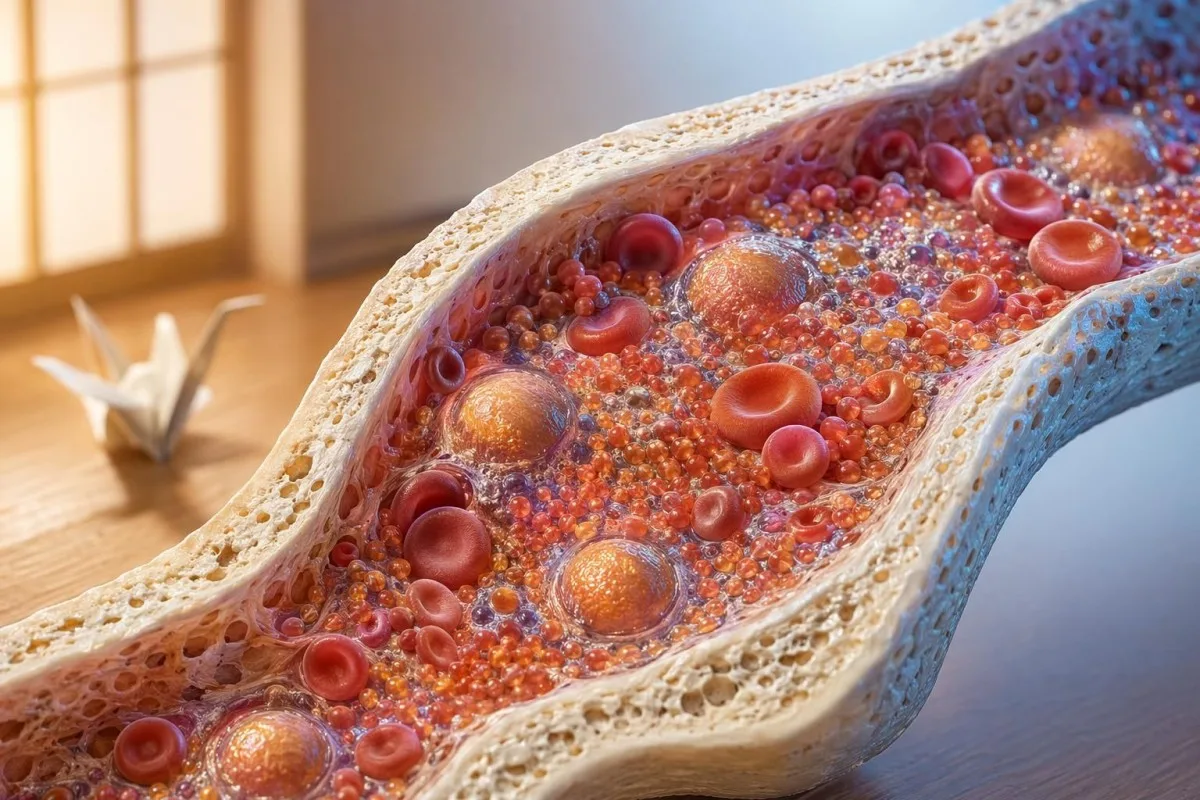
Many small red cells can look alarming on a CBC, but the pattern is often explainable. The real question is whether the body is short of iron, making inherited small cells, or dealing with both.


- Red blood cell count above about 5.0 million/µL with low MCV often points toward thalassemia trait, especially if hemoglobin is normal or only mildly low.
- Low MCV means the average red cell is small; in adults, MCV below 80 fL is usually called microcytosis.
- Iron deficiency more often causes low MCV with low or falling hemoglobin, high RDW, low ferritin, and transferrin saturation below 16–20%.
- Thalassemia trait commonly shows MCV 60–75 fL, RBC count above 5.0 million/µL, normal RDW, and a lifelong pattern on old CBCs.
- Ferritin below 15 ng/mL is highly specific for depleted iron stores in adults; many clinicians treat values below 30 ng/mL as suspicious when symptoms fit.
- Mentzer index is MCV divided by RBC count; a value below 13 leans thalassemia trait, while above 13 leans iron deficiency, but it is only a screening clue.
- Hemoglobin electrophoresis can detect many beta-thalassemia traits when HbA2 is above 3.5%, but alpha-thalassemia trait may need genetic testing.
- Mixed iron deficiency and thalassemia trait is common enough that doctors often correct iron deficiency before interpreting borderline HbA2 results.
What a high RBC count with low MCV usually means
A high red blood cell count with low MCV usually means the body has many small red cells. The 2 leading explanations are thalassemia trait and iron deficiency, and the difference matters because one may need iron replacement while the other is inherited and usually should not be treated with iron unless iron stores are low. As of May 11, 2026, our Kantesti AI pattern engine reads this as a CBC pattern, not a single abnormal value.
When I review this pattern, I first ask 3 questions: is the hemoglobin low, is the ferritin low, and has the MCV been low for years? A lifelong MCV of 68–74 fL with an RBC count around 5.6 million/µL behaves very differently from a new MCV drop from 88 to 76 fL over 12 months.
The classic thalassemia trait pattern is low MCV, relatively high RBC count, and normal or mildly reduced hemoglobin. For a refresher on where a count sits by sex and age, our RBC normal range guide explains why a value that is high for one person may be ordinary for another.
I am Thomas Klein, MD, and in our analysis of 2M+ blood test uploads, this is one of the most misread CBC patterns. People are often told they have anemia when their hemoglobin is 13.1 g/dL, MCV is 69 fL, and RBC count is 5.9 million/µL; that combination often deserves thalassemia testing before anyone starts months of iron.
RBC normal range and MCV blood test cutoffs
The adult RBC normal range is roughly 4.5–5.9 million/µL for men and 4.1–5.1 million/µL for women, while the usual adult MCV blood test range is 80–100 fL. A result below 80 fL is called low MCV or microcytosis.
Reference ranges move a little by lab, altitude, age, pregnancy status, and analyzer method. Some European laboratories use male RBC upper limits near 5.7 million/µL, while several US reports flag only above 5.9 or 6.0 million/µL.
MCV is not the size of one cell; it is the average volume of thousands of red cells measured in femtoliters. Our deeper MCV blood test guide covers why an MCV of 79 fL can be clinically different from 62 fL, even though both are technically low.
Hemoglobin still matters most for oxygen-carrying capacity. Adult hemoglobin is often considered normal at about 13.5–17.5 g/dL in men and 12.0–15.5 g/dL in women, although pregnancy and local lab rules change those cutoffs; see our hemoglobin range breakdown for the age and sex details.
A high RBC count with low MCV is a volume-count mismatch: many cells, but each cell is small. That mismatch is the clue clinicians use to separate inherited microcytosis from acquired iron shortage.
Why thalassemia trait can raise the RBC count
Thalassemia trait can produce a high or high-normal RBC count because the marrow makes extra small red cells to compensate for reduced hemoglobin production per cell. The person may feel well even when MCV is 60–75 fL.
In beta-thalassemia trait, the beta-globin chain is underproduced, so each red cell carries less hemoglobin than expected. The marrow responds by releasing more red cells, which is why an RBC count of 5.5–6.5 million/µL can sit beside an MCV of 62–72 fL.
This is not the same as polycythemia, where red cell mass is increased and hematocrit is often high. In thalassemia trait, hematocrit is commonly normal or mildly low; the cells are just numerous and small, a pattern we also discuss in CBC anemia patterns.
Ryan et al. published British Society for Haematology guidance in 2010 emphasizing that thalassemia screening should combine red cell indices with hemoglobin analysis and family context, not rely on MCV alone. That matches what I see clinically: a 31-year-old runner with MCV 66 fL and RBC 6.1 million/µL may have no iron problem at all.
The practical clue is durability. If old CBCs from 2016, 2020, and 2024 all show MCV around 70 fL, inherited microcytosis jumps up the list.
How iron deficiency creates low MCV differently
Iron deficiency creates low MCV because developing red cells cannot load enough hemoglobin, so new cells become smaller and paler. The RBC count usually falls or stays normal rather than rising, especially once hemoglobin drops.
Ferritin is the usual first iron-storage test. In adults, ferritin below 15 ng/mL is highly specific for depleted iron stores, and Camaschella's 2015 New England Journal of Medicine review describes how iron deficiency progresses from low stores to low transferrin saturation and then microcytic anemia.
Early iron deficiency may show normal hemoglobin with falling MCV, rising RDW, and ferritin of 10–30 ng/mL. Our iron deficiency anemia labs article explains why ferritin often changes before hemoglobin does.
There is a trap here. A patient with heavy periods can have ferritin 8 ng/mL and RBC count 5.2 million/µL if they also carry thalassemia trait, so the count alone does not settle the question.
For iron storage ranges and why inflammation can hide deficiency, see our ferritin normal range guide. In clinic, I treat ferritin as a context marker: 25 ng/mL may be acceptable for one asymptomatic person but too low for someone with restless legs, pregnancy planning, or hair shedding.
Mentzer index, RDW, and quick CBC clues
The Mentzer index is MCV divided by RBC count, and it helps screen low MCV patterns: below 13 leans thalassemia trait, while above 13 leans iron deficiency. It is useful, but it is not a diagnosis.
Example: MCV 68 fL divided by RBC 5.8 million/µL gives a Mentzer index of 11.7, which leans thalassemia trait. MCV 76 fL divided by RBC 3.9 million/µL gives 19.5, which leans iron deficiency.
Mentzer described this distinction in The Lancet in 1973, and the idea still survives because it is quick at the bedside. But it misclassifies patients with mixed iron deficiency and thalassemia trait, recent transfusion, chronic disease, or pregnancy.
RDW adds another layer because it measures size variation between red cells. Iron deficiency often raises RDW above 14.5%, while uncomplicated thalassemia trait may keep RDW normal; our RDW blood test guide shows why a high RDW is a variability signal rather than a disease name.
I use indices as traffic lights. Green means routine follow-up, amber means order iron studies and hemoglobin analysis, and red means review symptoms, hemoglobin, smear, and timing within 24–72 hours if the patient is unwell.
Iron studies doctors check after low MCV
Doctors usually check ferritin, serum iron, TIBC or transferrin, and transferrin saturation after finding low MCV. Transferrin saturation below 16–20% suggests iron-restricted red cell production, especially when ferritin is low.
Ferritin is a storage marker, serum iron is a circulating snapshot, and TIBC reflects how much iron-binding capacity is available. A classic iron deficiency pattern is ferritin below 30 ng/mL, TIBC high, and transferrin saturation below 20%.
Functional iron deficiency is trickier. In inflammation, kidney disease, or chronic immune activation, ferritin can be 80–200 ng/mL while transferrin saturation stays below 20%, which is why serum iron alone misleads.
Our article on low ferritin with normal hemoglobin explains the early phase where symptoms can appear before anemia. For the full binding-capacity pattern, the TIBC test guide is more useful than looking at iron in isolation.
One underused test is reticulocyte hemoglobin content, sometimes reported as CHr or Ret-He. Values below about 28 pg can show iron-restricted red cell production within days, long before MCV fully changes.
When hemoglobin electrophoresis or genetic testing helps
Hemoglobin electrophoresis helps diagnose beta-thalassemia trait when HbA2 is elevated, usually above 3.5%. Alpha-thalassemia trait can have normal electrophoresis, so DNA testing may be needed when the CBC pattern and family risk fit.
Beta-thalassemia trait commonly shows HbA2 above 3.5% and sometimes mildly increased HbF. Ryan et al. (2010) recommended hemoglobinopathy screening when microcytosis is unexplained by iron deficiency, particularly before pregnancy or in families with known carrier status.
Alpha-thalassemia trait is the quiet one. A patient may have MCV 68 fL, RBC 5.7 million/µL, normal ferritin, normal HbA2, and still carry alpha-globin gene deletions.
That is where family context becomes clinical data. Our hereditary disease blood test guide explains why partner testing matters when both parents may carry a hemoglobin variant.
At Kantesti, cases touching inherited blood conditions are reviewed against medically supervised rules, and our Medical Advisory Board helps keep those rules conservative. Our AI can flag a thalassemia-like pattern in about 60 seconds, but it cannot replace confirmatory electrophoresis or genetic counseling.
Why iron deficiency and thalassemia can coexist
Iron deficiency and thalassemia trait can occur together, and this mixed pattern is one reason CBC rules fail. Low ferritin can suppress HbA2, making beta-thalassemia trait harder to recognize until iron stores are corrected.
A real-world example: a 28-year-old woman has MCV 64 fL, RBC 5.4 million/µL, hemoglobin 10.9 g/dL, ferritin 6 ng/mL, and HbA2 3.1%. Treating iron first and repeating hemoglobin analysis after 8–12 weeks may reveal HbA2 above 3.5%.
This is why I dislike one-word interpretations such as 'thalassemia' or 'iron deficiency' when the pattern is messy. Both can be true, and the treatment plan changes if ferritin is 6 ng/mL versus 86 ng/mL.
Transferrin saturation helps when ferritin is borderline or inflammation is present. Our low iron saturation article explains the common pattern of ferritin that looks acceptable while available iron is still too low.
The safest sequence is usually: document iron deficiency, replace iron if appropriate, recheck CBC and ferritin, then interpret hemoglobin electrophoresis. Shortcuts create false reassurance.
Pregnancy, children, and ancestry change the interpretation
Pregnancy, childhood, and ancestry change how doctors interpret a high RBC count with low MCV. Iron needs rise sharply in pregnancy, while thalassemia carrier rates vary by family origin and can affect reproductive risk.
During pregnancy, plasma volume expands by roughly 40–50%, so hemoglobin may fall even when red cell production is healthy. Low MCV with ferritin below 30 ng/mL in pregnancy deserves attention because fetal and maternal iron needs increase from the first trimester onward.
For trimester-specific context, our iron in pregnancy guide explains why a ferritin of 18 ng/mL is read differently in pregnancy than in a non-pregnant adult. Carrier screening becomes especially relevant if both partners have low MCV.
Children have age-specific ranges, and a toddler with MCV 72 fL may not mean the same thing as an adult with MCV 72 fL. Our teen blood test ranges guide covers puberty-related shifts that can confuse adult-style interpretation.
Ancestry is not destiny, but it is medically useful. Thalassemia traits are more common in people with Mediterranean, Middle Eastern, South Asian, Southeast Asian, and African family origins, and I ask about grandparents because the clue is often 2 generations back.
Symptoms and red flags that change urgency
Low MCV with a high RBC count is often non-urgent when hemoglobin is stable and symptoms are mild. Urgency rises when hemoglobin is below 8 g/dL, there is chest pain, shortness of breath at rest, fainting, black stools, or rapid decline.
Thalassemia trait alone is usually asymptomatic or causes mild fatigue at most. Severe fatigue, palpitations, ice craving, restless legs, hair shedding, or reduced exercise tolerance point more toward iron deficiency, thyroid disease, B12 deficiency, or another overlapping issue.
Hemoglobin trend is the safety marker. A drop from 13.4 to 10.2 g/dL in 4 months is more concerning than a stable MCV of 69 fL for 10 years.
Our low hemoglobin causes guide lays out when anemia needs faster investigation. In my practice, any microcytosis plus unintentional weight loss, bowel habit change, or positive stool blood test in an adult deserves clinician review, even if ferritin is only mildly low.
Do not let a 'possible thalassemia trait' comment explain away new symptoms. Inherited traits are lifelong; new weakness or breathlessness still needs a fresh medical look.
Follow-up tests doctors commonly consider
The usual follow-up sequence is repeat CBC, ferritin, transferrin saturation, CRP if inflammation is suspected, reticulocyte count, peripheral smear, and hemoglobin electrophoresis when iron deficiency does not fully explain the low MCV. Genetic testing is reserved for selected cases.
A repeat CBC is not busywork. Lab variation, hydration, recent illness, and sample handling can move MCV by 1–3 fL and hemoglobin by 0.3–0.7 g/dL, enough to change whether a borderline result is flagged.
Doctors often add CRP because ferritin rises during inflammation. If CRP is high and ferritin is 60 ng/mL, iron deficiency is still possible when transferrin saturation is 12%.
Kantesti AI maps this sequence across 15,000+ biomarkers in our biomarker guide, including CBC, iron studies, inflammatory markers, kidney results, and nutrition markers. If you are preparing for a first appointment, our new doctor lab checklist can help you avoid asking for 20 tests when 5 would answer the question.
Peripheral smear can still be valuable. Target cells support thalassemia or liver disease, pencil cells support iron deficiency, and basophilic stippling raises lead exposure or sideroblastic possibilities.
Why iron should not be automatic
Iron should not be taken automatically for low MCV because thalassemia trait does not improve with iron unless iron stores are actually low. Unnecessary iron can cause constipation, nausea, misleading ferritin changes, and in rare cases harmful accumulation.
For confirmed iron deficiency, many adults respond to 40–65 mg elemental iron once daily or every other day, depending on tolerance and clinician preference. Hemoglobin often rises by about 1 g/dL every 2–3 weeks if absorption is good and blood loss is controlled.
Ferritin replacement takes longer than hemoglobin recovery. I usually expect at least 8–12 weeks of therapy after hemoglobin normalizes to rebuild stores, although the exact target may be 30, 50, or 75 ng/mL depending on symptoms and the condition being treated.
If iron is causing side effects, do not simply double down. Our retest timeline guide explains why checking CBC, ferritin, and saturation too early can make a working plan look like a failure.
People with known thalassemia trait should keep a copy of their baseline CBC. It prevents the same low MCV from being rediscovered every year and treated as a new emergency.
Why trends beat a single CBC screenshot
Trends beat a single CBC because inherited low MCV is usually stable, while iron deficiency often worsens over months. A drop in MCV from 86 to 76 fL is more informative than one isolated MCV of 76 fL.
Kantesti's neural network compares old and new files when users upload serial reports, which is often where the answer appears. A stable RBC count of 5.8 million/µL and MCV 70 fL across 6 years looks inherited; a ferritin fall from 42 to 9 ng/mL over 9 months looks acquired.
Our AI-powered blood test interpretation platform does not diagnose thalassemia from a screenshot. It flags the pattern, checks contradictions, and prompts sensible next tests so the conversation with your clinician starts in the right place.
The same logic underpins our clinical validation work, including the Kantesti benchmark across multiple specialties. For patients who like tracking, our blood test history guide explains how to store CBCs so changes are visible instead of scattered across portals.
Thomas Klein, MD, practical rule: if the abnormality was present before your current symptoms began, it may not be the cause of those symptoms. That one sentence has saved many patients from chasing the wrong lab flag.
Sample quality and lab issues that can distort results
CBC results can be distorted by sample age, clumping, recent transfusion, severe dehydration, or analyzer flags. A suspicious combination should be repeated before labeling someone with a lifelong condition.
EDTA samples are generally reliable, but delayed processing can affect cell indices in some settings. A result drawn at 8 a.m. and processed promptly is not the same as a sample that sat warm for many hours before analysis.
Recent transfusion is a major confounder. Donor red cells can temporarily normalize MCV or blur a thalassemia pattern for weeks, so doctors often wait before ordering definitive hemoglobin studies unless the clinical need is urgent.
If you upload a report photo, clarity matters. Our blood test PDF upload guide shows why units, reference ranges, and analyzer comments must be readable for safe interpretation.
Kantesti follows clinical standards described in our medical validation work, including checks for impossible units and conflicting values. A red blood cell count entered as 55 million/µL instead of 5.5 million/µL should be caught before anyone panics.
Questions to ask your doctor about this pattern
The best doctor questions are specific: ask whether the pattern looks more like iron deficiency, thalassemia trait, or both, and which test will separate them. Bring old CBCs if you have them.
A useful opening is: 'My RBC count is high and MCV is low; do my ferritin and transferrin saturation support iron deficiency?' That question forces the discussion toward evidence rather than a generic anemia label.
Next ask whether hemoglobin electrophoresis is appropriate now or after iron repletion. If ferritin is 7 ng/mL, many clinicians will treat iron first and interpret HbA2 later because low iron can make borderline results less reliable.
If you have family planning concerns, ask whether your partner should be screened too. Two carriers can have a 25% risk in each pregnancy for a child with a major hemoglobin disorder, depending on the specific variants.
You can also try free blood test analysis before your appointment to organize the questions, not to replace the appointment. I find patients get better care when they arrive with 3 focused questions instead of 30 screenshots.
Research publications and the safe bottom line
The safe bottom line is simple: high red blood cell count with low MCV is a pattern that needs iron studies and, when appropriate, hemoglobinopathy testing. Do not assume iron deficiency from MCV alone, and do not assume thalassemia trait until iron status is clear.
Kantesti is built by Kantesti LTD, UK Company No. 17090423, and our clinical content is written and reviewed for patient safety rather than search volume. The broader AI engine has been described in a pre-registered benchmark, Clinical Validation of the Kantesti AI Engine, using anonymised blood test cases and hyperdiagnosis trap cases.
Formal Kantesti research publication: Kantesti AI Medical Research Group. (2026). C3 C4 Complement Blood Test & ANA Titer Guide. Zenodo. https://doi.org/10.5281/zenodo.18353989. ResearchGate and Academia.edu versions are provided for academic indexing and reader access.
Formal Kantesti research publication: Kantesti AI Medical Research Group. (2026). Nipah Virus Blood Test: Early Detection & Diagnosis Guide 2026. Zenodo. https://doi.org/10.5281/zenodo.18487418. ResearchGate and Academia.edu versions are provided for academic indexing and reader access.
If your CBC shows MCV below 80 fL and RBC count above 5.0 million/µL, upload the PDF or photo to our platform and then discuss the flagged pattern with your clinician. Most patients need 2–4 targeted follow-up tests, not a huge panel.
Frequently Asked Questions
What does high red blood cell count with low MCV mean?
High red blood cell count with low MCV means there are many small red cells on the CBC. The 2 most common explanations are thalassemia trait and iron deficiency, although both can occur together. In adults, MCV below 80 fL is low, and an RBC count above about 5.0 million/µL with MCV 60–75 fL often raises suspicion for thalassemia trait. Ferritin and transferrin saturation are usually needed before deciding whether iron is appropriate.
Can iron deficiency cause a high RBC count?
Iron deficiency usually causes a normal or low RBC count as hemoglobin falls, but a high-normal count can occur early or when thalassemia trait is also present. A ferritin below 15 ng/mL strongly supports depleted iron stores in adults, and many clinicians treat values below 30 ng/mL as suspicious when symptoms fit. Transferrin saturation below 16–20% adds evidence of iron-restricted red cell production. The RBC count alone cannot prove or exclude iron deficiency.
How do doctors tell thalassemia trait from iron deficiency?
Doctors compare CBC indices, ferritin, transferrin saturation, RDW, old CBCs, and sometimes hemoglobin electrophoresis. Thalassemia trait often has RBC count above 5.0 million/µL, MCV 60–75 fL, normal or mildly low hemoglobin, and relatively stable results over years. Iron deficiency more often has low ferritin, transferrin saturation below 20%, rising RDW above 14.5%, and a falling hemoglobin trend. Hemoglobin electrophoresis can detect many beta-thalassemia traits when HbA2 is above 3.5%.
What is the Mentzer index for low MCV?
The Mentzer index is calculated by dividing MCV by the RBC count in millions per microliter. A Mentzer index below 13 leans toward thalassemia trait, while a value above 13–15 leans toward iron deficiency. For example, MCV 68 fL divided by RBC 5.8 million/µL gives 11.7, which supports a thalassemia-like pattern. The index is only a screening clue and becomes less reliable when iron deficiency and thalassemia coexist.
Should I take iron if my MCV is low?
You should not take iron only because MCV is low; iron is most appropriate when ferritin, transferrin saturation, or clinical context supports deficiency. Many adults with confirmed iron deficiency take 40–65 mg elemental iron daily or every other day, but dosing should match tolerance, pregnancy status, and the reason for deficiency. Thalassemia trait does not improve with iron unless iron stores are also low. Rechecking CBC and ferritin after about 6–12 weeks is common.
Can thalassemia trait have normal hemoglobin?
Yes, thalassemia trait can have normal hemoglobin with low MCV and a high or high-normal RBC count. A common pattern is hemoglobin around 12–14 g/dL, MCV 60–75 fL, and RBC count above 5.0 million/µL. People may feel completely well, which is why the pattern is often discovered during routine blood work. Family history and old CBCs are very helpful because inherited microcytosis is usually lifelong.
When is low MCV with high RBC count urgent?
Low MCV with high RBC count is usually not urgent if hemoglobin is stable and symptoms are mild. Urgency increases when hemoglobin is below 8 g/dL, symptoms include chest pain, fainting, shortness of breath at rest, black stools, or the hemoglobin has dropped quickly over weeks to months. Adults with new iron deficiency also need evaluation for blood loss, including gastrointestinal causes when appropriate. A clinician should review any rapid change rather than assuming an inherited trait explains it.
Get AI-Powered Blood Test Analysis Today
Join over 2 million users worldwide who trust Kantesti for instant, accurate lab test analysis. Upload your blood test results and receive comprehensive interpretation of 15,000+ biomarkers in seconds.
📚 Referenced Research Publications
Klein, T., Mitchell, S., & Weber, H. (2026). C3 C4 Complement Blood Test & ANA Titer Guide. Kantesti AI Medical Research.
Klein, T., Mitchell, S., & Weber, H. (2026). Nipah Virus Blood Test: Early Detection & Diagnosis Guide 2026. Kantesti AI Medical Research.
📖 External Medical References
Mentzer WC Jr (1973). Differentiation of iron deficiency from thalassaemia trait. The Lancet.
⚕️ Medical Disclaimer
This article is for educational purposes only and does not constitute medical advice. Always consult a qualified healthcare provider for diagnosis and treatment decisions.
E-E-A-T Trust Signals
Experience
Physician-led clinical review of lab interpretation workflows.
Expertise
Laboratory medicine focus on how biomarkers behave in clinical context.
Authoritativeness
Written by Dr. Thomas Klein with review by Dr. Sarah Mitchell and Prof. Dr. Hans Weber.
Trustworthiness
Evidence-based interpretation with clear follow-up pathways to reduce alarm.