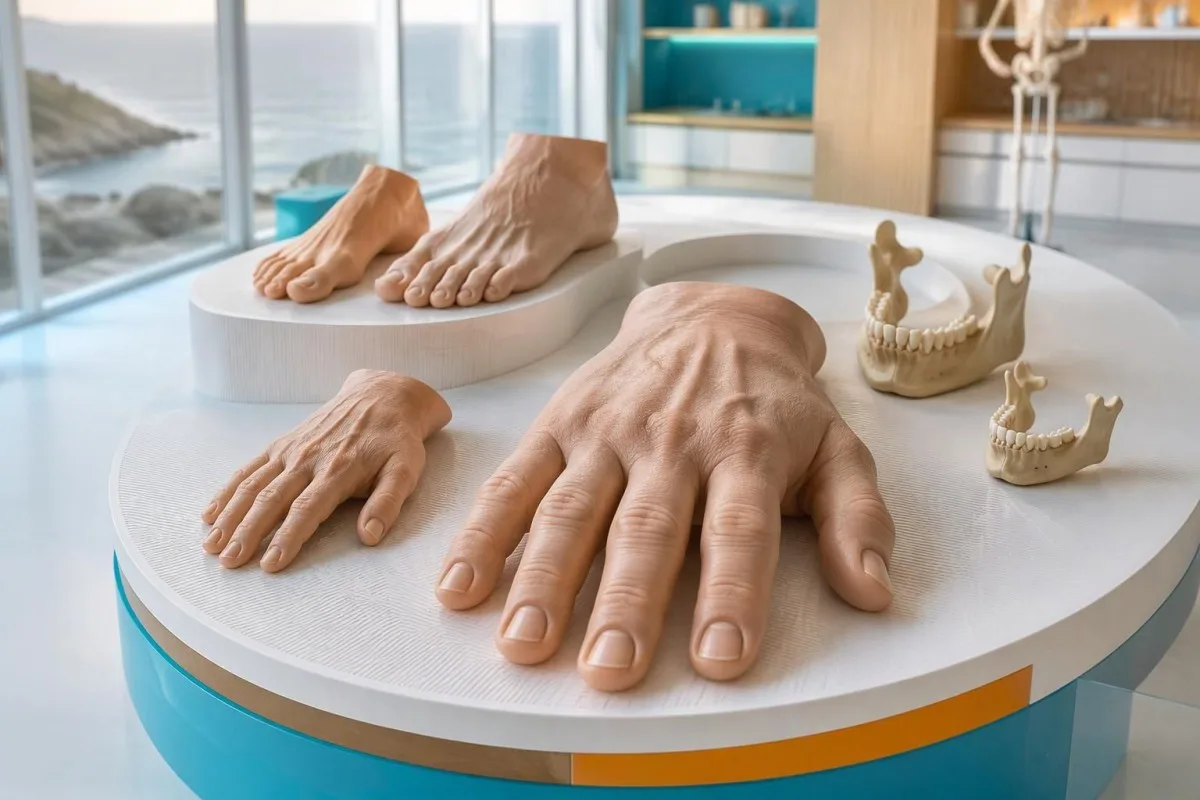
Поступове збільшення кистей або стоп, зміна щелепи, розширення проміжків між зубами, посилене потовиділення та апное сну можуть свідчити про акромегалію — особливо якщо кілька змін розвиваються одночасно. Симптоми не можуть підтвердити діагноз; потрібні клінічне обстеження та аналіз крові на IGF-1 з урахуванням віку.

Ключові висновки
- Прогресування важливіше за окремий симптом: збільшення розміру каблучки разом зі зміною прикусу протягом кількох років є підставою для клінічного огляду, навіть за відсутності виражених змін обличчя.
- Кисті та стопи можуть ставати ширшими після припинення збільшення зросту в дорослому віці; не існує підтвердженої кількості розмірів каблучки чи взуття, за якою можна діагностувати акромегалію.
- Зміни обличчя можуть включати виразніше виступання нижньої щелепи, ширший ніс, товстіші губи та появу проміжків між зубами; порівняння 2 фотографій із зазначеними датами може допомогти визначити хронологію змін.
- Апное сну разом зі збільшенням кистей, стоп або щелепи посилює підстави перевірити надлишок гормону росту; саме по собі хропіння не є специфічною ознакою.
- IGF-1 зазвичай є першим біохімічним аналізом, а його референтний інтервал має відповідати віку людини та методу аналізу лабораторії.
- Поріг 1,3× походить із консенсусу щодо акромегалії 2024 року: рівень IGF-1, що перевищує верхню вікову межу норми в 1,3 раза, може підтвердити діагноз за наявності характерних клінічних ознак.
- Тест із пригніченням глюкозою іноді допомагає усунути невизначеність: лікар може використати 75 г пероральної глюкози та серійні вимірювання гормону росту замість того, щоб покладатися на один випадковий результат аналізу на гормон росту.
- Екстрені симптоми включають раптовий сильний головний біль із новими проблемами із зором, блюванням або зниженням рівня свідомості; зверніться по невідкладну допомогу, а не чекайте на прийом щодо гормонів.
На які симптоми акромегалії варто звернути увагу?
Симптоми акромегалії викликають занепокоєння, коли збільшення кистей, стоп або обличчя прогресує разом із такими змінами, як пітливість, хропіння або зміна прикусу. Одна каблучка, що стала тісною, зазвичай є неспецифічною ознакою; 2 незалежні зміни, що розвиваються одночасно, є вагомішою підставою для клінічного обстеження, хоча жоден перелік симптомів не дає змоги встановити діагноз.

Акромегалія виникає внаслідок надлишку гормону росту після закриття зон росту кісток. Гормон росту стимулює вироблення інсуліноподібного фактора росту 1, або IGF-1, який сприяє збільшенню м’яких тканин і деяких кісток; більшість випадків спричинені доброякісною аденомою гіпофіза, а не проблемою з харчуванням.
Поступові зміни буває важче помітити, ніж раптовий симптом. Порівняння нинішньої зовнішності зі світлинами 3–5-річної давності може виявити зміни надбрівних дуг, щелепи або носа, які не помітні під час щоденних перевірок у дзеркалі; цей проміжок є практичним для порівняння, а не обов’язковим періодом очікування.
Наприклад, уявіть собі 46-річну людину, якій двічі змінювали розмір обручки, взуття якої стало ширшим і стоматолог якої зафіксував зміну прикусу. Стабільна маса тіла робить звичайний набір ваги менш вичерпним поясненням, але перш ніж називати це акромегалією, усе одно потрібні огляд і аналізи на гормони.
Kantesti — це аналізатор аналізів крові на основі штучного інтелекту, який може допомогти пояснити результат аналізу на IGF-1, не трактуючи перелік симптомів як діагноз. Наш організація та мета поясніть нашу роль: ми допомагаємо розібратися з уже наявними результатами, тоді як лікар оцінює фізичні зміни та вирішує, чи доцільне обстеження у спеціаліста.
Як акромегалія змінює кисті та розмір каблучки
Акромегалія може призвести до того, що кисті дорослої людини стають ширшими й товстішими, через що каблучки поступово перестають підходити, а не лише в спекотну погоду. Збільшення обох кистей із часом є більш показовим, ніж набряк, обмежений 1 пальцем, особливо якщо водночас змінюється посадка взуття, форма обличчя або пітливість.
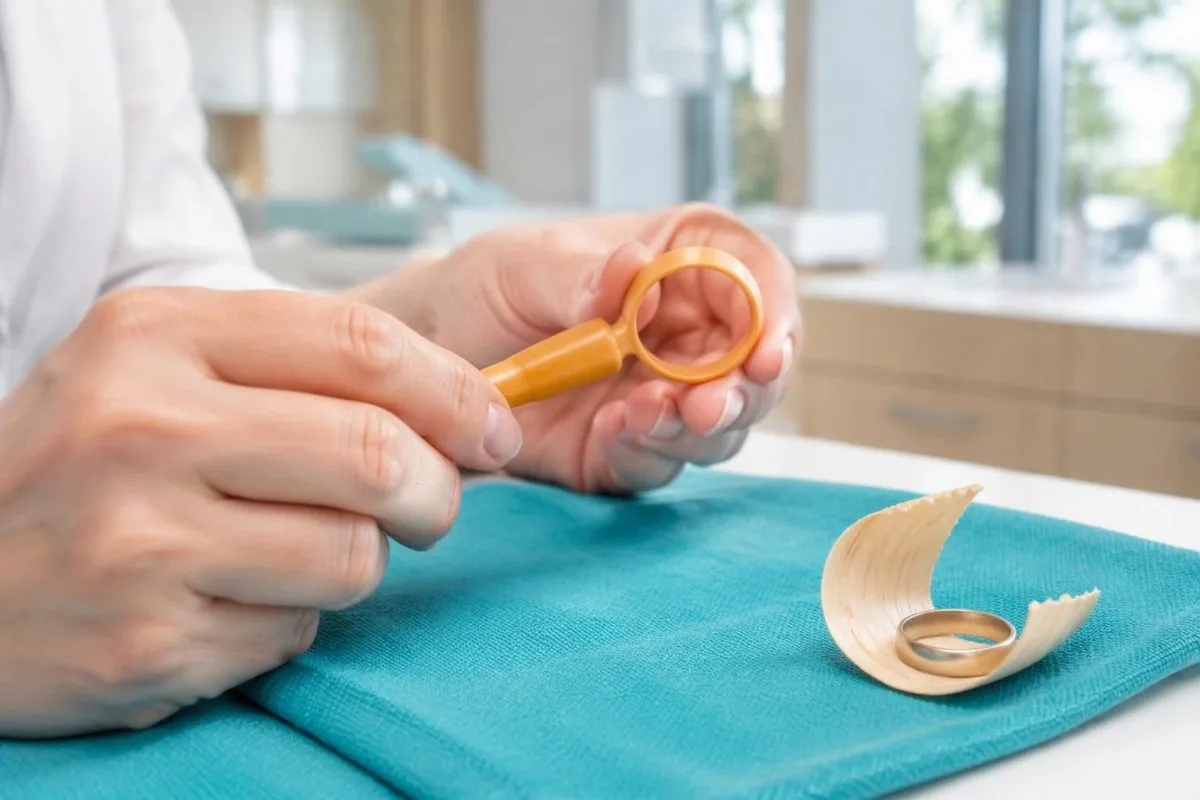
Розмір каблучки вимірює окружність, а не причину збільшення. Зміна на 1 розмір каблучки може бути наслідком набору ваги, артриту, затримки рідини або використання іншої системи розмірів; акромегалію розглядають, коли зміна є стійкою та супроводжується потовщенням долонь чи іншими характерними ознаками.
Тимчасовий набряк проявляється інакше, ніж прогресивне збільшення тканин. Перевірка того, чи одна й та сама каблучка підходить уранці та ввечері протягом 1 тижня, може виявити коливання, але таке домашнє спостереження не дає змоги виключити акромегалію; не намагайтеся багаторазово силоміць протягувати тісну каблучку через набряклий суглоб.
Затримка рідини, пов’язана зі щитоподібною залозою, може нагадувати припухлість кистей, але не відтворює повної картини акромегалії. Наше пояснення щодо легкого зниження функції щитоподібної залози допомагає відрізнити зміни щитоподібної залози, визначені за лабораторними показниками, від фізичного збільшення; лише незначне відхилення TSH від норми не повинно автоматично пояснювати зміну розміру кистей і щелепи, що тривала кілька років.
Для корисних записів до прийому окремо зафіксуйте 2 спостереження: загальне розширення кистей і збільшення, зосереджене на окремих суглобах. Вкажіть приблизні дати зміни розміру каблучки та зазначте, що з’явилося раніше: біль у кісточках пальців, ранкова скутість чи потовщення долонь; ці подробиці допоможуть лікарю відрізнити розростання тканин від захворювання суглобів або періодичного набряку.
Коли збільшення розміру взуття є ранньою ознакою
Поступове збільшення ширини або розміру стоп у дорослому віці може бути ранньою ознакою акромегалії, особливо якщо змінюється також розмір кистей. Одноразова заміна взуття не є діагностичною ознакою: посадка також може змінитися через відмінності між брендами, зміни стоп під час вагітності, набір ваги, кісточки або опущення склепінь стоп без надлишку гормону росту.
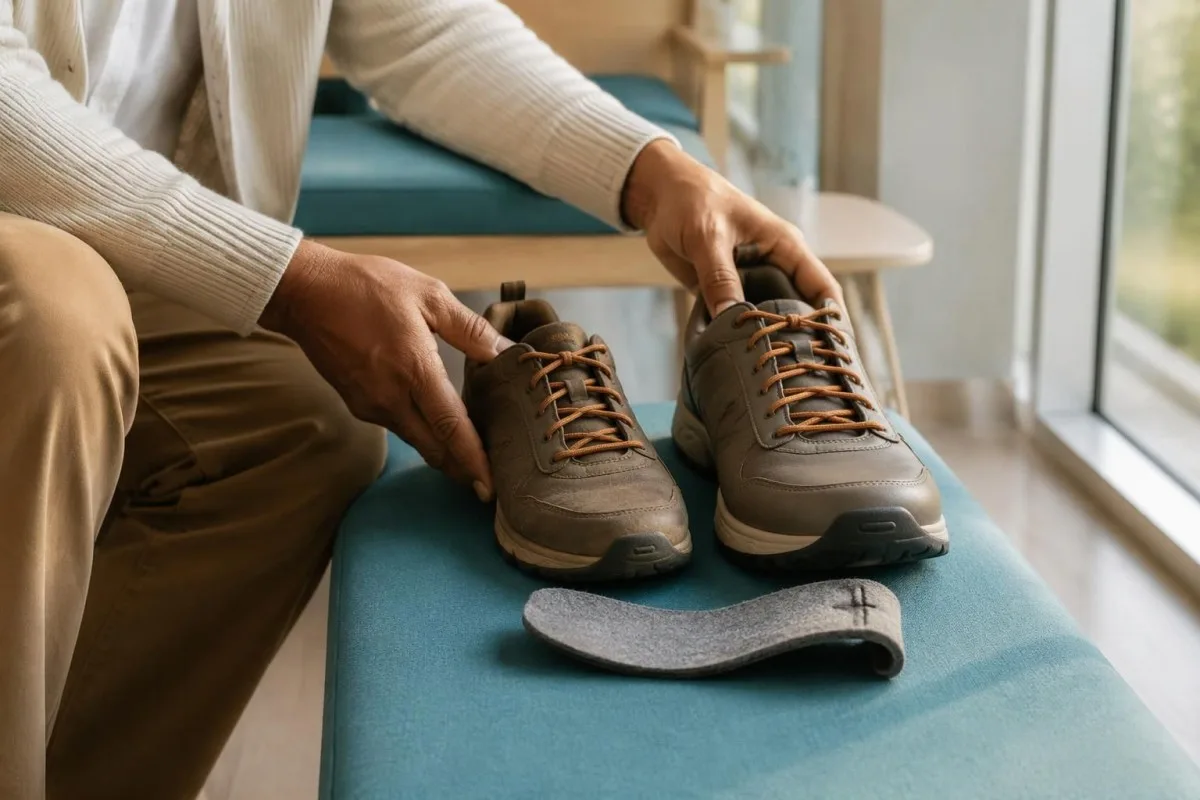
Ширина стопи іноді змінюється раніше, ніж зазначений розмір взуття. Якщо у взутті, купленому з інтервалом у 3 роки, довжина однакова, але потрібні дедалі просторіші носкові частини, зафіксуйте цю подробицю; потовщення м’яких тканин і механічні зміни стопи можуть співіснувати, тож сама довжина є неповним вимірюванням.
Збільшення, пов’язане з акромегалією, зазвичай розвивається поступово й вражає обидві стопи. Раптовий набряк 1 ноги або стопи, особливо з дискомфортом чи відчуттям тепла в литці, потребує іншої оцінки; наш посібник із urgent one-sided leg swelling explains why that pattern should not be attributed to a slow hormonal disorder.
For a hypothetical 51-year-old, moving from the same manufacturer's size 8 to size 10 over several years would be more informative than comparing unrelated brands. The observation becomes more meaningful if a ring has also needed resizing, but there is no validated shoe-size increase that confirms acromegaly.
Bring 2 pairs of dated shoes or purchase records if available, rather than buying measuring equipment. A clinician can assess edema, arches, joints and soft tissues together; foot photographs should be taken in comparable positions because perspective can make a stable foot appear larger.
На що можуть вказувати зміни щелепи та зубів
Acromegaly facial changes can include a more prominent lower jaw, broader nose, thicker lips and wider spacing between teeth. A changing bite documented on 2 dental visits can be more useful than a subjective impression of looking different, because jaw growth and ordinary weight gain affect appearance differently.
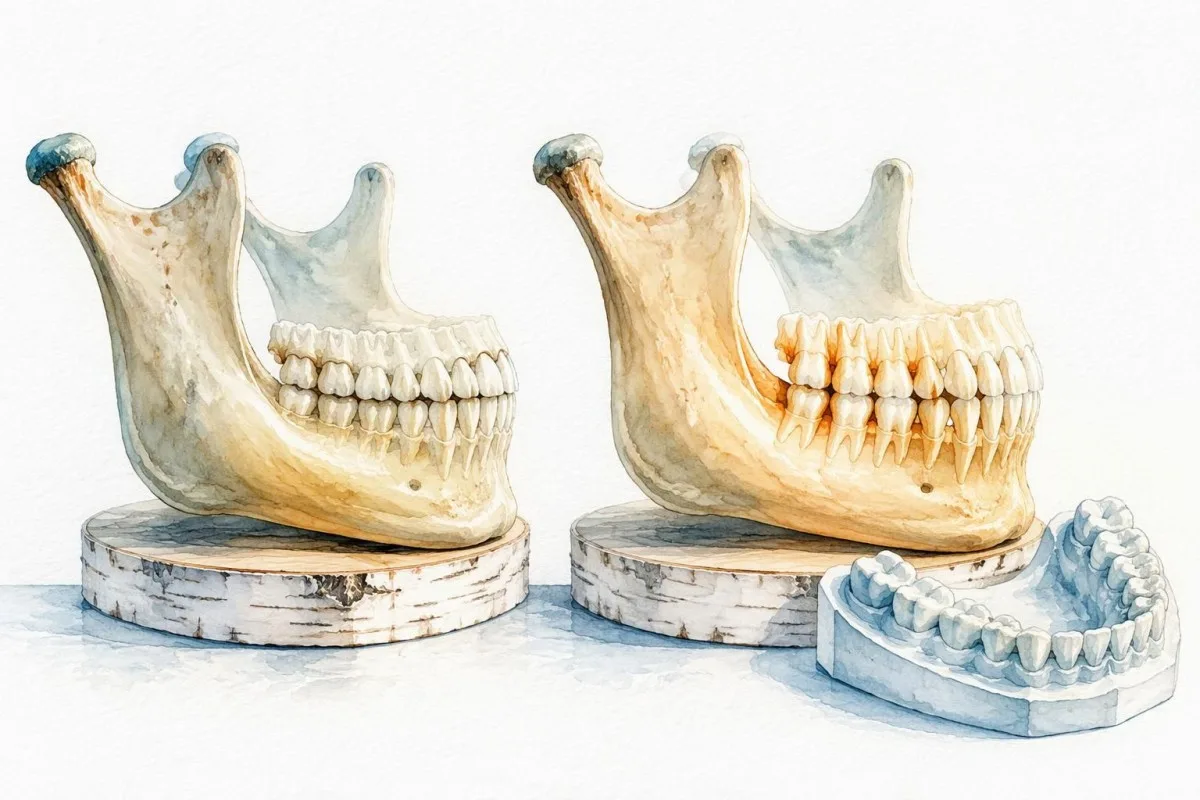
New tooth spacing does not necessarily mean the teeth themselves have enlarged. Enlargement of the jaw can change their positions relative to one another, while gum disease, missing teeth and orthodontic movement can also produce gaps; comparing dental records from 2 dates helps identify which process is more plausible.
Photographs are most useful when lighting, camera distance and head position are similar. Choose 1 older front-view photograph and 1 side view if possible; wide-angle phone lenses can exaggerate the nose and jaw, so apparent enlargement in a close selfie is not reliable evidence of hormone excess.
Bone disorders can also change skull or jaw shape, but usually require a different diagnostic pathway. Our explanation of Paget disease testing describes one alternative; an ALP result, whether normal or raised, cannot replace IGF-1 testing when the broader pattern suggests acromegaly.
Ask a dentist whether 2 findings are documented: a progressive bite change and new spacing not explained by gum or orthodontic disease. A dentist may recognize the physical pattern, but photographs, bite impressions and dental imaging cannot confirm acromegaly without an endocrine assessment.
Чому посилене потовиділення має значення лише в ширшій картині
Increased sweating and oily or thicker skin can accompany acromegaly, but sweating alone is a weak diagnostic clue. Persistent sweating becomes more relevant when it develops alongside at least 1 structural change, such as broader hands or a changing jaw; the combination guides evaluation rather than proving a hormonal cause.
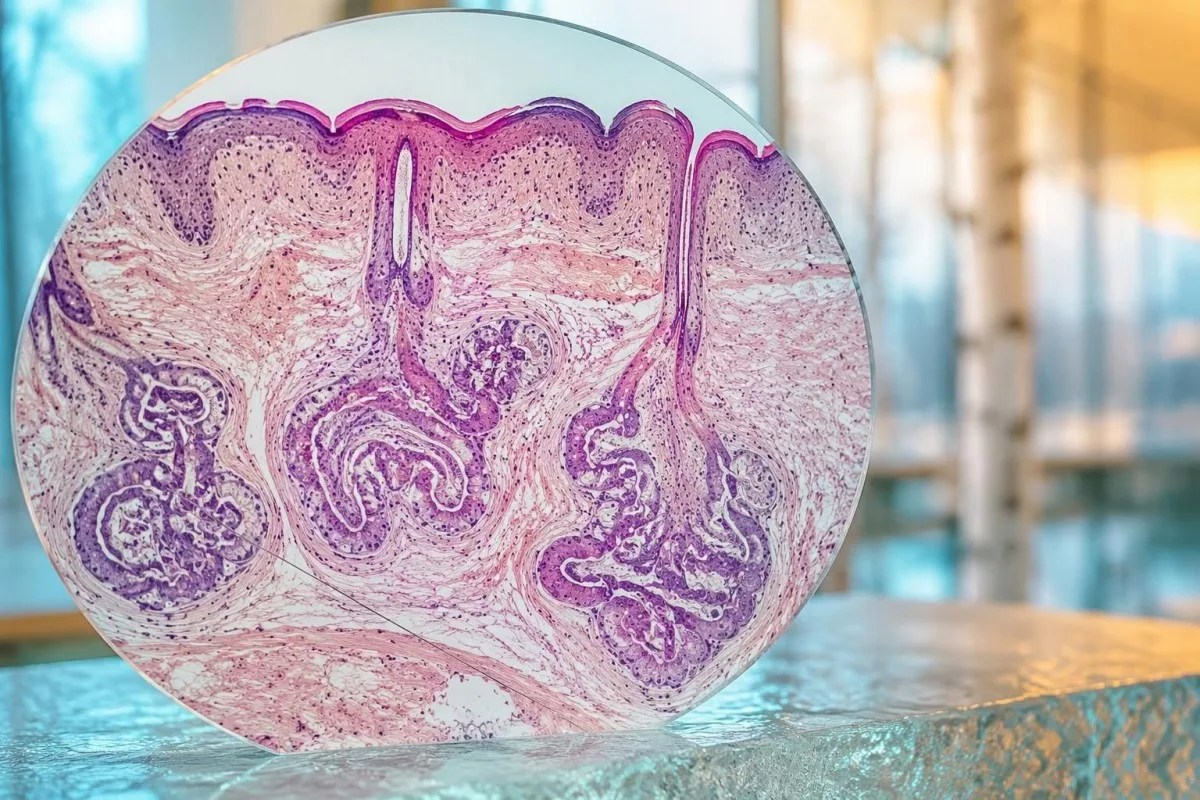
A useful sweating history distinguishes persistent excess perspiration from brief episodes. Recording triggers and timing for 7 days can reveal links to exercise, medicines, meals or hot flashes; acromegaly does not have a distinctive sweat odor or a validated sweating frequency that separates it from other causes.
Episodic sweating with pounding headaches, palpitations and marked blood-pressure swings suggests a different endocrine question. Our guide to adrenal hormone warning patterns explains when metanephrine testing may be considered; that test and IGF-1 answer different questions, even when 2 conditions share sweating as a symptom.
Hot flashes can coincide with the age at which acromegaly becomes noticeable, creating an easy attribution error. The discussion of fluctuating menopause hormone results explains why 1 estradiol measurement is not a complete explanation for sweating, especially if ring fit and facial shape are also changing.
Skin tags are common and are not an acromegaly screening test. In a hypothetical 48-year-old with new sweating and several skin tags, we would distinguish metabolic or medication-related explanations from the much more specific observation of progressive hand and jaw enlargement; counting skin tags does not resolve that distinction.
Як апное сну пов’язане зі збільшенням тканин
Acromegaly can contribute to obstructive sleep apnea through enlargement of the tongue and other upper-airway tissues. Loud snoring, witnessed breathing pauses and daytime sleepiness warrant sleep evaluation; when these occur with progressive hand or jaw enlargement, an IGF-1 test may also be appropriate rather than assuming 1 diagnosis explains everything.
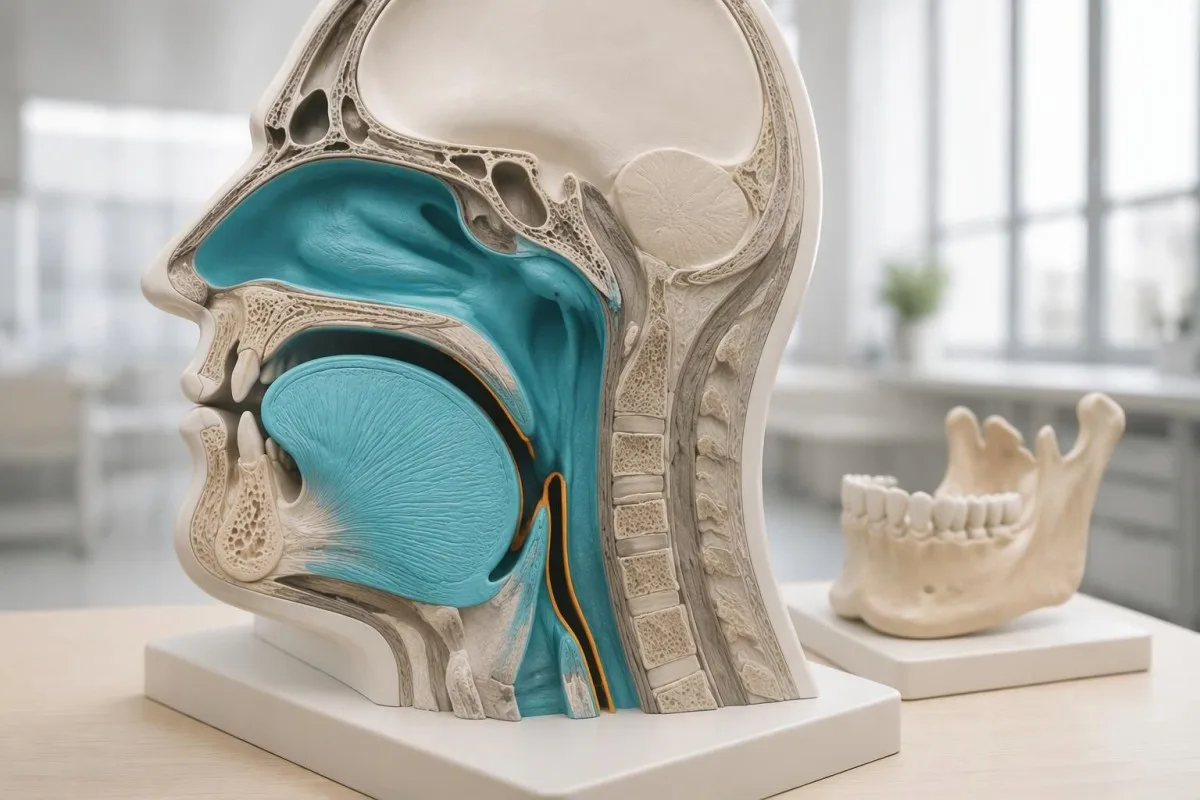
Obstructive sleep apnea is assessed using respiratory events during sleep, not facial appearance. An apnea–hypopnea index of at least 5 events/hour with relevant symptoms or comorbidities, or at least 15 events/hour regardless of symptoms, commonly supports adult diagnosis; neither threshold identifies the underlying cause as acromegaly.
Sleep studies answer a different question from a daytime sleepiness test. Our explanation of sleep-study test selection distinguishes overnight respiratory assessment from testing for narcolepsy; a normal or abnormal multiple sleep latency test does not assess growth hormone excess.
The Endocrine Society guideline recommends considering IGF-1 testing when several associated conditions occur together, including sleep apnea, diabetes, arthritis, carpal tunnel syndrome, excessive sweating and hypertension (Katznelson et al., 2014). Having 1 of these common conditions does not justify assuming acromegaly, but their coexistence can lower the threshold for discussing testing.
Treating hormone excess does not guarantee that sleep apnea disappears. If a person already uses positive-airway-pressure treatment, 1 improved night of sleep is not evidence that it can be stopped; residual airway anatomy and weight-related factors may persist, and any treatment change requires reassessment by the sleep team.
Оніміння кистей і біль у суглобах: додаткові ознаки
Carpal tunnel syndrome and joint discomfort can accompany acromegaly because tissue enlargement affects nerves, cartilage and joint mechanics. Numbness in the thumb, index and middle fingers is more consistent with median-nerve compression than numbness involving all 5 fingers equally, but the nerve pattern does not establish a hormonal cause.
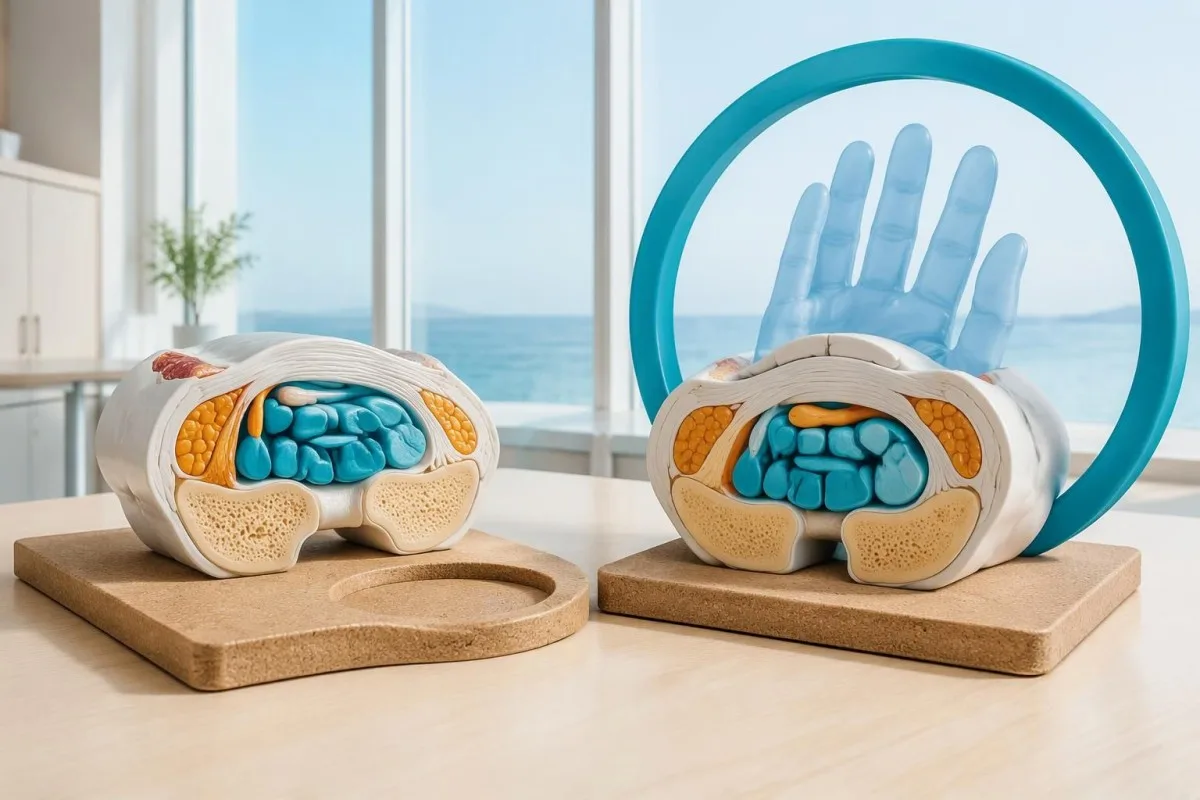
Bilateral symptoms are useful context, not proof of acromegaly. Nighttime tingling in both hands plus 2 ring resizings and a changing bite deserves a different discussion from isolated tingling after repetitive wrist use; the associated structural changes explain why an endocrine cause might enter the differential.
The fingers involved help localize the problem before choosing tests. Our guide to median-nerve symptom patterns explains why little-finger numbness may point elsewhere; an abnormal nerve-conduction study can confirm nerve dysfunction without answering whether IGF-1 excess contributed.
Joint symptoms can outlast successful control of growth hormone excess. After years of altered cartilage and bone mechanics, correcting 1 hormone pathway does not necessarily reverse established degenerative changes; this is why early recognition matters even when pain has been labeled ordinary arthritis.
Kantesti can help organize an IGF-1 result alongside glucose or thyroid findings, but nerve symptoms still require clinical localization. For a hypothetical 55-year-old, distinguishing 2 problems—median-nerve compression and progressive tissue enlargement—avoids interpreting every abnormal laboratory value as the cause of hand numbness.
Інші ознаки: рівень глюкози, артеріальний тиск і гормональні зміни
Growth hormone excess can contribute to insulin resistance, high blood pressure and changes in other pituitary hormone functions. These findings are common outside acromegaly; concern rises when at least 2 metabolic or hormonal problems develop alongside progressive hand, foot or facial enlargement, rather than when a single routine result is abnormal.
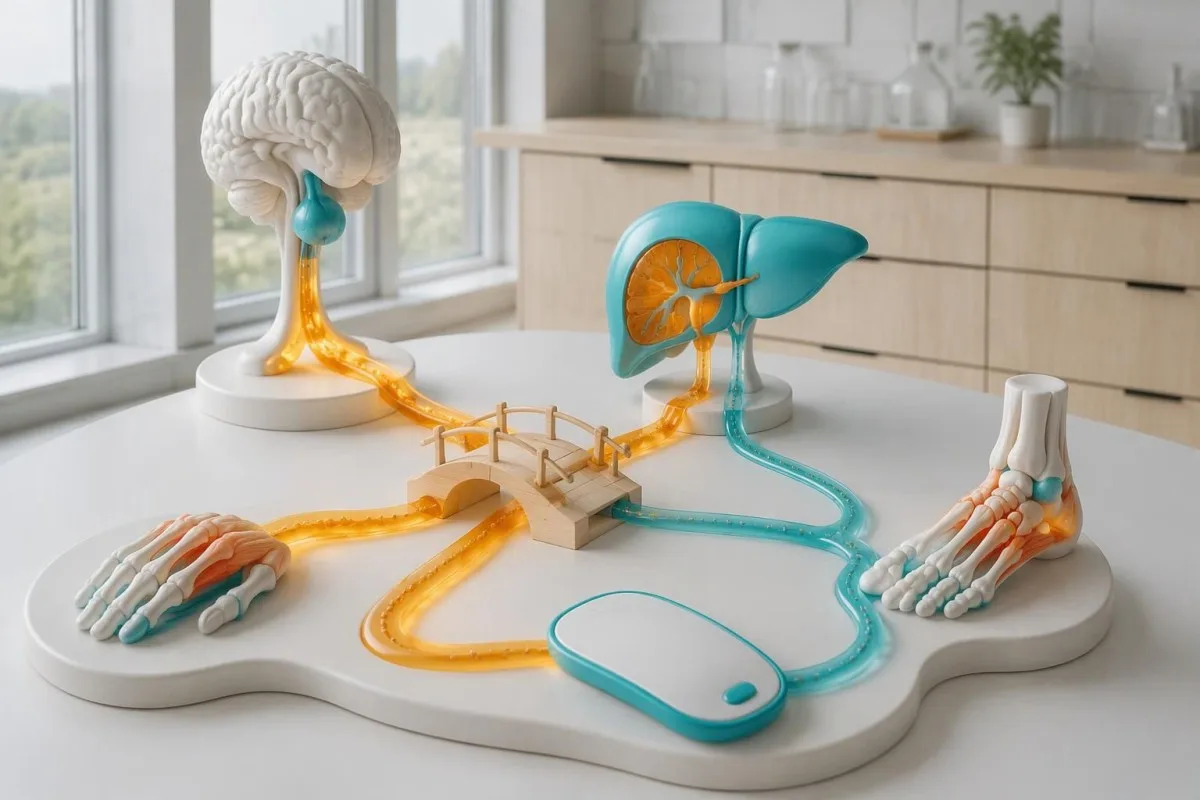
Diabetes is a possible associated condition, not a diagnostic shortcut. An HbA1c of at least 6.5% or fasting plasma glucose of at least 126 mg/dL, equivalent to 7.0 mmol/L, meets commonly used diabetes thresholds when confirmation requirements are satisfied; neither value identifies growth hormone excess as the cause.
Thirst and blurred vision may therefore need evaluation independently of changes in appearance. Our guide to симптоми попередження про високий рівень глюкози explains why a hypothetical glucose result of 280 mg/dL with symptoms deserves prompt clinical attention, even while a separate acromegaly assessment is being arranged.
Pituitary dysfunction can alter menstrual cycles, sexual function or fertility, but these symptoms have many causes. Our women's hormonal symptom guide discusses relevant alternatives; missing 2 periods alongside progressive jaw and hand changes deserves a broader review than assuming a single age-related explanation.
At Kantesti, we distinguish a complication marker from a disease-specific test: 1 abnormal HbA1c cannot substitute for age-adjusted IGF-1. Bring blood-pressure readings, medication names and the timing of hormonal symptoms, because a clinician may need to assess associated conditions and pituitary function in parallel.
Що ще може спричиняти подібні фізичні зміни?
Weight gain, fluid retention, thyroid disease, arthritis and dental problems can resemble parts of the acromegaly pattern. The distinction depends on the distribution and progression of change: enlargement affecting hands, feet and jaw over several years is harder to explain with 1 localized joint or dental problem.
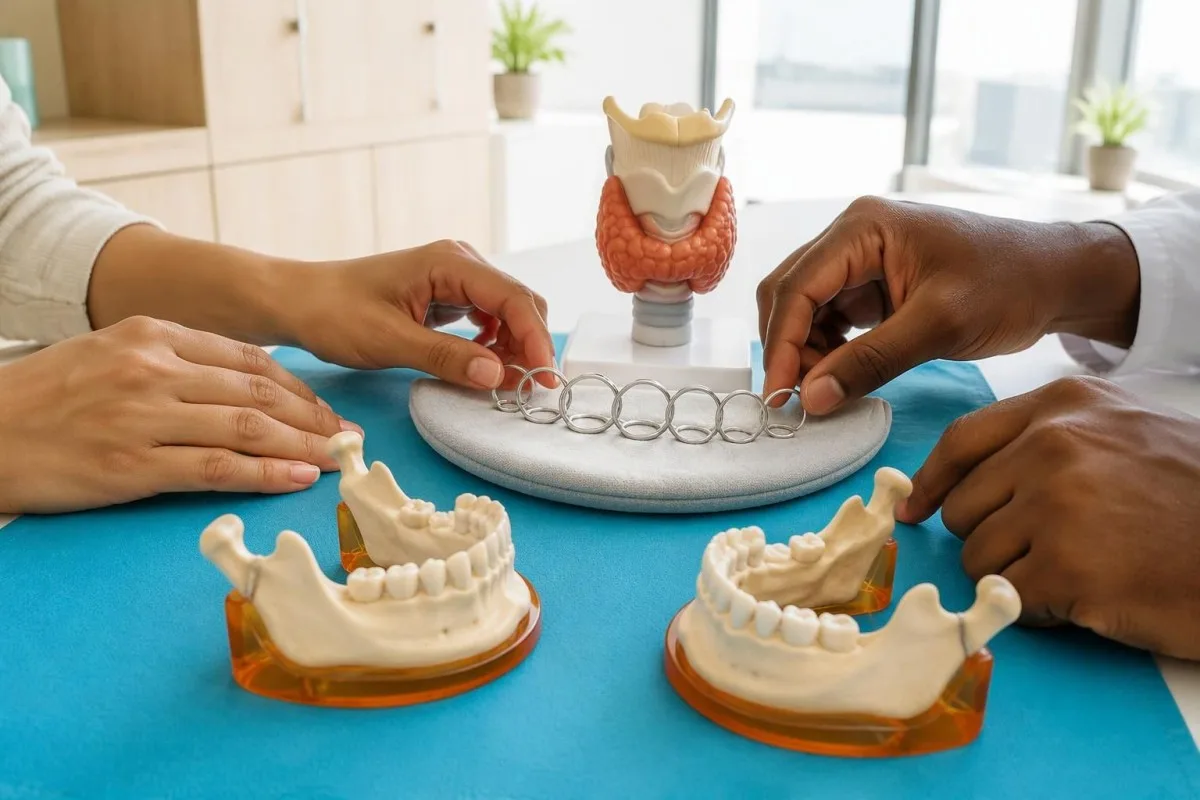
Weight gain often changes facial fullness without producing the same progressive mandibular prominence or dental spacing. In a hypothetical 50-year-old whose weight rose by 12 kg, tighter rings may have an ordinary explanation; a dentist-confirmed change in jaw relationship still deserves separate attention rather than dismissal.
Cushing syndrome can cause facial rounding, metabolic problems and muscle weakness, but its testing pathway differs from acromegaly. Our guide to cortisol screening and confirmation explains why 1 random cortisol result does not establish Cushing syndrome, just as a random growth hormone result does not establish acromegaly.
A pituitary problem can sometimes produce low free T4 without an appropriately elevated TSH. Our explanation of low T4 with normal TSH helps clarify why those 2 measurements must be interpreted together; a normal TSH alone is not a complete assessment of pituitary-related thyroid function.
Childhood growth and adult tissue enlargement should not be confused. Excess growth hormone before growth-plate closure can cause gigantism, whereas adult acromegaly does not usually increase height; a naturally large shoe size that has remained unchanged for 20 years is not equivalent to progressive adult enlargement.
Чому IGF-1 зазвичай є першим аналізом крові
Age-adjusted IGF-1 is usually the first biochemical test when acromegaly is suspected because it reflects growth hormone activity more consistently than a single growth hormone measurement. The 2024 consensus states that characteristic clinical features plus IGF-1 above 1.3 times the age-adjusted upper limit can confirm the diagnosis (Giustina et al., 2024).
IGF-1 has no single normal adult range that applies to every age and assay. For example, if a hypothetical laboratory upper limit is 250 ng/mL and the result is 340 ng/mL, the result is 1.36 times that upper limit; using another laboratory's range could change the interpretation incorrectly.
A normal IGF-1 usually argues against acromegaly, but confounders can reduce its reliability. Poorly controlled diabetes, significant liver disease, undernutrition and oral estrogen can affect results; 1 normal measurement should be reviewed in context when physical features are compelling, rather than overridden or accepted automatically.
Kantesti is an AI blood test interpretation platform that can explain an IGF-1 value relative to the reference interval printed on the report. Наш посібник з інтерпретації біомаркерів provides laboratory context, but identifying the assay, age range and clinical reason for testing remains part of clinician-led assessment.
Liver and nutritional status matter because IGF-1 production is closely linked to hepatic function and systemic health. Our посібник з інтерпретації білків сироватки крові explains relevant background markers; 1 albumin result cannot validate or invalidate IGF-1, but it may prompt a closer review of illness or nutrition.
| Рівень | Діапазон | Що це означає |
|---|---|---|
| В межах лабораторного інтервалу | At or below the age-adjusted upper limit | Usually argues against acromegaly; consider confounders if clinical suspicion remains strong. |
| Прикордонне підвищення | >1.0–1.3× the age-adjusted upper limit | Requires clinical review; repeat testing and sometimes glucose suppression testing resolve uncertainty. |
| Above the consensus diagnostic threshold | >1.3× the age-adjusted upper limit | Can confirm acromegaly when characteristic clinical features are present; specialist interpretation is needed. |
Коли доцільно проводити тест на пригнічення гормону росту
A glucose suppression test may help when IGF-1 results and clinical findings are equivocal. The test commonly uses 75 g oral glucose followed by serial growth hormone measurements; it assesses whether growth hormone suppresses appropriately, rather than treating one high random growth hormone value as diagnostic.
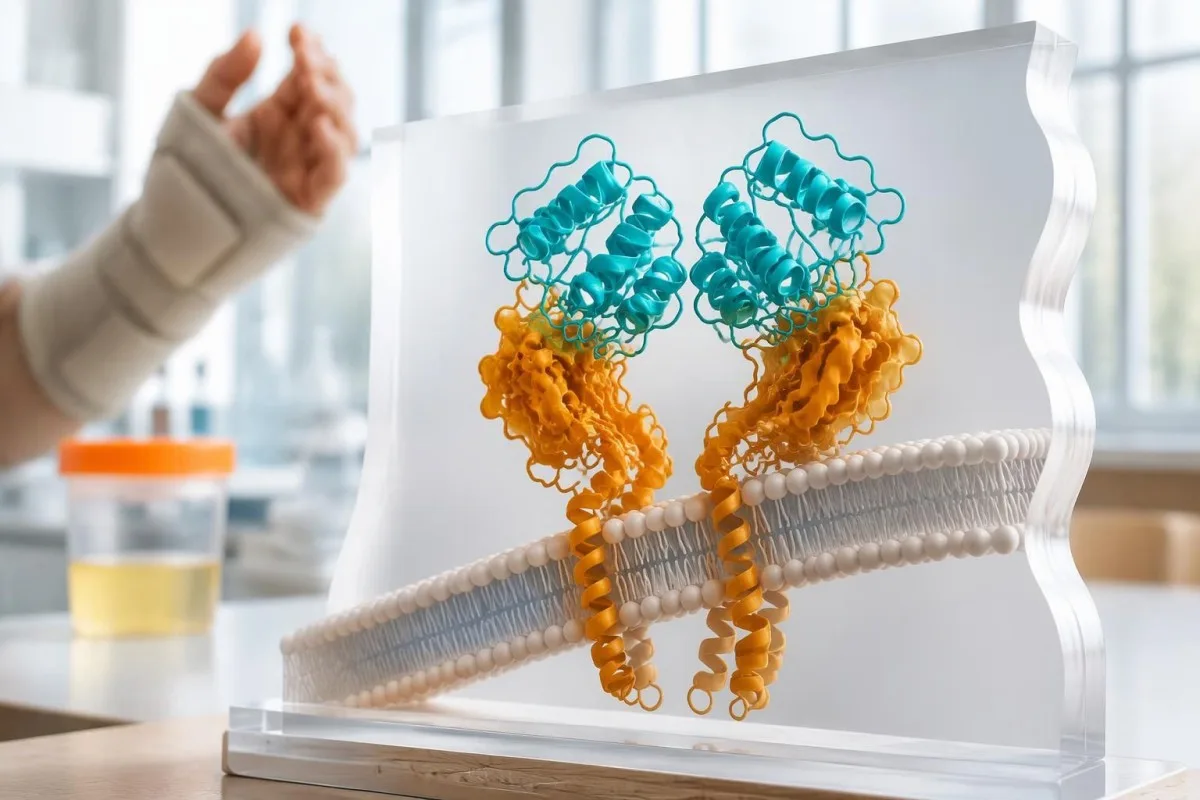
Growth hormone is released in pulses and can rise with sleep, exercise and physiological stress. That is why 1 random value, whether high or low, is unreliable for establishing or excluding acromegaly; an isolated result should not trigger a diagnosis based solely on a generic laboratory range.
Diagnostic cutoffs have changed with assay sensitivity. The Endocrine Society guideline used suppression below 1 ng/mL after glucose to exclude acromegaly in the appropriate testing context (Katznelson et al., 2014); specialist practice may use lower assay-dependent thresholds, including 0.4 ng/mL, rather than one universal cutoff.
For example, a hypothetical IGF-1 of 275 ng/mL against an upper limit of 250 ng/mL equals 1.10 times the upper limit. If growth hormone falls to 0.7 ng/mL, interpretation may differ by assay and clinical context; repeating IGF-1 and reviewing confounders is safer than selecting whichever cutoff gives a preferred answer.
Kantesti does not independently validate an acromegaly diagnosis or choose a glucose-test cutoff. Our клінічні методи та обмеження explain why interpretation must remain tied to the source report; our separate guide to значущих змін лабораторних показників explains why 2 results are not automatically comparable.
Коли записатися на огляд — і коли симптоми потребують невідкладної допомоги
Book a clinical review for unexplained progressive enlargement of hands, feet or jaw, especially when sweating, sleep apnea or a changing bite accompanies it. There is no minimum duration you must wait; a sudden severe headache with new visual symptoms is a separate emergency, not something to observe for 2 weeks.
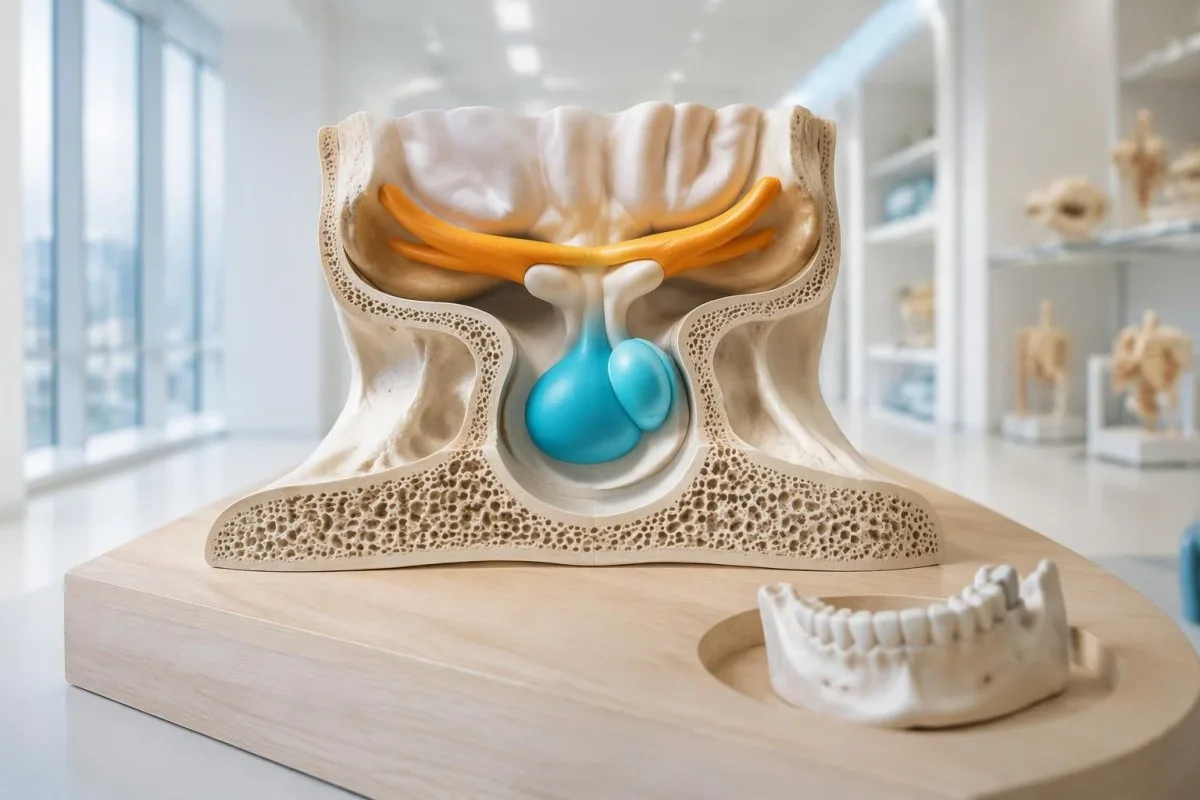
A pituitary growth can affect nearby visual pathways, sometimes causing loss of peripheral vision. New difficulty noticing objects on either side, double vision or a substantial visual change warrants prompt assessment; involvement of 1 or both eyes does not reliably determine whether the cause is pituitary, retinal or neurological.
Sudden severe headache with vomiting, double vision, reduced alertness or visual loss can indicate pituitary apoplexy or another neurological emergency. Seek emergency care immediately rather than waiting for an IGF-1 result; even 1 abrupt neurological warning symptom can justify urgent assessment when severe or unexplained.
Pituitary adenomas are usually noncancerous, but noncancerous does not mean harmless when a growth produces excess hormones or presses on nearby structures. Our guide to neurological warning symptoms explains why progressive and sudden symptoms follow different routes; a 5-year appearance change and an abrupt visual deficit should not receive the same triage.
For gradual changes without emergency features, prepare 3 categories of evidence: appearance or sizing changes, associated symptoms and existing results. Ask whether an age-adjusted IGF-1 test and endocrine referral are appropriate; avoid arriving with a self-confirmed diagnosis or postponing care until every possible symptom appears.
Що відбувається після аномального результату гормонального аналізу?
After biochemical confirmation or strong specialist-supported suspicion, pituitary MRI usually identifies the source and its relationship to surrounding structures. Imaging alone cannot confirm acromegaly: a pituitary finding may be incidental, and the 10 mm size boundary between microadenoma and macroadenoma describes size rather than hormone secretion.
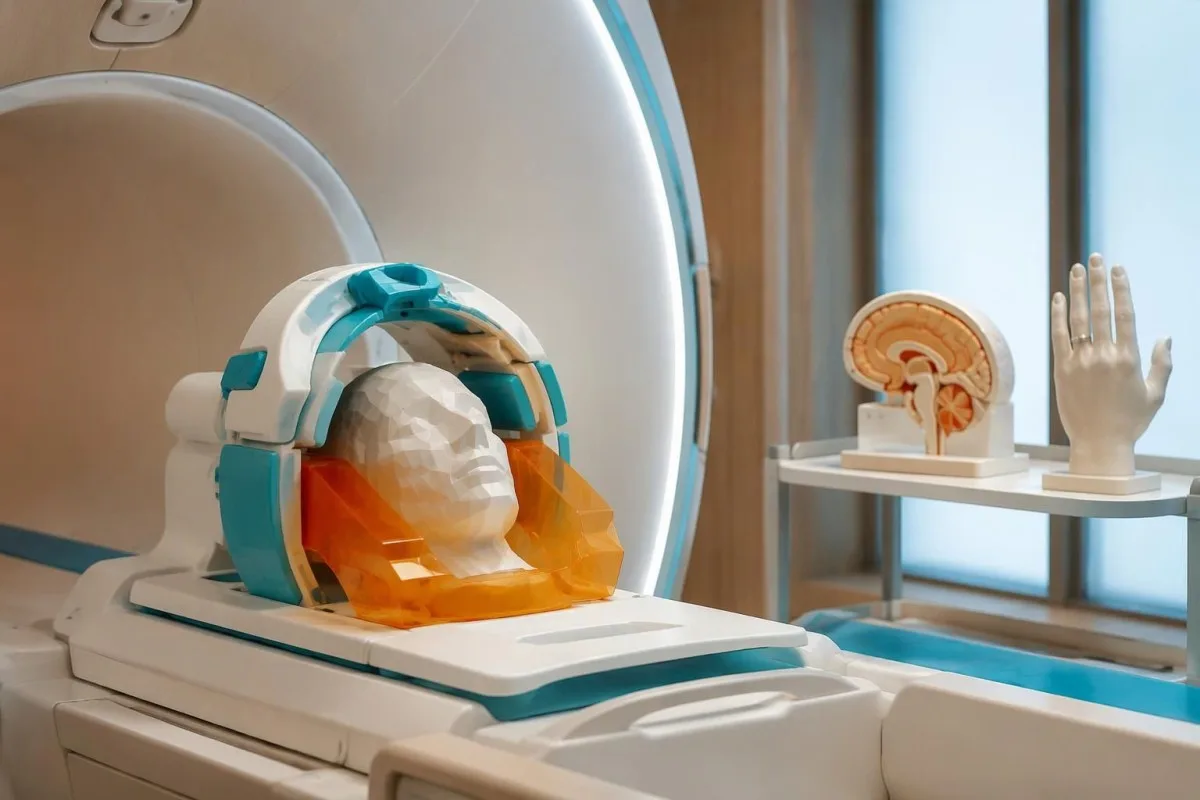
A pituitary microadenoma measures less than 10 mm, while a macroadenoma measures at least 10 mm. A smaller growth can still secrete clinically significant growth hormone; conversely, a larger nonfunctioning growth may not cause acromegaly, so dimensions and biochemical activity answer different questions.
An endocrine team may assess prolactin, thyroid function, adrenal function and reproductive hormone pathways as well as IGF-1. Our guide to легких підвищень пролактину explains why 1 raised prolactin result can have several causes; it does not prove that a pituitary growth is secreting multiple hormones.
Visual-field testing may be needed when MRI shows proximity to the optic chiasm or when vision is affected. A reassuring ability to read a phone screen at 30 cm does not exclude peripheral field loss; formal testing assesses a different part of vision from everyday reading.
Kantesti AI cannot infer pituitary growth size from an IGF-1 concentration. If the pituitary MRI does not explain convincing biochemical findings, a specialist may review imaging quality, assay issues and rare alternative sources; a negative scan should not be converted into an unsupported claim that 1 hormone result was necessarily wrong.
Як підготуватися до прийому та перевірити наші джерела
The most useful next step is a short timeline connecting physical changes, associated symptoms and existing laboratory results. Bring 2 dated photographs if available, ring or shoe history and the full IGF-1 report; these support a focused clinical discussion without turning home observations into a diagnostic score.
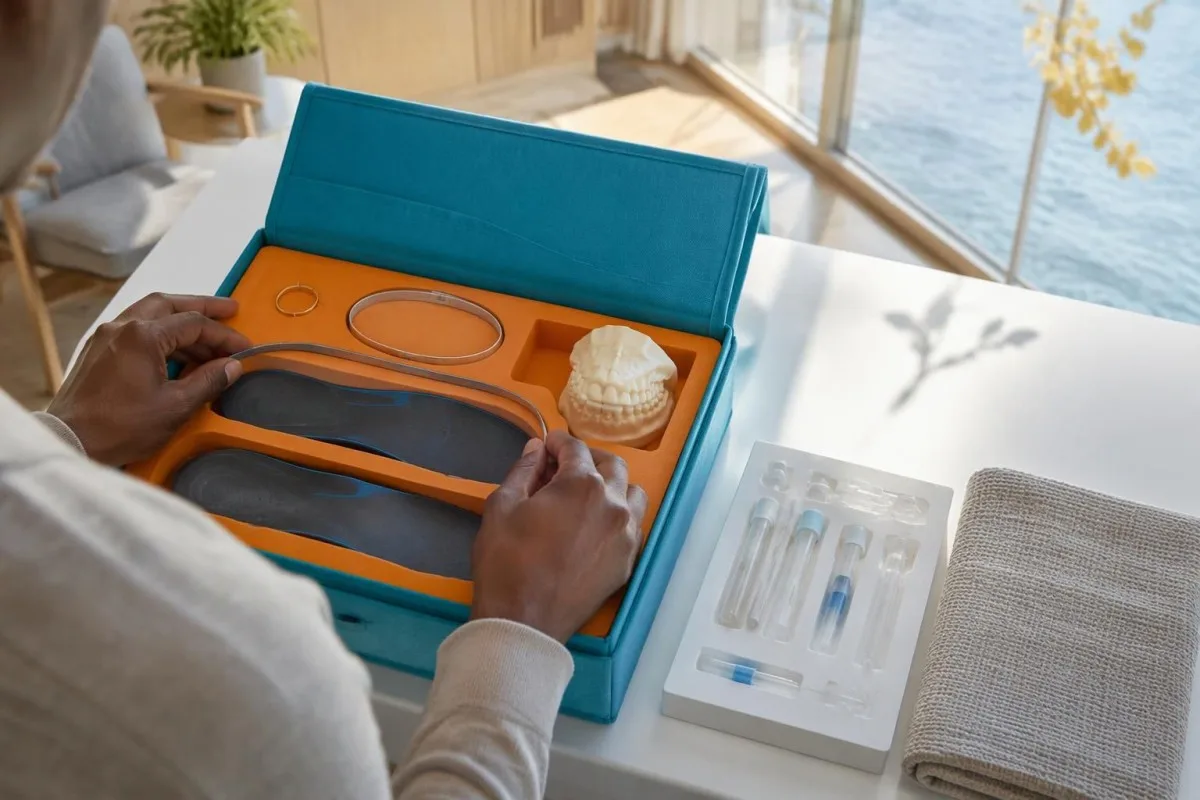
Write down when each change began and whether it has continued, fluctuated or stopped. A 1-page record is usually more useful than dozens of unlabeled photographs: include weight changes, dental observations, sleep-apnea treatment and medication or supplement use, especially prescribed hormones that could influence laboratory interpretation.
Kantesti is an AI-powered blood test analysis tool that can help explain an existing IGF-1 report and organize questions for your clinician. Наш гід щодо перевірки пояснень звіту від ШІ describes source verification; an explanation cannot replace examination, and a normal metabolic panel does not mean IGF-1 was tested.
Protect identifying information when sharing laboratory reports or old photographs. Kantesti's рекомендації щодо конфіденційності та даних explains our data approach; use only the materials needed for the question, and obtain permission before sharing another person's results or images, even when comparing 2 family members.
The clinical recommendations here draw on the Endocrine Society's 2014 guideline and the 2024 diagnostic consensus, listed below. The 2 accompanying Figshare publications concern gastrointestinal and women's hormonal health; they are related educational resources, not evidence for acromegaly diagnosis, and a repository DOI does not by itself establish peer review.
Поширені запитання
Які ранні ознаки акромегалії?
Ранні ознаки акромегалії можуть включати поступове збільшення розміру каблучок і взуття, посилене потовиділення, появу симптомів синдрому зап’ясткового каналу та зміну прикусу. Порівняння 2 фотографій із зазначеними датами або стоматологічних записів може виявити зміни, які важко помітити день у день. Жодне конкретне збільшення розміру каблучки чи кількість симптомів не підтверджує акромегалію. Незрозуміле прогресування має стати приводом для клінічного обстеження та визначення рівня IGF-1 з урахуванням віку.
Чи означає, що в мене акромегалія, якщо збільшується розмір каблучки або взуття?
Збільшення розміру каблучки чи взуття саме по собі не означає, що у вас акромегалія. На посадку також можуть впливати набір ваги, затримка рідини, артрит, зміни стоп під час вагітності та відмінності у взутті. Зміна розміру взуття на 1 не має підтвердженого діагностичного значення, але стійке збільшення розміру в поєднанні зі змінами щелепи, пітливістю або апное сну потребує медичної оцінки. Діагноз залежить від клінічних ознак і належного дослідження рівня гормонів.
Чи може акромегалія змінити обличчя або спричинити появу щілин між зубами?
Акромегалія може зробити нижню щелепу виразнішою та збільшити проміжки між зубами внаслідок зміни розмірів щелепи. Вона також може розширити ніс і потовщити губи, однак подібні ознаки можуть спостерігатися при захворюванні ясен, ортодонтичному переміщенні зубів і звичайних змінах обличчя. Порівняння стоматологічних записів за 2 дати може допомогти встановити, чи прогресували зміни прикусу або проміжків між зубами. Фотографії обличчя та стоматологічні дані не можуть підтвердити акромегалію без біохімічного обстеження.
Який аналіз крові виявляє акромегалію?
Скоригований за віком рівень IGF-1 зазвичай є першим аналізом крові, який призначають за підозри на акромегалію. Згідно з консенсусом 2024 року, рівень IGF-1, що перевищує верхню межу норми з урахуванням віку в 1,3 раза, може підтвердити акромегалію за наявності характерних клінічних ознак. Прикордонні або суперечливі результати можуть потребувати повторного обстеження та проведення під наглядом лікаря тесту з пригніченням секреції глюкозою. Одноразове випадкове вимірювання рівня гормону росту не є надійною діагностичною альтернативою.
Чи може бути акромегалія за нормального рівня IGF-1?
Нормальний рівень IGF-1, достовірно виміряний з урахуванням віку, зазвичай свідчить проти нелікованої акромегалії. Однак погано контрольований діабет, значне захворювання печінки, недоїдання та пероральний прийом естрогенів можуть впливати на IGF-1 і ускладнювати інтерпретацію результату. Якщо характерні фізичні зміни зберігаються попри 1 нормальний результат, лікар має переглянути метод аналізу, референтний інтервал і можливі чинники, що можуть впливати на результат. Замість того щоб припускати, що симптоми доводять діагноз або що контекст ніколи не має значення, доцільно повторити аналіз або звернутися до спеціаліста.
Коли можливі симптоми акромегалії слід вважати невідкладним станом?
Поступове збільшення кистей, стоп або обличчя зазвичай потребує планового клінічного огляду, а не невідкладної допомоги. Раптовий сильний головний біль із новою втратою зору, двоїнням в очах, блюванням або зниженням рівня свідомості потребує невідкладного обстеження, оскільки можливі апоплексія гіпофіза та інші невідкладні неврологічні стани. За появи цих тривожних ознак не чекайте 24 години на результат планового аналізу на гормони. Нові або прогресуючі проблеми із зором також потребують оперативної клінічної оцінки, навіть якщо помітних змін зовнішності немає.
Дізнайтеся, як читати аналіз крові
Завантажте лабораторний звіт, і ШІ Kantesti за лічені секунди пояснить кожен біомаркер простою мовою. Ним користуються понад 2 мільйони людей у всьому світі.
Посилання
- Klein, T., Mitchell, S., & Weber, H. (2026). Діарея після голодування, чорні цятки у випорожненнях і посібник із ШКТ, 2026. Медичні дослідження ШІ Kantesti. DOI
- Klein, T., Mitchell, S., & Weber, H. (2026). Посібник зі здоров’я жінок: овуляція, менопауза та гормональні симптоми. Медичні дослідження ШІ Kantesti. DOI
- Katznelson L et al. (2014). Acromegaly: An Endocrine Society Clinical Practice Guideline. The Journal of Clinical Endocrinology & Metabolism. DOI
- Giustina A et al. (2024). Consensus on criteria for acromegaly diagnosis and remission. Pituitary. DOI
- 2 млн+Проаналізовані тести
- 127+Країни
- 100+Мови
Про медичну команду


Сигнали довіри E-E-A-T
Досвід
Лікарський клінічний огляд робочих процесів інтерпретації лабораторних показників.
Експертиза
Лабораторна медицина з акцентом на те, як біомаркери поводяться в клінічному контексті.
Авторитетність
Медичну рецензію провів доктор Томас Кляйн за участю доктора Сари Мітчелл і професора, доктора Ганса Вебера.
Довірливість
Інтерпретація на основі доказів із чіткими шляхами подальших дій, щоб зменшити тривогу.




Застереження щодо медичної інформації
Ця стаття призначена лише для освітніх цілей і не становить медичної поради. Завжди консультуйтеся з кваліфікованим медичним працівником щодо рішень про діагностику та лікування.
Опубліковано · Зв’язатися з редакційною командою
Опубліковано компанією Kantesti Ltd, зареєстрованою в Англії та Уельсі під номером компанії. 17090423, Лондон, Велика Британія.
