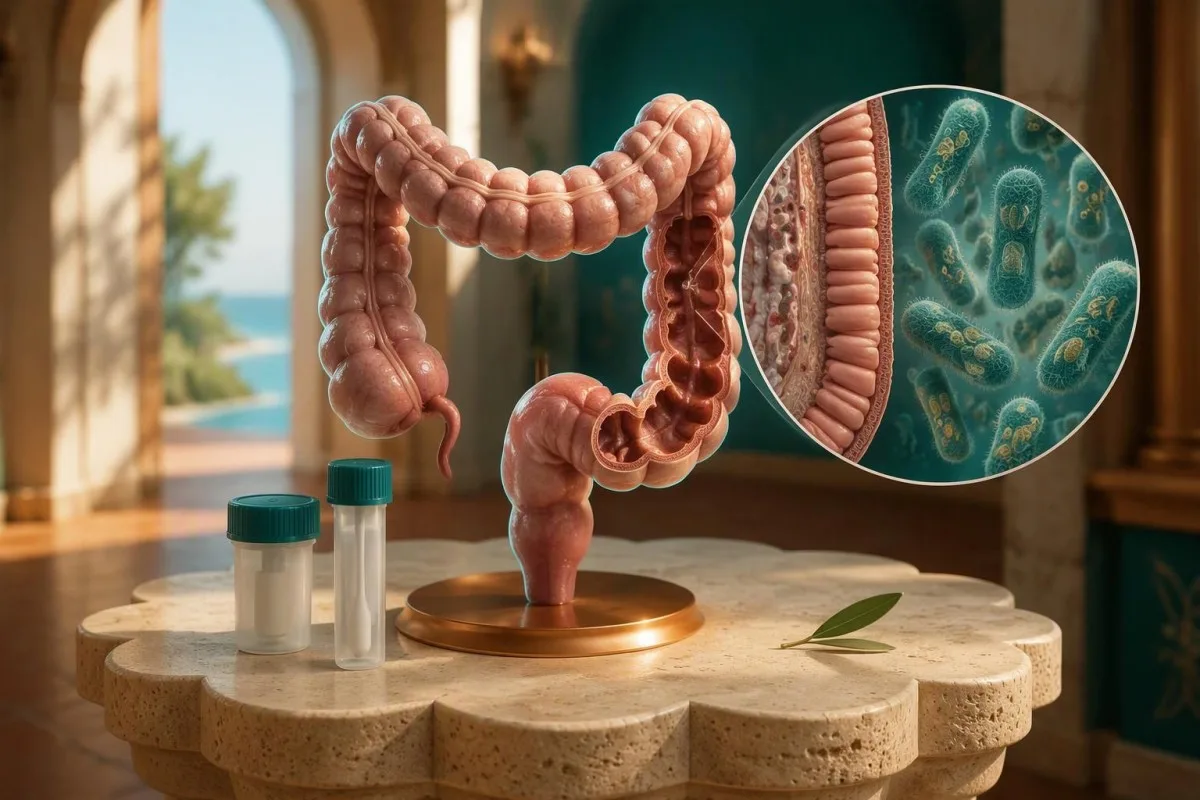
The screen detects the organism, not necessarily the cause of your diarrhea. Treatment depends on the complete testing pathway and what is happening clinically.


- ผลตรวจไม่สอดคล้องกัน mean GDH was detected but stool toxin was not; these 2 findings alone do not establish active C. difficile infection.
- Reflex PCR identifies toxin-producing genetic potential, not proof that toxin is causing symptoms right now.
- Diarrhea threshold is usually at least 3 new, unexplained unformed stools within 24 hours before testing is appropriate.
- Colonization without compatible symptoms generally needs no C. difficile antibiotic treatment, even when PCR is positive.
- Antibiotic exposure within the previous 3 months increases suspicion but is neither necessary nor sufficient for diagnosis.
- Severity flags include a white cell count around 15,000/µL, rising creatinine, dehydration, and worsening abdominal findings.
- อาการที่ควรรีบด่วน include severe abdominal pain or swelling, fainting, confusion, very little urine, or inability to keep fluids down.
- การตรวจซ้ำ is generally discouraged within 7 days during the same diarrheal episode; a test of cure is not recommended.
Does a GDH-positive, toxin-negative result need treatment?
A C diff GDH positive toxin negative result does not automatically need treatment. GDH suggests C. difficile is present, but a negative toxin assay does not establish active infection; reflex PCR and symptoms determine the next step. With no diarrhea, treatment is usually unnecessary; with at least 3 unexplained unformed stools in 24 hours, contact your clinician.
Treatment targets illness, not an isolated laboratory flag. The first distinction I make is between a person passing formed stool normally and someone developing repeated watery diarrhea after antibiotics; the same 2 laboratory results carry very different weight in those situations, especially when fever, dehydration, or abdominal tenderness accompanies the diarrhea.
A negative toxin result lowers concern but cannot exclude every genuine case. Toxin immunoassays are less sensitive than molecular tests, so a patient with 8 watery stools daily and deteriorating health needs clinical assessment even when the toxin box says negative; severe abdominal swelling with little stool output is a separate emergency exception.
Kantesti is an AI blood test analyzer that can help explain accompanying white cell and kidney results, but a stool assay requires its own diagnostic pathway. I am Dr. Thomas Klein, Chief Medical Officer at Kantesti LTD; our องค์กรและวัตถุประสงค์ทางคลินิก are described separately, and neither our AI nor 1 positive screen should replace a clinician’s assessment.
What do GDH antigen and toxin tests actually measure?
GDH antigen positive meaning: the stool contains a detectable enzyme associated with C. difficile, including strains that cannot produce disease-causing toxins. A toxin assay looks for toxin proteins instead. These 2 tests answer different questions, which is why a positive screen can coexist with a negative toxin result without either test being wrong.
GDH stands for glutamate dehydrogenase, not a toxin. Laboratories use it as a sensitive first-stage screen because many C. difficile strains produce this enzyme; the 2 clinically relevant toxins are usually called toxin A and toxin B, and their presence is more directly connected with intestinal injury than GDH antigen alone.
A negative toxin enzyme immunoassay means toxin was not detected above that assay’s threshold. It does not mean the stool contains absolutely zero toxin, and laboratories use different manufacturers, detection limits, and reporting algorithms; 1 lab may automatically add PCR, while another reports an indeterminate result and asks the treating clinician to interpret it.
A qualitative result is not a measurement of bacterial burden or severity. A report saying positive does not tell you whether there are 10 times more organisms than yesterday, and a darker assay line is not a validated severity score; our explanation of ผลเชิงคุณภาพเทียบกับผลเชิงปริมาณ helps separate detection from measurement.
Which diarrhea symptoms make C. diff testing meaningful?
At least 3 new, unexplained unformed stools in 24 hours is the usual adult testing threshold for suspected C. difficile infection. The 2017 IDSA/SHEA guideline, published in 2018, recommends targeting this symptomatic population rather than screening people indiscriminately, because testing the wrong patient increases false attribution of symptoms to colonization (McDonald et al., 2018).
Stool consistency matters as much as frequency. Bristol types 6 and 7 generally describe mushy or watery stool, while 3 formed bowel movements do not meet the usual diarrhea definition; the แผนภูมิความสม่ำเสมอของอุจจาระ can help you describe the sample accurately without trying to diagnose the cause from appearance alone.
Recent laxatives can make a positive C. difficile result misleading. Clinicians often review laxative use during the previous 48 hours before testing, but ongoing severe diarrhea, substantial illness, or another strong reason for suspicion can justify testing despite that exposure; stopping a laxative and watching symptoms is appropriate only when the treating team considers it safe.
Adult testing rules do not transfer directly to infants. Routine testing is generally discouraged under 12 months because asymptomatic carriage is common; between ages 1 and 2 years, other causes should usually be excluded first, and severe suspected ileus at any age requires hospital assessment rather than waiting to collect 3 loose stools.
C. diff colonization vs infection: what is the difference?
C. diff colonization vs infection is the distinction between carrying the organism and experiencing illness caused by its toxins. A person with positive GDH, negative toxin, and positive PCR may have either colonization or infection; the 3-result pattern cannot settle the diagnosis without compatible symptoms and consideration of other explanations.
Asymptomatic C. difficile carriage generally should not be treated. Antibiotics are not reliably useful for eliminating carriage and can further disrupt the intestinal microbiome, so finding the organism in a patient with 0 new loose stools is usually not a reason to prescribe treatment; uncommon presentations such as ileus require separate clinical judgment.
Colonization can coexist with diarrhea caused by something else. Consider a hypothetical 67-year-old taking polyethylene glycol after a hospital stay: if loose stools stop after the laxative is withdrawn and there is no fever or tenderness, positive PCR may identify a passenger rather than the cause; the sequence of events matters more than the highlighted laboratory flag.
Detecting a microbe does not always justify antibiotics. Kantesti’s educational explanations distinguish organism detection from a compatible clinical syndrome, a principle also relevant to bacteria without urinary symptoms; however, the 2 conditions have different treatment exceptions, so urinary guidance should never be applied directly to a C. difficile report.
How do recent antibiotics change the interpretation?
Recent antibiotics increase the likelihood of C. difficile infection, particularly during treatment and in the following 3 months, but they do not prove that a discordant result represents disease. Antibiotics reduce competing intestinal bacteria, allowing C. difficile to expand; diarrhea can also arise from antibiotic effects without toxin-mediated C. difficile illness.
Clindamycin, cephalosporins, and fluoroquinolones are familiar higher-risk exposures. Almost any antibiotic can contribute, however, and 2 details often matter more than the drug name alone: how recently the course finished and whether the patient received several agents or a prolonged course; community-acquired disease can also occur without recognized antibiotic exposure.
Hospitalization, older age, and immune suppression strengthen suspicion but are not diagnostic tests. Age over 65 years is also relevant to recurrence risk once infection is established, whereas an otherwise well younger adult with 1 medication-related loose stool should not be labeled infected simply because a screen was ordered after a hospital visit.
A commercial microbiome profile cannot resolve this treatment decision. Broad bacterial diversity scores do not substitute for the established GDH, toxin, and NAAT pathway, even when the report contains dozens of organisms; our discussion of microbiome testing limits explains why a detailed-looking report can still answer the wrong clinical question.
How does reflex PCR resolve C. diff discordant results?
Reflex PCR checks whether toxin-producing genetic material is present after a GDH-positive, toxin-negative screen. A positive PCR supports the presence of a potentially toxigenic strain but does not prove active toxin-mediated illness; a negative PCR usually makes toxigenic C. difficile less likely, leaving another explanation for diarrhea more probable.
PCR-positive, toxin-negative results require clinical interpretation rather than automatic antibiotics. In Polage and colleagues’ 2015 prospective study of 1,416 hospitalized adults, CDI-related complications occurred in 0% of toxin-negative/PCR-positive patients versus 7.6% of toxin-positive/PCR-positive patients; this supports concern about overdiagnosis, but an observational cohort cannot justify withholding treatment from every symptomatic patient (Polage et al., 2015).
PCR-negative discordance can reflect a non-toxigenic strain or a misleading GDH screen. Check whether the laboratory’s final comment says toxigenic C. difficile detected, not detected, or indeterminate; these 3 phrases are more useful than reading only the first positive line, and report source checks help prevent that common interpretation error.
Sampling and handling can influence toxin detection. Ask about delayed transport, refrigeration requirements, or treatment started before sample collection if the clinical picture and result disagree; there is no universally accepted PCR cycle-threshold number that safely separates colonization from infection, and repeating 1 toxin assay simply to obtain a preferred answer is poor diagnostic practice.
Can white cells and creatinine identify a severe case?
White cell count and creatinine help assess severity, not establish the stool diagnosis. The 2017 IDSA/SHEA framework uses a white cell count of at least 15,000/µL or creatinine above 1.5 mg/dL as adult severe-CDI criteria; these thresholds matter only alongside a clinical diagnosis and do not turn colonization into infection (McDonald et al., 2018).
Creatinine above 1.5 mg/dL is approximately above 133 µmol/L. A patient whose usual creatinine is 0.7 mg/dL and now measures 1.4 mg/dL may still have a clinically significant acute rise despite not crossing that absolute cutoff; kidney results after dehydration explain why the baseline and hydration history belong in the assessment.
Normal inflammatory blood results do not exclude important intestinal illness. A person receiving chemotherapy may be unable to mount a white cell count of 15,000/µL, and CRP can rise from many unrelated causes; our guide to discordant infection blood markers explains why fever, examination findings, and trajectory can outweigh a reassuring-looking panel.
Kantesti is an AI blood test interpretation platform that can explain a creatinine of 1.5 mg/dL alongside previous measurements, without deciding whether C. difficile caused the diarrhea. Clinicians may also review urea and electrolytes for fluid loss; the urea-to-creatinine interpretation guide describes why these supportive results are not substitutes for stool testing.
When will a clinician treat despite a negative toxin assay?
Treatment may be appropriate despite a negative toxin assay when diarrhea is strongly compatible with CDI, reflex PCR detects a toxigenic strain, and competing causes do not explain the illness. In fulminant disease or when confirmation will be substantially delayed, sometimes beyond 48 hours, clinicians may start treatment before the full laboratory pathway is complete.
A positive PCR is a reason to assess, not an automatic prescription. In a hypothetical patient with 7 watery stools daily after clindamycin, abdominal tenderness, rising creatinine, and no laxative exposure, the balance may favor treatment; in another patient whose diarrhea stops after magnesium is discontinued, exactly the same PCR result may favor observation and reassessment.
Adult initial non-fulminant CDI treatment commonly uses fidaxomicin or oral vancomycin. The 2021 IDSA/SHEA update conditionally prefers fidaxomicin, typically 200 mg twice daily for 10 days, while oral vancomycin 125 mg four times daily for 10 days remains an acceptable alternative; availability, recurrence risk, and local guidance affect prescribing (Johnson et al., 2021).
Do not self-start leftover antibiotics or stop an essential prescription without advice. Oral treatment reaches the intestinal site differently from intravenous vancomycin, which is not a substitute for standard oral CDI therapy; patients using warfarin should also discuss การเปลี่ยนแปลง INR ที่เกี่ยวข้องกับยาปฏิชีวนะ because illness and medication changes can alter anticoagulation during a 10-day treatment course.
What can you safely do while waiting for clarification?
Maintain hydration, track symptoms, and contact the ordering clinician while awaiting reflex PCR or a treatment decision. Record the number of unformed stools over 24 hours, temperature, fluid intake, urine output, and medication exposures; do not interpret feeling slightly better after 1 drink as proof that a potentially serious diarrheal illness has resolved.
An oral rehydration solution replaces both water and salts lost in diarrhea. For an adult without fluid restriction, roughly 200–250 mL after a loose stool can be a practical starting point, adjusted to thirst and losses; follow packet dilution instructions exactly, and obtain individual advice if heart failure, advanced kidney disease, or persistent vomiting limits drinking.
Electrolyte abnormalities can persist even when thirst improves. Ongoing diarrhea may lower potassium or magnesium, and weakness, palpitations, or dizziness deserve assessment rather than simply increasing plain water; the electrolyte warning-pattern guide explains why 2 drinks that look similar can differ substantially in their ability to replace intestinal salt losses.
Avoid starting loperamide or similar medicines without discussing suspected CDI. A clinician may use an antimotility medicine selectively after appropriate treatment begins, but slowing the bowel during untreated severe colitis can be unsafe; review magnesium supplements and laxatives as possible contributors, while remembering that magnesium loss from diarrhea can also occur during several days of illness.
Which warning signs need urgent or emergency care?
Severe abdominal pain or swelling, fainting, confusion, very little urine, or inability to keep fluids down requires urgent assessment. Seek emergency care for collapse, rapidly worsening abdominal distension, or signs of shock; a systolic blood pressure below 90 mmHg is concerning, but you should not wait for a home measurement before seeking help.
Suddenly having fewer stools is not always improvement. In severe CDI, ileus can prevent intestinal contents from moving, so a patient who had 10 watery stools yesterday and now has a swollen abdomen with minimal output may be deteriorating; that combination needs emergency evaluation, especially with vomiting, fever, marked tenderness, or a generally unwell appearance.
Fever and bleeding need interpretation beyond the C. difficile result. A temperature of 38.5°C with persistent diarrhea warrants prompt advice, particularly in older or immunocompromised patients; visible blood or black, tarry stool may suggest another urgent problem, and our stool bleeding warning signs describe why stool color cannot confirm CDI.
Normal blood tests should not override a concerning abdominal examination. A patient with worsening focal pain or severe tenderness can require imaging and hospital review even with a white cell count below 15,000/µL; the same limitation appears in normal tests and appendicitis, where a reassuring number does not reliably exclude an important abdominal diagnosis.
Are you contagious if GDH is positive but toxin is negative?
A toxin-negative result does not guarantee that C. difficile cannot spread. Colonized people can shed spores, and hygiene precautions are especially sensible while unexplained diarrhea continues; wash hands with soap and water for at least 20 seconds after using the toilet and before handling food, because alcohol hand gel alone does not reliably remove or kill spores.
Household contacts generally do not need screening or preventive antibiotics. A partner with 0 symptoms should not request PCR simply because someone else has a discordant result, and asymptomatic family members should not share treatment; concentrate instead on bathroom hygiene, separate personal towels during diarrhea, and careful handwashing after handling laundry or assisting with toileting.
Use a suitable sporicidal cleaner according to its instructions. Product-specific dilution and contact time matter more than applying extra cleaner, and bleach must never be mixed with other cleaning chemicals; healthcare or food-handling work may require staying away for at least 48 hours after diarrhea stops, but local occupational policies can impose additional requirements.
Infection-control decisions and antibiotic decisions are not identical. A hospital may maintain contact precautions while assessing a toxin-negative/PCR-positive patient even when antibiotics are withheld; if 2 clinicians are coordinating care, Kantesti’s educational workflow recommends sharing the complete report and symptom timeline, while secure result-sharing guidance explains how to avoid forwarding only a cropped positive line.
Should you repeat testing or request a test of cure?
Do not routinely repeat C. difficile testing within 7 days of the same diarrheal episode, and do not request a test of cure after symptoms resolve. Molecular tests may remain positive after successful treatment because organism detection is not the same as ongoing illness; a new episode of compatible diarrhea is a different clinical question (McDonald et al., 2018).
Recurrence is often considered when diarrhea returns within 2–8 weeks after treatment. Tell the clinician when the first course finished, whether stools normalized in between, and whether another antibiotic was started; renewed symptoms need reassessment, but leftover PCR positivity should not automatically trigger another course without considering the new clinical picture.
Persistent diarrhea can have a different cause after CDI. Post-infectious bowel disturbance, medication effects, inflammatory bowel disease, and other intestinal infections can mimic recurrence, particularly when a patient has 3 or more loose stools daily but repeated assessment does not support toxin-mediated illness; new weight loss, nocturnal symptoms, or bleeding should widen the investigation rather than narrow it.
Fecal calprotectin cannot distinguish C. difficile colonization from active CDI on its own. It measures intestinal inflammatory activity rather than the organism or its toxins, so 1 elevated result may reflect infection, inflammatory bowel disease, or another process; our แนวทางการติดตามผล calprotectin ก้ำกึ่ง explains why follow-up timing depends on symptoms and the suspected cause.
What should you bring to your follow-up appointment?
Bring the complete stool report, a 24-hour stool count, and a medication timeline covering the previous 3 months. Include the GDH, toxin, and PCR lines together, plus any laboratory interpretation comment; a screenshot of only the positive screen hides the information most likely to change a treatment decision.
Ask 3 specific questions before leaving the appointment: Was reflex PCR performed, is my diarrhea clinically compatible with CDI, and what should trigger reassessment if we do not treat? I prefer a clear safety-net plan over a vague instruction to watch symptoms; a patient should know whom to contact that day if stool frequency, drinking ability, or abdominal pain worsens.
Kantesti is an AI lab test interpretation service that can organize accompanying CBC and metabolic results, not independently prescribe treatment for a stool finding. Before relying on an uploaded report, verify 2 easily confused details—units and negative versus positive wording—and read our วิธีการแปลผลด้วย AI for the distinction between educational explanation and clinical decision-making.
Clinical standards require preserving uncertainty when tests disagree. As of October 6, 2026, this article draws on the 2017 diagnostic framework and 2021 focused treatment update rather than claiming a new universal PCR rule; as Dr. Thomas Klein, Chief Medical Officer at Kantesti LTD, I recommend reviewing our แนวทางการยืนยันความถูกต้องทางคลินิก separately from the physician assessment needed for an individual diarrheal illness.
Research publications and the evidence behind this guidance
Clinical guidelines and peer-reviewed CDI studies support the treatment guidance here; the 2 Figshare resources below provide supplementary education, not proof that discordant stool results need antibiotics. Kantesti’s educational publications should be read with those limits in mind, especially because a blood-marker guide cannot validate a diagnosis made from stool testing.
The 2018 McDonald guideline explains patient selection and multistep testing. The 2021 Johnson focused update addresses adult treatment choices, including fidaxomicin, while Polage’s 2015 cohort highlights the risk of overdiagnosing toxin-negative molecular positives; these sources answer different questions, so a treatment recommendation should not be inferred from a screening study alone.
The digestive-symptom resource broadens the differential diagnosis rather than confirming CDI. Diarrhea following a change in fasting or eating pattern may have several explanations, and 1 GDH-positive result cannot establish which is responsible; the associated digestive symptom education guide is background reading, while the hematology publication is only peripheral to this stool-test question.
Publication links are not endorsements of a treatment decision. The 2 DOI entries are supplied as supplementary resources with APA-style citations and clearly labeled research-discovery links; named reviewer status should be verified separately through our คณะกรรมการที่ปรึกษาทางการแพทย์, and this page should not be interpreted as documenting an individual patient review or independent validation of either Figshare resource.
คำถามที่พบบ่อย
Does GDH positive and toxin negative mean I have C. diff?
GDH positive and toxin negative means C. difficile-associated antigen was detected, but toxin was not detected by that assay. It does not establish active C. difficile infection. Clinicians usually consider reflex PCR and whether you have at least 3 new, unexplained unformed stools in 24 hours. With no compatible symptoms, the result often reflects colonization or a non-toxigenic strain rather than an illness requiring treatment.
Do I need antibiotics if C. diff PCR is positive but toxin is negative?
A positive C. difficile PCR with a negative toxin assay does not automatically require antibiotics. PCR detects genetic potential for toxin production, while treatment depends on compatible symptoms, severity, and other possible causes of diarrhea. At least 3 unexplained unformed stools in 24 hours generally warrants clinical assessment. Severe abdominal pain, swelling, dehydration, or rapid deterioration requires urgent evaluation even when toxin testing is negative.
Can a negative C. diff toxin test miss an infection?
A negative C. difficile toxin immunoassay can miss some genuine infections because toxin may be below the assay’s detection threshold or affected by sample handling. Reflex PCR can help identify a potentially toxigenic strain, but it still needs clinical interpretation. A patient with 6 or more watery stools daily, recent antibiotics, and worsening abdominal symptoms should not assume the negative toxin result rules out disease. Contact the ordering clinician rather than repeatedly submitting samples without a plan.
Is C. diff colonization treated?
Asymptomatic C. difficile colonization is generally not treated with C. difficile antibiotics. A person with 0 new loose stools and no compatible illness usually gains no benefit from treating a positive GDH or PCR result. Antibiotics can further disrupt the microbiome and do not reliably eliminate carriage. Severe abdominal distension with reduced stool output is an exception that needs urgent assessment because ileus can occur without frequent diarrhea.
Should I repeat my C. diff test after treatment?
A C. difficile test of cure is not recommended after symptoms resolve. PCR may remain positive despite successful treatment, and routine repeat testing within 7 days of the same diarrheal episode is generally discouraged. New compatible diarrhea after improvement should be discussed with a clinician, particularly within 2–8 weeks after treatment. Retesting should answer a new clinical question rather than simply prove that the organism has disappeared.
Am I contagious with GDH positive and toxin negative results?
A GDH-positive, toxin-negative result does not guarantee that C. difficile spores cannot spread. Wash hands with soap and water for at least 20 seconds after using the toilet and before preparing food, particularly while diarrhea continues. Alcohol hand sanitizer alone does not reliably remove or kill C. difficile spores. Household members without symptoms generally do not need testing or preventive antibiotics, and healthcare isolation decisions follow local infection-control policies.
รับการวิเคราะห์ผลตรวจเลือดด้วย AI วันนี้
เข้าร่วมผู้ใช้งานมากกว่า 2 ล้านคนทั่วโลกที่ไว้วางใจ Kantesti สำหรับการวิเคราะห์ผลตรวจทางห้องแล็บแบบทันทีและแม่นยำ อัปโหลดผลตรวจเลือดของคุณ แล้วรับการอ่านผลตรวจเลือดอย่างครอบคลุมของไบโอมาร์กเกอร์ 15,000+ ภายในไม่กี่วินาที.
📚 งานวิจัยที่อ้างอิง
Klein, T., Mitchell, S., & Weber, H. (2026). คู่มือกรุ๊ปเลือดบีลบ การตรวจเลือด LDH และการนับเม็ดเลือดแดงตัวอ่อน.
Klein, T., Mitchell, S., & Weber, H. (2026). อาการท้องเสียหลังอดอาหาร, จุดดำในอุจจาระ และคู่มือระบบทางเดินอาหาร ปี 2026.
📖 อ้างอิงทางการแพทย์ภายนอก
⚕️ ข้อสงวนสิทธิ์ทางการแพทย์
บทความนี้จัดทำเพื่อวัตถุประสงค์ด้านการศึกษาเท่านั้น และไม่ถือเป็นคำแนะนำทางการแพทย์ โปรดปรึกษาผู้ให้บริการด้านสุขภาพที่มีคุณสมบัติเหมาะสมเสมอสำหรับการตัดสินใจด้านการวินิจฉัยและการรักษา.
สัญญาณความน่าเชื่อถือ E-E-A-T
ประสบการณ์
การทบทวนเชิงคลินิกโดยแพทย์ที่นำโดยกระบวนการตีความผลตรวจในห้องแล็บ.
ความเชี่ยวชาญ
โฟกัสด้านเวชศาสตร์ห้องปฏิบัติการเกี่ยวกับพฤติกรรมของไบโอมาร์กเกอร์ในบริบททางคลินิก.
อำนาจ
เขียนโดย ดร. โธมัส ไคลน์ (Dr. Thomas Klein) พร้อมทบทวนโดย ดร. ซาราห์ มิตเชลล์ (Dr. Sarah Mitchell) และ ศ.ดร. ฮันส์ เวเบอร์ (Prof. Dr. Hans Weber).
ความน่าเชื่อถือ
การตีความที่อิงหลักฐาน พร้อมเส้นทางการติดตามที่ชัดเจนเพื่อลดความตื่นตระหนก.