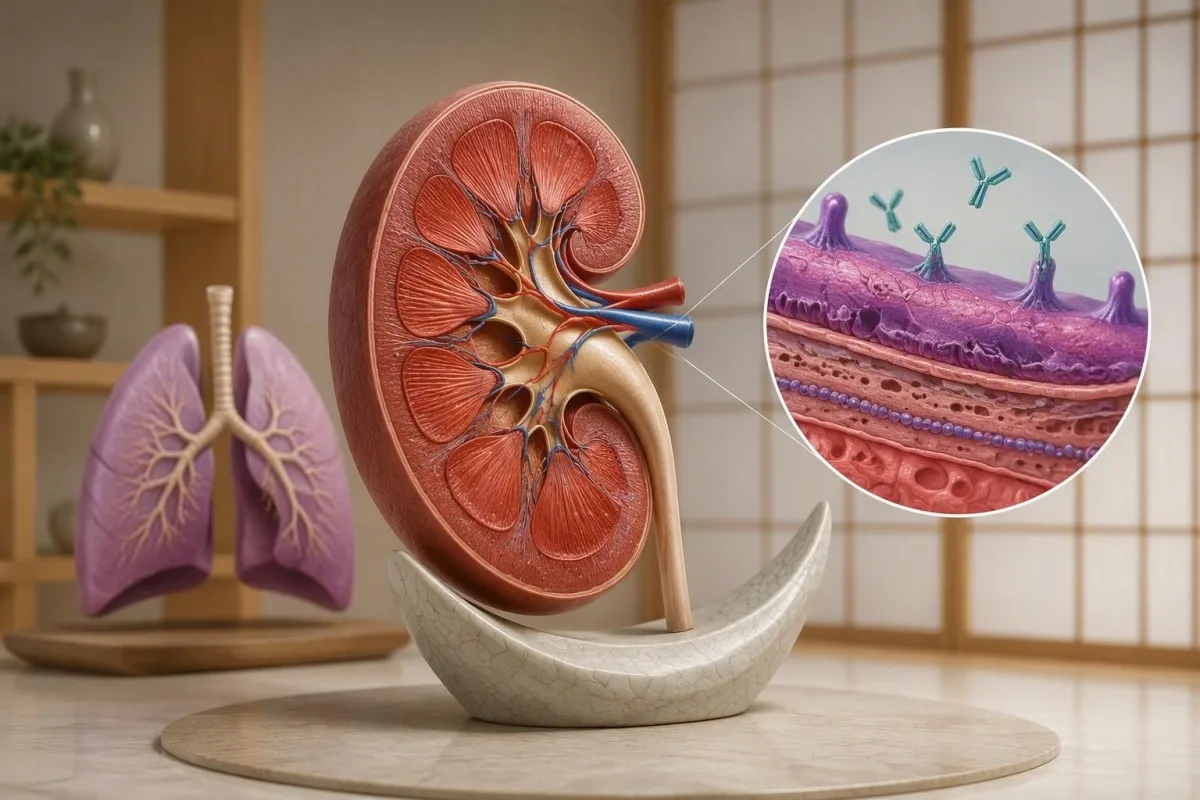
Matokeo haya ya kingamwili yanaweza kuashiria shida ya figo inayohitaji muda maalum-kupumua hata wakati kunahisi kawaida. Utambuzi unategemea njia ya maabara, matokeo ya mkojo, utendaji wa figo, na wakati mwingine uchunguzi wa tishu.


- Kingamwili chanya za anti-GBM huunga mkono ugonjwa unaowezekana wa anti-GBM lakini haiwezi kuthibitisha utambuzi kutoka kwa matokeo 1 ya maabara pekee.
- Ugonjwa wa figo pekee unawezekana: ushiriki wa mapafu hutokea katika takriban 40–60% ya kesi za kawaida zilizoripotiwa, sio kila mtu.
- Jeraha la figo la ghafla unajumuisha ongezeko la creatinine la angalau 0.3 mg/dL, au 26.5 µmol/L, ndani ya saa 48; kizingiti hiki sio maalum kwa ugonjwa wa anti-GBM.
- Dalili za dharura jumuisha kukohoa damu, kupumua kwa shida, au kupungua kwa kiasi kikubwa cha mkojo; tafuta huduma ya dharura badala ya kusubiri kipimo cha kingamwili kurudiwa.
- Microscopy ya mkojo inaweza kutambua maganda ya chembechembe nyekundu, ambayo huunga mkono kutokwa na damu kutoka kwa vichujio vya figo badala ya maambukizi ya kawaida ya kibofu cha mkojo.
- Vizingiti vya kingamwili hutegemea vipimo: matokeo ya 21 U/mL yana maana tu kulingana na kiwango cha marejeleo cha maabara hiyo.
- Magonjwa ya ziada-chanya inamaanisha kwamba kingamwili za anti-GBM na ANCA hutokea pamoja; inaweza kubadilisha ufuatiliaji wa kurudia na matibabu ya muda mrefu.
- Muda wa matibabu ni muhimu: wataalamu wanaweza kuanza matibabu kabla ya uthibitisho wakati picha ya kimatibabu inapendekeza kwa nguvu ugonjwa unaoendelea kwa kasi.
- Wakati wa kupandikiza kwa ujumla huhitaji kingamwili za anti-GBM kubaki hazionekani kwa angalau miezi 6, kulingana na KDIGO 2021.
Je! matokeo mazuri ya kingamwili za anti-GBM huashiria nini hasa?
Kingamwili chanya za anti-GBM inaweza kuashiria ugonjwa wa kingamwili dhidi ya utando mkuu wa figo, hali ya kinga mwilini ambayo inaweza kuharibu kwa kasi vichungi vya figo na wakati mwingine mapafu. Hazithibitishi peke yao, ugonjwa wa Goodpasture. Wasiliana na daktari anayeagiza leo; kukohoa damu, ugumu mpya wa kupumua, au mkojo kupungua sana kunahitaji tathmini ya dharura.
Anti-GBM inaelezea lengo la kingamwili, sio utambuzi kamili: utando mkuu wa figo ni sehemu ya kizuizi cha uchujaji cha figo. Ugonjwa mwingi wa kawaida unahusisha kingamwili dhidi ya sehemu isiyo ya collagen ya mnyororo wa alpha-3 wa kolajeni ya aina IV, muundo unaopatikana pia katika mifuko ya hewa ya mapafu; mwitikio huo huo wa kinga unaweza kuathiri viungo 2 vyenye dalili tofauti sana.
Mimi ni Thomas Klein, Afisa Mkuu wa Matibabu katika Kantesti; swali langu la kwanza ni kama matokeo haya yanaambatana na ushahidi wa uharibifu wa viungo, badala ya jinsi bendera ya maabara inavyoonekana ya kutisha. Matokeo moja ya wastani yenye kiwango kisicho imara cha creatinine ni hali tofauti na uthibitisho pamoja na ongezeko la creatinine zaidi ya saa 48, ingawa zote zinahitaji ufuatiliaji unaoongozwa na daktari badala ya uhakikisho wa kawaida.
Kantesti ni Mchambuzi wa mtihani wa damu wa AI ambayo inaweza kusaidia kuelezea matokeo ya anti-GBM pamoja na creatinine, elektroliti, na vipindi vya marejeleo vya maabara, lakini haiwezi kuthibitisha ugonjwa wa figo unaosababishwa na kingamwili. shirika na kusudi letu eleza jukumu hilo la elimu; mwongozo wetu wa matokeo chanya ya antibody unaeleza kwa nini alama moja ya kinga yenye thibitisho sio sawa na utambuzi.
Je! ugonjwa wa anti-GBM ni sawa na ugonjwa wa Goodpasture?
Ugonjwa wa Anti-GBM unajumuisha ugonjwa wa figo pekee, ugonjwa wa mapafu pekee, na ugonjwa unaoathiri viungo vyote viwili. Ugonjwa wa Goodpasture mara nyingi hurejelea mchanganyiko wa glomerulonephritis na kutokwa na damu kwa mapafu, ingawa wataalamu hutumia jina hilo bila msimamo. Takriban 40–60% ya visa vya kawaida vya anti-GBM vina ushiriki wa mapafu, kwa hivyo istilahi haipaswi kamwe kuamua kama tathmini ya figo ni ya haraka.
Jina Ugonjwa wa Goodpasture unaweza kuelezea uwasilishaji wa mapafu-figo badala ya kuthibitisha sababu yake. Vasculitis inayohusishwa na ANCA na magonjwa mengine pia inaweza kusababisha kuvimba kwa figo na kutokwa na damu kwa alveoli, kwa hivyo utambuzi wa ugonjwa wa Goodpasture unahitaji ufafanuzi wa kisababishi; uhakiki wa McAdoo na Pusey wa 2017 unatofautisha ugonjwa wa kimatibabu kutoka kwa ugonjwa wa anti-GBM unaosababishwa na kingamwili.
Ugonjwa wa Anti-GBM ni adimu, na tukio linalokadiriwa kuwa karibu visa 1 kwa kila watu milioni kila mwaka katika idadi ya watu wanaotajwa mara kwa mara, ingawa makadirio hutofautiana kulingana na eneo na ugunduzi wa visa. Uadimu huo ni muhimu wakati wa kutafsiri matokeo ya uchunguzi wa kushtukiza: hata kipimo kizuri kinaweza kutoa matokeo chanya ya udanganyifu wakati kinatumiwa kwa watu wenye ushahidi mdogo wa kimatibabu wa ugonjwa huo.
eGFR ya chini wakati wa ugonjwa huu inaweza kuakisi jeraha la figo la ghafla, sio hatua sugu iliyoanzishwa. Ugonjwa sugu wa figo kwa ujumla huhitaji uharibifu unaodumu kwa angalau miezi 3; yetu kidney staging guide explains that distinction, but a rapidly changing result needs an acute assessment rather than being filed under a long-term CKD label.
Kwa nini uharibifu wa figo unaweza kutokea bila dalili za mapafu?
Kidney-only anti-GBM disease occurs because antibody access and tissue vulnerability differ between kidney filters and lung air sacs. A normal breathing pattern does not protect the kidneys or exclude this diagnosis. Since only approximately 40–60% of classic cases involve the lungs, waiting for a cough can delay treatment.
The glomerular filtration barrier is continuously exposed to circulating plasma under filtration pressure, whereas the lung's alveolar–capillary barrier has different structural protections. Antibody binding also depends on whether relevant collagen epitopes are accessible; this is not simply a situation where antibodies circulate to 1 organ but somehow fail to reach the other.
Smoking and hydrocarbon exposure are associated with pulmonary involvement in anti-GBM disease, and respiratory illness may influence the lung barrier's susceptibility. Those associations do not allow a precise personal risk calculation: a nonsmoker can develop lung involvement, while a smoker may have kidney-only disease, so 0 respiratory symptoms should never be used as a rule-out test.
Consider an illustrative patient with creatinine increasing from 0.9 to 1.8 mg/dL over several days, microscopic urine blood, and no cough at all. That combination needs urgent nephrology assessment because filtration has changed substantially; our dalili za onyo za eGFR ya chini also explain why significant kidney impairment can initially feel surprisingly quiet.
Je! nambari ya kipimo cha kingamwili cha anti-GBM inapaswa kusomwa vipi?
The anti-GBM antibody test must be interpreted using the reporting laboratory's method, units, and cutoff. There is no universal positive concentration that can be transferred between every assay. For example, 21 U/mL is only slightly above a cutoff of 20 U/mL—but that example is not a recommended diagnostic threshold.
Immunoassays may use different antigen preparations and measurement systems, with results reported as U/mL, IU/mL, an index, or a qualitative positive. A result of 30 on an index assay cannot be meaningfully compared with 30 U/mL from another laboratory; the distinction between vipimo vya ubora na kiasi is particularly useful here.
Low-level positivity deserves more scrutiny when urine findings and kidney function are normal, but a high concentration still cannot measure irreversible damage by itself. I would examine 3 details before interpreting a trend: whether the same assay was used, whether treatment had begun, and whether the laboratory describes the change as analytically meaningful.
Kantesti AI cannot repair an incorrect transcription of a laboratory result, so verify the value, units, reference interval, and collection date against the original report. Our orodha ya ukaguzi wa uchapishaji wa PDF covers those checks; a missing decimal can turn 2.1 into 21 and change the apparent significance of an antibody measurement.
Je! matokeo mazuri ya anti-GBM yanaweza kuwa ya uongo au yanayodanganya?
A false-positive or clinically misleading anti-GBM result is possible, particularly when positivity is weak and the clinical picture does not fit. A clinician may request confirmation using another method. However, 1 repeat antibody test must not delay assessment when creatinine is rising, urine contains blood, or respiratory symptoms suggest lung involvement.
Pretest probability changes what a positive result means: a person tested for rapidly progressive kidney disease has a different starting likelihood from someone given a broad autoimmune screen without symptoms. Analytical interference, nonspecific reactivity, and differences in antigen recognition can complicate interpretation; repeating the same assay 2 times may reproduce the same problem rather than resolve it.
A reportedly normal urine test should be examined carefully, because a dipstick is not the same as microscopy and a negative result may reflect timing or specimen limitations. Clinicians often pair urine dipstick interpretation with sediment examination and protein measurement; 1 clean-looking urine sample cannot describe everything happening inside the kidney.
Creatinine, urine microscopy, and a urine albumin-to-creatinine or protein-to-creatinine ratio provide complementary information during confirmation. An ACR of at least 3 mg/mmol, approximately 30 mg/g, is abnormal but does not identify anti-GBM disease; our urine creatinine ratio guide explains why dilution-adjusted measurements are more useful than urine concentration alone.
Ni matokeo gani ya mkojo yanayoashiria uharibifu wa vichujio vya figo?
Hematuria, proteinuria, dysmorphic red cells, and red-cell casts can support glomerular injury when anti-GBM antibodies are positive. Red-cell casts are especially concerning because they form within kidney tubules. An isolated finding of 3 or more red cells per high-power field warrants clinical interpretation, but does not establish the cause.
Hematuria ya microscopic may appear before urine visibly changes color, so clear urine is not evidence that the kidney filters are unaffected. Conversely, a dipstick positive for blood can reflect hemoglobin or myoglobin without intact red cells; comparing the dipstick with 1 microscopy result helps distinguish these possibilities, particularly after intense exercise or muscle injury.
Protein loss in anti-GBM disease does not have to reach the nephrotic range, conventionally around 3.5 g per 24 hours in adults, to be clinically serious. A patient can have rapidly progressive kidney injury with a much smaller protein measurement; focusing only on whether urine protein is dramatically elevated can miss the more urgent creatinine trajectory.
Sample quality matters because delayed examination can make cellular elements and casts harder to identify, and menstrual contamination can complicate hematuria interpretation. Our Mwongozo wa uchafu wa mkojo explains the principal patterns; if the first specimen is inconclusive, clinicians may request a fresh sample rather than assume 0 reported casts means no glomerular disease.
Ni mabadiliko gani ya utendaji wa figo yanayofanya matokeo kuwa ya haraka?
A rising creatinine level makes positive anti-GBM antibodies more urgent, especially alongside urine blood or protein. Standard acute kidney injury criteria include a rise of at least 0.3 mg/dL, or 26.5 µmol/L, within 48 hours, or at least 1.5 times baseline within 7 days; these criteria do not identify the underlying cause.
An apparently normal creatinine can still represent acute kidney injury if it has risen substantially from a low baseline. An increase from 0.6 to 1.0 mg/dL over 48 hours meets the absolute rise criterion even if 1.0 is inside the laboratory's adult reference interval; the comparison with baseline is therefore more informative than the flag alone.
Estimated GFR equations are less reliable during rapidly changing kidney function because they assume a relatively steady creatinine concentration. Our Ulinganifu wa BUN na creatinine explains additional influences such as dehydration and protein intake, but those alternatives do not safely explain away a 2-fold creatinine increase accompanied by positive anti-GBM antibodies and glomerular urine findings.
Kantesti, ambayo jukwaa la tafsiri ya vipimo vya damu la AI, can organize dated laboratory results so a creatinine change over 48 hours is easier to recognize; treatment decisions still require a clinician. Urine output below 0.5 mL/kg/hour for 6 hours also meets a standard AKI criterion, although patients should seek help for markedly reduced urine without attempting a precise home calculation.
Ni dalili zipi zinazohitaji huduma ya dharura badala ya rufaa ya kawaida?
Coughing up blood, new breathlessness, low oxygen, or markedly reduced urine output require emergency assessment when anti-GBM disease is possible. New oxygen saturation at or below 92% at sea level is concerning, but a normal home reading does not exclude lung bleeding. Do not wait for the antibody result to be repeated.
Alveolar hemorrhage can occur without obvious coughing up blood because blood remains within the air sacs rather than reaching the mouth. New breathlessness, an unexplained hemoglobin fall, and new lung imaging abnormalities can therefore be more informative than 0 visible blood; our shortness of breath testing guide explains why respiratory assessment requires more than a single laboratory marker.
Severe kidney injury can produce dangerous potassium accumulation, fluid overload, and acid–base disturbance before an antibody diagnosis is finalized. Potassium at or above 6.5 mmol/L generally requires emergency management; lower levels may also be urgent with AKI or ECG changes, as discussed in our potassium escalation guide.
Chest symptoms, confusion, fainting, or an abrupt fall in urine output should be described clearly to emergency services, including the known positive anti-GBM result. Bring the report and any creatinine measurements from the previous 7 days if readily available, but do not delay departure to gather paperwork; the clinical team can investigate and stabilize complications at the same time.
Wataalam huthibitishaje utambuzi wa ugonjwa wa anti-GBM?
Anti-GBM disease diagnosis combines serology with evidence of kidney or lung injury, and kidney biopsy often provides decisive information when safe and appropriate. Typical findings include crescentic glomerulonephritis and linear IgG staining along the glomerular basement membrane. These are 2 different observations: tissue injury and the pattern of antibody deposition.
Kidney biopsy can help establish the mechanism of injury and estimate how much potentially recoverable tissue remains, but no single microscopic feature should be read without context. Linear staining can occasionally occur in other settings, and atypical anti-GBM disease may differ from the classic pattern; specialists interpret light microscopy, immunofluorescence, and clinical findings together rather than treating 1 image as definitive.
The KDIGO 2021 glomerular diseases guideline recommends starting treatment without delay when anti-GBM disease is strongly suspected, even before confirmation. That does not mean every isolated positive result needs immediate immunosuppression: a patient with rapidly worsening kidney function has a different risk balance from someone with stable creatinine and an equivocal antibody on 2 separate assays.
The broader assessment usually includes ANCA, a full blood count, electrolytes, urine studies, and investigations for alternative immune-mediated kidney disease. ANA, anti-dsDNA, and complement may be useful when lupus is a possibility; our mwongozo wa tafsiri ya anti-dsDNA explains why a second positive antibody can suggest an alternative or additional process rather than simply confirming the first.
Nini hubadilika ikiwa ANCA pia ina matokeo mazuri?
Magonjwa ya ziada-chanya means a patient has both anti-GBM antibodies and ANCA, usually assessed through MPO-ANCA and PR3-ANCA testing. The acute presentation may resemble anti-GBM disease, while later relapse risk can resemble ANCA-associated vasculitis. Those 2 antibody systems therefore affect both immediate treatment and the longer-term follow-up plan.
McAdoo and colleagues' 2017 Kidney International cohort compared 37 double-positive patients with isolated anti-GBM disease and ANCA-associated vasculitis groups. The double-positive group showed features of both conditions, including clinically relevant later relapses; this is why disappearance of the anti-GBM antibody does not automatically justify stopping every form of immune monitoring or maintenance treatment.
An MPO test is not always an MPO-ANCA test: some laboratories offer myeloperoxidase concentration assays for other purposes, which do not answer the same autoimmune question. Confirm that the report identifies antibodies against MPO or PR3; there are 2 major antigen-specific ANCA targets, and a generic enzyme measurement should not be used to classify double-positive disease.
Complement levels can help explore competing diagnoses, but normal C3 and C4 do not exclude anti-GBM disease or ANCA-associated vasculitis. Our low complement interpretation guide explains how reduced complement may point toward another immune process; these 2 results refine the differential diagnosis rather than functioning as a safety check that rules out kidney injury.
Ugonjwa wa anti-GBM hutibiwaje, na figo zinaweza kupona?
Classic anti-GBM disease is usually treated with plasma exchange, glucocorticoids, and cyclophosphamide, although specialists adapt treatment to presentation and recovery potential. KDIGO 2021 describes cyclophosphamide for approximately 2–3 months and glucocorticoids for about 6 months. Kidney recovery depends heavily on function and tissue damage when treatment begins.
Plasma exchange removes circulating antibodies, while immunosuppression reduces further antibody production and tissue-directed immune activity. Treatment often continues until anti-GBM antibodies are undetectable, commonly involving daily exchanges over approximately 2–3 weeks, though duration is individualized; antibody disappearance does not instantly repair scarred kidney tissue or guarantee that dialysis can be stopped.
KDIGO allows carefully selected exceptions to intensive treatment when a patient needs dialysis at presentation, has 100% crescents or more than 50% globally sclerotic glomeruli on an adequate biopsy, and has no pulmonary hemorrhage. These criteria require specialist judgment, not self-interpretation: lung involvement, sampling uncertainty, and the amount of viable tissue can change the treatment balance.
Treatment monitoring includes blood counts, kidney function, infection risk, and drug-specific precautions; changes across 2 visits may reflect medication effects rather than renewed autoimmune injury. Kantesti can help arrange those results chronologically, but our mwongozo wa mwelekeo wa usalama wa dawa is educational support—not authorization to alter steroids, cyclophosphamide, or a specialist's plasma-exchange schedule.
Ni uangalizi upi unahitajika baada ya kingamwili kuwa na matokeo hasi?
A negative anti-GBM result after treatment does not mean follow-up can stop, because kidney recovery, medication toxicity, and possible ANCA overlap still need assessment. KDIGO 2021 recommends postponing kidney transplantation until anti-GBM antibodies have remained undetectable for at least 6 months. The monitoring schedule is individualized rather than a universal monthly timetable.
Relapse is uncommon in isolated classic anti-GBM disease, but double-positive disease needs a different long-term strategy because ANCA-associated vasculitis can recur. New urine blood, worsening creatinine, or recurrent breathlessness after 1 apparently successful treatment course deserves assessment; clinicians should not assume every new abnormality is relapse, but should not dismiss it merely because an earlier antibody test was negative.
The 6-month antibody-negative interval before transplantation concerns recurrence risk, not simply recovery from the original hospitalization. Transplant teams also consider clinical stability, infection risk, cardiovascular health, and other eligibility factors; a person can be antibody-negative while still requiring dialysis, and that does not mean the original treatment failed to control the immune process.
Diet and supplements cannot remove anti-GBM antibodies or replace immune treatment, and impaired filtration changes the safety of many over-the-counter products. Our mwongozo wa usalama wa virutubisho vya figo explains common concerns; potassium-containing products, herbal mixtures, and high-dose nutrients deserve review when eGFR is reduced, even if only 1 ingredient is advertised as kidney-supporting.
Tafsiri ya AI inaweza kusaidia na nini—na nini kinapaswa kubaki cha kimatibabu?
AI interpretation can help organize an anti-GBM report, but cannot diagnose Goodpasture syndrome or decide whether emergency treatment is needed. The most useful handoff includes the antibody method, creatinine trend, urine findings, and symptoms. A change over 48 hours can matter more than the report's color-coded positive flag.
Kantesti ni huduma ya kutafsiri vipimo vya maabara ya AI that can explain the relationship between anti-GBM antibodies and accompanying laboratory findings when those results are supplied. Our maelezo ya teknolojia describes the interpretation workflow; the original report remains the source for 3 essentials—value, unit, and reference interval—and an AI summary is not independent confirmation.
A technical benchmark is not a clinical diagnosis study, and a tool that explains reports cannot assess lung sounds, examine urine itself, or interpret a kidney biopsy firsthand. Our viwango vya kliniki na uhalali page provides methodological context; even excellent performance on 1 reporting task does not establish safety for every rare autoimmune presentation.
A note from Thomas Klein: the practical question to ask your clinician is, 'Do these antibodies come with evidence of kidney or lung injury, and how quickly should I be assessed?' As of Oktoba 6, 2026, this article cites KDIGO 2021 guidance and the named studies below; ask for an explicit plan today rather than leaving a positive result without a follow-up pathway.
Marejeleo ya kimatibabu, utafiti unaohusiana, na mapungufu ya chanzo
The anti-GBM recommendations in this article are supported by 3 directly relevant clinical references, listed separately from our 2 related Zenodo resources. The Zenodo materials concern coagulation and serum proteins; they are supporting laboratory education, not trials, clinical guidelines, or evidence that establishes a Goodpasture syndrome diagnosis.
KDIGO 2021 supplies the treatment and transplantation recommendations; McAdoo and Pusey 2017 explains classic disease mechanisms and presentations; McAdoo and colleagues 2017 addresses double-positive outcomes. These 3 sources answer different questions, and no general protein or coagulation guide can substitute for them; Kantesti's habari za ushauri wa kimatibabu describes the clinical expertise relevant to interpreting medical content.
aPTT Normal Range: D-Dimer, Protein C Blood Clotting Guide. (n.d.). Zenodo. DOI: 10.5281/zenodo.18262555. This related coagulation interpretation resource explains laboratory concepts relevant to treatment safety, not anti-GBM confirmation; ResearchGate discovery search na Academia.edu discovery search are search links, not verified publication profiles.
Serum Proteins Guide: Globulins, Albumin & A/G Ratio Blood Test. (n.d.). Zenodo. DOI: 10.5281/zenodo.18316300. This related serum protein resource explains why albumin and globulins add context without measuring anti-GBM activity; Utafutaji wa machapisho ya ResearchGate na Utafutaji wa machapisho ya Academia.edu likewise do not establish independent peer review of either of these 2 resources.
Maswali Yanayoulizwa Mara Kwa Mara
Je, kingamwili chanya cha anti-GBM kinamaanisha nina ugonjwa wa Goodpasture?
Vipimo chanya vya kingamwili za anti-GBM vinasaidia uwezekano wa ugonjwa wa anti-GBM lakini haviwezi peke yake kuthibitisha ugonjwa wa Goodpasture. Utambuzi unahitaji tathmini ya kimatibabu ya utendaji wa figo, matokeo ya mkojo, na uwezekano wa kuathirika kwa mapafu, huku uchunguzi wa tishu za figo mara nyingi ukitoa ushahidi muhimu. Uathiraji wa mapafu hutokea katika takriban 40–60% ya visa vya kawaida vilivyoripotiwa, hivyo ugonjwa wa figo pekee unawezekana. Wasiliana na daktari aliyeagiza vipimo mara moja, na utafute huduma ya dharura kwa kukohoa damu, ugumu mpya wa kupumua, au kupungua sana kwa mkojo.
Je, ugonjwa wa anti-GBM unaweza kuathiri figo bila kukohoa?
Magonjwa ya anti-GBM yanaweza kuharibu figo bila kusababisha kukohoa au dalili zingine dhahiri za mapafu. Vichujio vya figo na mifuko ya hewa ya mapafu hutofautiana katika upatikanaji wa kingamwili na uwezekano wa kuathirika, kwa hivyo kuhusika kwa kiungo 1 hakuhitaji kuhusika kwa kingine. Kuongezeka kwa kiwango cha creatinine kwa angalau 0.3 mg/dL, au 26.5 µmol/L, ndani ya saa 48 hukidhi kigezo cha kawaida cha uharibifu wa figo wa papo hapo na huhitaji tafsiri ya haraka wakati kingamwili za anti-GBM zinakuwa chanya. Kupumua kwa kawaida hakupaswi kuchelewesha tathmini ya figo.
Kiwango gani cha kingamwili cha anti-GBM kinachukuliwa kuwa positive?
Mpaka wa juu wa vituo vya kingamwili dhidi ya GBM hutegemea kipimo cha maabara na vitengo vya taarifa. Hakuna kizingiti kimoja cha kawaida cha U/mL au IU/mL kinachotumika kwa kila maabara. Kwa mfano, 21 U/mL ni juu kidogo ya kizingiti cha maabara cha 20 U/mL, lakini nambari hizo hazipaswi kutumiwa kwa kipimo kingine. Uhai unategemea majeraha yanayoambatana na figo au mapafu, sio mkusanyiko wa kingamwili pekee.
Je, kipimo chanya cha kingamwili cha anti-GBM kinaweza kukosea?
Kipimo kinachoonyesha kuwa na kingamwili chanya cha anti-GBM kinaweza kuleta mkanganyiko kwa sababu ya kuingiliwa kwa uchambuzi, mwitikio usio maalum, au uwezekano mdogo wa kimatibabu wa ugonjwa. Kile kinachoonyesha kuwa na athari hafifu huku utendaji kazi wa figo ukiwa sawa na matokeo ya kawaida ya mkojo huenda ikahitaji uthibitisho kwa kutumia njia nyingine. Kurudia kipimo kilekile mara 2 kunaweza kuleta tatizo lilelile la uchambuzi, kwa hivyo waganga wanaweza kujadiliana kuhusu kipimo mbadala na maabara. Uthibitisho haupaswi kuchelewesha tathmini ya haraka wakati utendaji kazi wa figo unazidi kuwa mbaya au dalili za mapafu zinapoonekana.
Ni dalili zipi za anti-GBM zinazopaswa kunipeleka katika chumba cha wagonjwa mahututi?
Kukohoa damu, ugumu mpya au unaozidi wa kupumua, kupungua sana kwa kiasi cha mkojo, kuchanganyikiwa, au kuzirai kunahitaji tathmini ya dharura wakati ugonjwa wa anti-GBM unashukiwa. Kiwango kipya cha kueneza oksijeni cha 92% au chini ya hapo katika usawa wa bahari ni cha kuhuzunisha, ingawa usomaji wa kawaida wa nyumbani hauwezi kuondoa athari za mapafu. Potasiamu ya 6.5 mmol/L au zaidi kwa ujumla inahitaji usimamizi wa dharura, na viwango vya chini vinaweza pia kuwa hatari kwa uharibifu mkubwa wa figo au mabadiliko ya ECG. Usisubiri majibu ya marudio ya kipimo cha kingamwili kabla ya kutafuta msaada.
Je, ugonjwa wa anti-GBM unaweza kutibiwa, na ninaweza kupandikizwa figo?
Magonjwa ya kupambana na GBM yanaweza kutibiwa, kwa kawaida kwa kubadilishana plasma, glucocorticoids, na cyclophosphamide, lakini kupona kwa figo hutegemea ukali na muda wa jeraha kabla ya matibabu. KDIGO 2021 inaelezea matibabu ya cyclophosphamide kwa takriban miezi 2–3 na glucocorticoids kwa miezi 6, na marekebisho ya mtu binafsi na wataalamu. Watu wenye kushindwa kwa figo ambayo haiwezi kurekebishwa wanaweza kuzingatiwa kwa upandikizaji. KDIGO inapendekeza kusubiri hadi antibodies za anti-GBM zibaki hazipatikani kwa angalau miezi 6 kabla ya kupandikizwa.
Pata Uchambuzi wa Vipimo vya Damu kwa AI Leo
Jiunge na zaidi ya watumiaji 2 milioni duniani kote wanaoamini Kantesti kwa uchambuzi wa papo hapo na sahihi wa vipimo vya maabara. Pakia matokeo yako ya vipimo vya damu na upate tafsiri ya kina ya viashiria vya 15,000+ ndani ya sekunde.
📚 Machapisho ya Utafiti Yanayorejelewa
Klein, T., Mitchell, S., & Weber, H. (2026). Kiwango cha Kawaida cha aPTT: D-Dimer, Mwongozo wa Kuganda kwa Damu wa Protini C. Kantesti uchambuzi wa damu kwa AI ya utafiti wa matibabu.
Klein, T., Mitchell, S., & Weber, H. (2026). Mwongozo wa Protini za Seramu: Kipimo cha Damu cha Globulini, Albumini na A/G. Kantesti uchambuzi wa damu kwa AI ya utafiti wa matibabu.
📖 Marejeo ya Nje ya Tiba
Kidney Disease: Improving Global Outcomes Glomerular Diseases Work Group (2021). Mwongozo wa Mazoezi ya Kliniki wa KDIGO 2021 wa usimamizi wa Magonjwa ya Glomerular. Kidney International.
McAdoo SP and Pusey CD (2017). Anti-Glomerular Basement Membrane Disease. Jarida la Tiba la American Society of Nephrology.
McAdoo SP et al. (2017). Patients double-seropositive for ANCA and anti-GBM antibodies have varied renal survival, frequency of relapse, and outcomes compared to single-seropositive patients. Kidney International.
⚕️ Kanusho la Kimatibabu
Makala haya ni kwa madhumuni ya elimu tu na si ushauri wa kimatibabu. Wasiliana na mtoa huduma aliyehitimu kila wakati kwa maamuzi ya utambuzi na matibabu.
E-E-A-T Trust Signals
Uzoefu
Mapitio ya kimatibabu inayoongozwa na daktari ya mifumo ya tafsiri ya maabara.
Utaalamu
Kuzingatia dawa za maabara kuhusu jinsi viashiria (biomarkers) vinavyobadilika katika muktadha wa kliniki.
Mamlaka
Imeandikwa na Dk. Thomas Klein kwa mapitio ya Dk. Sarah Mitchell na Prof. Dk. Hans Weber.
Uaminifu
Tafsiri inayotegemea ushahidi yenye njia zilizo wazi za ufuatiliaji ili kupunguza tahadhari za hofu.