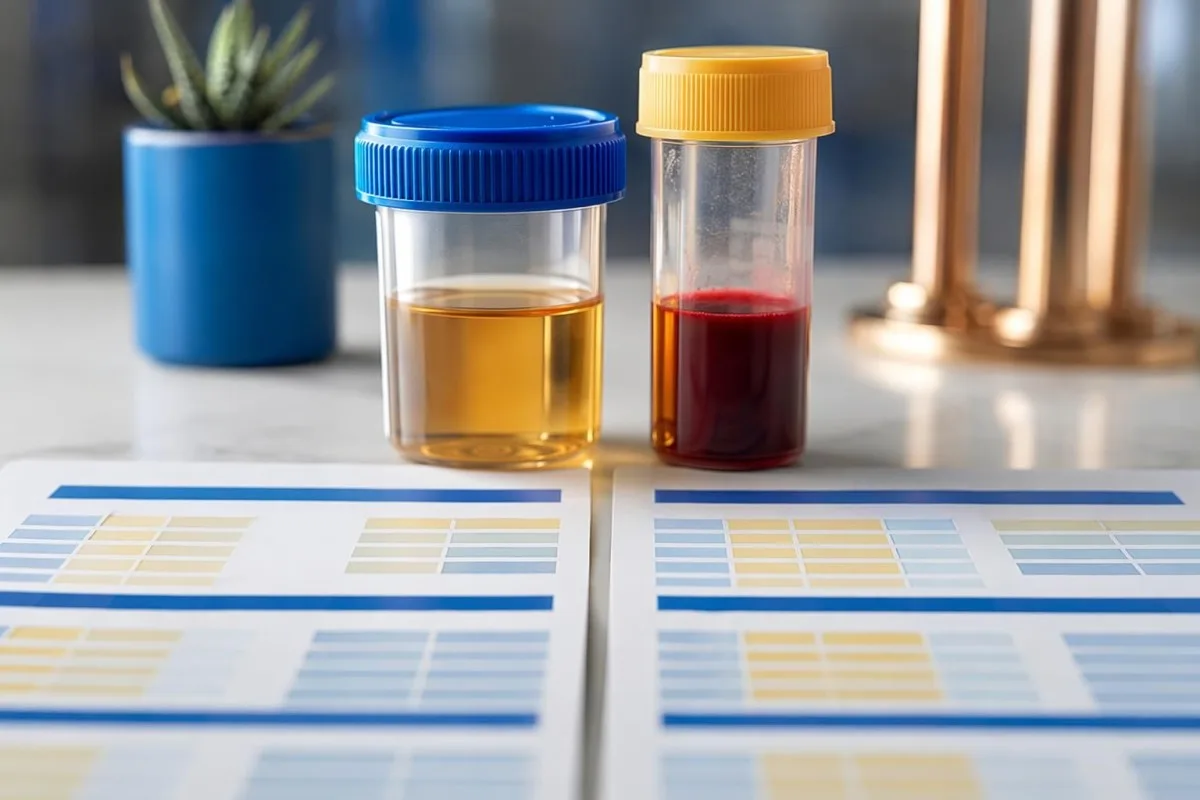
En sida-vid-sida-jämförelse av blodprover är säkrast när du matchar enheter, fastestatus, analysmetod, tidpunkt för medicinering och din egen baslinje innan du bedömer en ökning eller minskning. Per den 1 juni 2026 ser jag fortfarande mer skada av att reagera för mycket på små laboratorieavvikelser än av att lugnt upprepa rätt prov.


- Blodprov sida vid sida jämförelsen bör börja med enheter, datum, fastestatus, labbnamn och tidpunkt för medicinering innan du tolkar någon förändring.
- Normal biologisk variation betyder att en 5% natriumförändring kan spela roll, medan en 25% ALT-förändring fortfarande kan vara tillfällig efter träning eller sjukdom.
- Triglycerider stiger ofta cirka 20–30 mg/dL efter vanliga måltider, så lipidrapporter i fastande och icke-fastande tillstånd bör inte jämföras som identiska förhållanden.
- Kreatinin förändringar över ungefär 15–20% förtjänar uppmärksamhet, särskilt när eGFR också sjunker eller kvoten albumin–kreatinin i urin stiger.
- HbA1c förändringar på 0,3 procentenheter kan vara betydelsefulla, men anemi, transfusion, njursjukdom och hemoglobinsvarianter kan förvränga resultatet.
- TSH kan skifta 20–50% med tid på dygnet, missade doser levotyroxin, biotin, akut sjukdom och graviditetens trimester.
- Läkemedelstidpunkt det som spelar roll: omprovtagning av levotyroxin behöver vanligtvis 6–8 veckor, kontroller av statinrelaterade lipider behöver ofta 4–12 veckor, och järnprover kan förvrängas i flera dagar efter kosttillskott.
- Brådskande förändringar inklusive kalium över 6,0 mmol/L, natrium under 125 mmol/L, hemoglobin nära 7 g/dL, eller snabbt stigande kreatinin med symtom.
- Återkommande analys av blodprovsresultat fungerar bäst när nästa prov upprepar samma labb, samma provtagnings-tid och samma rutin före provtagning.
Så jämför du labbbesök utan att överreagera
A blodprov sida vid sida blir bara medicinskt användbart när du har bekräftat att båda rapporterna är jämförbara. Jämför samma biomarkör, samma enhet, liknande fastetillstånd, samma labbmetod om möjligt, och samma läkemedelsschema; fråga sedan om förändringen är större än förväntad dygn-till-dygn-biologi.
Kantesti är en AI-plattform för tolkning av blodprov som placerar upprepade rapporter i en enda tidslinje i stället för att behandla en enda röd flagga som en diagnos. I vårt kliniska granskningsflöde är första genomgången medvetet tråkig: datum för rapport, provtagningstid, enhet, fastetillstånd, labbnamn och om patienten var sjuk under de föregående 14 dagarna. För en djupare patientbild av verkliga trender, se vår guide till verkliga blodprovs-trender.
Som Thomas Klein, MD, säger jag till patienter att ett värde som rör sig från 4,2 till 4,5 mmol/L kalium vanligtvis inte är en historia i sig. Ett värde som rör sig från 4,2 till 6,2 mmol/L, särskilt vid njursjukdom, användning av ACE-hämmare eller hjärtklappning, är ett helt annat samtal.
Uttrycket skillnad i blodprov mellan besöken kan låta dramatiskt, men många skillnader är aritmetiska snarare än medicinska. Ett kreatinin på 1,0 mg/dL och 88 µmol/L är i praktiken samma värde eftersom 1,0 mg/dL kreatinin motsvarar cirka 88,4 µmol/L.
Det praktiska tricket är att skilja på tre frågor: ändrades siffran verkligen, ändrades kroppen, och passar förändringen symtomen? De flesta misstag sker när människor besvarar den tredje frågan utifrån ett enda isolerat värde.
Kontrollera enheter, datum och analysmetoder innan du drar slutsatser
Ändringar av enheter kan få stabila resultat att se onormala ut när inget biologiskt har förändrats. Innan du tolkar en jämförelse av flera blodprov, konvertera enheter och bekräfta att båda laboratorierna mätte samma analyte med samma typ av metod.
Kolesterol, LDL-C och HDL-C konverteras från mg/dL till mmol/L genom att multiplicera med 0,02586; triglycerider konverteras genom att multiplicera med 0,01129. Hemoglobin i g/dL blir g/L genom att multiplicera med 10, så 13,5 g/dL motsvarar 135 g/L. Vår guide för enhetsomvandling går igenom de vanliga fällor som patienter skickar till oss.
Analysmetod spelar störst roll för hormoner, vitamin D, troponin, D-dimer och vissa autoimmuna antikroppar. Jag har sett en patient få panik över ett fall av 25-OH vitamin D från 34 ng/mL till 78 nmol/L, när 78 nmol/L är cirka 31 ng/mL; kliniskt är det en liten skillnad, inte en kollaps.
Referensintervall är inte utbytbara mellan laboratorier. Ett TSH-övre gränsvärde kan vara 4,0 mIU/L på ett labb och 4,5 mIU/L på ett annat; fria testosteronintervall kan skilja sig ännu mer eftersom immunoassay- och masspektrometrimetoder inte beter sig likadant.
Titta också efter anteckningar om provet. Hemolys, lipemi, fördröjd hantering eller ett prov som tagits i fel rör kan flytta kalium, AST, LDH, glukos och koagulationstester tillräckligt för att skapa ett falskt mönster.
Använd biologisk variation för att avgöra vad som har ändrats
Biologisk variation är den normala fluktuationen inom en individ som sker även när hälsan är stabil. En förändring är mer övertygande när den överstiger den förväntade sammanlagda variationen från din kropp och laboratorieinstrumentet.
Den klassiska Fraser- och Harris-modellen beskriver den referensförändringsvärde, ofta uppskattad som 2,77 × √(analytisk variation² + biologisk variation²), för att avgöra om två resultat verkligen skiljer sig (Fraser och Harris, 1989). På enkelt språk: vissa markörer är naturligt stabila, och andra studsar runt.
Natrium regleras strikt, så en förflyttning från 140 till 132 mmol/L är mycket mer meningsfull än en triglyceridförflyttning från 145 till 175 mg/dL efter lunch. För mer djupgående kontext om förväntade svängningar, vår variationsguide förklarar varför referensintervall “för alla” missar personliga baslinjer.
Ungefärliga trösklar för verklig förändring som jag använder kliniskt är 4-5% för natrium, 10-15% för kreatinin, 20-30% för ALT, 30-50% för ferritin och 40-60% för triglycerider eller TSH. Detta är inte diagnosgränser; det är gränser för signal jämfört med brus.
Evidensen här är ärligt talat blandad för nyare välmåendemarkörer som omega-3-index, IGF-1 och avancerade lipidpartiklar. De kan vara användbara, men upprepad provtagning bör standardiseras tätt, eftersom små skiften kan spegla preanalytisk hantering snarare än fysiologi.
Fastestatus ändrar mer än glukos
Faste- och icke-faste-rapporter ska inte behandlas som identiska labbbesök. Måltider kan flytta triglycerider, glukos, insulin, bilirubin, fosfat och ibland njurmarkörer tillräckligt för att förvirra en jämförelse sida vid sida.
Nordestgaard et al. rapporterade att rutinmässiga lipidprofiler ofta kan mätas utan fasta, men icke-fastande triglycerider stiger ändå med cirka 0,3 mmol/L, eller ungefär 26 mg/dL, efter normalt matintag (Nordestgaard et al., 2016). Det är okej för kardiovaskulär screening; det är mindre okej om du bedömer om en diet sänkte triglycerider med 20 mg/dL.
Fasteglukos på 100–125 mg/dL tyder på nedsatt fasteglukos, medan 126 mg/dL eller högre vid upprepad provtagning stödjer diabetesdiagnos. Ett slumpmässigt glukos över 200 mg/dL med klassiska symtom är en annan diagnostisk kontext, inte något man ska snitta slentrianmässigt med förra årets fastevärde.
Bilirubin kan stiga under fasta, särskilt hos personer med Gilbert syndrom; jag ser ofta att totalt bilirubin rör sig från 1,1 till 1,8 mg/dL medan ALT och AST förblir normala. Vår guide till fastestatus förändras förklarar varför det mönstret vanligtvis är mindre oroande än bilirubin tillsammans med högt ALP eller GGT.
Njurpaneler skiftar också med nyligt proteinintag och vätskeintag. BUN kan stiga efter en måltid med högt proteininnehåll eller vid uttorkning, så kvoten BUN/kreatinin bör jämföras med vätskeintag, inte bara med “njurrädsla”.
Skillnader mellan laboratorier kan efterlikna sjukdom
Olika laboratorier kan rapportera olika värden för samma person under samma vecka. Problemet är vanligtvis kalibrering, analysmetodens utformning, lokala referenspopulationer eller rapporteringskonventioner snarare än en plötslig sjukdomsprocess.
Kantesti är en AI-baserat analysverktyg för blodprov som kontrollerar om ett resultat har flyttats på grund av att enheten, referensintervallet eller laboratoriekällan har ändrats. Detta är särskilt användbart för återkommande blodprovsanalyser mellan länder, där ferritin, vitamin D, TSH och njurrapporteringens format varierar kraftigt.
Vissa europeiska laboratorier använder en lägre övre referensgräns för ALT än äldre amerikanskt rapporteringssätt, ofta cirka 35 IU/L för män och 25 IU/L för kvinnor. Ett värde på 42 IU/L kan flaggas i ett sammanhang och ignoreras i ett annat, även om levern inte förändrades mellan flygplatserna.
Samma problem påverkar eGFR. Ett kreatininbaserat eGFR på 58 mL/min/1,73 m² hos en 72-åring tolkas inte på samma sätt som samma eGFR hos en 28-årig uthållighetsidrottare; ålder, muskelmassa, cystatin C och urinalbumin avgör risken.
Referensintervall beskriver populationer, inte din personliga inställningspunkt. Vår artikel om varför normalvärden vilseleder är värd att läsa innan du jagar varje värde som hamnar en punkt utanför det tryckta intervallet.
Tidpunkt för medicinering är en del av resultatet
Tidpunkt för läkemedel och kosttillskott kan ändra ett laboratorieresultat lika mycket som den sjukdom som övervakas. En giltig jämförelse dokumenterar dos, missade doser, startdatum, tid för senaste dos och om blodet togs före eller efter läkemedlets topp.
Ändringar av levotyroxindosen behöver vanligtvis 6–8 veckor innan TSH når ett nytt stabilt jämviktsläge. Provtagning efter 2 veckor kan visa ett missvisande mellanresultat, medan fritt T4 kan skifta tidigare än TSH.
Biotin i 5–10 mg/dag kan störa vissa analyser för sköldkörtel, troponin och hormoner; många kliniker ber patienter att sluta med det i 48–72 timmar före provtagning, beroende på dos och analys. Jag har sett ett lågt TSH och ett högt fritt T4 försvinna efter att en patient slutat med ett hårtillskott i tre dagar.
Järntillskott kan tillfälligt höja serumjärn och transferrinmättnad, medan ferritin rör sig långsammare över veckor. För detaljer om tidpunkt för läkemedel för läkemedel, vår läkemedelstidslinjeguiden är mer användbar än att försöka komma ihåg varje halveringstid.
Statinrespons bedöms vanligtvis efter 4–12 veckor, och LDL-C sjunker ofta 30–50% beroende på intensitet och följsamhet. Om den andra lipidpanelen togs efter missade doser, en paus eller ett annat faste-tillstånd, förlorar jämförelsen sin styrka.
Träning, sjukdom och vätskeintag lämnar spår
Nylig träning, virusinfektion, vaccination, värmeexponering och dehydrering kan skapa tillfälliga laboratoriemönster som ser alarmerande ut när de ses isolerat. Dessa mönster är vanligtvis igenkännbara när flera markörer rör sig tillsammans.
En 52-årig maratonlöpare med AST 89 IU/L och ALT 42 IU/L kan sakna leverpåverkan helt om CK är 2 800 IU/L och symtomen är muskelömhet. AST finns i både muskel och lever, så högt AST med normalt bilirubin och högt CK talar mer emot problem i gallgångarna.
Uttorkning koncentrerar albumin, hematokrit, totalprotein, kalcium och ibland BUN. En hemoglobinstigning från 14,2 till 15,7 g/dL efter en varm dag kan spegla förlust av plasmavolym snarare än nybildning av röda blodkroppar.
Inflammationsmarkörer ligger efter symtomen. CRP kan nå sin topp 24–72 timmar efter att en infektion börjar, och milda förhöjningar under 10 mg/L är vanligt efter en virusinfektion eller hård träning. Vår guide till laboratorieförändringar efter träning går igenom CK, AST, WBC och ferritinmönster.
Även tidpunkten efter vaccination spelar roll. En liten förändring i WBC, CRP eller trombocyter inom 1–7 dagar är vanligtvis mindre oroande än en ihållande avvikelse vid 3–4 veckor, särskilt om feber, blåmärken, bröstsmärta eller andfåddhet saknas.
Långsamma trender betyder ofta mer än varningsflaggor
Långsam förändring över tre eller fler provtillfällen är ofta mer kliniskt meningsfullt än en enda gränsfallsmarkering. Återkommande analys av blodprover fungerar bäst när den känner igen lutning, persistens och markörkluster snarare än enstaka avvikande värden.
I vår analys av 2M+ användaruppladdade rapporter ser vi konsekvent risk som gömmer sig i värden som fortfarande tekniskt sett är normala. Ett fasteglukos som stiger från 86 till 94 till 101 mg/dL över tre år förtjänar ett annat samtal än en enstaka 101 mg/dL efter dålig sömn.
Njurpåverkan är liknande. KDIGO 2024 noterar att en eGFR-förändring större än 20% vid efterföljande provtagning överstiger förväntad variation och kräver utvärdering, särskilt när urinens albumin-kreatinin-kvot också försämras (KDIGO, 2024).
Ferritin är en annan markör för långsam trend. Ett fall från 78 till 42 till 18 ng/mL över 18 månader kan förklara rastlösa ben, håravfall eller trötthet innan hemoglobin sjunker under 12 g/dL hos kvinnor eller 13 g/dL hos män.
För en djupare ram, vår guide till långsamma labbtrender förklarar varför tre punkter gör en trend och två punkter gör en fråga. Den skillnaden förhindrar både självgodhet och onödig oro.
Vilka förändringar kräver snabb medicinsk vård
Vissa labbförändringar ska inte hanteras som rutinmässig trendgranskning. Svåra elektrolytavvikelser, sjunkande hemoglobin, stigande kreatinin med symtom, mycket högt glukos, positiv troponin eller förändringar i koagulationstester vid antikoagulantia kräver snabb klinisk bedömning.
Kalium över 6,0 mmol/L eller under 2,8 mmol/L kan vara farligt, särskilt vid svaghet, hjärtklappning, njursjukdom eller hjärtmediciner. En upprepning kan behövas för att utesluta hemolys, men symtomen ska inte vänta på ett kalkylblad.
Natrium under 125 mmol/L eller över 155 mmol/L kan orsaka förvirring, kramper, fall eller svår törst beroende på hur snabbt förändringen sker. Samma siffra kan tolereras när den är kronisk men vara farlig när den är akut, vilket är varför tidpunkt och symtom spelar roll.
Hemoglobin nära 7 g/dL, trombocyter under 20 × 10⁹/L, neutrofiler under 0,5 × 10⁹/L eller WBC över 50 × 10⁹/L behöver vanligtvis direkt bedömning av läkare. Vår kritiska värden styr listar situationer där ett akut samtal slår hem-tolkning.
Kreatinin som stiger 30% efter att man startat en ACE-hämmare kan i vissa fall övervakas, men en fördubbling av kreatinin jämfört med utgångsvärdet är ingen liten trend. Om minskad urinmängd, svullnad, andfåddhet, bröstsmärta, svarta avföringar eller svimning uppträder tillsammans med avvikande labbvärden, behandla personen först och jämförelsen sen.
Så jämför du CBC, CMP, lipider och tyreoidea
Vanliga paneler bör jämföras utifrån mönster, inte genom att skanna efter röda bokstäver. CBC, CMP, lipidpanel, sköldkörteltest, järnstatus och inflammatoriska markörer har alla sina egna regler för meningsfull förändring.
För CBC:er spelar absoluta värden oftast större roll än procentandelar. Neutrofiler på 75% kan se höga ut, men ett absolut neutrofilt antal på 4.8 × 10⁹/L är ofta normalt om total WBC är normalt.
För CMP:er spelar kluster roll: ALT plus AST tyder på hepatocellulär stress, ALP plus GGT tyder på kolestatisk eller biliär mönsterbild, och högt kalcium plus lågt albumin kan behöva korrigerat kalcium eller joniserat kalcium. Vår guide till avvikande kluster visar varför grupperade resultat är säkrare än tolkning av enstaka värden.
För lipider berättar LDL-C, icke-HDL-C, ApoB, triglycerider och fastetillstånd alla något lite olika. Enligt 2018 års AHA/ACC-kolesterolriktlinje kan ApoB vara användbart när triglycerider är 200 mg/dL eller högre eftersom LDL-C kan underskatta risk kopplad till partiklar (Grundy et al., 2019).
För sköldkörteln: jämför TSH med fritt T4 och tidpunkt. TSH kan stiga över natten och sjunka senare på dagen; en förskjutning från 2,8 till 4,1 mIU/L kan vara tidsrelaterad, medan TSH 12 mIU/L med lågt fritt T4 är ett tydligare hypotyreosmönster.
Din baslinje förändras med ålder, graviditet och träning
En bra jämförelse använder rätt baslinje för personen, inte bara det tryckta referensintervallet. Ålder, graviditet, pubertet, menopaus, uthållighetsträning, muskelmassa och kronisk läkemedelsanvändning kan alla ändra det förväntade intervallet.
Barn är inte små vuxna i labbtolkning. Alkalisk fosfatas kan vara mycket högre under tillväxt, lymfocytantal är högre hos yngre barn, och tolkning av ferritin beror på ålder, inflammation och kost.
Graviditet sänker kreatinin eftersom njurfiltrationen ökar, så ett kreatinin på 0,9 mg/dL kan vara mindre betryggande sent i graviditeten än hos en icke-gravid vuxen. TSH-trimester-mål är också lägre tidigt i graviditeten, vilket är varför en rapport som flaggats som normal ändå kan behöva obstetrisk kontext.
Idrottare har ofta högre CK, lägre kreatinin i förhållande till kroppsstorlek om de är uthållighetstränade, och övergående AST-stegringar efter hårda pass. Äldre vuxna kan ha skenbart normalt kreatinin trots låg muskelmassa; cystatin C kan hjälpa när eGFR ser för betryggande ut.
Om du jämför en förälder, ett barn eller en idrottare: använd åldersspecifik tolkning i stället för generella gränsvärden. Vår åldersspecifika intervall är en användbar startpunkt för familjer som följer flera rapporter tillsammans.
Hur Kantesti AI hanterar återkommande rapporter
Kantesti AI jämför upprepade rapporter genom att standardisera enheter, kontrollera referensintervall, upptäcka sannolika labbartifakter och rangordna förändringar utifrån klinisk kontext. Den omvandlar inte ett avvikande värde till en diagnos; den letar efter mönster som förtjänar uppföljning.
Kantesti är en Plattform för tolkning av AI-biomarkörer används av 2M+ personer i 127+ länder, så motorn ser rapporter i många enheter, språk och labbformat. Vårt system kan läsa en PDF eller ett foto på cirka 60 sekunder, men hastighet är inte det kliniska målet; kontext är.
Plattformen kontrollerar om en kreatininförändring beror på enhetsomräkning, uttorkning, läkemedelstidpunkt eller möjlig njurförsämring innan den ger en förklaring på lätt svenska. Läsare som vill ha den tekniska detaljnivån kan gå igenom vår guide för AI-teknik.
Vår medicinska valideringsprocess testar också för fällor med överdiagnostik, där ett svar låter självsäkert men överdriver en normal variant. Den underliggande benchmark-designen beskrivs i det kliniska valideringsbenchmarket.
Jag vill fortfarande att patienter använder kliniker. AI kan organisera, flagga och förklara; den kan inte undersöka din buk, höra ett nytt blåsljud, bedöma uttorkning vid sängkanten eller avgöra om ditt bröstsmärta är säkert.
Gör jämförelsen till ett användbart meddelande till läkare
Ett bra meddelande från en läkare är kort, daterat och specifikt. Skicka de förändrade biomarkörerna, storleken på förändringen, symtom, läkemedelsförändringar, fastestatus och den fråga du behöver få besvarad.
Ett bra meddelande låter så här: Mitt kreatinin steg från 0,92 till 1,18 mg/dL över 4 månader, eGFR sjönk från 82 till 63, jag började med lisinopril 10 mg för sex veckor sedan, och jag har ingen svullnad eller minskad urinmängd. Det ger en kliniker tillräckligt med signal för att avgöra om man ska upprepa, kontrollera urin ACR eller justera läkemedel.
Ett svagare meddelande är: Mina njurprover är dåliga, vad betyder det? Jag säger det vänligt; ångest gör att alla vi blir luddiga. Siffror, datum och symtom minskar risken för fram-och-tillbaka-fördröjningar.
Thomas Klein, MD och våra kliniska granskare använder samma struktur när vi granskar svåra tolkningar: vad som förändrades, hur mycket, under vilka förhållanden och vad mer som förändrades tillsammans med det. Vår medicinsk rådgivande nämnd granskning beskriver standarderna bakom hur vi ramar in risk utan att skrämma människor i onödan.
Bifoga båda rapporterna om du kan. Skärmdumpar som beskärs till ett enda rött värde döljer ofta ledtråden, som ett högt albumin som tyder på uttorkning eller ett högt CK som förklarar AST.
Standardisera nästa omprovtagning innan du bedömer framsteg
Nästa omtest bör upprepa de förhållanden som spelar roll för den biomarkör du följer. Samma laboratorium, samma tid på dygnet, samma fastefönster, liknande träningsbelastning och dokumenterad läkemedelstidpunkt gör nästa jämförelse betydligt mer tillförlitlig.
För lipider: använd samma fasta-beslut varje gång om du bedömer respons på livsstil. För sköldkörtel: testa vid en liknande morgontid och undvik biotin i 48–72 timmar om din kliniker håller med. För testosteron: ta provet före kl. 10 på morgonen när det är möjligt eftersom morgonnivåer ofta är avsevärt högre.
För njurmarkörer: kom normalt välnärd/hydrerad och undvik ovanligt högt proteinintag eller intensiv träning under de föregående 24–48 timmarna. För ferritin och CRP: undvik att testa under akut sjukdom om inte sjukdomen är anledningen till testningen.
För HbA1c: testa inte om för snabbt. Eftersom livslängden för röda blodkroppar i genomsnitt är cirka 120 dagar är ett nytt test efter 8–12 veckor mer informativt än ett efter 10 dagar, om det inte finns en fråga om noggrannhet eller en stor förändring i behandlingen.
Kantesti följer dokumenterat team för kliniska standarder för att förklara osäkerhet, upprepad testning och eskalering. Slutsats: en jämförelse sida vid sida handlar inte om att vinna över förra månadens siffra; det handlar om att hitta förändringarna som är tillräckligt stora, tillräckligt bestående och tillräckligt sammanhängande för att förtjäna åtgärd.
Vanliga frågor
Vad är det bästa sättet att jämföra två blodprovsrapporter?
Det bästa sättet att jämföra två blodprovsrapporter är att först matcha biomarkörens namn, enhet, analysmetod, fastestatus, provtagningstid och tidpunkt för medicinering. Beräkna sedan den procentuella förändringen i stället för att bara reagera på om värdet är rött eller svart. En ökning av kreatinin från 0,9 till 1,1 mg/dL är ungefär 22%, vilket kan förtjäna mer uppmärksamhet än en liten avvikelse i ALT efter träning. Om förändringen är stor, kvarstår eller åtföljs av symtom, skicka båda rapporterna till din behandlande läkare.
Hur mycket variation i blodprovsresultat är normalt mellan besök?
Normal variation i blodprov beror på markören: natrium kan variera endast cirka 4–5%, medan triglycerider, TSH, ferritin och leverenzymer kan variera 25–60% beroende på fasta, sjukdom, träning och analysmetod. En liten förskjutning inom referensintervallet är ofta biologiskt brus. En förändring som överstiger det förväntade värdet för referensförändring, upprepas i ett andra prov eller uppträder tillsammans med förändringar i relaterade markörer är mer sannolikt att vara verklig. Symtom och tidpunkt för medicinering bör alltid granskas innan man avgör vad förändringen betyder.
Varför såg mitt blodprov sämre ut på ett annat laboratorium?
Ett blodprov kan se sämre ut på ett annat laboratorium eftersom enheter, referensintervall, instrument, antikroppsanalyser och kalibreringsstandarder skiljer sig åt. Till exempel kan kreatinin som anges i mg/dL och µmol/L se helt olika ut om du inte vet att 1,0 mg/dL motsvarar cirka 88,4 µmol/L. Sköldkörtelhormoner, vitamin D, ferritin och testosteron är särskilt känsliga för metodskillnader. Om möjligt, upprepa trendkänsliga tester på samma laboratorium.
Kan icke-fastande prover jämföras med fastande prover?
Icke-fastande prover kan jämföras med fastande prover endast för vissa markörer, och fastestatus måste anges. Triglycerider stiger ofta med cirka 20–30 mg/dL efter måltider, medan glukos, insulin, bilirubin, fosfat och BUN också kan påverkas. LDL-C och total kolesterol är ofta fortfarande användbara för risk-screening, men livsstilsframsteg bör bedömas under liknande förhållanden. Om ditt resultat ändrades precis så mycket att det oroar dig, upprepa det med samma fastefönster.
Vilka förändringar i blodprover är brådskande?
Brådskande blodprovsförändringar innefattar kalium över 6,0 mmol/L, kalium under 2,8 mmol/L, natrium under 125 mmol/L, natrium över 155 mmol/L, hemoglobin nära 7 g/dL eller ett positivt troponin med bröstsymtom. Mycket högt glukos, snabbt stigande kreatinin, svåra trombocytavvikelser eller förändringar i koagulationstester vid blodförtunnande behandling kräver också omedelbar klinisk rådgivning. Ett nytt prov kan behövas för att utesluta en laboratorieartefakt, men symtom som bröstsmärta, svimning, förvirring, svaghet eller andfåddhet ska inte invänta provsvaret. I sådana fall, sök akut medicinsk vård.
Hur ofta bör jag upprepa avvikande blodprover?
Upprepningstid beror på markören och svårighetsgraden. Lindriga, isolerade avvikelser upprepas ofta inom 1–4 veckor under standardiserade förhållanden, medan läkemedelsuppföljning kan kräva fasta intervall som 6–8 veckor för TSH efter förändringar av levotyroxin eller 4–12 veckor för lipider efter förändringar av statiner. HbA1c behöver vanligtvis cirka 8–12 veckor för att spegla en meningsfull behandlingsförändring. Kritiska värden eller avvikande resultat med symtom bör diskuteras samma dag i stället för att planeras mer oreflekterat.
Kan KI flera blodprover jämföra på ett säkert sätt?
AI kan säkert stödja flera jämförelser av blodprover när den standardiserar enheter, kontrollerar fasta- och läkemedelssammanhang, flaggar sannolika artefakter och förklarar osäkerhet i stället för att ställa diagnos utifrån ett enskilt värde. Kantesti AI är utformad för att organisera upprepade rapporter, identifiera mönster och hjälpa patienter att ställa bättre frågor på cirka 60 sekunder. Den bör inte ersätta en kliniker när resultaten är kritiska, symtomen är svåra eller när diagnos kräver undersökning. Den säkraste användningen är AI plus medicinsk granskning, inte AI i stället för vård.
Kan bloddonation förklara en förändring i mitt hemoglobin eller HbA1c?
En nyligen genomförd helblodsdonation kan tillfälligt sänka hemoglobinet och få HbA1c att verka lägre än vad din faktiska glukoskontroll skulle indikera. Tala om för din läkare när du donerade; glukosmätningar kan hjälpa till att klargöra en oväntad HbA1c-förändring medan dina blodkroppar återhämtar sig.
Kan min menstruationscykel påverka hur jag jämför blodprovsresultat?
Ja. Estradiol, progesteron, luteiniserande hormon och follikelstimulerande hormon varierar naturligt över menstruationscykeln, så anteckna cykeldagen och provtagningstiden. Kraftiga menstruationsblödningar kan också bidra till lägre hemoglobin och järndepåer över tid.
Vad ska jag göra om mitt gamla labbresultat saknar referensintervall?
Du kan fortfarande jämföra det faktiska värdet och enheten, men tolkningen blir mindre exakt utan labbets eget intervall och metod. Be labbet eller mottagningen om hela rapporten, särskilt för tyreoideaprov, hormoner, vitaminer och specialiserade tester.
Få AI-drivna analyser av blodprov redan idag
Gå med i över 2 miljoner användare världen över som litar på Kantesti för snabb och korrekt analys av blodprover. Ladda upp dina blodprovsresultat och få en heltäckande tolkning av 15,000+-biomarkörer på sekunder.
📚 Refererade forskningspublikationer
Klein, T., Mitchell, S., & Weber, H. (2026). Kliniskt valideringsramverk v2.0 (Medical Validation Page). Kantesti AI Medical Research.
Klein, T., Mitchell, S., & Weber, H. (2026). AI blodprovsanalys: 2,5M analyserade tester | Global hälsorapport 2026. Kantesti AI Medical Research.
📖 Externa medicinska referenser
Fraser CG och Harris EK (1989). Framtagning och tillämpning av data om biologisk variation inom klinisk kemi. Kritiska översikter inom klinisk laboratorievetenskap.
KDIGO-arbetsgruppen (2024). KDIGO 2024 Klinisk riktlinje för utvärdering och hantering av kronisk njursjukdom. Kidney International.
⚕️ Medicinsk ansvarsfriskrivning
Den här artikeln är endast avsedd för utbildningsändamål och utgör inte medicinsk rådgivning. Rådgör alltid med en behörig vårdgivare för beslut om diagnos och behandling.
E-E-A-T förtroendesignaler
Uppleva
Läkarledd klinisk granskning av arbetsflöden för laboratorietolkning.
Expertis
Laboratoriemedicinskt fokus på hur biomarkörer beter sig i kliniskt sammanhang.
Auktoritet
Skrivet av Dr. Thomas Klein med granskning av Dr. Sarah Mitchell och Prof. Dr. Hans Weber.
Trovärdighet
Evidensbaserad tolkning med tydliga uppföljningsspår för att minska larm.