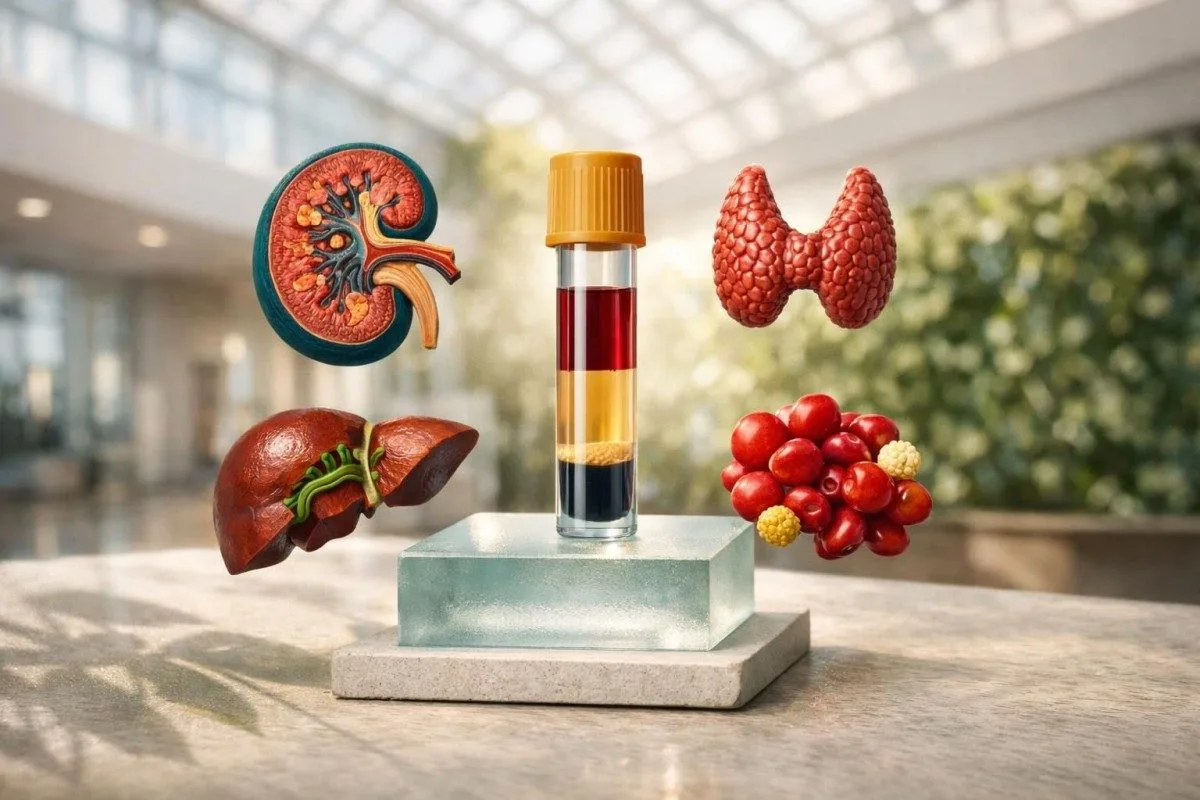
La franja del laboratòri es un punt de partida, pas un veredicte. Un creatinina de 1,0 mg/dL, una ferritina de 25 ng/mL, o un TSH de 3,8 mIU/L pòdon èsser rasserenants, enganaires, o urgents segon de qui siá lo resultat.


- Interval de referéncia sol èsser lo centre 95% d’una populacion seleccionada, doncas aperaquí 1 sus 20 personas d’èsseras sanas sortirá d’aicí per designi.
- Ferritina jos 30 ng/mL sovent sostèn una manca d’èr, encara abans que la hemoglobina baissa e encara quand lo laboratòri imprime encara valors normalas.
- TSH de 3,8 mIU/L pòt èsser acceptabla dins un adult, mas se tractarà mai prudentament dins una pregància del primièr trimestre, ont fòrça clinicians encara miran jos de 2.5 mIU/L.
- Creatinina en creissença per 0,3 mg/dL dins 48 oras reünís un criteri d’una injúria renala aguda, encara se lo nombre final demòra dins l’interval de referéncia.
- La biotina a 5.000-10.000 mcg/dia pòt distorsionar d’unes immunoassajos tiroïdians e de troponina e crear de resultats falsament rasserenants o alarmants.
- ALT los limits superiors son sovent tròp larges; mantun expert considera aperaquí 19-25 IU/L en las femnas e 29-33 IU/L en los òmes mai pròche de valors vertadièrament sanes.
- eGFR jos 60 mL/min/1.73 m² al mens 3 meses suggerís una malautiá cronica de ren, mas la creatinina sola pòt aquò mancar en de personas amb massa musculària bassa.
- analisi de tendéncia dels resultats d’analisi de sang se’n pòt tornar utila aprèp 3 resultats comparables; 5 o mai fa que vòstre basa personal siá fòrça mai clar.
- B12 limitrof dins lo 200-300 pg/mL pòt encara correspondre a de simptòmas reals, subretot se l’acid metilmalonic o l’òmocisteïna son anormals.
Perqué lo meteis resultat d’analisi de sang pòt voler dire de causas diferentas
A analisi de sang personalizada vòu dire legir vòstre resultat en comparason amb vòstra basa, pas solament la gamma imprimida. Lo meteis ferritina, TSH, creatinina o ALT pòt èsser rassurant, trompaire o urgent un còp que tengam en compte edat, sèxe, medicaments, simptòmas, moment, e resultats precedents.
La màger part de las personas recebon un rapòrt de laboratòri e se lor ditz solament se una xifra es nauta o bassa. En Kantesti AI, veirem cada jorn que una sola fotografia sovent manca çò que de tendéncias vertadièras de laboratòri al long del temps fan evident.
Prengatz TSH. Un valor de 3,8 mIU/L pòt èsser acceptable tanben en un adult mai ancià sens simptòmas, tròp naut per qualqu’un amb simptòmas tiroïdians e anticòrs TPO positius, e generalament tractat mai prudentament dins lo primièr trimestre de la pregància, ont fòrça clinicians encara miran jos 2.5 mIU/L.
En data de 17 d’abril de 2026, l’interpretacion mai segura demòra encara contextuala e non pas automatica. Cossí Thomas Klein, MD, ai totjorn de pacients que se lor ditz qu’es normal après una ferritina de 22 ng/mL, encara que la combinason de caiguda dels pels, fatiga, e un MCV que davala fa fòrça mai probable una desplecion de fèrre ièrenca que çò que l’alarma del laboratòri indica.
Una gamma imprimida es un punt de partida, pas res mai. Un ALP de 180 U/L me preocupa fòrça diferentament en un adolescent de 14 ans en creissença que non pas en un òme de 64 ans sedentari amb pèrda de pes, e aquò es precisament perqué la basa (baseline) importa.
Cossí los laboratoris bastisson de valors de referéncia — e perqué mancan los individus
Las analisis generalament construisson un interval de referéncia a partir del centre 95% dels resultats dins una populacion sana seleccionada. Aquela aproximacion es utila, mas es bruta, e los instruments bruts mancan sovent la fisiologia individuala.
A prepaus 1 sus 20 personas d’èsseras sanas sortirà d’una gama de referéncia per design, e aquò es una de las rasons per las qualas una analisi de sang estandard pòt enganar quand s’utiliza coma un veredict, e non pas coma un senhal. Aquela taxa de faussa alarma es integrada dins las matematicas, e non pas un signe que lo pacient a fach quicòm de picant.
Las populacions de referéncia son pas universalas. La equipa Kantesti revisa los rapòrts de 127+ païses, e la limit superiora per ALT pòt se situar a proximitat de 35 U/L dins un laboratòri e 55 U/L dins una autra, encara abans de tenir compte de recomandacions especificas per sexe.
Prati e sos collègas an argumentat fa d’annadas que los limits vertadièrament sans son jos de fòrça de las gamas ancianas—aproximativament ALT . D’unes laboratoris europèus s’en son aprochats; d’autres encara rapòrtan de cutoffs mai larges, e doncas lo meteis ALT de 19-25 IU/L en las femnas e 29-33 IU/L en los òmes. 41 IU/L pòt èsser senhalat dins un rapòrt e ignorat dins un autre. La nòrma (noise) pre-analitica apondís una autra capa. L’idrataçion, la postura, l’exercici recent, lo temps de torniquet e la manipulacion de la mostra pòdon nudjar.
l’albumina, l’ematocrit, lo potassi, la lactat e la bilirubina pro per cambiar la istòria, e un punh clenchat pendent la recòlta pòt far montar lo potassi per aproximativament 0.2-0.4 mmol/L ..
Perqué l’analisi de tendéncias dels resultats de sang sovent bat una sola fotografia
Los resultats en sèria mòstran la direccion e la taxa de cambiament, e aquò sovent es mai utili clinicament que un sol nombre isolat. En lenga plan comprensible: una tendéncia pòt èsser anormala abans que una valor paregue anormala.
fòrça biomarcadors an un punt de referéncia personal e una variacion relativament pichona dins la meteissa persona. Lo trabalh de Fraser sus la variacion biologica es per aquò que los laboratoristas parlan de valor de cambiament de referéncia, e aquò es exactament per aquò que los pacients que seguisson los resultats analisi de sang en linha comprenen generalament lor santat mai lèu que los pacients que recòlton PDF desconnectats.
Per mantunes marcadors rutinièrs, l’ índex d’individualitat es prou bass per que vòstre basa personal batte un interval larg de la populacion. Un creatinina augment de 0,7 a 1,0 mg/dL pòt encara aparéisser coma normal, mas aquela 43% saut non es una causa que nos calem.
La meteissa logica s’aplica a una numeracion de plaquetas que s’esbalaça dempuèi 280 cap a 150 ×10^9/L o a un ALT que passa de 18 cap a 34 IU/L. Se aqueles desplaçaments se debanan jos de condicions similaras, an mai de pes que una valor solitària que solament roça lo limit del laboratòri.
Lo bruch de l’assaig es real, doncas la tecnica conta. Se un HbA1c s’executa al Laboratòri A e lo seguent al Laboratòri B, un diferéncia de 0.2-0.3 punts de percentatge pòt èsser de bruch de metòde; un desplaçament de 5.5% cap a 6.1% jos de condicions ajustadas es fòrça mai dificil de desestimar.
Cossí l’edat, lo sèxe, lo moment del cicle e la massa muscular reencadran una valor
L’interpretacion cambia amb l’edat e lo sèxe, perque la fisiologia modifica la basa abans que la malautiá i entre. L’emoglobina, la ferritina, la creatinina, l’ALP, los lipids e las hormonas se comportan totes de manièra diferenta al cors de las etapas de la vida.
Lo BUN adult emoglobina sol èsser a l’entorn de 13,5-17,5 g/dL en los òmes e 12,0-15,5 g/dL en las femnas, e la prenheson, l’altitud e l’ipotidat fan avançar aquestes xifras encara mai. Es per aquò que nòstre guia de la gama d’emoglobina es mai util que un sol punt de tall universal.
Las hormonas son encara mai dependentas del contèxte. Estradiòl pòt èsser completament ordinari a 40 pg/mL sus un jorn del cicle e, de manièra inesperada, bassa o auta sus un autre, donc lo moment a d’importància; nòstre guia de temporizacion de l’estradiòl mòstra perqué sovent la fas(a) del cicle importa tant coma la valor ela meteissa.
Puèi i a creatinina. Un òme muscular de 28 ans sus creatina pòt viure a l’entorn de 1,2 mg/dL pendent d’annadas, mentre qu’un òme feble de 82 ans amb sarcopenia pòt aver una creatinina aparentament bona de 0,8 mg/dL malgrat una reserva renala reducha.
Avèm lo meteis efècte amb ALP e ferritina. L’ALP es sovent mai auta dins los adolescents e dins la fin de la prenheson, e la ferritina tend a èsser mai bassa dins los adults que menstrúan, donc una ferritina de 25 ng/mL es pas escambiabla entre sexes e estapas de vida.
Quéls medicaments, suplements e quin moment pòdon distorsionar una analisi de sang personalizada
Los medicaments e los suplements cambian los analisis de sang de doas manèras: o alteran la fisiologia, o interferisson tanben amb l’analisi en se. Se o ignoratz, podètz legir mal un nombre completament vertadièr.
L’exemple classic es abans d’immunoassajos tiroïdians o d’hormònas, dejunatz. Molts produches pels pels e las ungles contenon 5,000-10,000 mcg cada jorn, en quantitat sufisenta per distorsionar qualques immunoassais d’examen tiroïdian e de troponina, qu’avèm cobèrts dins nòstre article sus la biotina e l’examen tiroïdian.
De corses curts de prednisona pòdon elevar los neutròfils dins d’oras per demargination, de còps per 2-5 ×10^9/L sensa cap infeccion. Abans un panèl, revisatz las basicas dins nòstre guia de analisi de sang en dejuni, perque lo cafè, la desidratacion e un esfòrç dur lo jorn abans pòdon cambiar la glucosa, los triglicerids, AST, CK, BUN e l’hematocrit.
Las prescripcions quotidianas importan tanben. Metformina e los inhibidors de la bomba de protons pòdon baissar vitamina B12 al long del temps, l’estrogèn oral pòdon aumentar la globulina de ligason de l’ormòna tiroïdiana e lo T4 total, l’amiodarona e pòdon elevar TSH, T4 liure, enzims liverencs, o totas tres.
Los suplements complican encara mai aquò. La creatina pòdon elevar la creatinina d’unes 0,1-0,3 mg/dL dins qualques utilizaires sensa engatjament renala, e los estatins pòdon empentar AST e CK, subretot aprèp d’exercici fòrça intens; l’evidéncia es francament mesclada sus la talha exacta del desplaçament, mas la direccion es pro vertadièra que ieu jamai cossí legir lo panèl sensa veire.
Perqué los simptòmas e los patrons de laboratòri importan mai que un sol nombre fòra de la franja
De petites anormalitats isoladas son sovent mens importantas que patròn d’unes cambiaments relacionats e de simptòmas. Las malautiás acostuman de desrabar de gropes de marcaires, pas d’un sol pixel.
Se la ferritina es 22 ng/mL, MCV s’enfonça jos 84 fL, RDW es superior a 14.5%, e las plaquetas van en augmentant, la deficiéncia de fèrre precoça ven fòrça mai probable, encara se l’emoglobina encara es normal. Es per aquò que l’iron sèrum sol sovent mena a error dins nòstre guia d’interpretacion de l’iron.
I vei aqueste patròn totjorn dins los corredors. Un maratonian de 52 ans amb AST 89 UI/L, ALT 31 UI/L, CK 620 UI/L, e una bilirubina normala es mai probabla de mostrar una liberacion del musclè que una malautiá primària del fetge, e nòstre guia de pista d’AST explica perqué la rason AST-contra lo contèxte importa.
Lo contrari tanben se passa. Un augment leugièr d’ALT ven mai preocupant quand GGT e ALP son tanben elevats, coma un recompte blanc a la franja que importa mai quand CRP es naut e los simptòmas correspondon a una infeccion o a una responsa del teissut.
Es una d’aquelas zònas ont lo contèxte importa mai que la chifra. Quand los resultats e los simptòmas s’acordan pas, la mesura practica es de tornar far l’analisi jos de condicions ajustadas e d’apondre los marcaires relacionats que complèton lo patròn.
Qué revela la vòstra istòria d’analisi de sang que la franja del laboratòri pòt pas
Ton istòria de l’analisi de sang crea un ponch de consigna personal, e una desviacion d’aquel ponch pòt importar abans que lo rapòrt vengue roge. Al consultòri, aquò es sovent la pista que separa lo soroll de la malautiá precoça.
A nòstra plataforma d’analisi de sang amb IA, un augment de creatinina de 0,3 mg/dL dins 48 oras es tractat seriosament perque KDIGO utiliza aquela cambiament coma un dels critèris per una injúria renala aguda, encara se la creatinina finala sembla encara ordinària. La meteissa logica s’aplica a un baissament del recompte de plaquetas de 320 a 170 ×10^9/L o a un sodi que s’esllissa de 141 a 136 mmol/L dins lo bon contèxte clinic.
Los laboratoris d’ospital utilizen contròls de delta per la meteissa rason: comparan un resultat novèl amb los precedents e demandan se lo gap es biologicament plausibla. Nòstre estandards de validacion clinica descriu cossí s’entracta la normalizacion de las unitats, lo tipe de specimen e la metòde d’assaig, per que un sodi de 139 mmol/L siá pas comparat naivament amb un panèl raportat de manièra diferenta.
Una basa personala tanben ajuda per lo moment de las seguiments. TSH generalament necessita d’unes 6 setmanas aprèp un cambiament de dosatge de levotiroxina, ferritina sovent es tornat verificar en 6-8 setmanas aprèp un tractament amb fèrre, e HbA1c cal aperaquí 8-12 setmanas per reflectir un cambiament de vida o de medicacion significatiu.
Quand ieu, Thomas Klein, revisi de panèls en sèrie, la question es rarament «Es aquò anormal?». Es sovent «Es aquò novèl, es aquò mantengut, e aquò s’acòrda amb la rèsta de la fisiologia?».
Quand un resultat d’analisi de sang “normal” es pas vertadièrament rasserenant
Un resultat que sembla normal pòt mancar una malautiá precoça quand se demanda lo mauvais examèn, la valor es al limit per la vòstra fisiologia, o los marcaires relacionats son ignorats. «Normal» es una declaracion de distribucion, pas una confirmacion de seguretat.
Una creatinina que sembla ordinària pòt coexiste amb una eGFR jos 60 mL/min/1,73 m², subretot dins los adults mai ancians amb pauc massa muscular. Nòstre eGFR bass amb creatinina normala guida mòstra perqué la foncion renala sovent s’esvalora quand los clinicians miran solament la creatinina.
Los resultats al limit son una autra trapa. Un vitamina B12 de 200-300 pg/mL sovent se nomena «bassa-normala», mas la neuropatia, la glositis o los simptòmas cognitius pòdon encara èsser reals, e nòstre article d’interpretacion de B12 explica perqué acid metilmalonic o l’homocisteïna pòdon calmar lo debat.
La ferritina se comporta de manièra semblabla. Una ferritina de 25 ng/mL pòt s’acòrdar amb l’interval del laboratòri e encara èsser en linha amb la pèrda de pels, las cames inquietas o l’intolerància a l’exercici, mentre que una calci de 10.2 mg/dL sembla mens innocent se PTH es pas suprimida.
La troponina es un autre exemple classic. Un sol valor normal, lèu après una dolor de pit, non exclutz pas de manièra fisabla una lesion miocardica; çò que compta es lo creissement o la baissada al cors del temps, l’assaig utilizat, e lo quadre clinic.
Cossí Kantesti AI transforma un rapòrt generic en interpretacion personalizada
Kantesti l’IA personaliza l’interpretacion en legissent lo raport vertadièr, en standardizant las unitats, en ajustant lo contèxte d’edat e de sèxe, e en comparant de valors seriadas en luòc de marcar cada nombre isoladament. Aquò sembla tecnic, mas l’objectiu clinic es simple: far que lo resultat s’adapti a la persona.
Se volètz veire coma analizèm un raport de biais segur, nòstre guia de cargament PDF passa pel procès dempuèi la fotografia o lo fichièr fins a l’interpretacion dins un periòde d’environ 60 segondas. Aquela meteissa operacion servís ara 2M+ d'utilizaires a travèrs de 127+ païses e 75+ lengas.
Avèm bastit aquela operacion amb supervison de metge, perque la reconeissença de patrons sens garas clinicas es riscada. Nòstre Conselh Consultatiu Medical revisa los cas-limita, e coma Thomas Klein, MD, me preocupa mai los resultats de la zòna grisa—ferritina 20-40 ng/mL, TSH 3-5 mIU/L, las variacions de creatinina que demòran normalas, e los panèls modificats per de suplementacions o per una malautiá recenta.
Al dessús, la ret neurau de Kantesti associam los biomarcadors a la fisiologia en luòc de los tractar coma de rengs isolats. Lo metòde es descrich dins nòstre guia de tecnologia amb IA, e es alimentat per nòstra paràmetre 2.78T IA de santat.
Sem dempuèi de las limitas. Las escansas marridas, los temps de recòlta mancants, la pregnesa, los panèls pediatric, e las malautiás agudas que cambian rapidament pòdon encara necessitar una revirada dirècta del clinician, çò que explica perqué nòstra operacion alineada amb CE, HIPAA, GDPR e ISO 27001 es bastida per ajudar a la presa de decision, e non pas per la remplaçar.
Cossí bastir una istòria d’analisi de sang que lo vòstre mèstre pòt vertadièrament utilizar
Lo melhor punt de basa ven de condicions de test consistentas, e non pas d’un nombre infinit de tests. Meteis laboratòri se possible, meteis moment del jorn, meteis estat de dejun similar, un pichòt registre dels simptòmas, e al mens 3 resultats comparables vos menarà fòrça luènh.
Començar per la consisténcia plan “borrosa”. Se volètz un rapèl de quant los liquids pòdon torçar la quimia, legissètz nòstre guia de desidratacion e de falses valors autes; albumina, calci, BUN, hemoglobina, e hematocrit totes pòdon semblar mai naut que çò que son vertadièrament quand la presa ven après una idratacion marrida.
Manteni una pichòta nòta amb cada resultat: jorn del cicle, infeccion, febre, alcohol, una corsa o una session de gimasia intensa, nòus suplementes, e cambiaments de medicacion. Nòstra decodador de simptòmas ajuda los pacients a associar los simptòmas amb los marcaires de seguiment dreches, çò que conta, perque l’èrre sèric après un desjuni rapidament pres es pas comparable amb una presa del matin en dejuni.
Trés resultats comparables son generalament pro per començar una tendéncia, e cinc son melhor. Se volètz seguir los resultats analisi de sang sens bastir de taulas d’espreadsheet manualas, ensajatz nòstra demostracion liura d’analisi de sang e cargatz los meteisses marcaires al long del temps, per que lo dessenh — pas solament la senhal — siá visible.
La màger part dels pacients troba aquò d’un biais surprenentament calmant. Un còp que podètz veire que vòstre ALT totjorn se pausa a l’entorn de 17-22 IU/L o que vòstre ferritina baissa de biais previsible cada ivèrn, un petit “tremol” se torna mai aisit d’interpretar e los vertadièrs cambiaments se fan mai lèu remarcables.
Publicacions de recèrca e lectura mai prigonda
Se volètz de detalhs a nivèl de marcador, comencètz per las publicacions sus la distribucion dels globuls roges e lo dessenh renal, perque l’interpretacion personalizada sovent depen de relacions e de tendéncias, pas de nombres isolats. Son de complements utils quand volètz anar mai luènh que un document estandard de laboratòri.
Nos mantenèm las actualizacions ligadas dins lo Blòg de Kantesti, ont los articles son revisats cossí que la practica de laboratòri evoluciona e que apareisson de nòus cases clinics.
Analisi de sang RDW: Guia completa de RDW-CV, MCV e MCHC. (2025). Zenodo. Recòrd DOI: https://doi.org/10.5281/zenodo.18202598. Cercable Recòrd de ResearchGate. Cercable Recòrd de Academia.edu.
Ratio BUN/Creatinina explicat: Guia de l’examen de foncion renala. (2025). Zenodo. Recòrd DOI: https://doi.org/10.5281/zenodo.18207872. Cercable Recòrd de ResearchGate. Cercable Recòrd de Academia.edu.
Questions frequentas
Qué es una analisi de sang personalizada?
Una analisi de sang personalizada es pas un autre tub o una panel de laboratòri especiala; es una manièra d’interpretar los resultats en comparason amb vòstre basa, edat, sèxe, simptòmas, medicaments e valors precedentas. Un creatinina de 1.0 mg/dL pòt èsser ordinària se es estada establa pendent d’annadas, mas preocupant se s’es montada de 0.7 mg/dL en 48 oras. La màger part dels laboratoris imprimisson d’intervals de referéncia de la populacion, generalament lo mitan 95% d’adults dobèrts seleccionats. L’interpretacion personalizada demanda se la valor es normalament vòstra, e pas solament se se tròba entre doas xifras imprimidas.
Un anàlisis de sang normal encara pòt voler dire qu’una causa es pas totjorn bona?
Òc. Una ferritina de 25 ng/mL, una vitamina B12 de 240 pg/mL, o un creatinina que sembla normal amb un eGFR jos 60 mL/min/1,73 m² encara pòt correspondre a de símptomes reals o a una malautiá precoça. Aquò es subretot frequent quand los marcaires relacionats son ignorats, que lo moment de la presa de mostra es pas lo bon, o que lo pacient a una basa particulara per causa de l’edat, del sèxe, de la massa musculara, de la pregnesa o de la presa de medicaments. Una franja normalа es un instrument per una populacion, pas una garantia que i aja pas de problèma.
Quantas resultats precedents son pro suficients per l’analisi de tendéncias dels resultats d’analisi de sang?
Normalment, tres resultats comparables son pro per començar una analisi de tendéncias útils dels resultats d’analisi de sang, e cinc o mai fan la basa personal encara mai clara. «Comparable» vòl dire lo meteis marcador, un temps de recuèlh similar, un estat de dejuni similar, e idealament la meteissa metodologia del laboratòri. En practica, una tendéncia de ferritina de 18 a 24 a 31 ng/mL me ditz mai que pas una sola ferritina isolada de 24 ng/mL. Lo meteis se pòt dire per la creatinina, HbA1c, ALT, plaquetas e TSH.
Devèri utilizar lo meteis laboratòri cada còp que seguissi los resultats d’analisi de sang?
Òc, quand i podètz. Diferents analitzadors e metòdes de calibratge pòdon crear de pichonas diferéncias, e per de marcaires coma HbA1c una variacion de 0,2-0,3 punts de percentatge pòt reflectir la variacion del metòde mai que la biologia. Utilizar lo meteis laboratòri reduch aquel soroll e fa que vòstra basa de referéncia siá mai neta. Se cal cambiar de laboratòri, comparatz las unitats seccion per seccion e tractatz las pichonas variacions mai prudentament.
Quines suplements o medicaments distòrtan mai sovent las analisi de sang?
La biotina, la prednisona, la creatina, los estatins, la metformina, los inhibidors de la bomba de protons, l’estrogèn oral e l’amiodarona son de responsables frequentas. La biotina a 5.000-10.000 mcg per jorn pòt distorsionar qualques exàmens immunològics de tiroida e de troponina, mentre que la prednisona pòt elevar los neutròfils dins d’unas oras sensa infeccion. La creatina pòt far pujar la creatinina d’unas 0,1-0,3 mg/dL, e la metformina o los IPP pòdon baissar la vitamina B12 amb lo temps. L’abitud mai segura es d’enregistrar lo nom del medicament, la dosi e l’ora de darrièra presa amb cada panèl.
Quand un cambiament dins los resultats d’analisi de sang es urgent?
L’urgéncia dependís de la valor e de la taxa de cambiament. Un augment de creatinina de 0,3 mg/dL dins 48 oras, un potassi superior a 6,0 mmol/L o inferior a 2,5 mmol/L, un sodi inferior a 125 mmol/L, un novèl augment de troponina, o una baissa de hemoglobina de mai de 2 g/dL amb de simptòmas merita una atencion medica prompta. Un sol resultat a la limit sensa simptòmas es diferent d’un cambiament rapid amb debilitat, dolor de pit, manca d’aire, confuson, o desmaïament. Dins mon experiéncia, es la combinason de la velocitat e dels simptòmas qu’es sovent passada per naut.
Cossí l’IA Kantesti utiliza l’istòria d’analisi de sang?
L’IA Kantesti utiliza l’istòria d’analisi de sang en extraiant de marcaires dempuèi un PDF o una fotografia, en normalizant las unitats, e en comparant de valors en sèrie puslèu que de jutjar cada nombre sol. Nòstre sistèma pèsa l’edat, lo sèxe, lo contèxte de medicaments, e los patrons dels biomarcaires relacionats, de biais que una creatinina establa de 1,2 mg/dL siá pas tractada de la meteissa manièra que un novèl augment de 0,8 a 1,2 mg/dL. Aquò es subretot fòrça util per de resultats dins la zòna grisa coma ferritina 20-40 ng/mL, TSH 3-5 mIU/L, o de cambiaments leugèrs d’ALT. En tot, per 2M+ d’utilizaires, la valor practica es simpla: los patrons se fan veire pus lèu.
Los kits de proves de sang a domicili pòdon èsser utilizats per establir una basa personala?
Pòdon ajudar a seguir una tendéncia quand utilizatz lo meteis kit validat e recampatz d'esemples dins de condicions similaras, mas los resultats pòdon èsser pas intercanviables amb las analisis de sang venosas de laboratòri. Confirmatz los resultats inattenduts, persistents o clinicament significatius amb una analisi de laboratòri prescrita per un clinician.
Pòdi comparar de resultats d’analisi de sang de diferents païses se las unitats o las gamas de referéncia son diferentas?
Òc, mas compara-los solament après d’aver confirmat las unitats e la metòde d’analisi, perque de valors coma la glucòsa, lo colesterol, la ferritina e la vitamina D pòdon èsser reportadas de biais diferent. Mantén lo rapòrt original per que lo teu mèstre o l’aisina d’IA pòsca interpretar la xifra de manièra precisa.
La desidratacion pòt far que los resultats de mon ronyó o de mon comptatge de sang pareguen anormals?
Òc. La desidratacion pòt concentrar lo sang e far pujar de biais temporari la creatinina, l’urea/BUN, lo sodi, l’albúmina o l’hematocrit, çò que fa que los resultats semblen mai marrits que lo teu nivèl de basa vertadièr. Se te trobavas malaut, se transpiravas, o se bevías pauc, demana se una repeticion de l’analisi aprèp reidratar-se es sensata.
Obtén uèi una analisi de sang amb IA
Joinhètz mai de 2 milions d’utilizaires al mond que confian en Kantesti per una analisi instantanèa e precisa dels analisis de laboratòri. Mandatz vòstres resultats analisi de sang e recebetz una interpretacion complèta de 15,000+ biomarcadors en segondas.
📚 Publicacions de recerca citadas
Klein, T., Mitchell, S., & Weber, H. (2026). Analisi de sang de RDW: Guia complèta per RDW-CV, MCV e MCHC. Kantesti IA Recèrca Medicala.
Klein, T., Mitchell, S., & Weber, H. (2026). Rapòrt BUN/Creatinina explicat: Guida de tèst de foncion renala. Kantesti IA Recèrca Medicala.
⚕️ Avertiment medical
Aqueste article es solament per tòcas educatius e constituís pas de conselh medical. Consultatz totjorn un professional de la sant qualificat per las decisions de diagnostica e de tractament.
Senhals de confiança E-E-A-T
Experiéncia
Revisión clinica menada pel metge de las practicas d’interpretacion de las analisis.
Expertisa
Fòcus sus la medicina de laboratòri sus cossí los biomarcadors se comportan dins un contèxte clinic.
Autoritat
Escrich pel Dr. Thomas Klein amb revisión pel Dr. Sarah Mitchell e Prof. Dr. Hans Weber.
Fisança
Interpretacion basada sus d’evidéncias amb de camins de seguiment clars per reduzir l’alarmisme.