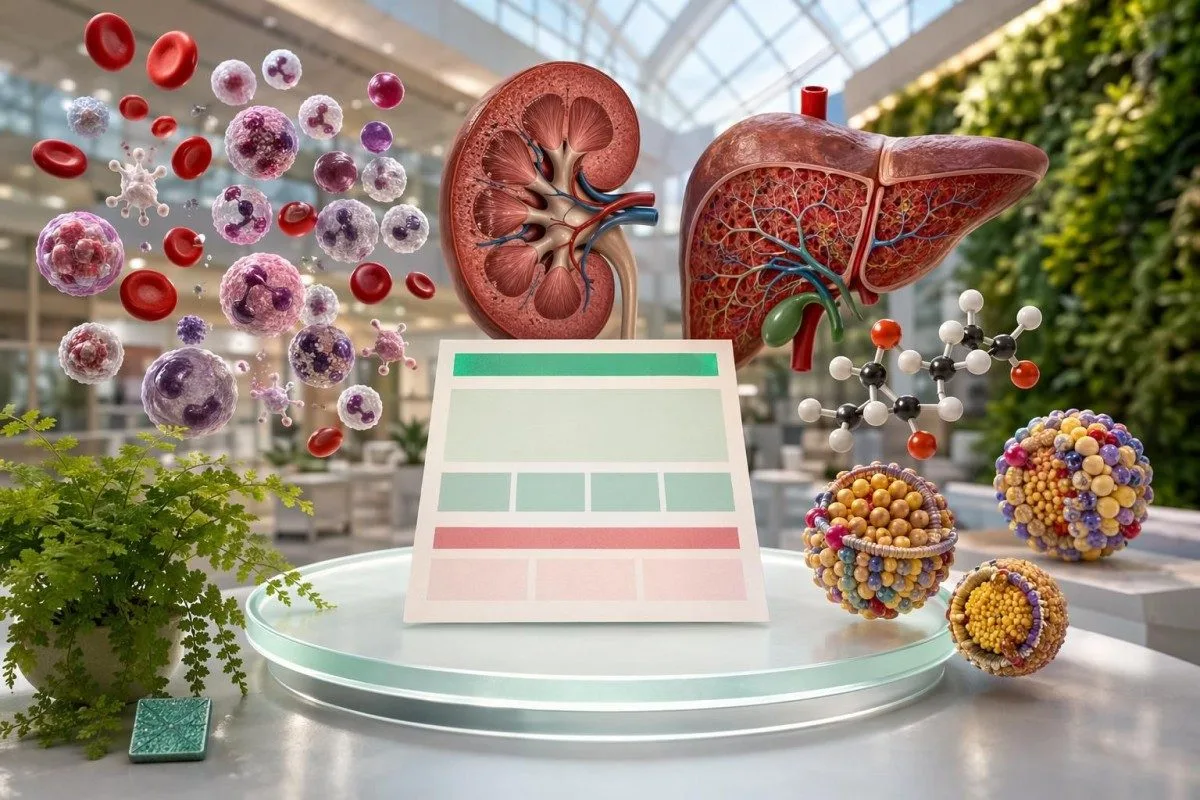
De fleste unormale laboratorieflagg er ikke diagnoser. Det tryggere spørsmålet er om relaterte verdier beveger seg sammen i et mønster som din kliniker kan bekrefte.


- Pattern reading betyr å sammenligne relaterte markører som hemoglobin, MCV, RDW og ferritin i stedet for å reagere på ett høyt eller lavt flagg.
- Dehydrering øker ofte hematokrit, albumin, totalprotein, natrium og BUN sammen; et BUN/kreatinin-forhold over 20:1 kan passe et mønster med lite væske.
- Inflammasjon er mer overbevisende når CRP over 10 mg/L, ESR-forhøyelse, høye nøytrofiler eller blodplater, og symptomer peker i samme retning.
- Anemia clues starter med hemoglobin under 12,0 g/dL hos mange voksne kvinner eller under 13,5 g/dL hos mange voksne menn, deretter snevrer MCV og RDW inn årsaken.
- Kidney stress er ikke bare kreatinin; eGFR under 60 mL/min/1,73 m² i 3 måneder eller urin ACR over 30 mg/g krever strukturert oppfølging.
- Metabolic risk kan oppstå før diabetes når fastende glukose er 100-125 mg/dL, A1C er 5,7-6,4%, triglyserider er høye, og HDL er lavt.
- Lipid risk bedømmes bedre med LDL-C, non-HDL-C, triglyserider, ApoB der det er tilgjengelig, blodtrykk, alder, røyking og diabetesstatus.
- Trends betyr noe: en laboratorieendring mindre enn normal biologisk variasjon kan være støy, mens den samme endringen gjentatt to ganger er vanligvis mer handlingsrettet.
Les mønstre før du reagerer på et flagg
Betydning av blodprøvetall blir tydeligere når du leser klynger: CBC-verdier, kjemi-verdier, nyremarkører, leverenzymer, glukose og lipider. Et enkelt rødt flagg diagnostiserer sjelden noe; et mønster av 3-5 relaterte endringer kan indikere dehydrering, betennelse, anemi, nyrestress eller metabolsk risiko før din oppfølgingsavtale. Vår Kantesti AI analysator er bygget rundt den mønsterlogikken, ikke panikk over ett tall.
Det praktiske skiftet er enkelt: slutt å spørre, “Er denne verdien høy?” og spør, “Hvilke andre verdier beveget seg med den?” Hvis hematokrit, albumin og BUN alle stiger, er det en annen historie enn isolert BUN på 23 mg/dL med normal urin, normal kreatinin og et proteinrikt middag kvelden før.
I vår analyse av blodprøver er den vanligste pasientfeilen å behandle et lab-flagg som en diagnose. For en mer fullstendig forklaring på hvorfor referanseområder kan villede, les vår veiledning til normale referanseområder for blodprøver.
Per 14. mai 2026 rapporterer de fleste store laboratorier fortsatt resultater som isolerte linjer, selv om klinikere tenker i klynger. Den uoverensstemmelsen er grunnen til at pasienter ofte føler seg forvirret etter å ha mottatt resultater fra blodpaneler kl. 22 uten menneskelig forklaring.
Hvorfor ett høyt eller lavt resultat kan villede
Én unormal verdi kan være støy, timing, hydrering, trening, medisineffekt eller normal biologisk variasjon. Et sant klinisk signal blir vanligvis mer troverdig når to eller flere markører som deler en fysiologi beveger seg i samme retning.
De fleste referanseområder inneholder den midtre delen av en valgt populasjon, noe som betyr at omtrent 1 av 20 friske personer kan ha et flagget resultat på en enkelt test. Bestill 20 markører og, matematisk sett, er minst ett mildt flagg ikke overraskende.
Kantestis nevrale nettverk leser enhetssystemer, alder, kjønn, graviditetsstatus der gitt, medisin-ledetråder og resultat-klynger mot vår biomarker guide. Det har betydning fordi kreatinin på 1,2 mg/dL kan være vanlig hos en muskuløs 28-åring, men bekymringsfull hos en skrøpelig 82-åring.
Noen europeiske laboratorier bruker lavere øvre grenser for ALT enn mange amerikanske laboratorier, og noen pediatriske områder endres hver måned i spedbarnsalderen. Hvis forkortelser er en del av forvirringen, er vår blodprøveforkortelser veiledning en god følgesvenn.
Jeg forteller pasienter å sirkle tre ting før de bekymrer seg: graden av abnormalitet, om relaterte resultater er enige, og om resultatet samsvarer med symptomer. Et kalium på 5,2 mmol/L med en vanskelig prøvetaking er svært forskjellig fra kalium på 6,3 mmol/L med svakhet eller EKG-endringer.
Dehydreringsmønster: konsentrert blodkjemi
Et dehydreringsmønster viser vanligvis konsentrasjon: høyere hematokrit, hemoglobin, albumin, totalprotein, natrium og BUN, ofte med et BUN/kreatinin-forhold over 20:1. Mønsteret er sterkere hvis urinen er mørk, pulsen er høy, eller testen fulgte etter faste, varme, oppkast, diaré eller intens trening.
BUN er vanligvis 7-20 mg/dL hos voksne, men en BUN på 28 mg/dL med normal kreatinin kan passe med dehydrering eller høyt proteininntak. Hvis kreatinin også stiger, tenker vi hardere på nyre-perfusjon, medisin-effekter eller ekte nyreskade.
En 41 år gammel syklist sendte oss en gang et panel etter en varm 90 km tur: hematokrit 52%, albumin 5,2 g/dL, natrium 146 mmol/L og BUN 31 mg/dL. Gjentakelsestesten 72 timer senere, etter normal væskeinntak og ingen utholdenhetsøkt, så umerkelig ut; vår dehydrering falske høyder artikkel dekker dette mønsteret i mer detalj.
Her er nyansen pasienter går glipp av: dehydrering kan få kolesterol, kalsium og totalprotein til å se mildt høye ut fordi væskedelen av plasma er redusert. Et kalsium på 10,4 mg/dL med albumin 5,1 g/dL kan normaliseres etter korrigering for albumin, mens kalsium på 11,2 mg/dL med normal albumin fortjener en annen samtale.
Ikke tving i deg vann før hver test; overhydrering kan fortynne natrium og forvirre tolkningen. De fleste pasienter har det best med normal hydrering, ingen ekstrem trening i 24-48 timer, og følger laboratoriets fasteinstruksjoner.
Betennelsesmønster: CRP, ESR, WBC og blodplater
Et inflammatorisk mønster er mest overbevisende når CRP, ESR, differensialtelling av hvite blodceller og blodplater støtter samme historie. CRP over 10 mg/L indikerer vanligvis en aktiv vevsrespons, mens hs-CRP over 3 mg/L brukes oftere for kardiovaskulær risiko når det ikke er akutt sykdom.
CRP kan stige innen 6-8 timer etter en immunutløser og faller ofte raskt når utløseren har roet seg. ESR beveger seg saktere fordi den påvirkes av fibrinogen, immunglobuliner, alder, kjønn, graviditet og anemi.
Jeg er Thomas Klein, MD, og i klinisk vurdering stoler jeg mer på en CRP på 48 mg/L pluss nøytrofiler på 12,0 x10^9/L enn på en ESR på 38 mm/time hos en 76-åring med normal CRP. Vår sammenligning av inflammasjonsblodprøver forklarer hvorfor de to markørene kan være uenige.
Blodplater ligger normalt rundt 150-450 x10^9/L, men de kan stige over 450 x10^9/L i uker etter infeksjon, kirurgi eller jernmangel. Derfor kan høye blodplater pluss lav MCV og lav ferritin indikere en jernhistorie, ikke et primært blodplatproblem.
Når ESR er høy og hemoglobin er lav, tenker klinikere på kronisk betennelse, nyresykdom, autoimmun sykdom, okkult blødning eller malignitet avhengig av alder og symptomer. Vår artikkel om høy ESR og lav hemoglobin gir den klyngen den oppmerksomheten den fortjener.
Anemimønster: hemoglobin, MCV, RDW og ferritin
Anemi er et mønster, ikke bare lav hemoglobin. I mange laboratorier for voksne er hemoglobin under 12,0 g/dL hos kvinner eller under 13,5 g/dL hos menn lavt, men MCV, RDW, ferritin, transferrinmetning og retikulocytter forteller vanligvis årsaken.
MCV på 80-100 fL er vanligvis normocytisk, under 80 fL er mikrocytisk, og over 100 fL er makrocytisk. En lav MCV med høy RDW peker ofte mot jernmangel, mens en lav MCV med et høyt RBC-tall kan tyde på thalassemietrekk.
Kantesti AI leser anemiklynger ved å pare CBC-indekser med jernstudier, B12, folat, nyremarkører og betennelsesmarkører når tilgjengelig. For en dypere klinisk ruteplan, se vår anemi-mønsterveiledning.
Ferritin rapporteres ofte som normalt ned til 12-15 ng/mL, men mange symptomatiske menstruerende pasienter føler seg bedre når jernlagrene er tydelig over 30 ng/mL; klinikere er uenige om den nøyaktige grensen. Bevisene her er ærlig talt blandede, spesielt når betennelse presser ferritin oppover.
Et vanlig tidlig mønster er ferritin 14 ng/mL, hemoglobin 12,4 g/dL og RDW 15,2%, der pasienten ennå ikke formelt er anemisk. Derfor lavt ferritin med normalt hemoglobin fortjener oppfølging snarere enn avvisning.
Nyrestressmønster: eGFR, kreatinin, BUN og urin ACR
Nyrestress leses best ved å kombinere eGFR, kreatinin, BUN, elektrolytter, blodtrykk og urin albumin-kreatinin-ratio. KDIGO definerer kronisk nyresykdom ved nyreabnormiteter som varer minst 3 måneder, inkludert eGFR under 60 mL/min/1,73 m² eller urin ACR på eller over 30 mg/g (KDIGO CKD Work Group, 2024).
Kreatinin er en muskeldrevet avfallsmarkør, så den kan se bedragersk normal ut hos eldre voksne med lav muskelmasse. Et kreatinin på 0,9 mg/dL kan skjule en eGFR på 58 mL/min/1,73 m² hos en mindre eldre pasient.
BUN og kreatinin stiger sammen ved mange nyreproblemer, men BUN kan stige alene ved dehydrering, gastrointestinal blødning, steroider eller høyt proteininntak. Vår guide på enkelt engelsk til hva eGFR betyr er nyttig når rapporten gir et tall, men ingen kontekst.
Urin ACR er en av de mest underutnyttede tidlige varslingstestene i primærhelsetjenesten. En urin ACR under 30 mg/g er vanligvis normal, 30-300 mg/g er moderat økt, og over 300 mg/g er alvorlig økt; vår urin ACR-veiledning forklarer hvorfor den kan endre behandlingen før kreatinin beveger seg.
Når jeg gjennomgår et panel som viser eGFR 52, kalium 5,4 mmol/L og bikarbonat 18 mmol/L, behandler jeg ikke disse som tre separate flagg. Sammen antyder de redusert renal reserve eller medikamentrelatert nyrestress inntil det motsatte er bevist.
Elektrolyttmønster: natrium, kalium, klorid og CO2
Elektrolyttmønstre viser væskebalanse, syre-base-status, nyrefunksjon og medikamenteffekter. Natrium er vanligvis 135-145 mmol/L, kalium 3,5-5,0 mmol/L, klorid 98-107 mmol/L og CO2/bikarbonat ca. 22-29 mmol/L i mange voksne laboratorier.
Lavt natrium er ikke alltid “for lite salt”. Natrium på 128 mmol/L kan reflektere overskudd av vann, diuretika, hjertesvikt, binyresykdom, nyresykdom eller syndrom med inadekvat antidiuretisk hormon, og symptomer betyr mer enn merkelappen.
Kalium fortjener respekt fordi hjertet er elektrisk sensitivt. Et kalium under 3,0 mmol/L eller over 6,0 mmol/L kan være akutt, spesielt ved svakhet, hjertebank, brystsmerter eller nyresvikt; vår elektrolyttpanel guide viser de vanlige mønstrene.
CO2 på en grunnleggende metabolsk panel er mest bikarbonat, ikke lungeoksygen. Lav CO2 med høy aniongap kan passe med ketoacidose, melkesyreacidose, nyresvikt eller eksponering for giftstoffer, mens lav CO2 med høy klorid kan passe med diaré eller renal tubulær acidose.
En prøvefeil kan etterligne farlig kalium, spesielt hvis celler brytes under innsamling eller transport. Derfor gjentar klinikere ofte et uventet kalium på 5,7 mmol/L før de handler, med mindre symptomer eller EKG-funn er til stede.
Metabolsk risikofaktor: glukose, A1C, insulin og triglyserider
Metabolsk risiko dukker ofte opp som en klynge: fastende glukose 100-125 mg/dL, A1C 5,7-6,4%, fastende insulinøkning, triglyserider over 150 mg/dL og HDL under mål. ADA Professional Practice Committee lister A1C 6,5% eller høyere, fastende glukose 126 mg/dL eller høyere, eller 2-timers glukose 200 mg/dL eller høyere som diabetesområderesultater når de er bekreftet (ADA, 2026).
A1c estimerer omtrent 2-3 måneders glykemi, men det er ikke perfekt. Jernmangel, nylig blodtap, nyresykdom, graviditet, hemoglobinvarianter og endret levetid for røde blodceller kan gjøre at A1c er uenig med fastende glukose.
I praksis er pasienten som bekymrer meg ofte ikke den med en enkelt glukose på 103 mg/dL etter dårlig søvn. Det er personen med fastende glukose 108 mg/dL, triglyserider 210 mg/dL, HDL 38 mg/dL og ALT 52 IU/L, fordi den klyngen passer med insulinresistens og risiko for fettlever.
Vår blodprøve for prediabetes guide forklarer hvorfor grenseresultater trenger kontekst, ikke skam. Hvis fastende insulin er tilgjengelig, kan HOMA-IR over ca. 2,0-2,5 tyde på insulinresistens, selv om grenseverdiene varierer etter populasjon og metode.
Kantesti AI tolker metabolske paneler ved å sjekke om glukose, A1c, triglyserider, HDL, ALT, midjemål-risikofaktorer og medikamenthistorikk peker i samme retning. Et enkelt grenseglukoseresultat fortjener sjelden en drastisk kostholdsomlegging.
Kolesterollmønster: LDL, HDL, non-HDL og ApoB-ledetråder
Kolesterolrisiko er ikke bare totalt kolesterol; LDL-C, ikke-HDL-C, triglyserider, HDL-C, ApoB når tilgjengelig, alder, blodtrykk, røyking og diabetesstatus endrer betydningen. 2018 AHA/ACC kolesterolretningslinje behandler risikoforsterkere som vedvarende høye triglyserider, familiehistorikk og kronisk inflammatorisk sykdom som kontekst for LDL-beslutninger (Grundy et al., 2019).
LDL-C under 100 mg/dL kalles ofte nær optimalt for voksne med lav risiko, men pasienter med høy risiko kan få mål under 70 mg/dL eller enda lavere avhengig av lokale retningslinjer. Derfor er “normal LDL” ikke det samme som “lav risiko.”
Triglyserider under 150 mg/dL er vanligvis normale, 150-499 mg/dL er forhøyet, og 500 mg/dL eller høyere gir bekymring for pankreatittrisiko så vel som metabolisk risiko. Vår lipidpanel-veiledning gir de vanlige grenseverdiene og deres begrensninger.
Ikke-HDL-kolesterol er totalkolesterol minus HDL, og det fanger opp kolesterol båret av aterogene partikler. Hos pasienter med triglyserider over 200 mg/dL kan ApoB være mer informativt fordi det estimerer partikkelantall heller enn kolesterolmasse.
Et klinisk eksempel: LDL-C 118 mg/dL, HDL 62 mg/dL og triglyserider 82 mg/dL er ikke det samme risikemønsteret som LDL-C 118 mg/dL, HDL 36 mg/dL og triglyserider 260 mg/dL. Samme LDL, forskjellig fysiologi.
Lever- eller muskelsmønster: AST, ALT, ALP, GGT og CK
Leverenzymbetydning avhenger av mønsteret: ALT og AST tyder på hepatocellulær stress, ALP og GGT tyder på gallegang- eller kolestatiske mønstre, og CK bidrar til å skille muskel-skade fra leverskade. ALT er ofte mer leverspesifikk enn AST, mens AST kan stige etter hard trening, muskelskade eller alkoholrelatert leverstress.
En 52 år gammel maratonløper presenterte en gang med AST 89 IU/L og ALT 42 IU/L etter et løp. Før noen fikk panikk, kom CK tilbake over 1 200 IU/L, noe som omdefinerte AST som muskelrelatert snarere enn primært leverrelatert.
ALT rapporteres vanligvis med øvre grenser rundt 35-56 IU/L, men noen leverspesialister foretrekker lavere terskler, spesielt hos kvinner. Vår AST/ALT-ratioguide forklarer hvorfor et AST/ALT-forhold over 2 kan gi bekymring for alkoholassosiert leverskade i riktig kontekst.
ALP-økning med normal GGT peker ofte bort fra leveren og mot bein, vekst, graviditet eller helende brudd. ALP-økning med høy GGT er mer hepatobiliær og fortjener gjennomgang av gallegangsykdom, fettlever, alkoholpåvirkning og medisiner.
Vår AI kaller ikke hver mild ALT-økning for “leversykdom.” Den sjekker BMI-ledetråder, triglyserider, glukose, AST, ALP, GGT, bilirubin, medisiner og treningstidspunkt fordi en ALT på 61 IU/L kan bety veldig forskjellige ting i forskjellige kropper.
Falske mønsterdannere: faste, trening, sykdom og medisiner
Falske mønstre oppstår når testbetingelsene endrer biologien mer enn sykdommen gjør. Fastevarighet, nylig trening, alkohol, kosttilskudd, steroider, diuretika, biotin, infeksjon og til og med tidspunktet på dagen kan forskyve resultater nok til å skape misvisende klynger.
En 16-timers faste kan øke ketoner, urinsyre og noen ganger bilirubin, mens en kort faste etter et måltid med mye fett kan øke triglyserider. Vår faste versus ikke-faste veiledning viser hvilke resultater som ofte beveger seg.
Hard styrketrening kan øke CK i 2–7 dager og kan heve AST, ALT og noen ganger kreatinin. En muskuløs person som tar kreatin kan vise kreatinin 1,3 mg/dL med et normalt nyreestimat basert på cystatin C.
Biotindoser på 5–10 mg/dag, som ofte selges for hår og negler, kan forstyrre enkelte immunanalyser og få resultater for TSH eller hormoner til å se feil ut. Jeg spør rutinemessig om biotin når TSH, fritt T4 og symptomer ikke stemmer overens.
Sykdom gir en ekstra felle. En mild virusinfeksjon kan øke lymfocytter, senke nøytrofiler, øke CRP moderat og senke trombocytter i en til to uker, og det er derfor det ofte er mer nyttig å gjenta grenseverdige avvik etter rekonvalesens enn å bestille 12 ekstra tester med én gang.
Trendmønster: når en liten endring faktisk er reell
En trend er meningsfull når endringen er større enn forventet biologisk og laboratoriemessig variasjon, gjentas over tid, og passer med resten av panelet. En kreatininendring fra 0,82 til 0,88 mg/dL er vanligvis støy; en økning fra 0,82 til 1,18 mg/dL med fallende eGFR er det ikke.
Mange vanlige analyter varierer fra dag til dag. Triglyserider kan skifte 20–30% med måltider og alkohol, mens TSH kan endre seg med tidspunkt på døgnet, forstyrret søvn og tidspunkt for medisinering.
Vår blodprøvesammenligning sjekker retning, størrelse og nærliggende markører i stedet for bare å plotte en linje. Det er nyttig fordi en ferritinøkning fra 18 til 55 ng/mL etter jernbehandling er forventet, mens ferritin 55 til 420 ng/mL med CRP 68 mg/L tyder på at inflammasjon kan drive økningen.
Den mest nyttige pasientvanen er å holde samme laboratorium, samme fastegrad og omtrent samme prøvetakingstid når du følger opp en grenseverdi. For mer detaljer, vår variasjon i blodprøver forklarer hvorfor to “normale” resultater likevel kan representere en reell personlig endring.
Thomas Klein, MD vurderer tilfeller der en teknisk sett normal trend betyr noe: eGFR 105, 91, 78 og 66 over fire år er ikke en rød flagg alene, men stigningen fortjener oppmerksomhet. Et enkelt normalt øyeblikksbilde kan skjule et langsomt mønster.
Røde flagg-klynger som fortjener råd samme dag
Noen laboratoriegrupper bør ikke vente på en rutineavtale. Råd samme dag er fornuftig for kalium på eller over 6,0 mmol/L, natrium under 125 mmol/L med symptomer, hemoglobin nær eller under 7–8 g/dL, trombocytter under 20 x10^9/L, eller raskt stigende kreatinin med redusert vannlating.
Tallenes haster øker når symptomene stemmer: brystsmerter med høy troponin, forvirring ved alvorlig natriumavvik, svarte avføringer med fallende hemoglobin, eller feber med svært lave nøytrofiler. Vår kritiske laboratorieverdier forklarer hvorfor symptomer og tempo i endring betyr noe.
Et WBC-antall over 30 x10^9/L kan forekomme ved alvorlig infeksjon, steroider, inflammasjon eller blodsykdommer, men differensialen endrer bekymringen. Blaster, svært høye umodne celler, eller samtidig anemi og lave trombocytter bør eskaleres raskt.
Våre leger og vurderere, inkludert medlemmer av den Medisinsk rådgivende styre, behandler hastegrupper annerledes enn velværemønstre. KI kan triagere kontekst, men den kan ikke undersøke deg, sjekke EKG-en din eller avgjøre om du trenger akutt helsehjelp.
Hvis svaret ditt er farlig og du føler deg dårlig, ikke vent på en app-tolkning. Bruk lokale legevakttjenester eller medisinsk hjelp samme dag.
Hva du skal spørre din kliniker etter å ha sett et mønster
De beste oppfølgingsspørsmålene er spesifikke: hvilken klynge er til stede, hvor stor er abnormaliteten, hvilket gjentatt intervall er tryggest, og hvilken bekreftende test vil endre håndteringen? Å be om “flere laboratorietester” er mindre nyttig enn å spørre om ferritin, urin ACR, cystatin C, retikulocytter eller ApoB vil klargjøre mønsteret.
For anasmimønstre, spør om jernstudier, B12, folat, retikulocytt-telling og CRP er nødvendig. For nyremønstre, spør om urin ACR, gjentatt kreatinin, cystatin C eller medisin-gjennomgang vil endre planen.
For metabolske mønstre, spør om din A1c passer til dine glukoseavlesninger og om søvnapné, steroider, nattarbeid eller nylig sykdom kan øke glukosen. Vår guide om å gjenta unormale laboratorieprøver gir praktiske tidsintervaller.
For lipidmønstre, spør om risikoberegning, ApoB, Lp(a), skjoldbruskkjertelfunksjon eller leverenzymer er relevant før medisinbeslutninger tas. En pasient med LDL 165 mg/dL og en sterk familiehistorie trenger en annen samtale enn LDL 132 mg/dL etter julevektøkning.
Ta med de gamle resultatene. Ett års trenddata sparer ofte en ny time, spesielt når en verdi ligger like utenfor laboratoriegrensen.
Kantesti forskningsnotater og trygg AI-tolkning
Kantesti AI hjelper pasienter med å forstå blodprøveresultater ved å gruppere relaterte verdier, sjekke enheter, sammenligne trender og markere mønstre som krever oppfølging av helsepersonell. Det er ikke en diagnosemotor; det er et strukturert tolkningslag som hjelper deg med å stille bedre spørsmål på omtrent 60 sekunder.
Vår AI-drevet tolkning av blodprøver plattformen støtter opplasting av PDF og bilder, trendanalyse, gjennomgang av familiens helserisiko og ernæringsplanlegging på 75+ språk. Hvis du vil ha en rask lesning før avtalen din, kan du prøv gratis analyse med din egen rapport.
Kantestis kliniske standarder er dokumentert gjennom vår medisinsk validering prosess, og teamet vårt er beskrevet på Om Kantesti. I praksis er den tryggeste bruken å ta med AI-sammendraget til en helsepersonell, ikke å erstatte helsepersonellet.
Klein, T., & Kantesti AI Clinical Research Group. (2026). Multilingual AI Assisted Clinical Decision Support for Early Hantavirus Triage: Design, Engineering Validation, and Real-World Deployment Across 50,000 Interpreted Blood Test Reports. Figshare. DOI: 10.6084/m9.figshare.32230290. ResearchGate-søk. Academia.edu-søk.
Klein, T., & Kantesti AI Clinical Research Group. (2025). RDW Blood Test: Complete Guide to RDW-CV, MCV & MCHC. Zenodo. DOI: 10.5281/zenodo.18202598. ResearchGate-søk. Academia.edu-søk.
Ofte stilte spørsmål
Hva er den enkleste måten å forstå blodprøvesvar?
Den enkleste måten å forstå blodprøvetall på er å lese tilhørende verdier sammen i stedet for å reagere på én enkelt høy eller lav flaggverdi. For eksempel kan høyt BUN, høy albumin og høy hematokrit tyde på dehydrering, mens lavt hemoglobin, lav MCV og høy RDW kan tyde på jernrelatert anemi. En enkelt mild avvikende verdi er ofte mindre meningsfull enn en gjentatt klynge på tvers av 2 eller flere tester.
Hvilket blodprøvemønster tyder på dehydrering?
Et dehydreringmønster omfatter ofte BUN over 20 mg/dL, BUN/kreatinin-ratio over 20:1, høyere hematokrit, albumin over omtrent 5,0 g/dL, økning i totalprotein og noen ganger natrium over 145 mmol/L. Dette mønsteret er mer sannsynlig etter faste, kraftig svetting, oppkast, diaré eller lav væskeinntak. Raskt stigende kreatinin, forvirring, besvimelse eller redusert vannlating krever rask medisinsk vurdering.
Hvilke blodprøvetall tyder på betennelse?
Inflammasjon er mer sannsynlig når CRP er over 10 mg/L, ESR er forhøyet i forhold til alder og kjønn, nøytrofiler eller trombocytter er høye, og symptomene passer med infeksjon, autoimmun sykdom eller vevsskade. hs-CRP over 3 mg/L tolkes vanligvis annerledes fordi den ofte brukes for kardiovaskulær risiko når det ikke foreligger akutt sykdom. ESR kan forbli forhøyet lenger enn CRP og kan økes ved anemi, graviditet, alder og høye immunglobuliner.
Hvordan viser blodprøver anemimønstre?
Anemi starter vanligvis med lavt hemoglobin, ofte under 12,0 g/dL hos voksne kvinner eller under 13,5 g/dL hos voksne menn, men årsaken avhenger av MCV, RDW, ferritin, transferrinmetning og retikulocyttantall. Lav MCV under 80 fL med høy RDW tyder ofte på jernmangel. Høy MCV over 100 fL kan peke mot B12-mangel, folatmangel, alkoholeffekt, leversykdom, stoffskiftesykdom eller medikamenteffekter.
Hvilket blodprøvemønster tyder på nyrepåvirkning?
Nyrestress antydes av fallende eGFR, økende kreatinin, økende BUN, kalium over 5,0 mmol/L, bikarbonat under omtrent 22 mmol/L, eller urin ACR på eller over 30 mg/g. KDIGO definerer kronisk nyresykdom når avvik som eGFR under 60 ml/min/1,73 m² eller forhøyet urin ACR vedvarer i minst 3 måneder. En brå økning i kreatinin eller kalium nær 6,0 mmol/L fortjener akutt innspill fra behandlende lege.
Kan blodprøver vise metabolsk risiko før diabetes?
Ja, metabolsk risiko kan oppstå før diabetes når fastende glukose er 100–125 mg/dL, A1C er 5,7–6,4%, triglyserider overstiger 150 mg/dL og HDL er lav. Resultater i diabetesområdet omfatter A1c på eller over 6,5% eller fastende glukose på eller over 126 mg/dL når det er bekreftet. A1c kan være misvisende ved jernmangel, nyresykdom, graviditet, nylig blodtap eller hemoglobinsvarianter.
Når bør unormale blodprøvesvar gjentas?
Milde uventede avvik gjentas ofte innen 1–8 uker avhengig av markør, symptomer og risikonivå. Kalium-, natrium-, kreatinin-, hemoglobin-, trombocytt- og leukocyttavvik kan kreve raskere kontrollprøver dersom resultatet er betydelig eller symptomer foreligger. Å gjenta under like forhold – samme laboratorium, lik fastestatus og omtrent samme tidspunkt på dagen – gjør trender lettere å stole på.
Hvorfor kan et høyt kaliumresultat måtte gjentas med en gang?
Et uventet høyt kaliumresultat kan oppstå når røde blodceller brytes ned under prøvetaking, og frigjør kalium i prøven. Kontakt rekvirerende lege raskt for veiledning og gjenta testingen; søk akutt hjelp ved svakhet, hjertebank, brystsmerter, eller hvis laboratoriet anbefaler umiddelbare tiltak.
Bør jeg bekymre meg hvis resultatene mine endrer seg etter at jeg bytter til et annet laboratorium?
Ikke automatisk; små endringer kan skyldes ulike testmetoder, referanseområder eller prøvehåndtering. Spør behandleren din om hvorvidt forskyvningen passer med det totale mønsteret ditt, og prøv å bruke samme laboratorium for planlagt oppfølging når det er mulig.
Få AI-drevet analyse av blodprøver i dag
Bli med over 2 millioner brukere over hele verden som stoler på Kantesti for øyeblikkelig, nøyaktig analyse av laboratorietester. Last opp blodprøveresultatene dine og få omfattende tolkning av 15,000+-biomarkører på sekunder.
📚 Refererte forskningspublikasjoner
Klein, T., Mitchell, S., & Weber, H. (2026). Flerspråklig AI-assistert klinisk beslutningsstøtte for tidlig triage ved hantavirus: design, ingeniørmessig verifisering og utrulling i den virkelige verden på tvers av 50 000 tolket blodprøverapporter. Kantesti KI medisinsk forskning.
Klein, T., Mitchell, S., & Weber, H. (2026). RDW-blodprøve: komplett veiledning til RDW-CV, MCV og MCHC. Kantesti KI medisinsk forskning.
📖 Eksterne medisinske referanser
Nyresykdom: Forbedre globale utfall CKD arbeidsgruppe (2024). KDIGO 2024 kliniske retningslinjer for evaluering og håndtering av kronisk nyresykdom. Kidney International.
American Diabetes Association Professional Practice Committee (2026). 2. Diagnosis and Classification of Diabetes: Standards of Care in Diabetes—2026. Diabetes Care.
⚕️ Medisinsk ansvarsfraskrivelse
Denne artikkelen er kun for informasjonsformål og utgjør ikke medisinsk rådgivning. Rådfør deg alltid med en kvalifisert helsepersonell for beslutninger om diagnose og behandling.
E-E-A-T tillitssignaler
Experience
Klinisk gjennomgang ledet av lege av arbeidsflyter for laboratorietolkning.
Expertise
Fagområde laboratoriemedisin med fokus på hvordan biomarkører oppfører seg i klinisk kontekst.
Authoritativeness
Skrevet av Dr. Thomas Klein med gjennomgang av Dr. Sarah Mitchell og Prof. Dr. Hans Weber.
Trustworthiness
Evidensbasert tolkning med tydelige oppfølgingsveier for å redusere uro.