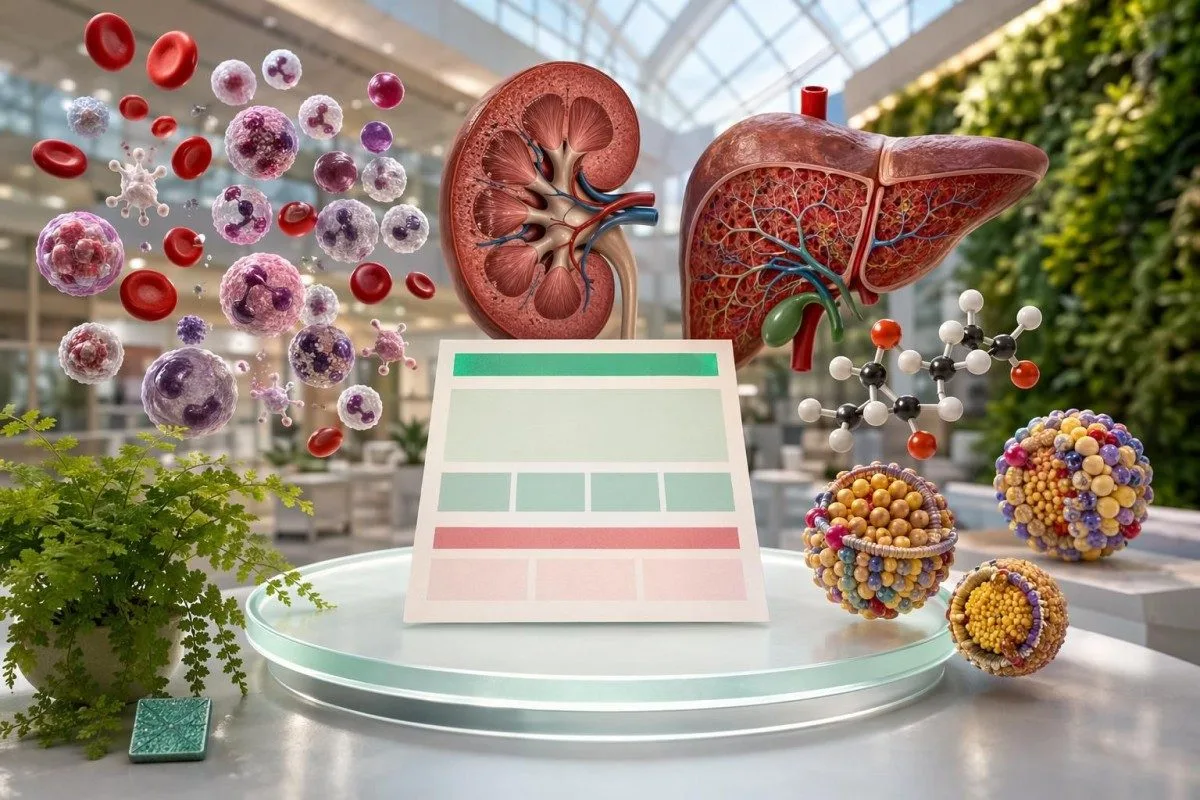
Flestar óeðlilegar rannsóknarstofumerkingar eru ekki greiningar. Öruggari spurningin er hvort tengdar mælingar hreyfast saman í ákveðnu mynstri sem læknirinn þinn getur staðfest.


- Mynstralestur þýðir að bera saman tengda mælikvarða eins og blóðrauða, MCV, RDW og ferritín frekar en að bregðast við einni háu eða lágu merkingu.
- Ofþornun hækkar oft blóðkornahlutfall (hematocrit), albúmín, heildarprótein, natríum og BUN saman; BUN/kreatínín hlutfall yfir 20:1 getur passað við lágt-vökvamynstur.
- Bólga er sannfærandi þegar CRP er yfir 10 mg/L, ESR hækkar, hækkaðir daufkyrningar eða blóðflögur eru til staðar og einkennin benda í sömu átt.
- Ábendingar um blóðleysi byrja á blóðrauða undir 12.0 g/dL hjá mörgum fullorðnum konum eða undir 13.5 g/dL hjá mörgum fullorðnum körlum, og þá þrengja MCV og RDW orsökina.
- Álag á nýru er ekki bara kreatínín; eGFR undir 60 mL/min/1.73 m² í 3 mánuði eða þvag ACR yfir 30 mg/g krefst skipulagðrar eftirfylgni.
- Efnaskiptaáhætta getur komið fram áður en sykursýki þróast þegar fastandi glúkósi er 100-125 mg/dL, HbA1c er 5.7-6.4%, þríglýseríð eru há og HDL er lágt.
- Lípíðáhætta er betur metin með LDL-C, non-HDL-C, þríglýseríðum, ApoB ef það liggur fyrir, blóðþrýstingi, aldri, reykingastöðu og stöðu sykursýki.
- Þróun skiptir máli: breyting á rannsóknarstofu sem er minni en eðlileg líffræðileg breytileiki getur verið suð, en sama tilfærslan endurtekin tvisvar er venjulega meira framkvæmanleg.
Lestu mynstrin áður en þú bregst við merkingu
Merking talna í blóðprufu verður skýrari þegar þú lest klasa: gildi úr heildarblóðtölu (CBC), lífefnafræðigildi, nýrnamerki, lifrarensím, glúkósa og lípíð. Ein einangruð rauð flögg sjaldan greinir neitt; mynstur 3–5 tengdra breytinga getur bent til ofþornunar, bólgu, blóðleysis, álags á nýru eða efnaskiptaáhættu áður en þú kemur í eftirfylgni. Okkar Kantesti AI greinir er byggður utan um þetta mynsturlógík, ekki læti yfir einu gildi.
Hagnýta tilfærslan er einföld: hættu að spyrja, “Er þetta gildi hátt?” og spyrðu, “Hvaða önnur gildi færðust með?” Ef hematókrít, albúmín og BUN eru öll upp, þá er það önnur saga en einangrað BUN upp á 23 mg/dL með eðlilegu þvagi, eðlilegu kreatíníni og hápróteinmat kvöldið áður.
Í greiningu okkar á 2M+ blóðprufum er algengasta mistök sjúklings að meðhöndla rannsóknarstofuflögg eins og það sé greining. Til að fá fyllri skýringu á því hvers vegna viðmiðunarsvið geta villt um fyrir, lestu leiðarvísinn okkar til eðlileg blóðgildi.
Frá og með 14. maí 2026 skila flestum helstu rannsóknarstofum enn niðurstöðum sem einangruðum línum, jafnvel þótt læknar hugsi í klösum. Þessi misræmi er ástæðan fyrir því að sjúklingar finna sig oft ruglaða eftir að hafa fengið niðurstöður blóðprófapakkans kl. 22:00 án mannlegrar skýringar.
Af hverju eitt hátt eða lágt gildi getur villt um fyrir
Eitt óeðlilegt gildi getur verið suð, tímasetning, vökvun, hreyfing, áhrif lyfja eða eðlileg líffræðileg breytileiki. Raunverulegt klínískt merki verður yfirleitt trúverðugra þegar tvö eða fleiri mælikvarðar sem deila lífeðlisfræði færast í sömu átt.
Flest viðmiðunarsvið innihalda miðju 95% valins hóps, sem þýðir að um það bil 1 af hverjum 20 heilbrigðum einstaklingum getur haft flöggða niðurstöðu í hvaða einu prófi sem er. Pantaðu 20 mælikvarða og stærðfræðilega er að minnsta kosti eitt vægt flögg ekki óvænt.
Kantesti les taugakerfið einingakerfi, aldur, kyn, þungunarstöðu þar sem það liggur fyrir, vísbendingar um lyf og klasa niðurstaðna gegn okkar lífmerkjahandbókin okkar. Það skiptir máli vegna þess að kreatínín 1,2 mg/dL getur verið eðlilegt hjá vöðvamiklum 28 ára karlmanni en áhyggjuefni hjá veikburða 82 ára konu.
Sumar evrópskar rannsóknarstofur nota lægri efri mörk fyrir ALT en margar rannsóknarstofur í Bandaríkjunum og sum börn/unglinga-svið breytast á nokkurra mánaða fresti á unglingsárum. Ef skammstafanir eru hluti af ruglinu, þá skammstafanir í blóðprufum eru góður fylgifiskur.
Ég segi sjúklingum að hringja í þrjá hluti áður en þeir hafa áhyggjur: stærð fráviksins, hvort tengdar niðurstöður séu sammála og hvort niðurstaðan passi við einkenni. Kalíum 5,2 mmól/L með erfiðri sýnatöku er mjög ólíkt kalíum 6,3 mmól/L með máttleysi eða breytingum á hjartalínuriti (EKG).
Ofþornunarmynstur: þéttari blóðefnafræði
Ofþornunarmynstur sýnir venjulega þéttingu: hærri hematókrít, hemóglóbín, albúmín, heildarprótein, natríum og BUN, oft með BUN/kreatínín hlutfalli yfir 20:1. Mynstrið er sterkari ef þvagið er dökkt, hjartsláttur er hærri eða prófið var tekið fastandi, í hita, eftir uppköst, niðurgang eða ákafa hreyfingu.
BUN er algengt 7–20 mg/dL hjá fullorðnum, en BUN 28 mg/dL með eðlilegu kreatíníni getur passað við ofþornun eða mikla próteinneyslu. Ef kreatínín hækkar líka, hugsum við meira um blóðflæði til nýrna, áhrif lyfja eða raunverulegt áverka á nýrum.
41 árs hjólreiðamaður sendi okkur einu sinni blóðprófapakka eftir 90 km hjólreiðar í miklum hita: hematókrít 52%, albúmín 5,2 g/dL, natríum 146 mmól/L og BUN 31 mg/dL. Endurtekið próf 72 klukkustundum síðar, eftir eðlilega vökva og án þolsæfingar, virtist óáhugavert; okkar ofþornun sem veldur fölskum háum gildum grein fjallar um þetta mynstur nánar.
Hér er blæbrigðin sem sjúklingar missa af: ofþornun getur látið kólesteról, kalsíum og heildarprótein líta vægilega hátt út vegna þess að vökvahluti blóðvökvans minnkar. Kalsíum 10,4 mg/dL með albúmín 5,1 g/dL getur orðið eðlilegt eftir leiðréttingu fyrir albúmín, en kalsíum 11,2 mg/dL með eðlilegu albúmíni á skilið aðra umræðu.
Ekki neyða vatn fyrir hvert próf; ofvökvun getur þynnt natríum og ruglað túlkun. Flestir sjúklingar standa sig best með eðlilegri vökvun, engri mikilli hreyfingu í 24–48 klukkustundir og með því að fylgja leiðbeiningum rannsóknarstofunnar um föstu.
Bólgumynstur: CRP, ESR, WBC og blóðflögur
Bólgumynstur er sannfærandiast þegar CRP, ESR, hvítfrumumunur og blóðflögur styðja sömu sögu. CRP yfir 10 mg/L bendir venjulega til virkrar svörunar í vefjum, en hs-CRP yfir 3 mg/L er oftar notað vegna hjarta- og æðaráhættu þegar engin bráð veikindi eru til staðar.
CRP getur hækkað innan 6-8 klukkustunda eftir ónæmisörvun og fellur oft fljótt þegar örvunin líður hjá. ESR hreyfist hægar vegna þess að það hefur áhrif frá fíbrínógeni, immúnóglóbúlínum, aldri, kyni, meðgöngu og blóðleysi.
Ég heiti Thomas Klein, læknir, og í klínískri yfirferð treysti ég CRP upp á 48 mg/L ásamt daufkyrningum 12.0 x10^9/L mjög ólíkt ESR upp á 38 mm/klst. hjá 76 ára einstaklingi með eðlilegt CRP. Samanburður okkar á bólgublóðrannsóknum útskýrir hvers vegna þessir tveir mælikvarðar geta verið ósammála.
Blóðflögur eru venjulega um 150-450 x10^9/L, en þær geta hækkað yfir 450 x10^9/L í margar vikur eftir sýkingu, skurðaðgerð eða járnskort. Þess vegna getur hátt blóðflögugildi ásamt lágu MCV og lágu ferritíni verið járnsaga, ekki frumvandamál í blóðflögum.
Þegar ESR er hátt og blóðrauði er lágur hugsa læknar um langvinna bólgu, nýrnasjúkdóm, sjálfsofnæmissjúkdóm, dulda blæðingu eða illkynja sjúkdóm eftir aldri og einkennum. Grein okkar um hátt ESR og lágt blóðrauði fær þessum klasa þá athygli sem hann á skilið.
Blóðleysismynstur: blóðrauði, MCV, RDW og ferritín
Blóðleysi er mynstur, ekki bara lágt blóðrauðagildi. Í mörgum fullorðinsrannsóknum er blóðrauði undir 12.0 g/dL hjá konum eða undir 13.5 g/dL hjá körlum lágur, en MCV, RDW, ferritín, transferrínmettun og retíkúlócýtur segja venjulega til um orsökina.
MCV 80-100 fL er venjulega normósýtískt, undir 80 fL er míkrósýtískt og yfir 100 fL er makrósýtískt. Lágt MCV með háu RDW bendir oft til járnskorts, en lágt MCV með háum RBC-fjölda getur bent til thalassemíu-eiginleika.
Kantesti AI les blóðleysis-klasa með því að para CBC-vísa við járnrannsóknir, B12, fólínsýru, nýrnamerki og bólgumælikvarða þegar þeir liggja fyrir. Fyrir ítarlega klíníska leiðarkortlagningu, sjáðu okkar leiðarvísir um blóðleysis-mynstur.
Ferritín er oft skráð sem eðlilegt niður í 12-15 ng/mL, en margir einkennamiklir sjúklingar sem eru með blæðingar upplifa að þeim líði betur þegar járnbirgðir eru greinilega yfir 30 ng/mL; læknar eru ósammála um nákvæma viðmiðunarmörk. Rannsóknargögnin hér eru hreint út sagt blönduð, sérstaklega þegar bólga ýtir ferritíni upp.
Algengt snemma mynstur er ferritín 14 ng/mL, blóðrauði 12.4 g/dL og RDW 15.2%, þar sem sjúklingurinn er ekki formlega með blóðleysi ennþá. Þess vegna lágt ferritín með eðlilegu blóðrauða á það skilið eftirfylgni frekar en að því sé vísað frá.
Álagsmynstur á nýru: eGFR, kreatínín, BUN og þvag ACR
Álagsmat á nýru er best lesið með því að sameina eGFR, kreatínín, BUN, raflausnir, blóðþrýsting og þvag-albúmín/kreatínínhlutfall. KDIGO skilgreinir langvinna nýrnasjúkdóma með frávikum í nýrum sem vara í að minnsta kosti 3 mánuði, þar á meðal eGFR undir 60 ml/mín/1,73 m² eða þvag ACR sem er 30 mg/g eða hærra (KDIGO CKD Work Group, 2024).
Kreatínín er úrgangsvísir sem tengist vöðvum, þannig að það getur litið blekkjandi eðlilega út hjá eldri fullorðnum með lítið vöðvamagn. Kreatínín 0,9 mg/dL getur falið eGFR upp á 58 ml/mín/1,73 m² hjá smærri eldri sjúklingi.
BUN og kreatínín hækka saman í mörgum nýrnavandamálum, en BUN getur hækkað eitt sér við ofþornun, blæðingu í meltingarvegi, stera eða mikla próteinneyslu. Einfaldur leiðarvísirinn okkar á hvað eGFR þýðir er gagnlegur þegar skýrslan gefur tölugildi en engin samhengi.
Þvag ACR er ein af þeim snemmbúnu viðvörunarprófum sem er síst notuð í heilsugæslu. Þvag ACR undir 30 mg/g er venjulega eðlilegt, 30-300 mg/g er í meðallagi aukið og yfir 300 mg/g er mjög aukið; okkar leiðarvísir um ACR í þvagi útskýrir hvers vegna það getur breytt meðferð áður en kreatínín breytist.
Þegar ég fer yfir panel sem sýnir eGFR 52, kalíum 5,4 mmól/L og bíkarbónat 18 mmól/L, meðhöndla ég ekki þetta sem þrjár aðskildar viðvaranir. Samtals benda þetta til minnkaðs nýrnaforða eða nýrnasress vegna lyfja þar til annað er sannað.
Raflausnamynstur: natríum, kalíum, klóríð og CO2
Mynstur raflausna sýna vökvajafnvægi, sýru-basa stöðu, hvernig nýrun vinna úr efnum og áhrif lyfja. Natríum er venjulega 135-145 mmól/L, kalíum 3,5-5,0 mmól/L, klóríð 98-107 mmól/L og CO2/bíkarbónat um 22-29 mmól/L í mörgum blóðrannsóknum fullorðinna.
Lítið natríum er ekki alltaf “of lítið salt”. Natríum 128 mmól/L getur endurspeglað umframvatn, þvagræsilyf, hjartabilun, sjúkdóma í nýrnahettum, nýrnasjúkdóm eða heilkenni óviðeigandi seytingar andþvagræsihormóns (SIADH) og einkenni skipta meira máli en merkingin.
Kalíum á skilið sérstaka virðingu vegna þess að hjartað er rafrænt næmt. Kalíum undir 3,0 mmól/L eða yfir 6,0 mmól/L getur verið bráðnauðsynlegt, sérstaklega með máttleysi, hjartsláttarónotum, brjóstverkjum eða skertri nýrnastarfsemi; okkar raflausnapanel leiðarvísir setur fram algeng mynstrin.
CO2 í grunn efnaskipta paneli er að mestu bíkarbónat, ekki súrefni úr lungum. Lítið CO2 með háu anjónabili getur passað við ketósýrublóðsýringu, mjólkursýrublóðsýringu, nýrnabilun eða eiturefnasmit, en lítið CO2 með háu klóríði getur passað við niðurgang eða nýrnapíplubólgu (renal tubular acidosis).
Dæmi um sýnishornsvandamál getur líkt eftir hættulegu kalíum, sérstaklega ef frumuhlutar brotna við söfnun eða flutning. Þess vegna endurtaka læknar oft óvænt kalíum 5,7 mmól/L áður en þeir grípa til aðgerða, nema einkenni eða niðurstöður á hjartalínuriti (EKG) séu til staðar.
Efnaskiptaáhættumynstur: glúkósi, HbA1c, insúlín og þríglýseríð
Efnaskiptahætta birtist oft sem klasi: fastandi glúkósi 100-125 mg/dL, HbA1c 5,7-6,4%, hækkun á fastandi insúlíni, þríglýseríð yfir 150 mg/dL og HDL undir markmiði. ADA Professional Practice Committee skráir HbA1c 6,5% eða hærra, fastandi glúkósa 126 mg/dL eða hærra, eða 2-stunda glúkósa 200 mg/dL eða hærra sem niðurstöður á sykursýkisbilinu þegar það er staðfest (ADA, 2026).
HbA1c metur gróflega 2-3 mánuði af blóðsykri, en það er ekki fullkomið. Skortur á járni, nýleg blóðtaka, nýrnasjúkdómur, meðganga, blóðrauðaafbrigði og breyttur líftími rauðra blóðkorna geta valdið því að HbA1c sé ósamræmt við fastandi glúkósa.
Í framkvæmd er sá sjúklingur sem ég hef áhyggjur af oft ekki sá sem er með einn glúkósa 103 mg/dL eftir slæman svefn. Það er manneskjan með fastandi glúkósa 108 mg/dL, þríglýseríð 210 mg/dL, HDL 38 mg/dL og ALT 52 IU/L, því þessi klasi passar við insúlínviðnám og áhættu á fitulifur.
Okkar blóðpróf vegna forsykursýki leiðarvísirinn útskýrir hvers vegna jaðarniðurstöður þurfa samhengi, ekki skömm. Ef fastandi insúlín liggur fyrir, getur HOMA-IR yfir um 2,0-2,5 bent til insúlínviðnáms, þó að mörk breytist eftir þýði og mæliaðferð.
Kantesti AI túlkar efnaskipta panel með því að athuga hvort glúkósi, HbA1c, þríglýseríð, HDL, ALT, vísbendingar um mittisáhættu og lyfjasaga bendi í sömu átt. Ein jaðarniðurstaða í glúkósa á sjaldan skilið róttæka breytingu á mataræði.
Kólesterólmynstur: LDL, HDL, non-HDL og vísbendingar um ApoB
Kólesteróláhætta er ekki bara heildarkólesteról; LDL-C, non-HDL-C, þríglýseríð, HDL-C, ApoB þegar það liggur fyrir, aldur, blóðþrýstingur, reykingar og staða varðandi sykursýki breyta merkingunni. Árið 2018 meðhöndlar AHA/ACC-kólesterólleiðbeiningin áhættuauka eins og tartilega há þríglýseríð, heilsufarasögu fjölskyldu og langvinna bólgusjúkdóma sem samhengi fyrir ákvarðanir um LDL (Grundy o.fl., 2019).
LDL-C undir 100 mg/dL er oft kallað nær ákjósanlegt fyrir fullorðna með minni áhættu, en sjúklingar í mikilli áhættu geta fengið markgildi undir 70 mg/dL eða jafnvel lægri eftir staðbundnum leiðbeiningum. Þess vegna er “eðlilegt LDL” ekki það sama og “lág áhætta”.”
Þríglýseríð undir 150 mg/dL eru venjulega eðlileg, 150-499 mg/dL er hækkað og 500 mg/dL eða hærra vekur áhyggjur af áhættu á brisbólgu auk efnaskiptaáhættu. Okkar leiðarvísirinn okkar um fitupróf gefur venjuleg mörk og takmörk þeirra.
Non-HDL kólesteról er heildarkólesteról að frádregnu HDL og fangar kólesteról sem berst með æðakölkunarvaldandi agnum. Hjá sjúklingum með þríglýseríð yfir 200 mg/dL getur ApoB verið upplýsandi þar sem það áætlar fjölda agna frekar en magn kólesteróls.
Klínísk dæmi: LDL-C 118 mg/dL, HDL 62 mg/dL og þríglýseríð 82 mg/dL er ekki sama áhættumynstur og LDL-C 118 mg/dL, HDL 36 mg/dL og þríglýseríð 260 mg/dL. Sama LDL, mismunandi lífeðlisfræði.
Lifrar- eða vöðvamynstur: AST, ALT, ALP, GGT og CK
Merking lifrarensíma fer eftir mynstri: ALT og AST benda til álags í lifrarfrumum, ALP og GGT benda til gallganga- eða kólestatískra mynstra og CK hjálpar aðgreina vöðvaskaða frá lifrarskaða. ALT er oft sértækara fyrir lifur en AST, en AST getur hækkað eftir erfiða hreyfingu, vöðvaskaða eða lifrarálagi tengdu áfengi.
52 ára gamall maraþonhlaupari kom einu sinni fram með AST 89 IU/L og ALT 42 IU/L eftir hlaup. Áður en nokkur læti tóku við kom CK aftur yfir 1.200 IU/L, sem endurskýrði AST sem vöðvatengt frekar en fyrst og fremst lifartengt.
ALT er oft skráð með efri mörkum um 35-56 IU/L, en sumir lifrarsérfræðingar kjósa lægri þröskulda, sérstaklega hjá konum. Okkar leiðarvísir fyrir AST/ALT-hlutfallið útskýrir hvers vegna hlutfallið AST/ALT yfir 2 getur vakið áhyggjur um lifrarskaða sem tengist áfengi í réttu samhengi.
Hækkun ALP með eðlilegri GGT bendir oft frekar frá lifur og í átt að beinum, vexti, meðgöngu eða gróanda beinbrota. Hækkun ALP með háu GGT er meira lifrar-gallvegstengd og á skilið yfirferð vegna sjúkdóms í gallgöngum, fitulifrar, áfengisáhrifa og lyfja.
Kantesti AI kallar ekki hverja væga hækkun á ALT “lifrarsjúkdóm”. Það athugar vísbendingar um BMI, þríglýseríð, glúkósa, AST, ALP, GGT, bilirúbín, lyf og hvenær æfing fór fram, því ALT 61 IU/L getur þýtt mjög ólíka hluti í mismunandi líkama.
Rangar mynstragerðir: föstu, hreyfing, veikindi og lyf
Rangar myndir verða þegar prófunarskilyrði breyta líffræðinni meira en sjúkdómurinn gerir. Lengd fastans, nýleg hreyfing, áfengi, fæðubótarefni, sterar, þvagræsilyf, bíótín, sýking og jafnvel tími dags getur fært niðurstöður svo mikið að myndist villandi klös.
16 klukkustunda fast getur hækkað ketón, þvagsýru og stundum bilirúbín, en stutt fast eftir fituríka máltíð getur hækkað þríglýseríð. Okkar föstupróf á móti prófum án föstu leiðarvísirinn listar hvaða niðurstöður hreyfast oft.
Þung mótstöðuþjálfun getur hækkað CK í 2-7 daga og hækkað AST, ALT og stundum kreatínín. Vöðvamaður sem tekur kreatín getur sýnt kreatínín 1,3 mg/dL með eðlilegri áætlun um nýru byggða á cystatíni C.
Bíótínskammtar 5-10 mg/dag, sem oft eru seldir fyrir hár og neglur, geta truflað ákveðnar ónæmisprófanir og látið skjaldkirtils- eða hormónaniðurstöður líta rangar út. Ég spyr reglulega um bíótín þegar TSH, frítt T4 og einkenni passa ekki saman.
Veiki bætir við annarri gildru. Væg veirusýking getur hækkað eitilfrumur, lækkað daufkyrninga, hækkað CRP í hóflegu magni og lækkað blóðflögur í viku eða tvær, þess vegna er oft gagnlegra að endurtaka jaðarnákvæmar frávik eftir bata en að panta 12 aukapróf strax.
Þróunarmynstur: þegar lítil breyting er í raun raunveruleg
Túlkun á þróun er marktæk þegar breytingin er meiri en búist er við miðað við líffræðilegan og rannsóknarstofubreytilleika, endurtekur sig með tímanum og passar við restina af mælipakkanum. Breyting á kreatíníni úr 0,82 í 0,88 mg/dL er venjulega suð; hækkun úr 0,82 í 1,18 mg/dL með lækkandi eGFR er það ekki.
Mörg algeng mæligildi sveiflast frá degi til dags. Þríglýseríð geta breyst um 20-30% með mat og áfengi, en TSH getur breyst eftir tíma dags, truflun á svefni og tímasetningu lyfja.
Okkar samanburð á blóðprufum eiginleikaskoðanir meta átt, stærð og tengd mæligildi í nágrenninu frekar en að teikna bara línu. Það er gagnlegt vegna þess að búist er við að ferritín hækki úr 18 í 55 ng/mL eftir járnameðferð, en ferritín úr 55 í 420 ng/mL með CRP 68 mg/L bendir til að bólga geti verið að knýja hækkunina.
Besta venja sjúklingsins er að halda sömu rannsóknarstofu, sömu fastandi stöðu og svipuðum söfnunartíma þegar fylgst er með jaðargildi. Fyrir nánari upplýsingar, leiðarvísirinn okkar um breytileika blóðprufa útskýrir hvers vegna tvær “eðlilegar” niðurstöður geta samt endurspeglað raunverulega persónulega breytingu.
Thomas Klein, læknir, fer yfir tilvik þar sem tæknilega eðlileg þróun skiptir máli: eGFR 105, 91, 78 og 66 á fjórum árum er ekki rauður fáni í einangrun, en hallan á skilið athygli. Ein eðlileg „mynd“ getur falið hæglátan mynstur.
Rauðir fánaklasar sem eiga skilið ráðgjöf sama dag
Sumir mælahópar ættu ekki að bíða eftir venjulegum tíma. Ráðleggingar sama dag eru skynsamlegar fyrir kalíum við eða yfir 6,0 mmol/L, natríum undir 125 mmol/L með einkennum, blóðrauða nálægt eða undir 7–8 g/dL, blóðflögur undir 20 x10^9/L, eða kreatínín sem hækkar hratt með minnkaðri þvagmyndun.
Tölur verða brýnni þegar einkennin samræmast: brjóstverkur með háu troponíni, ringlun með alvarlegri fráviki í natríum, svartir hægðir með lækkandi blóðrauða, eða hiti með mjög fáum daufkyrningum. Leiðarvísirinn okkar um mikilvægar frávik í blóðrannsóknum útskýrir hvers vegna einkenni og hraði breytinga skipta máli.
WBC-fjöldi yfir 30 x10^9/L getur komið fram við alvarlega sýkingu, stera, bólgu eða blóðsjúkdóma, en mismunagreiningin breytir áhyggjunni. Blöðrur, mjög háar óþroskaðar frumur, eða samtímis blóðleysi og lágar blóðflögur ætti að vísa fljótt áfram.
Læknarnir okkar og yfirlesarar, þar á meðal meðlimir í Læknisfræðileg ráðgjafarnefnd, meðhöndla brýna mælahópa öðruvísi en heilsumynstur. AI getur forgangsraðað eftir samhengi, en getur ekki skoðað þig, athugað hjartalínurit (EKG) eða ákveðið hvort þú þurfir bráðamóttöku.
Ef niðurstaðan þín er hættuleg og þér líður illa skaltu ekki bíða eftir túlkun í appi. Notaðu staðbundna bráðaþjónustu eða læknisþjónustu sama dag.
Hvað á að spyrja lækninn þinn eftir að hafa séð mynstur
Bestu eftirspurnarspurningarnar eru sértækar: hvaða mælahópur er til staðar, hversu stórt er frávikið, hvaða endurprófunartímabil er öruggast og hvaða staðfestingarpróf myndi breyta meðferðaráætlun? Að biðja um “fleiri blóðprufur” er minna gagnlegt en að spyrja hvort ferritín, þvag ACR, cystatin C, reticulocytes eða ApoB myndu skýra mynstur.
Fyrir blóðleysismynstur skaltu spyrja hvort þörf sé á járnrannsóknum, B12, fólati, reticulocyte-fjölda og CRP. Fyrir nýrnamynstur skaltu spyrja hvort þvag ACR, endurtekning kreatíníns, cystatin C eða lyfjayfirlit myndi breyta áætluninni.
Fyrir efnaskiptamynstur skaltu spyrja hvort HbA1c þín passi við glúkósamælingarnar þínar og hvort kæfisvefn, sterar, næturvaktavinna eða nýleg veikindi gætu verið að hækka glúkósa. Leiðarvísirinn okkar um að endurtaka óeðlileg blóðpróf gefur hagnýt tímabil.
Fyrir fitumynstur skaltu spyrja hvort áhættureikningur, ApoB, Lp(a), starfsemi skjaldkirtils eða lifrarensím skipti máli áður en teknar eru lyfj ákvarðanir. Sjúklingur með LDL 165 mg/dL og sterka heilsufarasögu fjölskyldu þarf aðra umræðu en LDL 132 mg/dL eftir þyngdaraukningu um hátíðir.
Komdu með gömlu niðurstöðurnar. Eitt ár af þróunargögnum sparar oft annan tíma, sérstaklega þegar gildi er rétt utan við viðmiðunarsvið rannsóknarstofunnar.
Kantesti rannsóknarnótur og örugg AI blóðrannsókn
Kantesti AI hjálpar sjúklingum að skilja niðurstöður blóðrannsókna með því að flokka skyld gildi, athuga einingar, bera saman þróun og merkja mynstur sem eiga skilið eftirfylgni hjá heilbrigðisstarfsmanni. Þetta er ekki greiningarvél; þetta er skipulagt túlkunarlag sem hjálpar þér að spyrja betri spurninga á um það bil 60 sekúndum.
Okkar Túlkun blóðprufa með gervigreind pallurinn styður PDF- og myndaupload, þróunargreiningu, heilsufarasöguskoðun fjölskyldu og næringaráætlanagerð á 75+ tungumálum. Ef þú vilt fljótlega yfirsýn áður en þú mætir í viðtal geturðu prófað ókeypis greiningu með þinni eigin skýrslu.
Klínískir staðlar Kantesti eru skjalfestir í gegnum okkar læknisfræðileg staðfesting ferli og teymið okkar er lýst á Um Kantesti. Í framkvæmd er öruggasta notkunin að koma með AI-yfirlitið til heilbrigðisstarfsmanns, ekki til að koma í stað hans.
Klein, T., & Kantesti AI Clinical Research Group. (2026). Fjöltyngt AI-aðstoðað klínískt ákvarðanastuðningur fyrir snemmgreiningu og flokkum snemma Hantaveiru: Hönnun, verkfræðileg staðfesting og notkun í raunheimi yfir 50.000 túlkaðar blóðprufuskýrslur. Figshare. DOI: 10.6084/m9.figshare.32230290. Leitarniðurstöður á ResearchGate. Academia.edu leit.
Klein, T., & Kantesti AI Clinical Research Group. (2025). RDW blóðpróf: Heildarhandbók um RDW-CV, MCV og MCHC. Zenodo. DOI: 10.5281/zenodo.18202598. Leitarniðurstöður á ResearchGate. Academia.edu leit.
Algengar spurningar
Hver er auðveldasta leiðin til að skilja tölur úr blóðprufum?
Auðveldasta leiðin til að skilja tölur úr blóðprufum er að lesa tengdar mælingar saman í stað þess að bregðast við einu háu eða lágu viðvörunarmerki. Til dæmis geta hátt BUN, hátt albúmín og hátt hematókrít bent til ofþornunar, en lágt blóðrauði, lágt MCV og hátt RDW geta bent til blóðleysis sem tengist járni. Ein væg frávik er oft minna þýðingarmikið en endurtekin samstæða yfir 2 eða fleiri próf.
Hvaða blóðrannsóknarmynstur benda til ofþornunar?
Ofþornunarmynstur felur oft í sér BUN yfir 20 mg/dL, BUN/kreatínínhlutfall yfir 20:1, hærra blóðkornahlutfall (hematókrít), albúmín yfir um 5,0 g/dL, hækkun heildarpróteins og stundum natríum yfir 145 mmól/L. Þetta mynstur er líklegra eftir föstu, mikla svitamyndun, uppköst, niðurgang eða lítið vökvainntak. Skyndilega hækkandi kreatínín, ringlun, yfirlið eða minnkuð þvaglát krefjast tafarlausrar læknisrýni.
Hvaða tölur úr blóðprufum benda til bólgu?
Bólga er líklegri þegar CRP er yfir 10 mg/L, ESR er hækkað miðað við aldur og kyn, daufkyrningar eða blóðflögur eru háar og einkennin passa við sýkingu, sjálfsofnæmissjúkdóm eða vefjaskaða. hs-CRP yfir 3 mg/L er venjulega túlkað á annan hátt vegna þess að það er oft notað til að meta hjarta- og æðahættu þegar engin bráð veikindi eru til staðar. ESR getur haldist hærra lengur en CRP og getur hækkað vegna blóðleysis, meðgöngu, aldurs og hárra immúnóglóbúlína.
Hvernig sýna blóðprufur mynstur blóðleysis?
Blóðleysi byrjar oft á lágum blóðrauða, oft undir 12,0 g/dL hjá fullorðnum konum eða undir 13,5 g/dL hjá fullorðnum körlum, en orsökin fer eftir MCV, RDW, ferritíni, transferrínmettun og fjölda reticulocytes. Lágur MCV undir 80 fL með háu RDW bendir oft til járnskorts. Hár MCV yfir 100 fL getur bent til B12-vítamínskorts, fólatskorts, áhrifa áfengis, lifrarsjúkdóms, skjaldkirtilssjúkdóms eða áhrifa lyfja.
Hvaða blóðrannsóknarmynstur benda til álags á nýru?
Nýrnaálag er gefið til kynna með lækkandi eGFR, hækkandi kreatíníni, hækkandi BUN, kalíum yfir 5,0 mmól/L, bíkarbónati undir um 22 mmól/L eða þvag ACR sem er 30 mg/g eða hærra. KDIGO skilgreinir langvinna nýrnasjúkdóma þegar frávik eins og eGFR undir 60 ml/mín/1,73 m² eða hækkað þvag ACR vara í að minnsta kosti 3 mánuði. Skyndileg hækkun kreatíníns eða kalíum nálægt 6,0 mmól/L krefst bráðrar inntaks frá lækni.
Geta blóðrannsóknarniðurstöður sýnt efnaskiptaáhættu áður en sykursýki kemur fram?
Já, efnaskiptahætta getur komið fram áður en sykursýki þróast þegar fastandi glúkósi er 100–125 mg/dL, HbA1c er 5,7–6,4%, þríglýseríð eru yfir 150 mg/dL og HDL er lágt. Niðurstöður á bilinu fyrir sykursýki fela í sér HbA1c sem er 6,5% eða hærra eða fastandi glúkósi sem er 126 mg/dL eða hærra þegar það er staðfest. HbA1c getur verið villandi við járnskort, nýrnasjúkdóma, meðgöngu, nýlegt blóðtap eða blóðrauðaafbrigði.
Hvenær ætti að endurtaka óeðlilegar blóðprufunúmer?
Væg frávik sem koma óvænt fram eru oft endurtekin innan 1–8 vikna eftir því hvaða mælikvarði er, einkennum og áhættustigi. Kalíum, natríum, kreatínín, blóðrauði, blóðflögur og frávik í hvítum blóðkornum gætu þurft hraðari endurpróf ef niðurstaðan er mikil eða ef einkenni eru til staðar. Að endurtaka við svipaðar aðstæður—sama rannsóknarstofu, svipaðan föstustað og svipaðan tíma dags—gerir þróunina auðveldari að treysta.
Af hverju gæti þurft að endurtaka kalíumhækkaða niðurstöðu strax?
Óvænt há kalíumniðurstaða getur komið fram þegar rauð blóðkorn brotna við blóðtöku og losa kalíum út í sýnið. Hafðu samband við þann sem pantaði rannsóknina tafarlaust til leiðbeininga og endurtaktu prófun; leitaðu bráðrar aðstoðar vegna máttleysis, hjartsláttarónot, brjóstverkja eða ef rannsóknarstofan ráðleggur tafarlausar aðgerðir.
Á ég að hafa áhyggjur ef niðurstöðurnar breytast eftir að ég skipti yfir í annan rannsóknarstofu?
Ekki sjálfkrafa; litlar breytingar geta stafað af mismunandi prófunaraðferðum, viðmiðunarmörkum eða meðhöndlun sýnis. Spyrðu lækninn þinn hvort breytingin passi við heildarmynstur þitt og reyndu að nota sömu rannsóknarstofu fyrir fyrirhugaða eftirfylgni þegar það er mögulegt.
Fáðu AI-knúna greiningu á blóðprufum í dag
Vertu með yfir 2 milljónir notenda um allan heim sem treysta Kantesti fyrir tafarlausa og nákvæma greiningu á blóðprufum. Hladdu upp niðurstöðum blóðrannsókna þinna og fáðu yfirgripsmikla túlkun á 15,000+ lífmerkjum á sekúndum.
📚 Tilvísuð rannsóknarútgáfa
Klein, T., Mitchell, S., & Weber, H. (2026). Fjöltyngt AI-aðstoðað klínískt ákvarðanastuðningur fyrir snemmgreiningu á Hantavirus triage: Hönnun, verkfræðileg staðfesting og notkun í raunheimi yfir 50.000 túlkuð blóðpróf. Kantesti AI Medical Research.
Klein, T., Mitchell, S., & Weber, H. (2026). Blóðpróf fyrir RDW: Heildarleiðbeiningar um RDW-CV, MCV og MCHC. Kantesti AI Medical Research.
📖 Ytri læknisfræðilegar heimildir
Nýrnasjúkdómur: Bættar alþjóðlegar niðurstöður (KDIGO) CKD-vinnuhópurinn (2024). KDIGO 2024 klínískar leiðbeiningar um mat og meðferð langvinnrar nýrnasjúkdóms. Kidney International.
American Diabetes Association Professional Practice Committee (2026). 2. Greining og flokkun sykursýki: Viðmið um meðferð í sykursýki—2026. Diabetes Care.
⚕️ Fyrirvari vegna læknisfræðilegra mála
Þessi grein er eingöngu til fræðslu og felur ekki í sér læknisráðgjöf. Leitaðu alltaf til hæfs heilbrigðisstarfsmanns vegna ákvarðana um greiningu og meðferð.
E-E-A-T traustmerki
Reynsla
Læknastýrð klínísk yfirferð á vinnuferlum við túlkun rannsóknarniðurstaðna.
Sérþekking
Áhersla á rannsóknarstofulækningar: hvernig lífmarkarar hegða sér í klínísku samhengi.
Yfirvald
Skrifað af Dr. Thomas Klein með yfirferð Dr. Sarah Mitchell og próf. Dr. Hans Weber.
Traustleiki
Rökstudd túlkun byggð á gögnum með skýrum eftirfylgnileiðum til að draga úr ávörun.