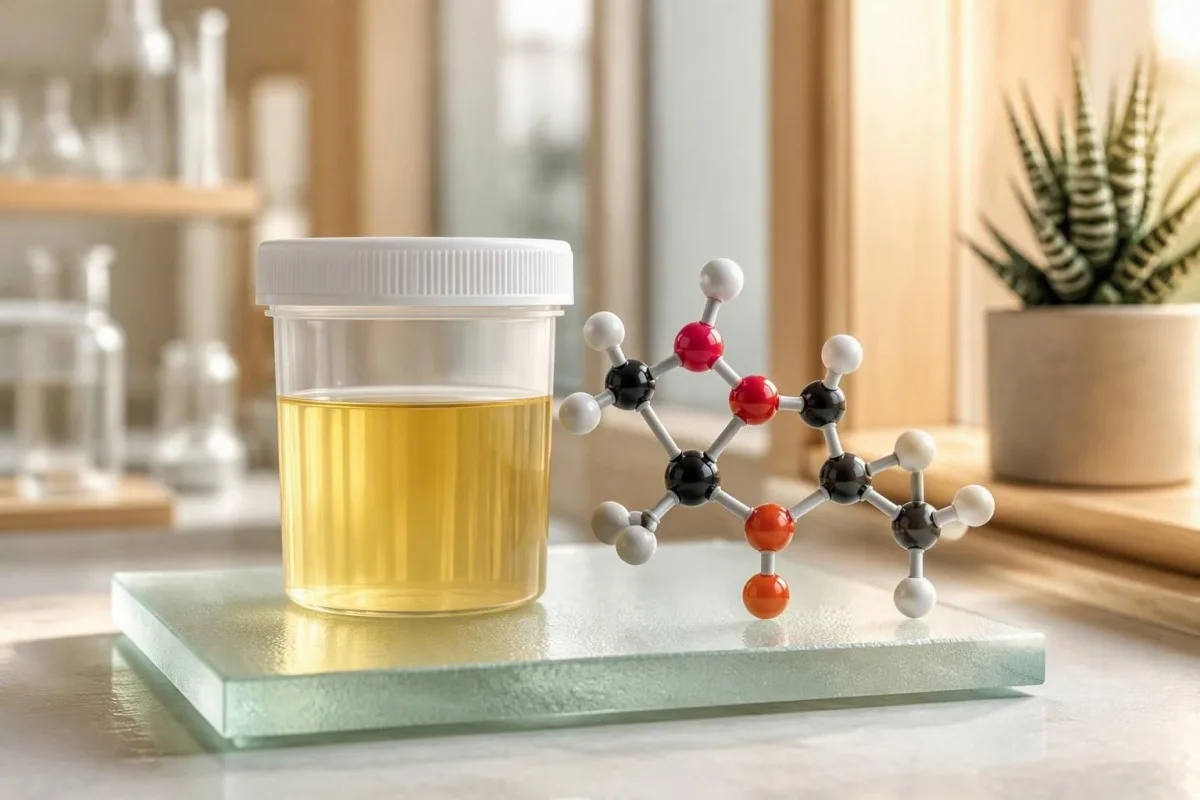
A urine EtG result records recent ethanol exposure, not drunkenness, alcohol use disorder, or a precise drinking date. Here is how clinicians read the number without overclaiming what it can prove.


- EtG meaning: Urine ethyl glucuronide is a direct ethanol metabolite; a positive result supports recent alcohol exposure but does not establish impairment.
- Typical window: A 500 ng/mL urine EtG cutoff often detects heavier drinking for roughly 24-48 hours, while low cutoffs may remain positive longer.
- Common cutoffs: Laboratories commonly use 100, 200, 500, or 1,000 ng/mL; the laboratory's stated cutoff determines whether a result is reported positive.
- Blood versus urine: Blood alcohol concentration reflects alcohol currently circulating, whereas urine EtG reflects ethanol exposure after alcohol itself has cleared.
- Incidental exposure: Mouthwash, hand sanitiser, medicines, and fermentation can sometimes contribute low EtG values, especially near a 100 ng/mL cutoff.
- No dose calculation: An EtG concentration cannot reliably identify the number of drinks, the exact time of drinking, or whether someone was impaired.
- Creatinine context: Very dilute urine can lower an EtG concentration; urinary creatinine helps laboratories judge specimen concentration.
- Clinical next step: If an EtG result has legal, employment, or treatment consequences, ask about the cutoff, collection timing, confirmation method, EtS, and specimen validity.
What urine EtG actually measures
Urine EtG measures a metabolite formed after the body processes ethanol, so it indicates recent alcohol exposure rather than current intoxication. As of September 15, 2026, that distinction remains the single most useful part of an EtG test explained: alcohol can be gone from blood while EtG remains detectable in urine.
EtG stands for ethyl glucuronide, produced when a small fraction of ethanol is joined to glucuronic acid in the liver. Most ethanol is oxidised through alcohol dehydrogenase; only about 0.02% to 0.06% is excreted as EtG, yet modern mass-spectrometry methods can detect it at 100 ng/mL. That analytical sensitivity is helpful, but it is also why context matters.
In my clinical work, the misunderstanding I hear most often is, “My EtG is positive, so the test says I was drunk.” It does not. Kantesti е анализатор на крвни тестови со вештачка интелигенција, and our reports deliberately separate direct alcohol biomarkers from urine toxicology because a urine EtG result is neither a blood alcohol concentration nor a measure of functional impairment.
EtG is usually reported as positive or negative against a laboratory threshold, with some programmes also reporting a numeric concentration. The specimen itself deserves attention: urine sample interpretation starts with collection quality, appearance, specific gravity, creatinine, and whether the sample was plausibly diluted.
EtG and EtS are companion markers
Ethyl sulfate (EtS) is another minor direct ethanol metabolite that may be measured beside EtG. Concordant EtG and EtS results increase confidence that ethanol exposure occurred, while an isolated borderline EtG result deserves more careful review for collection, storage, and incidental-exposure issues.
Urine EtG versus blood alcohol testing
Blood alcohol testing answers whether ethanol is present now; urine EtG answers whether ethanol exposure occurred recently. The two tests have different biological clocks and cannot be substituted for one another.
A blood alcohol concentration, often expressed as mg/dL or g/dL, falls as ethanol is metabolised at an average rate near 15 to 20 mg/dL per hour in many adults, although rates vary. A BAC of 80 mg/dL indicates alcohol in circulation at the time of sampling; an EtG result does not. That is why a later positive EtG cannot reconstruct an earlier BAC.
Urine EtG can outlast blood alcohol by one to several days, particularly after repeated or heavy intake. In a study of volunteers, Jatlow et al. found that EtG detection depended strongly on dose and cutoff selection, rather than following a fixed “80-hour rule” (Jatlow et al., 2006). A one-size detection promise is clinically unsound.
I advise patients to read the test name before interpreting the flag. A report labelled EtG is a metabolite test, while a result labelled ethanol, BAC, or serum alcohol is a direct measurement; our guide to квалитативни и квантитативни тестови explains why those report formats convey very different certainty.
Why EtG cannot establish impairment
Impairment is assessed at a particular time through observed function, clinical examination, and where relevant a contemporaneous alcohol concentration. A urine EtG concentration of 2,000 ng/mL collected the next morning cannot show whether a person was impaired at 09:00, 18:00, or at any other specific hour.
Realistic EtG test detection windows
A urine EtG detection window is commonly about 24 to 48 hours at a 500 ng/mL cutoff after heavier drinking, but it can be shorter after a small exposure and longer at lower cutoffs. No laboratory value can identify an exact last-drink time.
At a 100 ng/mL cutoff, EtG may detect low-level exposure into the next day and sometimes beyond; this greater sensitivity also increases vulnerability to incidental sources. At 500 ng/mL, many programmes aim for greater specificity for beverage alcohol exposure, though even this threshold does not guarantee a particular number of drinks or a 48-hour window in every person.
Body size, liver function, urine concentration, dose, drinking pattern, time since exposure, and assay method all shift the result. A person who drinks several standard drinks over one evening may remain positive longer than someone with a single drink, but rapid water loading can lower the concentration without changing whether exposure occurred. The водич за кратенки за црнробни тестови is useful if a clinician is also reviewing liver-related blood markers.
The phrase “EtG detects alcohol for 80 hours” has become sticky online. It is not a dependable promise for light or isolated drinking. In my experience, people facing a monitored test are better served by asking the laboratory for its cutoff and collection time than by relying on an internet timetable.
How EtG cutoff levels change the meaning
EtG cutoff levels are policy choices that balance sensitivity against false-positive risk, not medical severity bands. A result of 450 ng/mL is negative at a 500 ng/mL laboratory and positive at a 100 ng/mL laboratory.
The most common urine EtG cutoffs are 100, 200, 500, and 1,000 ng/mL. Lower thresholds are useful when a programme wants to detect any plausible recent exposure, while 500 ng/mL is often selected to reduce the effect of routine environmental ethanol. Neither approach is universally right; the purpose of testing should be stated openly.
A cutoff does not transform a result into proof. A concentration of 600 ng/mL is only 100 ng/mL above a 500 ng/mL threshold, so sample concentration and analytic method matter more than many people realise. Check the report for an immunoassay screen versus LC-MS/MS confirmation, because confirmation is more analytically specific.
A urine sample with low creatinine may be diluted, whether deliberately or simply because the person drank a large volume of water. Urine creatinine below 20 mg/dL is commonly used as a specimen-validity concern in workplace testing, although programme rules differ; специфична тежина на урината supplies complementary evidence about dilution.
Cutoffs are not clinical risk categories
EtG values do not have a normal range analogous to cholesterol or glucose. They are threshold results tied to the test's intended purpose, and a higher number does not diagnose alcohol use disorder, liver damage, or dangerous intoxication.
How to read EtG urine test results safely
A negative EtG result means the concentration was below that laboratory's cutoff at collection; it does not prove lifelong abstinence or exclude earlier drinking. A positive result supports recent exposure but needs timing, specimen, and test-method context.
Start with five details: collection date and time, reported cutoff, numeric result if available, method, and urine creatinine or specific gravity. A negative result at 500 ng/mL collected 60 hours after drinking says something very different from a negative result at 100 ng/mL collected 12 hours after a suspected exposure.
For treatment monitoring, clinicians should compare serial samples rather than make sweeping conclusions from one value. Kantesti е платформа за толкување крвна слика со вештачка интелигенција that can organise related liver, nutrition, and metabolic results over time, but it does not convert a urine EtG finding into a diagnosis or a legal opinion. Patterns are more informative than isolated flags.
A positive EtG result also does not automatically explain elevated ALT, AST, GGT, or triglycerides. Alcohol can contribute, but so can fatty liver disease, medicines, exercise, viral illness, and metabolic conditions; this is why our article on blood markers after stopping alcohol focuses on trends and competing explanations.
When a repeat sample is reasonable
A promptly collected repeat specimen may clarify an unexpected low positive, especially where the result sits near the cutoff and consequences are substantial. The original result remains part of the record, but a repeat with documented collection conditions can reveal whether a pattern persists.
Can mouthwash or hand sanitiser cause a positive EtG?
Incidental ethanol exposure can occasionally produce low urine EtG concentrations, particularly near a 100 ng/mL cutoff, but it is a less convincing explanation for sustained or clearly high confirmed results. The answer depends on amount, frequency, timing, and the laboratory threshold.
Alcohol-containing mouthwash, liquid medicines, fermented foods, topical products, and repeated occupational hand-sanitiser exposure are the usual concerns. I have seen patients focus on one mouthwash rinse while overlooking a prescription elixir taken four times daily; documenting every product and its ethanol content is more useful than guessing after a result arrives.
Experimental work has found that intense sanitizer exposure can produce detectable EtG in some circumstances, especially with low thresholds. The Substance Abuse and Mental Health Services Administration advised caution when interpreting low positive EtG results because incidental exposure and pre-analytical factors can occur (SAMHSA, 2012). A 500 ng/mL cutoff is commonly used partly to reduce this ambiguity.
If abstinence monitoring matters, use alcohol-free mouthwash and personal products for the entire monitoring period, retain package details, and disclose necessary ethanol-containing medicines before collection. Unexpected results should also trigger a check for laboratory result errors rather than an assumption of wrongdoing.
Fermentation after collection
Improperly stored urine can undergo microbial changes that complicate ethanol-related testing, particularly when ethanol itself is measured. Refrigeration, prompt transport, and confirmatory testing reduce uncertainty; EtS may be helpful when EtG degradation is a concern.
Screening tests, confirmation, and EtS
Immunoassay EtG testing is fast but can be less specific than confirmatory LC-MS/MS testing; a consequential positive deserves clarity about the method used. EtS is often tested alongside EtG to strengthen interpretation.
Many laboratories begin with an имуноанализа screen, which uses antibodies to detect EtG above a preset cutoff. A positive screen may then be confirmed by liquid chromatography-tandem mass spectrometry, or LC-MS/MS, which identifies molecules by their mass and fragmentation pattern. The latter is especially relevant where employment, licensing, or family-court decisions are involved.
EtS often tracks with EtG after beverage alcohol exposure, but it has its own limitations and detection characteristics. A laboratory may report EtG positive and EtS negative because of timing, differing cutoffs, specimen handling, or assay variation; that mismatch is a reason for expert review, not a shortcut to a conclusion.
Kantesti AI е алатка за анализа на крвни тестови управувана со вештачка интелигенција, not a forensic toxicology laboratory. We can help patients recognise when a report needs method-level clarification and connect related blood data, while the originating laboratory must answer questions about confirmation, chain of custody, and analytical uncertainty; see our urine dipstick guide for the broader difference between screening and diagnostic urine tests.
Hydration, kidneys, and diluted urine samples
Hydration changes urine EtG concentration because it changes urine volume, not because water removes EtG from the body on demand. Dilute samples can produce lower concentrations and may be flagged through creatinine or specific gravity.
A person who drinks 2 litres of water shortly before collection may produce a more dilute specimen than usual. The EtG concentration in ng/mL can fall even though recent ethanol exposure occurred. This is why clinicians should not compare two EtG numbers without looking at the accompanying urine creatinine and collection circumstances.
Reduced kidney function can also alter urinary excretion and complicate assumptions about the detection window. An eGFR below 60 mL/min/1.73 m² persisting for 3 months meets a chronic kidney disease definition, and people with impaired renal function should not be given rigid EtG clearance predictions; our low eGFR symptoms guide explains when kidney results need clinical follow-up.
Do not attempt to “flush” a test. Apart from being unreliable, excessive water intake can cause dangerous hyponatraemia. A properly collected sample reflects real-world physiology better than a specimen distorted by unusual fluid intake.
Creatinine adjustment is not universal
Some programmes review EtG relative to urine creatinine, while others use the raw ng/mL result and specimen-validity rules. Ask which approach your laboratory uses before comparing values across different organisations.
Why EtG cannot prove intoxication or impairment
EtG cannot establish intoxication, impairment, driving ability, consent, or the exact time of alcohol use because it persists after ethanol has cleared. Those questions require contemporaneous clinical observations and, when appropriate, direct alcohol measurement.
The biological reason is simple: EtG is a downstream metabolite. A person can have a BAC of 0 mg/dL and a positive urine EtG 24 hours later. Conversely, a person may be impaired by alcohol while a later urine sample is unavailable or diluted, making EtG a poor substitute for an observed-time assessment.
Dr Thomas Klein has reviewed many laboratory reports where a single number was treated as a complete story. It never is. A confirmed EtG result supports prior ethanol exposure, but it cannot distinguish one episode from several, calculate standard drinks, or identify whether alcohol caused a symptom such as fatigue, anxiety, or elevated liver enzymes.
When alcohol-related liver injury is a clinical concern, GGT above the laboratory upper limit is nonspecific and cannot confirm alcohol use by itself. Pairing GGT with AST, ALT, bilirubin, medication history, and imaging is more defensible; our водич за интерпретација на GGT explains those competing causes.
Clinical language matters
“Consistent with recent exposure” is accurate wording for a positive EtG result; “proves intoxication” is not. Patients should ask that distinction be preserved in clinical, occupational, and legal documentation.
EtG results alongside liver blood tests
EtG and liver tests measure different things: EtG reflects recent ethanol exposure, while ALT, AST, GGT, bilirubin, albumin, and INR reflect potential organ stress or function. A normal liver panel does not negate a positive EtG, and a raised liver enzyme does not prove alcohol use.
ALT and AST can rise after alcohol exposure, but modest elevations are common with metabolic dysfunction-associated steatotic liver disease, strenuous exercise, medicines, and viral infections. AST:ALT ratios above 2 can occur in alcohol-associated hepatitis, yet the ratio alone is neither sensitive nor diagnostic. Symptoms such as jaundice, vomiting, confusion, or abdominal swelling require urgent in-person assessment.
For a longer alcohol-exposure perspective, clinicians may consider phosphatidylethanol (PEth) in blood, which often reflects repeated drinking over roughly 2 to 4 weeks rather than a single recent event. PEth has its own interpretation limits, including transfusion-related considerations, so it should be selected for a defined clinical question rather than used reflexively.
Kantesti AI interprets liver results by looking for patterns across bilirubin, enzymes, proteins, blood counts, and kidney markers rather than assigning causation from one abnormality. Our practical водич за панел за црн дроб shows which combinations warrant a clinician’s review.
Symptoms outweigh a screening result
Seek urgent care for yellow skin or eyes, vomiting blood, black stools, severe abdominal pain, new confusion, seizures, or severe withdrawal symptoms. An EtG result is never the triage tool for these emergencies.
Preparing honestly for an EtG urine test
The safest preparation is to follow collection instructions, avoid non-essential ethanol-containing products when abstinence is required, and report all medicines and exposures before testing. Attempts to manipulate hydration or specimens can create medical and administrative problems.
Ask in advance whether the test uses EtG alone or EtG plus EtS, whether confirmation is automatic, and whether the cutoff is 100, 200, 500, or 1,000 ng/mL. If you use a liquid medication, record the brand, dose, schedule, and ethanol content. This documentation is particularly useful when a low positive result is unexpected.
Use your typical fluid intake. Overhydrating does not reliably make EtG negative and can lead to a sample labelled dilute; underhydrating can make collection unpleasant and may concentrate many urine analytes. Patients who need urine testing for other reasons can review our guide to грешки при собирање урина во тек на 24 часа for the broader principles of accurate collection.
For tests with major consequences, I favour transparent chain-of-custody procedures, a documented medication list, and confirmatory testing where appropriate. Our standards are reviewed through медицинска валидација, but individual workplace and legal programmes may apply their own rules.
What to do after a positive EtG result
After a positive EtG result, request the exact value, cutoff, method, collection time, and urine-validity data before drawing conclusions. This information determines whether the result is a low-level screen, a confirmed exposure marker, or a finding that needs repeat testing.
If the result is unexpected, write down all alcohol-containing exposures in the preceding 72 hours, including oral rinses, cough mixtures, topical products, fermented drinks, and medicines. Do not alter that account after the fact; contemporaneous details are more credible and clinically useful than a vague reconstruction several days later.
If alcohol use is becoming difficult to control, a positive EtG can be an opening for care rather than a moral verdict. In the UK, primary care, local drug and alcohol services, and urgent mental-health support can assess withdrawal risk; abrupt cessation after heavy daily drinking may require supervised management because seizures and delirium are real risks.
Kantesti’s pattern-based reports can help prepare questions about associated nutrition or liver results, but they cannot replace addiction medicine, toxicology, or legal advice. For practical examples of how our tools are used within care pathways, see clinical workflow scenarios.
When EtG results conflict with your history
A result that conflicts with your history should trigger verification, not panic: check identity, timing, cutoff, specimen concentration, assay type, and confirmation status. Discordance is uncommon but medically meaningful when the consequences are serious.
The first practical question is whether the reported finding was a screen or a confirmed quantitative result. A second is whether the sample was unusually dilute, poorly stored, or collected near the period of an unavoidable ethanol-containing medicine. These facts do not erase a result, but they change the confidence a clinician should attach to it.
False negatives are possible after enough time has passed, at higher cutoffs, after light exposure, or in dilute urine. False positives are less likely with confirmatory LC-MS/MS than with screening alone, but analytical and pre-analytical error are never literally zero. Good laboratory practice means acknowledging that uncertainty.
For patients comparing several reports, Kantesti is an AI lab test interpretation service that can organise dates and related blood markers without hiding differences between laboratories. The Водич за AI технологија explains why source documents, reference intervals, and test methods remain visible in responsible interpretation.
EtG testing in pregnancy, kidney disease, and adolescents
EtG interpretation requires extra caution in pregnancy, reduced kidney function, and adolescents because the clinical stakes are higher and a test result alone cannot explain risk or behaviour. Testing should always have a clear consent and care purpose.
In pregnancy, alcohol avoidance is recommended because no established safe amount or safe timing has been identified, but an EtG result still cannot quantify fetal exposure or predict an outcome. A supportive, non-punitive clinical conversation is more likely to improve care than treating a urine metabolite as a complete account of behaviour.
For adolescents, developmental stage, family safety, confidentiality rules, and possible coercion change how testing should be used. Parents should not treat a home or clinic result as a disciplinary tool without considering clinical support; our discussion of AI толкување за деца explains why paediatric laboratory context is different.
People with chronic kidney disease may have unpredictable urinary metabolite handling, while people taking ethanol-containing medicines may have unavoidable exposure. These groups benefit from laboratory medicine or addiction-medicine input rather than rigid interpretations based on a generic detection table.
Questions to ask the laboratory or clinician
The best questions are concrete: What cutoff was used, was the result confirmed, when was the sample collected, were EtS and creatinine measured, and what conclusion can the test not support? Asking these five questions prevents most avoidable misunderstandings.
Ask whether the laboratory follows a screening-then-confirmation workflow and whether the result is expressed in ng/mL. Ask whether the programme has a policy for ethanol-containing medicines and personal-care products. If a result is being used beyond healthcare, ask who is qualified to interpret uncertainty and chain-of-custody details.
Bring other relevant results, especially liver enzymes, complete blood count, kidney function, and medicines. A clinician may also assess sleep, mood, nutrition, withdrawal symptoms, and safety; an EtG number alone cannot do this work. Dr Thomas Klein’s practical rule is simple: use the test to start a precise conversation, never to end one.
Kantesti’s clinical material is overseen with input from our Медицински советодавен одбор. If you need a human medical decision, a treating clinician who knows your history remains the appropriate person to make it.
The patient-first bottom line on EtG testing
A positive urine EtG result supports recent ethanol exposure above a stated cutoff, while a negative result means only that EtG was below that cutoff at collection. Neither outcome establishes impairment, exact drinking quantity, alcohol use disorder, or a precise last-drink time.
If you remember one number, make it the cutoff: 100 ng/mL and 500 ng/mL answer materially different monitoring questions. If you remember one limitation, make it this: urine EtG lasts longer than blood alcohol, which is exactly why it cannot describe whether you were impaired at a particular moment.
Most patients find that a calm review of timing, products, hydration, method, and confirmation makes an alarming report far more understandable. When an unexpected result affects treatment, work, or family matters, request the original laboratory documentation and seek qualified review promptly.
Kantesti Ltd, the organisation behind Kantesti, provides privacy-focused lab-result education across 127+ countries, while clinical judgement stays with licensed professionals. You can read more about our clinical mission and governance on our страница About Us.
Често поставувани прашања
Колку долго EtG останува во урината?
Уринот EtG обично останува детектибилен околу 24 до 48 часа по потешкото пиење кога лабораторијата користи прекин од 500 ng/mL, но периодот може да биде пократок по мала изложеност и подолг при прекин од 100 ng/mL. Дозата, разредувањето на урината, функцијата на бубрезите, времето на собирање и тестот влијаат на детекцијата. Позитивен резултат од EtG не може да воспостави точно време на последното пиење. Прекинот на лабораторијата испечатен на извештајот е неопходен за толкување на резултатот.
Како ниво на EtG се смета за позитивно?
Нивото на EtG се смета за позитивно кога ќе го достигне или надмине прагот за известување на лабораторијата, најчесто 100, 200, 500 или 1.000 ng/mL. Вредност од 450 ng/mL е позитивна во програма од 100 ng/mL, но негативна во програма од 500 ng/mL. Овие прагови се прагови на политиката за тестирање, наместо категории на медицинска сериозност. Повисоките концентрации на EtG не докажуваат одреден број на пијалоци или нарушување.
Може ли еден пијалок да направи EtG тест позитивен?
Едно стандардно пиење може да предизвика позитивен EtG тест за урина, особено ако собирањето се случи набргу потоа и лабораторијата користи чувствителен праг како 100 ng/mL. При праг од 500 ng/mL, едно пиење помалку сигурно се открива со текот на времето, но индивидуалните варијации се значителни. Внесот на вода, концентрацијата на урината, големината на телото и дизајнот на анализата влијаат на резултатот. Ниту еден клиничар не може сигурно да го пресмета бројот на пиења на лице од една EtG концентрација.
Дали спрејот за дезинфекција на раце или водата за уста може да предизвика позитивен EtG тест?
Повторено изложување на алкохолни води за уста, течни лекови или средства за дезинфекција на раце може повремено да придонесе за ниски резултати на уринарен EtG, особено близу до прагот од 100 ng/mL. Ова објаснување станува помалку убедливо за потврден резултат далеку над 500 ng/mL или за повторени високи резултати, иако ниту една концентрација сама по себе не докажува пиење алкохолни пијалоци. SAMHSA препорача претпазливост при толкување на ниски позитивни EtG резултати поради случајно изложување и постоење на лабораториски фактори. Документирањето на производи пред тестирање е разумен пристап.
Does a positive EtG test mean I was intoxicated?
A positive EtG test does not mean a person was intoxicated at the time of collection or at any earlier specified time. EtG is a urine metabolite that can remain after alcohol itself has cleared from blood, whereas blood alcohol concentration measures ethanol circulating at collection. Impairment requires time-specific clinical observation and, when relevant, a contemporaneous direct alcohol measurement. EtG cannot establish driving ability, consent, or functional impairment.
What should I do if my EtG result is unexpectedly positive?
An unexpectedly positive EtG result should be reviewed with the exact concentration, cutoff, collection time, testing method, urine creatinine or specific gravity, and confirmation status. List all ethanol-containing medicines and personal-care products used during the prior 48 to 72 hours, and preserve relevant packaging if consequences are significant. A repeat sample may be appropriate when a low positive result conflicts with the history, but it does not retroactively change the first test. Seek a clinician, laboratory medicine specialist, or addiction-medicine professional when the result affects health care, employment, or legal matters.
Добијте AI анализа на крв со моќ на вештачка интелигенција денес
Придружете се на над 2 милиони корисници ширум светот кои му веруваат на Kantesti за инстантна, точна анализа на лабораториски тестови. Поставете ги вашите резултати од крвна слика и добијте сеопфатно толкување на 15,000+ биомаркери за секунди.
📚 Реферирани научни публикации
Клајн, Т., Мичел, С., и Вебер, Х. (2026). Kantesti. (2026). Urobilinogen in Urine Test: Complete Urinalysis Guide 2026. Zenodo. https://doi.org/10.5281/zenodo.18226379. AI Medical Research.
Клајн, Т., Мичел, С., и Вебер, Х. (2026). Kantesti. (2026). Iron Studies Guide: TIBC, Iron Saturation & Binding Capacity. Zenodo. https://doi.org/10.5281/zenodo.18248745. AI Medical Research.
📖 Надворешни медицински референци
Wurst FM et al. (2003). Ethyl glucuronide—the direct ethanol metabolite on the threshold from science to routine use. Addiction.
Substance Abuse and Mental Health Services Administration (2012). The role of biomarkers in the treatment of alcohol use disorders. SAMHSA Advisory.
⚕️ Медицинско одрекување од одговорност
Овој напис е само за едукативни цели и не претставува медицински совет. Секогаш консултирајте се со квалификуван здравствен работник за одлуки за дијагноза и третман.
Сигнали за доверба E-E-A-T
Искуство
Клиничка ревизија водена од лекар за работните текови на толкување на лабораториски резултати.
Експертиза
Фокус на лабораториска медицина за тоа како биомаркерите се однесуваат во клинички контекст.
Авторитивност
Напишано од д-р Thomas Klein, со ревизија од д-р Sarah Mitchell и проф. д-р Hans Weber.
Доверливост
Толкување засновано на докази со јасни патеки за следење за да се намали алармирањето.