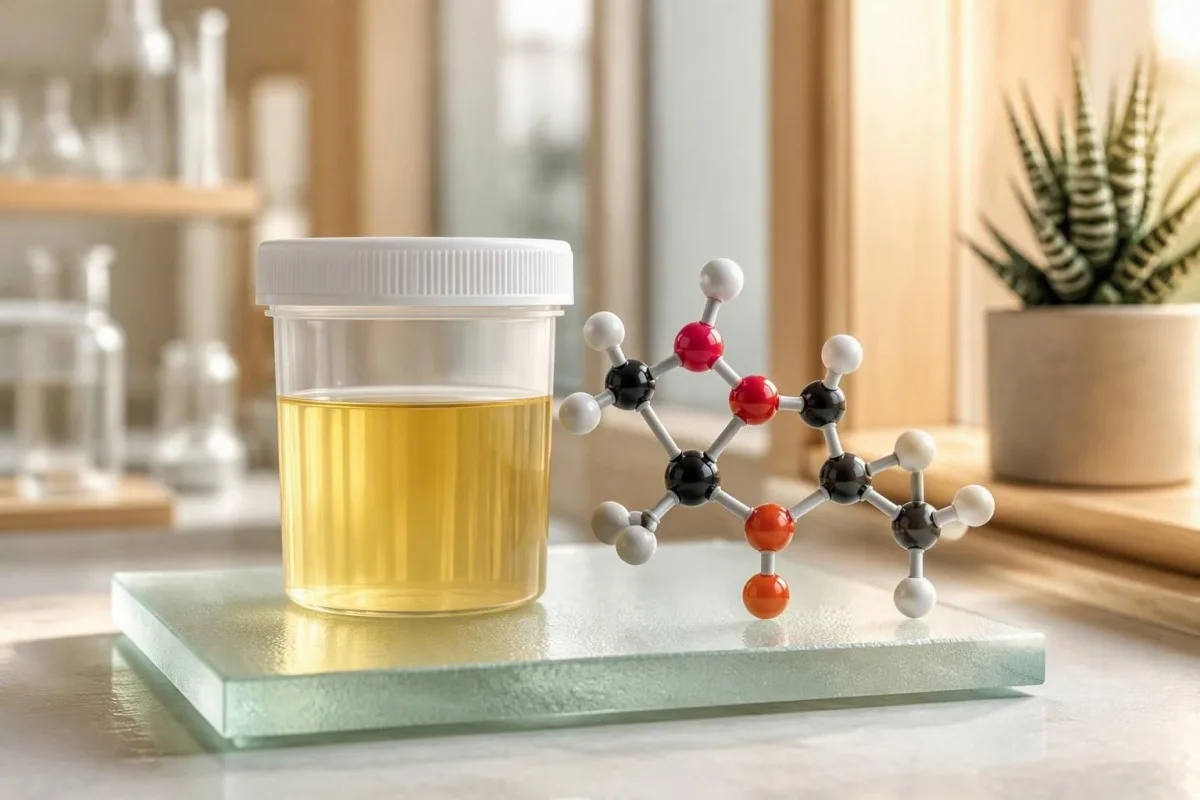
Wynik EtG z moczu zapisuje ostatni exposição na alkohol, a niy pijanstwo, alkoholowe zaburzenie, ani dokładno datę picio. Tu je, jak medycy czytaj numery bez przeplacania, co mog dowodzić.


- Znaczenie EtG: Ethyl glucuronide w moczu je bezpośrednim metabolitem etanolu; pozytywny wynik wspiyro ostatnie exposição na alkohol, ale niy ustala upośledzenia.
- Typowe okno: 500 ng/mL EtG w moczu często wykrywo wiynksze picie przez około 24-48 godzin, podczas gdy niskie poziomy mogą pozostawać pozytywne dłużej.
- Powszechne poziomy odciecia: Laboratoria zwykle używajom 100, 200, 500 albo 1,000 ng/mL; podany poziom odciecia laboratorium decyduje, czy wynik jest zgłoszony jako pozytywny.
- Krew przeciwko moczu: Koncentracya alkohola we krwji pokŏzuje alkohol, kiery cirkuluje, a EtG we moczu pokŏzuje ekspozycyjo alkohola po tym, kej alkohol sam sie już usunōł.
- Przipadkowŏ ekspozycyjo: Płukanki do ust, dezynfektory do rōk, leki i fermentacyjo mogōm czasym dować niskië EtG wartōści, szczegōlnie blisko 100 ng/mL cutoffu.
- Bez dawkōw lichōniy: Koncentracya EtG niy mŏże nadziejnie identyfikować liczby pić, dokładnego czasu picia, aji czy kto bōł upōrtōny.
- Kreotyninowy kōntekst: Bardzo rzadki mocz mŏże ôbniżyć koncentracyjo EtG; kreotynina w moczu pomŏgŏ laborantōm ôcyyniś koncentracyjo probki.
- Kliniczny nastympny krok: Jak ôdpowiyedź EtG mŏ prawné, zatrudniyniōwe abo traktōwaniōwe konsekwencyje, pytej ô cutoff, czas pobraniŏ, metoda potwiyrdzyniŏ, EtS i wiarygodność probki.
Co EtG z moczu faktycznie mierzi
EtG w moczu mjeři metabolit, kery sie twŏrzy po tym, kej ciało przetwŏrzŏ etanol, wiync ôny pokŏzuje ostatnią ekspozycyjo alkohola, a niy teraźniyjszõ intoxikacyjo. Ôd 15 września 2026 roku, ta ôdrōżniyniŏ zŏstŏwŏ jednōm z nojprzōd przidajnych czōści testu EtG, ôbjaśnijōno: alkohol mŏże być zuŏ wyjęty z krwji, a EtG zŏstŏwŏ wykrywalny we moczu.
EtG stoji za ethyl glucuronide, wytwōrzōny, kej mały frakcjõ alkohola sie zŏpina z kwŏsōm glukuronowōm w wōtrobie. Wiynkszōś alkohola je ôksydōwano przez alkohol dehydrogenaza; yno kole 0.02% do 0.06% je wydalany jako EtG, ale nowŏdne metody spektrometrie masy mogōm go wykryć przy 100 ng/mL. Ta analitycznŏ czułość je przidajno, ale to je tyż dlŏczegōd kōntekst je wŏżny.
W mojij klinicznyj robocie, niyporozumiyōniy, kere nojczōścij słysza, to: “Mōj EtG je pozytywny, wiync test mōwi, żech bōł pijany.” To niy je prawda. Kantesti to analizator AI do badań krwi, a nasze raporty celowo ôddzielajō bezpośrednie biomarkery alkohola ôd toksykologii moczu, bo wynik EtG w moczu niy je ani koncentracyjōm alkohola we krwji, ani miarōm wydolnościowõ.
EtG je zazōwiyd noszōn jako pozytywny abo negatywny w stosunku do progu laboratoryjnego, a niy kere programy tyż ôbiyndajō numeryczno koncentracyjo. Sama probka zasługuje na uwōgã: interpretacyjo probki moczu zaczyno sie ôd jakośći pobraniŏ, wyglōdu, grawitacyje właściwej, kreotyniny i czy probka była plausybilnie rozcieńczōnŏ.
EtG a EtS sōm markery partnerske
Ethyl sulfate (EtS) je dalij mały, bezpośredni metabolit alkohola, kery może być mierzony obok EtG. Zgodne wyniki EtG i EtS zwiykszajō wiarã, że doszło do ekspozycyji alkohola, a tymczasym izolowany, pograniczny wynik EtG zasługuje na bŏrdzij uwŏżnõ kontrolã pod kōntem kwestyj pobraniŏ, przechowywaniŏ i przypadkowōj ekspozycyji.
EtG z moczu przeciwko testowi alkoholu we krwi
Testy alkohola we krwji ôdpŏwiŏdajō na pytanie, czy alkohol jest obecny teraz; EtG w moczu ôdpŏwiŏdŏ, czy doszło do ostatniej ekspozycyji alkohola. Te dwa testy majō ôddzielne zegary biologiczne i niy mogō być zastōmpione jedyn za drugim.
A blood alcohol concentration, often expressed as mg/dL or g/dL, falls as ethanol is metabolised at an average rate near 15 to 20 mg/dL per hour in many adults, although rates vary. A BAC of 80 mg/dL indicates alcohol in circulation at the time of sampling; an EtG result does not. That is why a later positive EtG cannot reconstruct an earlier BAC.
Urine EtG can outlast blood alcohol by one to several days, particularly after repeated or heavy intake. In a study of volunteers, Jatlow et al. found that EtG detection depended strongly on dose and cutoff selection, rather than following a fixed “80-hour rule” (Jatlow et al., 2006). A one-size detection promise is clinically unsound.
I advise patients to read the test name before interpreting the flag. A report labelled EtG is a metabolite test, while a result labelled ethanol, BAC, or serum alcohol is a direct measurement; our guide to testow jakościowych i ilościowych explains why those report formats convey very different certainty.
Why EtG cannot establish impairment
Impairment is assessed at a particular time through observed function, clinical examination, and where relevant a contemporaneous alcohol concentration. A urine EtG concentration of 2,000 ng/mL collected the next morning cannot show whether a person was impaired at 09:00, 18:00, or at any other specific hour.
Realistyczne okna detekcji testu EtG
A urine EtG detection window is commonly about 24 to 48 hours at a 500 ng/mL cutoff after heavier drinking, but it can be shorter after a small exposure and longer at lower cutoffs. No laboratory value can identify an exact last-drink time.
At a 100 ng/mL cutoff, EtG may detect low-level exposure into the next day and sometimes beyond; this greater sensitivity also increases vulnerability to incidental sources. At 500 ng/mL, many programmes aim for greater specificity for beverage alcohol exposure, though even this threshold does not guarantee a particular number of drinks or a 48-hour window in every person.
Body size, liver function, urine concentration, dose, drinking pattern, time since exposure, and assay method all shift the result. A person who drinks several standard drinks over one evening may remain positive longer than someone with a single drink, but rapid water loading can lower the concentration without changing whether exposure occurred. The przewodnik po skrótach testōw wōsy is useful if a clinician is also reviewing liver-related blood markers.
The phrase “EtG detects alcohol for 80 hours” has become sticky online. It is not a dependable promise for light or isolated drinking. In my experience, people facing a monitored test are better served by asking the laboratory for its cutoff and collection time than by relying on an internet timetable.
Jak poziomy odciecia EtG zminiaja znaczenie
EtG cutoff levels are policy choices that balance sensitivity against false-positive risk, not medical severity bands. A result of 450 ng/mL is negative at a 500 ng/mL laboratory and positive at a 100 ng/mL laboratory.
The most common urine EtG cutoffs are 100, 200, 500, and 1,000 ng/mL. Lower thresholds are useful when a programme wants to detect any plausible recent exposure, while 500 ng/mL is often selected to reduce the effect of routine environmental ethanol. Neither approach is universally right; the purpose of testing should be stated openly.
A cutoff does not transform a result into proof. A concentration of 600 ng/mL is only 100 ng/mL above a 500 ng/mL threshold, so sample concentration and analytic method matter more than many people realise. Check the report for an immunoassay screen versus LC-MS/MS confirmation, because confirmation is more analytically specific.
A urine sample with low creatinine may be diluted, whether deliberately or simply because the person drank a large volume of water. Urine creatinine below 20 mg/dL is commonly used as a specimen-validity concern in workplace testing, although programme rules differ; względny ciężar właściwy moczu supplies complementary evidence about dilution.
Cutoffs are not clinical risk categories
EtG values do not have a normal range analogous to cholesterol or glucose. They are threshold results tied to the test's intended purpose, and a higher number does not diagnose alcohol use disorder, liver damage, or dangerous intoxication.
Jak czytać wyniki testu EtG z moczu bezpiecznie
A negative EtG result means the concentration was below that laboratory's cutoff at collection; it does not prove lifelong abstinence or exclude earlier drinking. A positive result supports recent exposure but needs timing, specimen, and test-method context.
Start with five details: collection date and time, reported cutoff, numeric result if available, method, and urine creatinine or specific gravity. A negative result at 500 ng/mL collected 60 hours after drinking says something very different from a negative result at 100 ng/mL collected 12 hours after a suspected exposure.
For treatment monitoring, clinicians should compare serial samples rather than make sweeping conclusions from one value. Kantesti to platforma do interpretacji wyników badań krwi AI that can organise related liver, nutrition, and metabolic results over time, but it does not convert a urine EtG finding into a diagnosis or a legal opinion. Patterns are more informative than isolated flags.
A positive EtG result also does not automatically explain elevated ALT, AST, GGT, or triglycerides. Alcohol can contribute, but so can fatty liver disease, medicines, exercise, viral illness, and metabolic conditions; this is why our article on blood markers after stopping alcohol focuses on trends and competing explanations.
When a repeat sample is reasonable
A promptly collected repeat specimen may clarify an unexpected low positive, especially where the result sits near the cutoff and consequences are substantial. The original result remains part of the record, but a repeat with documented collection conditions can reveal whether a pattern persists.
Czy płyn do płukania ust albo dezynfekcyjny do rąk może spowodować pozytywny EtG?
Incidental ethanol exposure can occasionally produce low urine EtG concentrations, particularly near a 100 ng/mL cutoff, but it is a less convincing explanation for sustained or clearly high confirmed results. The answer depends on amount, frequency, timing, and the laboratory threshold.
Alcohol-containing mouthwash, liquid medicines, fermented foods, topical products, and repeated occupational hand-sanitiser exposure are the usual concerns. I have seen patients focus on one mouthwash rinse while overlooking a prescription elixir taken four times daily; documenting every product and its ethanol content is more useful than guessing after a result arrives.
Experimental work has found that intense sanitizer exposure can produce detectable EtG in some circumstances, especially with low thresholds. The Substance Abuse and Mental Health Services Administration advised caution when interpreting low positive EtG results because incidental exposure and pre-analytical factors can occur (SAMHSA, 2012). A 500 ng/mL cutoff is commonly used partly to reduce this ambiguity.
If abstinence monitoring matters, use alcohol-free mouthwash and personal products for the entire monitoring period, retain package details, and disclose necessary ethanol-containing medicines before collection. Unexpected results should also trigger a check for laboratory result errors rather than an assumption of wrongdoing.
Fermentation after collection
Improperly stored urine can undergo microbial changes that complicate ethanol-related testing, particularly when ethanol itself is measured. Refrigeration, prompt transport, and confirmatory testing reduce uncertainty; EtS may be helpful when EtG degradation is a concern.
Testy przesiewowe, potwierdzenie i EtS
Immunoassay EtG testing is fast but can be less specific than confirmatory LC-MS/MS testing; a consequential positive deserves clarity about the method used. EtS is often tested alongside EtG to strengthen interpretation.
Many laboratories begin with an immunoassay screen, which uses antibodies to detect EtG above a preset cutoff. A positive screen may then be confirmed by liquid chromatography-tandem mass spectrometry, or LC-MS/MS, which identifies molecules by their mass and fragmentation pattern. The latter is especially relevant where employment, licensing, or family-court decisions are involved.
EtS often tracks with EtG after beverage alcohol exposure, but it has its own limitations and detection characteristics. A laboratory may report EtG positive and EtS negative because of timing, differing cutoffs, specimen handling, or assay variation; that mismatch is a reason for expert review, not a shortcut to a conclusion.
Kantesti AI to narzędzie do analizy badań krwi oparte na AI, not a forensic toxicology laboratory. We can help patients recognise when a report needs method-level clarification and connect related blood data, while the originating laboratory must answer questions about confirmation, chain of custody, and analytical uncertainty; see our urine dipstick guide for the broader difference between screening and diagnostic urine tests.
Nawodnienie, nerki i rozcieńczone próbki moczu
Hydration changes urine EtG concentration because it changes urine volume, not because water removes EtG from the body on demand. Dilute samples can produce lower concentrations and may be flagged through creatinine or specific gravity.
A person who drinks 2 litres of water shortly before collection may produce a more dilute specimen than usual. The EtG concentration in ng/mL can fall even though recent ethanol exposure occurred. This is why clinicians should not compare two EtG numbers without looking at the accompanying urine creatinine and collection circumstances.
Reduced kidney function can also alter urinary excretion and complicate assumptions about the detection window. An eGFR below 60 mL/min/1.73 m² persisting for 3 months meets a chronic kidney disease definition, and people with impaired renal function should not be given rigid EtG clearance predictions; our low eGFR symptoms guide explains when kidney results need clinical follow-up.
Do not attempt to “flush” a test. Apart from being unreliable, excessive water intake can cause dangerous hyponatraemia. A properly collected sample reflects real-world physiology better than a specimen distorted by unusual fluid intake.
Creatinine adjustment is not universal
Some programmes review EtG relative to urine creatinine, while others use the raw ng/mL result and specimen-validity rules. Ask which approach your laboratory uses before comparing values across different organisations.
Czemu EtG niy może udowodnić intoksykacji abo upośledzenia
EtG cannot establish intoxication, impairment, driving ability, consent, or the exact time of alcohol use because it persists after ethanol has cleared. Those questions require contemporaneous clinical observations and, when appropriate, direct alcohol measurement.
The biological reason is simple: EtG is a downstream metabolite. A person can have a BAC of 0 mg/dL and a positive urine EtG 24 hours later. Conversely, a person may be impaired by alcohol while a later urine sample is unavailable or diluted, making EtG a poor substitute for an observed-time assessment.
Dr Thomas Klein has reviewed many laboratory reports where a single number was treated as a complete story. It never is. A confirmed EtG result supports prior ethanol exposure, but it cannot distinguish one episode from several, calculate standard drinks, or identify whether alcohol caused a symptom such as fatigue, anxiety, or elevated liver enzymes.
When alcohol-related liver injury is a clinical concern, GGT above the laboratory upper limit is nonspecific and cannot confirm alcohol use by itself. Pairing GGT with AST, ALT, bilirubin, medication history, and imaging is more defensible; our przewodnik interpretacji GGT explains those competing causes.
Clinical language matters
“Consistent with recent exposure” is accurate wording for a positive EtG result; “proves intoxication” is not. Patients should ask that distinction be preserved in clinical, occupational, and legal documentation.
Wyniki EtG przy testach krwi wątroby
EtG and liver tests measure different things: EtG reflects recent ethanol exposure, while ALT, AST, GGT, bilirubin, albumin, and INR reflect potential organ stress or function. A normal liver panel does not negate a positive EtG, and a raised liver enzyme does not prove alcohol use.
ALT and AST can rise after alcohol exposure, but modest elevations are common with metabolic dysfunction-associated steatotic liver disease, strenuous exercise, medicines, and viral infections. AST:ALT ratios above 2 can occur in alcohol-associated hepatitis, yet the ratio alone is neither sensitive nor diagnostic. Symptoms such as jaundice, vomiting, confusion, or abdominal swelling require urgent in-person assessment.
For a longer alcohol-exposure perspective, clinicians may consider phosphatidylethanol (PEth) in blood, which often reflects repeated drinking over roughly 2 to 4 weeks rather than a single recent event. PEth has its own interpretation limits, including transfusion-related considerations, so it should be selected for a defined clinical question rather than used reflexively.
Kantesti AI interprets liver results by looking for patterns across bilirubin, enzymes, proteins, blood counts, and kidney markers rather than assigning causation from one abnormality. Our practical przewodnik po panelu wątrobowym shows which combinations warrant a clinician’s review.
Symptoms outweigh a screening result
Seek urgent care for yellow skin or eyes, vomiting blood, black stools, severe abdominal pain, new confusion, seizures, or severe withdrawal symptoms. An EtG result is never the triage tool for these emergencies.
Szczere przygotowanie do testu EtG z moczu
The safest preparation is to follow collection instructions, avoid non-essential ethanol-containing products when abstinence is required, and report all medicines and exposures before testing. Attempts to manipulate hydration or specimens can create medical and administrative problems.
Ask in advance whether the test uses EtG alone or EtG plus EtS, whether confirmation is automatic, and whether the cutoff is 100, 200, 500, or 1,000 ng/mL. If you use a liquid medication, record the brand, dose, schedule, and ethanol content. This documentation is particularly useful when a low positive result is unexpected.
Use your typical fluid intake. Overhydrating does not reliably make EtG negative and can lead to a sample labelled dilute; underhydrating can make collection unpleasant and may concentrate many urine analytes. Patients who need urine testing for other reasons can review our guide to błędów w dobowej zbiórce moczu for the broader principles of accurate collection.
For tests with major consequences, I favour transparent chain-of-custody procedures, a documented medication list, and confirmatory testing where appropriate. Our standards are reviewed through walidacyjo medyczno, but individual workplace and legal programmes may apply their own rules.
Co robić po pozytywnym wyniku EtG
After a positive EtG result, request the exact value, cutoff, method, collection time, and urine-validity data before drawing conclusions. This information determines whether the result is a low-level screen, a confirmed exposure marker, or a finding that needs repeat testing.
If the result is unexpected, write down all alcohol-containing exposures in the preceding 72 hours, including oral rinses, cough mixtures, topical products, fermented drinks, and medicines. Do not alter that account after the fact; contemporaneous details are more credible and clinically useful than a vague reconstruction several days later.
If alcohol use is becoming difficult to control, a positive EtG can be an opening for care rather than a moral verdict. In the UK, primary care, local drug and alcohol services, and urgent mental-health support can assess withdrawal risk; abrupt cessation after heavy daily drinking may require supervised management because seizures and delirium are real risks.
Kantesti’s pattern-based reports can help prepare questions about associated nutrition or liver results, but they cannot replace addiction medicine, toxicology, or legal advice. For practical examples of how our tools are used within care pathways, see clinical workflow scenarios.
Kiedy wyniki EtG sprzeczają się z Twoją historią
A result that conflicts with your history should trigger verification, not panic: check identity, timing, cutoff, specimen concentration, assay type, and confirmation status. Discordance is uncommon but medically meaningful when the consequences are serious.
The first practical question is whether the reported finding was a screen or a confirmed quantitative result. A second is whether the sample was unusually dilute, poorly stored, or collected near the period of an unavoidable ethanol-containing medicine. These facts do not erase a result, but they change the confidence a clinician should attach to it.
False negatives are possible after enough time has passed, at higher cutoffs, after light exposure, or in dilute urine. False positives are less likely with confirmatory LC-MS/MS than with screening alone, but analytical and pre-analytical error are never literally zero. Good laboratory practice means acknowledging that uncertainty.
For patients comparing several reports, Kantesti is an AI lab test interpretation service that can organise dates and related blood markers without hiding differences between laboratories. The przewodnik po technologii AI explains why source documents, reference intervals, and test methods remain visible in responsible interpretation.
Testowanie EtG w ciąży, chorobach nerek i u młodocianych
EtG interpretation requires extra caution in pregnancy, reduced kidney function, and adolescents because the clinical stakes are higher and a test result alone cannot explain risk or behaviour. Testing should always have a clear consent and care purpose.
In pregnancy, alcohol avoidance is recommended because no established safe amount or safe timing has been identified, but an EtG result still cannot quantify fetal exposure or predict an outcome. A supportive, non-punitive clinical conversation is more likely to improve care than treating a urine metabolite as a complete account of behaviour.
For adolescents, developmental stage, family safety, confidentiality rules, and possible coercion change how testing should be used. Parents should not treat a home or clinic result as a disciplinary tool without considering clinical support; our discussion of AI interpretacyjo dziyci explains why paediatric laboratory context is different.
People with chronic kidney disease may have unpredictable urinary metabolite handling, while people taking ethanol-containing medicines may have unavoidable exposure. These groups benefit from laboratory medicine or addiction-medicine input rather than rigid interpretations based on a generic detection table.
Pytania do laboratorium albo lekarza
The best questions are concrete: What cutoff was used, was the result confirmed, when was the sample collected, were EtS and creatinine measured, and what conclusion can the test not support? Asking these five questions prevents most avoidable misunderstandings.
Ask whether the laboratory follows a screening-then-confirmation workflow and whether the result is expressed in ng/mL. Ask whether the programme has a policy for ethanol-containing medicines and personal-care products. If a result is being used beyond healthcare, ask who is qualified to interpret uncertainty and chain-of-custody details.
Bring other relevant results, especially liver enzymes, complete blood count, kidney function, and medicines. A clinician may also assess sleep, mood, nutrition, withdrawal symptoms, and safety; an EtG number alone cannot do this work. Dr Thomas Klein’s practical rule is simple: use the test to start a precise conversation, never to end one.
Kantesti’s clinical material is overseen with input from our Rada Doradczo Medyczno. If you need a human medical decision, a treating clinician who knows your history remains the appropriate person to make it.
Podsumowanie testowania EtG dla pacjenta
A positive urine EtG result supports recent ethanol exposure above a stated cutoff, while a negative result means only that EtG was below that cutoff at collection. Neither outcome establishes impairment, exact drinking quantity, alcohol use disorder, or a precise last-drink time.
If you remember one number, make it the cutoff: 100 ng/mL and 500 ng/mL answer materially different monitoring questions. If you remember one limitation, make it this: urine EtG lasts longer than blood alcohol, which is exactly why it cannot describe whether you were impaired at a particular moment.
Most patients find that a calm review of timing, products, hydration, method, and confirmation makes an alarming report far more understandable. When an unexpected result affects treatment, work, or family matters, request the original laboratory documentation and seek qualified review promptly.
Kantesti Ltd, the organisation behind Kantesti, provides privacy-focused lab-result education across 127+ countries, while clinical judgement stays with licensed professionals. You can read more about our clinical mission and governance on our stronie O nas.
Czynsto zadawane pytania
Kaj czas EtG zostaje w moczu?
Moč EtG zwykle pozostaje wykrywalna przez około 24 do 48 godzin po większym piciu, gdy laboratorium używa progu 500 ng/mL, ale okres ten może być krótszy po małej ekspozycji i dłuższy przy progu 100 ng/mL. Dawka, rozcieńczenie moczu, funkcja nerek, czas pobrania i badanie wpływają na wykrycie. Pozytywny wynik EtG nie może ustalić dokładnego czasu ostatniego spożycia alkoholu. Próg laboratoryjny wydrukowany na raporcie jest konieczny do interpretacji wyniku.
Kajaki je EtG level pozytywny?
Poziom EtG je poczyntovany, kej spotkōno abo przekroczono prōg raportowaniŏ laborantōv, nojčymścij 100, 200, 500 abo 1000 ng/mL. Wartŏść 450 ng/mL je poczyntovano we progrŏmie 100 ng/mL, ale negatywno we progrŏmie 500 ng/mL. Te prōgi sōm progami polityki testowaniŏ, a niy kategorjami ciymkośći medycznej. Wyžše kōncentracyje EtG niy dowŏdajōm pewnyj liczby napojōw abo zaburzyniŏ.
Skuś pić może pozytywny test EtG?
Jedna standardowo piwniach cug może dać pozytywny wynik testu moczu EtG, szczególnie kej zbiór idzie rychło po tym a laboratorium używo czuły próg jako 100 ng/mL. Przy progu 500 ng/mL, jeden cug je mńij richtik wykrywalny kej mija czas, ale indywidualne różnice je potężne. Spożycie wody, koncentracja moczu, wielkoś ciała a projekt testu wszyjsko wpływo na wynik. Żaden lekarz niy umie richtik wyliczyć liczby piwniach cugów u ôsoby z jednij koncentracyji EtG.
Może płyn do dezynfekcji rōk abo płukadlo do ust spowodować pozytywny EtG test?
Powtórzono eksponiyrowanie na płukiwaczki do ust ze etanolem, syropy, abo dezynfektanty do rōk może czasami przyczynić sie do niski'ch wynōmikōw moczu EtG, zwłaszca koło 100 ng/mL. To wyjaśnienie je mōńij przekōnywujōnce dla potwierdzonego wyniku znojsie powyżyj 500 ng/mL abo dlo powtórzōnych wysoki'ch wynōmikōw, chocioż żodna koncentracja sama niy dowodzi pijōncego. SAMHSA poradziło być ostrożnym we interpretacji niski'ch pozytywnych wynōmikōw EtG, skōnd istnieją incydentalne ekspozycyje i czynniki laboratoryjne. Dokumentowanie produktōw przed testōw je sensownym podejściym.
Czi pozytywny test EtG przedstawi, że byłech pod wpłyym alkoholu?
Pozytywny test EtG niy ôznaczô, że ôsoba bōła pod wpłyym alkoholu w czas skłōdaniô abo w jakimkolwiek ranij wymieniōnym czas. EtG je metabolitem moczu, kiery mòże ôstać po tym, jak sam alkohol ôpuszczô krew, naôprostyô stężenie alkoholu we krōwi mieři etanol krążōcy w czas skłōdaniô. Niewydolność wymôga specyficznego czasowo badaniô klinicznego i, tam, kaj je to istōtne, ôdpowiadajōcego mu bezpośredniōgô miary alkoholu. EtG niy mòże potwierdzić zdolności do kierowania, zgody abo wydolnościowoôści.
Co poradzić, jak moje EtG wyszło pozytywne, a tego sie niy spodziewało?
Nespodziewany pozytywny wynik EtG nŏleży przedstawiŷć do analizy z dokładnōm koncentracyjōm, progiym, czasym pobraniŏ, metodōm testowaniŏ, kreatyninōm w mŏču abo specyficznōm grawitacyjōm, a także statusym potwierdzenia. Wymiyniŷć wszyjske leki zawiyrajōce etanol i produkty do higiyeny osobistyj, używane w cylgu 48 do 72 godzin przed testym, ażeśli konsekwencyje sōm znaczōce, zachōwać relevante opakowaniŏ. Powtōrzone pobraniy mogōm być adekwatne, kej niskŏ pozytywnŏ probōwka kōnfli[k]tuje z historiōm, ale niy ôdwraŏca ôstaṀcyjnych wynŏjkōw piyrszygo testu. Szōkać lekarza, specyjalisty medycyny laboratoryjnyj abo profesjonalisty medycyny uzależniyń, kej wynik wpływŏ na ôpiekã zdrowotnōm, zatrudniyni lub prawni sprawy.
Zdobōdź analizō krwi z AI dzisiaj
Dołącz do wiyncyj niż 2 milionōw użytkownikōw na całym świecie, co ufajōm Kantesti za natychmiastowō i dokładnō analizō badań labolatoryjnych. Wgraj swoje wyniki badańo krwi i dostōń kompleksowō interpretacyjo biomarkerōw 15,000+ w sekundach.
📚 Publikacyje badawcze z referencjami
Klein, T., Mitchell, S., & Weber, H. (2026). Kantesti. (2026). Urobilinogen in Urine Test: Complete Urinalysis Guide 2026. Zenodo. https://doi.org/10.5281/zenodo.18226379. Kantesti AI Medycynne Badań.
Klein, T., Mitchell, S., & Weber, H. (2026). Kantesti. (2026). Iron Studies Guide: TIBC, Iron Saturation & Binding Capacity. Zenodo. https://doi.org/10.5281/zenodo.18248745. Kantesti AI Medycynne Badań.
📖 Zewnętrzne medyczne referencyje
Wurst FM et al. (2003). Ethyl glucuronide—the direct ethanol metabolite on the threshold from science to routine use. Addiction.
Substance Abuse and Mental Health Services Administration (2012). The role of biomarkers in the treatment of alcohol use disorders. SAMHSA Advisory.
⚕️ Uchylynie ôd ôdpowiedzialności medycznyj
Ten artykuł je wyłōncznie do celōw edukacyjnych i nie stanowi porady medyczno. Zawsze skonsultuj się z wykwalifikowanym pracownikiem ochrony zdrowio w sprawie decyzji o diagnozie i leczeniu.
Sygnały zaufanio E-E-A-T
Doświadczynie
Kliniczny przeglōnd prowadzōny przez lekarza w ramach procydur interpretacyje wynikōw laboratorijnych.
Ekspertyza
Skupiyńce na medycynie laboratorijnej: jak biomarkery zachowujōm sie w klinicznym kontekście.
Autorytetność
Napisane przez dr. Thomasa Kleina z przeglōndym przez dr. Sarah Mitchell i prof. dr. Hansa Webera.
Godność
Interpretacyja na bazie dowodōw z jasnymi ścieżkami dalszego postępowania, coby zredukujōć alarm.