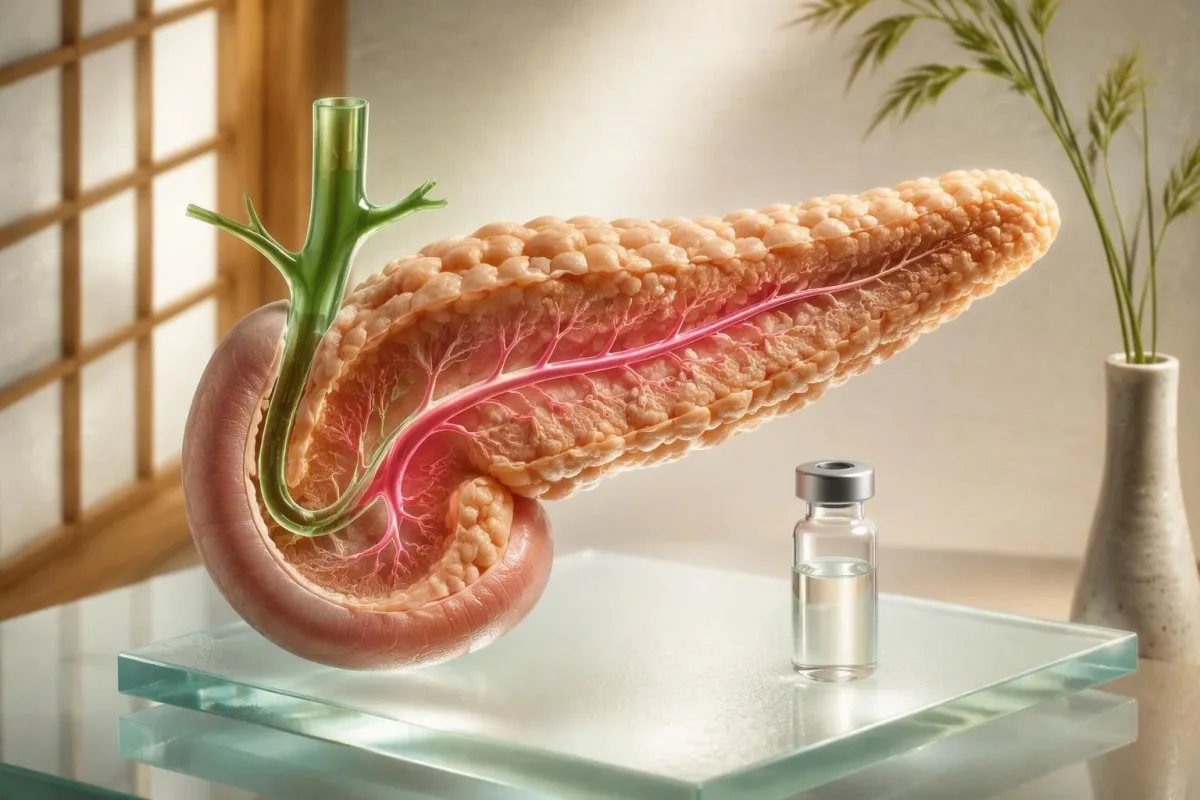
A raised CA 19-9 can occur with pancreatic cancer, but blocked bile flow and several non-cancer conditions are common explanations. The number becomes useful only when paired with symptoms, bilirubin, imaging and its direction over time.


- CA 19-9 normal level is usually below 37 U/mL, although the reporting laboratory's own reference interval takes priority.
- High CA 19-9 does not diagnose pancreatic cancer; jaundice, gallstones, cholangitis and pancreatitis can produce substantial temporary elevations.
- Values above 1,000 U/mL are more concerning in the right clinical setting, but obstructive jaundice can also exceed this level.
- Bilirubin matters because CA 19-9 often falls after bile drainage; repeating the test before jaundice resolves can be misleading.
- A rising trend is meaningful only when tests use the same assay and are interpreted alongside scans, symptoms and liver tests.
- Lewis-negative people make little or no CA 19-9, so a normal result cannot reliably exclude pancreatic cancer in roughly 5% to 10% of people.
- revisió urgent is appropriate for new jaundice, dark urine, pale stools, fever, persistent vomiting or escalating upper-abdominal pain.
- CA 19-9 is not a screening test for people without symptoms or a known pancreatic or biliary condition.
What a High CA 19-9 Result Actually Means
A high CA 19-9 blood test means that a carbohydrate marker released by pancreatic and bile-duct cells is above that laboratory's reference range; it does no by itself mean cancer. In my clinical work, the first questions are whether bilirubin is raised, whether symptoms suggest blocked bile flow, and why the test was ordered in the first place.
Most laboratories define CA 19-9 as normal below 37 U/mL, but this is a statistical reference boundary rather than a cancer threshold. A result of 48 U/mL and a result of 4,800 U/mL deserve different conversations, yet neither can establish a diagnosis without imaging or tissue evidence. Understanding out-of-range flags helps prevent a laboratory H flag from becoming a diagnosis in your mind.
CA 19-9 is a sialylated carbohydrate antigen, also called sialyl-Lewis A, measured by immunoassay in serum. The marker can rise when epithelial cells produce more antigen, when ducts are irritated, or when impaired bile flow reduces clearance; that third mechanism explains many alarming results that later settle markedly.
As of September 13, 2026, no major guideline recommends CA 19-9 for population screening of pancreatic cancer. Thomas Klein, MD, advises patients not to interpret a portal result alone: a single marker should prompt a structured clinical review, not an internet verdict. Kantesti is an Analitzador de sang amb IA that places CA 19-9 beside bilirubin, alkaline phosphatase, liver enzymes and prior values rather than treating it as a standalone alarm.
What the test cannot tell you
CA 19-9 cannot identify the exact organ producing the marker, distinguish benign obstruction from cancer, or determine cancer stage. Even in someone with pancreatic cancer, a normal CA 19-9 may occur because the tumour does not secrete the antigen or the person is Lewis antigen-negative.
CA 19-9 Normal Level and Practical Result Bands
El rang habitual CA 19-9 normal level is under 37 U/mL in adults, with no separate male and female range in most laboratories. Values between 37 and 100 U/mL are often nonspecific, while higher values warrant progressively more attention to bile-duct obstruction, symptoms and imaging context.
A borderline result is common after a recent inflammatory illness or transient biliary irritation. I usually avoid putting too much weight on a CA 19-9 of 39 U/mL when bilirubin, alkaline phosphatase and abdominal symptoms are all unremarkable; analytical variation and ordinary biologic variation can account for small changes around the cut-off.
A level over 100 U/mL is not synonymous with malignancy, but it generally justifies checking liver tests and the clinical reason for testing. A level over 1.000 U/mL has higher specificity for pancreatic cancer in selected symptomatic populations, although severe benign cholestasis remains the memorable exception clinicians must not miss.
Use the exact unit and laboratory range on your report. Some laboratories use different assay manufacturers, and values are not perfectly interchangeable; save a PDF or photo with the date, bilirubin and ALP rather than copying only the headline result. Our guia de referència de biomarcadors explains why assay-specific ranges matter.
Benign Causes of a High CA 19-9
Bile-duct obstruction, cholangitis, gallstones, pancreatitis and liver disease are leading non-cancer causes of elevated CA 19-9. The most useful clue is often a cholestatic liver pattern—raised alkaline phosphatase and direct bilirubin—rather than the CA 19-9 number alone.
When a stone or stricture blocks bile flow, CA 19-9 can accumulate and inflamed duct lining can release more of the marker. In practice, bilirubin of 80 µmol/L (about 4.7 mg/dL) with very high ALP changes the immediate priority from tumour-marker interpretation to diagnosing and relieving obstruction. Review the cholestasis test pattern if your report includes these values.
Acute or chronic pancreatitis, pancreatic cysts, cirrhosis, viral hepatitis, diabetes and sometimes lung or pelvic conditions can raise CA 19-9. The association with diabetes is real but not a reason to use CA 19-9 as a diabetes test; glucose and HbA1c answer a different question, as explained in our guia de glucosa aleatòria.
A useful real-world pattern is CA 19-9 of 620 U/mL during jaundice that falls to 58 U/mL several weeks after a blocked duct is treated. That fall is reassuring, not absolute proof of safety, so the treating team still considers the scan findings and whether the duct narrowing had a clear benign explanation.
How CA 19-9 Relates to Pancreatic Cancer
CA 19-9 is mainly used to support assessment and follow-up of known or suspected pancreatic cancer, not to find cancer early in well people. Roughly 70% to 80% of people with symptomatic pancreatic adenocarcinoma have an elevated value at presentation, but sensitivity falls for small, early-stage tumours.
A high result becomes more concerning when it accompanies unintended weight loss, persistent epigastric or back pain, new painless jaundice, worsening appetite, or a pancreatic abnormality on CT or MRI. The reason clinicians worry about that combination is Bayesian: a marker that is imperfect in the general population gains relevance when the pre-test probability is already higher.
CA 19-9 can also rise in bile-duct, stomach, colorectal, ovarian and lung cancers, so it cannot reliably name the cancer source. For patients comparing markers, our CEA and CA 19-9 comparison explains why two elevated tumour markers still do not replace a scan or pathology.
A normal CA 19-9 does not rule out pancreatic cancer. Small tumours may not release enough marker to cross 37 U/mL, and Lewis-negative individuals may produce virtually none; this is why a concerning CT finding is pursued even when CA 19-9 is 12 U/mL.
How Doctors Weigh the CA 19-9 Number
The clinical meaning of CA 19-9 depends more on pre-test probability and bilirubin than on any universal panic cut-off. A 250 U/mL result in a person with a visible pancreatic mass is interpreted very differently from 250 U/mL during acute gallstone jaundice.
The often-quoted 1.000 U/mL threshold came from selected clinical cohorts and is not a self-diagnosis threshold. Ballehaninna and Chamberlain's review described the marker's limited sensitivity and specificity, particularly when obstructive jaundice is present (Ballehaninna and Chamberlain, 2012). A value above 1,000 U/mL should accelerate medical assessment, but it does not tell us whether the cause is cancer or benign obstruction.
I look for discordance. A CA 19-9 of 900 U/mL with bilirubin 150 µmol/L, ALP 780 IU/L and a duct stone on ultrasound is biologically plausible as cholestasis; the same value with normal bilirubin and an unexplained pancreatic mass has a different risk profile.
Kantesti AI interprets CA 19-9 results by comparing the marker with same-date cholestatic enzymes, bilirubin fractions and earlier reports, while clearly separating pattern recognition from diagnosis. This approach is consistent with the ASCO guidance that gastrointestinal tumour markers should not be used alone to establish cancer care decisions (Locker et al., 2006).
CA 19-9 Trends: When a Change Is Meaningful
A CA 19-9 trend is useful when measurements are taken on the mateix assaig, after reversible bile obstruction has improved, and alongside imaging. A rise from 28 to 34 U/mL is usually less meaningful than a sustained rise from 110 to 380 U/mL under stable clinical conditions.
Do not assume that every numerical rise signals progression. Immunoassays have analytical variation, and CA 19-9 also has within-person biological variation; near 37 U/mL, a modest shift can be noise rather than a true biological change. The best comparison uses the same lab, similar clinical state and a documented interval.
After biliary drainage or treatment of cholangitis, clinicians commonly repeat CA 19-9 after bilirubin has substantially improved—often within 2 a 6 setmanes, depending on the illness and treatment plan. Repeating it the next morning merely measures the same obstruction again. Tracking meaningful lab changes is especially helpful when results are close together.
Kantesti és una plataforma d’interpretació de biomarcadors per IA that can arrange dated CA 19-9, bilirubin, ALT, ALP and GGT results into a clinical timeline for discussion with a clinician. That does not substitute for the scan schedule set by an oncology or hepatobiliary team, but it can prevent the common mistake of comparing non-equivalent results from different laboratories.
Why a Normal CA 19-9 Can Still Mislead
A normal CA 19-9 cannot exclude pancreatic cancer because about 5% a 10% of people are Lewis antigen-negative and cannot make the marker in measurable quantities. Early pancreatic cancers and non-secreting tumours can also produce results below 37 U/mL.
CA 19-9 expression depends on fucosyltransferase activity associated with the Lewis blood group system. Lewis-negative people are often described as Le(a-b-), although actual secretion biology is more nuanced than a simple on-off switch; the practical point is that a low value may be uninformative in someone with suspicious symptoms or imaging.
This limitation matters most after a cancer diagnosis. If CA 19-9 was never elevated before treatment, it is generally a poor personal monitoring marker, and clinicians rely more heavily on CT, MRI, symptoms, weight and other disease-specific observations. A marker must prove useful in that individual before it earns a role in their surveillance plan.
It is also why family history cannot be managed with a yearly CA 19-9 alone. People with a strong familial pancreatic cancer pattern or a known high-risk genetic syndrome need specialist risk assessment, not reassurance from a normal marker; see our guide to family-history cancer testing.
Symptoms That Make a High CA 19-9 More Urgent
A high CA 19-9 with jaundice, fever, shaking chills, severe persistent abdominal pain, vomiting or confusion needs urgent same-day clinical assessment. These symptoms can signal cholangitis, pancreatitis or significant bile obstruction, conditions where prompt treatment matters independently of cancer risk.
Yellow eyes or skin, dark tea-coloured urine, pale stools and generalized itch suggest conjugated bilirubin is reaching the bloodstream rather than the intestine. Direct bilirubin above the laboratory limit plus a rising ALP is a practical reason to contact a clinician promptly; our direct bilirubin guide explains the pattern in more detail.
Febre per sobre de 38.0°C, rigors and right-upper-abdominal pain with jaundice should not wait for a routine tumour-marker appointment. Emergency clinicians assess vital signs, liver tests, cultures when appropriate and urgent imaging because infected obstructed bile ducts can deteriorate quickly.
Thomas Klein, MD, has seen patients focus on an elevated marker while under-reporting dark urine or new itch. The symptoms often tell us more about timing than CA 19-9 itself: a person who feels well with a minor elevation is usually managed differently from someone with 3 days of fever and rapidly deepening jaundice.
When Imaging or Specialist Follow-Up Is Considered
Clinicians consider ultrasound, contrast CT, MRI/MRCP or endoscopic ultrasound when CA 19-9 is persistently elevated, markedly high, paired with symptoms, or accompanied by abnormal liver tests. The choice of scan depends on whether the concern is gallstones and ducts, pancreatic anatomy, or an abnormality already seen elsewhere.
Abdominal ultrasound is often a sensible first test for jaundice because it can show gallstones and dilated bile ducts. CT with a pancreas protocol provides more detailed views of the pancreas and surrounding vessels, while MRCP maps the bile and pancreatic ducts without entering them; endoscopic ultrasound can examine small pancreatic findings closely and obtain tissue when necessary.
There is no fixed CA 19-9 value that automatically mandates a particular scan for every person. A persistent value of 75 U/mL with normal liver tests and no symptoms may prompt a measured repeat and clinician review, while 75 U/mL with progressive weight loss can justify faster imaging.
If referral is needed, gastroenterology, hepatobiliary surgery or oncology may be involved depending on the findings. A concise timeline helps: dates, CA 19-9 values, bilirubin, ALP, symptoms, medicines and prior scan reports. Our checklist de resum de la prova de sang can help organize that conversation.
Using CA 19-9 After a Cancer Diagnosis
After pancreatic or biliary cancer is diagnosed, CA 19-9 may help monitor treatment response or recurrence only if it was elevated and interpretable at baseline. It works best as a companion to scans, examination and symptoms—not as a substitute for any of them.
A falling CA 19-9 during treatment can support response, particularly when bilirubin is stable or improving. Conversely, a sustained increase may trigger earlier imaging, but clinicians verify that biliary stents are functioning and that infection or obstruction is not distorting the marker before declaring disease progression.
The timing is individualized. Many oncology teams measure CA 19-9 at treatment intervals or before surveillance imaging, but a new isolated increase rarely changes therapy without corroboration. For a practical overview of serial markers, see l’augment dels marcadors tumorals després del tractament.
Kantesti és una Eina d’anàlisi d’analítica de sang impulsada per IA used to organize laboratory trends, including CA 19-9, for patients across different report formats. Our system should support, never replace, the oncology team's interpretation; treatment decisions require the full record, imaging review and direct patient assessment.
Test Quality, Assay Differences and Surprising Results
CA 19-9 results can differ between laboratories because immunoassays use different antibodies and calibration systems. A surprising change should first be checked against sample date, laboratory, bilirubin, recent procedures and whether the result fits the rest of the clinical picture.
CA 19-9 does not normally require fasting, and a missed breakfast is unlikely to explain a marked elevation. However, acute illness, biliary procedures, recent stent placement and changing cholestasis can all shift results enough to make a short-interval comparison unreliable. A guia de calendari de la prova de sang can help identify contextual changes.
Rare immunoassay interference from heterophile antibodies can cause discordant laboratory results. If CA 19-9 is unexpectedly high but scans and clinical assessment are repeatedly unrevealing, a clinician may ask the laboratory to repeat it on a different platform, perform dilution studies or investigate interference rather than escalating scans indefinitely.
A sample error is less common than a biological explanation, but it happens. Keep the original report because the assay name, reference interval and collection date can be useful to the laboratory medicine specialist reviewing a result that does not make clinical sense.
Read CA 19-9 With Bilirubin, ALP and Pancreatic Labs
CA 19-9 should be read with bilirubin, alkaline phosphatase, GGT, ALT and AST because those tests distinguish a likely bile-flow pattern from isolated marker elevation. Lipase and amylase may add evidence of acute pancreatic irritation, but normal values do not exclude pancreatic structural disease.
A cholestatic pattern usually means ALP and GGT rise more prominently than ALT and AST, often with direct bilirubin elevation. ALP above the laboratory upper limit together with high GGT supports hepatobiliary origin, although ALP can also come from bone; our interpretació de proves hepàtiques explains the usual combinations.
Lipase greater than three times the upper limit of normal in someone with characteristic pain supports acute pancreatitis, but CA 19-9 is not used to diagnose pancreatitis. A normal lipase several weeks after an episode says little about the cause of an earlier CA 19-9 elevation, because the tests follow different biological timelines.
Albumin, INR, full blood count, renal function and glucose may also influence urgency and imaging choices. For example, rising bilirubin with an INR change or low albumin can signal more significant hepatobiliary illness, while new diabetes plus weight loss is a clinical clue that deserves prompt assessment even with a modest CA 19-9 elevation.
Questions to Take to Your Appointment
The best question after a high CA 19-9 is: “What is the most likely reason for this result in my case, and what finding would change the plan?” This invites your clinician to connect the number to symptoms, bilirubin, imaging and a concrete follow-up interval.
Ask whether jaundice or abnormal liver tests could be inflating the result, whether repeat testing should wait until treatment is complete, and whether the same laboratory should be used. Also ask what scan, if any, is appropriate now and when the team expects to review the result. Those are more productive questions than asking whether a particular number “means cancer.”
Bring a medication list, including antibiotics, diabetes medicines, supplements and recent procedures, plus family history of pancreatic, ovarian, breast, colorectal or melanoma cancers. A one-page history of weight change, stool colour, pain location and duration can be clinically more valuable than a dozen isolated laboratory screenshots.
Kantesti's clinical workflow is built around structured context, and our AI use-case examples show why laboratory data need a timeline rather than a one-result interpretation. Privacy matters too: remove unnecessary identifiers before sharing reports, particularly if you are seeking an informal second opinion.
Safe Next Steps After an Elevated CA 19-9
A safe plan for elevated CA 19-9 is to confirm the clinical context, assess urgent symptoms, review bilirubin and liver tests, and follow the clinician's imaging or repeat-test plan. Do not try to lower CA 19-9 with supplements, restrictive diets or “detox” programmes; the marker is a signal, not a treatment target.
If you have no urgent symptoms and the rise is mild, a planned review within days to weeks is often reasonable, depending on why the test was ordered and the accompanying results. If jaundice, fever, severe pain or vomiting is present, seek same-day medical care. The marker itself does not create an emergency; the clinical syndrome may.
AI can identify patterns and help you prepare questions, but it cannot examine you, review imaging quality, diagnose a growth or decide whether a procedure is needed. Kantesti's interpretation methods and clinical oversight are described in our informació de validació mèdica, i el nostre Consell Assessor Mèdic supports ongoing physician review standards.
My final practical advice as Thomas Klein, MD: keep the original reports, use the same laboratory for trends where possible, and make sure a clinician knows about new symptoms rather than waiting for the next scheduled CA 19-9. Most patients find that a written plan—what to repeat, when, and which symptoms change urgency—reduces the anxiety that a lone tumour-marker number can create.
Preguntes freqüents
Quin nivell de CA 19-9 es considera alt?
La majoria dels laboratoris consideren que la CA 19-9 per sobre de 37 U/mL és elevada, tot i que s'ha d'utilitzar l'interval de referència imprès al seu propi informe. Els valors de 37 a 100 U/mL sovint són inespecífics, especialment durant malalties hepàtiques o de les vies biliars. Els valors superiors a 1.000 U/mL són més preocupants en un entorn clínic adequat, però una icterícia benigna greu també pot produir nivells en aquest rang. Un resultat alt requereix interpretació amb bilirubina, proves hepàtiques, símptomes i imatges en lloc d'un diagnòstic només pel número.
Pot un CA 19-9 elevat significar alguna cosa diferent del càncer de pàncrees?
Sí. Els càlculs biliars, els conductes biliars obstruïts, la colangitis, la pancreatitis, l'hepatitis, la cirrosi i la diabetis poden elevar la CA 19-9 per sobre de 37 U/mL. La icterícia obstructiva pot elevar ocasionalment la CA 19-9 per sobre de 1.000 U/mL sense càncer perquè el flux biliar alterat afecta l'alliberament i la depuració del marcador. Els metges solen repetir la CA 19-9 entre 2 i 6 setmanes després que millora l'obstrucció biliar. Una caiguda substancial després que la bilirrubina es normalitza dóna suport a una causa reversible, però no substitueix el seguiment d'imatges adequat.
Com és d'alt el CA 19-9 en el càncer de pàncrees?
El CA 19-9 en el càncer de pàncrees pot variar des de poc més de 37 U/mL fins a molts milers de U/mL, i el rang es solapa substancialment amb l'obstrucció biliar benigna. Aproximadament entre el 70% i el 100% de les persones amb adenocarcinoma de pàncrees simptomàtic tenen un CA 19-9 elevat en el moment del diagnòstic, però els càncers precoços poden tenir resultats normals. Un valor superior a 1.000 U/mL augmenta la preocupació quan la bilirubina és normal i les imatges són sospitoses, però no pot confirmar el càncer. La TC, la RM, l'ecografia endoscòpica i l'avaluació del teixit determinen el diagnòstic.
El CA 19-9 pot baixar després del tractament de càlculs biliars o de les vies biliars?
El CA 19-9 sovint disminueix després que s'hagi tractat un càlcul biliar, una colangitis o una altra obstrucció del conducte biliar i la bilirubina millora. Els metges esperen comunament de 2 a 6 setmanes abans de repetir el marcador perquè les proves immediatament després del tractament encara poden reflectir colèstasi residual o irritació del conducte. Per exemple, una disminució de 600 U/mL durant la icterícia a 55 U/mL després del drenatge és tranquil·litzadora. El metge que tracta encara revisa l'explicació de la imatge i si el valor torna a l'interval del laboratori per sota de 37 U/mL.
Should I repeat a mildly elevated CA 19-9?
A mildly elevated CA 19-9, such as 42 to 90 U/mL, is often repeated when the result is unexplained, particularly if bilirubin, ALP or GGT were abnormal. The repeat should ideally use the same laboratory and occur after an acute illness, biliary episode or procedure has settled. Repeating the test is not always needed if there is a clear benign cause and the clinical team has addressed it. New jaundice, weight loss, persistent pain or a rising result warrants earlier clinician contact rather than a routine repeat alone.
Can a normal CA 19-9 rule out pancreatic cancer?
No, a normal CA 19-9 below 37 U/mL cannot rule out pancreatic cancer. About 5% to 10% of people are Lewis antigen-negative and produce little or no measurable CA 19-9, while small or non-secreting tumours may also leave the result normal. A suspicious pancreatic scan, persistent upper-abdominal symptoms or unexplained jaundice needs appropriate assessment regardless of the CA 19-9 value. CA 19-9 is a supporting marker, not an exclusion test.
Obteniu avui una anàlisi de sang amb IA
Uneix-te a més de 2 milions d’usuaris a tot el món que confien en Kantesti per a una anàlisi instantània i precisa de proves de laboratori. Pengeu els vostres resultats d’anàlisi de sang i rebeu una interpretació completa de biomarcadors 15,000+ en segons.
📚 Publicacions de recerca citades
Klein, T., Mitchell, S., & Weber, H. (2026). Serum Proteins Guide: Globulins, Albumin & A/G Ratio Blood Test. Kantesti LTD. (2026). Zenodo. ResearchGate: https://www.researchgate.net/ Academia.edu: https://www.academia.edu/. Kantesti Recerca mèdica amb IA.
Klein, T., Mitchell, S., & Weber, H. (2026). C3 C4 Complement Blood Test & ANA Titer Guide. Kantesti LTD. (2026). Zenodo. ResearchGate: https://www.researchgate.net/ Academia.edu: https://www.academia.edu/. Kantesti Recerca mèdica amb IA.
📖 Referències mèdiques externes
⚕️ Avís mèdic
Aquest article és només per a finalitats educatives i no constitueix assessorament mèdic. Consulteu sempre un professional sanitari qualificat per a decisions de diagnòstic i tractament.
Senyals de confiança E-E-A-T
Experiència
Revisió clínica liderada per metges dels fluxos de treball d’interpretació de laboratori.
Experiència
Enfocament en medicina de laboratori sobre com es comporten els biomarcadors en context clínic.
Autoritat
Escrit pel Dr. Thomas Klein amb revisió de la Dra. Sarah Mitchell i el Prof. Dr. Hans Weber.
Fiabilitat
Interpretació basada en l’evidència amb vies de seguiment clares per reduir l’alarma.