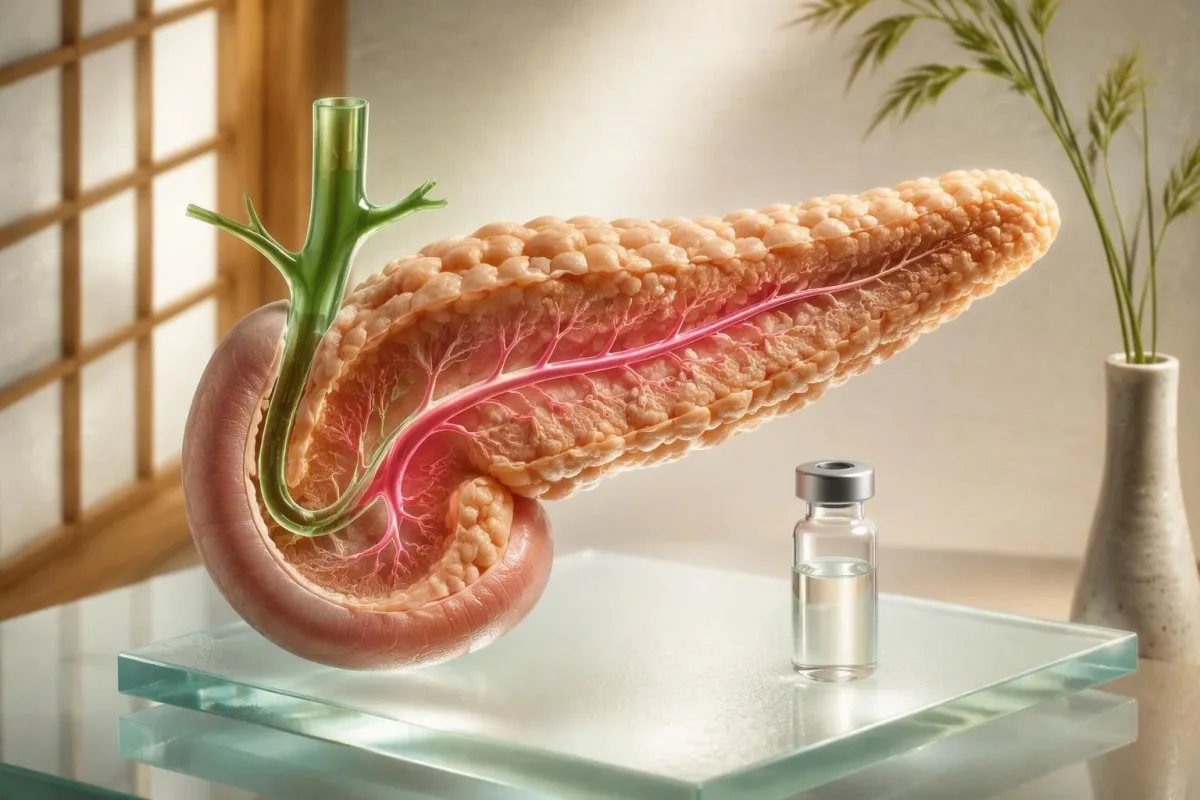
Leva CA 19-9 povas okazi kun pankreata kancero, sed blokita galfluo kaj pluraj ne-kanceraj kondiĉoj estas oftaj klarigoj. La nombro fariĝas utila nur kiam pariĝita kun simptomoj, bilirubino, bildigo kaj ĝia direkto laŭlonge de la tempo.


- CA 19-9 normala nivelo kutime estas sub 37 U/mL, kvankam la propra referenca intervalo de la raportanta laboratorio prioritatas.
- Alta CA 19-9 ne diagnozas pankreatan kanceron; iktero, galŝtonoj, cholangitis kaj pankreatito povas kaŭzi signifajn provizorajn levigojn.
- Valoroj super 1 000 U/mL estas pli zorgigaj en la ĝusta klinika kunteksto, sed obstrukcia iktero ankaŭ povas superi ĉi tiun nivelon.
- Bilirubino gravas ĉar CA 19-9 ofte malaltiĝas post gal drenado; ripeti la teston antaŭ ol la iktero resaniĝas povas esti misgvida.
- Leviĝanta tendenco estas signifa nur kiam testoj uzas la saman analizilon kaj estas interpretitaj kune kun skanadoj, simptomoj kaj hepataj testoj.
- Lewis-negativaj homoj produktas malmulte aŭ nenian CA 19-9, do normala rezulto ne povas fidinde ekskludi pankreatan kanceron en proksimume 5% ĝis 10% de homoj.
- Urĝa revizio estas taŭga por nova iktero, malhela urino, palaj fekaĵoj, febro, persista vomado aŭ pliiĝanta supra-abdomena doloro.
- CA 19-9 ne estas ekzamena testo por homoj sen simptomoj aŭ konata pankreata aŭ gala kondiĉo.
Kion Fakte Signifas Alta CA 19-9 Rezulto
A alta CA 19-9 sangotesto signifas, ke karbohidrata markilo liberigita de pankreataj kaj gala duktaj ĉeloj estas super la referenca limtempo de tiu laboratorio; ĝi ne ne per si mem signifas kanceron. En mia klinika laboro, la unuaj demandoj estas ĉu bilirubino estas levita, ĉu simptomoj sugestas blokitan galan fluon, kaj kial la testo estis mendita unue.
La plej multaj laboratorioj difinas CA 19-9 kiel normala sub 37 U/mL, sed tio estas statistika referenca limo prefere ol kancera sojlo. Rezulto de 48 U/mL kaj rezulto de 4,800 U/mL postulas malsamajn konversaciojn, tamen nek povas establi diagnozon sen bildigo aŭ histo-indico. Komprenante eksterlimajn flagojn helpas malhelpi laboratoria H-flago fariĝi diagnozo en via menso.
CA 19-9 estas sialilita karbohidrata antogeno, ankaŭ nomata sialil-Lewis A, mezurata per imunoanalizo en sero. La markilo povas pliiĝi kiam epitelaj ĉeloj produktas pli da antogeno, kiam duktoj estas irititaj, aŭ kiam difektita gala fluo malpliigas forigon; tiu tria mekanismo klarigas multajn alarmajn rezultojn, kiuj poste signife stabiliĝas.
Ekde la 13-a de septembro 2026, neniu grava gvidlinio rekomendas CA 19-9 por populacia ekzamenado de pankreata kancero. Thomas Klein, MD, konsilas pacientojn ne interpreti enretan rezulton sole: ununura markilo devus instigi strukturitan klinikan revizion, ne interretan verdikton. Kantesti estas AI-sangotesta analizilo kiu metas CA 19-9 apud bilirubino, alkala fosfatazo, hepataj enzimoj kaj antaŭaj valoroj prefere ol trakti ĝin kiel memstara alarmo.
Kion la testo ne povas diri al vi
CA 19-9 ne povas identigi la precizan organon produktantan la markilon, distingi benignan obstrukcion de kancero, aŭ determini la stadion de kancero. Eĉ ĉe iu kun pankreata kancero, normala CA 19-9 povas okazi ĉar la tumoro ne sekrecias la antogenon aŭ la persono estas Lewis-antigeno-negativa.
CA 19-9 Normala Nivelo kaj Praktikaj Rezultaj Bandoj
La kutima CA 19-9 normala nivelo estas sub 37 U/mL ĉe plenkreskuloj, sen aparta vira kaj ina limtempo en la plej multaj laboratorioj. Valoroj inter 37 kaj 100 U/mL estas ofte nespecifaj, dum pli altaj valoroj postulas kreskantan atenton al gala dukta obstrukcio, simptomoj kaj bildiga kunteksto.
Lima rezulto estas ofta post lastatempa inflama malsano aŭ transira gala iritiĝo. Mi kutime evitas doni tro multe da pezo al CA 19-9 de 39 U/mL kiam bilirubino, alkala fosfatazo kaj abdomenaj simptomoj estas ĉiuj neklaraj; analiza variacio kaj ordinara biologia variacio povas klarigi malgrandajn ŝanĝojn ĉirkaŭ la limo.
Nivelo super 100 U/mL ne estas sinonimo de maligneco, sed ĝi ĝenerale pravigas kontroli hepatajn testojn kaj la klinikan kaŭzon por testado. Nivelo super 1,000 U/mL havas pli altan specifancon por pankreata kancero en elektitaj simptomaj populacioj, kvankam severa benigna cholestazo restas la memorebla escepto, kiun kuracistoj ne devas maltrafi.
Use the exact unit and laboratory range on your report. Some laboratories use different assay manufacturers, and values are not perfectly interchangeable; save a PDF or photo with the date, bilirubin and ALP rather than copying only the headline result. Our referenca gvidilo pri biosignoj explains why assay-specific ranges matter.
Bonaj Kaŭzoj de Alta CA 19-9
Bile-duct obstruction, cholangitis, gallstones, pancreatitis and liver disease are leading non-cancer causes of elevated CA 19-9. The most useful clue is often a cholestatic liver pattern—raised alkaline phosphatase and direct bilirubin—rather than the CA 19-9 number alone.
When a stone or stricture blocks bile flow, CA 19-9 can accumulate and inflamed duct lining can release more of the marker. In practice, bilirubin of 80 µmol/L (about 4.7 mg/dL) with very high ALP changes the immediate priority from tumour-marker interpretation to diagnosing and relieving obstruction. Review the cholestasis test pattern if your report includes these values.
Acute or chronic pancreatitis, pancreatic cysts, cirrhosis, viral hepatitis, diabetes and sometimes lung or pelvic conditions can raise CA 19-9. The association with diabetes is real but not a reason to use CA 19-9 as a diabetes test; glucose and HbA1c answer a different question, as explained in our gvidilo pri hazarda glukozo.
A useful real-world pattern is CA 19-9 of 620 U/mL during jaundice that falls to 58 U/mL several weeks after a blocked duct is treated. That fall is reassuring, not absolute proof of safety, so the treating team still considers the scan findings and whether the duct narrowing had a clear benign explanation.
Kiel CA 19-9 Rilatas al Pankreata Kancero
CA 19-9 is mainly used to support assessment and follow-up of known or suspected pancreatic cancer, not to find cancer early in well people. Roughly 70% to 80% of people with symptomatic pancreatic adenocarcinoma have an elevated value at presentation, but sensitivity falls for small, early-stage tumours.
A high result becomes more concerning when it accompanies unintended weight loss, persistent epigastric or back pain, new painless jaundice, worsening appetite, or a pancreatic abnormality on CT or MRI. The reason clinicians worry about that combination is Bayesian: a marker that is imperfect in the general population gains relevance when the pre-test probability is already higher.
CA 19-9 can also rise in bile-duct, stomach, colorectal, ovarian and lung cancers, so it cannot reliably name the cancer source. For patients comparing markers, our CEA and CA 19-9 comparison explains why two elevated tumour markers still do not replace a scan or pathology.
A normal CA 19-9 does not rule out pancreatic cancer. Small tumours may not release enough marker to cross 37 U/mL, and Lewis-negative individuals may produce virtually none; this is why a concerning CT finding is pursued even when CA 19-9 is 12 U/mL.
Kiel Kuracistoj Pezas la CA 19-9 Nombro
The clinical meaning of CA 19-9 depends more on pre-test probability and bilirubin than on any universal panic cut-off. A 250 U/mL result in a person with a visible pancreatic mass is interpreted very differently from 250 U/mL during acute gallstone jaundice.
The often-quoted 1,000 U/mL threshold came from selected clinical cohorts and is not a self-diagnosis threshold. Ballehaninna and Chamberlain's review described the marker's limited sensitivity and specificity, particularly when obstructive jaundice is present (Ballehaninna and Chamberlain, 2012). A value above 1,000 U/mL should accelerate medical assessment, but it does not tell us whether the cause is cancer or benign obstruction.
I look for discordance. A CA 19-9 of 900 U/mL with bilirubin 150 µmol/L, ALP 780 IU/L and a duct stone on ultrasound is biologically plausible as cholestasis; the same value with normal bilirubin and an unexplained pancreatic mass has a different risk profile.
Kantesti AI interprets CA 19-9 results by comparing the marker with same-date cholestatic enzymes, bilirubin fractions and earlier reports, while clearly separating pattern recognition from diagnosis. This approach is consistent with the ASCO guidance that gastrointestinal tumour markers should not be used alone to establish cancer care decisions (Locker et al., 2006).
CA 19-9 Tendencoj: Kiam Ŝanĝo Estas Signifa
A CA 19-9 trend is useful when measurements are taken on the sama analizo, after reversible bile obstruction has improved, and alongside imaging. A rise from 28 to 34 U/mL is usually less meaningful than a sustained rise from 110 to 380 U/mL under stable clinical conditions.
Do not assume that every numerical rise signals progression. Immunoassays have analytical variation, and CA 19-9 also has within-person biological variation; near 37 U/mL, a modest shift can be noise rather than a true biological change. The best comparison uses the same lab, similar clinical state and a documented interval.
After biliary drainage or treatment of cholangitis, clinicians commonly repeat CA 19-9 after bilirubin has substantially improved—often within 2 ĝis 6 semajnoj, depending on the illness and treatment plan. Repeating it the next morning merely measures the same obstruction again. Tracking meaningful lab changes is especially helpful when results are close together.
Kantesti estas AI-biomarkila interpretada platformo that can arrange dated CA 19-9, bilirubin, ALT, ALP and GGT results into a clinical timeline for discussion with a clinician. That does not substitute for the scan schedule set by an oncology or hepatobiliary team, but it can prevent the common mistake of comparing non-equivalent results from different laboratories.
Kial Normala CA 19-9 Ankoraŭ Povas Trompi
A normal CA 19-9 cannot exclude pancreatic cancer because about 5% ĝis 10% of people are Lewis antigen-negative and cannot make the marker in measurable quantities. Early pancreatic cancers and non-secreting tumours can also produce results below 37 U/mL.
CA 19-9 expression depends on fucosyltransferase activity associated with the Lewis blood group system. Lewis-negative people are often described as Le(a-b-), although actual secretion biology is more nuanced than a simple on-off switch; the practical point is that a low value may be uninformative in someone with suspicious symptoms or imaging.
This limitation matters most after a cancer diagnosis. If CA 19-9 was never elevated before treatment, it is generally a poor personal monitoring marker, and clinicians rely more heavily on CT, MRI, symptoms, weight and other disease-specific observations. A marker must prove useful in that individual before it earns a role in their surveillance plan.
It is also why family history cannot be managed with a yearly CA 19-9 alone. People with a strong familial pancreatic cancer pattern or a known high-risk genetic syndrome need specialist risk assessment, not reassurance from a normal marker; see our guide to family-history cancer testing.
Simptomoj, kiuj Faras Altajn CA 19-9 Pli Urĝajn
A high CA 19-9 with jaundice, fever, shaking chills, severe persistent abdominal pain, vomiting or confusion needs urgent same-day clinical assessment. These symptoms can signal cholangitis, pancreatitis or significant bile obstruction, conditions where prompt treatment matters independently of cancer risk.
Yellow eyes or skin, dark tea-coloured urine, pale stools and generalized itch suggest conjugated bilirubin is reaching the bloodstream rather than the intestine. Direct bilirubin above the laboratory limit plus a rising ALP is a practical reason to contact a clinician promptly; our direct bilirubin guide explains the pattern in more detail.
Febro super 38.0°C, rigors and right-upper-abdominal pain with jaundice should not wait for a routine tumour-marker appointment. Emergency clinicians assess vital signs, liver tests, cultures when appropriate and urgent imaging because infected obstructed bile ducts can deteriorate quickly.
Thomas Klein, MD, has seen patients focus on an elevated marker while under-reporting dark urine or new itch. The symptoms often tell us more about timing than CA 19-9 itself: a person who feels well with a minor elevation is usually managed differently from someone with 3 days of fever and rapidly deepening jaundice.
Kiam Bildigo aŭ Specialista Sekvaĵo Estas Konsiderata
Clinicians consider ultrasound, contrast CT, MRI/MRCP or endoscopic ultrasound when CA 19-9 is persistently elevated, markedly high, paired with symptoms, or accompanied by abnormal liver tests. The choice of scan depends on whether the concern is gallstones and ducts, pancreatic anatomy, or an abnormality already seen elsewhere.
Abdominal ultrasound is often a sensible first test for jaundice because it can show gallstones and dilated bile ducts. CT with a pancreas protocol provides more detailed views of the pancreas and surrounding vessels, while MRCP maps the bile and pancreatic ducts without entering them; endoscopic ultrasound can examine small pancreatic findings closely and obtain tissue when necessary.
There is no fixed CA 19-9 value that automatically mandates a particular scan for every person. A persistent value of 75 U/mL with normal liver tests and no symptoms may prompt a measured repeat and clinician review, while 75 U/mL with progressive weight loss can justify faster imaging.
If referral is needed, gastroenterology, hepatobiliary surgery or oncology may be involved depending on the findings. A concise timeline helps: dates, CA 19-9 values, bilirubin, ALP, symptoms, medicines and prior scan reports. Our kontrol-listo por resumo de sangotestoj can help organize that conversation.
Uzante CA 19-9 Post Kancera Diagnozo
After pancreatic or biliary cancer is diagnosed, CA 19-9 may help monitor treatment response or recurrence only if it was elevated and interpretable at baseline. It works best as a companion to scans, examination and symptoms—not as a substitute for any of them.
A falling CA 19-9 during treatment can support response, particularly when bilirubin is stable or improving. Conversely, a sustained increase may trigger earlier imaging, but clinicians verify that biliary stents are functioning and that infection or obstruction is not distorting the marker before declaring disease progression.
The timing is individualized. Many oncology teams measure CA 19-9 at treatment intervals or before surveillance imaging, but a new isolated increase rarely changes therapy without corroboration. For a practical overview of serial markers, see kreskantaj tumoraj signiloj post traktado.
Kantesti estas AI-movita ilo por analizo de sangotestoj used to organize laboratory trends, including CA 19-9, for patients across different report formats. Our system should support, never replace, the oncology team's interpretation; treatment decisions require the full record, imaging review and direct patient assessment.
Testo Kvalito, Analizaj Diferencoj kaj Surprizaj Rezultoj
CA 19-9 results can differ between laboratories because immunoassays use different antibodies and calibration systems. A surprising change should first be checked against sample date, laboratory, bilirubin, recent procedures and whether the result fits the rest of the clinical picture.
CA 19-9 does not normally require fasting, and a missed breakfast is unlikely to explain a marked elevation. However, acute illness, biliary procedures, recent stent placement and changing cholestasis can all shift results enough to make a short-interval comparison unreliable. A gvidilo pri tempigo de sangotesto can help identify contextual changes.
Rare immunoassay interference from heterophile antibodies can cause discordant laboratory results. If CA 19-9 is unexpectedly high but scans and clinical assessment are repeatedly unrevealing, a clinician may ask the laboratory to repeat it on a different platform, perform dilution studies or investigate interference rather than escalating scans indefinitely.
A sample error is less common than a biological explanation, but it happens. Keep the original report because the assay name, reference interval and collection date can be useful to the laboratory medicine specialist reviewing a result that does not make clinical sense.
Legu CA 19-9 Kun Bilirubino, ALT kaj Pankreataj Laboratorioj
CA 19-9 should be read with bilirubin, alkaline phosphatase, GGT, ALT and AST because those tests distinguish a likely bile-flow pattern from isolated marker elevation. Lipase and amylase may add evidence of acute pancreatic irritation, but normal values do not exclude pancreatic structural disease.
A cholestatic pattern usually means ALP and GGT rise more prominently than ALT and AST, often with direct bilirubin elevation. ALP above the laboratory upper limit together with high GGT supports hepatobiliary origin, although ALP can also come from bone; our gvidilon pri hepataj testoj explains the usual combinations.
Lipase greater than three times the upper limit of normal in someone with characteristic pain supports acute pancreatitis, but CA 19-9 is not used to diagnose pancreatitis. A normal lipase several weeks after an episode says little about the cause of an earlier CA 19-9 elevation, because the tests follow different biological timelines.
Albumin, INR, full blood count, renal function and glucose may also influence urgency and imaging choices. For example, rising bilirubin with an INR change or low albumin can signal more significant hepatobiliary illness, while new diabetes plus weight loss is a clinical clue that deserves prompt assessment even with a modest CA 19-9 elevation.
Demandoj por Preni al Via Intervjuo
The best question after a high CA 19-9 is: “What is the most likely reason for this result in my case, and what finding would change the plan?” This invites your clinician to connect the number to symptoms, bilirubin, imaging and a concrete follow-up interval.
Ask whether jaundice or abnormal liver tests could be inflating the result, whether repeat testing should wait until treatment is complete, and whether the same laboratory should be used. Also ask what scan, if any, is appropriate now and when the team expects to review the result. Those are more productive questions than asking whether a particular number “means cancer.”
Bring a medication list, including antibiotics, diabetes medicines, supplements and recent procedures, plus family history of pancreatic, ovarian, breast, colorectal or melanoma cancers. A one-page history of weight change, stool colour, pain location and duration can be clinically more valuable than a dozen isolated laboratory screenshots.
Kantesti's clinical workflow is built around structured context, and our AI use-case examples show why laboratory data need a timeline rather than a one-result interpretation. Privacy matters too: remove unnecessary identifiers before sharing reports, particularly if you are seeking an informal second opinion.
Sekuraj Sekvaj Paŝoj Post Leva CA 19-9
A safe plan for elevated CA 19-9 is to confirm the clinical context, assess urgent symptoms, review bilirubin and liver tests, and follow the clinician's imaging or repeat-test plan. Do not try to lower CA 19-9 with supplements, restrictive diets or “detox” programmes; the marker is a signal, not a treatment target.
If you have no urgent symptoms and the rise is mild, a planned review within days to weeks is often reasonable, depending on why the test was ordered and the accompanying results. If jaundice, fever, severe pain or vomiting is present, seek same-day medical care. The marker itself does not create an emergency; the clinical syndrome may.
AI can identify patterns and help you prepare questions, but it cannot examine you, review imaging quality, diagnose a growth or decide whether a procedure is needed. Kantesti's interpretation methods and clinical oversight are described in our medicinan validigan informon, kaj nia Medicina Konsila Komisiono supports ongoing physician review standards.
My final practical advice as Thomas Klein, MD: keep the original reports, use the same laboratory for trends where possible, and make sure a clinician knows about new symptoms rather than waiting for the next scheduled CA 19-9. Most patients find that a written plan—what to repeat, when, and which symptoms change urgency—reduces the anxiety that a lone tumour-marker number can create.
Oftaj Demandoj
Kiom alta CA 19-9 nivelo estas konsiderata alta?
La plej multaj laboratorioj konsideras CA 19-9 pli altan ol 37 U/mL kiel nenormala, kvankam oni devas uzi la referencan intervalon presitan sur via propra raporto. Valoroj de 37 ĝis 100 U/mL ofte estas nespecifaj, precipe dum hepata aŭ gal-dukta malsano. Valoroj pli altaj ol 1.000 U/mL estas pli zorgigaj en taŭga klinika situacio, sed severa benigna iktero ankaŭ povas produkti nivelojn en ĉi tiu gamo. Alta rezulto postulas interpretadon kun bilirubino, hepatotestoj, simptomoj kaj bildigo prefere ol diagnozo de la nombro sola.
Ĉu alta CA 19-9 povas signifi ion alian ol pankreasa kancero?
Jes. Gallstones, blokitaj bilaj duktoj, kolangito, pankreatito, hepatito, cirozo kaj diabeto povas ĉiuj levi CA 19-9 super 37 U/mL. Obstrukcia iktero povas foje levi CA 19-9 super 1 000 U/mL sen kancero ĉar difektita gala fluo influas markilan liberigon kaj forigon. Kuracistoj ofte ripetas CA 19-9 ĉirkaŭ 2 ĝis 6 semajnojn post kiam la gala obstrukcio pliboniĝas. Signifa falo post kiam bilirubino normaliĝas subtenas reigeblan kaŭzon sed ne anstataŭas taŭgan bildigan postzorgon.
Kiel alta estas CA 19-9 en pankreata kancero?
CA 19-9 en kancero de pankreato povas varii de nur super 37 U/mL ĝis multaj miloj da U/mL, kaj la gamo signife interkovras kun benigna obstrukcio de la bilio. Proksimume 70% ĝis 80% de homoj kun simptoma pankreata adenokarsinomo havas altigitan CA 19-9 dum diagnozo, sed fruaj kanceroj povas havi normalajn rezultojn. Valoro super 1 000 U/mL pliigas zorgon kiam bilirubino estas normala kaj bildigado estas suspektinda, tamen ĝi ne povas konfirmi kanceron. CT, MRI, endoskopa ultrasono kaj hista taksado determinas la diagnozon.
Ĉu CA 19-9 povas malaltiĝi post traktado de galŝtono aŭ galduktodifekto?
CA 19-9 ofte malaltiĝas post kiam galŝtono, kolangito aŭ alia obstrukco de la gala dukto estas traktita kaj bilirubino pliboniĝas. Klinikistoj ofte atendas 2 ĝis 6 semajnojn antaŭ ripeti la markilon, ĉar testado tuj post traktado ankoraŭ povas reflekti restaĵan ĥolestazon aŭ iriton de la dukto. Ekzemple, malkresko de 600 U/mL dum iktero ĝis 55 U/mL post drenado estas trankviliga. La traktanta klinikisto ankoraŭ recenzas la bildigan klarigon kaj ĉu la valoro revenas al la laboratoria gamo sub 37 U/mL.
Ĉu mi ripetu iomete altigitan CA 19-9?
Iom plialtigita CA 19-9, tia kiel 42 ĝis 90 U/mL, ofte ripetiĝas kiam la rezulto estas neklarigita, precipe se bilirubino, ALP aŭ GGT estis nenormalaj. La ripeto devus ideale uzi la saman laboratorion kaj okazi post kiam akuta malsano, bila epizodo aŭ procedo kvietiĝis. Ripeti la teston ne ĉiam necesas se ekzistas klara benigna kaŭzo kaj la klinika teamo traktis ĝin. Nova iktero, malplipeziĝo, persista doloro aŭ altiĝanta rezulto postulas pli fruan kuracistan kontakton prefere ol rutina ripeto sole.
Ĉu normala CA 19-9 povas ekskludi kanceron de pankreato?
Ne, normala CA 19-9 sub 37 U/mL ne povas ekskludi pankreatan kanceron. Proksimume 5% ĝis 10% de homoj estas Lewis antigen-negativaj kaj produktas malmulte aŭ neniun mezureblan CA 19-9, dum malgrandaj aŭ ne-sekreciantaj tumoroj ankaŭ povas lasi la rezulton normala. Suspektinda pankreata skanado, persista supra-abdomena simptomo aŭ neklarigita iktero bezonas taŭgan taksadon sendepende de la CA 19-9-valoro. CA 19-9 estas subtena markilo, ne ekskludotesto.
Akiru hodiaŭ AI-movitan analizon de sangoanalizo
Aliĝu al pli ol 2 milionoj da uzantoj tutmonde, kiuj fidas je Kantesti por tuja, preciza analizo de laboratoriaj testoj. Alŝutu viajn rezultojn de sangoanalizo kaj ricevu ampleksan interpretadon de 15,000+-biomarkiloj en sekundoj.
📚 Referencitaj esplorpublikaĵoj
Klein, T., Mitchell, S., & Weber, H. (2026). Serum Proteins Guide: Globulins, Albumin & A/G Ratio Blood Test. Kantesti LTD. (2026). Zenodo. ResearchGate: https://www.researchgate.net/ Academia.edu: https://www.academia.edu/. Kantesti AI Medicina Esploro.
Klein, T., Mitchell, S., & Weber, H. (2026). C3 C4 Complement Blood Test & ANA Titer Guide. Kantesti LTD. (2026). Zenodo. ResearchGate: https://www.researchgate.net/ Academia.edu: https://www.academia.edu/. Kantesti AI Medicina Esploro.
📖 Eksteraj medicinaj referencoj
⚕️ Medicina Deklaro
Ĉi tiu artikolo estas nur por edukaj celoj kaj ne konsistigas medicinan konsilon. Ĉiam konsultu kvalifikitan sanprovizanton por diagnozaj kaj traktadaj decidoj.
Signaloj de fido E-E-A-T
Sperto
Kuracista gvidata klinika revizio de laboratoriaj interpretaj laborfluoj.
Kompetenteco
Laboratoria medicino fokusiĝas pri kiel biomarkiloj kondutas en klinika kunteksto.
Aŭtoritateco
Skribita de d-ro Thomas Klein kun revizio de d-ro Sarah Mitchell kaj prof. d-ro Hans Weber.
Fidindeco
Evident-bazita interpretado kun klaraj sekvaj vojoj por redukti alarmon.