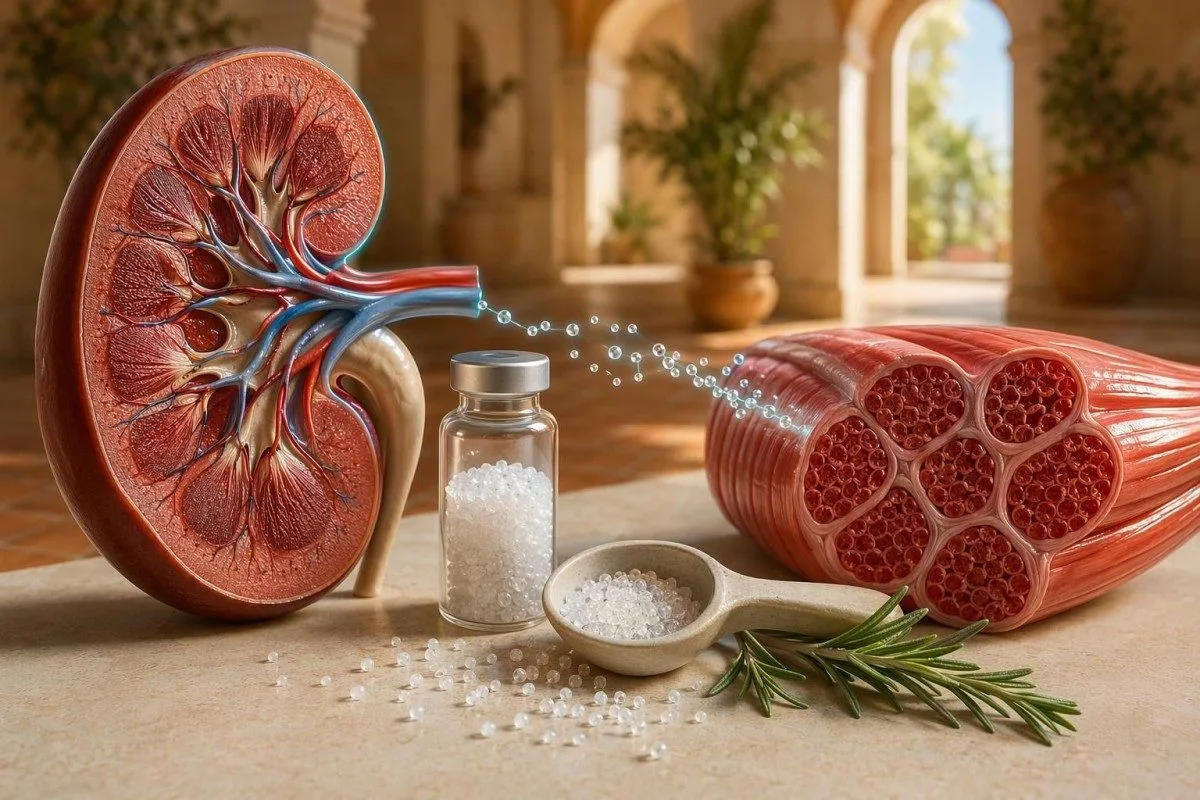
Creatine is one of the better-studied supplements in sports nutrition, but the lab story is often misunderstood. The tricky part is separating a harmless creatinine bump from a true kidney signal.


- Creatine supplement benefits are strongest for strength, repeated sprint power, lean mass, and muscle recovery when paired with resistance training.
- Typical dose is 3–5 g/day of creatine monohydrate; loading is optional at about 20 g/day for 5–7 days.
- Creatine and creatinine blood test confusion happens because creatine can convert into creatinine, raising the lab number without kidney injury.
- Creatine kidney labs should include creatinine, eGFR, BUN, electrolytes, and urine albumin-creatinine ratio when risk factors are present.
- Cystatin C is useful because creatine intake and muscle mass affect it far less than creatinine-based eGFR.
- Red flags include eGFR below 60 mL/min/1.73 m² for more than 3 months, urine albumin-creatinine ratio above 30 mg/g, swelling, very high blood pressure, or rising potassium.
- Creatine for muscle recovery may reduce soreness and improve training volume, but it is not a painkiller and will not fix poor sleep, under-eating, or overtraining.
- Brain evidence is promising but mixed; benefits appear more likely during sleep deprivation, vegetarian diets, ageing, or high cognitive stress.
- Before testing avoid unusually hard training for 24–48 hours if you are checking creatinine, CK, AST, or ALT, because exercise can muddy the result.
What creatine actually helps—and why labs can look odd
Creatine supplement benefits are best proven for strength, repeated sprint power, lean mass, and training recovery; brain benefits are plausible but less predictable. Creatine can also raise serum creatinine by about 10–30 µmol/L in some users, which does not automatically mean kidney damage. If your eGFR drops after starting creatine, context matters. Uploading trends to creatine supplement benefits through Kantesti AI can help separate a supplement effect from a true kidney pattern.
As of May 3, 2026, the best-supported dose is 3–5 g/day of creatine monohydrate for adults who tolerate it. The International Society of Sports Nutrition position stand by Kreider et al. in 2017 concluded that creatine monohydrate is effective for high-intensity exercise and has a strong safety record in studied populations.
The lab trap is simple: creatine becomes creatinine, and creatinine is also the biomarker most laboratories use to estimate kidney filtration. That is why an athletic 28-year-old taking 5 g/day can show creatinine of 115 µmol/L while having normal urine albumin, normal potassium, and excellent training capacity; our guide to athlete blood tests goes deeper into those patterns.
In my clinical work, I worry less about one creatinine value and more about the pattern: eGFR trend, BUN, urine albumin-creatinine ratio, potassium, blood pressure, hydration status, and recent heavy training. Dr. Thomas Klein would not call kidney disease from creatinine alone in a muscular creatine user without checking those cross-signals first.
How creatine powers muscle during hard efforts
Creatine helps muscle because phosphocreatine rapidly donates phosphate to regenerate ATP during short, intense efforts lasting roughly 5–30 seconds. This is why creatine usually helps repeated sprints, heavy sets, jumping, and high-volume resistance training more than steady walking or easy cycling.
Skeletal muscle stores about 95% of the body’s creatine, mostly as free creatine and phosphocreatine. Supplementation can raise total muscle creatine stores by roughly 10–40%, with the largest response in people who start with lower stores, such as many vegetarians and smaller-bodied athletes.
The thing is, not everyone responds the same way. In practice I see non-responders: usually people already eating large amounts of meat or fish, people with inconsistent dosing, or lifters whose program lacks enough hard volume to reveal the benefit; our biohacking lab guide explains why baseline tracking matters.
Kantesti is built around this same principle of baseline first, interpretation second. You can learn more about how we think as an organisation on About Us, but clinically the point is plain: a creatinine number means more when compared with your own prior values.
Creatine for muscle recovery: what changes and what does not
Creatine for muscle recovery may improve the ability to repeat hard training sessions, reduce markers of muscle disruption in some studies, and support faster glycogen restoration when paired with carbohydrate. It does not replace rest, protein, or a sane training plan.
A practical recovery signal is training volume. If a lifter adds 1–2 extra quality reps in sets 3 and 4 for several weeks, that small difference compounds into more mechanical tension, which is where lean mass changes usually come from.
A 52-year-old marathon runner once came to me with AST of 89 IU/L after hill repeats and a new creatine habit. Before panic, we repeated the panel after 72 hours without hard running; AST fell to 34 IU/L, which fits muscle spillover better than liver injury, as discussed in our AST muscle guide.
Kreider et al. 2017 also notes that creatine may help athletes tolerate training volume, especially repeated high-intensity work. I still ask about sleep: less than 6 hours/night can erase the recovery benefit that people hoped a 5 g scoop would deliver.
Strength, power and lean mass benefits by the numbers
Creatine most reliably improves maximal strength and power output when used alongside resistance training for at least 4–12 weeks. The usual visible change is 0.5–2.0 kg early weight gain, much of it water held inside muscle rather than fat.
In controlled training studies, creatine users often gain more lean mass than placebo users, though the exact amount varies by programme, diet, sex, and baseline stores. A typical clinical expectation is not dramatic overnight strength; it is a few percent more work capacity across repeated sets.
I tell patients to track outcomes that matter: estimated one-rep max, total weekly sets completed, body weight, waist measurement, and soreness lasting beyond 48 hours. If weight jumps 1.5 kg in week one but waist is unchanged, that is usually intracellular water rather than fat gain.
Kantesti AI reads lab patterns differently in muscular people because creatinine is partly a muscle-mass marker. Our biomarkers guide covers more than 15,000 markers, including kidney, liver, metabolic, and recovery-related values.
Brain benefits: promising, but not magic
Creatine may help brain energy metabolism, especially during sleep loss, ageing, vegetarian diets, or cognitively demanding stress. The evidence for everyday memory improvement in well-rested young adults is honestly mixed.
The brain uses phosphocreatine as a rapid energy buffer, just as muscle does, but it turns over a smaller creatine pool. In a 2018 systematic review, Avgerinos et al. reported potential cognitive benefits, with stronger signals in older adults and people under metabolic stress than in healthy young adults.
Vegetarian and vegan patients are interesting here because baseline dietary creatine intake may be close to zero. When a patient with brain fog, low ferritin, borderline B12, and no meat intake asks about creatine, I check the whole pattern rather than pretending one supplement explains everything; our brain fog labs piece lays out those checks.
A common dose for cognitive trials ranges from 3–20 g/day, but higher doses more often cause bloating or loose stools. For most adults, I start at 3 g/day for 2–4 weeks and reassess sleep, training load, and symptoms before changing the dose.
Older adults: creatine works best with resistance training
Creatine may help older adults gain strength and lean mass, but the best results occur when it is paired with progressive resistance exercise. Creatine alone rarely reverses frailty, sarcopenia, low protein intake, vitamin D deficiency, or untreated illness.
After age 50, muscle protein synthesis becomes less responsive to small protein doses, and training stimulus matters more. In clinic, a 70-year-old taking 5 g/day but eating 45 g protein/day and avoiding leg training usually sees little change beyond scale weight.
For older patients, I check creatinine, eGFR, BUN, potassium, calcium, albumin, vitamin D, HbA1c, and sometimes TSH before interpreting fatigue or weakness. Our guide to senior blood tests explains why albumin and kidney trends can reframe supplement decisions.
Women after menopause can respond well to creatine plus lifting, but the evidence varies by study design and training intensity. Dr. Thomas Klein’s practical rule is simple: if a patient cannot stand from a chair 10 times without fatigue, we prioritise safe strength work before chasing supplement nuance.
Creatine and creatinine blood test: why the number rises
Creatine and creatinine blood test confusion happens because a small fraction of creatine naturally degrades into creatinine each day. Extra creatine can therefore raise serum creatinine without reducing actual kidney filtration.
Adult creatinine reference ranges vary by lab, but many use about 60–110 µmol/L for men and 45–90 µmol/L for women. Some European laboratories use narrower upper limits, so the same 100 µmol/L result can be flagged in one report and normal in another.
A creatinine rise of 10–30 µmol/L after creatine is not rare, especially in muscular people or those using a loading phase. The question is whether eGFR, urine albumin, potassium, blood pressure, and symptoms move in the same direction; our article on the normal creatinine range shows why one value can mislead.
Kantesti AI interprets creatinine by checking units, age, sex, prior baselines, muscle clues, medication context, and companion markers. When I review a panel showing creatinine 122 µmol/L but cystatin C normal and urine albumin-creatinine ratio below 30 mg/g, I do not treat that as the same risk as a rising creatinine with albumin in the urine.
Creatine kidney labs to check before starting
Creatine kidney labs are most useful before starting if you have kidney disease risk factors or no recent baseline. A practical pre-creatine panel includes creatinine, eGFR, BUN, electrolytes, urine albumin-creatinine ratio, and sometimes cystatin C.
KDIGO 2024 defines chronic kidney disease by abnormalities of kidney structure or function present for at least 3 months, including eGFR below 60 mL/min/1.73 m² or albuminuria. That time requirement matters because one dehydrated result after a hard workout is not the same as a persistent kidney pattern.
A urine albumin-creatinine ratio below 30 mg/g or 3 mg/mmol is generally considered normal to mildly increased. If ACR is repeatedly above that range, I become more cautious with supplements, NSAIDs, high-protein diets, and dehydration risks; our renal panel guide compares the usual blood tests.
For high-risk patients, cystatin C can be the tie-breaker. The cystatin C eGFR guide explains why cystatin C-based estimates are often helpful when creatinine is distorted by muscle mass, creatine use, or very low body weight.
Who should get labs before taking creatine
You should check labs before creatine if you have known kidney disease, diabetes, high blood pressure, heart failure, recurrent dehydration, pregnancy, a transplant history, or medications that affect kidney blood flow. I also check first in adults over 60 who have not had labs in the past year.
Medications matter. ACE inhibitors, ARBs, diuretics, SGLT2 inhibitors, lithium, calcineurin inhibitors, and frequent NSAID use can all change kidney lab interpretation, so a creatine-related creatinine bump may create real diagnostic confusion.
Patients with eGFR below 45 mL/min/1.73 m² should not casually start creatine without clinician input. Below 30 mL/min/1.73 m², I would generally avoid non-prescribed creatine unless a kidney specialist has a specific reason and monitoring plan; our kidney diet guide covers related lab-sensitive choices.
There is a quieter group I watch: people doing aggressive weight cuts, sauna sessions, endurance events, or low-carbohydrate dieting. They can arrive with high BUN, concentrated urine, low sodium, or high-normal potassium, and creatine becomes one more variable rather than the only story.
Reading eGFR, BUN and cystatin C while on creatine
Creatinine-based eGFR can look lower in creatine users even when true kidney filtration has not changed. BUN, cystatin C, urine albumin, potassium, and trend history help decide whether the low eGFR is real.
A BUN of 7–20 mg/dL or 2.5–7.1 mmol/L is a common adult reference range, but dehydration and high protein intake can push it upward. A high BUN with stable creatinine and concentrated urine often points to hydration or protein load rather than structural kidney injury.
The BUN-creatinine ratio can be helpful, but clinicians disagree on strict cutoffs because units and lab methods differ. Our BUN-creatinine ratio article explains why a ratio above 20:1 can suggest dehydration in one context and gastrointestinal fluid loss in another.
Kantesti AI compares creatinine-based eGFR with cystatin C patterns where available. If creatinine eGFR falls from 92 to 68 mL/min/1.73 m² after a loading phase but cystatin C eGFR remains near 95 and ACR is normal, I usually repeat after stopping creatine for 1–2 weeks before labelling kidney disease.
Hydration, electrolytes and side effects that matter
Creatine commonly causes early water-weight gain, occasional bloating, and sometimes loose stools at higher doses. It does not usually cause dangerous dehydration, but poor fluid intake can make kidney labs harder to interpret.
The classic early weight change is 0.5–2.0 kg during the first 1–2 weeks, mainly from water held with creatine inside muscle cells. That is not the same as ankle swelling, breathlessness, or rapid weight gain with high blood pressure, which needs medical review.
Potassium is the electrolyte I do not ignore. A potassium result above 5.5 mmol/L deserves prompt repeat or clinician review, especially if eGFR is low, ACE inhibitors or ARBs are used, or the sample may have been damaged; our electrolyte panel guide gives the broader pattern.
Most stomach effects improve by splitting the dose: 2 g with breakfast and 2 g after training, rather than 5–10 g at once. If diarrhoea continues for more than a few days, stop and reassess; losing fluid while trying to improve performance is a bad trade.
Dose, form and timing: keep it boring
Creatine monohydrate is the best-studied form, and 3–5 g/day works for most adults. Timing matters far less than consistency, though taking it with a meal may reduce stomach upset.
Loading is optional. A common loading plan is 20 g/day split into 4 doses for 5–7 days, followed by 3–5 g/day, but many patients prefer skipping loading and reaching saturation over about 3–4 weeks.
I avoid complicated blends when the goal is clean interpretation. Caffeine, diuretics, high-dose magnesium, pre-workout stimulants, and multiple powders can blur side effects, sleep, blood pressure, and lab timing; our supplement timing guide is useful here.
Kantesti AI can generate nutrition and supplement suggestions only after reading the lab context, not just a supplement wish list. The AI supplement recommendations page shows how our platform connects deficiencies, kidney markers, liver markers, and diet patterns.
Food sources and diet context change the response
Creatine comes mainly from meat and fish, so people with low intake may respond more strongly to supplementation. A typical omnivorous diet provides roughly 1–2 g/day of creatine, while vegetarian diets often provide very little.
This is why two patients can take the same 5 g/day and feel different results. A 24-year-old vegan powerlifter with low baseline stores may gain training capacity quickly, while a 35-year-old eating steak and fish daily may notice only subtle changes.
Protein intake still matters. For many resistance-trained adults, a daily protein range around 1.6–2.2 g/kg/day is commonly used in sports nutrition, but kidney disease changes the conversation; albumin, BUN, eGFR, and urine albumin help keep the advice grounded.
Diet can also alter lab interpretation through hydration, sodium, carbohydrate intake, and training fuel. If you are comparing labs across months, our guide on lab unit changes helps prevent false alarm when a report switches from mg/dL to µmol/L.
Athlete labs: when training muddies the picture
Hard training can raise creatinine, AST, ALT, CK, LDH, and inflammatory markers even without organ injury. For athletes using creatine, timing the blood test around training is often as important as the supplement history.
I usually ask athletes to avoid unusually hard lifting, long downhill running, or race efforts for 24–48 hours before routine labs. If CK is being checked after extreme exertion, a longer rest window may be needed because CK can stay high for several days.
ALT and AST can both rise after muscle injury, but AST often moves more with skeletal muscle. If bilirubin, ALP, GGT, and symptoms are normal, isolated AST after hard training is a different pattern than hepatitis or bile duct disease; our liver function guide explains the split.
Kantesti AI reads the training story alongside the chemistry panel. That matters when a CrossFit athlete has creatinine 118 µmol/L, AST 62 IU/L, normal urine albumin, and a competition 36 hours before testing.
When to pause creatine or repeat blood tests
Pause creatine and repeat labs when creatinine rises sharply, eGFR falls below expected range, urine albumin appears, potassium rises, or symptoms develop. A 1–2 week washout often clarifies whether creatine is driving the creatinine change.
Creatine washout is not instant, but serum creatinine related to intake can improve after stopping, especially if the rise followed a loading phase. I usually repeat creatinine, eGFR, BUN, potassium, bicarbonate, and urine ACR after hydration and training normalise.
Red flags need faster action: reduced urination, swelling, shortness of breath, severe muscle pain, dark urine, persistent vomiting, or potassium above 6.0 mmol/L. Those are not supplement-optimisation questions; they are clinical safety questions.
Trend history is the best antidote to guesswork. Keeping old reports in a single place through blood test history lets you see whether creatinine was always high-normal or truly changed after creatine.
How Kantesti AI reads creatine-related lab patterns
Kantesti AI interprets creatine-related labs by combining creatinine, eGFR, BUN, cystatin C, urine albumin, electrolytes, liver enzymes, exercise timing, and previous results. The goal is not to diagnose from one marker; it is to rank the most likely explanations safely.
Our AI blood test interpretation workflow checks whether the creatinine result fits muscle mass, age, sex, unit system, and prior baseline. It also looks for discordant signs: normal cystatin C, normal ACR, and stable potassium often make true kidney injury less likely.
Medical review matters with YMYL content. Our medical validation standards and clinical oversight help keep outputs conservative when kidney markers conflict, and our doctors review safety framing through the Medical Advisory Board.
The validation work behind Kantesti’s neural network is described in our pre-registered benchmark paper, linked in the research section and on the AI benchmark page. In daily use, that translates into practical triage: reassure, repeat, or refer.
Bottom line: use creatine, but read the labs properly
Creatine is evidence-backed for muscle performance and may help selected brain-energy situations, but creatinine can rise without kidney damage. The safest approach is baseline labs for higher-risk people, consistent dosing, and interpretation using more than one kidney marker.
If you are healthy, under 60, have no kidney risk factors, and use 3–5 g/day, creatine monohydrate is usually a reasonable supplement to discuss with your clinician. If you have diabetes, hypertension, kidney disease, pregnancy, transplant history, or kidney-active medications, get labs first.
Before routine labs, do not start a loading phase, dehydrate yourself, or do maximal deadlifts the night before. If the result looks strange, compare it with your baseline and consider repeating after 1–2 weeks off creatine, especially when cystatin C or urine ACR was not checked.
You can upload a PDF or photo of your results to our AI blood test platform for a structured interpretation in about 60 seconds. For a quick no-cost check, try the free blood test analysis and bring the output to your clinician if anything looks concerning.
Frequently Asked Questions
Does creatine increase creatinine on a blood test?
Yes, creatine can increase serum creatinine because creatine naturally degrades into creatinine. A rise of about 10–30 µmol/L can occur in some users, especially during loading phases or in muscular people. This does not automatically mean kidney damage; eGFR trend, cystatin C, urine albumin-creatinine ratio, potassium, BUN, and blood pressure decide whether the pattern is concerning.
Is creatine bad for kidneys?
Creatine monohydrate at 3–5 g/day has not been shown to damage kidneys in healthy adults in the major sports nutrition literature, including the 2017 International Society of Sports Nutrition position stand. The caution is different for people with known kidney disease, eGFR below 60 mL/min/1.73 m², albuminuria above 30 mg/g, diabetes, uncontrolled hypertension, or kidney-active medications. Those patients should check labs and speak with a clinician before using creatine.
Should I stop creatine before a kidney blood test?
You do not always need to stop creatine before a kidney blood test, but pausing for 1–2 weeks can help if creatinine has risen or eGFR looks unexpectedly low. Avoid unusually hard training for 24–48 hours before testing because exercise can raise creatinine, AST, ALT, and CK. If the test is being used to diagnose kidney disease, tell your clinician about the dose, timing, loading phase, protein intake, and training schedule.
What labs should I check before taking creatine?
A sensible baseline for higher-risk adults includes serum creatinine, eGFR, BUN, sodium, potassium, bicarbonate or CO2, urine albumin-creatinine ratio, and sometimes cystatin C. Urine albumin-creatinine ratio below 30 mg/g is generally considered normal to mildly increased, while persistent values above that range need follow-up. Adults with kidney disease, diabetes, hypertension, pregnancy, transplant history, or kidney-active medications should check labs before starting creatine.
How much creatine should I take for muscle recovery?
Most adults use 3–5 g/day of creatine monohydrate for muscle recovery and training support. Loading is optional at about 20 g/day split into 4 doses for 5–7 days, followed by 3–5 g/day. If bloating or loose stools occur, skipping the loading phase or splitting the daily dose often helps.
Can creatine help brain fog?
Creatine may help brain energy metabolism, but brain fog has many causes and the evidence is mixed. Cognitive benefits appear more likely during sleep deprivation, ageing, vegetarian diets, or high mental stress, with studied doses ranging from 3–20 g/day. Before blaming low creatine, clinicians usually check B12, ferritin, TSH, glucose, HbA1c, vitamin D, sleep quality, medications, and mood symptoms.
What creatinine level is dangerous while taking creatine?
There is no single dangerous creatinine cutoff that applies to every creatine user because muscle mass, age, sex, lab units, and baseline values change interpretation. More concerning patterns include a rapid rise from baseline, eGFR below 60 mL/min/1.73 m² for more than 3 months, potassium above 5.5 mmol/L, urine albumin-creatinine ratio above 30 mg/g, or symptoms such as swelling, reduced urination, or shortness of breath. A creatinine result that is mildly high but stable, with normal cystatin C and normal urine albumin, is a different clinical picture.
Get AI-Powered Blood Test Analysis Today
Join over 2 million users worldwide who trust Kantesti for instant, accurate lab test analysis. Upload your blood test results and receive comprehensive interpretation of 15,000+ biomarkers in seconds.
📚 Referenced Research Publications
Klein, T., Mitchell, S., & Weber, H. (2026). Women's Health Guide: Ovulation, Menopause & Hormonal Symptoms. Kantesti AI Medical Research.
Klein, T., Mitchell, S., & Weber, H. (2026). Clinical Validation of the Kantesti AI Engine (2.78T) on 100,000 Anonymised Blood Test Cases Across 127 Countries: A Pre-Registered, Rubric-Based, Population-Scale Benchmark Including Hyperdiagnosis Trap Cases — V11 Second Update. Kantesti AI Medical Research.
📖 External Medical References
KDIGO Work Group (2024). KDIGO 2024 Clinical Practice Guideline for the Evaluation and Management of Chronic Kidney Disease. Kidney International.
⚕️ Medical Disclaimer
This article is for educational purposes only and does not constitute medical advice. Always consult a qualified healthcare provider for diagnosis and treatment decisions.
E-E-A-T Trust Signals
Experience
Physician-led clinical review of lab interpretation workflows.
Expertise
Laboratory medicine focus on how biomarkers behave in clinical context.
Authoritativeness
Written by Dr. Thomas Klein with review by Dr. Sarah Mitchell and Prof. Dr. Hans Weber.
Trustworthiness
Evidence-based interpretation with clear follow-up pathways to reduce alarm.