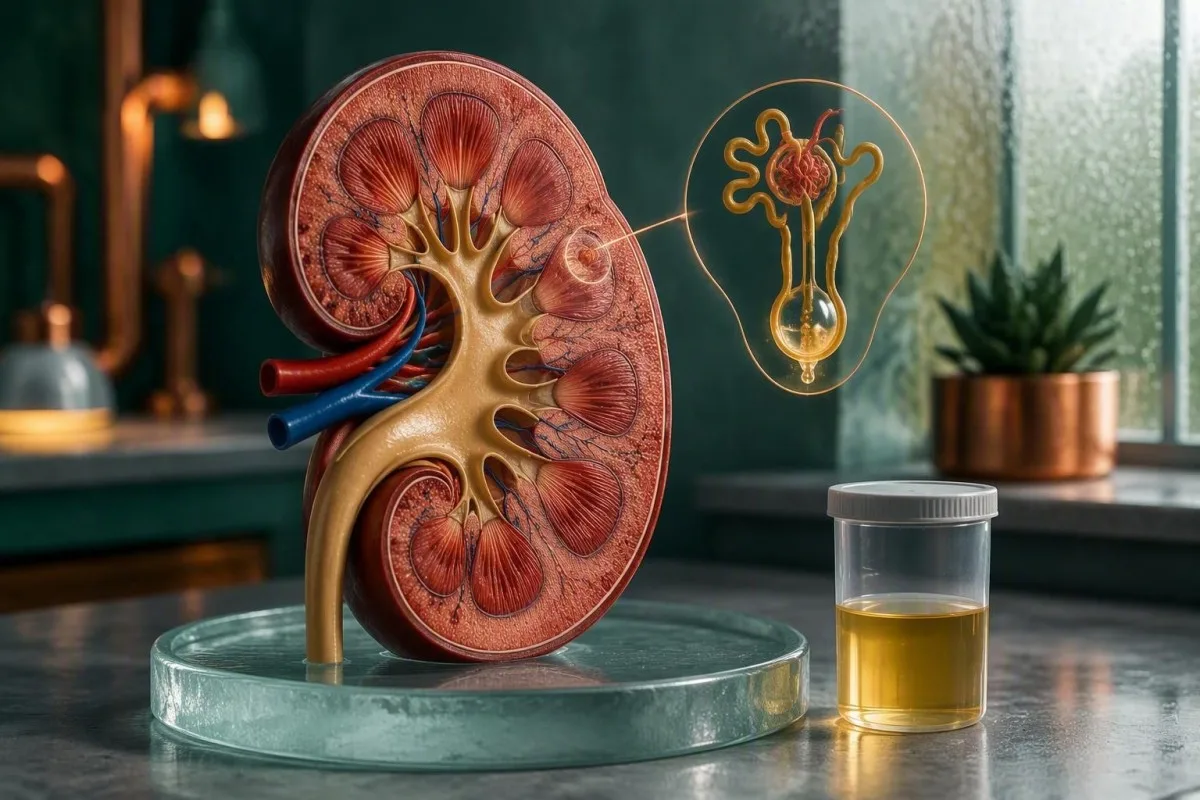
A low or high urine creatinine concentration usually reflects how diluted the sample was, not kidney damage by itself. The more useful question is whether the albumin-creatinine ratio or protein-creatinine ratio remains abnormal on a properly collected sample.


- Spot urine creatinine commonly varies from about 20 to 320 mg/dL because fluid intake changes concentration dramatically.
- Low urine creatinine below 20 mg/dL often indicates a very dilute random sample; it does not independently diagnose poor kidney function.
- 白蛋白-肌酐比值 below 30 mg/g is KDIGO category A1, 30-300 mg/g is A2, and above 300 mg/g is A3.
- Protein-creatinine ratio near 0.15 g/g or less is generally expected in adults; values above 0.5 g/g deserve clinical review.
- 清晨第一次尿液 is preferred for confirming a raised albumin-creatinine ratio because it reduces posture and hydration variation.
- Timed urine collection is useful when spot ratios conflict with symptoms, body size, pregnancy, or suspected heavy protein loss.
- 复查 after fever, vigorous exercise, urinary infection, menstruation, or dehydration prevents many false alarms.
- 需要紧急复查 is appropriate for swelling, breathlessness, visible blood in urine, reduced urine output, or a protein-creatinine ratio near 3.5 g/g.
What a Random Urine Creatinine Result Actually Measures
Urine creatinine measures concentration in that one urine sample, not the amount of creatinine circulating in your blood. A result can shift from 35 mg/dL to 180 mg/dL in the same person within hours simply because one sample was collected after several glasses of water and the other after sleep.
A random laboratory result is usually reported in mg/dL or mmol/L. Many laboratories see roughly 20-320 mg/dL in adult spot specimens, but that broad interval is a specimen-quality clue rather than a personal target. In practice, I interpret the colour, specific gravity, timing, and requested ratio before reacting to the isolated number; our 尿液试纸指南 explains why those findings belong together.
Creatinine enters urine after filtration and a modest amount of tubular secretion. A concentrated morning specimen may read 220 mg/dL while total daily creatinine output remains entirely ordinary. By contrast, serum creatinine and eGFR address filtration in the bloodstream; they should never be substituted for a spot urine concentration.
As of September 17, 2026, Kantesti is an AI blood test analyzer that reads urine creatinine alongside serum creatinine, eGFR, albumin, and collection timing rather than treating one spot value as a diagnosis. That distinction has prevented a fair amount of needless anxiety in my clinical work.
Concentration is not excretion
A spot concentration answers “how much creatinine is in this cup right now?” A 24-hour value answers “how much creatinine left the body in a day?” Those are related measurements, but clinically they are not interchangeable.
Why Low Urine Creatinine Is Usually a Dilution Finding
Low urine creatinine most often results from a dilute specimen caused by high fluid intake, a short bladder-holding time, or collection later in the day. In many specimen-validity settings, less than 20 mg/dL is flagged as dilute, although medical laboratories must interpret it with the full clinical picture.
A patient who drinks 1-2 litres rapidly before an appointment can produce urine with creatinine below 20 mg/dL and a very low specific gravity. Diuretics, diabetes with high urine volume, pregnancy, and recovery from intravenous fluids can produce the same pattern. A dilute specimen may also make albumin concentration look low in mg/L, which is exactly why ratios were developed.
Low muscle mass can lower daily creatinine production, especially in frail older adults, people with neuromuscular disease, and those with substantial recent weight loss. A 45-kg adult may have a lower creatinine denominator than a 95-kg strength athlete, so an albumin ratio can look higher even when absolute albumin loss is modest. This is one limitation clinicians should say out loud.
Low urine creatinine with thirst, frequent urination, glucose in urine, or an elevated blood glucose needs a broader review, not just a repeat cup. Our guide to frequent urination tests covers the common metabolic and urinary causes.
Why High Urine Creatinine Often Means Concentrated Urine
High urine creatinine in a spot sample usually means concentrated urine after reduced intake, sweating, vomiting, diarrhoea, or an early-morning collection. A value above 300 mg/dL can occur in a concentrated specimen and does not, on its own, prove excess muscle breakdown or impaired kidney filtration.
I see this after endurance events more often than patients expect. A 52-year-old runner may submit a dark specimen at 7 am after a long run and show urine creatinine of 290 mg/dL; if serum creatinine, CK, blood pressure, and urine microscopy are reassuring, hydration and a later repeat often clarify the picture. Read more about 运动后的肌酐.
A concentrated sample can exaggerate albumin and protein concentrations expressed as mg/L, but a ratio should partly correct that effect. “Partly” matters: very concentrated or very dilute samples are mathematically less stable, particularly near decision cutoffs. Laboratories occasionally add a comment when urine creatinine is extremely low because ratio reliability becomes questionable.
Kantesti is an AI blood test interpretation platform that identifies discordance between a high spot urine creatinine concentration and signs of systemic dehydration, including raised sodium, urea, or haematocrit. 这 BUN and creatinine relationship can add useful context, although it does not diagnose dehydration by itself.
How the Urine Creatinine Ratio Corrects for Dilution
A urine creatinine ratio divides albumin or total protein by urine creatinine so that a watery or concentrated sample is less misleading. Albumin-creatinine ratio is commonly reported as mg/g in the United States and mg/mmol in the UK and many other countries.
The formula is straightforward: urine albumin divided by urine creatinine. For example, albumin 18 mg/L with creatinine 0.6 g/L produces an ACR of 30 mg/g, not simply “albumin 18.” This correction is why a ratio can uncover clinically relevant albumin loss in a pale sample that otherwise appears almost normal.
For international conversion, 1 mg/mmol is approximately 8.84 mg/g. An ACR of 3 mg/mmol is therefore about 27 mg/g, close to the usual A1-A2 boundary. Unit confusion is surprisingly common when patients compare reports from different countries, so I recommend recording both the number and unit in a results log.
The 2024 KDIGO chronic kidney disease guideline recommends confirming an elevated random ACR with a first-morning void when possible (KDIGO, 2024). Our ACR 制备指南 explains how to collect that sample without artificially overhydrating.
Albumin-Creatinine Ratio Cutoffs That Change Follow-Up
An albumin-creatinine ratio below 30 mg/g is category A1, 30-300 mg/g is moderately increased albuminuria or A2, and above 300 mg/g is severely increased albuminuria or A3. Persistent A2 or A3 results deserve assessment with eGFR, blood pressure, diabetes status, and urine microscopy.
The 30 mg/g cutoff exists because albumin excretion above this level, when persistent, predicts higher kidney and cardiovascular risk more reliably than a single dipstick trace. ACR of 30-300 mg/g corresponds roughly to 3-30 mg/mmol; ACR above 300 mg/g corresponds to over 30 mg/mmol. The threshold is a risk category, not a sudden switch from safe to dangerous.
Diabetes, hypertension, sleep apnoea, obesity, smoking, heart failure, and inflammatory kidney conditions can raise ACR. Temporary increases also occur after fever, urinary infection, uncontrolled blood pressure, and strenuous exercise. In my experience, repeating before labelling someone with chronic disease is humane and medically sound when the initial elevation is modest.
KDIGO defines chronic kidney disease as an abnormality present for at least 3 months, not one result after a difficult week (KDIGO, 2024). For a wider framework, see our CKD分期和ACR指南.
Protein-Creatinine Ratio Versus Albumin-Creatinine Ratio
Protein-creatinine ratio measures total urinary protein, whereas albumin-creatinine ratio measures albumin specifically. PCR is especially useful when a clinician suspects non-albumin protein loss, such as tubular disease or light-chain proteinuria.
A PCR below about 150 mg/g, or 0.15 g/g, is generally expected in adults, though reporting conventions vary. A PCR of 500 mg/g equals 0.5 g/g and warrants follow-up in most settings, particularly if it persists. A PCR around 3.5 g/g can approximate nephrotic-range protein loss and needs prompt evaluation rather than casual retesting.
When PCR is high but ACR is relatively low, clinicians consider tubular protein, monoclonal light chains, and occasionally sample interference. This is not a diagnosis of myeloma, but it is a pattern that changes the next test: urine and serum protein electrophoresis, free light chains, microscopy, and kidney assessment may be appropriate. See our explanation of the free light chain ratio.
Conversely, ACR is usually preferred for diabetes and hypertension monitoring because albumin is the earliest consistently validated marker of glomerular barrier stress. Kantesti AI interprets urine creatinine ratios by preserving the laboratory’s original units, rather than silently converting a mg/mmol result into a mg/g category.
Collection Details That Can Distort Urine Creatinine Ratios
First-morning midstream urine is the most reproducible sample for albumin-creatinine testing because it reduces hydration, exercise, and upright-posture effects. A random sample remains useful, but it should be repeated when it is borderline or clinically unexpected.
Avoid intense exercise for 24 hours before a planned repeat if your clinician agrees. Hard exercise can transiently raise albumin excretion and create a misleading ACR; long distance running can also cause temporary blood in urine. Our explanation of 跑者血尿 addresses when that is benign and when it is not.
Menstruation, visible blood, semen contamination, urinary infection, fever, and recent catheterisation can affect protein and albumin measurements. A clean-catch midstream specimen reduces contamination from skin cells and genital secretions. If epithelial cells are abundant, the epithelial cells in urine guide can help explain why a recollection is often sensible.
Do not force fluids before testing. Normal drinking is enough; an artificially clear sample may produce creatinine below 20 mg/dL and a ratio that your laboratory cannot interpret confidently.
When a Repeat Urine Creatinine Test Is the Right Next Step
Repeat a urine albumin or protein ratio when the first result is mildly abnormal, the sample is very dilute, or a temporary trigger was present. For a stable person without red flags, a first-morning repeat within 1-2 weeks is often reasonable, with persistence assessed over at least 3 months.
I generally repeat an ACR of 30-100 mg/g after infection resolves, after avoiding strenuous exercise, and when blood pressure is back to usual. A result over 300 mg/g, especially with reduced eGFR or swelling, should prompt earlier clinician contact rather than waiting months. The exact timetable depends on pregnancy, diabetes, medication use, and symptoms.
Transient albuminuria is more common than most online summaries admit. Orthostatic proteinuria, seen mainly in adolescents and young adults, can yield daytime protein but a normal first-morning ratio; comparing these samples can spare a young person invasive testing. Persistent proteinuria is different and should not be dismissed as “just hydration.”
Dr. Thomas Klein’s practical rule is simple: repeat the collection under controlled conditions, not the entire story. If a result remains abnormal, compare it with previous values using a 可作为实验室趋势清单 rather than focusing on a single flagged line.
When a 24-Hour Timed Urine Collection Adds Value
A 24-hour urine collection is useful when a spot ratio conflicts with symptoms or clinical findings, when protein loss may be heavy, or when accurate daily excretion will guide treatment. It is not automatically more accurate; a missed or extra void can make it less reliable than a carefully collected spot ratio.
Expected daily creatinine excretion is roughly 15-20 mg/kg/day in many adult women and 20-25 mg/kg/day in many adult men, with large variation from age, diet, muscle mass, and mobility. Laboratories use this value as a rough completeness check. A surprisingly low daily creatinine may mean missed collections, while a very high value can mean an extra specimen was added.
Timed collections are particularly helpful for stone risk, selected endocrine testing, pregnancy complications, and quantifying substantial proteinuria. They can also clarify a ratio in someone with very low muscle mass, where the creatinine denominator is unusually small. The collection process itself has traps; our 24小时尿收集指南 describes the common ones.
Keep the container as instructed, collect every void including the final one at the exact end time, and document spills. A collection that is “almost complete” is often not clinically interpretable; that small detail genuinely changes management.
Urine Creatinine Interpretation in Pregnancy, Athletes and Older Adults
Pregnancy, high-level sport, and low muscle mass alter urine creatinine interpretation because creatinine production and urine volume differ from the average adult. The ratio may remain useful, but thresholds, timing, and clinical urgency change.
In pregnancy, proteinuria can develop quickly with hypertensive disorders. A PCR of 0.3 g/g or more is widely used as a clinically significant threshold in the appropriate setting, but symptoms and blood pressure matter more than a home interpretation. Headache, visual changes, right upper abdominal pain, sudden swelling, or high blood pressure merit same-day maternity assessment; see our HELLP laboratory warning signs.
Athletes often have a high daily creatinine output from larger muscle mass and transient albuminuria after exertion. Testing after 24-48 hours of usual recovery can be more informative than a post-race sample. A high spot urine creatinine in an athlete is usually concentration, not a measure of “excellent kidneys.”
Older adults with sarcopenia can have low serum and urine creatinine despite reduced filtration, so cystatin C, eGFR trend, and ACR may be more informative together. Our cystatin C 概览 explains why this alternative marker is sometimes requested.
Medicines and Illnesses That Change Urine Creatinine Results
Diuretics, SGLT2 inhibitors, NSAIDs, lithium, and acute illnesses can change urine volume, albumin excretion, or kidney filtration and therefore alter urine creatinine interpretation. Medication effects should be reviewed against serum creatinine, eGFR, potassium, blood pressure, and the reason the medicine was prescribed.
Diuretics can concentrate urine, while SGLT2 inhibitors increase urine glucose and volume early in treatment. Neither medication makes a spot urine creatinine result diagnostic on its own. An early eGFR dip after an SGLT2 inhibitor can be expected, but a sustained decline, dizziness, or dehydration calls for prescriber review; our SGLT2 eGFR 指南 provides context.
NSAIDs can reduce kidney blood flow in vulnerable people, especially during vomiting, diarrhoea, or diuretic treatment. Lithium requires particular care because chronic exposure can affect concentrating ability and kidney function; review our lithium monitoring tests if this applies to you.
Kantesti is an AI-powered blood test analysis tool that can organise medication dates with kidney-result trends, but it cannot decide whether a prescribed medicine should be stopped. That decision belongs with the clinician who knows the indication, dose, blood pressure, and current symptoms.
What to Do When Urine Creatinine and Other Kidney Results Disagree
A low urine creatinine with normal eGFR usually reflects specimen dilution, whereas albuminuria with declining eGFR suggests a more meaningful kidney pattern. Discordant findings should trigger a check of timing, hydration, blood pressure, diabetes control, microscopy, and repeat testing rather than a quick conclusion.
Consider a person with urine creatinine 12 mg/dL, ACR 55 mg/g, eGFR 98 mL/min/1.73 m², and a sample taken after excessive water intake. The ratio may still be valid enough to take seriously, but its denominator is weak; I would usually confirm a first-morning ACR before diagnosing persistent albuminuria. One number rarely earns a label.
The converse matters too: normal ACR does not rule out every kidney problem. Blood in urine, casts, rapidly rising serum creatinine, electrolyte disturbance, or systemic autoimmune symptoms need a different pathway. Granular casts, for example, change the urgency and differential diagnosis; our 颗粒状管型指南 解释了原因。.
Kantesti的 医学验证框架 requires contextual flags for contradictory laboratory patterns rather than a simplistic normal/abnormal verdict. In a patient with symptoms, a clinician should always overrule an algorithmic reassurance.
When Urine Protein or Creatinine Results Need Prompt Care
Seek prompt medical assessment for urine protein with new swelling, shortness of breath, visible blood in urine, markedly reduced urine output, severe headache with high blood pressure, or a rapid eGFR fall. Urine creatinine concentration alone is rarely an emergency, but the pattern around it sometimes is.
A PCR near or above 3.5 g/g, ACR above 2,000 mg/g, or proteinuria with low serum albumin can indicate substantial protein loss and should be assessed quickly. Foamy urine alone is not a reliable measure of protein, but persistent foam plus ankle swelling merits testing. Our article on 持续的泡沫尿 解释了两者的区别.
Visible blood, flank pain, fever, or clots require a different level of attention because infection, stones, obstruction, and glomerular disease are possibilities. A negative nitrite test does not exclude a urinary infection, especially with frequent urination or fever. Do not wait for a ratio repeat if you are unwell.
Dr. Thomas Klein advises treating severe symptoms as the priority, not as an add-on to laboratory interpretation. Emergency care is appropriate for confusion, severe breathlessness, chest pain, fainting, or inability to pass urine.
A Practical Plan for Your Next Urine Creatinine Test
For the most reliable urine creatinine ratio, collect a first-morning clean-catch midstream sample, maintain normal fluid intake, avoid unusually hard exercise for 24 hours, and tell the laboratory about menstruation or urinary symptoms. Bring previous eGFR, ACR, PCR, blood pressure, and medication information to the review.
Write down the collection time, whether you exercised the day before, recent fever or urinary symptoms, and major fluid changes. This modest record often explains a 2-fold ratio difference better than a dramatic biological change. For support reading a complete panel, our 生物标志物指南 puts kidney markers into their wider laboratory context.
Ask three focused questions: Was the specimen dilute? Do I need a first-morning repeat? Does the ratio persist for 3 months or coexist with low eGFR, hypertension, diabetes, blood, or casts? Those questions help turn a confusing result into a sensible care plan without either panic or false reassurance.
我们的医生在 医疗顾问委员会 review the clinical principles behind Kantesti’s interpretations. Kantesti AI is an AI lab test interpretation service designed to make the next clinical question clearer, not to replace examination, diagnosis, or treatment from your own care team.
常见问题
低尿肌酐是什么意思?
随机标本中尿液肌酐含量低最常见的原因是由于大量饮水、频繁排尿、利尿剂或距离上次排尿时间较短导致尿液稀释。在标本有效性工作中,低于 20 mg/dL 的值通常被标记为稀释,但这本身并不能诊断肾功能下降。肌肉量低也会减少每日肌酐排泄。如果稀释标本中的白蛋白-肌酐比值异常,首次晨尿复查通常是最有用的下一步。.
高尿肌酐危险吗?
尿肌酐浓度高本身通常并无危险,因为它通常反映了隔夜禁食、出汗、呕吐、腹泻或饮水不足后的浓缩尿液。在浓缩样本中,高于 300 毫克/分升的即时值可能出现,但并不表示肾衰竭。临床上重要的发现是持续的高白蛋白-肌酐比值、高蛋白-肌酐比值、eGFR 下降、尿液中有血、水肿或高血压。临床医生应结合尿液比重和血清肾脏检查结果来解读尿肌酐高的情况。.
正常的尿肌酐比率是多少?
对于白蛋白-肌酐比值,低于 30 毫克/克,或低于 3 毫克/毫摩尔,为 KDIGO A1 类,正常至轻度升高。ACR 为 30-300 毫克/克为 A2 类,而 ACR 高于 300 毫克/克为 A3 类。对于总蛋白-肌酐比值,成人一般预期约为 0.15 克/克或更低,尽管实验室参考限值不同。当结果临界或出乎意料时,应用晨尿标本确认比值。.
喝水能降低尿肌酐吗?
是的,大量饮水可在数小时内降低尿肌酐浓度,因为每天产生的肌酐量溶解在更多的尿液中。高度稀释的样本可能显示尿肌酐低于 20 毫克/分升,这会使比值解释在临床临界值附近变得不稳定。最好在检测前保持正常的液体摄入量;故意限制或强迫饮水都会扭曲结果。晨尿通常为重复 ACR 检测提供最稳定的浓度。.
24小时尿液检查比随机尿液比值何时更佳?
24小时尿液检查在以下情况中有用:当单次尿液比例与症状或其他肾脏检查结果不符时;当可能出现大量蛋白质丢失时;或者当临床医生需要每日总排泄量来做出特定决定时。成年女性每日肌酐排泄量通常约为15-20毫克/公斤,成年男性约为20-25毫克/公斤,但年龄和肌肉量会造成很大差异。遗漏一次排尿就会使收集无效,因此,常规筛查通常最好采用仔细收集的晨尿比例。定时收集的决定应由临床医生个体化确定。.
Should I worry about a high protein-creatinine ratio?
A persistent protein-creatinine ratio above 0.5 g/g generally deserves clinical review, while a ratio near 3.5 g/g can indicate nephrotic-range protein loss and requires prompt assessment. The urgency rises when proteinuria occurs with swelling, low serum albumin, high blood pressure, blood in urine, or reduced eGFR. Exercise, fever, urinary infection, and pregnancy can temporarily raise urinary protein, so repeat testing may be appropriate when symptoms are absent. Do not rely on urine foam alone to estimate protein loss.
立即获取AI驱动的血液检测分析
加入全球超过2,000,000名用户,他们信任Kantesti进行即时、准确的检验分析。上传你的血液检查结果,并在几秒内获得对15,000+生物标志物的全面解读。.
📚 参考研究论文
Klein, T., Mitchell, S., & Weber, H. (2026). 临床验证框架 v2.0(医学验证页面). Kantesti AI医学研究。.
Klein, T., Mitchell, S., & Weber, H. (2026). AI血液检测分析:已分析2.5M项检测 | 全球健康报告2026. Kantesti AI医学研究。.
📖 外部医学参考资料
⚕️ 医疗免责声明
本文仅用于教育目的,不构成医疗建议。诊断和治疗决策请始终咨询合格的医疗专业人员。.
E-E-A-T信任信号
经验
由医生主导的临床审阅:实验室解读工作流程。.
专业知识
实验室医学重点:生物标志物在临床情境中的表现。.
权威
由 Thomas Klein 博士撰写,并由 Sarah Mitchell 博士与 Hans Weber 教授审阅。.
可信度
基于循证的解读,并提供清晰的后续路径以减少警报。.