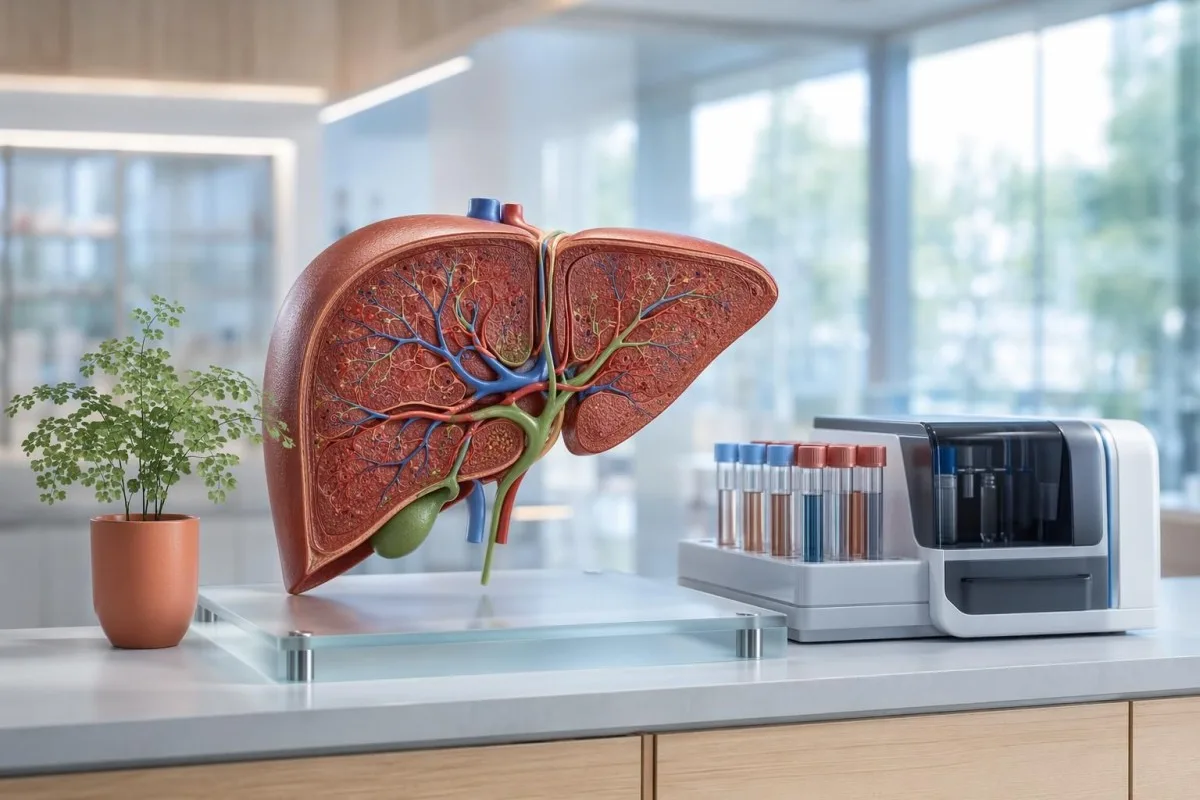
Before starting medicines that can irritate the liver, doctors usually want a baseline pattern, not just one enzyme. The safest decision often comes from ALT, AST, ALP, GGT, bilirubin, albumin, INR and platelet trends read together.


- ALT and AST are the main enzymes doctors check for liver-cell irritation before medicines; ALT above about 2–3 times the lab upper limit usually needs follow-up.
- ALP and GGT help identify a bile-flow pattern; ALP above 1.5 times the upper limit with high GGT deserves investigation before many liver-affecting drugs.
- Bilirubin above 2.0 mg/dL with ALT or AST above 3 times the upper limit is a high-risk drug-induced liver injury pattern.
- Albumin and INR measure liver synthetic capacity; albumin below 3.5 g/dL or INR above 1.2 can change medication decisions.
- Platelets below 150 × 10^9/L may be an early clue to portal hypertension or chronic liver disease, especially with low albumin.
- Baseline liver tests before starting medication reduce risk by separating pre-existing liver abnormalities from drug-related changes later.
- Mild fatty liver elevations below 2 times the upper limit do not automatically block statins, GLP-1 medicines or many antidepressants, but the pattern matters.
- Repeat testing is often done within 1–4 weeks if results are borderline, and sooner if bilirubin, INR or symptoms are abnormal.
What blood tests check liver function before medication?
Doctors usually check ALT, AST, ALP, GGT, total and direct bilirubin, albumin, and PT/INR before starting medicines that may affect the liver. In plain English, ALT and AST look for liver-cell irritation, ALP and GGT look for bile-flow stress, and bilirubin, albumin and INR tell us whether the liver is still doing its job. As of May 9, 2026, this is the core answer to what blood tests check liver function before new meds.
A typical liver function blood test before medication is really a liver chemistry and function panel. The name is a little misleading because ALT and AST do not measure liver function; they measure enzyme leakage from irritated cells, while albumin and INR better reflect function.
When I review a panel before terbinafine, methotrexate, isotretinoin or a statin, I want a starting point that can be compared later. Patients can also upload results to Kantesti AI for a structured explanation, and our deeper guide to liver enzyme patterns explains the same pattern-based logic.
Normal ranges differ by lab, but common adult ranges are ALT 7–35 IU/L in women and 10–40 IU/L in men, AST 10–40 IU/L, ALP 40–130 IU/L, GGT 5–60 IU/L, total bilirubin 0.2–1.2 mg/dL, albumin 3.5–5.0 g/dL and INR 0.8–1.1. Some European laboratories use lower ALT upper limits than US laboratories, which can make a result look newly flagged even when the biology has not changed.
Why baseline liver tests before starting medication reduce risk
Baseline liver tests before starting medication reduce risk because they prove what was present before the first dose. Without that baseline, a new ALT of 95 IU/L at week 6 could be fatty liver, alcohol, exercise, viral hepatitis, or the medication itself.
The most useful baseline is done within 30 days before starting a potentially hepatotoxic medicine, and within 7–14 days if the patient is unwell or the planned drug is high risk. In my practice, old results from 18 months ago are better than nothing, but they are not a clean medication baseline.
Kantesti's clinical workflow follows physician-reviewed rules from our medical validation standards so that a single flagged enzyme is not overcalled. A 52-year-old marathon runner with AST 89 IU/L after hill training is a very different patient from a 52-year-old with AST 89 IU/L, bilirubin 2.4 mg/dL and dark urine.
The baseline also protects patients from unnecessary discontinuation. If ALT was already 62 IU/L before treatment and is 66 IU/L after 8 weeks, the medicine may not be the cause; if ALT rises from 22 to 156 IU/L, that change deserves a different conversation.
The baseline number is less important than the baseline story
A safe medication decision usually needs the exact drug, dose, alcohol intake, viral hepatitis risk, pregnancy status, body weight change, and supplement list. I often see turmeric, green tea extract, anabolic agents and high-dose niacin missing from the medication history, yet each can matter as much as a prescription.
How ALT and AST before medication are interpreted
ALT AST before medication mainly checks whether liver cells are already irritated before a drug is added. ALT is more liver-specific than AST, while AST can also rise from muscle injury, intense exercise, thyroid disease and hemolysis.
The American College of Gastroenterology guideline notes that a truly healthy ALT may be closer to 29–33 IU/L in men and 19–25 IU/L in women, even though many lab reports list higher cutoffs (Kwo et al., 2017). That gap explains why I sometimes follow an ALT of 42 IU/L in a woman even when the lab prints only a mild flag.
ALT above 3 times the upper limit of normal before treatment usually deserves repeat testing or evaluation before starting higher-risk medicines. For a lab with ALT upper limit 40 IU/L, that means ALT above about 120 IU/L; for a lab using 30 IU/L, it means above about 90 IU/L.
AST without ALT can fool people. A patient with AST 78 IU/L and ALT 24 IU/L after a heavy leg workout may need CK testing and rest before assuming liver disease; our guide to the ALT blood test covers this distinction in more detail.
When ALP and GGT point to bile duct or medication risk
ALP and GGT help doctors detect a cholestatic pattern, meaning bile flow may be slowed or irritated. A high ALP with a high GGT is more suggestive of liver or bile duct origin than a high ALP alone.
ALP is not liver-specific because bone, intestine and placenta can also produce it. If ALP is 180 IU/L and GGT is normal, I think about bone turnover, vitamin D deficiency, healing fracture or pregnancy before blaming a new medicine.
GGT above 60 IU/L in adult men or above 35–40 IU/L in many adult women can reflect alcohol exposure, fatty liver, bile duct disease, or enzyme induction from drugs such as anticonvulsants. A GGT of 210 IU/L with ALP 220 IU/L before starting an azole antifungal needs more caution than either number alone.
A cholestatic baseline matters because some medicines, including certain antibiotics, anabolic agents and antipsychotics, can worsen bile-flow patterns. We explain isolated and combined GGT changes in our guide to high GGT results.
Bilirubin, albumin and INR show liver capacity not just irritation
Bilirubin, albumin and INR are the liver tests that tell doctors about excretion and synthetic capacity. ALT can be high in a person who is still clinically stable, but high bilirubin or INR changes the safety picture quickly.
Total bilirubin is usually 0.2–1.2 mg/dL or about 3–21 µmol/L. Direct bilirubin above about 0.3 mg/dL, especially with high ALP or GGT, pushes me toward bile duct obstruction, hepatitis or drug-related cholestasis rather than harmless Gilbert syndrome.
Albumin normally sits around 3.5–5.0 g/dL, but it falls slowly because its half-life is about 20 days. A low albumin before treatment may reflect chronic liver disease, kidney protein loss, inflammation or malnutrition; our bilirubin guide explains why bilirubin patterns need that wider context.
INR is often 0.8–1.1 in people not taking anticoagulants. An INR above 1.5 with jaundice, confusion, severe nausea or abdominal swelling is not a routine medication question; it is a same-day clinical assessment.
Gilbert syndrome is the common trap
A lifelong total bilirubin of 1.6–2.5 mg/dL with normal direct bilirubin, ALT, AST, ALP, albumin and INR is often Gilbert syndrome. That pattern usually does not mean the liver is failing, but it should be documented before a drug is started so nobody misreads the later bilirubin.
Platelets, total protein and CBC clues doctors should not ignore
Platelets, total protein and CBC results are not classic liver enzymes, but they can reveal chronic liver disease before ALT rises. Platelets below 150 × 10^9/L with low albumin or enlarged spleen clues can suggest portal hypertension.
A normal platelet count is roughly 150–450 × 10^9/L. I worry more about platelets falling from 240 to 135 × 10^9/L over 3 years than about a single ALT of 48 IU/L, because trends can show slow fibrosis before the chemistry panel looks dramatic.
Total protein is usually 6.0–8.3 g/dL, and the albumin-globulin pattern can hint at immune liver disease, chronic infection or inflammation. Kantesti's neural network reads these relationships across our biomarker guide rather than treating each flag as an isolated abnormality.
A CBC also matters before drugs that can affect bone marrow and liver together, such as azathioprine, methotrexate or valproate. If WBC is low, platelets are low and AST is high, I do not call that a simple liver enzyme issue.
Medication groups that usually deserve baseline liver testing
Medicines that commonly trigger baseline liver tests before starting medication include statins, methotrexate, terbinafine, isotretinoin, valproate, carbamazepine, amiodarone, isoniazid, rifampin, pyrazinamide, azole antifungals and some immune therapies. The exact panel depends on the drug and the patient's risk.
For statins, most clinicians check ALT at baseline and repeat only if symptoms or high-risk patterns appear. A mild ALT elevation from fatty liver is not automatically a reason to avoid statins, and our statin lab checklist explains why cardiovascular risk often outweighs fear of a small enzyme flag.
Methotrexate is different. I usually want ALT, AST, albumin, bilirubin, CBC, creatinine, hepatitis B and C status, and alcohol history before long-term therapy; low albumin can increase toxicity risk because methotrexate handling changes when protein binding and kidney clearance are poor.
Isoniazid, rifampin and pyrazinamide deserve special respect because liver injury can be abrupt. Many TB protocols stop therapy if ALT or AST rises above 3 times upper limit with symptoms or above 5 times upper limit without symptoms, although local guidance can differ.
Abnormal patterns that should be investigated before the first dose
The abnormal baseline patterns that should usually be investigated before a first dose are ALT or AST above 3 times the upper limit, ALP above 1.5 times the upper limit with high GGT, bilirubin above 2.0 mg/dL, albumin below 3.5 g/dL, or INR above 1.2 without explanation. Symptoms lower the threshold.
The EASL drug-induced liver injury guideline highlights the classic high-risk Hy's law pattern: ALT or AST above 3 × upper limit plus bilirubin above 2 × upper limit without major ALP elevation (EASL, 2019). That combination is rare, but when it appears I pause non-urgent medicines and look hard for hepatitis, obstruction, autoimmune disease and drug exposure.
The ACG drug-induced liver injury guideline also separates hepatocellular, cholestatic and mixed patterns because the likely causes differ (Chalasani et al., 2014). A mixed picture, such as ALT 210 IU/L with ALP 260 IU/L and bilirubin 1.8 mg/dL, is not something I would explain away as a simple borderline lab.
A useful rule: one mild abnormality can often be repeated, but two or three abnormalities pointing in the same direction deserve a plan. Our guide to elevated liver enzymes lays out the pattern approach patients can discuss with their clinician.
Mild fatty liver elevations are common but still need context
Mild fatty liver often causes ALT and GGT elevations below 2 times the upper limit, and that pattern does not automatically block new medication. The key is whether bilirubin, INR, albumin and platelets remain reassuring.
In our analysis of large-scale lab uploads, the common outpatient pattern is ALT 45–85 IU/L, GGT 50–140 IU/L and triglycerides above 150 mg/dL. That combination often travels with insulin resistance, sleep apnea, abdominal weight gain and alcohol intake that patients describe as modest.
The practical question is not simply, 'Can I take the medicine?' It is, 'Do we have enough reserve and a monitoring plan?' A patient with ALT 72 IU/L, bilirubin 0.7 mg/dL, albumin 4.4 g/dL, INR 1.0 and platelets 245 × 10^9/L is usually a safer candidate than someone with lower ALT but abnormal synthetic markers.
Food choices can move these numbers, but slowly. Our guide to fatty liver diet changes explains why losing 5–10% of body weight can improve liver fat and ALT in many patients, while GGT may lag behind for months.
Exercise, alcohol and supplements can distort the baseline
Exercise, alcohol and supplements can raise liver-related markers enough to confuse a pre-medication baseline. A hard workout can raise AST and CK, alcohol can raise GGT, and certain supplements can raise ALT or bilirubin.
A 48-hour pause from intense resistance training is often enough to clarify an AST-heavy pattern. I have seen AST above 100 IU/L with ALT under 40 IU/L and CK above 2,000 IU/L in healthy athletes after eccentric training; that is muscle chemistry, not classic liver injury.
Alcohol effects are more variable than patients expect. GGT can remain high for 2–6 weeks after heavy use, while AST often exceeds ALT in alcohol-related liver irritation, especially when the AST:ALT ratio is above 2.
Supplements are the quiet problem. Green tea extract, kava, anabolic agents, high-dose vitamin A and multi-ingredient fat-loss products have all been linked to liver injury; our article on exercise-related lab shifts is a good companion when AST is the odd result.
How I ask patients to prepare
For a clean baseline, I usually suggest no heavy exercise for 48–72 hours, no alcohol for at least 72 hours if possible, and a full list of prescription drugs, over-the-counter products and supplements. Fasting is not always needed for liver enzymes, but it may be needed if lipids or glucose are being checked at the same visit.
Follow-up tests doctors order when liver markers are abnormal
When baseline liver markers are abnormal, doctors commonly add hepatitis B and C tests, CK, ferritin and transferrin saturation, autoimmune markers, ultrasound, and sometimes FibroScan or specialist review. The follow-up depends on whether the pattern is hepatocellular, cholestatic or synthetic.
For ALT-predominant elevations, I usually look at hepatitis B surface antigen, hepatitis C antibody with reflex RNA, ferritin, transferrin saturation, fasting glucose or HbA1c, lipids and medication exposure. Hepatitis testing is especially relevant before immune-suppressing drugs; our guide to hepatitis blood results explains antibody versus active infection patterns.
For ALP and GGT elevation, ultrasound is often the first imaging test because it can show gallstones, bile duct dilation and fatty infiltration. If ALP is high but GGT is normal, bone-specific ALP, vitamin D, calcium and PTH may be more useful than more liver tests.
For low albumin or high INR, I broaden the lens. Urine albumin, kidney function, nutrition markers, inflammatory markers and medication history can all matter, because not every low albumin is caused by liver failure.
When to repeat baseline tests and how monitoring schedules differ
Borderline baseline liver tests are often repeated in 1–4 weeks, while high-risk medication monitoring can start at 2–6 weeks after the first dose. The schedule depends on the drug, baseline pattern, dose and symptoms.
For a mild ALT of 48 IU/L before a low-risk medicine, repeating in 4–12 weeks may be reasonable. For ALT 115 IU/L before methotrexate, terbinafine or TB therapy, I would usually repeat sooner and look for a cause before the start date.
Timing matters because drug-induced liver injury has latency. Some reactions appear in days, many in 2–12 weeks, and others after months; Kantesti AI flags trend speed because a rise from ALT 25 to 70 IU/L means something different from a stable ALT around 70 for 5 years.
The safest monitoring plan is written before the prescription is filled. Our medication monitoring timeline gives patients a practical way to ask, 'When do I recheck, and what number means stop and call?'
Special situations: kidney disease, pregnancy, age and dosing
Kidney disease, pregnancy, older age and low body weight can change how doctors interpret liver tests before medication. The liver panel is only one part of dose safety; creatinine, eGFR, albumin and interacting medicines often decide the final plan.
Kidney impairment can increase exposure to medicines or metabolites even when liver enzymes are normal. Before methotrexate, allopurinol combinations, antivirals or some antibiotics, eGFR below 60 mL/min/1.73 m² changes the risk conversation.
Pregnancy can raise ALP because the placenta produces ALP, while albumin may be lower because plasma volume expands. That is why a pregnant patient with ALP 180 IU/L and normal GGT is not interpreted the same way as a non-pregnant adult with the same ALP.
Older adults often have normal ALT despite significant liver scarring because muscle mass and enzyme release can be lower. I pair liver markers with kidney numbers, medication count and frailty; our renal function panel is worth reading when dose safety is the real question.
How Kantesti AI reads liver panels in real clinical context
Kantesti AI reads liver panels by combining enzyme pattern, function markers, trend speed, age, sex, units, reference ranges and related biomarkers. Our platform does not diagnose liver disease; it explains risk patterns and helps people ask better questions before medication starts.
A lab PDF may report ALT in IU/L, bilirubin in mg/dL, and albumin in g/L depending on country. Our blood test PDF upload workflow standardizes units, checks whether a flag is clinically coherent, and compares the result with prior reports when the user provides them.
Kantesti AI blood test interpretation works best when patients include medication lists, symptoms, alcohol intake and exercise timing. The reason is simple: ALT 74 IU/L in a sedentary patient starting terbinafine is not the same as ALT 74 IU/L in a runner tested 18 hours after a race.
Our AI methods are documented in the Kantesti benchmark publication on clinical validation, including trap cases designed to prevent overdiagnosis (validation benchmark). I’m Thomas Klein, MD, and I still tell patients the same thing I tell clinicians: AI can organize the evidence quickly, but urgent symptoms and abnormal INR or bilirubin need human medical care.
Questions to ask your clinician before starting the medicine
Before starting a liver-affecting medicine, ask which baseline tests are needed, what result would delay treatment, when to repeat labs, and which symptoms mean you should stop and call. A clear plan prevents both missed toxicity and unnecessary fear.
The most useful question is specific: 'My ALT is 58 IU/L and GGT is 92 IU/L; does that change this medicine or just the monitoring?' That invites clinical reasoning instead of a yes-or-no answer based on a single red flag.
Ask whether your doctor wants bilirubin fractionation, INR, hepatitis tests or CK before the first dose. If you have a history of fatty liver, heavy alcohol exposure, viral hepatitis, bariatric surgery, autoimmune disease or prior drug reaction, say so before the prescription is finalized.
You can try free AI blood test analysis before your appointment and bring the interpretation to your clinician. Kantesti is built by a medical and engineering team described on our About Us page, and I’m Thomas Klein, MD; my practical advice is to never start a non-urgent hepatotoxic medicine when bilirubin or INR is unexplained and abnormal.
Symptoms that should not wait for a routine recheck
Call promptly for yellow eyes, dark urine, pale stools, severe itching, right-upper-abdominal pain, persistent vomiting, confusion, easy bruising or extreme fatigue after starting a new medicine. These symptoms are uncommon, but when they appear with ALT, bilirubin or INR changes, the risk calculation changes fast.
Frequently Asked Questions
What blood tests check liver function before medication?
Doctors usually check ALT, AST, ALP, GGT, total and direct bilirubin, albumin and PT/INR before starting medicines that may affect the liver. ALT and AST show liver-cell irritation, ALP and GGT show bile-flow patterns, and bilirubin, albumin and INR show excretion and synthetic function. A CBC with platelets is often added because platelets below 150 × 10^9/L can suggest chronic liver disease. The safest interpretation uses the full pattern, not one flagged enzyme.
Is ALT or AST more important before starting a new medicine?
ALT is generally more liver-specific than AST, so doctors often focus on ALT before starting a liver-affecting medication. AST can rise from muscle injury, heavy exercise, thyroid disease or hemolysis, so AST alone is less specific. ALT or AST above 3 times the lab upper limit usually deserves repeat testing or follow-up before higher-risk medicines. If bilirubin or INR is also abnormal, the concern is much higher.
Can I start a statin if my liver enzymes are mildly high?
Many patients can start a statin with mild, stable ALT or AST elevations below about 3 times the upper limit, especially if bilirubin and INR are normal. Fatty liver commonly causes ALT in the 40–90 IU/L range, and cardiovascular benefit may still outweigh liver enzyme concerns. Doctors usually check baseline ALT and then repeat testing only if symptoms, high-risk history or significant enzyme rise occurs. The decision should be individualized if alcohol use, hepatitis or prior drug-induced liver injury is present.
What liver test result should delay a new medication?
Non-urgent liver-affecting medication is often delayed when ALT or AST is above 3 times the upper limit, ALP is above 1.5 times the upper limit with high GGT, bilirubin is above 2.0 mg/dL, albumin is below 3.5 g/dL, or INR is unexplained and above 1.2. The combination of ALT or AST above 3 times the upper limit plus bilirubin above 2 times the upper limit is especially concerning. Symptoms such as jaundice, dark urine, severe itching or vomiting lower the threshold for urgent assessment. A repeat test may be enough for one mild isolated abnormality.
How soon should liver blood tests be repeated after starting medication?
Repeat timing depends on the medication, baseline results and symptoms. For higher-risk medicines, doctors may recheck liver tests around 2–6 weeks after starting, while low-risk drugs with normal baseline tests may not need routine repeat testing. Borderline baseline abnormalities are often repeated in 1–4 weeks before treatment begins. New jaundice, dark urine, persistent nausea, severe fatigue or right-upper-abdominal pain should prompt earlier testing.
Do normal liver tests mean a medication is completely safe for the liver?
Normal baseline liver tests reduce risk but do not guarantee that a medication will be liver-safe. Drug-induced liver injury can be idiosyncratic, meaning it can occur unpredictably even when ALT, AST, bilirubin and INR start normal. Most clinically meaningful reactions appear within days to 12 weeks, but some take months. A symptom plan and repeat testing schedule are still useful for medicines with known liver risk.
Should GGT be included in baseline liver tests before medication?
GGT is useful when ALP is high or when alcohol exposure, fatty liver or bile-flow stress is suspected. A GGT above about 60 IU/L in men or 35–40 IU/L in women can support a liver source for ALP elevation, but it is not specific by itself. Some anticonvulsants, alcohol use and fatty liver can raise GGT without acute liver failure. Doctors usually interpret GGT alongside ALT, AST, ALP and bilirubin.
Does a past hepatitis infection change which tests I need before a new medication?
Yes. Tell your prescriber about previous hepatitis, jaundice, injection-drug exposure, or contact with viral hepatitis. They may add hepatitis B or C testing and adjust monitoring or arrange referral; this does not automatically mean you cannot take the medicine.
Should I avoid alcohol before baseline liver blood tests for a new medication?
Avoiding alcohol for at least 48–72 hours before baseline testing can make results easier to interpret, especially if your drinking has been heavier than usual. Do not hide alcohol use from your clinician; it helps them choose safer dosing and monitoring.
Get AI-Powered Blood Test Analysis Today
Join over 2 million users worldwide who trust Kantesti for instant, accurate lab test analysis. Upload your blood test results and receive comprehensive interpretation of 15,000+ biomarkers in seconds.
📚 Referenced Research Publications
Klein, T., Mitchell, S., & Weber, H. (2026). Clinical Validation Framework v2.0 (Medical Validation Page). Kantesti AI Medical Research.
Klein, T., Mitchell, S., & Weber, H. (2026). AI Blood Test Analyzer: 2.5M Tests Analyzed | Global Health Report 2026. Kantesti AI Medical Research.
📖 External Medical References
⚕️ Medical Disclaimer
This article is for educational purposes only and does not constitute medical advice. Always consult a qualified healthcare provider for diagnosis and treatment decisions.
E-E-A-T Trust Signals
Experience
Physician-led clinical review of lab interpretation workflows.
Expertise
Laboratory medicine focus on how biomarkers behave in clinical context.
Authoritativeness
Written by Dr. Thomas Klein with review by Dr. Sarah Mitchell and Prof. Dr. Hans Weber.
Trustworthiness
Evidence-based interpretation with clear follow-up pathways to reduce alarm.