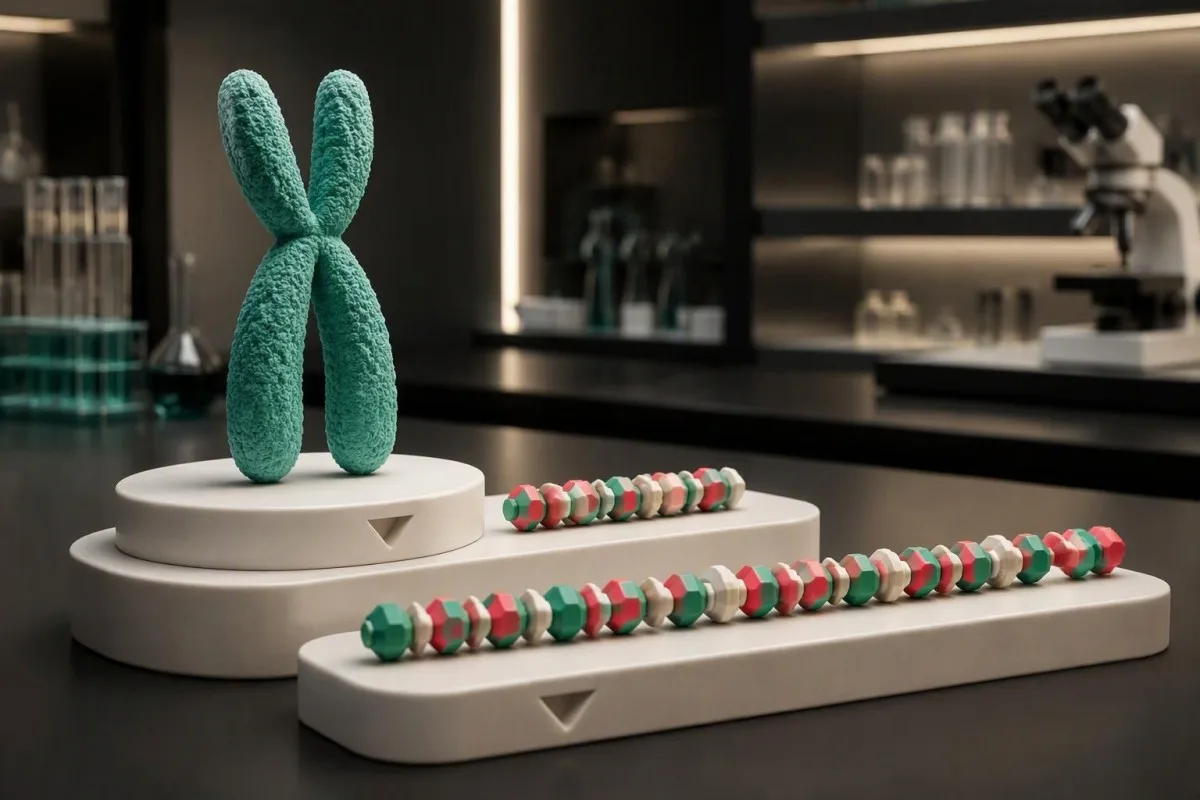
Результати FMR1 зазвичай поділяють на чотири діапазони кількості повторів: нормальний, проміжний, премутація або повна мутація. Статус носія — це не те саме, що синдром ламкої Х-хромосоми, а репродуктивний ризик залежить від того, хто з батьків передає алель і чи відбувається його експансія.


- Нормальний алель: Приблизно 5–44 повтори CGG у FMR1 зазвичай свідчать про стабільний алель; рутинний скринінг не виключає всіх рідкісних варіантів FMR1.
- Проміжний алель: 45–54 повтори не підтверджують ні синдром ламкої Х-хромосоми, ні статус носія премутації; розмір деяких алелів може змінюватися в наступних поколіннях.
- Премутація: 55–200 повторів свідчать про премутацію FMR1, яка має репродуктивні наслідки та може підвищувати певні ризики для здоров’я дорослих.
- Повна мутація: Понад 200 повторів зазвичай пов’язані з аномальним метилюванням і зниженою експресією FMR1; клінічні прояви варіюють, особливо у жінок і за мозаїчних результатів.
- AGG-вставки: Їхня кількість і розташування можуть уточнити оцінки ризику материнської експансії, особливо для невеликих премутацій, але не можуть гарантувати результат.
- Передача: Жінка з одним алелем FMR1 із розширеною кількістю повторів має ймовірність передачі цього алеля 50% у кожній вагітності; передача та розширення — це окремі ймовірності.
- Тестування партнера: Негативний результат партнера не усуває репродуктивний ризик, пов’язаний із премутацією FMR1 у матері, оскільки синдром ламкої Х-хромосоми успадковується зчеплено з Х-хромосомою, а не є типовим станом із рецесивним успадкуванням у парі носіїв.
- Наступні кроки: Генетичне консультування доцільне за наявності премутацій, повних мутацій, невизначених результатів на межі категорій і відповідного сімейного анамнезу; пренатальну діагностику або спеціалізоване тестування при ЕКЗ можна обговорити, не чекаючи на результат партнера.
Що насправді показує скринінг на носійство ламкої Х-хромосоми
Скринінг носійства синдрому ламкої Х-хромосоми вимірює розширення кількості повторів CGG у гені FMR1, а не діагностує синдром ламкої Х-хромосоми за симптомами. Нормальними зазвичай є результати з 5–44 повторами, проміжними — з 45–54, премутаціями — з 55–200, а повними мутаціями — з понад 200; AGG-вставки допомагають уточнити деякі оцінки ймовірності розширення в матері.
Результат, що вказує на носійство, не означає, що у вас чи вашої дитини обов’язково розвинеться певний стан. Для людини з 68 повторами першочергові запитання: чи планується вагітність, чи проводився аналіз AGG і чи потребують оцінювання особисті симптоми або симптоми в сімейному анамнезі, а не чи вже діагностовано синдром ламкої Х-хромосоми.
Я — Томас Кляйн, MD, головний лікар Kantesti; моє практичне правило — розділяти три запитання: що виміряла лабораторія, що це означає для обстеженої людини і що може передатися. Змішування цих запитань призводить до того, що ймовірність успадкування 50% помилково сприймають як ймовірність 50% народження дитини з відповідним захворюванням.
Kantesti — це аналізатор аналізів крові на основі ШІ, призначений для пояснення лабораторної інформації, а не лабораторія, що визначає кількість повторів FMR1 або метилювання. Наші організація та клінічна сфера пояснюють цю відмінність; генетичний консультант має інтерпретувати розширений алель разом з оригінальним молекулярним звітом, сімейним анамнезом і репродуктивними планами.
Діапазони кількості повторів CGG у FMR1: спершу перевірте число, а потім позначку
Діапазони кількості повторів CGG у FMR1 класифікують алелі з розширенням кількості повторів на чотири групи, але важливо враховувати похибку вимірювання лабораторії на межах категорій. До результату поблизу 54–55 або 200 повторів слід поставитися уважніше, ніж до простого позитивного чи негативного позначення, особливо якщо у звіті зазначено приблизну оцінку кількості повторів.
CGG позначає послідовність із трьох нуклеотидів ДНК, що повторюється в некодуючій ділянці FMR1. На відміну від багатьох рутинних лабораторних показників, кількість повторів вимірюють не в мг/дл чи МО/л; відповідна одиниця — кількість повторів, а фізичні вправи чи голодування не змінюють успадковану категорію на день тестування.
Людина з двома X-хромосомами зазвичай має два зазначені алелі FMR1 — наприклад, 30 і 72 повтори, — тоді як людина з однією X-хромосомою зазвичай має один. Два алелі однакового розміру можуть виглядати як один пік, тому одне число у звіті саме по собі не доводить, що лабораторія виявила лише один алель.
Межа у 55 повторів визначає категорію премутації, а не раптову біологічну межу, за якою всі ризики для здоров’я змінюються за одну ніч. У нашому обговоренні інтерпретації кількості повторів при хворобі Гантінгтона наведено корисне порівняння: для станів, спричинених розширенням кількості повторів, потрібні специфічні для захворювання порогові значення, і порогові значення CGG для FMR1 не можна підміняти пороговими значеннями CAG для іншого гена.
Проміжний алель FMR1 — це не премутація
An intermediate FMR1 allele contains 45–54 CGG repeats and does not establish fragile X syndrome or premutation carrier status. Intermediate alleles have not been documented to expand directly to a full mutation in a single maternal transmission, although some can change size or enter the premutation range.
A hypothetical report showing 30 and 52 repeats should not be read as equivalent to 30 and 82 repeats. The first includes an intermediate allele; the second includes a premutation, with a different reproductive discussion and different established associations with adult conditions.
Laboratory uncertainty becomes relevant when the reported result is 54 repeats and the stated sizing tolerance crosses 55. Ask whether the classification already accounts for uncertainty, whether confirmatory sizing is useful, and whether AGG testing would change counseling; simply repeating the same assay without that question may add little.
An intermediate result also does not explain every symptom in the family. If there are two relatives with unexplained intellectual disability, a clinical genetics referral can still be appropriate because another inherited condition may be present; our guide to значення результату поза діапазоном addresses why a laboratory flag and a diagnosis are different things.
Що означає бути носієм премутації ламкої Х-хромосоми
A fragile X premutation carrier has an FMR1 allele with 55–200 CGG repeats, not the usual methylated full mutation that causes fragile X syndrome. A premutation can affect reproductive counseling and susceptibility to certain adult conditions, but many carriers have no related symptoms.
Premutations and full mutations have different biological effects. Premutation alleles commonly produce increased FMR1 messenger RNA, whereas methylated full mutations usually reduce gene expression and the FMRP protein; that distinction helps explain why the adult premutation syndromes are not simply mild versions of childhood fragile X syndrome.
Consider an asymptomatic 32-year-old with 76 repeats and a normal developmental history: the result can be relevant even though nothing feels wrong. Reproductive counseling is one task, while checking menstrual history and discussing future neurological symptoms are separate tasks; neither requires assigning a current disease diagnosis.
A genetic finding should lead to a specific, evidence-based action rather than a vague list of predicted problems. Our інтерпретації результатів MTHFR provides a useful contrast: FMR1 premutations have established counseling implications, but a positive genetic label still does not justify unproven supplements, restrictive diets, or assuming that every symptom has one cause.
Як AGG-вставки уточнюють консультування щодо ризику експансії
AGG interruptions can reduce the instability of a maternal FMR1 repeat sequence, so two women with the same CGG count may have different estimated expansion risks. AGG analysis is most useful for intermediate alleles and smaller premutations, particularly below roughly 90–100 repeats; it does not eliminate uncertainty.
Yrigollen et al. (2012), in Genetics in Medicine, demonstrated that AGG interruptions improve prediction of maternal expansion to a full mutation. The number of interruptions matters, but so does their position: a long uninterrupted stretch near the end of the repeat can behave differently from an equally long allele with more strategically placed interruptions.
Two hypothetical women with 70 repeats—one with no AGG interruptions and one with two—should not receive an identical risk estimate based only on repeat count. Ask the counselor which dataset or model is being used, whether maternal age is included, and whether the percentage describes expansion among transmitted expanded alleles or among all pregnancies.
Kantesti is an AI lab test interpretation service, not a validated FMR1 expansion-risk calculator; a 70-repeat result requires the molecular details and specialist counseling before assigning a percentage. Our клінічну рамку валідації describes why ordinary laboratory interpretation accuracy cannot establish accuracy for genetic expansion predictions; quantitative test reporting also explains why a number needs its method.
Передача FMR1 від матері та батька відрізняється
A woman with one expanded FMR1 allele has a 50% chance of transmitting that allele in each pregnancy. A man with a premutation passes his X chromosome to all daughters and no sons; paternal premutations generally remain premutations rather than expanding to full mutations.
The 50% chance of transmitting an expanded maternal allele is separate from the chance that the transmitted allele expands. If a counselor's hypothetical expansion estimate is 20% conditional on transmission, the corresponding chance of a fetal full mutation is approximately 10% per pregnancy: 0.50 multiplied by 0.20, before considering clinical expression.
A father with 90 repeats does not transmit that FMR1 allele to his sons because sons inherit his Y chromosome. His daughters generally inherit a premutation, potentially with a repeat-size change, and may later need counseling about their own reproductive and adult health implications; the absence of a childhood diagnosis does not make the result irrelevant.
Each pregnancy is a new event; two previous children without the expanded allele do not change the next pregnancy's 50% transmission probability for a heterozygous mother. Our explanation of X-linked bleeding disorders offers a chromosome-level comparison, although hemophilia does not share FMR1's repeat-expansion mechanism and should not be used to estimate fragile X risk.
Чому негативний скринінг партнера не скасовує ризик, пов’язаний із FMR1
Maternal FMR1 expansion risk does not depend on both partners carrying the same condition. A woman with a premutation can appropriately start genetic counseling and reproductive planning before receiving a partner's carrier-screening results; a negative partner FMR1 result does not remove her allele's expansion risk.
Many carrier-screening conversations use an autosomal recessive model: two carriers of the same condition can have a 25% chance of an affected child in each pregnancy. FMR1 does not follow that carrier-pair calculation, so the familiar instruction to test the partner first can create an unnecessary delay when applied to a maternal premutation.
ACOG Committee Opinion No. 691 (2017) recommends fragile X carrier screening for women with relevant family histories and for women with unexplained ovarian insufficiency or elevated FSH before age 40. It also recommends genetic counseling for intermediate results and identified premutations or full mutations; recommendations about broad screening offerings vary by professional framework and country.
Partner-independent planning does not mean partner information is never useful: a partner's personal or family history may raise separate concerns, and other screened conditions can still require paired interpretation. Our hemoglobin screening interpretation illustrates why a 25% recessive calculation belongs to a specific inheritance situation, not to every report labeled carrier.
Репродуктивні можливості після виявлення експансії FMR1
Reproductive options include natural conception with or without prenatal diagnosis, IVF with specialized PGT-M, donor gametes, adoption, or choosing not to conceive. Chorionic villus sampling is generally performed around 10–13 weeks, while amniocentesis is generally performed from 15 weeks; neither choice is required simply because a carrier result exists.
PGT-M for FMR1 requires a specialist laboratory and may combine direct testing with linked genetic markers because long repeats can be technically difficult to analyze in very small samples. Setup may require relatives' samples, and no transferable embryo is guaranteed; our IVF laboratory planning guide explains why fertility monitoring and inherited-condition testing answer different questions.
Prenatal FMR1 testing measures the fetal allele, not just the mother's probability of transmission. Early chorionic villus samples can require additional interpretation because FMR1 methylation may not yet match later fetal tissue; an amniocentesis may sometimes be recommended to clarify methylation or an ambiguous result rather than because every CVS result is unreliable.
Standard cell-free DNA screening for chromosome conditions does not rule out an FMR1 expansion, even when the report says low risk. If pregnancy is already at 11 weeks, contact the genetics or fetal medicine team promptly to discuss timing; waiting for routine ultrasound findings will not resolve a repeat-expansion question, and ultrasound cannot predict fragile X severity.
Премутації, фертильність і ризик недостатності яєчників
Approximately 20% of women with an FMR1 premutation develop fragile X-associated primary ovarian insufficiency, defined by loss of normal ovarian function before age 40. The risk is not linear across repeat sizes; midrange premutations, often around 80–99 repeats, have higher reported risk than some smaller or larger premutations.
Primary ovarian insufficiency is not identical to complete, permanent infertility. Ovarian activity can be intermittent, so irregular periods, a high FSH result, and occasional ovulation can coexist; a woman with 88 repeats should receive individualized fertility advice rather than being told that pregnancy is either impossible or assured.
A low AMH value can help describe ovarian reserve and expected response to stimulation, but it does not diagnose fragile X-associated ovarian insufficiency or reliably predict an individual's menopause date. Our інтерпретації низького AMH explains that limitation; a normal AMH value at age 29 also does not erase future premutation-associated risk.
Before attributing missed periods to FMR1, clinicians consider pregnancy, thyroid disease, prolactin abnormalities, medication effects, and other causes alongside FSH and estradiol. Our hormone and menopause guide provides that broader context; no food or supplement has been shown to shorten a 90-repeat allele or prevent its expansion during transmission.
Неврологічні ризики в дорослому віці не означають наявності діагнозу
Fragile X-associated tremor/ataxia syndrome, or FXTAS, is an age-associated condition affecting some FMR1 premutation carriers, usually beginning after age 50. Commonly cited estimates are about 40% of male carriers and 16–20% of female carriers in older carrier populations, but age and ascertainment strongly influence those figures.
Those percentages are not the probability that an asymptomatic 35-year-old carrier has FXTAS today. Diagnosis requires a neurological assessment integrating symptoms, examination, and sometimes MRI; intention tremor, gait imbalance, neuropathy, and cognitive changes can also arise from conditions unrelated to FMR1.
A hypothetical 67-year-old carrier with a new action tremor and progressive unsteadiness deserves assessment rather than reassurance based on previously good health. Sudden weakness or rapidly developing confusion needs urgent evaluation for other causes; our memory-loss laboratory guide explains why thyroid, vitamin, and medication-related contributors can remain relevant even when a genetic susceptibility is known.
Premutation-associated anxiety or other neuropsychiatric symptoms are an area where causation and risk estimates are less settled, partly because families referred to specialty clinics may differ from unselected carriers. Our genetic susceptibility interpretation discusses the same probability-versus-diagnosis distinction; one FMR1 result should not become an explanation for every change in mood, sleep, or concentration.
Повні мутації: метилювання та мозаїцизм змінюють інтерпретацію
An FMR1 full mutation usually contains more than 200 CGG repeats and abnormal methylation that reduces FMR1 expression. Clinical effects depend on more than repeat length: methylation, size mosaicism, tissue differences, and X-chromosome inactivation can alter expression, especially in people with two X chromosomes.
Most males with a methylated full mutation have fragile X syndrome with developmental and intellectual effects, while females show a wider range of outcomes. Approximately half of females with a full mutation have intellectual disability, and others may have learning or emotional difficulties; neither fetal sex nor the mother's presentation reliably predicts one child's severity.
Size mosaicism means that the tested sample contains more than one repeat-size population, such as premutation and full-mutation alleles. Methylation mosaicism means that methylation differs between allele populations; percentages measured in a laboratory sample do not directly reveal expression throughout the brain, so a favorable-looking fraction cannot guarantee a mild clinical course.
A result marked mosaic needs the laboratory's precise definition rather than a guess based on the word alone. Our chromosome mosaicism explanation illustrates why sample and cell-population context matter, but chromosome mosaicism and FMR1 repeat or methylation mosaicism are different processes; ask specifically which of these mechanisms the report describes.
Що тест FMR1 може не виявити або залишити невизначеним
FMR1 testing must use methods capable of detecting repeat expansions, and additional analysis may be needed for methylation or mosaicism. Conventional sequencing, standard exome testing, routine chromosome analysis, and a normal general carrier panel do not automatically exclude an FMR1 repeat expansion unless the report explicitly includes appropriate testing.
Spector et al. (2021), in the ACMG technical standard for fragile X laboratory testing, describe the importance of suitable expansion-detection and characterization methods. Laboratories may use repeat-primed PCR, repeat-sizing PCR, methylation-sensitive assays, or Southern blot analysis in selected workflows; a phrase such as greater than 200 can be clinically meaningful without an exact repeat count.
Rare FMR1 sequence variants or deletions can cause fragile X-related findings without the common expansion mechanism, so a normal repeat screen is not a complete investigation of every possible FMR1 disorder. When a child has unexplained developmental delay, targeted testing and broader evaluation should follow the clinical history; our pediatric AI safety guidance explains why automated reassurance is insufficient.
Testing children also requires attention to the purpose of testing: diagnosis for current developmental concerns differs from predictive testing solely for adult premutation risks. Our посібником з тестування для сім’ї на основі віку supports a proportionate approach; before ordering another sample, ask whether the unresolved question is repeat size, methylation, AGG structure, or a different genetic condition.
Підготуйтеся до консультування та безпечно поділіться сімейною інформацією
Bring the complete FMR1 report, a three-generation family history, and your reproductive timeline to genetic counseling. Useful report details include both alleles where applicable, the testing method, sizing uncertainty, AGG findings, methylation results, and any comments about mosaicism; a cropped positive-result screenshot can omit the information that changes advice.
A three-generation history should include known fragile X diagnoses, unexplained learning disability, autism, ovarian insufficiency before 40, and later-life tremor or gait problems. Relatives may describe early menopause or shaky hands without knowing a genetic diagnosis, but those descriptions are clues for assessment—not proof that the same allele is present.
Kantesti is an AI blood test interpretation platform for contextual laboratory explanations, not a substitute for cascade genetic testing or specialist family counseling. Our privacy and data practices describe handling of sensitive information; obtain permission before uploading another adult's genetic report, even when you share a surname or have a 50% inheritance concern.
Family sharing works best when relatives receive a factual letter stating the identified allele and how to access counseling, rather than an alarming message predicting disease. Our consent-based family tracking guide addresses that distinction; record separately what is confirmed, what is reported secondhand, and which one or two relatives are the most informative starting points for testing.
Які запитання поставити далі та що підтверджують докази
The next step after an expanded FMR1 result is a counseling plan, not an automatic treatment plan. As of October 18, 2026, this article distinguishes established repeat categories from individualized expansion estimates; start with three questions: which allele category applies, whether AGG or methylation testing is needed, and what decision the result will inform.
For a 63-repeat result, ask for the estimated risk with and without available AGG information, the denominator behind the percentage, and whether prenatal or IVF laboratory setup is relevant now. For a result above 200, ask about methylation and mosaicism; Thomas Klein, MD, emphasizes that a larger number alone cannot provide a reliable personal forecast of symptom severity.
The 2 Figshare items below cover hormonal education and infectious-disease decision support, not FMR1 expansion prediction, and should not be used as evidence validating fragile X counseling or our genetic interpretation performance. Questions about specialist oversight can be directed through our медична консультаційна інформація; the directly relevant medical sources are listed separately under external references.
Women's Health Guide: Ovulation, Menopause & Hormonal Symptoms. (n.d.). Figshare. The DOI link is provided in the research references. A Пошук назв у ResearchGate is a discovery link, not confirmation of a hosted copy. An Пошук назв в Academia служить тією ж обмеженою метою.
Multilingual AI Assisted Clinical Decision Support for Early Hantavirus Triage: Design, Engineering Validation, and Real-World Deployment Across 50,000 Interpreted Blood Test Reports. (n.d.). Figshare. Its DOI appears below. The Пошук публікацій на ResearchGate does not verify a hosted manuscript. The Пошук публікацій в Academia is likewise a discovery link; authorship and publication dates should be checked against the deposited metadata.
Часті запитання
Якими є нормальні діапазони кількості повторів CGG у гені FMR1?
Алелі FMR1 зазвичай класифікують як нормальні за приблизно 5–44 повторами CGG, проміжні за 45–54, з премутацією за 55–200 і з повною мутацією понад 200. Ці категорії описують молекулярний результат, а не безпосередню шкалу тяжкості симптомів. Невизначеність лабораторного визначення розміру може мати значення поблизу 54–55 або 200 повторів. Ознайомтеся з класифікацією та методом лабораторії разом із зазначеним числом.
Чи означає те, що я є носієм синдрому ламкої Х-хромосоми, що в мене синдром ламкої Х-хромосоми?
Премутація FMR1 із 55–200 повторами CGG сама по собі не є діагнозом синдрому ламкої Х-хромосоми. Носійство премутації може мати репродуктивні наслідки та підвищувати схильність до таких станів, як первинна недостатність яєчників, асоційована з ламкою Х-хромосомою, або синдром тремору й атаксії. У багатьох носіїв немає пов’язаних із цим симптомів. Повна мутація з понад 200 повторами потребує додаткової інтерпретації, зокрема оцінювання метилювання та клінічного обстеження.
Чи може проміжний алель синдрому ламкої Х-хромосоми вплинути на мою дитину?
Проміжний алель FMR1 містить 45–54 повтори CGG, і не було задокументовано, щоб під час однієї передачі від матері він безпосередньо розширився до повної мутації. Розмір деяких проміжних алелів може змінюватися, зокрема вони можуть перейти в діапазон премутації, що може мати значення для наступних поколінь. Якщо результат близький до 55 повторів, може знадобитися уточнення щодо невизначеності лабораторного визначення розміру. Генетичне консультування допоможе розглянути результат у належному контексті, не класифікуючи його як премутацію.
Що означають переривання AGG у результатах мого тесту FMR1?
AGG-переривання — це переривання послідовності в ділянці повторів FMR1, які можуть підвищувати стабільність алеля під час передачі від матері. Їхня кількість і розташування дають змогу уточнити оцінки ризику експансії, особливо для невеликих премутацій із менш ніж приблизно 90–100 повторами CGG. Для двох людей із 70 повторами оцінки можуть відрізнятися, якщо в однієї людини немає переривань, а в іншої їх два. Результати аналізу AGG зменшують невизначеність, але не можуть гарантувати, що алель залишиться стабільним.
Чи потрібно моєму партнеру пройти тестування, якщо я є носієм премутації синдрому ламкої Х-хромосоми?
Негативний результат тестування партнера не усуває репродуктивний ризик, пов’язаний із материнською премутацією FMR1. Жінка з одним розширеним алелем має 50% шанс передати цей алель під час кожної вагітності, а ризик розширення залежить насамперед від характеристик переданого алеля. Тестування партнера все ще може бути доцільним для інших станів, на які проводять скринінг, або за наявності відповідного сімейного анамнезу. Генетичне консультування та планування репродуктивних рішень щодо FMR1 можуть розпочатися незалежно від результатів партнера.
Чи може НІПТ виключити синдром ламкої Х-хромосоми під час вагітності?
Стандартне неінвазивне пренатальне тестування на хромосомні порушення не виключає експансію повторів FMR1. Для пренатальної діагностики зазвичай проводять біопсію ворсин хоріона приблизно на 10–13-му тижні або амніоцентез починаючи з 15-го тижня з цільовим молекулярним тестуванням. Деякі ранні результати дослідження ворсин хоріона потребують уточнення, оскільки інтерпретація метилювання може бути складною. Обговоріть тестування з командою фахівців із генетики або медицини плода, а не покладайтеся на результат стандартного НІПТ із низьким ризиком.
Чи можуть носії премутації синдрому ламкої Х-хромосоми мати дітей природним шляхом?
Багато носіїв премутації FMR1 можуть зачати природним шляхом, хоча приблизно 20% жінок із премутацією мають первинну недостатність яєчників до 40 років. Фертильність, ризик передачі та ризик експансії — це окремі питання. Варіанти включають природне зачаття з пренатальною діагностикою або без неї, ЕКЗ зі спеціалізованим ПГТ-М або інші способи створення сім’ї. Нормальний результат AMH не усуває майбутнього ризику для яєчників, а низький результат AMH не доводить, що природне зачаття неможливе.
Отримайте аналіз крові з підтримкою ШІ вже сьогодні
Приєднуйтесь до понад 2 мільйонів користувачів у всьому світі, які довіряють Kantesti для миттєвого та точного аналізу лабораторних тестів. Завантажте результати аналізу крові та отримайте комплексну інтерпретацію біомаркерів 15,000+ за секунди.
📚 Дослідження з посиланнями на публікації
Klein, T., Mitchell, S., & Weber, H. (2026). Посібник з жіночого здоров'я: овуляція, менопауза та гормональні симптоми. Медичні дослідження ШІ Kantesti.
Klein, T., Mitchell, S., & Weber, H. (2026). Багатомовна ШІ-підтримка клінічних рішень для раннього тріажу при хантавірусній інфекції: дизайн, інженерна валідація та реальне розгортання в межах 50,000 інтерпретованих звітів аналізу крові. Медичні дослідження ШІ Kantesti.
📖 Зовнішні медичні посилання
Американський коледж акушерів і гінекологів (2017). Committee Opinion No. 691: Carrier Screening for Genetic Conditions. Акушерство та гінекологія.
Yrigollen CM et al. (2012). AGG interruptions within the maternal FMR1 gene reduce the risk of offspring with fragile X syndrome. Генетика в медицині.
Spector EB et al. (2021). Laboratory testing for fragile X, 2021 revision: a technical standard of the American College of Medical Genetics and Genomics (ACMG). Генетика в медицині.
⚕️ Медична відмова від відповідальності
Ця стаття призначена лише для освітніх цілей і не становить медичної поради. Завжди консультуйтеся з кваліфікованим медичним працівником щодо рішень про діагностику та лікування.
Сигнали довіри E-E-A-T
Досвід
Лікарський клінічний огляд робочих процесів інтерпретації лабораторних показників.
Експертиза
Лабораторна медицина з акцентом на те, як біомаркери поводяться в клінічному контексті.
Авторитетність
Написано доктором Томасом Кляйном за редакційного перегляду докторки Сари Мітчелл і професора доктора Ганса Вебера.
Довірливість
Інтерпретація на основі доказів із чіткими шляхами подальших дій, щоб зменшити тривогу.