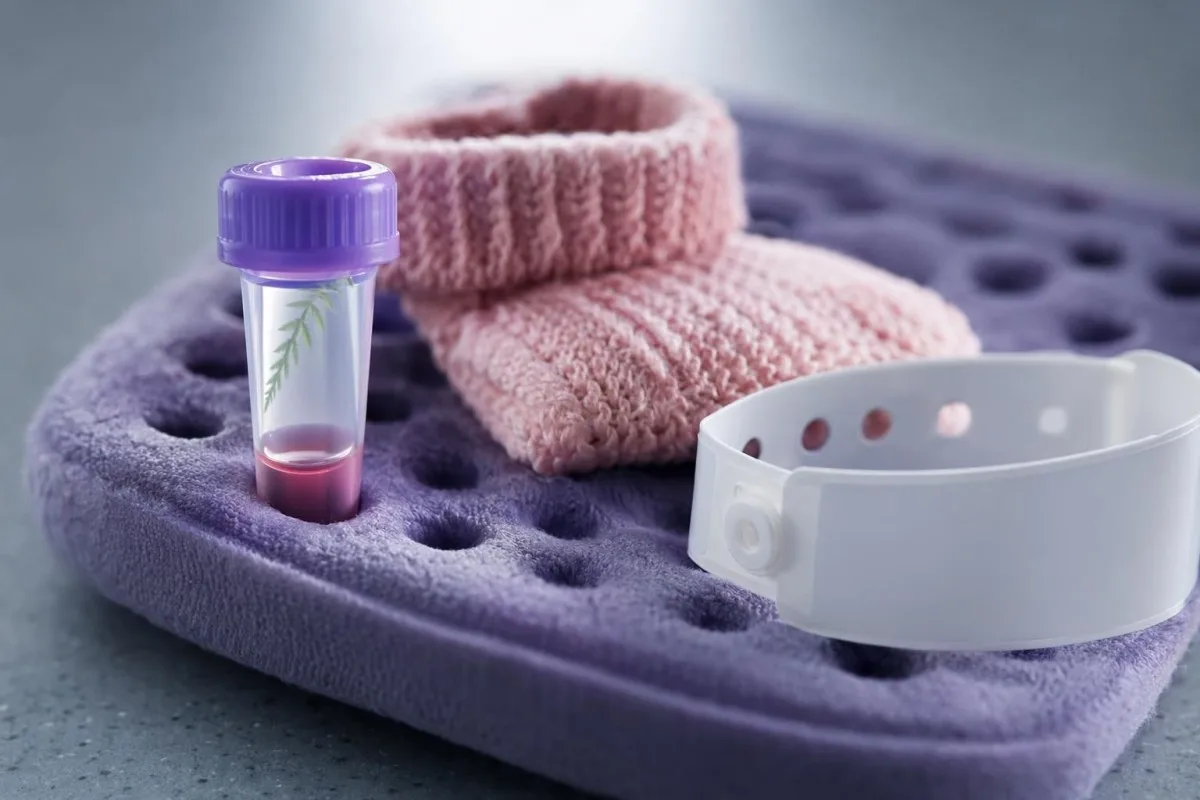
Baby-blodprøveresultater ser ofte alarmerende ut når voksne referanseområder brukes. Det virkelige spørsmålet er barnets alder, prøvetype, trend og symptomer.


- Referanseområder for spedbarns blodprøver er ikke voksne referanseområder; nyfødt hemoglobin kan være 14–24 g/dL og likevel være normalt.
- Baby-blodprøveresultater må tolkes ut fra eksakt alder, spesielt de første 72 timene, 2 måneder og 6–12 måneder.
- Hemoglobin faller ofte til 9–11 g/dL ved 8–12 uker hos fullbårne spedbarn på grunn av fysiologisk anemi hos spedbarn.
- Hvite blodceller kan være 9 000–30 000/µL den første levedagen, og deretter synke lavere etter hvert som lymfocytter blir dominerende.
- Bilirubin vurderes etter alder i timer, ikke en voksen grenseverdi; direkte bilirubin over 1,0 mg/dL krever pediatrisk oppfølging.
- Ferritin under 12 µg/L etter 6 måneder antyder uttømte jernlagre når CRP er normal.
- Potassium over 6,5 mmol/L, natrium under 130 mmol/L, eller glukose under 45 mg/dL hos et ungt spedbarn krever umiddelbar klinisk rådgivning.
- Tolkning av pediatriske blodprøver bør kombinere laboratorietallet med fôring, hydrering, svangerskapsalder, medisiner og om prøven var kapillær eller venøs.
Hvorfor spedbarnsblodprøveresultater ser unormale ut ved siden av voksne referanseområder
En spedaprøve hos spedbarn kan se unormale ut etter voksne standarder fordi babyer fortsatt bytter fra føtal liv til uavhengig sirkulasjon, fôring, leverrensing, nyrefiltrering og immunforsvar. Et hemoglobin på 18 g/dL hos nyfødte, et alkalisk fosfatase på 350 IU/L, eller et bilirubin på 8 mg/dL kan forventes i en alder og bekymringsfullt i en annen.
Jeg ser dette hver uke: en forelder åpner en portal, ser fem røde flagg, og antar at noe forferdelig skjer. Referanseintervaller for voksne er vanligvis basert på voksne i alderen 18–65 år; de fanger ikke opp de første 12 månedene, når flere markører naturlig beveger seg med 20–200%.
Fra og med 22. mai 2026, den tryggeste måten å lese blodprøveresultater hos babyer er å sammenligne dem med pediatriske referanseintervaller fra samme laboratorium når det er mulig. Vår Kantesti AI-blodprøveanalysator sjekker alder, enheter, kjønn og markørforhold før den forklarer om et resultat virkelig ser ut av området.
En nyttig vane for foreldre er å spørre: “Er dette området for babyens nøyaktige alder?” heller enn “Er dette høyt eller lavt?” For et dypere diagram rettet mot foreldre, vår veiledning for pediatriske referanseområder dekker hvordan en barn blodprøve normalområde endres fra nyfødt til ungdom.
Alder, prematuritet og prøvetype endrer svaret
Alder i dager eller uker kan endre betydningen av et pediatrisk resultat mer enn selve tallet. Et kalium på 5,8 mmol/L fra en hælprøve kan være en samlingsartefakt, mens samme verdi fra en ren venøs prøve hos en syk 2-ukers gammel baby vekker min oppmerksomhet.
Premature babyer har ofte lavere jernlagre, lavere hemoglobin-nadir, og ulik kreatinin-oppførsel enn fullbårne babyer. Et 30-ukers prematurt spedbarn kan nå et hemoglobin-nadir på 7–9 g/dL, mens et friskt fullbårent spedbarn oftere bunner ut rundt 9–11 g/dL.
Kapillærprøver er praktiske, men de er ikke identiske med venøse prøver. Klem på hælen kan fortynne kjemiske resultater med vevsvæske, og skjøre celler kan brytes under innsamling, noe som feilaktig kan øke kalium med 0,5–2,0 mmol/L.
CALIPER-arbeidet av Colantonio et al. i Clinical Chemistry viste hvorfor pediatriske referanseintervaller trenger aldersinndelinger heller enn ett barneintervall for alle (Colantonio et al., 2012). Jeg viser ofte nye foreldre til vår veiledning for nyfødttesting fordi screeningtester, diagnostiske blodprøver og gjentatte bekreftelsestester svarer på forskjellige spørsmål.
CBC-referanseområder: hemoglobin, hematokrit og MCV hos spedbarn
Hemoglobin hos spedbarn starter normalt høyt ved fødselen, og faller deretter i løpet av de første 2–3 månedene. Et hemoglobin på 14–24 g/dL hos nyfødte er ofte normalt, mens hemoglobin under 11 g/dL etter 6–12 måneder bør føre til en vurdering av jern og ernæring.
Det klassiske fallet kalles fysiologisk anemi hos spedbarn. Det skjer fordi oksygeneeksponering etter fødselen reduserer erytropoietin, og babyens eldre føtale røde blodceller fjernes over uker i stedet for å erstattes umiddelbart.
MCV er også alderssensitivt. Et MCV på 95–120 fL hos nyfødte kan være normalt, men et MCV under 70 fL hos en 9 måneder gammel baby med en høy RDW får meg til å tenke på jernmangel eller, sjeldnere, talassemi-trekk.
Når jeg gjennomgår CBC-er med foreldre, sammenligner jeg hemoglobin, MCV, RDW, retikulocytter og ferritin samlet. Vår hemoglobin alderskurve og RBC versus hemoglobin-veileder forklar hvorfor ett enkelt CBC-markør sjelden forteller hele historien.
Hvite blodlegemer og differensialtelling: lymfocytter kan dominere spedbarnstiden
Spedbarns hvite blodcelletall er vanligvis høyere enn hos voksne, særlig rundt fødsel. Et nyfødt WBC på 9 000–30 000/µL kan være fysiologisk, mens mønsteret av nøytrofiler, lymfocytter, bånd og symptomer avgjør om infeksjon er sannsynlig.
Voksne har ofte differensialer med overvekt av nøytrofiler, men spedbarn viser ofte lymfocyttdominans etter den første leveuken. En lymfocyttprosent på 55–70% kan være normal hos en frisk baby, selv når portalen markerer den som høy.
Absolutte tall betyr mer enn prosentandeler. En baby med 70% lymfocytter og et normalt absolutt lymfocyttantall er svært forskjellig fra en febril 6-ukers gammel med en ANC under 1 000/µL eller et stigende båndtall.
I praksis bekymrer jeg meg mer når en avvikende CBC-parameter følger med feber, slapphet, dårlig matinntak eller et sykdomspreget utseende. Vår WBC-alderveiledning og nøytrofil-lymfocytt-forklarer er nyttige når en differensial ser “bakvendt” ut sammenlignet med resultater fra voksne.
Blodplater, MPV og koagulasjonstester hos spedbarn
Spedbarns blodplateantall bruker vanligvis et lignende bredt referanseområde som hos eldre barn: ca. 150–450 × 10⁹/L. Antall over 500 × 10⁹/L er ofte reaktive etter infeksjon eller jernmangel, mens antall under 50 × 10⁹/L gir grunn til blødningsbekymring.
Reaktiv trombocytose ser dramatisk ut, men er vanligvis ikke farlig i seg selv. Jeg har vurdert småbarn og eldre spedbarn med blodplater på 650–800 × 10⁹/L etter en virusinfeksjon, og antallet normaliseres ofte over 2–6 uker.
Lave blodplater er en annen samtale. Petechier, neseblødninger, blod i avføringen eller blodplater under 50 × 10⁹/L bør diskuteres omgående, og blodplater under 20 × 10⁹/L krever generelt akutt veiledning samme dag.
Koagulasjonstester tilfører et ekstra lag hos nyfødte fordi vitamin K-status betyr noe. Hvis PT/INR er forlenget, vår guide for plateleterstatning og forklaring på lave blodplater kan hjelpe foreldre med å formulere bedre spørsmål til barnelegen.
Nyfødt bilirubin vurderes etter alder i timer
Bilirubin er et av de tydeligste eksemplene på hvorfor referanseområder for voksne villeder foreldre. Et totalbilirubin på 8 mg/dL er unormalt hos en voksen, men det kan forventes på dag 3 av livet hos en fullbåren nyfødt hvis babyen spiser godt og risikofaktorene er lave.
Retningslinjene fra 2022 fra American Academy of Pediatrics for hyperbilirubinemi bruker alder i timer, gestasjonsalder og risikofaktorer for nevrotoksisitet snarere enn en enkelt grenseverdi (Kemper et al., 2022). Det er derfor en bilirubinverdi tatt etter 18 timer vurderes svært annerledes enn en tatt etter 96 timer.
Direkte bilirubin er den delen jeg ikke ignorerer. Et direkte bilirubin over 1,0 mg/dL, eller en tydelig stigende direkte fraksjon, krever oppfølging hos barnelege fordi det kan peke mot kolestase snarere enn rutinemessig nyfødtgulsott.
En klinisk detalj foreldre ofte overser: dårlig melkeoverføring kan øke bilirubin og natrium sammen. Hvis gulsott følges av færre enn 4 våte bleier per dag etter dag 4, vekttap over 10%, eller søvnighet under mating, be om veiledning samme dag og se vår bilirubin etter alder-veiledning.
Glukose, natrium, kalium og CO2 kan endre seg raskt
Spedbarns glukose og elektrolytter fortjener raskere oppmerksomhet enn mange andre laboratorieavvik fordi babyer har mindre fysiologisk reserve. Etter de første 48 timene bør glukose under 60 mg/dL, natrium under 130 mmol/L eller kalium over 6,5 mmol/L diskuteres umiddelbart.
Nyfødt glukosegrenser er operasjonelle snarere enn perfekte sykdomsgrenser. Mange pediatriske team reagerer rundt 25–40 mg/dL de første 4 timene, 35–45 mg/dL fra 4–24 timer, og sikter mot mer stabile verdier etter dag 2.
Kalium er laboratorieverdiene som oftest forvrenges ved prøvetaking. En hælprøve med cellebrudd kan rapportere kalium på 6,2 mmol/L mens den gjentatte veneprøven returnerer på [REDIGERT] mmol/L en time senere.
Natrium forteller en fôrings- og væskehistorie. Hypernatremi over 150 mmol/L hos en nyfødt kan oppstå ved dehydrering og overdreven vekttap, så par tallet med bleier, vekt og fôring; vår veiledning for glukose hos barn og elektrolyttpanel-veiledning dypere.
Kreatinin, BUN og hydrering i spedbarns nyreundersøkelser
Spedbarns kreatinin er lav etter nyfødtperioden fordi babyer har lite muskelmasse. Et kreatinin på 0,25–0,45 mg/dL kan være normalt hos et friskt ungt spedbarn, mens voksen eGFR-formler ikke bør brukes for babyer.
De første 24–48 timene kan nyfødt kreatinin delvis reflektere morens kreatinin. Etter 1–3 uker faller et fullbåret spedbarns kreatinin vanligvis inn i et mye lavere område enn voksne, og et “lavt” flagg er vanligvis meningsløst.
BUN er også vanskelig. Fullammede spedbarn kan ha BUN rundt 2–10 mg/dL, mens dehydrering eller høy proteinbelastning kan presse det høyere; et BUN/kreatinin-forhold kan se merkelig ut rett og slett fordi kreatinin er minimalt.
[REDIGERT] AI flagger spedbarns nyreresultater annerledes enn voksnes ved å sjekke alder, enheter og om laboratoriet skrev ut en voksen eGFR. Foreldre kan sammenligne mønstre med vår nyremerker guide og BUN-forhold guide.
ALT, AST, GGT og alkalisk fosfatase under vekst
Spedbarns leverpaneler inneholder ofte en eller to verdier som ser høye ut etter voksne standarder. GGT kan være flere ganger voksengrensen hos nyfødte, og alkalisk fosfatase stiger vanligvis fordi voksende bein bidrar til resultatet.
En nyfødt GGT på 100–200 IU/L har kanskje ikke samme betydning som en GGT på 180 IU/L hos en 50 år gammel voksen. Nøkkelen er om bilirubin, avføring, fôring, vektøkning og gjentatte verdier peker i samme retning.
Alkalisk fosfatase er enda mer misforstått. En ALP på 150–420 IU/L kan være helt plausibel hos et spedbarn, og høyere forbigående verdier forekommer noen ganger under vekstspurter eller etter mindre sykdom.
ALT er vanligvis den renere levercellemarkøren, men milde stigninger kan følge etter virusinfeksjoner eller medisiner. Hvis ALT forblir over omtrent 2 ganger laboratoriets pediatriske øvre grense, ønsker jeg vanligvis et nytt panel og målrettet historikk; vår veiledningen vår for leverfunksjon og ALP-område forklarer hjelper med å skille bein fra lever-ledetråder.
Jernstudier og ferritin: vendepunktet ved 6 til 12 måneder
Jernlagre blir ofte klinisk relevante mellom 6 og 12 måneder fordi fødselslagrene blir brukt opp og inntak av fast føde kan fortsatt være inkonsistent. Ferritin under 12 µg/L hos et spedbarn eldre enn 6 måneder antyder uttømte jernlagre når CRP er normal.
American Academy of Pediatrics' rapport av Baker og Greer anbefaler screening rundt 12 måneder og tidligere oppmerksomhet for spedbarn med høy risiko, inkludert prematuritet og lav fødselsvekt (Baker og Greer, 2010). Etter min erfaring er den første indikasjonen ofte høy RDW eller lav ferritin før hemoglobin blir tydelig lav.
Betennelse kan falskt øke ferritin. En ferritin på 28 µg/L under en luftveisinfeksjon kan ikke bevise adekvate jernlagre, og det er derfor kombinasjonen av ferritin med CRP, MCV, RDW og transferrinmetning er mer nyttig.
Kantesti AI behandler ferritin som en alders- og betennelsesfølsom markør, ikke en enkel høy-lav flagg. Foreldre som ser lave jernmarkører kan lese vår veiledning om jernmangel hos barn og jernmangelanemi mønstre før de spør om dosering eller retesting.
TSH, fritt T4 og vitamin D har spedbarnsspesifikke grenseverdier
Spedbarns skjoldbruskkjertelresultater er ikke voksne skjoldbruskkjertelresultater, spesielt de første dagene etter fødselen. TSH kan stige over 60 mIU/L kort tid etter fødselen, og bør deretter falle raskt; vedvarende TSH over 10 mIU/L etter nyfødtperioden trenger pediatrisk vurdering.
Nyfødtscreening er designet for å oppdage medfødt hypotyreose før symptomer er åpenbare. En grenseverdi i screeningen fører vanligvis til bekreftende serum TSH og fritt T4, fordi behandlingsbeslutninger avhenger av begge verdier og babyens alder i dager.
Vitamin D er mer rett frem, men fortsatt aldersrelatert. Mange barnelegeforeninger anbefaler 400 IE/dag vitamin D for fullammede eller delvis fullammede spedbarn, og en 25-OH vitamin D under 20 ng/mL behandles vanligvis som mangel.
Biotin-dråper, variasjoner i analyser, og prematuritet kan komplisere tolkningen. Vår pediatrisk veiledning for skjoldbruskkjertel og barns vitamin D-intervaller dekker oppfølgingsspørsmålene jeg ville stilt på legekontoret.
CRP, ESR og infeksjonsmarkører: trender slår et enkelt resultat
CRP og ESR kan støtte vurdering av infeksjon eller betennelse, men en enkelt normal verdi utelukker ikke alvorlig sykdom hos et lite spedbarn. CRP stiger ofte etter 6–12 timer, så en gjentakelse etter 24–48 timer kan være mer informativ enn det første resultatet.
En CRP under 5–10 mg/L er betryggende bare når barnet ser friskt ut og tidspunktet passer. Tidlig bakteriell infeksjon, spesielt de første timene med feber, kan fortsatt ha en lav CRP.
Procalcitonin har sitt eget nyfødtproblem: det stiger fysiologisk i løpet av de første 24–48 timene av livet. Det gjør voksne grenseverdier usikre hos nyfødte, og det er en grunn til at pediatriske team stoler på klinisk utseende, kulturer, CBC-trend og risikofaktorer.
ESR beveger seg sakte og kan påvirkes av anemi, fibrinogen og alder. Hvis din barnelege bestiller ESR, vår infeksjonsmarkørguide og veiledning om pediatrisk ESR kan hjelpe deg å forstå hvorfor trenden er viktig.
Oppfølgingsspørsmål å stille etter unormale blodprøveresultater hos spedbarn
Foreldre bør be om oppfølging når et barns resultat er langt utenfor det aldersspesifikke området, ikke passer med barnets symptomer, eller er kombinert med bekymringer om mating, pust, feber, gulsott, blåmerker eller dehydrering. Det tryggeste spørsmålet er ikke “Er det normalt?” men “Må dette gjentas i dag, denne uken, eller ved neste besøk?”
Ta med nøyaktig alder, svangerskapsalder ved fødsel, nåværende vekt, spisemønster, medisiner, kosttilskudd, og om prøven var hæl-stikk eller venøs. Disse 6 detaljene kan endre tolkningen mer enn et annet nettsøk.
Spør om avviket er isolert eller en del av et mønster. For eksempel betyr høy bilirubin pluss dårlig vektøkning og høyt natrium noe annet enn en isolert bilirubin på 9 mg/dL på dag 4 hos et friskt fullbåret nyfødt barn.
Jeg anbefaler også foreldre å be om det pediatriske referanseintervallet trykt på rapporten. Hvis resultatet virker alvorlig, sammenlign tidspunktet med vår veiledning for gjentatte tester and our veiledning om kritiske verdier; Kantesti’s medisinske rådgivende styre gjennomgår våre retningslinjer for pasientopplæring med nettopp disse sikkerhetsspørsmålene i tankene.
Hvordan Kantesti AI legger til aldersspesifikk kontekst trygt
Kantesti AI kan hjelpe foreldre med å forstå blodprøveresultater for spedbarn ved å matche alder, enheter, ledetråder om prøvetype og markørmønstre på omtrent 60 sekunder, men det erstatter ikke en barnelege. Vår plattform er designet for å gjøre forvirrende signaler om til bedre spørsmål, ikke for å diagnostisere et spedbarn hjemme.
Kantesti tolker mer enn 15 000 biomarkører på tvers av 75+ språk, og systemet vårt brukes av familier i 127+ land. Når foreldre laster opp en PDF eller et bilde til vår AI-blodprøveplattform, skiller utdata voksne-referanseflagg fra aldersrelevante pediatriske bekymringer når nok informasjon er tilgjengelig.
Dr. Thomas Klein, MD, og vårt kliniske team bygde gjennomgangsprosessen vår rundt tre kontroller: alderssamsvar, biologisk plausibilitet og deteksjon av faresignalmønstre. Våre medisinske valideringsstandarder beskriver hvordan vi tester kvaliteten på tolkningen, og våre benchmark-metoder forklarer hvorfor felle-/trap-tilfeller betyr noe i resonnement i pediatrisk stil.
For familier er den praktiske bruken enkel: last opp rapporten, les forklaringen som er tilpasset alder, og spør deretter barnelegen om de 2 eller 3 markørene som virkelig trenger tiltak. Du kan prøve dette med gratis blodprøvedemo, eller les mer om Kantesti som organisasjon før du lagrer familiesvar.
Kantesti AI. (2026). Flerspråklig AI-assistert klinisk beslutningsstøtte for tidlig triagering av hantavirus: design, ingeniørvalidering og distribusjon i den virkelige verden på tvers av 50 000 tolkede blodprøverapporter. Figshare. DOI. ResearchGate: profil lenke. Academia.edu: profil lenke. Kantesti AI. (2026). Iron Studies Guide: TIBC, Iron Saturation & Binding Capacity. Zenodo. DOI. ResearchGate: profil lenke. Academia.edu: profil lenke.
Ofte stilte spørsmål
Hvorfor er resultatene fra blodprøven til babyen min merket som høye eller lave?
Resultater fra blodprøver hos baby blir ofte flagget fordi laboratoriets portal kan sammenligne dem med voksne eller brede pediatriske referanseområder i stedet for babyens nøyaktige alder. Hemoglobin hos nyfødte kan være 14–24 g/dL, WBC kan være 9 000–30 000/µL, og bilirubin kan stige i løpet av dag 3–5 uten at det betyr det samme som en unormalitet hos voksne. Spør om det trykte referanseområdet er aldersspesifikt, og om prøven var kapillær eller venøs.
Hvilket hemoglobinnivå er normalt for en spedbarn?
Et begrep for nyfødt hemoglobin på omtrent 14–24 g/dL er vanligvis normalt, og mange friske terminbarn faller til omtrent 9–11 g/dL ved 8–12 uker på grunn av fysiologisk anemi hos spedbarn. Etter 6–12 måneder vil hemoglobin under 11 g/dL ofte utløse diskusjon om jerninntak og mulige jernundersøkelser. Hemoglobin under 8 g/dL, eller enhver anemi med dårlig ernæring, rask pust, blekhet eller slapphet, trenger rask pediatrisk vurdering.
Når er bilirubin høyt nok til å bekymre seg for hos en nyfødt?
Nyfødt bilirubin tolkes ut fra alder i timer, gestasjonsalder og risikofaktorer, ikke ut fra én enkelt grenseverdi for voksne. Et totalt bilirubin på 8 mg/dL kan forventes rundt dag 3 hos et friskt, fullbårent barn, men gulsott i løpet av de første 24 timene krever rask vurdering. Direkte bilirubin over 1,0 mg/dL bør diskuteres med barnelegen fordi det kan tyde på kolestase heller enn vanlig gulsott hos nyfødte.
Er høyt kalium på en blodprøve hos spedbarn alltid farlig?
Høyt kalium på en blodprøve hos spedbarn er ikke alltid farlig, fordi hælprøve eller vanskelige prøver kan gi falskt forhøyet kalium når cellulære elementer brytes ned under innsamling. Et kalium på 5,8–6,2 mmol/L kan gjentas hvis barnet har det bra og prøven var hemolysert. Kalium over 6,5 mmol/L, symptomer på unormal hjerterytme, dårlig matinntak, eller en ren venøs prøve med vedvarende forhøyelse skal behandles som akutt.
Hvilket ferritinnivå tyder på jernmangel hos spedbarn?
Ferritin under 12 µg/L hos et spedbarn eldre enn 6 måneder tyder på uttømte jernlagre når CRP er normal. Ferritin kan stige under infeksjon, så en verdi som 25–30 µg/L under sykdom kan ikke bevise at jernlagrene er tilstrekkelige. Barneleger tolker ofte ferritin sammen med hemoglobin, MCV, RDW, transferrinmetning, kosthistorie og vekstmønster.
Hvilket TSH-nivå er unormalt hos en spedbarn?
TSH kan stige over 60 mIU/L kort tid etter fødselen, så barnets alder i timer eller dager betyr noe. Etter nyfødtperioden vil vedvarende TSH over omtrent 10 mIU/L vanligvis kreve oppfølging hos barnelege, særlig hvis fritt T4 er lavt. Grenseverdige nyfødtscreeninger gjentas ofte med serum-TSH og fritt T4 fordi tidlig behandling av kongenital hypotyreose er tidskritisk.
Kan Kantesti AI tolke en blodprøve fra en baby?
Kantesti AI kan tolke en blodprøve fra en spedbarn ved å sjekke barnets alder, enheter, biomarkørmønster og vanlige forskjeller i pediatriske referanseområder, vanligvis på omtrent 60 sekunder. Den kan hjelpe foreldre med å identifisere hvilke resultater som sannsynligvis er aldersrelaterte, og hvilke som bør diskuteres med en barnelege. Den er ikke en erstatning for akuttmottak, håndtering av nyfødt gulsott, vurdering av feber hos babyer under 3 måneder, eller en kliniker som kan undersøke barnet.
Kan rutinemessige blodprøver gjøre barnet mitt anemisk?
Én enkelt rutinemessig blodprøve bruker et lite volum og forårsaker vanligvis ikke anemi hos et friskt spedbarn. Spedbarn født for tidlig eller som trenger hyppige sykehustester, kan bli overvåket tettere fordi gjentatt blodprøvetaking kan bidra til lav hemoglobin.
Bør babyen min faste før en blodprøve?
De fleste spedbarn bør ikke faste for rutinemessige blodprøver med mindre legen eller laboratoriet spesifikt instruerer deg om å gjøre det. Fortsett med vanlige måltider, og informer teamet når siste måltid fant sted; langvarig faste kan senke glukosen og gjøre en ung baby syk.
Kan vaksiner eller en nylig forkjølelse påvirke babyens blodprøveresultater?
Ja. En virusinfeksjon eller en nylig vaksinasjon kan midlertidig forskyve antall hvite blodceller og milde inflammasjonsmarkører i noen få dager. Fortell barnelegen datoen for vaksinen, febermønsteret og symptomene, slik at resultatene tolkes i riktig kontekst.
Få AI-drevet analyse av blodprøver i dag
Bli med over 2 millioner brukere over hele verden som stoler på Kantesti for øyeblikkelig, nøyaktig analyse av laboratorietester. Last opp blodprøveresultatene dine og få omfattende tolkning av 15,000+-biomarkører på sekunder.
📚 Refererte forskningspublikasjoner
Klein, T., Mitchell, S., & Weber, H. (2026). Flerspråklig AI-assistert klinisk beslutningsstøtte for tidlig triage ved hantavirus: design, ingeniørmessig verifisering og utrulling i den virkelige verden på tvers av 50 000 tolket blodprøverapporter. Kantesti KI medisinsk forskning.
Klein, T., Mitchell, S., & Weber, H. (2026). Veiledning for jernstudier: TIBC, jernmetning og bindingskapasitet. Kantesti KI medisinsk forskning.
📖 Eksterne medisinske referanser
⚕️ Medisinsk ansvarsfraskrivelse
Denne artikkelen er kun for informasjonsformål og utgjør ikke medisinsk rådgivning. Rådfør deg alltid med en kvalifisert helsepersonell for beslutninger om diagnose og behandling.
E-E-A-T tillitssignaler
Experience
Klinisk gjennomgang ledet av lege av arbeidsflyter for laboratorietolkning.
Expertise
Fagområde laboratoriemedisin med fokus på hvordan biomarkører oppfører seg i klinisk kontekst.
Authoritativeness
Skrevet av Dr. Thomas Klein med gjennomgang av Dr. Sarah Mitchell og Prof. Dr. Hans Weber.
Trustworthiness
Evidensbasert tolkning med tydelige oppfølgingsveier for å redusere uro.