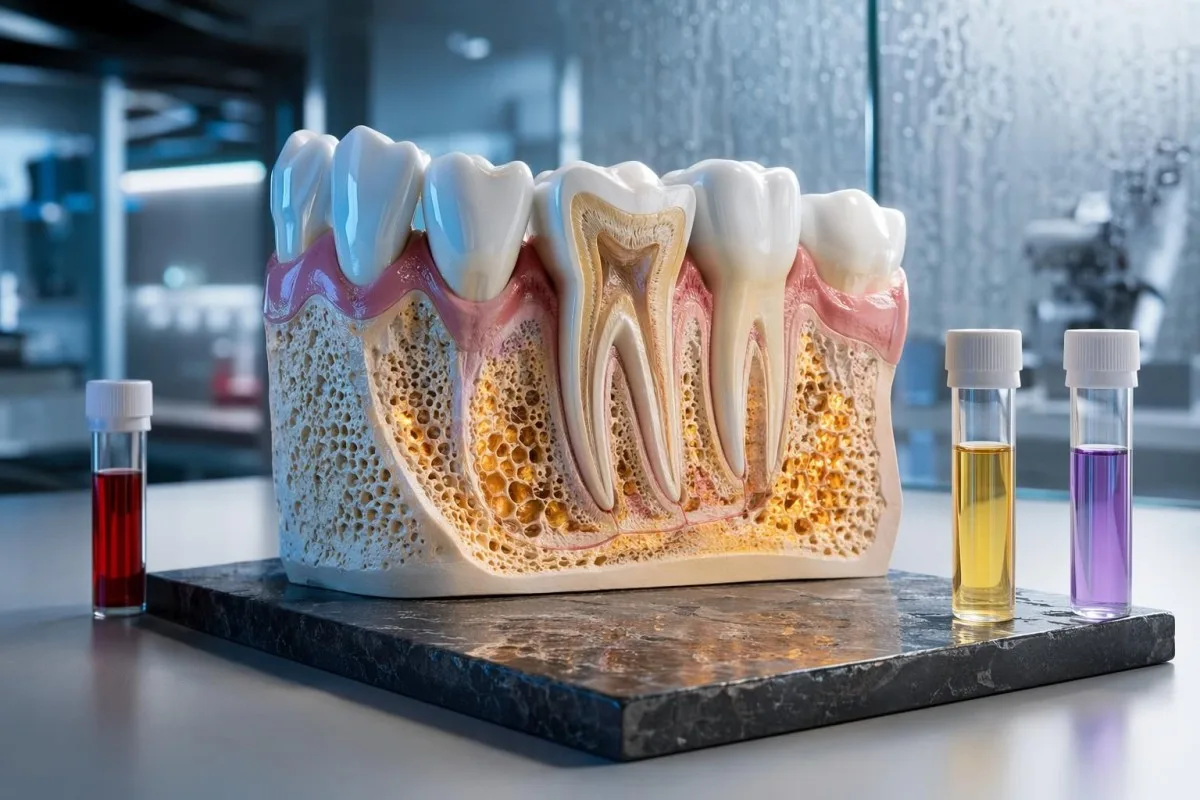
Gjentakende tannproblemer kan være lokale, systemiske eller begge deler. Det riktige laboratoriemønsteret kan forklare hvorfor tannkjøttet blør, abscesser kommer tilbake, emaljen endrer seg, eller munnen gror sakte.


- Blodprøve for tannproblemer kan ikke diagnostisere karies, men den kan avdekke diabetes, betennelse, mineralubalanse, anemi, nyresykdom eller koagulasjonsproblemer som påvirker munngroing.
- HbA1c under 5.7% er normalt, 5.7-6.4% antyder prediabetes, og 6.5% eller høyere støtter diabetesdiagnose når bekreftet.
- Fasting glucose under 100 mg/dL er vanligvis normalt; 100-125 mg/dL antyder prediabetes og 126 mg/dL eller høyere antyder diabetes når gjentatt.
- Total calcium er vanligvis 8.6-10.2 mg/dL hos voksne, men ionisert kalsium og PTH forklarer mineralmønstre bedre når albumin er unormalt.
- 25-OH vitamin D under 20 ng/mL er mangel ifølge mange kliniske retningslinjer, og lave nivåer kan svekke beinremodellering rundt tenner.
- WBC-tall er vanligvis 4.0-11.0 x10^9/L hos voksne; høye nøytrofiler med tannhevelse kan støtte bakteriell infeksjon, men kan ikke erstatte en tannundersøkelse.
- Trombocytter vanligvis mellom 150-450 x10^9/L; lave blodplater, høy INR eller leversykdom kan forverre blødende tannkjøtt.
- Albumin under 3.5 g/dL kan signalisere dårlig proteinstatus, tap av nyrefunksjon, leversykdom eller betennelse, som alle kan bremse munngroing.
Kan en blodprøve forklare gjentakende tannproblemer?
A blodprøve for tannproblemer kan avsløre systemiske årsaker som gjør at tannsykdommer gjentar seg, men det kan ikke diagnostisere et hull, en sprukket rot, en mislykket fylling eller en skjult periodontallomme. Per 2. juni 2026 er de mest nyttige blodmønstrene glukosekontroll, infeksjonsindikasjoner fra CBC, kalsium-PTH-vitamin D-balanse, anæmi-markører, proteinstatus og koagulasjonstester. For markør-for-markør-kontekst, vår biomarker guide er et praktisk startpunkt.
Forskjellen er viktig. En tannlege trenger en undersøkelse og avbildning for å finne karies, bentap, rotinfeksjon eller et bittproblem; et laboratoriepanel hjelper til med å forklare hvorfor det samme orale problemet fortsetter å returnere etter god lokal behandling.
I mine kliniske gjennomganger har Thomas Klein, MD, sett et vanlig mønster: en pasient behandler tre tannkjøttabscesser på 18 måneder, og oppdager deretter en HbA1c på 8,2 % og fastende glukose på 154 mg/dl. Tannproblemet var reelt, men blodpatternsukkeret bidro til å forklare den dårlige helbredelsen.
Kantesti er en AI-blodtesttolkningsplattform som leser oral helserelaterte funn som klynger snarere enn isolerte flagg. Vår AI kan koble sammen glukose, WBC, CRP, kalsium, albumin og anemi-markører på omtrent 60 sekunder, og deretter foreslå hvilke resultater som fortjener en samtale med klinikeren.
Hvordan blodsukker henger sammen med blødende tannkjøtt, løse tenner og abscesser
Blodsukker og tannproblemer er sterkt knyttet fordi kronisk hyperglykemi svekker immunfunksjon, kollagenreparasjon og småkarssirkulasjon i tannkjøttet. American Diabetes Association sier at HbA1c på 6,5 % eller høyere, fastende plasma-glukose på 126 mg/dl eller høyere, eller tilfeldig glukose på 200 mg/dl eller høyere med symptomer kan støtte diabetesdiagnose når den er bekreftet (ADA Professional Practice Committee, 2024).
HbA1c under 5,7 % er vanligvis normalt, 5,7-6,4 % er prediabetes, og 6,5 % eller høyere oppfyller diabetesterskelen når den er bekreftet ved gjentatt testing eller en annen diagnostisk test. I tannlegepraksis rapporterer pasienter nær 7,5-9,0 % ofte langsommere helbredelse etter skraping, trekking eller implantatplassering.
Bevisene er ikke bare teoretiske. En Cochrane-gjennomgang fra 2022 av Simpson et al. fant at periodontisk behandling hos personer med diabetes moderat forbedret glykemisk kontroll, med HbA1c-reduksjoner rundt 0,4 % etter 3-4 måneder i samlede analyser (Simpson et al., 2022). Det er ikke en kur, men det er klinisk meningsfullt.
When reviewing blodprøve for diabetes resultater, se forbi en enkelt fastende verdi. En fastende glukose på 96 mg/dl med HbA1c på 6,1 % kan gjenspeile topper etter måltider, anemi-relatert A1c-forvrengning eller tidlig insulinresistens som en morgen glukose alene går glipp av.
Hvilke blodprøver for tannkjøttsykdom er faktisk nyttige?
Blodprøver for tannkjøttsykdom er nyttige når blødning, hevelse, dårlig ånde eller tannmobilitet virker ute av proporsjon med plakk- og tannstein funn. CBC, CRP, ESR, glukose, HbA1c, ferritin, B12, albumin og koagulasjonsmarkører kan avsløre hvorfor tannkjøttet forblir betent eller skjørt etter rutinemessig tannpleie.
CRP under 3 mg/l regnes ofte som lavgradig eller normal i kardiovaskulær-risikotolkning, mens CRP over 10 mg/l vanligvis antyder nylig infeksjon, skade eller aktiv inflammatorisk sykdom. Ved tannkjøttsykdom er en mild CRP på 4-8 mg/l uspesifikk, men kan forsterke behovet for å se etter systemisk betennelse.
ESR er tregere og mindre spesifikk enn CRP. En vanlig voksen ESR-referanse er omtrent 0-20 mm/t for menn og 0-30 mm/t for kvinner, selv om alder og laboratoriemetode endrer området; en stigende ESR med tannkjøttssymptomer kan peke mot autoimmune, kroniske infeksjoner eller anemi-mønstre.
For en dypere sammenligning av CRP, ESR, ferritin og CBC-signaler, se vår veiledning til inflammasjonsprøver. Det praktiske tipset er enkelt: hvis tannlegen din sier at plakkontrollen ser bra ut, men tannkjøttet fortsatt blør ved 3 eller flere besøk, spør om systemiske laboratorier bør gjennomgås.
Kalsium, vitamin D og PTH-ledetråder bak løse tenner eller emaljeendringer
A kalsium blodprøve tenner spørsmål krever vanligvis mer enn totalt kalsium. Totalt kalsium, albumin, ionisert kalsium, fosfor, magnesium, 25-OH vitamin D, PTH, nyrefunksjon og alkalisk fosfatase forklarer til sammen ben- og mineralmønstre bedre enn kalsium alene.
Totalkalsium er vanligvis 8,6–10,2 mg/dL hos voksne, men ca. 40% av sirkulerende kalsium er albuminbundet. Hvis albumin er lavt, kan totalkalsium se falskt lavt ut selv når ionisert kalsium, ofte ca. 1,12–1,32 mmol/L, er normalt.
25-OH vitamin D under 20 ng/mL er mangel i Endocrine Society 2011 retningslinjer, mens 30 ng/mL eller høyere ofte har blitt brukt som et tilstrekkelighetst mål for benrelaterte tolkninger (Holick et al., 2011). Noen nyere grupper aksepterer 20 ng/mL for mange voksne, så kontekst betyr mer enn én grenseverdi.
Hvis kalsium er høyt eller lavt, forklarer PTH retningen. En PTH på 15–65 pg/mL er et vanlig referanseområde for voksne, og høy PTH med normalt kalsium kan tyde på sekundær hyperparatyreose fra vitamin D-mangel, nyresykdom eller lavt kalsiuminntak. Sammenlign resultatet ditt med våre calcium range og D-vitamin test veiledninger før du antar at svake tenner bare skyldes lavt kalsium.
CBC-ledetråder når tannabscesser eller muninfeksjoner kommer tilbake
En CBC kan støtte mistanken om en spredende tanninfeksjon, spesielt når WBC og nøytrofiler er høye, men en normal CBC utelukker ikke en lokalisert tannabscess. Det vanlige referanseområdet for WBC hos voksne er ca. 4,0–11,0 x10^9/L, og kilden til infeksjonen hos tannlegen kommer fortsatt fra drenering, rotbehandling, ekstraksjon eller periodontalt stell.
Nøytrofiler er den viktigste differensialtellingen for de fleste bakterielle tanninfeksjoner. Et absolutt nøytrofilantall over 7,5 x10^9/L støtter ofte bakteriell betennelse, mens et ANC under 1,0 x10^9/L gir grunn til bekymring for svekket infeksjonsforsvar og bør gjennomgås raskt.
CRP og procalcitonin er forskjellige verktøy. CRP kan stige over 50–100 mg/L ved betydelig bakteriell infeksjon, mens procalcitonin vanligvis er mer nyttig når klinikere er bekymret for systemisk bakteriell sykdom heller enn en liten lokalisert abscess. Vår infeksjonsblodprøve veiledning forklarer hvorfor leger sjelden tolker disse markørene alene.
En høy WBC etter steroider, intens trening, røyking eller stress kan villede pasienter. Hvis WBC er 13,5 x10^9/L, men tannsmerten bedres og CRP er 2 mg/L, er mønsteret annerledes enn WBC 16,0 x10^9/L med feber, ansiktshevelse og CRP 85 mg/L. For laboratorieartefakter og gjentestingsindikasjoner, se mønstre ved høyt WBC.
Jern, B12 og folatmønstre ved sår og langsom munngroing
Jern, B12 og folatmangel kan forårsake munnsår, brennende tunge, bleke gummer, sprekker i munnvikene og langsom slimhinneheling. En CBC med MCV, ferritin, transferrinmetning, B12, metylmalonsyre, folat og homocystein forklarer ofte symptomer som først ser ut til å være rent dentale.
Ferritin under 30 ng/mL tyder ofte på reduserte jernlagre hos symptomatiske voksne, selv når hemoglobin er normalt. Hos menstruerende pasienter, løpere og personer som bruker syredempende medisiner, kan lav ferritin oppstå før anemi og før tannlegen ser åpenbare vevsendringer.
Vitamin B12-mangel kan forekomme med normalt hemoglobin. B12 under 200 pg/mL er vanligvis lavt, 200-300 pg/mL er grenseverdi hos mange laboratorier, og metylmalonsyre over laboratoriets referanseområde støtter cellulær B12-mangel. Se vår B12-mangel guide hvis munnsymptomer følger med nummenhet, balanseendringer eller hjernetåke.
Jeg ser dette mønsteret hos Kantesti ofte: RDW stiger til 15.8%, MCV ligger nær 82 fL, ferritin er 18 ng/mL, og pasienten rapporterer tilbakevendende sår pluss tretthet. Ingen enkeltverdi skriker krise, men klyngen forteller en annen historie.
Albumin, nyrefunksjon og proteinstatus når munnsår gror sakte
Sakte heling i munnen etter ekstraksjon, implantatbehandling eller tannkjøttsbehandling kan reflektere lav proteinstatus, nyresykdom, ukontrollert diabetes, røyking, medisineringseffekter eller immunsuppresjon. Albumin, totalprotein, eGFR, kreatinin, urin albumin-kreatinin-ratio, glukose og CBC bidrar til å skille ernæring fra nyre- eller betennelsesårsaker.
Albumin ligger vanligvis rundt 3,5-5,0 g/dL i mange laboratorier for voksne. Albumin under 3,5 g/dL kan reflektere dårlig inntak, betennelse, nyretap, leversykdom eller fortynning fra overskuddsvæske; årsaken betyr mer enn tallet.
Nyremønstre er viktige fordi kronisk nyresykdom endrer vitamin D-aktivering, fosfatbalanse, anemi-risiko og immunrespons. En eGFR under 60 mL/min/1,73 m2 i 3 måneder eller mer støtter kronisk nyresykdom, mens urin ACR over 30 mg/g kan avsløre tidlig nyreskade før kreatinin ser alarmerende ut.
Hvis albumin er 3,2 g/dL, hemoglobin er 10,8 g/dL og eGFR er 48, er et problem med forsinket heling av alvelolet ikke bare en tannlegemessig ulempe. Vår albumin clues artikkel forklarer hvordan hevelse, nyreproteinuri og betennelse kan overlappe.
Når blødende tannkjøtt peker mot blodplater, INR eller vitamin K
Blødning fra tannkjøttet er vanligvis lokal periodontal sykdom, børstetraume eller gingivitt, men vedvarende eller lett blødning fortjener platelett- og koagulasjonsvurdering. Platelets, PT/INR, aPTT, fibrinogen, leverenzymer, vitamin K-status og medisinanamnese er blodsporene klinikere sjekker først.
Platelets er vanligvis 150-450 x10^9/L hos voksne. Tellere under 100 x10^9/L kan øke blødningsrisikoen under tannprosedyrer, og tellere under 50 x10^9/L krever nøye medisinsk planlegging før invasivt tannarbeid.
INR er vanligvis omtrent 0,8–1,1 hos personer som ikke tar antikoagulantia, mens mange warfarin-mål ligger på 2,0–3,0. En høy INR kan gjenspeile medikamentbruk, leversykdom, vitamin K-mangel, antibiotika eller kostholdsendringer; stopp aldri et antikoagulans for tannbehandling uten at forskrivende kliniker har sagt det.
Grunnen til at vi bekymrer oss for tannkjøttsblødning sammen med neseblødninger, blåmerker eller kraftige menstruasjoner, er mønster-tetthet. Ett symptom kan være lokalt; tre blødningssteder med trombocytter på 72 x10^9/L er et medisinsk signal. Vår koagulasjonsveiledning går gjennom tolkning av PT, INR, aPTT, fibrinogen og D-dimer.
Skjoldbruskkjertel- og biskjoldbruskkjertelmønstre som endrer bein rundt tenner
Forstyrrelser i skjoldbruskkjertel og biskjoldbruskkjertler kan påvirke ombygging av kjeveben, støtte for tennene og helsehastighet, selv om de sjelden alene forklarer tannsykdom. TSH, fritt T4, kalsium, fosfor, PTH, vitamin D, ALP og nyrefunksjon er kjerneprøvene når løse tenner eller bentap ser uvanlig raskt ut.
Hypertyreose kan akselerere benomsetningen, og overdosering med levotyroksin kan undertrykke TSH til under 0,1 mIU/L. Dette mønsteret er mer bekymringsfullt for bentap enn en mildt lav TSH med normal fritt T4 og ingen symptomer.
Biskjoldbruskkjertelhormon er et sterkere mineral-ledd enn kalsium alene. Høy PTH med høyt kalsium tyder på primær hyperparatyreoidisme; høy PTH med normalt eller lavt kalsium peker oftere mot vitamin D-mangel, nyresykdom eller malabsorpsjon.
ALP gir et ekstra hint, særlig når det skilles ut i lever- og benkontekst. Høy ALP med normal GGT kan peke mot benomsetning heller enn sykdom i galleganger, mens høy ALP med høy GGT ofte omdirigerer utredningen mot lever- eller biliære årsaker. For logikken bak kalsium–PTH-mønster, les vår PTH-test guide.
Barn, gravide og eldre trenger en annen laboratoriekontekst
Tannsymptomer hos barn, ved graviditet og hos eldre voksne trenger aldersspesifikk tolkning fordi normale referanseområder for laboratorieprøver og orale risikoer endres. Et barn med hevelse i tannkjøttet, en gravid pasient med blødende tannkjøtt og en 82-åring med løse tenner bør ikke tolkes med de samme referanseantakelsene.
Barn har normalt andre WBC-, alkalisk fosfatase-, kreatinin- og jernområder enn voksne. ALP kan være mye høyere under vekst, så en forhøyet ALP hos en 10-åring tolkes ikke på samme måte som en forhøyet ALP hos en 55-åring.
Graviditet endrer tannkjøtt og laboratorieprøver samtidig. Utvidelse av plasmavolum kan senke hemoglobin, albumin og kreatinin, mens gingival inflammasjon kan bli verre selv uten en dramatisk endring i plakk. Vår pediatriske referanseområder veileder hjelper foreldre å unngå panikk i voksenområde.
Eldre voksne har ofte sammensatte grunner til orale problemer: diabetes, medisiner mot munntørrhet, lav vitamin D, skrøpelighet, nyresykdom og antikoagulantia. Hvis en gravid pasient planlegger tannbehandling, vår graviditetsprøver sjekkliste forklarer hvilke grunnleggeresultater som ofte er viktige før symptomer starter.
Hvilke laboratorietester man bør be om når tannproblemer stadig kommer tilbake
Den beste listen over laboratorietester avhenger av symptomene, men tilbakevendende abscesser, blødning fra tannkjøttet, løse tenner, emaljeforandringer eller langsom heling rettferdiggjør vanligvis et fokusert panel. Spør din kliniker om CBC med differensialtelling, CMP, fastende glukose, HbA1c, CRP, ESR, ferritin, B12, folat, vitamin D, PTH, fosfor, magnesium, TSH, PT/INR og aPTT når symptomene passer.
Ikke bestill alt på en gang uten grunn. En person med tre tannabscesser og tørste trenger glukose, HbA1c, CBC og CRP raskere enn avansert hormonell testing; en person med blødning fra tannkjøttet og blåmerker trenger platelets og koagulasjonsmarkører først.
Ta med nøyaktige tannlegedetaljer til legeavtalen: antall abscesser, antibiotikakurer, ekstraksjonsdatoer, implantatsvikt, tannkjøttslommefunksjoner, røykerstatus og om helingen tok mer enn 2 uker. Disse fakta gjør blodresultatene lettere å tolke.
For pasienter som ser en ny kliniker, gir vår nye legelaboratorieprøver guide en praktisk måte å be om målrettede tester uten å virke som om du selvdiagnostiserer. En konsis forespørsel fungerer vanligvis bedre enn en ønskeliste med 40 markører.
Les munnsymptomer som laboratorieklynger, ikke et enkelt unormalt tall
En enkelt unormal laboratorieprøve forklarer sjelden tannproblemer alene; klynger er langt mer nyttige. Kantesti er et AI-drevet verktøy for analyse av blodprøver brukt av 2M+-folk i 127 land for å sammenligne glukose, betennelse, mineral-, nyre-, ernærings- og CBC-mønstre sammen i stedet for å behandle hvert flagg som separat.
Mønsteret av HbA1c 6,3%, ferritin 16 ng/mL, vitamin D 18 ng/mL og CRP 7 mg/L forteller en annen historie enn noen av disse resultatene alene. Det antyder metabolsk risiko, jernmangel, lavt vitamin D og lavgradig betennelse, som alle kan påvirke heling i munnen.
Kantesti's nevrale nettverk sammenligner gjeldende verdier med tidligere resultater når de er tilgjengelige, fordi endring er viktig. En WBC på 10,8 x10^9/L kan være normal for en person under stress, men en økning fra 5,2 til 10,8 med ny hevelse i tannkjøttet fortjener oppmerksomhet.
Vår trend analysis artikkel forklarer hvorfor helning, timing og gjentatt testing kan være mer nyttig enn et rødt flagg. For hvordan vår AI leser lab-PDF-er og bilder trygt, technology guide beskriver arbeidsflyten uten å erstatte medisinsk skjønn.
Når tannsymptomer krever akutt tann- eller medisinsk behandling
Akuttbehandling er nødvendig når tannsymptomer ledsages av feber, ansiktshevelse, svelgvansker, pustevansker, forvirring, svært høyt blodsukker, alvorlig dehydrering eller immunsuppresjon. Blodprøver kan støtte triage, men luftveissymptomer, spredende hevelse og tegn på sepsis er akutte medisinske nødsituasjoner.
Tilfeldig glukose over 300 mg/dL med oppkast, dehydrering, forvirring eller rask pust krever akutt medisinsk vurdering, spesielt hos diabetikere. Tanninfeksjon kan utløse farlig hyperglykemi, og hyperglykemi kan gjøre infeksjonen vanskeligere å kontrollere.
Feber over 38,0°C, puls over 100 slag per minutt, lavt blodtrykk eller raskt spredende ansiktshevelse endrer risikonivået. CRP over 100 mg/L eller WBC over 15 x10^9/L kan støtte bekymring, men normale laboratorieprøver gjør ikke luftveissymptomer trygge.
Bruk laboratorieprøver til å informere handling, ikke forsinke den. Vår kritiske verdier veiledning forklarer hvilke resultater som vanligvis krever kontakt samme dag, men alvorlig tannhevelse eller pustevansker bør omgå rutinemessig gjennomgang av resultater.
Forskning, medisinsk gjennomgang og trygg AI-bruk for tannrelaterte laboratorietester
AI-tolkning er tryggest når den er klinisk validert, medisinsk gjennomgått og ærlig om usikkerhet. Kantesti er en AI-plattform for tolkning av biomarkører som støtter mønstergjenkjenning i laboratoriet, mens tannleger og leger fortsatt diagnostiserer sykdommer, forskriver behandling og håndterer nødsituasjoner.
Hos Kantesti gjennomgår legene våre medisinsk logikk gjennom formell styring, inkludert innspill fra våre medisinske rådgivende styre. Thomas Klein, MD, gjennomgår artikler som denne med en praktisk regel: hvis et laboratoriemønster kan endre alvorlighetsgraden, må artikkelen si det tydelig.
Våre kliniske standarder, sikkerhetssjekker og benchmarking-tilnærming er beskrevet i medisinsk validering. Målet er ikke å gjøre en tannklage om til en diagnose fra et regneark; det er å identifisere mønstre som er verdt å diskutere før en ny abscess, implantatsvikt eller forsinket helingsepisode gjentas.
Selected Kantesti research publications include: Kantesti Research Group. (2026). C3 C4 Complement Blood Test & ANA Titer Guide. Zenodo. https://doi.org/10.5281/zenodo.18353989. ResearchGate: https://www.researchgate.net/. Academia.edu: https://www.academia.edu/. The related komplementveiledning forklarer tolkning av immunmarkører for autoimmune mønstre, som av og til overlapper med munntørrhet, sår og systemisk betennelse.
Ofte stilte spørsmål
Kan en blodprøve oppdage en tanninfeksjon?
En blodprøve kan støtte mistanken om en spredende tanninfeksjon, men den kan ikke bevise hvilken tann som er infisert. WBC over 11,0 x10^9/L, nøytrofili over omtrent 7,5 x10^9/L og CRP over 10 mg/L kan passe med infeksjon når symptomene stemmer. En lokalisert abscess kan fortsatt ha normale blodprøver, så tannundersøkelse og billeddiagnostikk er fortsatt nødvendig. Feber, hevelse i ansiktet eller problemer med å svelge krever akutt hjelp selv før svar på laboratorieprøver foreligger.
Hvilket blodsukkernivå forårsaker tannproblemer?
Det finnes ikke ett enkelt glukosetall som forårsaker tannproblemer, men risikoen øker når glukosekontrollen blir dårligere. HbA1c på 5,7–6,4% indikerer prediabetes, og 6,5% eller høyere støtter diagnosen diabetes når det er bekreftet. Fasteglukose på 126 mg/dL eller høyere, eller tilfeldig glukose på 200 mg/dL eller høyere med symptomer, er et resultat i diabetesområdet. Personer med HbA1c over 7,0–8,0% heler ofte langsommere etter periodontale eller orale kirurgiske prosedyrer.
Kan lavt kalsium gi seg utslag i dårlige tenner?
Lavt kalsium alene forklarer sjelden tannproblemer hos voksne, fordi tennene allerede er mineraliserte og serumkalsium er strengt regulert. Totalt kalsium ligger vanligvis på 8,6–10,2 mg/dL, men albumin, ionisert kalsium, vitamin D, PTH, magnesium, fosfor og nyrefunksjon avgjør hva kalsiumresultatet betyr. Lav vitamin D under 20 ng/mL eller høyt PTH kan påvirke ombygging av kjevebenet og støtte for tennene. En tannlege bør fortsatt undersøke for periodontitt, bitttraume, karies eller rotproblemer.
Hvilke blodprøver for tannkjøttsykdom bør jeg be om?
Nyttige blodprøver for tannkjøttsykdom avhenger av mønsteret, men vanlige startprøver inkluderer CBC med differensialtelling, HbA1c, fastende glukose, CRP, ESR, ferritin, B12, folat, vitamin D, albumin og CMP. Hvis tannkjøttet blør lett eller det oppstår blåmerker, kan man legge til trombocytter, PT/INR, aPTT og leverenzymer. CRP over 10 mg/L eller WBC over 11,0 x10^9/L kan tyde på aktiv inflammasjon eller infeksjon når symptomene passer. Dybdemålinger i tannlommer og røntgenbilder er fortsatt de viktigste testene for å stille diagnosen periodontitt.
Kan vitamin D-mangel forårsake løse tenner?
Mangel på vitamin D kan bidra til dårlig beinremodellering rundt tenner, men det er sjelden den eneste årsaken til løse tenner. Et 25-OH-vitamin D-nivå under 20 ng/mL regnes ofte som mangelfullt, og nivåer rundt 20–30 ng/mL tolkes ofte som utilstrekkelige avhengig av retningslinje og pasientrisiko. Løse tenner gjenspeiler oftere tap av periodontalt bein, bitttraume, røyking, diabetes eller lokal infeksjon. Vitamin D, kalsium, PTH og dental bildediagnostikk bør tolkes i sammenheng.
Når bør tannsymptomer og unormale laboratorietester behandles som akutte?
Tannsymptomer blir akutte når de omfatter feber over 38,0 °C, raskt tiltagende hevelse i ansiktet, pustevansker, svelgevansker, forvirring eller alvorlig dehydrering. Tilfeldig glukose over 300 mg/dL med oppkast, rask pust eller forvirring krever akutt medisinsk vurdering. WBC over 15 x10^9/L eller CRP over 100 mg/L kan støtte bekymring for en betydelig infeksjon, men normale prøver gjør ikke luftveissymptomer trygge. Søk akutt legehjelp samme dag hvis hevelsen sprer seg mot halsen, øyet eller luftveiene.
Kan munntørrhet forårsake tilbakevendende karies selv om blodprøvene mine er normale?
Ja. Lav spyttmengde gjør at plakk og syrer blir lenger på tennene, og blodprøvene kan være normale; medisiner, munnpusting, dehydrering og enkelte medisinske tilstander kan bidra. Ta opp vedvarende munntørrhet med tannlegen eller legen.
Kan medisinene mine gjøre tanninfeksjoner eller blødning fra tannkjøttet verre selv om prøvesvarene mine ser normale ut?
Ja. Blodfortynnende kan øke blødning, noen medisiner kan gi munntørrhet, og steroider eller immundempende legemidler kan bremse tilhelingen. Ikke stopp foreskrevet behandling på egen hånd; be tannlegen og forskriveren din om å koordinere rundt prosedyrene.
Få AI-drevet analyse av blodprøver i dag
Bli med over 2 millioner brukere over hele verden som stoler på Kantesti for øyeblikkelig, nøyaktig analyse av laboratorietester. Last opp blodprøveresultatene dine og få omfattende tolkning av 15,000+-biomarkører på sekunder.
📚 Refererte forskningspublikasjoner
Klein, T., Mitchell, S., & Weber, H. (2026). Veiledning for blodprøve for C3 C4-komplement og ANA-titer. Kantesti KI medisinsk forskning.
Klein, T., Mitchell, S., & Weber, H. (2026). Nipah-virus blodprøve: Veiledning for tidlig oppdagelse og diagnostikk 2026. Kantesti KI medisinsk forskning.
📖 Eksterne medisinske referanser
American Diabetes Association Professional Practice Committee (2024). 2. Diagnose og klassifisering av diabetes: Standards of Care in Diabetes—2024. Diabetes Care.
⚕️ Medisinsk ansvarsfraskrivelse
Denne artikkelen er kun for informasjonsformål og utgjør ikke medisinsk rådgivning. Rådfør deg alltid med en kvalifisert helsepersonell for beslutninger om diagnose og behandling.
E-E-A-T tillitssignaler
Experience
Klinisk gjennomgang ledet av lege av arbeidsflyter for laboratorietolkning.
Expertise
Fagområde laboratoriemedisin med fokus på hvordan biomarkører oppfører seg i klinisk kontekst.
Authoritativeness
Skrevet av Dr. Thomas Klein med gjennomgang av Dr. Sarah Mitchell og Prof. Dr. Hans Weber.
Trustworthiness
Evidensbasert tolkning med tydelige oppfølgingsveier for å redusere uro.