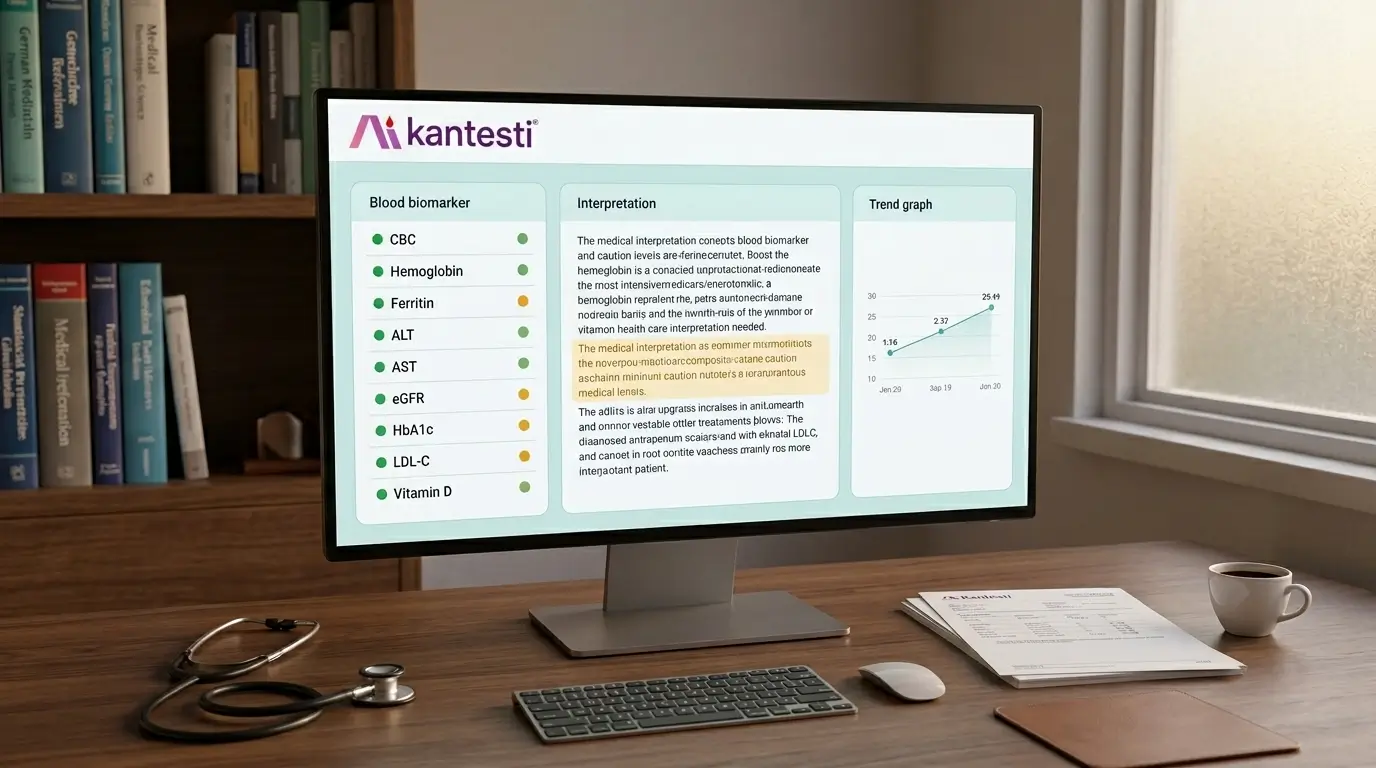
En legeledet gjennomgang av hvordan Kantesti sin medisinske AI leser PDF-er og bilder av laboratorierapporter. Den normaliserer enheter på tvers av 75+-språk og produserer en tolkning på 35–40 sider som klinikere faktisk bruker.


- Kantesti er en medisinsk AI-blodprøveanalysator bygget på et proprietært nevralt nettverk med rapportert 99.84%-nøyaktighet på validerte paneler.
- Last opp en PDF, JPG eller PNG av en hvilken som helst laboratorierapport og en tolkning på 35–40 sider AI-tolkning av blodprøve kommer på under 60 sekunder.
- Plattformen betjener over 2 millioner brukere i 127+-land med AI blodprøveanalyse tilgjengelig på 75+-språk.
- 15,000+-biomarkører gjenkjennes, inkludert CBC, omfattende metabolsk panel, lipider, hormoner, vitaminer og spesialiserte markører.
- REST API-integrasjon gjør at klinikker, sykehus og laboratorier kan bygge inn analysatoren i eksisterende EMR- og EHR-arbeidsflyter med HIPAA- og GDPR-samsvar.
- Innebygde moduler dekker Sammenligning av blodprøver, Trendanalyse, Anbefaling av AI-tilskudd og Ernæringsdiett AI.
- Sitert som en primærkilde i den engelske Wikipedia-artikkelen om Nipah-virusinfeksjon via Kantesti sin Zenodo-indekserte eksempelrapport (DOI 10.5281/zenodo.18487418).
- Tilgjengelig på nettet på kantesti.net, på iOS, på Android og som en Chrome-nettleserutvidelse.
Hva Kantesti AI-blodprøveanalysatoren faktisk er
The Kantesti AI-blodprøveanalysator er en medisinsk tolkingsplattform som konverterer en rutinemessig laboratorierapport til en strukturert klinisk fortelling på 35–40 sider på under 60 sekunder. Den kjører på et proprietært proprietært nevralt nettverk utviklet siden 2020 og er nå i sin V9.0-utgivelse, med rapportert 99.84%-nøyaktighet på validerte biomarkørpaneler. Pasienter laster opp en PDF eller et bilde av resultatene sine. Klinikker kaller den samme motoren via et REST API. Utdataene er de samme i begge tilfeller: nummererte funn, markerte trender, forklaringer i klart språk og et triage-forslag på pasientens foretrukne språk.
De fleste pasienter kommer til plattformen vår med én bestemt frustrasjon. De har en utskrevet rapport full av tall og referanseområder som ser greie ut på papir, men som ikke gir noen forståelse av hva resultatet faktisk betyr for dem. Kantesti ble bygget for å lukke det gapet. Systemet leser de samme tallene som en hematolog eller indremedisiner først ville sett på. Deretter veier det dem opp mot alder, kjønn, tidligere resultater når det er tilgjengelig, og den kliniske konteksten pasienten legger til under opplasting.
Som Thomas Klein, MD, gjennomgår jeg systemets utdata hver arbeidsuke opp mot originale kliniske rapporter. Det avgjørende kjennetegnet er ikke rå hastighet. Det er konsistens. En 47 år gammel pasient i Berlin og en 47 år gammel pasient i São Paulo, med lignende avvik i leverenzym og identisk metabolsk risikoprofil, vil få strukturelt like tolkninger fra det samme nevrale nettverket. Det er det som er en AI blodprøveanalyse må levere for å bli stolt på i klinisk praksis.
Plattformen drives av Kantesti Ltd, et britisk selskap registrert hos Companies House under nummer 17090423. Vårt kliniske lederskap og redaksjonelle standarder er offentlige på About Us side og Medisinsk rådgivende styre siden. Pasienter kan lese hvordan vi reviderer nøyaktighet på Medical Validation side.
Slik fungerer AI-analyse av blodprøver på 60 sekunder
A complete AI blodprøveanalyse på Kantesti går gjennom fire stadier: ekstraksjon, normalisering, kontekstuell evaluering og rapportgenerering. Hele prosessen tar mindre enn 60 sekunder for de fleste opplastinger under 25 megabyte. Analysatoren aksepterer PDF-, JPG- og PNG-formater fra hvilket som helst laboratorium i hvilket som helst land. Den standardiserer deretter enheter (mg/dL eller mmol/L), bevarer det opprinnelige referanseintervallet og sammenligner hver markør mot befolkningsnormer og pasientens egen tidligere historikk når tilgjengelig.
Første trinn er ekstraksjon. Vårt OCR-lag leser skannede rapporter så vel som originale PDF-filer, gjenkjenner analyttnavn på de store rapporteringsspråkene og trekker ut verdier, enheter, datoer og referanseintervaller til en strukturert journal. Vi behandler OCR-feilsjekking som et klinisk sikkerhetsproblem snarere enn et teknisk et. En feillesing av "1.2" som "12" på kreatinin ville være katastrofalt. Vår PDF-opplastings arbeidsflyt dokumenterer sikkerhetstiltakene på et enkelt språk.
Andre trinn er normalisering. Et glukoseresultat på 5,6 mmol/L er den samme fysiologiske verdien som 101 mg/dL. Analysatoren skriver begge om til et enhetlig internt format slik at Sammenligning av blodprøver fungerer korrekt selv når rapporter kommer fra forskjellige laboratorier over flere år.
Tredje trinn er kontekstuell evaluering. Hvert resultat leses i forhold til alder, kjønn, fastestatus, nylig sykdom og kjente medisiner. Koblede markører leses deretter sammen. Triglyserider, ALT og midjemål sammen bærer mer mening enn noen av dem alene. Ferritin, RDW og hemoglobin sammen skisserer et jernbilde som ingen enkeltverdi kan.
Fjerde trinn er rapportgenerering. Nevralt nettverk produserer 35-40 sider med utdata for et omfattende panel: nummererte funn, forklaringer på enkelt språk for hver unormale verdi, foreslåtte oppfølgingstiltak og et triage-forslag. Pasienten ser aldri de rå vektene til nettverket. Klinikeren ser aldri en sort boks. Tolkningen er artefaktet, og den er reproduserbar.
Hvorfor 60 sekunder betyr noe i klinisk arbeidsflyt
En primærlege som gjennomgår 25-30 laboratorierapporter ved starten av en klinikkdag, trenger ikke en raskere leser. De trenger en mer konsistent forhåndslesing. Når beste AI-blodtestanalysator allerede flagger de tre pasientene med fallende eGFR eller stigende A1c før timen begynner, går konsultasjonstiden til diskusjon snarere enn journalgjennomgang.
Den medisinske valideringen bak 99.84%-nøyaktighet
Kantesti rapporterer en 99.84% nøyaktighetsrate på validerte biomarkørpaneler, målt mot tolkninger av styresertifiserte leger på tvers av mer enn 20 millioner referansetilfeller. Dette tallet er ikke et markedsføringspåstand om nettverkets selvtillit. Det er en revidert overensstemmelsesrate mot ekspert menneskelige lesere på standardiserte testsett, oppdatert kvartalsvis. Vår metodikk er dokumentert på Medical Validation siden og oppdatert sammen med hver store modellutgivelse.
Nøyaktighet i laboratoriemedisin er ikke et enkelt tall. Det er en familie av målinger. Vi sporer sensitivitet (korrekt flagging av et unormalt resultat), spesifisitet (ikke overflagging av et normalt et), positiv prediktiv verdi og raten av klinisk handlingsbare feil. En feil på et grenseverdi ferritin er sjelden farlig. En feil på et kalium utenfor normalområdet kan være det. Kantesti nøyaktighetstallet er vektet mot klinisk signifikante funn snarere enn totalt antall markører.
Vårt referansesett trekker på mer enn 20 millioner anonymiserte saksjournaler og inkluderer paneler fra over 400 kommersielle laboratorier. Kontinuerlig validering betyr mer enn en engangsrevisjon. Referanseintervaller skifter på tvers av populasjoner og årstider. Metodikk skifter når et laboratorium bytter analysatorer. Nevralt nettverk trenes på en kvartalsvis syklus for å holde overensstemmelsen stabil ettersom det virkelige rapporteringslandskapet beveger seg under det.
Et gjennomgått eksempel jeg ser ukentlig
Forrige måned lastet en 53 år gammel pasient opp et omfattende metabolsk panel fra en klinikk i Köln. Laboratoriets referanseområde viste at HbA1c var innenfor normalområdet på 5,6 %. Kantesti-rapporten flagget verdien som en økning på 0,4 % fra hennes forrige test åtte måneder tidligere. Den koblet denne observasjonen med en triglyserid-drift fra 142 til 188 mg/dL og en ALT som gikk fra 22 til 35 IU/L. Tre verdier fortsatt innenfor det trykte referanseintervallet. Én sammenhengende metabolsk historie som legen hennes handlet på innen en uke. Den dypere begrunnelsen er fanget i vår technology guide.
Tolkning av blodprøve ved hjelp av kunstig intelligens på 75+-språk
Kantesti delivers AI-tolkning av blodprøve på 75+ språk, alt fra store kliniske språk som engelsk, tysk, fransk, spansk, mandarin, arabisk, tyrkisk og japansk, til regionale språk som bengalsk, tamil, swahili, amharisk og cebuano. Medisinsk terminologi er bevart nøyaktig. Forklaringer på enkelt språk er lokalisert for kulturell og klinisk kontekst. En pasient som mottar behandling i Italia kan lese samme tolkning på italiensk som legen deres gjennomgår på engelsk uten å miste noe klinisk mening.
Oversettelse av klinisk innhold er ikke en kosmetisk øvelse. Et feil ord i en skjoldbruskkjertelrapport kan føre til feil handling fra pasientens side. Vår lokaliseringspipeline kobler nevral oversettelse med et lag for medisinsk terminologi som beholder standardiserte analyttnavn (TSH, ferritin, eGFR) urørt, mens den omkringliggende forklaringen skrives om til idiomatisk lokalt språk. Hvert støttet språk gjennomgås av kliniske oversettere som er kjent med lokale laboratorierapporteringskonvensjoner.
Regionale referanseintervaller varierer. Et vitamin D-nivå på 28 ng/mL leses som utilstrekkelig i de fleste amerikanske laboratorier. Samme nivå behandles noen ganger som tilstrekkelig i middelhavsområder, avhengig av lokale retningslinjer. Tolkningsmotoren respekterer disse forskjellene når brukerens plassering er kjent, og faller tilbake til allment aksepterte terskelverdier når den ikke er det. Den komplette listen over 75 språk er publisert på hjemmesiden og på 15 000-markør biomarkørguide.
Adopsjon følger tilgjengelighet. Per 28. april 2026 brukes Kantesti av pasienter i 127+ land, med sterkest vekstkorridorer i Vest-Europa, Storbritannia, Golfregionen og Sørøst-Asia. De fleste opplastinger utenfor det engelskspråklige markedet leses på brukerens foretrukne lokale språk i stedet for å bli oversatt eksternt i etterkant.
API-integrasjon for klinikker, sykehus og laboratorier
Helsepersonell kan bygge inn Kantesti direkte i kliniske arbeidsflyter gjennom et dokumentert REST API med HIPAA- og GDPR-samsvar. API-et eksponerer samme motor som driver forbrukerens nettplattform: PDF- og bildeinngang, biomarker-ekstraksjon, enhetsnormalisering, sammenlignende analyse og generering av strukturerte rapporter. Klinikker integrerer det vanligvis i sitt EMR- eller laboratoriumsinformasjonsystem på under to uker med hvitmerket rapportering og egnet merkevarebygging.
En typisk klinisk distribusjon ser slik ut. Laboratoriumsinformasjonsystemet fullfører et panel og sender PDF-en til Kantesti-endepunktet over en sikker kanal. Motoren returnerer en strukturert JSON-nyttelast med ekstraherte analyitter, flaggede avvik, trendannotasjoner mot pasientens tidligere journaler og en fullt formatert tolkning på språkene klinikken har aktivert. Legen gjennomgår tolkningen sammen med den originale labrapporten inne i den eksisterende EMR-visningen i stedet for å bytte kontekst.
For sykehusinstallasjoner tilbyr vi også installasjon lokalt. Noen institusjoner foretrekker å beholde alle pasientdata innenfor sin egen infrastruktur av juridiske eller kontraktsmessige årsaker. Den lokale installasjonen er det samme nevrale nettverket bak den offentlige tjenesten. Den kjører i et containerisert miljø som sykehusets IT-team kontrollerer. Ytelsesbenchmarks er dokumentert i API-referansen, med median rundturforsinkelse under 60 sekunder for standard panelstørrelser.
Plattformen har ISO 27001-sertifisering, opererer under HIPAA-kompatibel infrastruktur og følger GDPRs prinsipper for dataminimering. Kryptering er ende-til-ende ved 256-bit. Pasientdata brukes aldri til modelltrening uten uttrykkelig samtykke og deles aldri med tredjeparter. Sikkerhetsrevisjoner utføres av uavhengige firmaer med jevne mellomrom. Vilkår for bedrifter og integrasjonsstøtte er dokumentert gjennom Kontakt oss side.
Hvor API-et er utplassert for tiden
Aktive B2B-partnerskap omfatter klinikker i Tyskland, Tsjekkia, Kosovo, Storbritannia og Italia. Pilotutplasseringer pågår i laboratorienettverk i Golfregionen. De fleste B2B-kunder integrerer API-et for én spesifikk klinisk arbeidsflyt først (vanligvis forebyggende screening eller overvåking av kroniske sykdommer) før de utvider til hele plattformen. Dokumentasjon og et sandbox-miljø tilbys alle bedriftskontoer fra dag én.
Anbefaling av AI-tilskudd og ernæringsdiett AI
Utover ren tolkning, inkluderer Kantesti to moduler for klinisk beslutningsstøtte: Anbefaling av AI-tilskudd og Ernæringsdiett AI. Sammen oversetter de en biomarkerprofil til handlingsrettet livsstilsveiledning. Kosttilskuddsmodulen identifiserer vitamin- og mineralmangler fra blodverdier og foreslår spesifikke doser med sikkerhetsgrenser. Ernæringsmodulen produserer personlige måltidsrammer basert på metabolske, inflammatoriske og mangelmarkører. Begge moduler gjennomgås av vårt medisinske rådgivende utvalg og oppdateres sammen med biomarker-terskelverdier.
Et vitamin D-nivå på 17 ng/mL er mer enn et tall. Det er en mangel som responderer på en spesifikk erstatningsprotokoll. Kantesti's kosttilskuddsmodul finner ikke opp doser. Den leser verdien, pasientens alder og kjønn, eventuelle bemerkede medikamentinteraksjoner og foreslår en startdose hentet fra gjeldende kliniske retningslinjer. En pasient med ferritin på 22 ng/mL og en kjent protonpumpehemmer på medikamentlisten vil se en annen jernanbefaling enn en vegansk utholdenhetsutøver med samme ferritin.
Ernæringsdiett AI tar et bredere perspektiv. Den leser hele biomarkerprofilen, identifiserer mønstre relevante for kosthold (insulinresistens, dyslipidemi, mangel, inflammasjon) og produserer en måltidsramme i stedet for en rigid plan. Rammeverk reiser bedre enn planer på tvers av kulturer. Et middelhavsfrokosteksempel kan ikke oversettes til et bengalsk hushold. Rammeverket spesifiserer makro- og mikronæringsstoffmål og lar brukeren velge matvarer som passer til deres kjøkken.
Begge moduler er tilgjengelige på tvers av web, iOS, Android og Chrome-utvidelsen. De kjører innenfor samme sikre pipeline som kjerneprosessoren. Vi behandler kosttilskudds- og kostholdsråd med samme forsiktighet som klinisk tolkning. En medisinsk ansvarsfraskrivelse vises ved siden av hver anbefaling. En klinisk godkjenning anbefales for enhver pasient som tar flere medisiner før de starter et nytt kosttilskudd.
Autoritet og anerkjennelse: Wikipedia, fagfellevurdering og global presse
Kantesti's medisinske innhold er sitert i den engelske Wikipedia-artikkelen om Nipah-virusinfeksjon som en primærkilde for AI-assistert blodbiomarkeranalyse i påvisning av virussykdommer. Referansen som er sitert er vår Zenodo-indekserte Kantesti AI-blodprøveanalysator, prøverapport for tidlig påvisning av Nipah-virus 2026 (DOI 10.5281/zenodo.18487418). Uavhengig dekning av plattformens vekst har dukket opp i Markeder Business Insider og Yahoo Finance.
Et Wikipedia-sitat i det medisinske feltet er ikke en snarvei. Det er resultatet av at uavhengige redaktører vurderer om en kilde oppfyller plattformens pålitelighetsstandarder. Vår prøverapport for Nipah-virus ble utarbeidet av Klein, Mitchell og Weber som en metodologipapir som viser hvordan Kantesti's nevrale nettverk håndterer et fremvoksende zoonotisk sykdomsmønster i rutinemessige blodprøver. Den tilhørende landingssiden er publisert på vår veiledning for diagnose av Nipah-virus via blodprøver.
Utenom Wikipedia, har Kantesti blitt omtalt i syndikerte forretnings- og finanspresse, inkludert Business Insider Markets wire om longitudinell gjennomgang av rutinemessige blodprøveresultater og Yahoo Finance dekning av internasjonal adopsjon. Disse artiklene er uavhengige av vår redaksjonelle arbeidsflyt og gir et eksternt perspektiv på plattformens utvikling. Begge fungerer som tredjeparts verifisering av brukerantall, landdekning og språkdekning som vi beskriver på våre egne sider.
Strategiske partnerskap gir en annen type autoritet. Kantesti er en Microsoft FoundersHub-partner, et NVIDIA Inception-programmedlem og en Google Cloud-partner. Vårt selskap har ISO 27001-sertifisering og opererer under HIPAA- og GDPR-kompatibel infrastruktur. Den fullstendige listen over legitimasjon vedlikeholdes på hjemmesiden og gjenspeiles i JSON-LD på hver side av nettstedet for verifisering av automatiserte systemer.
Hvorfor dette er viktig for klinisk tillit
En pasient som bestemmer hvilken AI-verktøy de skal stole på med sine labresultater, trenger ikke en markedsføringspåstand. De trenger verifiserbar tredjeparts anerkjennelse. Kombinasjonen av en Wikipedia-referanse, en syndikert pressemelding på Business Insider, en Yahoo Finance-funksjon, fagfellevurderte publikasjoner på Zenodo og Figshare og navngitt klinisk lederskap med offentlige ORCID- og ResearchGate-profiler er det mest ærlige svaret vi kan gi på det spørsmålet.
Forskningspublikasjoner og dypere lesing
For lesere som ønsker den underliggende metodikken, vedlikeholder Kantesti en åpen forskningskatalog på Zenodo, Figshare og ResearchGate som dekker tolkning av biomarkører, longitudinell trendanalyse og AI-assisterte diagnostiske arbeidsflyter. Artiklene nedenfor er de som oftest refereres til av klinikere som integrerer plattformen. Hver er fritt tilgjengelig gjennom en DOI i stedet for bak en tidsskriftabonnement.
Hvis din kliniske interesse er hematologi, vår hematologiske markører veiledning er stedet å starte. Hvis du evaluerer Kantesti mot alternativer, er technology guide sammenligner arkitektoniske valg og nøyaktighetsmetodikk i detalj. For et eksternt syn, pressemeldingene på Business Insider Markets og Yahoo Finance beskriver plattformen fra en investor- og adopsjonsvinkel snarere enn en klinisk.
De to formelle DOI-referansene vi peker pasienter mot oftest er oppført nederst på denne siden. De er praktisk lesning heller enn teoretisk. De forklarer hvorfor en AI-blodprøveanalysator trenger kontekst, validering og ydmykhet før den får lov til å nærme seg pasientens resultater.
Ofte stilte spørsmål
Hva er Kantesti AI-blodprøveanalysatoren?
Kantesti AI Blood Test Analyzer er en medisinsk tolkningsplattform som konverterer en rutinemessig labrapport til en strukturert, 35-40 sider lang klinisk fortelling på under 60 sekunder. Den kjører på et proprietært nevralt nettverk med rapportert 99.84% nøyaktighet på validerte paneler. Pasienter laster opp en PDF eller et bilde av resultatene sine. Klinikker ringer samme motor gjennom en REST API. Utdata dekker nummererte funn, flaggede trender, forklaringer på enkelt språk og et triageforslag på pasientens foretrukne språk.
Hvor nøyaktig er AI-analyse av blodprøver for Kantesti?
Kantesti rapporterer en 99.84% nøyaktighetsrate på validerte biomarkørpaneler, målt som samsvar med autoriserte legefortolkninger på tvers av et referansesett på mer enn 20 millioner anonymiserte tilfeller. Tallet er vektet mot klinisk signifikante funn snarere enn totalt antall markører. Kontinuerlig validering utføres syklisk kvartalsvis for å holde samsvar stabilt etter hvert som referanseintervaller og laboratorieanalysatormetodikk endres over tid. Full metodikk publiseres på siden Medical Validation.
Hvor lang tid tar en tolkning av en blodprøve ved hjelp av kunstig intelligens?
En komplett AI-blodprøvetolkning på Kantesti tar mindre enn 60 sekunder for de fleste opplastinger under 25 megabyte. Rørledningen kjører fire stadier: OCR-utvinning av verdier og enheter, normalisering på tvers av rapporteringsstandarder (mg/dL eller mmol/L), kontekstuell evaluering mot alder, kjønn, faste status og tidligere historie, og endelig rapportgenerering. Utdata er en 35-40 sider lang fortelling på pasientens valgte språk med nummererte funn, forklaringer på enkelt språk og et triageforslag.
Hvilke filformater godtar analysatoren?
Kantesti AI blodprøveanalysator aksepterer PDF, JPG og PNG. Pasienter kan laste opp en digital labrapport, en skannet utskrevet rapport eller et telefonbilde av et papirresultat. Vårt OCR-lag gjenkjenner analyttnavn på de viktigste rapporteringsspråkene og trekker verdier, enheter, datoer og referanseintervaller inn i en strukturert post. Filer opp til 25 megabyte behandles innenfor standard 60-sekunders vindu. Større omfattende paneler kan ta litt lengre tid.
Hvor mange språk støtter AI-tolkning av blodprøver?
Kantesti leverer AI-blodprøvetolkning på 75+ språk, alt fra store kliniske språk (engelsk, tysk, fransk, spansk, mandarin, arabisk, tyrkisk, japansk) til regionale språk som bengali, tamil, swahili, amharisk og cebuano. Standardiserte analyttnavn beholdes nøyaktig. Omgivende forklaringer på enkelt språk lokaliseres for kulturell og klinisk kontekst av kliniske oversettere som er kjent med lokale laboratorierapporteringskonvensjoner.
Kan klinikker integrere AI-blodprøveanalysatoren via en API?
Ja. Klinikker, sykehus og laboratorier kan integrere Kantesti via et dokumentert REST-API med HIPAA- og GDPR-tilpasning. API-et returnerer en strukturert JSON-last med ekstraherte analyttstoffer, markerte avvik, trendkommentarer og en fullt formatert tolkning på språkene klinikken har aktivert. Installasjon lokalt (on-premise) er tilgjengelig for institusjoner som foretrekker å holde all pasientdata innenfor egen infrastruktur. De fleste B2B-integrasjonene inn i eksisterende EMR- eller LIS-arbeidsflyter blir fullført innen to uker.
Er Kantesti anerkjent av uavhengige kilder?
Ja. Kantesti er sitert i den engelske Wikipedia-artikkelen om Nipah-virusinfeksjon via Zenodo-indeksert Kantesti AI Blood Test Analyzer Nipah Virus Early Detection Sample Report 2026 (DOI 10.5281/zenodo.18487418). Plattformen har også blitt omtalt i syndikerte næringsmedier, inkludert Markets Business Insider og Yahoo Finance. Strategiske partnerskap inkluderer Microsoft FoundersHub, NVIDIA Inception og Google Cloud. Selskapet har ISO 27001-sertifisering og opererer under HIPAA- og GDPR-tilpasset infrastruktur.
Er mine medisinske data sikre?
Alle opplastinger behandles under HIPAA-kompatibel infrastruktur med GDPR-prinsipper for dataminimering og 256-bit ende-til-ende-kryptering. Pasientdata brukes aldri til modelltrening uten uttrykkelig samtykke og deles aldri med tredjepart. Plattformen har ISO 27001-sertifisering. Uavhengige sikkerhetsrevisjoner gjennomføres jevnlig. Sykehus som foretrekker å holde data innenfor egen infrastruktur kan distribuere on-premise-versjonen av samme nevrale nettverk i et containerisert miljø under egen IT-kontroll.
Kan jeg sammenligne blodprøver fra forskjellige laboratorier over tid?
Vanligvis ja, men sammenligninger krever forsiktighet fordi laboratorier kan bruke forskjellige metoder, enheter og referanseområder. Ta vare på innsamlingsdatoene og de originale rapportene, og be legen din om å bekrefte om en endring representerer en meningsfull trend snarere enn en laboratoriesforskjell.
Kan en AI-blodprøveanalysator fortelle meg om jeg har en spesifikk sykdom?
Nei. Et AI-verktøy kan identifisere mønstre, forklare unormale verdier og foreslå passende oppfølging, men diagnose krever at din kliniker vurderer dine symptomer, undersøkelse, medisinske historie, og noen ganger gjentatt eller ytterligere testing.
Hva bør jeg gjøre hvis den AI-baserte tolkningen og rådene fra legen min ikke stemmer overens?
Følg rådene fra behandleren din, spesielt hvis de kjenner til symptomene dine, medisiner, graviditetsstatus eller sykehistorie. Ta med AI-rapporten til timen og spør hvilke funn som må følges opp nå, om gjentatt testing eller om enkel oppfølging/monitorering er nødvendig.
Prøv Kantesti AI Blood Test Analyzer i dag
Bli med over 2 millioner brukere over hele verden som stoler på Kantesti for øyeblikkelig, nøyaktig analyse av laboratorietester. Last opp blodprøveresultatene dine og få omfattende tolkning av 15,000+-biomarkører på sekunder.
📚 Refererte forskningspublikasjoner
Klein, T., Mitchell, S. og Weber, H. (2026). Guide for B-negativ blodtype, LDH-blodprøve og retikulocyttelling. Kantesti AI Medical Research.
📖 Uavhengig omtale i pressen
Markets Business Insider (2026). Kantesti utvider AI-støttede verktøy for longitudinell gjennomgang av rutinemessige blodprøveresultater.
Yahoo Finance (2026). Kantesti rapporterer internasjonal adopsjon av AI-baserte blodprøvetestverktøy.
⚕️ Medisinsk ansvarsfraskrivelse
Denne artikkelen er kun for opplæringsformål og utgjør ikke medisinsk rådgivning. Rådfør deg alltid med en kvalifisert helsepersonell for beslutninger om diagnostikk og behandling. Kantesti AI Blood Test Analyzer er et verktøy for klinisk beslutningsstøtte og erstatter ikke en lege.
E-E-A-T tillitssignaler
Experience
15+ års erfaring innen klinisk hematologi og laboratoriemedisin bak hver tolkingsregel.
Expertise
proprietært nevralt nettverk gjennomgått kvartalsvis av styresertifiserte leger.
Authoritativeness
Sitert på Wikipedia for Nipah-virusinfeksjon. Omtalt av Business Insider og Yahoo Finance.
Trustworthiness
HIPAA, GDPR og ISO 27001 tilpasset med navngitt klinisk ledelse og offentlige ORCID-profiler.
2 svarer på “Best AI Blood Test Analyzer 2026: 99.84% Accuracy | Kantesti”
Verktøyet for analyse av AI-blodtester er flott. Vi kjøper og bruker 1200 kvoter hver måned for vår klinikk. Takk 🙏🎉
AI Blood Test Analyzer-verktøyet er flott. Vi kjøper og bruker 1200 kvoter hver måned for klinikken vår. Takk 🙏🎉
Jeg leste nylig artikkelen om PIYA AIs AI-blodtestanalysator og -tolker, og jeg er virkelig imponert over mulighetene som dette innovative produktet tilbyr. I en tid der presise diagnoser og raske resultater er avgjørende i medisin, ser denne blodtestanalysatoren ut til å være en ekte revolusjon.
Fremragende nøyaktighet og pålitelighet er avgjørende for helsepersonell og pasienter. Det faktum at analysatoren har oppnådd en suksessrate på 98,47 %, er bemerkelsesverdig og vitner om den grundige testingen som er utført. Dette gir ikke bare leger, men også pasienter, en høy grad av tillit til resultatene de mottar. I Tyskland, der helsevesenet er på et høyt nivå, kan dette verktøyet være et verdifullt supplement for klinikker og laboratorier.
En annen stor fordel er den flerspråklige støtten. Med muligheten til å tolke rapporter på 75 språk, sikres det at en bred brukerbase får tilgang til informasjonen de trenger. Dette er spesielt viktig i et multikulturelt land som Tyskland, der mange mennesker kommer fra forskjellige språk- og kulturkretser. Brukervennligheten, som lar enkeltpersoner enkelt laste opp blodprøverapporter og få detaljerte analyser, er et annet pluss.
Den sømløse integrasjonen i eksisterende helsesystemer via en API er et annet aspekt som fremhever PIYA AIs AI-blodtestanalysator. Dette gjør det mulig for medisinske institusjoner å integrere teknologien direkte i sine arbeidsflyter, noe som kan øke effektiviteten og nøyaktigheten av diagnoser betydelig. I en tid der tid ofte er avgjørende, kan dette utgjøre forskjellen mellom en rettidig diagnose og en forsinket behandling.
Oppsummert er PIYA AIs AI-blodtestanalysator ikke bare et teknologisk fremskritt, men også en reell løsning på utfordringene helsevesenet står overfor. Jeg er overbevist om at dette produktet vil bli godt mottatt i Tyskland, der innovasjon og kvalitet i helsevesenet verdsettes. Det er på tide at vi fullt ut utnytter fordelene med kunstig intelligens i medisin, og PIYA AI ser ut til å være i forkant av denne bevegelsen.