
Tay-Sachs carrier screening can disagree because enzyme assays measure activity against laboratory substrates, while DNA tests identify HEXA variants. Pseudodeficiency can lower measured activity without causing disease; other variants can escape some enzyme methods. One disease-causing HEXA variant generally means carrier status, not Tay-Sachs disease. Partner testing and genetic counseling clarify reproductive risk.

ចំណុចសំខាន់ៗដែលត្រូវចងចាំ
- ស្ថានភាពជាអ្នកផ្ទុកហ្សែន usually means 1 pathogenic or likely pathogenic HEXA variant; carriers do not develop Tay-Sachs disease from that single variant.
- Affected pregnancies have a 25% probability when both reproductive partners carry disease-causing HEXA variants, with each pregnancy assessed independently.
- ភាពខ្វះអង់ស៊ីមក្លែងក្លាយ can produce low activity against artificial substrates without impairing the enzyme's handling of its natural substrate; 2 recognized examples are p.Arg247Trp and p.Arg249Trp.
- Hexosaminidase A activity may be reported as a percentage of total hexosaminidase or in method-specific activity units; neither has 1 universal carrier cutoff.
- Specimen choice matters: leukocyte enzyme testing is preferred over serum testing during pregnancy or oral contraceptive use.
- HEXA genetic testing should distinguish a limited variant panel from sequencing and deletion/duplication analysis; a negative result does not reduce carrier probability to 0.
- B1 variants can appear reassuring on some conventional enzyme assays despite being disease-causing, so a normal enzyme result does not automatically override DNA findings.
- A variant of uncertain significance is not a confirmed carrier result; 1 uncertain variant requires laboratory and genetics review rather than an automatic reproductive-risk label.
What does a Tay-Sachs carrier result actually mean?
ការបញ្ជាក់បាននៃ Tay-Sachs carrier usually has 1 pathogenic or likely pathogenic variant in HEXA and does not have Tay-Sachs disease. Tay-Sachs disease generally requires disease-causing variants in both HEXA copies, interpreted alongside enzyme findings and, when relevant, symptoms.

កាន់តេស្ទី គឺជា ឧបករណ៍វិភាគឈាម AI that helps explain laboratory reports, not a laboratory that measures hexosaminidase A or confirms HEXA variants. When we discuss a report containing 1 HEXA finding, we separate the laboratory's classification from the reader's health status; អង្គការរបស់យើង provides interpretation support rather than genetic diagnosis.
Two copies of a gene do not necessarily mean 2 different findings are on different copies. If sequencing identifies two variants, specialists may need to establish whether they are in cis, on the same copy, or trans, on opposite copies; the distinction can change an apparent disease result into a carrier result.
A carrier's enzyme result can overlap a laboratory's borderline interval without implying future neurological decline. Conversely, someone with 2 disease-causing variants may have an infantile, juvenile, or late-onset disorder, depending partly on residual function; age of onset cannot be predicted reliably from a screening percentage alone.
Autosomal recessive inheritance concerns the gene pair, not a person's appearance, surname, or presumed ancestry. Our explanation of ALDOB inheritance patterns illustrates the same 2-copy principle, although Tay-Sachs and hereditary fructose intolerance require different assays and have different clinical consequences.
What does hexosaminidase A activity measure?
Hexosaminidase A activity measures how effectively an enzyme preparation processes a laboratory substrate under defined conditions. Hexosaminidase A contains 2 subunits—an alpha subunit encoded by HEXA and a beta subunit encoded by HEXB—whereas hexosaminidase B contains two beta subunits.

Many carrier assays estimate the proportion of total hexosaminidase attributable to Hex A, sometimes using heat inactivation to distinguish enzyme forms. A percentage is a ratio, not an absolute amount: 100 multiplied by estimated Hex A activity divided by total hexosaminidase activity gives the reported fraction in such methods.
Consider a deliberately simplified example, not a diagnostic reference range: estimated Hex A activity of 60 arbitrary units out of 100 total units gives 60%, while the same numerator out of 150 gives 40%. This illustrates why the denominator matters; it does not establish that either hypothetical specimen is normal or carrier-positive.
Absolute activity may instead be expressed in units such as nmol/hour/mg protein, depending on the specimen and method. Results in U/L, protein-normalized units, and percentages cannot be interchanged by reading their numerical size; 1 result needs its own laboratory interval, assay description, and interpretation.
Artificial substrates make enzyme measurement practical, but they do not reproduce every feature of GM2 breakdown inside a lysosome. The distinction between functional testing and genetic confirmation also appears in Gaucher enzyme testing; each disorder nevertheless has its own substrates, thresholds, and sources of error.
Which specimen is best for a Tay-Sachs carrier test?
Leukocyte enzyme testing is preferred when screening someone who is pregnant or taking oral contraceptives because serum testing can give misleading results in those settings. The 2017 ACOG carrier-screening guidance specifically identifies this specimen distinction rather than recommending that every low serum result be treated as carrier-positive.

Serum and leukocyte measurements represent 2 different biological compartments, so their reference intervals are not interchangeable. An apparently abnormal serum percentage during pregnancy may need a leukocyte assay rather than another serum measurement; this recommendation comes from ACOG Committee Opinion No. 691, not from a universal numerical correction formula.
Shipping and processing requirements are laboratory-specific. Before collection, ask whether the receiving laboratory accepts a specimen arriving after 24 or 48 hours, which anticoagulant it requires, and whether refrigeration is appropriate; do not assume instructions from a routine chemistry panel apply to an enzyme specimen.
Sample integrity is part of interpretation, not an administrative afterthought. Our discussion of sample handling requirements explains why collection conditions can affect results, although ACTH and Hex A have different handling rules; one laboratory's accepted transport window cannot be borrowed for another assay.
Kantesti AI can help readers distinguish a report labeled serum from one labeled leukocytes, but neither label establishes carrier status on its own. Tell the testing team about 1 major exception to routine specimen assumptions: an allogeneic stem-cell transplant can make circulating-cell DNA reflect a donor, requiring specialist advice on genetic specimens.
What does HEXA genetic testing detect or miss?
HEXA genetic testing identifies DNA variants, but its scope depends on the test ordered. A targeted panel checks selected variants, while sequencing evaluates a much larger portion of the gene; deletion/duplication analysis is a separate capability that should not be assumed from the word sequencing alone.

A negative result on a panel containing only a small set of founder variants means those listed variants were not detected. It does not mean that all 14 HEXA exons, relevant splice regions, and copy-number changes were assessed; the report's methods section is more informative than the word negative.
Full-exon sequencing usually detects many single-nucleotide changes and small insertions or deletions, but some structural changes and deep intronic variants can remain outside its scope. Ask 3 coverage questions: were coding regions sequenced, which splice boundaries were included, and was deletion/duplication analysis performed or otherwise validated?
Analytical accuracy and carrier detection are different statistics. A laboratory might accurately identify more than 99% of variants within its validated target regions without detecting 99% of all possible carriers; the latter also depends on which disease-causing variants exist outside those regions and how unfamiliar variants are classified.
Variant classification is another layer of the Tay-Sachs carrier test, not a cosmetic label attached after sequencing. The distinction between pathogenic, uncertain, and benign findings is explained in genetic variant classifications; HEXA requires its own evidence, and a classification used for another gene cannot be transferred.
Why can enzyme and DNA findings disagree?
Enzyme and DNA findings can disagree because they examine different properties: measured substrate processing versus identifiable genetic variation. The 4 main explanations are pseudodeficiency, an assay-insensitive disease-causing variant, incomplete DNA coverage, and an enzyme result affected by specimen or borderline analytical variation.

Low enzyme activity with no detected pathogenic variant can reflect pseudodeficiency or a disease-causing change outside the DNA test's coverage. Those are 2 very different explanations: one may not create Tay-Sachs reproductive risk, while the other can leave carrier status unresolved until broader testing or specialist review is completed.
Normal enzyme activity with a pathogenic HEXA finding can occur when a variant retains activity against the assay substrate but not against the relevant natural substrate. Before dismissing the DNA result, ask whether the method detects B1 variants; a single reassuring percentage cannot answer that methodological question.
Cecchi et al. reported in Molecular Genetics & Genomic Medicine in 2019 that full-exon sequencing with their variant-interpretation approach outperformed enzyme screening in a pan-ethnic cohort. The result supports attention to molecular coverage and classification, but it does not establish that every sequencing product or every uncertain variant has equivalent diagnostic performance.
Kantesti treats a report containing 2 conflicting interpretations as a question for the testing laboratory, not an invitation to average the results. Our discussion of Pompe enzyme–DNA discordance shows a related interpretation problem; confirm specimen identity, exact variants, and assay methods before concluding that either HEXA result is wrong.
How does HEXA pseudodeficiency change interpretation?
HEXA pseudodeficiency means that an enzyme variant processes certain artificial assay substrates poorly while retaining sufficient function toward its natural substrate. Two recognized pseudodeficiency variants are p.Arg247Trp and p.Arg249Trp; these findings alone are not disease-causing Tay-Sachs carrier alleles.

The corresponding commonly used coding descriptions are c.739C>T for p.Arg247Trp and c.745C>T for p.Arg249Trp, subject to the reference transcript stated on the report. These 2 examples show why the exact variant matters more than an undifferentiated label such as HEXA mutation or low enzyme.
A person can have a pseudodeficiency variant and a separate pathogenic HEXA variant. Finding 1 pseudodeficiency allele therefore does not automatically settle every abnormal enzyme result; interpretation must account for all reported variants, their classifications, and whether the molecular test adequately assessed the rest of the gene.
Two pseudodeficiency findings should not automatically be converted into a diagnosis of Tay-Sachs disease. The relevant question is whether either of the 2 findings impairs natural-substrate function in a disease-causing way; laboratory nomenclature and evidence review are more useful here than counting how many variant lines appear.
For a hypothetical reader with low activity and only 1 established pseudodeficiency finding after an appropriately comprehensive evaluation, counseling may explain that the enzyme screen was misleading rather than confirming carrier status. Similar cautions about enzyme result limitations occur in other lysosomal disorders, but HEXA pseudodeficiency must be assessed on its own evidence.
Can normal enzyme activity miss a B1 allele?
B1 alleles can escape some conventional Hex A screening methods because their enzymes may process a nonsulfated artificial substrate while failing to process GM2 appropriately. The disease-causing p.Arg178His variant, commonly described as c.533G>A, is 1 established example that makes a reassuring conventional enzyme result insufficient.

The conventional substrate often abbreviated MUG is 4-methylumbelliferyl N-acetyl-beta-D-glucosaminide. A sulfated substrate, often abbreviated MUGS, can help assess alpha-subunit-related activity; these 2 substrates are not interchangeable, and the laboratory must interpret the assay within its validated diagnostic method.
Pseudodeficiency and B1 behavior point in opposite interpretive directions. Pseudodeficiency can make laboratory activity look concerning without disease-causing loss of natural-substrate function, whereas a B1 allele can make 1 conventional assay look reassuring despite a genuine pathogenic variant; both problems arise from substrate specificity.
Ask the laboratory a focused question: does this method reliably identify B1 carriers, and would a specialized substrate assay change the interpretation? A second test using the same substrate and the same analytical approach may reproduce the first result without resolving the underlying limitation.
Functional patterns can reveal information that a single normal/abnormal label hides. Our explanation of functional assay patterns illustrates that principle in a different condition; for HEXA, the useful pairing is the exact pathogenic variant with the specific enzyme method, not 2 unrelated screening labels.
How should borderline enzyme and HEXA VUS results be handled?
A borderline enzyme result ឬ HEXA variant of uncertain significance does not independently confirm carrier status. No single percentage cutoff applies across all laboratories, and 1 uncertain variant should not be treated as pathogenic merely because an enzyme measurement is near a carrier interval.
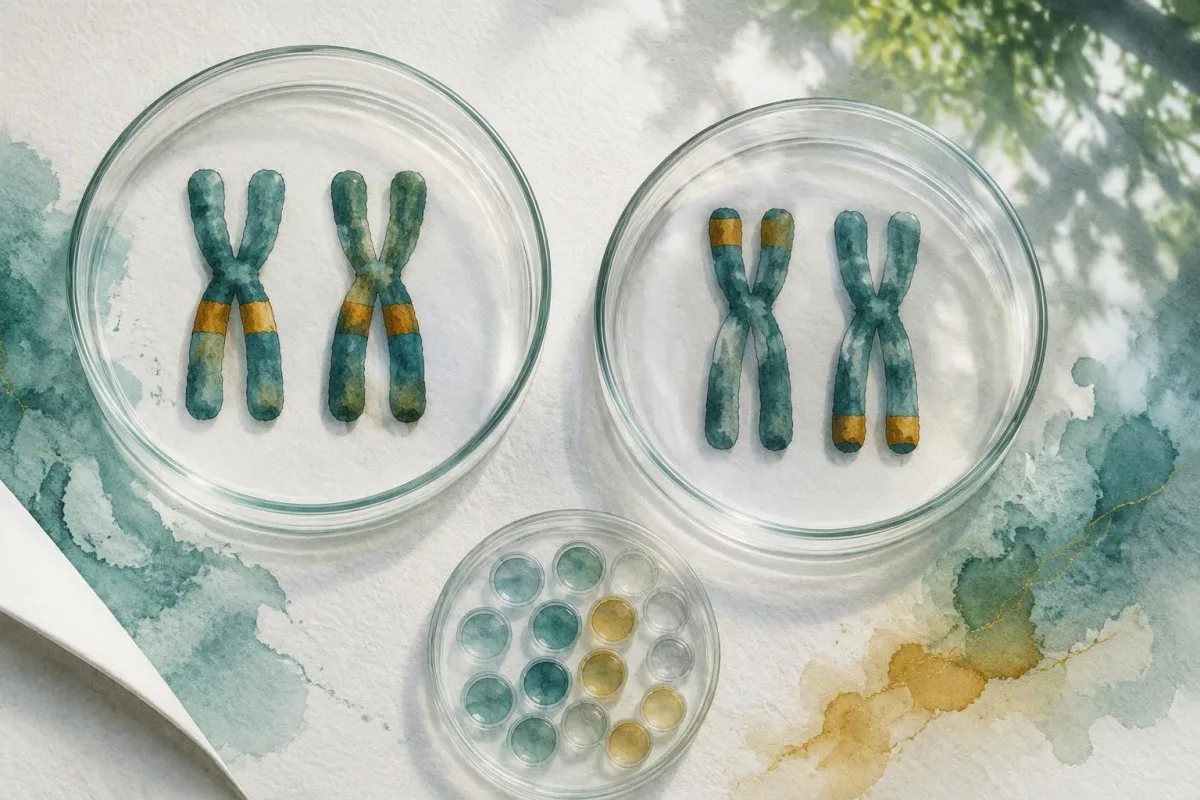
A borderline result should trigger review of the specimen, method, laboratory interval, and relevant medication or pregnancy history. Repeating an assay on a suitable specimen may clarify analytical variation, but 2 similar borderline measurements are not automatically equivalent to identifying a disease-causing HEXA variant.
Laboratories may use population frequency, segregation, functional evidence, and previously reported affected individuals to classify a variant. A low enzyme measurement can contribute evidence, but 1 screening assay affected by pseudodeficiency or substrate limitations is not necessarily a validated variant-specific functional study.
If 2 variants are reported, family testing may help establish phase or segregation when the genetics team judges that information useful. A pathogenic variant plus a VUS is not the same as two confirmed pathogenic variants in trans; neither disease certainty nor a precise severity prediction follows from that combination alone.
Variant interpretation can change as evidence accumulates, so ask who can request reanalysis and whether the laboratory has a recontact policy. Our discussion of uncertain hereditary test results explains this distinction; keep the original report and its date rather than relying on a 1-line summary copied into another record.
When should a reproductive partner be screened?
A reproductive partner should be offered HEXA carrier screening when the other partner has a confirmed disease-causing HEXA variant. The 2021 ACMG practice resource supports ancestry-neutral carrier-screening offers and recommends sufficiently broad analysis of the relevant gene in the partner, rather than checking only the first partner's variant.

Two partners can carry different pathogenic variants in the same gene and still have an affected child. Testing only for partner A's exact variant could miss partner B's different HEXA variant; ask about sequencing, deletion/duplication detection, and any enzyme testing needed to resolve the particular findings.
Pregnancy can make sequential testing too slow, so simultaneous screening of both partners may be reasonable when time-sensitive decisions are possible. Gregg et al., 2021, recommend discussing concurrent testing in pregnancy; 1 unresolved carrier result should prompt timely coordination rather than waiting for an arbitrary repeat-testing interval.
Ancestry can inform a carefully documented prior probability or reveal the limits of an older targeted panel, but it should not be the sole reason to offer or withhold testing. SMA residual carrier risk demonstrates why a reassuring result needs assay-specific interpretation, even when a report lists 2 gene copies.
កាន់តេស្ទី គឺជា សេវាកម្មបកស្រាយការធ្វើតេស្តរបស់ AI lab that can help organize 2 partners' reported findings into questions for a genetics appointment, without replacing that appointment. A pseudodeficiency-only result is not automatically a confirmed carrier finding; FMR1 screening interpretation also shows why different carrier conditions cannot share one generic risk calculator.
What is the reproductive risk when both partners carry HEXA?
When both reproductive partners carry disease-causing HEXA variants, each pregnancy has a 25% chance of an affected child, a 50% chance of a carrier child, and a 25% chance of a child who inherits neither familial variant. These probabilities apply independently to each pregnancy.

The 25% affected probability does not require both partners to carry the same variant. A child can inherit one pathogenic HEXA variant from each parent and be compound heterozygous; that is why partner testing should examine the gene adequately rather than search only for an identical family mutation.
A previous unaffected pregnancy does not reduce the next pregnancy's Mendelian risk to below 25%. Outcomes are independent, like separate draws from the same probability distribution; families should not be told that having one unaffected child means an affected pregnancy is now more or less likely.
The probability of inheriting 2 disease-causing variants and the likely clinical severity are separate questions. Some combinations are associated with later-onset disease or residual activity, but specialist interpretation is needed; a 25% genotype risk should not be presented as a precise prediction of onset age or neurological course.
If only 1 partner is a confirmed carrier, the affected-pregnancy probability is one quarter of the other partner's carrier probability, assuming the relevant variants cause recessive HEXA disease. Family inheritance analysis explains why identifying the gene and inheritance pattern must come before multiplying probabilities.
How much risk remains after a negative partner test?
A negative partner screen reduces residual carrier risk but does not make it 0. The remaining probability depends on the partner's prior carrier probability, the test's detection rate, and its coverage and classification limits; a generic negative label cannot supply those missing inputs.

Here is an explicitly hypothetical calculation: assume a prior carrier probability of 1 in 100 and a test detection rate of 95%, with essentially complete specificity. Bayes' rule gives a residual carrier probability of 0.01 × 0.05 divided by 1 − 0.01 × 0.95, approximately 1 in 1,981.
If the other partner is a confirmed HEXA carrier, that hypothetical residual probability gives an affected-pregnancy probability of approximately 1 in 7,924. The convenient approximation is about 1 in 8,000; neither figure is a population estimate or a result that can be assigned without validating the assumed 1% prior and 95% detection rate.
Two negative methods should not have their false-negative probabilities multiplied unless independence and combined performance are justified. Enzyme and DNA testing can share blind spots or classification problems; a claimed detection rate near 100% is especially sensitive to whether rare variants and specimen limitations were included.
Kantesti's explanations keep a quoted detection percentage separate from an individual's reproductive probability. When prior risk is uncertain, the genetics team may describe a range or say that a precise estimate is unavailable; negative familial genetic findings similarly need to distinguish a known-family-variant test from a broader screen.
What can genetic counseling and reproductive testing clarify?
ការប្រឹក្សាផ្នែកពន្ធុវិទ្យា can confirm which variants create reproductive risk, explain residual uncertainty, and discuss options without directing a family's decision. When familial HEXA variants are established, targeted prenatal diagnosis or IVF with preimplantation genetic testing for monogenic conditions may clarify whether 2 disease-causing variants were inherited.

Chorionic villus sampling is generally performed around 10–13 weeks of pregnancy, while amniocentesis is generally performed from 15 weeks onward. The specialist team should confirm local timing, procedural risks, and which molecular or enzyme analyses are validated for the obtained specimen before any procedure is scheduled.
Routine ultrasound and standard cell-free DNA aneuploidy screening do not exclude Tay-Sachs disease. A reassuring scan or common screening result is not evidence that a fetus avoided the 2 familial HEXA variants; ask specifically whether the offered test is diagnostic for the family's condition.
PGT-M requires a family-specific laboratory approach and IVF; it is not the same as routine embryo chromosome screening. Families should discuss test development, inconclusive results, and whether prenatal confirmation is recommended because 1 embryo test cannot eliminate every technical source of error.
Counseling can also discuss donor gametes, unassisted conception with or without prenatal testing, adoption, or choosing not to pursue pregnancy. Our discussion of genetic testing decisions addresses informed choice, although Huntington disease has a different inheritance pattern; no option is obligatory because a couple receives a 25% risk estimate.
What should symptomatic people or relatives do next?
Progressive neurological symptoms require a diagnostic assessment, not reinterpretation of a single carrier screen as proof of Tay-Sachs disease. Infantile Tay-Sachs commonly becomes apparent around 3–6 months, but juvenile and late-onset forms exist; 1 pathogenic HEXA variant alone does not explain a recessive disease diagnosis.

Loss of acquired skills, progressive weakness, or new movement difficulties should prompt clinical review, especially when there is a relevant family history. Diagnostic testing may combine enzyme studies and molecular analysis of both HEXA copies; acute breathing difficulty, prolonged seizures, or rapidly worsening function require urgent care regardless of the suspected genetic cause.
Related GM2 disorders can involve HEXB or GM2A rather than HEXA. Sandhoff disease may reduce both Hex A and Hex B activity, while GM2 activator deficiency can occur despite apparently preserved activities of these 2 enzymes; the full biochemical pattern helps determine which genes and methods need evaluation.
Adult neurological symptoms have many possible causes, and an incidental carrier result can distract from the actual diagnosis. Inherited ataxia assessment illustrates why neurological examination and disease-specific testing matter; neither a normal screening percentage nor 1 unrelated genetic finding should close the workup.
Relatives can benefit from targeted testing for an established familial pathogenic variant, with broader testing when their own reproductive situation requires it. For a child of 2 carriers whose affected genotype has been excluded, the remaining carrier probability is 2 in 3; absence of symptoms alone may not justify that calculation when late-onset disease is possible, particularly under ដែនកំណត់នៃការបកស្រាយចំពោះកុមារ.
What belongs in your follow-up and research notes?
A useful follow-up record contains the specimen, enzyme method and interval, exact HEXA variants, test coverage, and the laboratory's final interpretation. Keep both reports when 2 methods disagree; the clinical action should follow the resolved interpretation, not whichever result appeared first or sounded more reassuring.

Bring 5 practical items to the appointment: the complete enzyme report, complete DNA report, relevant family reports, pregnancy or contraceptive information, and the partner's testing status. Our វិធីសាស្ត្រគ្លីនិកស្តង់ដារ concern interpretation quality; they do not establish that an AI system can validate a HEXA variant, resolve pseudodeficiency, or replace an accredited genetics laboratory.
កាន់តេស្ទី គឺជា ឧបករណ៍វិភាគតេស្តឈាមដោយ AI that can help readers understand laboratory terminology while preserving the distinction between screening and diagnosis. Our មគ្គុទេសក៍បច្ចេកវិទ្យា AI describes the interpretation workflow, but a report containing 1 VUS or conflicting enzyme findings still needs qualified laboratory or genetics review before reproductive decisions.
Genetic results reveal information about relatives as well as the tested person, so obtain consent before sharing a partner's or family member's report. Kantesti's genetic report privacy information should be reviewed before submitting files; remove unnecessary identifiers, while preserving 2 clinically useful details—the laboratory method and variant reference transcript.
The Tay-Sachs recommendations discussed here are supported by the ACOG guidance, ACMG practice resource, and Cecchi et al. study listed below. The first of our 2 separately listed Zenodo resources accompanies the មគ្គុទ្ទេសក៍បកស្រាយប្រូតេអ៊ីនក្នុងឈាម; it is general laboratory education, not evidence validating HEXA carrier detection.
The second Zenodo resource accompanies our មគ្គុទេសក៍ complement និង ANA. Those 2 publications address different laboratory topics and should not be cited as Tay-Sachs screening studies; for unresolved HEXA findings, request a written explanation from the testing laboratory and a genetic counseling referral.
សំណួរដែលគេច្រើនសួរ
តើការជាអ្នកផ្ទុកហ្សែនជំងឺ Tay-Sachs មានន័យថាខ្ញុំកើតជំងឺនេះមែនទេ?
ការជាអ្នកផ្ទុកហ្សែន Tay-Sachs ដែលបានបញ្ជាក់ ជាទូទៅមានន័យថា មានបម្រែបម្រួល HEXA មួយ ដែលបង្កជំងឺ ឬទំនងជាបង្កជំងឺ មិនមែនមានជំងឺ Tay-Sachs ទេ។ ជំងឺនេះជាទូទៅតម្រូវឱ្យមានបម្រែបម្រួលបង្កជំងឺនៅក្នុងច្បាប់ចម្លង HEXA ទាំងពីរ ដោយបកស្រាយរួមជាមួយលទ្ធផលអង់ស៊ីម និងរោគសញ្ញាគ្លីនិក។ អ្នកផ្ទុកហ្សែនមិនកើតជំងឺ Tay-Sachs ដោយសារតែបម្រែបម្រួលតែមួយនោះទេ។ រោគសញ្ញាប្រព័ន្ធប្រសាទនៅតែគួរត្រូវបានវាយតម្លៃផ្នែកវេជ្ជសាស្ត្រដោយឡែក មិនមែនសន្មតដោយស្វ័យប្រវត្តិថាបណ្តាលមកពីស្ថានភាពជាអ្នកផ្ទុកហ្សែននោះទេ។
ហេតុអ្វីបានជាសកម្មភាពអង់ស៊ីម hexosaminidase A របស់ខ្ញុំទាប ប៉ុន្តែការធ្វើតេស្ត DNA របស់ខ្ញុំអវិជ្ជមាន?
Low hexosaminidase A activity with a negative DNA screen can result from pseudodeficiency, specimen-related effects, a borderline assay result, or a disease-causing variant outside the DNA test's coverage. Two recognized HEXA pseudodeficiency variants are p.Arg247Trp and p.Arg249Trp. A negative targeted panel is not equivalent to negative comprehensive sequencing with appropriate structural-variant assessment. Ask the laboratory to reconcile the exact enzyme method, specimen, and molecular coverage before treating the result as confirmed carrier status.
តើការខ្វះសកម្មភាព HEXA ដោយសារប៉ូលីម័រហ្វីសខុសមុខងារ បង្កើនហានិភ័យនៃជំងឺ Tay-Sachs ដែរឬទេ?
An established HEXA pseudodeficiency variant alone is not a disease-causing Tay-Sachs carrier allele. Pseudodeficiency reduces activity against certain laboratory substrates without the corresponding disease-causing impairment of natural GM2 processing. Finding 1 pseudodeficiency variant does not exclude a separate pathogenic variant elsewhere in HEXA. Reproductive-risk interpretation should therefore use all findings and the molecular test's coverage, not the low enzyme value alone.
តើការធ្វើតេស្តអង់ស៊ីម Tay-Sachs ធម្មតាអាចខកខានរកឃើញអ្នកផ្ទុកហ្សែនបានទេ?
A normal conventional Tay-Sachs enzyme test can miss some disease-causing B1 variants because the assay substrate may still be processed. The p.Arg178His variant, commonly described as c.533G>A, is 1 established example. Specialized substrate testing or appropriately interpreted HEXA genetic testing may resolve the discrepancy. A normal enzyme result should not automatically override a pathogenic DNA finding without review of the assay's limitations.
តើដៃគូរបស់ខ្ញុំគួរត្រូវបានធ្វើតេស្តដែរឬទេ ប្រសិនបើខ្ញុំជាអ្នកផ្ទុកហ្សែនជំងឺ Tay-Sachs?
A reproductive partner should be offered HEXA carrier screening when the other partner has a confirmed disease-causing HEXA variant. The partner's test should assess the gene adequately rather than check only 1 exact variant, because partners can carry different pathogenic changes. If both partners are carriers, each pregnancy has a 25% probability of an affected child. Screening should not be offered or withheld solely on presumed ancestry, and genetic counseling helps explain residual risk after a negative result.
Which Tay-Sachs carrier test is used during pregnancy?
Leukocyte enzyme testing is preferred over serum enzyme testing during pregnancy and oral contraceptive use because serum results can be misleading in those settings. ACOG Committee Opinion No. 691, published in 2017, identifies this specimen distinction. HEXA molecular testing may also be appropriate, depending on the screening approach and any conflicting findings. The laboratory should confirm collection and shipping instructions before the specimen is obtained.
What does a HEXA variant of uncertain significance mean for pregnancy?
A HEXA variant of uncertain significance means there is insufficient evidence to classify that finding as disease-causing or benign. One VUS is not a confirmed Tay-Sachs carrier result and should not automatically be assigned the same reproductive risk as a pathogenic variant. Genetics review may consider enzyme methods, family testing, phase, and future reclassification. The familiar 25% affected-pregnancy probability applies when both partners have established disease-causing HEXA carrier findings, not simply when both reports contain uncertain variants.
ទទួលបានការពន្យល់អំពីលទ្ធផលពិនិត្យឈាមរបស់អ្នក
បង្ហោះរបាយការណ៍មន្ទីរពិសោធន៍របស់អ្នក ហើយ AI របស់ Kantesti នឹងពន្យល់ជីវសញ្ញានីមួយៗជាភាសាសាមញ្ញ ក្នុងរយៈពេលត្រឹមតែប៉ុន្មានវិនាទី។ មនុស្សជាង 2 លាននាក់នៅទូទាំងពិភពលោកបានប្រើប្រាស់។.
ឯកសារយោង
- Klein, T., Mitchell, S., & Weber, H. (2026)។. មគ្គុទ្ទេសក៍អំពីប្រូតេអ៊ីនក្នុងសេរ៉ូម៖ ការធ្វើតេស្តឈាម Globulins, Albumin និងសមាមាត្រ A/G។. ការស្រាវជ្រាវវេជ្ជសាស្ត្រ AI របស់ Kantesti។. ក្រសួងអប់រំយុវជន និងកីឡា
- Klein, T., Mitchell, S., & Weber, H. (2026)។. ការណែនាំអំពីតេស្តឈាម C3 C4 Complement និងចំណងជើង ANA។. ការស្រាវជ្រាវវេជ្ជសាស្ត្រ AI របស់ Kantesti។. ក្រសួងអប់រំយុវជន និងកីឡា
- មហាវិទ្យាល័យគ្រូពេទ្យសម្ភព និងរោគស្ត្រីអាមេរិក (2017)។. មតិយោបល់របស់គណៈកម្មាធិការ លេខ 691៖ ការពិនិត្យរកភាពជាអ្នកផ្ទុកជំងឺហ្សែន។. ផ្នែកសម្ភព និងរោគស្ត្រី។. ក្រសួងអប់រំយុវជន និងកីឡា PubMed
- Gregg AR និងអ្នកដទៃ (2021)។. ការពិនិត្យរកជំងឺស្វ័យភាពរេសេស៊ីវ និងជំងឺដែលភ្ជាប់នឹងក្រូម៉ូសូម X អំឡុងពេលមានផ្ទៃពោះ និងមុនពេលមានផ្ទៃពោះ៖ ឯកសារណែនាំសម្រាប់ការអនុវត្តរបស់មហាវិទ្យាល័យវេជ្ជសាស្ត្រហ្សែន និងហ្សែនណូមិចអាមេរិក (ACMG)។. ទស្សនាវដ្តី Genetics in Medicine។. ក្រសួងអប់រំយុវជន និងកីឡា
- Cecchi E et al. (2019). Screening for Tay-Sachs disease carriers by full-exon sequencing with novel variant interpretation outperforms enzyme testing in a pan-ethnic cohort. Molecular Genetics & Genomic Medicine. ក្រសួងអប់រំយុវជន និងកីឡា
- 2M+ការធ្វើតេស្តដែលបានវិភាគ
- 127+ប្រទេស
- 100+ភាសា
អំពីក្រុមវេជ្ជសាស្ត្រ


សញ្ញាទុកចិត្ត E-E-A-T
បទពិសោធន៍
ការពិនិត្យព្យាបាលដោយវេជ្ជបណ្ឌិតលើដំណើរការការបកស្រាយលទ្ធផលមន្ទីរពិសោធន៍។.
ជំនាញ
ផ្តោតលើវិទ្យាសាស្ត្រមន្ទីរពិសោធន៍ថា សញ្ញាសម្គាល់ (biomarkers) មានឥរិយាបថយ៉ាងដូចម្តេចក្នុងបរិបទព្យាបាល។.
ភាពមានសិទ្ធិអំណាច
បានពិនិត្យផ្នែកវេជ្ជសាស្ត្រដោយវេជ្ជបណ្ឌិត Thomas Klein ដោយមានការចូលរួមចំណែកពីវេជ្ជបណ្ឌិត Sarah Mitchell និងសាស្ត្រាចារ្យបណ្ឌិត Hans Weber។.
ភាពគួរឱ្យទុកចិត្ត
ការបកស្រាយដោយផ្អែកលើភស្តុតាង ជាមួយផ្លូវបន្តតាមដានច្បាស់លាស់ ដើម្បីកាត់បន្ថយការភ័យខ្លាច។.






សេចក្តីប្រកាសបដិសេធការទទួលខុសត្រូវផ្នែកវេជ្ជសាស្ត្រ
អត្ថបទនេះមានគោលបំណងសម្រាប់ការអប់រំប៉ុណ្ណោះ ហើយមិនមែនជាការផ្តល់ដំបូន្មានផ្នែកវេជ្ជសាស្ត្រទេ។ សូមពិគ្រោះជាមួយអ្នកផ្តល់សេវាសុខភាពដែលមានសមត្ថភាពជានិច្ច សម្រាប់ការសម្រេចចិត្តអំពីការធ្វើរោគវិនិច្ឆ័យ និងការព្យាបាល។.
បានបោះពុម្ភ · ទាក់ទងក្រុមនិពន្ធ
បោះពុម្ពផ្សាយដោយ Kantesti Ltd ដែលបានចុះបញ្ជីនៅប្រទេសអង់គ្លេស និងវែលស៍ លេខក្រុមហ៊ុន. 17090423, ទីក្រុងឡុងដ៍ ចក្រភពអង់គ្លេស។.
