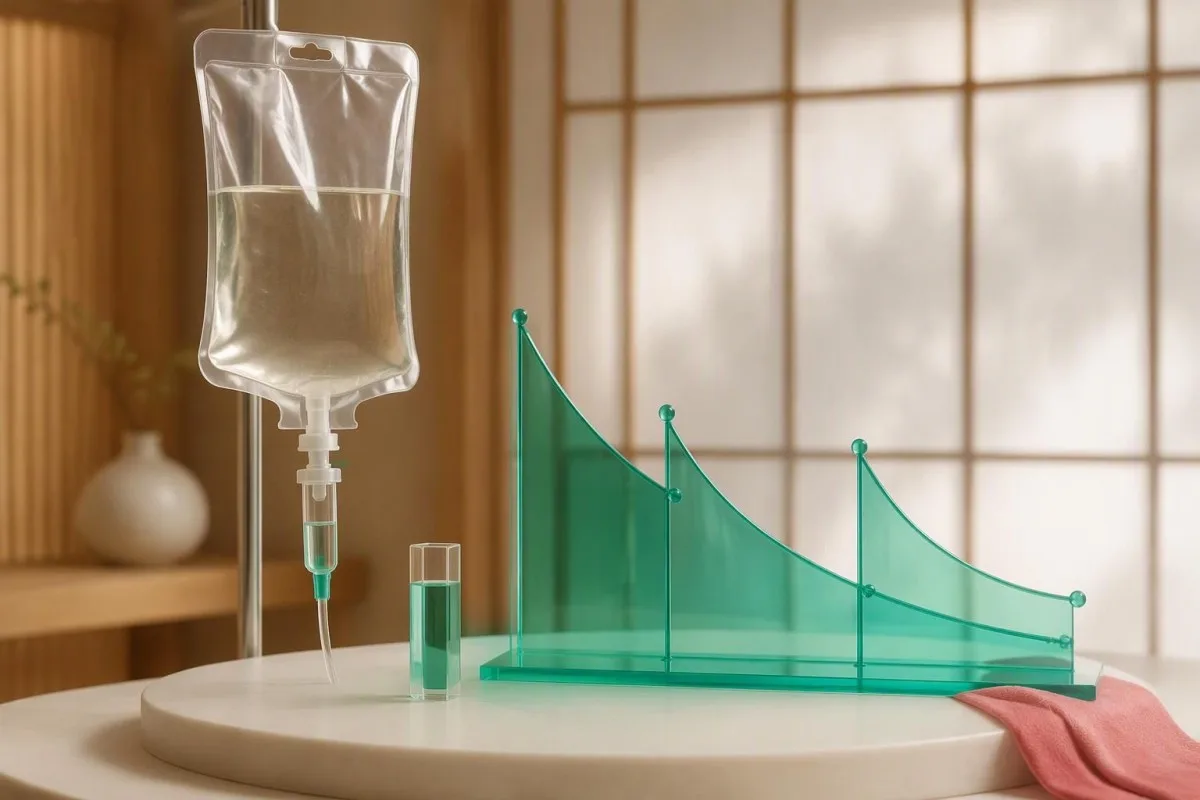
AUC vankomisin memperkirakan paparan total obat selama 24 jam, bukan jumlah dalam satu sampel. Target umum 400–600 mg·h/L terutama berlaku untuk infeksi MRSA serius dengan asumsi tertentu.


- AUC24 memperkirakan paparan vankomisin selama 24 jam dan dilaporkan dalam mg·h/L.
- 400–600 mg·h/L adalah target AUC24 yang umum direkomendasikan untuk infeksi MRSA serius ketika MIC diasumsikan sebesar 1 mg/L.
- AUC/MIC adalah rasio paparan terhadap kepekaan; AUC24 dan AUC24/MIC hanya bernilai numerik sama ketika MIC sama dengan 1 mg/L.
- Konsentrasi tunggal yang dilaporkan dalam mg/L bukanlah AUC dan tidak dapat dibandingkan langsung dengan target 400–600.
- Waktu pengambilan sampel harus mencakup waktu infus dan pengambilan sampel yang sebenarnya; estimasi konvensional dengan dua kadar biasanya menggunakan satu sampel 1–2 jam setelah infus berakhir dan satu lagi menjelang dosis berikutnya.
- Perubahan fungsi ginjal dapat membuat perkiraan pajanan kemarin tidak lagi berlaku, meskipun dosis yang diresepkan tidak berubah.
- Di atas 600 mg·h/L umumnya memicu peninjauan keselamatan, bukan membuktikan cedera ginjal; di bawah 400 mg·h/L memerlukan penilaian terhadap infeksi, waktu pengambilan sampel, dan keandalan model.
- Penyesuaian dosis merupakan tanggung jawab tim pemberi resep atau apoteker antimikroba, bukan kalkulator daring atau penanda laboratorium yang berdiri sendiri.
Apa yang sebenarnya diukur oleh pemantauan AUC vankomisin?
Pemantauan AUC vankomisin memperkirakan total pajanan vankomisin selama 24 jam, biasanya ditulis AUC24 dan diukur dalam mg·h/L. Untuk infeksi MRSA serius, klinisi umumnya menargetkan 400–600 mg·h/L saat MIC diasumsikan 1 mg/L; sebelum menyesuaikan pengobatan, konsentrasi tunggal, waktu pengambilan sampel, dan perubahan fungsi ginjal harus dipertimbangkan.
Luas di bawah kurva konsentrasi–waktu menggabungkan seberapa tinggi konsentrasi obat meningkat dan berapa lama konsentrasi tersebut tetap tinggi. AUC24 sebesar 480 mg·h/L secara matematis setara dengan konsentrasi rata-rata 20 mg/L selama hari tersebut, tetapi bukan berarti setiap sampel harus menunjukkan 20 mg/L.
Saya Thomas Klein, MD; pertanyaan pertama yang saya ajukan saat menafsirkan laporan vankomisin adalah apakah “480” berarti AUC24 atau konsentrasi. Konsentrasi 480 mg/L merupakan temuan yang sama sekali berbeda dan berpotensi berbahaya, sehingga satuan dan redaksi asli laboratorium harus selalu dicantumkan bersama setiap angka.
Kantesti adalah seorang Analisa tes darah AI yang dapat membantu menjelaskan perbedaan antara perkiraan AUC24 dan konsentrasi yang diukur pada laporan laboratorium. Peran kami bersifat edukatif, bukan meresepkan: organisasi di balik panduan ini tidak dapat menggantikan perangkat lunak penentuan dosis tim yang merawat, catatan pemberian obat, atau penilaian terhadap kondisi pasien saat ini.
Kapan target AUC vankomisin 400–600 berlaku?
Itu target AUC vankomisin sebesar 400–600 mg·h/L terutama berlaku untuk infeksi MRSA invasif yang serius, dengan asumsi MIC mikrodilusi kaldu sebesar 1 mg/L. Ini bukan rentang rujukan universal untuk setiap orang yang menerima vankomisin, setiap organisme, atau setiap rute pemberian.
Rybak et al. (2020), dalam pedoman konsensus bersama ASHP/IDSA/PIDS/SIDP, merekomendasikan pencapaian pajanan ini sejak dini, sebaiknya dalam 24–48 jam, untuk infeksi MRSA serius. Sebagian besar bukti efikasi yang mendukungnya berasal dari penyakit invasif, terutama infeksi aliran darah yang rumit; para penulis mengingatkan agar temuan tersebut tidak begitu saja diterapkan pada infeksi ringan atau spesies bakteri lain.
Penyebutnya penting: AUC24/MIC mengaitkan pajanan dengan konsentrasi hambat minimum organisme. AUC24 sebesar 500 dengan MIC 1 menghasilkan rasio 500, sedangkan pajanan yang sama dengan MIC 2 menghasilkan rasio 250; klinisi tidak seharusnya secara otomatis mengejar AUC24 sebesar 800 atau lebih untuk mengimbanginya.
Metode uji kerentanan dapat berbeda satu pengenceran dua kali lipat, sehingga MIC 1 dibandingkan 2 mg/L tidak selalu merupakan perbedaan biologis yang benar-benar presisi. Tim yang merawat mempertimbangkan metode pengujian, respons klinis, dan apakah antibiotik lain lebih sesuai; penjelasan kami tentang hasil kultur dan kontaminasi juga menjelaskan mengapa identifikasi patogen yang sebenarnya harus dilakukan sebelum menafsirkan target pajanan.
Mengapa AUC berbeda dari kadar palung vankomisin?
Kadar lembah vankomisin adalah satu konsentrasi yang diukur mendekati dosis berikutnya; AUC24 memperkirakan pajanan selama satu hari penuh. Karena itu, kadar lembah 15 mg/L tidak dapat disebut sebagai AUC 15, dan kadar lembah saja tidak memastikan apakah pajanan berada di antara 400 dan 600 mg·h/L.
Historical practice often targeted troughs of 15–20 mg/L for serious MRSA infections, using them as a surrogate for adequate exposure. The 2020 consensus guideline no longer recommends trough-only targeting of that interval for serious MRSA disease because the same trough can correspond to different AUC values and unnecessarily high exposure in some patients.
Consider an illustrative pair of patients with troughs near 12 mg/L: one receives frequent smaller infusions, while the other receives larger doses farther apart. Their peaks, clearance, and curve shapes can differ enough that their AUC24 estimates fall on opposite sides of the therapeutic window; the timing of digoxin samples offers another example of why a drug number needs a dosing timeline.
A trough below 15 mg/L is not automatically treatment failure when a reliable AUC24 estimate is within target and the infection is responding. Conversely, an apparently acceptable trough does not guarantee safety; unlike the free-versus-total phenytoin distinction, the central distinction here is a snapshot versus exposure accumulated over time.
Bagaimana perhitungan AUC vankomisin dilakukan?
Vancomycin AUC calculation usually uses Bayesian pharmacokinetic software or equations based on two appropriately timed concentrations. Both approaches combine measured levels with dosing information; neither calculates trustworthy 24-hour exposure from the laboratory number alone, and their assumptions should be visible to the clinician interpreting the result.
Bayesian software begins with a population pharmacokinetic model and updates its predictions using the patient’s concentrations and relevant characteristics. The guideline supports one or two concentrations for this approach, with two preferred for many circumstances; it can estimate exposure before steady state, helping teams assess the recommended 24–48-hour window rather than waiting several days.
Conventional first-order equations generally use two concentrations obtained near steady state: a post-distribution sample and a sample near the end of the dosing interval. Neely et al. (2018) evaluated Bayesian AUC-guided dosing prospectively; that evidence supports a clinical monitoring method, not the claim that any consumer calculator can accurately reconstruct exposure from one unverified result.
At steady state, a useful mathematical relationship is AUC24 = total daily dose ÷ clearance: 2,000 mg over 24 hours divided by clearance of 4 L/hour yields 500 mg·h/L. This is an explanatory example, not a dose recommendation; at Kantesti, our discussion of methodology and clinical limits should not be mistaken for validation of a patient-specific vancomycin dosing engine.
Waktu pengambilan sampel mana yang membuat estimasi AUC andal?
Reliable AUC estimation requires actual infusion start, infusion end, and sample collection times. For conventional two-level monitoring, a post-distribution concentration is commonly collected 1–2 hours after infusion ends and a trough near the next dose; local protocols and the selected Bayesian model may specify different acceptable windows.
A sample collected at 10:00 means something different if an infusion ended at 08:00 rather than 09:55. Immediately after infusion, vancomycin is still distributing between compartments, so treating that concentration as an equilibrated post-distribution level can distort an equation-based estimate; a Bayesian system must also receive the true time, not the intended time.
The actual administration record can reveal a delayed dose, an interrupted infusion, or a dose given over 2 hours instead of 1 hour. Those details reshape the predicted concentration curve even when the prescription still says the same number of milligrams; similar timestamp discipline applies to tacrolimus trough interpretation, although its therapeutic targets are entirely different.
Sampling through a line used to administer vancomycin can produce a falsely high concentration if residual drug contaminates the specimen. Staff should follow their collection protocol, and an unexpectedly extreme level may need confirmation from an appropriate site; patients should report what happened but should not disconnect lines, request a particular sampling maneuver, or alter the next infusion themselves.
Seberapa besar keyakinan yang sebaiknya Anda berikan pada hasil AUC?
An AUC24 estimate is only as credible as its input data and the suitability of its pharmacokinetic model. A reported value of 503 mg·h/L is not necessarily more certain than 500 mg·h/L, and small differences around 400 or 600 should not be interpreted without checking timing, dose history, and clinical stability.
One-level Bayesian estimation can work well when the model fits the patient and kidney function is stable, but uncertainty increases when those conditions fail. A critically ill patient with changing fluid balance may need 2 concentrations or repeat sampling even when a stable outpatient would not; software output is an estimate of physiology, not a direct measurement of the shaded area.
Ask which exposure window the report describes: the first 24 hours, the previous day, or predicted steady-state exposure on the current regimen. An AUC24 of 470 after a loading dose and a predicted maintenance AUC24 of 650 can both be correctly calculated because they answer different questions; neither should be copied into a handover without its time window.
Transcription errors deserve the same attention as pharmacokinetic uncertainty: 1,000 mg versus 100 mg, mg/L versus another unit, and collection date versus report date are not interchangeable. Our Daftar periksa kesalahan transkripsi PDF is relevant here because an uploaded laboratory page may omit administration details that are available only in the hospital medication record.
Mengapa perubahan fungsi ginjal mengubah keputusan dosis?
Vancomycin is cleared predominantly through the kidneys, so declining clearance can raise AUC24 without any dose increase. Recovering kidney function can do the reverse; a creatinine rise from 0.8 to 1.1 mg/dL within 48 hours may be more relevant to today’s dosing decision than yesterday’s apparently acceptable AUC.
Serum creatinine is a delayed marker when kidney function changes abruptly, and routine creatinine-based eGFR equations assume a relatively steady state. A reported eGFR of 60 mL/min/1.73 m² can therefore be misleading during evolving acute kidney injury; clinicians examine the trajectory, urine output, hemodynamics, and medication record rather than treating that estimate as a fixed drug-clearance measurement.
A creatinine increase of at least 0.3 mg/dL within 48 hours is one standard acute kidney injury criterion, even when the final value remains inside a laboratory reference interval. The different reasons BUN and creatinine rise help explain why dehydration, catabolic illness, and reduced filtration need to be separated rather than merged into one generic “kidney number.”
Kantesti adalah seorang platform interpretasi tes darah AI that can place serial creatinine results in context, but laboratory trend interpretation is not real-time estimation of vancomycin clearance. Our interpretasi rasio BUN terhadap kreatinin kami provides background; an AUC24 from before a major renal change still needs reassessment by the team managing the antibiotic.
Apa arti hasil AUC rendah, sesuai target, dan tinggi?
For serious MRSA infection with an assumed MIC of 1 mg/L, AUC24 below 400 mg·h/L may indicate insufficient exposure, 400–600 is the usual target, and above 600 warrants safety review. These categories are treatment benchmarks rather than universal normal ranges, and none independently determines whether to increase, continue, or hold a dose.
A value of 380 mg·h/L is not interpreted the same way in a patient whose infection is rapidly improving as in someone with persistent MRSA-positive cultures. The clinician first checks the estimate and intended treatment target, then considers whether inadequate exposure, an uncontrolled source, or an inappropriate antibiotic best explains the clinical picture.
An AUC24 of 620 mg·h/L does not prove toxicity, and a value of 590 does not eliminate kidney risk. The distinction between those estimates may be smaller than the uncertainty created by timing or changing clearance; our discussion of penanda lab di luar batas explains why a flag is a prompt for interpretation rather than a diagnosis.
An unexpected AUC24 of 800 mg·h/L generally deserves prompt prescribing-team review, especially if creatinine is rising or urine output is falling. Patients should ask how quickly the result will be reviewed and which exposure window it represents, but should not assume that an automated red flag means the next dose must be skipped.
Apakah pemantauan yang dipandu AUC mengurangi risiko cedera ginjal?
AUC-guided monitoring is intended to avoid unnecessary vancomycin exposure while maintaining antibacterial activity. Higher AUC values are associated with greater kidney injury risk, but 600 mg·h/L is a practical upper treatment boundary rather than a biological switch that separates completely safe from definitely harmful exposure.
Aljefri et al. (2019), in a Clinical Infectious Diseases meta-analysis, found an exposure–injury relationship around AUC values below versus above approximately 650 mg·h/L. The included studies used differing definitions and thresholds, so that number should not replace the guideline’s 400–600 target or be presented as an exact toxicity threshold for an individual patient.
Kidney injury can both increase vancomycin exposure and result from excessive exposure, creating a feedback loop rather than a simple one-direction association. A patient with shock, dehydration, or another nephrotoxic medicine can develop injury at an AUC24 of 500 mg·h/L; serial metabolic panel kidney clues help the team assess what else changed.
Concurrent medicines deserve review, including NSAIDs, aminoglycosides, and other treatments that may affect kidney function; patients should disclose nonprescription products rather than stopping prescribed medicines independently. A single reassuring creatinine value on day 2 does not certify that a longer course will remain safe, particularly if blood pressure, fluid balance, or the antimicrobial combination changes.
Bagaimana ukuran tubuh, usia, dan penyakit kritis mengubah interpretasi?
Obesity, childhood, frailty, and critical illness can change vancomycin distribution or clearance and weaken assumptions behind a standard AUC estimate. The 400–600 mg·h/L target may still be used in appropriate serious MRSA settings, but the population model, sampling strategy, and monitoring frequency require particular attention.
Body weight does not translate directly into clearance: 120 kg of body mass does not automatically imply twice the maintenance requirement of 60 kg. Loading-dose decisions address initial distribution, whereas maintenance decisions address ongoing elimination; obesity-specific models and early repeat measurements help clinicians avoid confusing these two pharmacokinetic problems.
A frail older adult can have a creatinine of 0.7 mg/dL despite reduced filtration because low muscle mass limits creatinine production. A young critically ill adult can instead clear vancomycin unusually quickly; our explanation of cystatin C beyond creatinine describes why additional filtration information may sometimes help, although it does not independently supply an AUC.
My rule when explaining these cases as Thomas Klein, MD, is to separate the target from confidence in the estimate: a familiar target does not guarantee a suitable model. For children, serious MRSA guidance includes AUC-based approaches, but age-dependent clearance and the limits of adult-derived evidence matter; pediatric AI interpretation safeguards reinforce why adult dose formulas should not be reused.
Apakah pendekatan yang sama berlaku untuk dialisis, infus kontinu, atau vankomisin oral?
Dialysis, continuous IV infusion, and oral vancomycin require different monitoring assumptions. Continuous infusion can simplify AUC24 estimation once concentrations stabilize, dialysis changes clearance over time, and oral vancomycin for C. difficile generally does not use the systemic 400–600 mg·h/L target because the intended treatment site is the intestine.
For continuous infusion at a stable concentration, AUC24 equals concentration multiplied by 24 hours: 20 mg/L gives 480 mg·h/L and 25 mg/L gives 600 mg·h/L. The 2020 consensus discusses continuous-infusion concentrations around 20–25 mg/L in relevant circumstances, but that shortcut is unreliable while concentrations or renal clearance are still changing.
Intermittent hemodialysis removes vancomycin differently depending on membrane, session length, dose timing, and residual kidney function; redistribution after dialysis also complicates an immediate post-session measurement. The guideline uses predialysis concentrations of approximately 15–20 mg/L as a practical approach expected to align with target exposure in many patients, rather than treating them as directly measured AUC values.
Oral vancomycin has limited systemic absorption under usual conditions, although appreciable absorption can occur with severe intestinal disease and impaired renal clearance. Routine systemic AUC monitoring is not standard for ordinary oral treatment; our guide to discordant C. difficile test results addresses a different question—whether the intestinal illness actually warrants treatment.
Seberapa sering AUC dan tes ginjal harus diulang?
Repeat monitoring depends on renal stability, treatment duration, and toxicity risk, not a fixed schedule for everyone. The 2020 consensus describes frequent or daily monitoring for unstable patients and approximately weekly monitoring for stable patients, with reassessment after meaningful dose, renal, or clinical changes.
Hospital discharge creates a vulnerable handover: the home infusion may begin at 09:00 rather than the hospital’s 06:00 schedule, or laboratory collection may occur after an unrecorded dose. Our explanation of laboratory changes after discharge helps distinguish physiological recovery from changes caused by medication timing and incomplete records.
A practical home-treatment plan should name who reviews each result, how the infusion times are communicated, and what happens if a sample is missed. Someone stable on day 7 may still need earlier-than-weekly reassessment after vomiting, reduced intake, fever recurrence, or a new kidney-affecting medicine; the existing schedule should never become a reason to ignore clinical deterioration.
Kantesti can help explain serial laboratory reports, but a 60-second interpretation is not a monitored antimicrobial service and should not be used to authorize the next infusion. Our panduan tren keamanan obat describes how tracking changes can support a conversation; the treating service must still review timestamps, exposure estimates, and decisions about treatment.
Apa yang harus dilakukan sebelum dosis vankomisin diubah?
A clinician-directed dose review should verify the indication, exposure window, sample timing, renal trend, and treatment response before changing vancomycin. An AUC24 of 450 mg·h/L does not justify continuing ineffective treatment without investigation, while an unexpected estimate of 650 does not automatically tell a patient to withhold a dose.
Persistent MRSA-positive cultures despite target exposure raise questions about source control, retained devices, deeper infection, susceptibility, or the need for a different antibiotic. Increasing an AUC24 from 500 toward 600 mg·h/L cannot substitute for draining a clinically indicated collection or investigating a source that continues to release organisms; the laboratory result is only one part of the treatment assessment.
Reduced urine output, new swelling, or an unexpected creatinine rise warrants prompt contact with the treating service, even if the previous AUC24 was within range. Severe breathlessness, confusion, fainting, or rapidly worsening illness requires emergency assessment; our guide to urgent kidney-function warning signs helps distinguish a routine follow-up question from a time-sensitive problem.
Bring 5 items to the discussion: the original concentration report, actual recent dose times, infusion duration, the AUC calculation summary, and serial kidney results. I would rather see a clearly documented estimate of 520 mg·h/L with its assumptions than a screenshot saying “therapeutic”; patients should ask for explicit instructions if the next dose is due before a concerning result has been reviewed.
Bagaimana penjelasan laboratorium dapat mendukung—bukan menggantikan—perawatan vankomisin?
Laboratory explanation tools can clarify units and trends, but they cannot independently authorize vancomycin dosing. Kantesti adalah seorang Alat analisis pemeriksaan darah berbasis AI that can explain why AUC24 of 500 mg·h/L differs from a concentration of 20 mg/L; our informasi privasi dan data also matters when sharing medication-linked reports.
A useful explanation should identify at least 3 limits: missing administration records, uncertainty about the calculated exposure window, and kidney function that may have changed since sampling. Our informasi penasihat medis describes the medical team; a public article or advisory listing does not mean that an individual patient’s AUC calculation has been reviewed or approved.
The related Figshare publication “B Negative Blood Type, LDH Blood Test & Reticulocyte Count Guide” belongs to broader laboratory education, not antibiotic pharmacokinetic evidence. The accompanying hematology interpretation background can support understanding of additional tests, but neither publication establishes the vancomycin 400–600 mg·h/L target or validates a dosing method.
The second listed Figshare publication, “Diarrhea After Fasting, Black Specks in Stool & GI Guide 2026,” addresses gastrointestinal interpretation rather than systemic vancomycin exposure. Our panduan interpretasi gejala pencernaan kami is related educational reading; it should not be used to diagnose C. difficile or decide whether oral or IV antibiotics are needed.
As of October 14, 2026, this article’s main dosing benchmark is attributed to the 2020 multidisciplinary consensus guideline, not to a newly claimed 2026 guideline. The 2 Figshare records below are supplied as supplementary publications with title-first citations because author and publication-date metadata were not provided; discovery links are searches, not verified mirrored publications.
Pertanyaan yang Sering Diajukan
Apa arti AUC vankomisin 400–600?
AUC vankomisin 400–600 biasanya berarti paparan 24 jam yang diperkirakan sebesar 400–600 mg·jam/L untuk infeksi MRSA serius, dengan asumsi MIC 1 mg/L. AUC menggabungkan konsentrasi obat dengan waktu, alih-alih menggambarkan satu sampel laboratorium. Target ini bukan rentang normal universal untuk setiap infeksi atau rute pemberian. Dokter yang menangani harus menafsirkannya bersama waktu pengambilan sampel, fungsi ginjal, dan respons pengobatan.
Apakah kadar lembah vankomisin sebesar 10–15 mg/L terlalu rendah?
Kadar palung vankomisin 10–15 mg/L tidak otomatis terlalu rendah jika estimasi AUC24 yang andal memenuhi target yang sesuai. Beberapa pasien mencapai AUC24 sebesar 400–600 mg·h/L tanpa kadar palung 15–20 mg/L. Kadar palung saja tidak dapat memastikan paparan total secara andal pada setiap pasien. Keputusan dosis harus mempertimbangkan indikasi klinis, metode pemantauan yang tervalidasi, dan fungsi ginjal saat ini.
Dapatkah AUC vankomisin dihitung dari satu kadar?
AUC vankomisin terkadang dapat diperkirakan dari satu konsentrasi menggunakan perangkat lunak farmakokinetik Bayesian yang sesuai dan riwayat pemberian dosis yang akurat. Pedoman konsensus 2020 mendukung penggunaan satu atau dua konsentrasi untuk estimasi Bayesian, dengan dua konsentrasi lebih diutamakan dalam banyak keadaan. Estimasi konvensional berbasis persamaan umumnya memerlukan dua konsentrasi yang diambil pada waktu yang tepat saat mendekati keadaan tunak. Satu angka laboratorium tanpa waktu pemberian dan pengambilan sampel bukanlah perhitungan AUC yang dapat dipercaya.
Apakah AUC vankomisin di atas 600 berarti terjadi kerusakan ginjal?
AUC24 vankomisin di atas 600 mg·h/L menunjukkan paparan melebihi sasaran umum untuk MRSA serius, tetapi tidak membuktikan adanya kerusakan ginjal. Paparan yang lebih tinggi dikaitkan dengan risiko cedera ginjal yang lebih besar, dan interpretasinya bergantung pada tren fungsi ginjal, obat-obatan lain, serta keakuratan estimasi. Peningkatan kreatinin setidaknya 0.3 mg/dL dalam 48 jam merupakan salah satu kriteria standar cedera ginjal akut. Segera hubungi tim yang menangani, alih-alih melewatkan atau mengubah dosis secara mandiri.
Kapan sampel vankomisin harus diambil untuk pemantauan AUC?
Pemantauan AUC vankomisin dua kadar konvensional umumnya menggunakan sampel pascadistribusi 1–2 jam setelah infus selesai dan sampel lembah menjelang dosis berikutnya. Protokol Bayesian dapat mengizinkan jendela pengambilan lain, bergantung pada model dan prosedur setempat. Waktu infus dan pengambilan sampel yang sebenarnya harus dicatat karena waktu yang dijadwalkan dapat berbeda dari waktu pelaksanaannya. Ikuti instruksi layanan yang merawat, alih-alih memilih sendiri waktu pengambilan sampel.
Apakah vankomisin oral perlu pemantauan AUC?
Pemantauan AUC rutin umumnya tidak diperlukan untuk vankomisin oral yang digunakan untuk mengobati C. difficile karena absorpsi sistemik biasanya terbatas. Target sistemik 400–600 mg·h/L bukan sasaran terapi yang lazim untuk antibiotik yang terutama bekerja di usus. Penyakit usus berat dan penurunan klirens ginjal terkadang dapat menyebabkan absorpsi sistemik yang cukup besar. Klinisi dapat meminta pemeriksaan kadar dalam keadaan berisiko tinggi tertentu alih-alih menerapkan pemantauan IV rutin pada setiap rangkaian pengobatan oral.
Dapatkan Analisis Tes Darah Berbasis AI Hari Ini
Bergabunglah dengan lebih dari 2 juta pengguna di seluruh dunia yang mempercayai Kantesti untuk analisis instan dan akurat terhadap tes lab. Unggah hasil tes darah Anda dan terima interpretasi komprehensif biomarker 15,000+ dalam hitungan detik.
📚 Publikasi Riset yang Dirujuk
Klein, T., Mitchell, S., & Weber, H. (2026). Panduan Golongan Darah B Negatif, Tes Darah LDH, dan Hitung Retikulosit. Kantesti Penelitian Medis AI.
Klein, T., Mitchell, S., & Weber, H. (2026). Diare Setelah Puasa, Bintik Hitam pada Tinja & Panduan GI 2026. Kantesti Penelitian Medis AI.
📖 Referensi Medis Eksternal
Rybak MJ et al. (2020). Therapeutic monitoring of vancomycin for serious methicillin-resistant Staphylococcus aureus infections: A revised consensus guideline and review by the American Society of Health-System Pharmacists, the Infectious Diseases Society of America, the Pediatric Infectious Diseases Society, and the Society of Infectious Diseases Pharmacists. American Journal of Health-System Pharmacy.
Neely MN et al. (2018). Prospective Trial on the Use of Trough Concentration versus Area under the Curve To Determine Therapeutic Vancomycin Dosing. Antimicrobial Agents and Chemotherapy.
Aljefri DM et al. (2019). Vancomycin Area Under the Curve and Acute Kidney Injury: A Meta-analysis. Clinical Infectious Diseases.
⚕️ Penafian Medis
Artikel ini hanya untuk tujuan edukasi dan tidak merupakan nasihat medis. Selalu konsultasikan dengan penyedia layanan kesehatan yang berkualifikasi untuk keputusan diagnosis dan perawatan.
Sinyal Kepercayaan E-E-A-T
Pengalaman
Tinjauan klinis yang dipimpin dokter terhadap alur kerja interpretasi hasil lab.
Keahlian
Fokus pada kedokteran laboratorium tentang bagaimana biomarker berperilaku dalam konteks klinis.
Kewenangan
Ditulis oleh Dr. Thomas Klein dengan peninjauan oleh Dr. Sarah Mitchell dan Prof. Dr. Hans Weber.
Kepercayaan
Interpretasi berbasis bukti dengan jalur tindak lanjut yang jelas untuk mengurangi kepanikan.