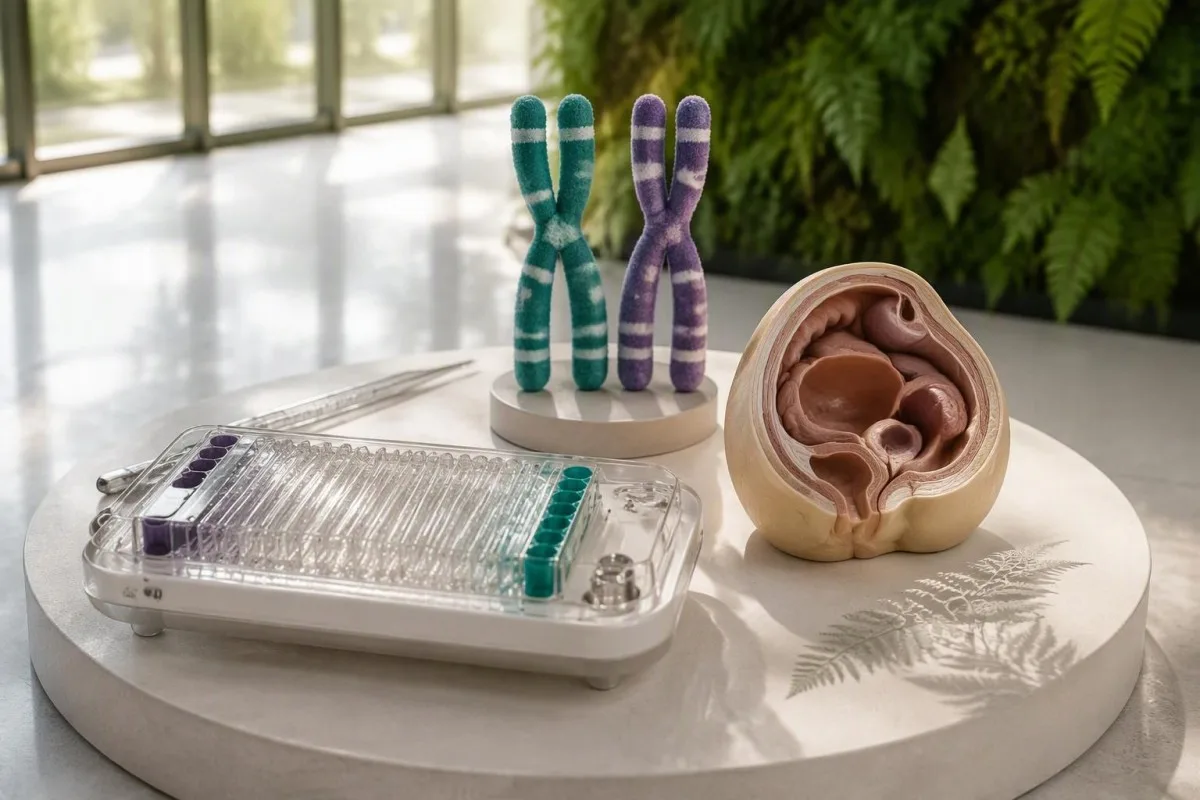
A genetic finding can strengthen an FMF diagnosis—or create a misleading label. The distinction depends on the variant, its inheritance, and what actually happens during fever attacks.


- MEFV gene test results support familial Mediterranean fever diagnosis but do not automatically establish symptomatic disease.
- Two pathogenic variants on opposite gene copies provide stronger molecular support than one variant; clinical assessment still determines their relevance.
- Five classification categories separate pathogenic, likely pathogenic, uncertain, likely benign, and benign findings.
- MEFV variant of uncertain significance is not proof of FMF and should not independently determine treatment or predictive testing.
- Typical FMF attacks often last 12–72 hours, with recurrent fever and abdominal, chest, or joint symptoms.
- Negative genetic testing does not exclude FMF, particularly when the test examines only selected common variants.
- CRP and serum amyloid A should be interpreted during attacks and between attacks; neither marker identifies FMF by itself.
- Persistent serum amyloid A matters because ongoing inflammation can lead to AA amyloidosis; the 2016 EULAR recommendations describe a treatment target below 10 mg/L.
- Comharraidhean èiginneach such as a rigid abdomen, new breathlessness, or severe chest pain require assessment even in someone with established FMF.
Does a positive MEFV result actually confirm FMF?
An MEFV gene test does not automatically confirm familial Mediterranean fever. Two pathogenic or likely pathogenic variants on opposite gene copies strongly support the diagnosis, but an isolated variant or uncertain finding may not explain symptoms. Recurrent attack patterns and clinical assessment remain necessary, and a negative result does not exclude FMF.
The distinction is between a molecular finding and a clinical diagnosis: a laboratory describes DNA, whereas a clinician decides whether a person has FMF. Even 2 disease-associated variants do not tell us the patient's current inflammatory burden or whether a particular episode of abdominal pain is an FMF attack; penetrance and severity vary.
My first question is not simply, “Was the test positive?” It is, “Which variant, on how many gene copies, and alongside what symptoms?” I’m Thomas Klein, MD, Chief Medical Officer at Kantesti; the background to our organization explains our educational role, but an individual FMF diagnosis belongs with the treating clinician.
Tha Kantesti na Anailisiche deuchainn fala AI that can help readers understand accompanying inflammatory laboratory results, not independently establish an inherited fever disorder. Consider an illustrative comparison: a person with 36-hour fever-and-abdominal-pain attacks differs substantially from someone with continuous fatigue and the same single MEFV finding; neither history should be reduced to a positive/negative label.
What does the MEFV gene test measure?
An MEFV gene test examines DNA changes in the gene encoding pyrin, a protein involved in innate immune regulation. MEFV is located on chromosome 16; testing may examine a short list of common variants or sequence much more of the gene, depending on the laboratory and clinical question.
Pyrin helps regulate an inflammatory pathway involving the inflammasome and interleukin-1β; FMF-associated changes can lower the threshold for inappropriate pathway activation. The gene result itself normally does not change between an attack and a symptom-free interval, so collecting DNA on day 1 of a fever offers no special genetic advantage over collecting it later.
Ask whether the laboratory performed targeted variant testing, sequencing, or a broader periodic-fever panel. A test checking 10 selected variants is not equivalent to sequencing all coding regions with clearly stated coverage; a negative result means nothing was detected within that particular method's scope, rather than that every possible relevant change was excluded.
A DNA sample may come from a laboratory sample or an appropriately collected cheek specimen, and fasting is usually unnecessary unless other tests require it. Genetic tests also answer different questions: our explanation of drug-response gene testing shows why a medication-risk finding and an inherited disease investigation should not be interpreted using the same assumptions.
Pathogenic, likely pathogenic, and benign: what changes?
A pathogenic MEFV variant has evidence supporting a disease-causing role, whereas a benign variant does not. Clinical laboratories commonly use 5 categories: pathogenic, likely pathogenic, variant of uncertain significance, likely benign, and benign; these classifications describe the variant's evidence, not the certainty that a particular patient has symptomatic FMF.
The ACMG/AMP framework defines likely pathogenic as greater than 90% confidence in pathogenicity, not a greater than 90% probability that the patient has FMF (Richards et al., 2015). That difference is easy to miss: variant classification considers population frequency, family segregation, functional evidence, and other data, while patient diagnosis adds inheritance, symptoms, and alternative explanations.
A report should identify the exact change using standardized notation, ideally including both DNA and protein descriptions—for example, p.Met694Val, often shortened to M694V. Two reports using different shorthand may describe the same change, while superficially similar names can represent different changes; the transcript and laboratory interpretation help prevent mistaken comparisons.
An fhacal mutation is less informative than a classification with supporting evidence and a review date. One reason I discourage treating every highlighted genetic result as a diagnosis is that common variants can acquire unjustified significance; our discussion of common variant interpretation illustrates that broader reporting problem without implying that MEFV and MTHFR have equivalent clinical consequences.
Does one MEFV variant mean carrier status or FMF?
One pathogenic MEFV variant often indicates carrier status, but some people with clinically convincing FMF have only 1 detectable pathogenic variant. Two relevant variants provide stronger support when they are on opposite gene copies—called in trans—rather than together on one copy, called in cis.
FMF usually follows an autosomal recessive inheritance pattern, but real-world genotype–phenotype relationships are not perfectly tidy. A heterozygous finding should neither automatically trigger an FMF label nor end the investigation when there are repeated, objectively documented 24–48-hour attacks with serosal symptoms; selected variants and families can have more complex inheritance.
Two different reported variants do not necessarily mean both MEFV copies are affected. If the laboratory cannot establish phase, testing biological parents may show whether the variants were inherited together from 1 parent or separately from both; this is particularly useful before giving recurrence-risk advice or describing the result as a biallelic molecular diagnosis.
Homozygous M694V is associated with greater disease severity and amyloidosis risk in many cohorts, but it does not dictate an individual's future. Genetic risk is not a timetable: our explanation of inherited kidney-risk findings offers another example of why 2 genetic findings still require careful clinical interpretation, although APOL1 and FMF have different biological mechanisms.
What should you do with an MEFV variant of uncertain significance?
An MEFV variant of uncertain significance, or VUS, means the laboratory lacks enough evidence to classify the change as disease-causing or benign. A VUS is not a positive FMF diagnosis, and finding 2 uncertain variants does not convert uncertainty into confirmation.
The ACMG/AMP recommendations state that a VUS should not be used in clinical decision-making as though it were pathogenic (Richards et al., 2015). Clinicians can still investigate and treat a convincing clinical syndrome; the distinction is that the symptoms and inflammatory evidence justify the decision, not the uncertain DNA finding by itself.
An p.Glu148Gln, or E148Q, variant deserves particular care because its disease contribution has been debated and classifications can differ. E148Q alone does not establish FMF, even when an older report calls it a mutation; the FMF-specific recommendations discuss this interpretive difficulty and the need to relate findings to phenotype (Giancane et al., 2015).
Ask the reporting laboratory about reclassification policies and whether a genetics specialist considers targeted family studies useful; there is no universal 6- or 12-month retesting rule for every VUS. Relatives should not be assigned an FMF diagnosis through an uncertain finding alone, just as a positive HLA-B27 result does not independently establish inflammatory spinal disease.
Can you have FMF with a negative MEFV gene test?
Tha—a negative MEFV gene test does not exclude familial Mediterranean fever. The result may reflect limited variant coverage, technical limitations, or a clinically compatible syndrome without an identifiable molecular explanation; the next step depends on what the original assay examined and how convincing the attacks are.
There is no single negative-test percentage that applies to every clinic, ancestry, and assay. A common-variant panel and full-gene sequencing have different detection capabilities, so the useful questions are whether coding regions and splice boundaries were assessed, whether low-coverage regions were filled in, and whether the laboratory reports 1 or more categories of technically undetectable changes.
Repeating exactly the same limited panel rarely resolves the uncertainty unless there was a specimen or technical problem. A specialist may instead request broader MEFV analysis or a multigene autoinflammatory panel; that choice should follow the symptom pattern, because looking at 20 genes rather than 1 also increases the chance of incidental and uncertain findings.
The FMF genetic-diagnosis recommendations preserve a role for clinical diagnosis when molecular testing is inconclusive (Giancane et al., 2015). An unrevealing result should prompt a structured reassessment, not endless testing; our discussion of borderline inherited-disease testing demonstrates how clinical evidence can remain relevant when a different diagnostic assay does not provide a simple answer.
Which recurrent fever pattern makes FMF more likely?
Typical FMF attacks often last 12–72 hours and recur with fever, abdominal pain, pleuritic chest pain, or joint symptoms. Recovery between episodes, repeated similarity of attacks, and objective inflammatory changes increase suspicion, although joint manifestations can last longer and not every patient follows the textbook pattern.
Record measured temperature, start and finish times, pain location, joint swelling, and whether you returned fully to baseline. Three well-documented episodes are often more informative for an appointment than a recollection of “fevers for years”; that is a practical documentation suggestion, not a universal diagnostic requirement or a reason to postpone care.
FMF abdominal attacks can resemble an acute abdomen, but a previous diagnosis must not become an excuse to miss appendicitis or another emergency. New focal pain, guarding, persistent vomiting, or an episode lasting beyond the person's usual 48-hour pattern needs assessment; normal appendicitis laboratory results cannot reliably provide reassurance by themselves.
Pleuritic pain means pain worsened by breathing; it does not identify its cause. A first episode of severe chest pain, breathlessness, fainting, or a different pattern from previous attacks needs urgent evaluation rather than waiting 72 hours to see whether it settles; our explanation of positional inflammatory chest pain describes another condition that can overlap symptomatically.
Which blood tests help during and between attacks?
CRP, serum amyloid A, ESR, and a complete blood count can document inflammation during suspected FMF attacks, but none confirms FMF by itself. Comparing an attack sample with a symptom-free sample—often approximately 1–2 weeks after recovery when clinically appropriate—can distinguish episodic inflammation from a persistently abnormal baseline.
Bidh mòran obair-lannan a’ cleachdadh CRP fo 5 mg/L as a reference limit, but the printed laboratory range should govern interpretation. An illustrative CRP of 85 mg/L during fever and 3 mg/L after recovery documents a substantial inflammatory swing; it does not distinguish FMF from an infection, and WBC agus CRP nach eil a’ freagairt ri chèile need clinical context.
Serum amyloid A, or SAA, may remain elevated between attacks even when a person feels well; many assays use a reference limit around 10 mg/L, with laboratory variation. Kantesti is an àrd-ùrlar mìneachaidh deuchainn fala AI that can help organize these accompanying laboratory results, but our AI cannot decide whether an elevated SAA comes from FMF, another inflammatory disorder, or a concurrent illness.
ESR changes more slowly than CRP and can remain elevated after an attack; anemia, age, and other factors also influence it. Record whether a sample was taken 6 hours into symptoms or several days after recovery, and avoid treating an isolated ESR of 40 mm/hour as a genetic-disease signature; the adhbharan airson ESR àrdaichte extend well beyond autoinflammatory conditions.
What else can resemble familial Mediterranean fever?
Recurrent infections, PFAPA, TRAPS, mevalonate kinase deficiency, and other inflammatory disorders can resemble FMF. Attack duration, mouth ulcers, lymph-node swelling, rash, exposures, and symptom-free intervals help prioritize alternatives; a 1-day abdominal attack and a 2-week fever with migrating muscle pain suggest different diagnostic pathways.
PFAPA commonly produces episodes lasting approximately 3–7 làithean, often with aphthous mouth ulcers, pharyngitis, and cervical lymph-node swelling. TRAPS episodes are often longer, approximately 5–25 days, while mevalonate kinase deficiency can produce 3–7-day attacks; these are characteristic patterns, not strict cutoffs that independently diagnose or exclude a syndrome.
Repeated mouth ulcers with eye inflammation, genital ulcers, or vascular symptoms require a different review, including possible Behçet disease. Painful red eyes or new visual change should receive urgent assessment rather than being attributed to the same MEFV result; our guide to Behçet symptom patterns explains why the combination matters more than any 1 symptom.
A roughly 21-day cycle of fever, mouth ulcers, and infections can raise concern for cyclic neutropenia; a single normal neutrophil count may miss the low point. Kantesti can support explanation of available laboratory reports, but identifying a cycle requires clinician-directed serial testing and an exposure history, as discussed in testing for repeated infections.
How do clinicians diagnose FMF beyond the genetic report?
FMF diagnosis combines attack history, examination, inflammatory measurements, family history, and genetic findings, while checking plausible alternatives. Clinical criteria support this process but are not interchangeable with genetic confirmation; a clinician may also assess response to a supervised colchicine trial over several months when the diagnosis remains uncertain.
Different criteria sets were developed for different purposes and populations: adult diagnostic criteria and pediatric classification tools need not agree in every patient. Counting 2 compatible symptoms is not a substitute for establishing discrete attacks, documenting inflammation, and excluding important alternatives; classification criteria are particularly easy to misuse as a self-diagnosis checklist.
An 2016 EULAR recommendations advise starting colchicine once a clinical FMF diagnosis is made, rather than waiting indefinitely for perfect genetic certainty (Ozen et al., 2016). Those recommendations describe an initial adult dose of 1.0–1.5 mg/day in suitable patients, but actual prescribing depends on local tablet strengths, kidney and liver function, interactions, tolerability, and current specialist guidance.
A clinician-supervised trial lasting approximately 3–6 mìosan may provide useful evidence when enough attacks occur to assess change, but spontaneous variation and imperfect adherence complicate interpretation. Do not start or stop colchicine yourself: interactions with medicines such as clarithromycin can be dangerous, and ath-sgrùdadh gluasadan sàbhailteachd cungaidh-leigheis supplements rather than replaces a prescriber or pharmacist assessment.
Why do SAA and urine protein matter after diagnosis?
Persistent inflammation in FMF can cause AA amyloidosis, which often affects the kidneys; preventing that complication is a major treatment goal. The 2016 EULAR recommendations describe maintaining SAA below 10 mg/L as a target where measurement is available, alongside control of attacks and monitoring for proteinuria.
An SAA of 30 mg/L between attacks deserves follow-up, but it does not prove that amyloid has deposited in the kidneys. The result may reflect persistent FMF activity or another inflammatory cause; repeat measurement, adherence review, and an assessment for other illness are more useful than assuming a single elevated value means irreversible damage.
A urine albumin-to-creatinine ratio of 30 mg/g, approximately 3 mg/mmol, is a commonly used threshold for increased albuminuria, although total urine protein measurement may also be needed. Fever, exercise, urinary infection, and menstruation can affect urine results, so repeat testing under appropriate conditions matters; persistent foamy urine needing testing is a prompt to investigate, not a diagnosis of amyloidosis.
Normal creatinine does not exclude early kidney involvement because protein leakage can precede a measurable decline in filtration. If urine protein is substantial or persistent, clinicians assess kidney function, serum albumin, and competing causes; our stiùireadh mìneachaidh pròtain serum explains why low albumin can reflect urinary loss as well as inflammation, liver disease, or nutritional problems.
Should relatives have familial Mediterranean fever genetic testing?
Family testing is most informative after the affected person's variants and inheritance are clarified. If both biological parents carry a pathogenic variant in the same recessive condition, each pregnancy has a 25% chance of inheriting both relevant variants, a 50% chance of carrier status, and a 25% chance of inheriting neither.
An fheadhainn sin 25/50/25 percentages apply to the standard two-carrier recessive model; they are not automatic probabilities for every MEFV-positive family. Variants in cis, uncertain classifications, unusual dominant inheritance, and incomplete penetrance can alter the interpretation, while inheriting a genotype does not precisely predict attack frequency or future severity.
Testing relatives for a known familial pathogenic variant can answer a specific inheritance question more cleanly than ordering another broad panel. A VUS may sometimes be studied in relatives to help a laboratory assess segregation, but that is different from predictive testing; nobody should be told they have FMF solely because they share an uncertain family finding.
Children with repeated unexplained fevers need clinical assessment whether their parent has 0, 1, or 2 reported variants, and ancestry should modify suspicion rather than act as a gatekeeper. Genetic counseling also separates carrier information from disease diagnosis; our discussion of family carrier-screening results illustrates that distinction, although FMR1 inheritance is not the same as MEFV inheritance.
What should you bring to an MEFV result review?
Thoir an complete genetic report, an attack diary, and laboratory results linked to symptom dates to an FMF review. Five details are especially useful: exact variants, classification, zygosity, assay coverage, and whether phase is known; a screenshot showing only “positive” leaves out most of the information a specialist needs.
My practical approach, as Thomas Klein, MD, is to separate 3 questions: does the history fit FMF, does the genotype support it, and is inflammation controlled? These questions can have different answers; our frèam comhairleachaidh meidigeach describes physician oversight, but this article does not substitute for an individual rheumatology, pediatric rheumatology, or clinical genetics consultation.
Tha Kantesti na àrd-ùrlar mìneachaidh biomarcadairean AI that can help explain accompanying CRP, CBC, kidney, and albumin results; it cannot sequence MEFV, establish variant phase, or independently reclassify a VUS. Before sharing a report, consider removing unnecessary identifiers and check our fiosrachadh mu phrìobhaideachd is dàta, especially when the document contains genetic information about more than 1 family member.
Mar 24 Dàmhair 2026, the practical message remains to interpret the report's scope and evidence rather than its headline alone. Ask what would change the working diagnosis, which tests should be repeated during the next attack, and when to seek urgent care; new severe chest pain, breathlessness, a rigid abdomen, confusion, or inability to keep fluids down should not wait for a genetics appointment.
Foillseachaidhean rannsachaidh agus crìochan fianais AI
Technical benchmarks and validation frameworks are not evidence that an AI system can diagnose FMF or classify MEFV variants independently. The 2 publications below concern laboratory interpretation methods and oversight; their results should not be transferred to genetic diagnosis without condition-specific clinical validation and clearly stated reference standards.
Kantesti LTD. (n.d.). A pre-registered, rubric-based automated technical benchmark of the Kantesti blood-test interpretation engine on 100,000 synthetic test cases [Technical benchmark]. Figshare. Clàr foillseachaidh DOI. The title specifies 100,000 cùisean sionnaich, which are not equivalent to 100,000 prospectively evaluated patients with suspected FMF.
Kantesti LTD. (n.d.). Clinical validation framework v2.0 (Medical validation page) [Validation framework]. Zenodo. clàr frèam DOI. A version 2.0 framework describes an evaluation approach rather than establishing diagnostic sensitivity for this condition; our dearbhadh teicnigeach agus stiùireadh page should be read with that distinction in mind.
Publication discovery is available through a Rannsachadh ResearchGate and does not itself establish independent peer review. An Rannsachadh tiotal Academia.edu is likewise a discovery route, not proof of clinical performance; the 3 external medical references listed separately support this article's clinical and variant-interpretation statements.
Ceistean Bitheanta
A bheil deuchainn dheimhinneach air a’ ghine MEFV a’ ciallachadh gu bheil fiabhras Meadhan-thìreach teaghlaich orm?
0 Tha toradh dearbhach ann an deuchainn gine MEFV a“ ciallachadh gu fèin-obrachail gu bheil fiabhras teaghlaich na Meadhan-thìreach ort. Tha dà dhreach phataigeach no coltach ri bhith pataigeach air dà leth-bhreac ghine eadar-dhealaichte a” toirt taic mholacileach nas làidire na tha aon dreach, ach tha na comharraidhean, dol a-mach a’ ghalair agus mìneachaidhean eile fhathast cudromach. Mairidh ionnsaighean àbhaisteach FMF gu tric 12–72 uair a thìde agus bidh fiabhras an cois comharraidhean bhoilg, ciste no altan. Bu chòir do lèirmheas le eòlaiche reumatòlais no ginteachd am fiosrachadh slàn a mhìneachadh seach am facal “dearbhach” leis fhèin.
An urrainn FMF a bhith aig cuideigin aig nach eil ach aon mhùthadh MEFV?
Faodaidh FMF a bhith air a dhearbhadh gu clionaigeach ann an cuideigin aig nach deach ach 1 tionndadh MEFV pataigineach a lorg, ged a tha mòran dhaoine le aon tionndadh nan luchd-giùlain gun bhuaidh. Feumaidh an clionaigear measadh a dhèanamh air ionnsaighean ath-chuairteach, tomhasan sèididh, eachdraidh an teaghlaich, agus farsaingeachd na deuchainn ginteil. Dh’fhaodadh nach lorg pannal cuibhrichte dàrna atharrachadh iomchaidh, ach chan eil deuchainnean nas fharsainge an-còmhnaidh ga chomharrachadh. Bu chòir làimhseachadh a bhith stèidhichte air a’ mheasadh chlionaigeach seach air inbhe giùlain a-mhàin.
Dè tha caochladh MEFV le cudromachd neo-chinnteach a’ ciallachadh?
0 Tha caochladh MEFV aig nach eil cudromachd chinnteach a’ ciallachadh nach eil fianais gu leòr ann gus an t-atharrachadh DNA sin a sheòrsachadh mar rud pataigeach no mì-mhodhail. Chan eil VUS a’ dearbhadh FMF, agus chan eil lorg 2 chaochladh mì-chinnteach a’ dearbhadh a’ bhreithneachaidh. Faodaidh luchd-clionaigeach fhathast suidheachadh fèin-atnamhach a dhearbhadh stèidhichte air fianais chlionaigeach, ach cha bu chòir don VUS leis fhèin làimhseachadh no deuchainnean ro-innseach a dhearbhadh. Faighnich don obair-lann a thug seachad an aithisg no do eòlaiche ginteachd mu ath-sheòrsachadh agus am biodh sgrùdaidhean cuimsichte air an teaghlach feumail.
An urrainn do dheuchainn MEFV àicheil fiabhras Meadhan-thìreach teaghlaich a chur às an t-sealladh?
Chan urrainn do dheuchainn MEFV àicheil fiabhras Meadhan-thìreach teaghlaich a chur às gu tur. Tha craoladh eadar-dhealaichte aig deuchainn a tha a’ sgrùdadh caochlaidhean cumanta taghte seach aig sreathadh a’ ghéin, agus faodaidh eadhon mion-sgrùdadh nas fharsainge cùis a tha co-chòrdail gu clinigeach fhàgail gun mhìneachadh moileciuil. Bu chòir an toradh ath-sgrùdadh an cois ionnsaighean a bhios a’ tachairt a-rithist, agus a mhaireas gu tric 12–72 uair a thìde, agus tomhasan sèididh. Faodaidh speisealaiche deuchainnean nas fharsainge no ath-mheasadh airson sionndrom eile le fiabhrasan ath-chuairteach a mholadh, seach dìreach an aon mheasadh ath-aithris.
A bheil an caochladh MEFV E148Q a’ dearbhadh FMF?
The MEFV E148Q variant, also written p.Glu148Gln, does not confirm FMF by itself. Its clinical contribution has been debated, and laboratories may differ in classification. Interpretation depends on whether there are additional relevant variants, whether findings affect 1 or both gene copies, and whether the clinical attack pattern fits FMF. An older report calling E148Q a “mutation” should be reviewed for its current classification rather than accepted as a diagnosis.
Which blood tests are useful when FMF is suspected?
CRP, serum amyloid A, ESR, and a complete blood count can document inflammation when FMF is suspected, but none identifies FMF on its own. Many laboratories use CRP below 5 mg/L as a reference limit, while SAA limits are often around 10 mg/L; the local assay range takes precedence. Comparing an attack sample with a sample approximately 1–2 weeks after recovery can show whether inflammation settles. Urine protein and kidney-function testing help monitor possible complications when FMF is diagnosed or strongly suspected.
Should I take colchicine because my MEFV test is positive?
A positive MEFV test alone is not enough reason to start colchicine without a clinical assessment. The 2016 EULAR recommendations support treatment once a clinical FMF diagnosis is made and describe initial adult doses of 1.0–1.5 mg/day for suitable patients. Kidney or liver impairment, interacting medicines, local tablet strengths, and adverse effects can change the prescription. A supervised treatment trial may contribute diagnostic evidence, but response does not independently prove FMF.
Faigh Mion-sgrùdadh Deuchainn Fala le Cumhachd AI an-diugh
Thig còmhla ri còrr is 2 mhillean neach air feadh an t-saoghail a tha a’ earbsa Kantesti airson mion-sgrùdadh sa bhad, ceart air deuchainnean obair-lann. Luchdaich suas na toraidhean deuchainn fala agad agus faigh mìneachadh coileanta air biomarcair 15,000+ ann an diogan.
📚 Foillseachaidhean Rannsachaidh le Iomraidhean
Klein, T., Mitchell, S., & Weber, H. (2026). Sgrùdadh Teicnigeach fèin-ghluasadach stèidhichte air Rubric a chaidh a chlàradh ro-làimh de Inneal Mìneachaidh Deuchainn Fala Kantesti air 100,000 cùis deuchainn fuadain. Rannsachadh Leigheis AI Kantesti.
Klein, T., Mitchell, S., & Weber, H. (2026). Frèam Dearbhaidh Clionaigeach v2.0 (Duilleag Dearbhaidh Meidigeach). Rannsachadh Leigheis AI Kantesti.
📖 Iomraidhean Meidigeach Taobh a-muigh
Giancane G et al. (2015). Evidence-based recommendations for genetic diagnosis of familial Mediterranean fever. Leabhraichean-latha nan Galaran Rheumatic.
⚕️ Àicheadh Meidigeach
Tha an artaigil seo dìreach airson adhbharan foghlaim agus chan eil e a’ dèanamh comhairle mheidigeach. Cuir fios an-còmhnaidh gu solaraiche cùram slàinte teisteanasach airson co-dhùnaidhean breithneachaidh is leigheis.
Comharran earbsa E-E-A-T
Eòlas
Lèirmheas clionaigeach air a stiùireadh le lighiche air sruthan-obrach mìneachaidh obair-lann.
Eòlas
Fòcas air leigheas obair-lann air mar a bhios bith-chomharraidhean (biomarkers) a’ giùlan ann an co-theacsa clionaigeach.
Ùghdarrasachd
Air a sgrìobhadh le Dr. Thomas Klein le ath-sgrùdadh le Dr. Sarah Mitchell agus Prof. Dr. Hans Weber.
Earbsachd
Mìneachadh stèidhichte air fianais le slighean leanmhainn soilleir gus dragh a lughdachadh.