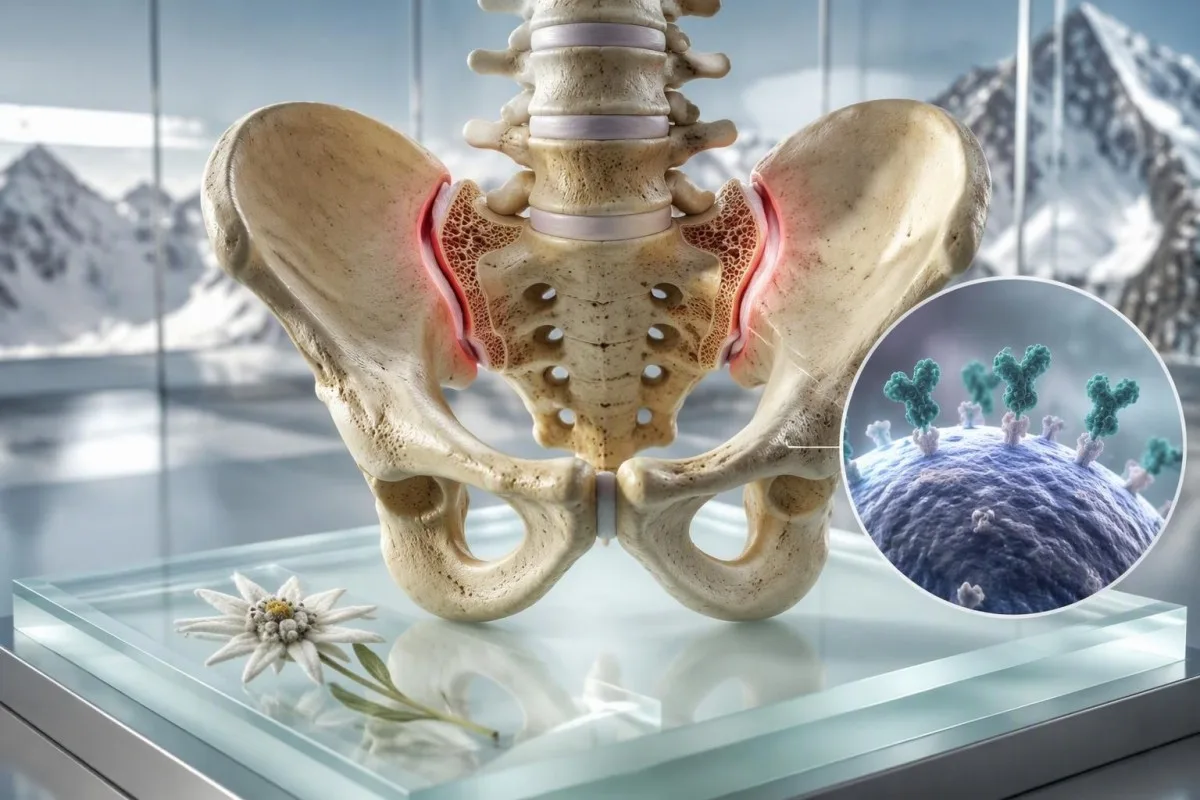
Tha toradh dearbhach air HLA-B27 a' comharrachadh comharra siostaim dìonach a tha air a shealbhachadh, chan e breithneachadh. Tha e nas cudromaiche nuair a tha e a' tighinn còmhla ri pian cùil a thòisicheas ro aois 45, sèasan sùla a thig gu h-obann, psoriasis, sèasan fiodha, no eachdraidh theaghlaich dlùth de spondyloarthritis.


- HLA-B27 dearbhach a' ciallachadh gu bheil comharra ginte agad; tha mòran de luchd-giùlan fallain nach leasaich galairean sèid a-riamh.
- Pian cùil sèid mar as trice a' tòiseachadh ro aois 45, mairidh e nas fhaide na 3 mìosan, a' leasachadh le gluasadan, agus gu tric a' cur dragh air cadal anns an dàrna leth den oidhche.
- Uveitis anterior acute ag adhbhrachadh sùil dhearg, goirt, mothachail do sholas le lèirsinn shoilleir agus feumach air measadh oftalmology an aon latha.
- CRP àbhaisteach nach dùin a-mach spondyloarthritis axial; tha CRP air a thogail ann an dìreach cuid de dhaoine le galar gnìomhach.
- jointan sacra-iliac MRI is urrainn dha freagairt gnìomhach nan nèap an aodann mus seall na X-ghathan sìmplidh atharrachadh structarail.
- Eachdraidh slàinte teaghlaich de spondylitis ankylosing, uveitis, psoriasis, no galar caola sèid a' meudachadh luach tar-chuir rheumatology air a bheil amas.
- Deuchainneachd HLA-B27 bu chòir freagairt a thoirt do cheist clionaigeach; chan e deuchainn sgrìonaidh feumail a th’ ann airson pian cùil meacanaigeach gun suaimhneas.
- Comharraidhean sùla èiginn nas cudromaiche na toraidhean obair-lann: na feithibh air deuchainn HLA-B27 mus iarr thu cùram airson pian sùla no atharrachadh lèirsinn.
Dè a tha toradh dearbhach air HLA-B27 ag innse dhut gu dearbh
Tha HLA-B27 deimhinneach a’ ciallachadh gu bheil gnèitheach sònraichte de sheòrsa HLA clas I aig neach; chan eil e a’ ciallachadh gu bheil spondylitis ankylosing aca no gum faigh iad e. Chan eil an deuchainn feumail gu clionaigeach ach nuair a tha comharran agus toraidhean sgrùdaidh a’ nochdadh a dhòigh air suidheachadh speactram spondyloarthritis. Nam chleachdadh, is e an mì-thuigse as milleadh a bhith a’ làimhseachadh toradh dearbhach mar ro-shealladh seach mar aon phàirt de fhianais stèidhichte air coltachd.
Tha HLA-B27 an làthair ann an timcheall air 6.1% de dh'inbhich anns na Stàitean Aonaichte, ged a tha an tricead ag atharrachadh gu mòr a rèir sinnsearachd agus cruinn-eòlas. Tha e nas cumanta ann an cuid de phoball a Tuath na Roinn Eòrpa agus dùthchasach agus neo-chumanta ann an cuid eile, mar sin tha luach ro-innseach eadar-dhealaichte aig toradh ann an diofar choimhearsnachdan. Bidh toradh àicheil a’ lughdachadh an coltas gu bheil galair co-cheangailte ri HLA-B27 ach chan urrainn dha spondyloarthritis axial a dhearbhadh.
Tha brìgh na deuchainn HLA-B27 dà-fhillte: air a lorg no nach eil air a lorg, chan e àrd no ìosal. Mar as trice bidh obair-lann a’ cleachdadh seòrsachadh moileciuil bho shampall obair-lann, agus chan eil an toradh ag atharrachadh le cadal, daithead, gluasacht no cungaidh-leigheis. Tha sin gu fundamental eadar-dhealaichte bho chomharraidhean sèid mar ESR, a dh’ fhaodadh atharrachadh thar làithean gu seachdainean.
Tha Kantesti na Anailisiche deuchainn fala AI a chuireas toradh HLA a chaidh a thoirt a-steach ri taobh comharraidhean sèid iomchaidh, ach chan urrainn dha spondyloarthritis a dhearbhadh bho chomharra ginteil a-mhàin. Tha Thomas Klein, MD, a’ comhairleachadh dhotairean faighneachd a’ cheist nas sìmplidhe: dè an duilgheadas clionaigeach a chaidh an deuchainn òrdachadh airson freagairt? Ar biomarker guide a’ mìneachadh carson a tha toradh air a chomharrachadh no dearbhach an-còmhnaidh ag iarraidh an dòigh obair-lann agus an co-theacsa clionaigeach aige.
Carson a dh’ fhaodadh toradh deimhinneach a bhith a’ faireachdainn nas eagalach na tha e
Cha mhòr nach leasaich daoine HLA-B27-deimhinneach gu bràth spondylitis ankylosing. Bidh an comharra a’ gabhail pàirt ann an taisbeanadh antigen, ach tha an slighe bith-eòlasach bho bhith ga ghiùlan gu bhith a’ leasachadh tinneas fhathast neo-choileanta; tha coltas gu bheil microbes caolain, riaghladh dìonach agus gnèithean eile a’ cur ris. Tha an teagmhach sin fìor, agus cha bu chòir do luchd-clionaigeach ceangal ginteil a thionndadh gu bhith na ro-innse.
HLA-B27 agus spondylitis ankylosing: co-cheangal an aghaidh breithneachadh
Mu dheidhinn 80% gu 95% de dhaoine le spondylitis ankylosing rèidio-graphach a tha HLA-B27 deimhinneach ann am mòran de bhuidhnean Eòrpach a Tuath, ach chan eil an comharra riatanach no gu leòr airson breithneachadh. Bidh dotairean a’ dearbhadh spondyloarthritis axial bhon phàtran iomlan: comharran, toraidhean corporra, ìomhaighean, toraidhean obair-lann, agus mìneachaidhean farpaiseach.
Tha an luach breithneachaidh as motha aig toradh HLA-B27 deimhinneach ann an cuideigin le pian cùil leantainneach a thòisich ro aois 45. Ann an neach 55-bliadhna a thòisich a’ chiad phian cùil aige às deidh dha àirneis a thogail aig 52, tha an aon toradh gu tric ag atharrachadh glè bheag. Seo carson a dh’ fhaodadh deuchainn a chaidh òrdachadh às aonais coltas clionaigeach ro-dheuchainn barrachd iomagain na soilleireachd a chruthachadh.
Tha frèam-obrach clasachaidh ASAS a’ ceadachadh do dhaoine le HLA-B27 deimhinneach le pian cùil leantainneach a thòisich ro 45 bliadhna coinneachadh ri slighe spondyloarthritis axial nuair a tha co-dhiù dà fheart eile de spondyloarthritis an làthair, leithid uveitis, psoriasis, galar caolain sèididh, arthritis, enthesitis, no eachdraidh teaghlaich (Rudwaleit et al., 2009). Tha slatan-tomhais clasachaidh a’ cuideachadh le cunbhalachd rannsachaidh; chan e liostaichean sgrùdaidh dachaigh a th’ annta.
Tha spondylitis ankylosing rèidio-graphach a’ toirt cunntas air atharrachadh structarail stèidhichte air joint sacroiliac air X-ray, fhad ‘s a dh’ fhaodadh nach bi X-rays àbhaisteach aig spondyloarthritis axial neo-rèidio-graphach. MRI can identify active bone-marrow tissue response earlier, although athletic loading, pregnancy-related changes, and degenerative disease can also make MRI interpretation tricky. A focused unexplained pain work-up urrainn cuideachadh le bhith a’ cruthachadh an eadar-dhealachaidh nas fharsainge.
The risk number patients usually want
First-degree relatives of a person with HLA-B27-associated ankylosing spondylitis have a higher risk than the general population, but family risk is not destiny. Risk estimates differ substantially by sex, ancestry, and whether the affected relative has radiographic disease. I do not recommend testing healthy children or siblings merely to settle worry unless a specialist identifies a specific clinical reason.
Ciamar a tha pian cùil sèid a' dèanamh eadar-dhealachadh bho phian cùil àbhaisteach
Inflammatory back pain typically begins gradually before age 45, persists for more than 3 months, improves with exercise, and does not improve reliably with rest. Mechanical pain more often follows a strain, worsens predictably with loading, and settles when the provoking movement stops.
Waking in the second half of the night because of back or buttock pain is a useful clue when it occurs repeatedly, not once after a poor mattress. Alternating buttock pain, morning stiffness lasting longer than 30 minutes, and marked improvement after getting moving add weight to the inflammatory pattern. None is individually diagnostic; together, they are more persuasive.
I often see a 32-year-old runner who says, I loosen up after the first kilometre. That is not proof of inflammation—many musculoskeletal problems warm up—but pain that returns after sitting, wakes them near 4 a.m., and has continued for 9 months deserves more than generic stretching advice. Pain severity is less informative than the pattern over time.
NICE advises rheumatology referral for back pain beginning before 45 and lasting more than 3 months when several spondyloarthritis features coexist; HLA-B27 testing can support referral when exactly three features are present. New bowel or bladder dysfunction, saddle numbness, fever, unexplained weight loss, cancer history, or rapidly progressive weakness requires urgent assessment for causes beyond spondyloarthritis. Review the practical distinction between inflammation and injury in our psoriasis laboratory guide, particularly if skin disease is also present.
A useful two-week symptom record
Record wake time, stiffness duration, exercise response, buttock location, and anti-inflammatory medicine response for 14 days before an appointment. This produces more diagnostic value than a generic pain score from 0 to 10, because rheumatologists are looking for a reproducible inflammatory rhythm.
Nuair a tha feum aig sùil dhearg co-cheangailte ri HLA-B27 air cùram an aon latha
A painful red eye with light sensitivity, blurred vision, or a smaller-looking pupil can be acute anterior uveitis and needs same-day assessment by an eye specialist or emergency eye service. HLA-B27-associated uveitis often starts suddenly in one eye and can recur, sometimes in the other eye at a later date.
Acute anterior uveitis is not the same as conjunctivitis. Conjunctivitis commonly causes discharge or gritty discomfort; uveitis more often causes deep aching pain, photophobia, reduced visual clarity, and redness concentrated around the iris. A normal-looking external eye does not reliably exclude it, especially early on.
Roughly half of acute anterior uveitis cases in many European-derived cohorts are HLA-B27 positive, but eye doctors still consider infection, sarcoidosis, Behçet disease, inflammatory bowel disease, trauma, and medication effects. Do not use leftover steroid eye drops without an examination, because steroid drops can worsen undiagnosed corneal infection and raise eye pressure. An stiùireadh againn air Behçet eye symptoms covers another condition where oral ulcers and eye symptoms change the urgency.
Treatment commonly uses prescription topical corticosteroid drops plus pupil-dilating drops, with a taper directed by ophthalmology. Follow-up matters because pressure elevation and swelling at the back of the eye can occur even when pain improves. A recurrent episode should trigger communication between ophthalmology and rheumatology rather than parallel, disconnected care.
Comharraidhean nach bu chòir feitheamh ri òrdanachadh cunbhalach
Sudden vision loss, a curtain or shower of new floaters, severe headache with nausea, halos around lights, or severe eye pain needs emergency evaluation immediately. These features can signal diagnoses other than uveitis, including acute angle-closure glaucoma or retinal disease, where delay can threaten sight.
Na comharran eile a tha a' dèanamh HLA-B27 nas ciallaiche
HLA-B27 becomes more clinically meaningful when back or eye symptoms occur with psoriasis, inflammatory bowel disease, heel enthesitis, swollen joints, or a close relative with related disease. This cluster is called the spondyloarthritis spectrum because different tissues may be involved at different times.
Enthesitis is inflammation where a tendon or ligament attaches to bone, commonly causing focal pain at the Achilles insertion or bottom of the heel. It differs from diffuse foot ache because the tenderness is usually sharply localized and may be worst after rest. Ultrasound can help, but body weight, sports loading, and footwear can produce similar symptoms.
Psoriasis-related nail pitting, separation of the nail plate, or a whole swollen finger or toe can be particularly helpful diagnostic clues. A person does not need widespread psoriasis for this to count; a small scalp patch or a long history of flaky plaques behind the ears may matter. Photographing an intermittent rash before it fades can save a surprising amount of time at review.
Chronic diarrhoea, nocturnal stool urgency, rectal bleeding, or unintended weight loss should prompt bowel evaluation rather than being attributed to stress. Faecal calprotectin is useful for detecting intestinal tissue response but is not specific for Crohn disease or ulcerative colitis; our calprotectin comparison explains its limitations. The connection matters because bowel inflammation can steer both imaging choices and treatment selection.
Symptoms that do not fit neatly
Fatigue is common in active inflammatory disease but is too non-specific to establish a diagnosis. Iron deficiency, sleep disruption, thyroid dysfunction, mood disorders, medications, and prolonged pain can all contribute, so I look for a coherent pattern rather than assigning fatigue to HLA-B27.
Ciamar a dh'atharraicheas eachdraidh teaghlaich an ath cheum
A first-degree relative with ankylosing spondylitis, recurrent uveitis, psoriasis, inflammatory bowel disease, or reactive arthritis increases suspicion when compatible symptoms are present. Family history supports a referral decision; it does not make testing or imaging mandatory in a person with no symptoms.
Ask relatives about diagnoses and major symptoms, not only whether they carry HLA-B27. People may remember being told they had iritis, a stiff spine, Crohn disease, or psoriasis but have never heard the term spondyloarthritis. The age at symptom onset is especially valuable: back pain that began at 22 tells a different story from osteoarthritis diagnosed at 72.
Kantesti AI ’s e àrd-ùrlar mìneachaidh deuchainn fala AI that can organise family-shared laboratory histories with consent, but family-history patterns still require a clinician to verify diagnoses. A useful record includes affected relative, relationship, condition, age at onset, eye episodes, and relevant imaging. Our lorgaire eachdraidh teaghlaich offers a practical template for recording that detail.
Routine HLA-B27 testing in symptom-free relatives usually does not improve outcomes. The result can create false reassurance when negative and unnecessary fear when positive, because no proven preventive treatment is prescribed simply for carrier status. A child with persistent limp, eye symptoms, or swollen joints needs paediatric assessment based on symptoms, whatever the family genotype.
What to bring to a specialist appointment
Bring prior X-ray or MRI reports, eye-clinic letters, medication dates, and a one-page family history. Imaging discs or digital access are often more useful than repeating scans, particularly because sacroiliac-joint MRI requires experienced interpretation.
Carson nach eil deuchainnean sèid àbhaisteach ga dùnadh a-mach
Normal CRP and ESR do not rule out axial spondyloarthritis or HLA-B27-associated uveitis. These tests measure systemic inflammatory activity indirectly, and localized disease can be clinically active while both results remain within the laboratory reference interval.
CRP is often reported in mg/L, with many laboratories using less than 5 mg/L as a reference threshold, while ESR reference limits vary with age and sex. A CRP of 2 mg/L can coexist with active sacroiliac inflammation on MRI. Conversely, a CRP of 28 mg/L is non-specific and may reflect infection, obesity, dental inflammation, or another inflammatory condition.
A complete blood count, liver profile, kidney profile, CRP, and ESR are baseline context tests rather than diagnostic proof. Anaemia, raised platelets, low albumin, or iron deficiency can suggest persistent inflammation or bowel involvement, but each has alternative explanations. This is one reason inflammatory conditions should not be inferred from a single marker.
Tha Kantesti na Inneal mion-sgrùdaidh deuchainn fala le cumhachd AI that can compare CRP, platelets, haemoglobin, and albumin across dates, helping users identify a pattern to discuss with their clinician. It cannot see sacroiliitis on an MRI or assess a painful eye. For antibody results that can be over-interpreted in a similar way, see our explanation of Deuchainn ANA.
Medication and test interpretation
NSAIDs can reduce CRP and improve symptoms without proving or disproving the diagnosis. Do not stop prescribed anti-inflammatory medication before testing unless the clinician managing your care specifically asks you to; an artificial flare is not a safe diagnostic strategy.
Dè na sganaidhean a chuidicheas, agus dè a dh'fhaodas gach sgan a chall
MRI of the sacroiliac joints is the preferred scan when axial spondyloarthritis is suspected but X-rays are normal or inconclusive. X-rays show structural change that often develops slowly, whereas MRI can show active bone-marrow tissue response and other early changes.
A normal lumbar-spine MRI does not replace a dedicated sacroiliac-joint MRI protocol. The relevant joints are lower and more lateral than the area commonly imaged for a slipped disc. I have seen patients reassured by an ordinary lumbar scan that was simply not designed to answer the inflammatory question.
MRI findings require clinical correlation because bone-marrow oedema can occur after intense exercise, childbirth, mechanical stress, and degenerative change. The radiology report should describe location, depth, distribution, erosions, fat change, and structural features; a vague statement of oedema alone is not enough. A rheumatologist may ask for image review when the report and symptom pattern disagree.
Pelvic X-rays remain useful for documenting chronic sacroiliac structural changes, but a normal X-ray does not close the case in a younger person. CT shows structure very clearly but uses ionising radiation and is not generally the first choice for early inflammatory disease. If persistent inflammation affects mobility, bone-health assessment may also be relevant; read our bone loss laboratory guide.
Why the scan report can sound uncertain
Radiologists appropriately use terms such as compatible with or non-specific when the imaging pattern is not definitive. That wording is not evasive; it reflects a real overlap between inflammatory and mechanical findings, and it prevents imaging from being treated as a diagnosis in isolation.
Cuin a dh'iarras tu airson tar-chur rheumatology
Ask for rheumatology evaluation when chronic back pain began before age 45 and is accompanied by inflammatory features, HLA-B27 positivity, recurrent uveitis, psoriasis, bowel symptoms, heel enthesitis, or a relevant family history. A positive test plus one convincing clinical feature is more useful than a positive test discovered during broad screening.
A referral is reasonable even when CRP is normal and X-rays are unremarkable if the clinical pattern is compelling. The 2019 ACR/SAA/SPARTAN guideline recommends treatment decisions based on disease activity, function, comorbidities, and patient preferences rather than a genetic result alone (Ward et al., 2019). This approach prevents both delayed diagnosis and reflexive overtreatment.
At the appointment, expect questions about age at onset, morning stiffness, night waking, response to NSAIDs, eye attacks, skin lesions, bowel symptoms, infection preceding arthritis, and family history. A rapid and clear response to a full-dose NSAID may support suspicion, but it is not a diagnostic test. NSAIDs also improve ordinary back pain.
Thomas Klein, MD, recommends making a dated timeline rather than trying to remember every symptom in the consulting room. Include medication dose and duration, especially if using ibuprofen, naproxen, or diclofenac, because kidney function, blood pressure, ulcer risk, and anticoagulant use alter the safety calculation. Our medication trend guide explains why repeat kidney and liver results may matter during longer courses.
When an orthopaedic or physiotherapy assessment may be better first
Back pain starting after age 45 following a specific injury, with clear load-related triggers and no inflammatory features, more often benefits initially from musculoskeletal care. That is a probability statement, not a dismissal; persistent uncertainty or new eye, skin, bowel, or joint symptoms warrants reassessment.
Dè a tha ann an làimhseachadh ma tha spondyloarthritis axial air a dhearbhadh
Confirmed axial spondyloarthritis is treated with education, regular movement, targeted physiotherapy, and anti-inflammatory medicines; biologic or targeted synthetic medicines are reserved for persistent active disease. HLA-B27 status does not determine treatment by itself.
Exercise is treatment, not a test of willpower. A programme that maintains spinal extension, hip mobility, chest expansion, and aerobic capacity is generally more sustainable than sporadic intense workouts. Most patients find short daily mobility work of 10 to 20 minutes easier to keep than a single ambitious weekend session.
NSAIDs are usually considered first-line when safe, but dose and duration must be individualised. Naproxen 500 mg twice daily is a common adult anti-inflammatory dose, yet it may be unsuitable with chronic kidney disease, prior ulcer bleeding, heart failure, uncontrolled hypertension, anticoagulants, or pregnancy. Gastroprotection may be appropriate for some people, but it does not remove kidney or cardiovascular risk.
Biologic medicines such as TNF inhibitors and IL-17 inhibitors require screening and specialist monitoring because infection risk and comorbidities affect selection. Recurrent uveitis, psoriasis, and inflammatory bowel disease influence which agent best fits the whole person. This is one reason a diagnosis based only on an HLA-B27 result can lead to the wrong treatment conversation.
Avoid the supplement trap
No supplement has been shown to prevent HLA-B27-associated spondyloarthritis in healthy carriers. Correcting a documented vitamin D, iron, or B12 deficiency can improve general health, but it is not a substitute for assessment of inflammatory back pain or a painful red eye.
Ciamar a nì thu sùil air toraidhean gun a bhith gad ghlacadh leotha
The most useful record combines symptoms, function, medications, eye episodes, imaging, and laboratory trends rather than repeatedly retesting HLA-B27. Once accurately typed, HLA-B27 status does not need serial monitoring because your inherited marker does not change.
Track functional measures that mean something to you, such as minutes until morning stiffness eases, uninterrupted sleep, walking tolerance, or ability to turn while driving. These details show treatment response more honestly than a single good or bad day. Note whether an eye flare preceded a back-pain change by days or weeks.
Kantesti can organise imported laboratory reports across time and flag changes for discussion, but it should not be used to self-start or stop prescription treatment. Our clinical framework is described in the stiùireadh teicneòlais AI: results are interpreted as context for professional care, not as a replacement for examination or imaging.
Repeating CRP during a flare can be useful when a clinician is also following symptoms and treatment response, but routine weekly testing is rarely helpful. In my experience, a symptom record every day and blood work at clinically meaningful intervals yields less noise and fewer false alarms. Laboratory trends only become informative when collection dates, infections, exercise, and medicines are documented.
A note about privacy and family data
Genetic information can affect relatives as well as the person tested, so share reports deliberately. Keep the original laboratory report, remove unrelated identifiers when appropriate, and obtain consent before adding another adult's results to a shared family record.
Mì-thuigse cumanta mu bhith dearbhach airson HLA-B27
HLA-B27 positivity does not mean your immune system is attacking your spine, that you are contagious, or that you need treatment while symptom-free. It is a common inherited allele whose significance depends on the clinical setting.
Myth: a positive HLA-B27 test explains every ache. Fact: mechanical back pain remains common among HLA-B27 carriers. Strain, disc disease, hip disorders, hypermobility, fibromyalgia, kidney stones, and pelvic conditions still deserve a normal differential diagnosis. The marker should sharpen clinical reasoning, not end it.
Myth: a negative HLA-B27 test rules out ankylosing spondylitis. Fact: HLA-B27-negative axial spondyloarthritis occurs, especially across populations with lower background carrier frequency. When imaging and clinical features are persuasive, a negative result should not be used to deny specialist review.
Myth: genes are the same as destiny. Fact: genetics influence risk, but no preventive biologic therapy is indicated for a well HLA-B27 carrier. This is conceptually similar to the limits of MTHFR result interpretation: genetic information is medically useful only when the result changes an evidence-based decision.
Can stress cause a flare?
Stress can worsen pain, sleep, fatigue, and coping, but it does not explain away objective uveitis or inflammatory arthritis. Treating sleep and stress is worthwhile alongside medical care; it should never delay eye assessment or replace a work-up for persistent inflammatory symptoms.
Ceistean a nì a' chiad coinneamh nas fheumail
The best first appointment questions focus on probability, alternative diagnoses, and the next decision—not on whether HLA-B27 is good or bad. A clinician should be able to explain what finding would increase or decrease their suspicion and what test would change management.
Ask whether your symptoms meet an inflammatory-back-pain pattern and which features argue against it. Then ask whether dedicated sacroiliac MRI is appropriate, whether an ophthalmology referral is needed, and whether psoriasis or bowel symptoms warrant coordinated review. This approach respects uncertainty without letting it become inaction.
Ask how long to try a treatment, what outcome defines success, and which adverse effects need a call. For NSAIDs, the specific safety discussion should include kidney function, blood pressure, gastrointestinal history, pregnancy plans, and interacting drugs. For biologics, ask about screening, vaccines, infection precautions, and how uveitis or bowel disease changes the choice.
Kantesti's clinical content is medically reviewed with structured quality controls; readers can examine our dòigh-obrach dearbhaidh meidigeach againn agus teisteanasan ar bòrd comhairleachaidh meidigeach. A laboratory interpretation is most valuable when it helps you ask a better question of the clinician who can examine you.
A concise appointment script
Say: My back pain started at age 29, has lasted 14 months, wakes me at 4 a.m., improves after 30 minutes of movement, and I had a painful light-sensitive eye last spring. That one sentence gives a rheumatologist more usable information than stating only that an HLA-B27 result was positive.
Comharran èiginneach agus plana sàbhailte airson an ath cheum
Seek same-day urgent eye care for eye pain, light sensitivity, red eye with blurred vision, or any sudden visual change; seek emergency care for new weakness, bladder or bowel dysfunction, saddle numbness, high fever, or severe unremitting back pain. Do not wait for repeat blood work, an MRI booking, or a rheumatology appointment when these red flags occur.
For non-urgent symptoms, book a primary-care review within weeks if back pain has lasted more than 3 months and began before age 45, especially with HLA-B27 positivity or family history. Bring your HLA report, symptom timeline, medication list, eye-clinic letters, and prior images. A targeted referral is generally faster and more useful than repeating broad autoimmune panels.
As of September 27, 2026, the central clinical principle remains unchanged: HLA-B27 is a risk marker, not a diagnosis. Thomas Klein, MD, has found that patients do best when they treat a positive result as a prompt to notice patterns—then obtain the right eye, primary-care, or rheumatology assessment rather than catastrophising or ignoring symptoms.
Tha Kantesti na seirbheis eadar-mhìneachaidh deuchainn-lann AI built to explain laboratory reports in plain language while preserving the boundary between information and diagnosis. Learn how our organisation approaches this work on our duilleag Mu Ar deidhinn and find further patient education in the Blog Kantesti.
Earrann foillseachaidh rannsachaidh
Kantesti LTD. (2026). Stiùireadh Seòrsa Fala B Negative, Deuchainn Fala LDH & Cunntas Reticulocyte. Figshare. https://doi.org/10.6084/m9.figshare.31333819. Related author records may be located through Geata-rannsachaidh agus Academia.edu.
Kantesti LTD. (2026). A' bhuinneach às dèidh trosgadh, breacan dubha anns an stòl & stiùireadh GI 2026. Figshare. https://doi.org/10.6084/m9.figshare.31438111. Related author records may be located through Geata-rannsachaidh agus Academia.edu.
These publications are not evidence for diagnosing HLA-B27-associated disease and should not replace the rheumatology and ophthalmology references cited above. They are listed as Kantesti research records for transparency.
Ceistean Bitheanta
A bheil HLA-B27 dearbhach a’ ciallachadh gu bheil spondylitis anchilosach orm?
Chan eil. Tha toradh dearbhach HLA-B27 a’ ciallachadh gu bheil comharra ginteil agad co-cheangailte ri spondylitis ankylosing agus suidheachaidhean co-cheangailte ris, ach tha mòran dhiubh sin fhathast fallain fad am beatha. Ann an buidhnean le spondylitis ankylosing rèidio-ghrafach, tha timcheall air 80% gu 95% dearbhach a thaobh HLA-B27, ach chan eil an taobh eile fìor: cha mhòr nach eil galairean air daoine dearbhach. Feumaidh breithneachadh comharraidhean co-fhreagarrach, sgrùdadh, ìomhaigh, agus dùnadh air falbh adhbharan eile.
Dè comharraidhean pian cùil a tha a 'moladh sèid co-cheangailte ri HLA-B27?
Tha cùl-phian nas fhaisge air spondyloarthritis axial nuair a thòisicheas e ro aois 45, a’ fàs mean air mhean, a’ mairsinn barrachd air 3 mìosan, a’ leasachadh le gluasad, agus ag adhbhrachadh stiffness sa mhadainn a mhaireas barrachd air 30 mionaidean. Bidh dùsgadh a-rithist anns an dàrna leth den oidhche agus pian caochlaideach anns a’ ghruaidhean a’ cur sanasan feumail ris. Leasaichear toradh HLA-B27 dearbhach an luach an fhoirm seo, ach feumaidh neach-clionaigeach fhathast casg a chuir air adhbharan meacanaigeach agus brataichean dearga.
An urrainn do HLA-B27 caus uveitis?
Chan eil HLA-B27 a' cur uile dhuilgheadas sùla air adhart gu dìreach, ach tha e ceangailte gu làidir ri sè an uimheir aghaidhach. Mar as trice bidh an seòrsa sè seo a' toirt dheargadh obann ann an aon shùil, pian domhain, mothalachd ri solas, agus sealladh doille; feumaidh e measadh leis an aon speisealaiche sùla air an aon latha. Mu leth nan cùisean sè uimheir aghaidhach tha HLA-B27 deimhinneach ann am mòran chòmhlan air an tàladh às an Roinn Eòrpa, ged a tha an tricead ag atharrachadh a rèir an t-sluaigh agus feumar adhbharan eile a mheasadh.
Am bu chòir dhomh dotair reumatachaidh fhaicinn ma tha mi deimhinneach a thaobh HLA-B27 ach mura h-eil comharraidhean orm?
Cha fheum a’ mhòr-chuid de dhaoine gun chomharran a tha deimhinneach airson HLA-B27 cùram cunbhalach bho rheumatology no làimhseachadh casgach. Tha ath-sgrùdadh ciallach ma thòisich pian cùil leantainneach ron aois 45, leasachadh uveitis a thig air ais, psoriasis, comharran caolain leantainneach, pian sàil bho enthesitis, buill-bodhaig air an goil, no eachdraidh theaghlaich làidir. Chan eil deuchainn HLA-B27 ath-aithris feumail oir chan atharraich inbhe HLA a tha air a shealbhachadh thar ùine.
Am faod CRP agus ESR a bhith àbhaisteach le spondylitis ankylosing?
Tha. Mar as trice bidh CRP air aithris mar àbhaisteach fo 5 mg/L anns an iomadh obair-lann, ach chan eil CRP agus ESR àbhaisteach a' dùnadh a-mach spondyloarthritis axial no uveitis gnìomhach. Tha na comharran seo a' nochdadh gnìomhachd sèid air feadh na buidhne agus faodaidh iad fuireach àbhaisteach nuair a tha an sèid air a chuingealachadh ris na joints sacroiliac no an t-sùil. Faodaidh MRI, pàtran comharraidhean, sgrùdadh corporra, agus measadh speisealaiche a bhith nas fhiosraiche na aon toradh sèid àbhaisteach.
A bheil deuchainn HLA-B27 air a dhèanamh bho fhuil?
Bidh clò-bhualadh HLA-B27 gu tric air a dhèanamh bho shampall obair-lann a’ cleachdadh modhan stèidhichte air moileciuil no sruth-citometry, agus bidh mòran obair-lann a’ cleachdadh shampall fala. Tha an deuchainn càileachdail, air aithris mar a chaidh a lorg no nach deach a lorg, seach mar dùmhlachd le raon àbhaisteach. Chan eil daithead, eacarsaich, agus gnìomhachd ghalaran ag atharrachadh an toraidh, oir tha HLA-B27 air a shealbhachadh seach mar chomharra sèid.
Faigh Mion-sgrùdadh Deuchainn Fala le Cumhachd AI an-diugh
Thig còmhla ri còrr is 2 mhillean neach air feadh an t-saoghail a tha a’ earbsa Kantesti airson mion-sgrùdadh sa bhad, ceart air deuchainnean obair-lann. Luchdaich suas na toraidhean deuchainn fala agad agus faigh mìneachadh coileanta air biomarcair 15,000+ ann an diogan.
📚 Foillseachaidhean Rannsachaidh le Iomraidhean
Klein, T., Mitchell, S., & Weber, H. (2026). Stuth fala B àicheil, stiùireadh deuchainn fala LDH & cunntas reticulocyte. Rannsachadh Leigheis AI Kantesti.
Klein, T., Mitchell, S., & Weber, H. (2026). A' bhuinneach às dèidh trosgadh, breacan dubha anns an stòl & stiùireadh GI 2026. Rannsachadh Leigheis AI Kantesti.
📖 Iomraidhean Meidigeach Taobh a-muigh
⚕️ Àicheadh Meidigeach
Tha an artaigil seo dìreach airson adhbharan foghlaim agus chan eil e a’ dèanamh comhairle mheidigeach. Cuir fios an-còmhnaidh gu solaraiche cùram slàinte teisteanasach airson co-dhùnaidhean breithneachaidh is leigheis.
Comharran earbsa E-E-A-T
Eòlas
Lèirmheas clionaigeach air a stiùireadh le lighiche air sruthan-obrach mìneachaidh obair-lann.
Eòlas
Fòcas air leigheas obair-lann air mar a bhios bith-chomharraidhean (biomarkers) a’ giùlan ann an co-theacsa clionaigeach.
Ùghdarrasachd
Air a sgrìobhadh le Dr. Thomas Klein le ath-sgrùdadh le Dr. Sarah Mitchell agus Prof. Dr. Hans Weber.
Earbsachd
Mìneachadh stèidhichte air fianais le slighean leanmhainn soilleir gus dragh a lughdachadh.