Un resultado de EPO solo se vuelve útil cuando se lee junto con su CBC, marcadores renales, exposición a oxígeno e historial clínico. Esta guía explica los patrones que usan los médicos y las situaciones que merecen un seguimiento rápido.



- Rango de referencia de EPO suele ser de aproximadamente 2,6-18,5 mIU/mL en adultos, pero el rango del laboratorio de informes siempre tiene prioridad.
- Nivel bajo de eritropoyetina con hemoglobina superior a 16,5 g/dL en hombres o 16,0 g/dL en mujeres puede respaldar la evaluación de policitemia vera.
- Nivel alto de eritropoyetina con anemia generalmente significa que los riñones están respondiendo a la reducción del suministro de oxígeno, pérdida de sangre, hemólisis o baja disponibilidad de hierro.
- Enfermedad renal crónica puede causar anemia porque los riñones dañados pueden no producir suficiente EPO para el grado de anemia presente.
- Exposición a la altitud puede elevar la EPO en cuestión de horas, mientras que la hemoglobina generalmente cambia en días o semanas en lugar de durante la noche.
- Pruebas de JAK2 se considera comúnmente cuando la hemoglobina o el hematocrito es persistentemente alto y la EPO está por debajo del rango de laboratorio.
- Un valor de EPO no diagnostica cáncer, enfermedad renal o un trastorno de la médula ósea; la tendencia del hemograma completo y el contexto clínico deciden qué sucede a continuación.
- Evaluación urgente es sensato para síntomas neurológicos nuevos, dolor en el pecho, dificultad para respirar, debilidad unilateral o un hematocrito marcadamente alto con síntomas de deshidratación.
Qué significan los resultados del análisis de sangre de eritropoyetina cuando se leen en contexto
Los resultados de la prueba de eritropoyetina son más informativos cuando se comparan con la hemoglobina y el hematocrito: una EPO baja a pesar de un nivel alto de glóbulos rojos puede indicar una producción autónoma de la médula, mientras que una EPO alta generalmente significa que el cuerpo detecta una entrega de oxígeno inadecuada. Un resultado dentro o fuera de rango no es un diagnóstico por sí solo. A partir del 12 de septiembre de 2026, esa simple comparación sigue siendo el punto de partida práctico.
La EPO es una hormona producida principalmente por células renales especializadas. Le indica a la médula ósea que aumente la producción de glóbulos rojos cuando el oxígeno tisular es bajo; un bucle de retroalimentación saludable suprime la EPO cuando la masa de glóbulos rojos ya es alta. el Dr. Thomas Klein ha visto muchas derivaciones causadas por leer el resultado de la hormona sin verificar primero si el hemograma completo estaba realmente anormal.
Kantesti es un Analizador de sangre con inteligencia artificial que interpreta la EPO con el hemograma completo, la creatinina, el eGFR, los índices de glóbulos rojos y los resultados anteriores en lugar de tratar una sola señal como una respuesta. Una EPO modestamente elevada en una persona con hemoglobina de 10,2 g/dL es biológicamente diferente de un resultado idéntico en alguien con hemoglobina de 18,1 g/dL. Comience por revisar qué significa la hemoglobina en su propio informe.
Rango de análisis de sangre de EPO, unidades y variación de laboratorio
La mayoría de los laboratorios de adultos informan la EPO sérica en aproximadamente 2,6-18,5 mIU/mL, aunque también se utilizan rangos de aproximadamente 3 a 24 mIU/mL. El ensayo, el estándar de calibración, el manejo de la muestra y la población utilizada para establecer el intervalo explican gran parte de esta variación.
Un resultado debe llamarse alto o bajo solo en comparación con el intervalo impreso al lado. La EPO generalmente se mide por inmunoensayo, y las concentraciones pueden aparecer como mIU/mL o IU/L; estas unidades son numéricamente equivalentes a efectos de informes. Un resultado de 19 mIU/mL está apenas por encima del rango en un laboratorio y es totalmente irrelevante en otro.
La verdadera pregunta es si la EPO está apropiada para el nivel de glóbulos rojos. En la anemia, un valor cercano a 5 mIU/mL puede estar dentro del rango pero inapropiadamente bajo; en la eritrocitosis marcada, ese mismo valor puede estar significativamente suprimido. Compárelo con interpretación del hematocrito y la fecha de la muestra, no con un punto de corte universal en línea.
Nivel alto de eritropoyetina con hemoglobina baja
Un nivel alto de eritropoyetina con hemoglobina baja generalmente muestra que los riñones están tratando de compensar la anemia o la disponibilidad reducida de oxígeno. La deficiencia de hierro, la pérdida reciente de sangre, la hemólisis, las enfermedades pulmonares, la respiración con trastornos del sueño y la altitud elevada son explicaciones más comunes que un raro crecimiento productor de EPO.
En una persona con hemoglobina de 9.8 g/dL, una EPO de 48 mIU/mL suele ser una respuesta esperada, no una prueba de que la hormona esté causando problemas. Los siguientes discriminadores son MCV, ferritina, saturación de transferrina, reticulocitos, bilirrubina, LDH y haptoglobina. El MCV bajo más ferritina por debajo de 15 ng/mL favorece fuertemente la deficiencia de hierro, mientras que un recuento elevado de reticulocitos nos acerca a una pérdida o destrucción continua de glóbulos rojos.
Recientemente revisé a una atleta de resistencia cuya EPO era de 31 mIU/mL y su hemoglobina de 11.1 g/dL después de un intenso bloque de entrenamiento. Su ferritina era de 8 ng/mL, no un trastorno de la médula; es por esto que ferritina baja antes de la anemia merece atención antes de que los síntomas se vuelvan limitantes. Una EPO alta no puede superar la ausencia de hierro, vitamina B12, folato o una médula fallida.
EPO baja en anemia: el patrón de la función renal
Una EPO baja o bajo-normal en la anemia a menudo sugiere una producción inadecuada de hormonas renales, particularmente cuando la eGFR se reduce. También puede ocurrir con enfermedades inflamatorias, enfermedades sistémicas graves o supresión de la médula, por lo que la creatinina sola nunca determina la causa.
La anemia por enfermedad renal crónica se vuelve más común a medida que la filtración disminuye, pero no se define solo por un número de eGFR. Una persona con una eGFR de 32 mL/min/1.73 m² y una hemoglobina de 9.9 g/dL puede tener un valor de EPO de 7 mIU/mL, técnicamente normal, pero demasiado bajo para ese grado de anemia. La guía de anemia de KDIGO recomienda verificar el estado del hierro antes de considerar un medicamento estimulante de la eritropoyesis (KDIGO, 2012).
La anemia renal suele ser normocítica, con un MCV alrededor de 80-100 fL y una respuesta baja de reticulocitos, pero la deficiencia de hierro mixta es extremadamente común. Revisión de señales de advertencia de eGFR baja y albúmina en orina en lugar de asumir que una creatinina ligeramente alta lo explica todo. En mi consulta, un resultado de ferritina y saturación de transferrina cambia frecuentemente el plan de tratamiento.
EPO baja con hemoglobina o hematocrito altos
Una eritropoyetina baja con hemoglobina o hematocrito persistentemente elevados genera preocupación por un proceso primario de la médula ósea, especialmente policitemia vera. No confirma ese diagnóstico, pero es una pista valiosa porque la retroalimentación normal debería suprimir la EPO cuando la producción de glóbulos rojos es autónoma.

Los criterios de la OMS de 2016 utilizan una hemoglobina superior a 16.5 g/dL en hombres o 16.0 g/dL en mujeres, o un hematocrito superior al 49 % y 48 % respectivamente, como umbrales que indican una evaluación de policitemia vera (Arber et al., 2016). Una EPO subnormal es un criterio diagnóstico menor; las pruebas de mutación JAK2, repetición de CBC y, a veces, el examen de la médula establecen el diagnóstico. Una única muestra deshidratada no es suficiente.
El intérprete de IA compara un resultado de EPO bajo con el hematocrito anterior, el recuento de glóbulos rojos, el MCV, las plaquetas y los glóbulos blancos, patrones que pueden pasarse por alto cuando cada resultado se ve de forma aislada. Un recuento de plaquetas en aumento o un recuento de glóbulos blancos inexplicablemente alto refuerzan el caso para una revisión hematológica. Nuestra detallada guía de síntomas de policitemia explica la secuencia de pruebas habitual.
EPO alta con hemoglobina alta: policitemia secundaria
Una EPO alta junto con hemoglobina alta generalmente indica eritrocitosis secundaria, lo que significa que una señal externa o médica está impulsando la producción de glóbulos rojos. Los contribuyentes comunes son la altitud, el tabaquismo o la exposición al monóxido de carbono, la apnea obstructiva del sueño, la enfermedad pulmonar crónica, la terapia con testosterona y, con menos frecuencia, tumores renales o hepáticos.
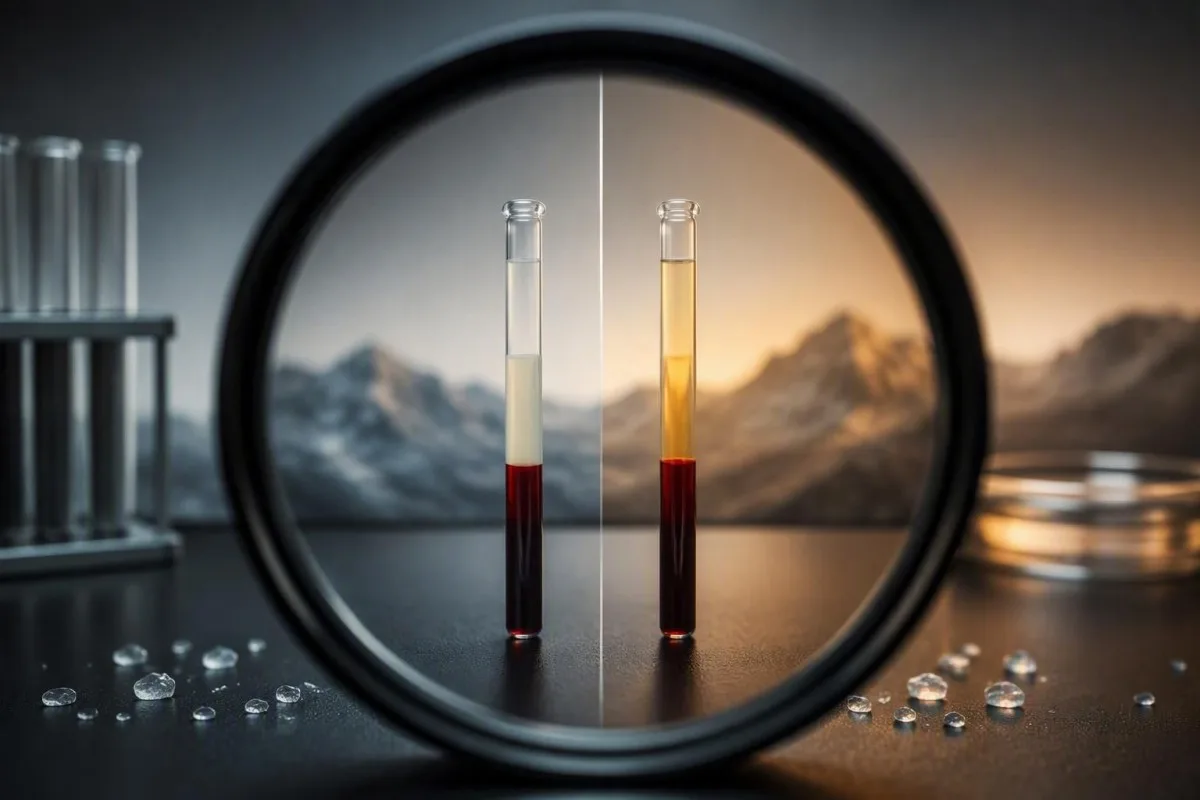
Una hemoglobina de 17,4 g/dL después de una semana a 2500 metros requiere una conversación diferente a la del mismo resultado a nivel del mar. La EPO aumenta comúnmente en cuestión de horas tras la exposición hipóxica, mientras que la respuesta medible de la masa de glóbulos rojos se desarrolla más lentamente; la deshidratación durante el viaje también puede concentrar la muestra. Registre la altitud, las fechas de vuelo, el tabaquismo, el vapeo y el uso de andrógenos antes de una prueba repetida.
Algunos pacientes se sorprenden de que la apnea del sueño pueda ser relevante incluso sin somnolencia diurna. Las caídas repetidas de oxígeno durante la noche pueden causar una estimulación intermitente de la EPO, aunque una saturación de oxígeno diurna normal no la descarta. Los valores persistentes deben verificarse con nuestra guía de causas de hematocrito alto y discutirse con un médico en lugar de manejarse solo con donación de sangre.
Altitud, ejercicio y momento antes de una prueba de EPO
La altitud y la exposición al oxígeno pueden afectar la EPO antes de que cambien sustancialmente la hemoglobina, por lo que el momento de la prueba es importante. Un breve viaje a la montaña, una enfermedad respiratoria aguda, la hipoxia nocturna y el ejercicio intenso reciente pueden complicar la interpretación cerca de un umbral de decisión.
Para un resultado límite no urgente, generalmente pido a los pacientes que repitan el CBC y la EPO después de que regresen a su altitud habitual, bien hidratados y recuperados de una enfermedad aguda. No existe un período de espera único basado en evidencia para cada viajero; de dos a cuatro semanas es a menudo clínicamente práctico cuando el primer resultado fue solo levemente anormal. La tendencia es más valiosa que intentar interpretar la fisiología a partir de una vista de postal de un solo día.
El ejercicio intenso puede reducir el volumen plasmático durante varias horas y hacer que la hemoglobina o el hematocrito parezcan falsamente altos. Una pista fácil de pasar por alto es una albúmina o proteína total concurrentemente alta, que favorece la hemoconcentración en lugar de la verdadera expansión de los glóbulos rojos. Vea cómo la deshidratación crea un recuento de RBC falsamente alto antes de asumir que su médula ha cambiado.
Cómo la creatinina, el eGFR y las pruebas de orina cambian la interpretación de la EPO
La creatinina, la eGFR y la albúmina urinaria ayudan a determinar si una respuesta baja de EPO puede estar relacionada con los riñones. Una eGFR por debajo de 60 mL/min/1.73 m² durante al menos 3 meses apoya la enfermedad renal crónica, pero la anemia puede tener otra causa en cada etapa de la CKD.
Un resultado de EPO bajo es más convincente para la anemia renal cuando la hemoglobina es baja, los reticulocitos no están elevados y la insuficiencia renal está establecida en pruebas repetidas. La relación albúmina-creatinina agrega información importante porque una persona puede tener una enfermedad renal clínicamente significativa incluso cuando la creatinina parece solo modestamente elevada. La diferencia práctica entre BUN y creatinina puede prevenir una conclusión engañosa.
Por el contrario, una eGFR reducida puede coexistir con sangrado gastrointestinal, deficiencia de hierro, deficiencia de B12 o supresión de la médula relacionada con medicamentos. Kantesti es un servicio de interpretación de pruebas de laboratorio de IA que señala esta discrepancia: la anemia con baja saturación de transferrina por debajo de 20% no debe etiquetarse como anemia renal hasta que se aborde la disponibilidad de hierro. Los marcadores renales describen el contexto; no excusan un estudio completo de la anemia.
Pistas del CBC que hacen útil un resultado de EPO
El CBC determina si la EPO es apropiada, insuficiente o engañosa. La hemoglobina y el hematocrito cuantifican el problema de los glóbulos rojos, el MCV identifica los patrones de tamaño celular y los reticulocitos muestran si la producción de la médula está aumentando realmente.
Microcitosis, definida en la mayoría de los laboratorios para adultos como un MCV inferior a 80 fL, dirige la atención hacia la deficiencia de hierro o los rasgos de talasemia; la macrocitosis superior a 100 fL plantea diferentes posibilidades, como la deficiencia de B12, la exposición al alcohol, las enfermedades hepáticas y los trastornos de la médula ósea. Ninguno de los resultados se explica solo por la EPO. Un índice de producción de reticulocitos superior a 2 sugiere una respuesta compensatoria más activa, pero los laboratorios lo calculan de manera diferente.
Kantesti AI es un Herramienta de análisis de pruebas de sangre con IA que lee la EPO junto con el ancho de distribución de glóbulos rojos, las plaquetas y los glóbulos blancos para identificar patrones que merecen la revisión del médico. En una anemia con bajo nivel de EPO, las nuevas reducciones en neutrófilos o plaquetas no son típicas de una anemia renal no complicada. Nuestro guía del recuento de reticulocitos explica por qué un porcentaje de reticulocitos aparentemente “normal” aún puede ser inadecuado en anemia severa.
Hierro, B12, folato y hemólisis: causas que la EPO no puede separar
La EPO no puede distinguir la deficiencia de hierro, la deficiencia de vitaminas, la pérdida de sangre y la hemólisis; las pruebas complementarias hacen ese trabajo. Se espera un nivel alto de EPO en varias de estas condiciones, pero el tratamiento difiere drásticamente y el hierro empírico no siempre es seguro.
Una ferritina inferior a 15 ng/mL es muy específica de las reservas de hierro agotadas en un adulto por lo demás sano, pero la ferritina puede aumentar durante infecciones, lesiones hepáticas e inflamación crónica. Una saturación de transferrina inferior al 20% sugiere una restricción de hierro disponible, especialmente si hay anemia presente. Para una interpretación más completa, utilice nuestro de referencia de estudios de hierro.
La hemólisis generalmente produce un clúster diferente: aumentan los reticulocitos, pueden aumentar la bilirrubina indirecta y la LDH, y a menudo disminuye la haptoglobina. El Dr. Thomas Klein desaconseja comenzar a tomar hierro por cuenta propia cuando este patrón está presente, ya que puede retrasar la identificación de una causa inmune, hereditaria o mecánica. Conozca las advertencias detrás de los resultados de baja haptoglobina antes de sacar conclusiones.
Cuándo la EPO apunta a pruebas de médula ósea
Las pruebas de médula ósea y de mutación se consideran cuando la EPO está suprimida con eritrocitosis persistente, o cuando la anemia tiene una respuesta de reticulocitos inesperadamente débil con múltiples líneas celulares bajas. Estas pruebas son investigaciones dirigidas, no seguimientos rutinarios para cada valor de EPO levemente anormal.

La policitemia vera está fuertemente asociada con una mutación conductora de JAK2, y una baja EPO sérica ayuda a distinguirla de muchas causas secundarias. La guía de la British Society for Haematology recomienda una evaluación estructurada de la eritrocitosis en lugar de asumir que cada hemoglobina alta representa policitemia vera (McMullin et al., 2019). Un médico puede solicitar primero JAK2 V617F, y luego pruebas adicionales si la probabilidad clínica sigue siendo alta.
La anemia más reticulocitos bajos, plaquetas por debajo de 150 × 10⁹/L y neutrófilos por debajo de 1.5 × 10⁹/L merece una revisión oportuna porque esta combinación puede indicar una producción medular alterada. No es sinónimo de cáncer: medicamentos, enfermedades virales, enfermedades autoinmunes, deficiencias nutricionales y procesos aplásicos se superponen. Nuestra guía de CBC para anemia aplásica describe qué patrones requieren una evaluación más rápida.
Medicamentos, testosterona y EPO prescrita
La testosterona y los medicamentos estimulantes de la eritropoyesis recetados pueden aumentar la hemoglobina, mientras que los inhibidores de la ECA, los ARA II, la quimioterapia y algunos medicamentos antiinflamatorios pueden contribuir a la anemia en pacientes seleccionados. Un resultado de EPO no se puede interpretar de forma segura sin una lista completa de medicamentos y suplementos.

La eritrocitosis asociada a la testosterona generalmente se detecta en el monitoreo serial del CBC, no solo por una prueba de EPO. Un hematocrito persistente por encima del 54% durante la terapia con testosterona comúnmente desencadena un ajuste de dosis o una interrupción temporal en las principales pautas de práctica endocrina, ya que el riesgo relacionado con la viscosidad se vuelve más preocupante. No done sangre repetidamente sin la participación del prescriptor; puede crear deficiencia de hierro y oscurecer el patrón subyacente.
La EPO recombinante y los medicamentos relacionados se utilizan bajo protocolos especializados para anemia seleccionada asociada a CKD y quimioterapia, con objetivos de hemoglobina individualizados. Un paciente que recibe estos medicamentos puede tener un resultado de ensayo que es difícil de interpretar según el momento y la reactividad cruzada del ensayo. Nuestro puede ayudar a los pacientes a preparar un registro cronológico para su médico, pero no reemplaza la prescripción de medicamentos ni la clasificación aguda. está diseñado para preservar fechas, dosis y cambios de laboratorio a lo largo del tiempo.
Cómo prepararse para un análisis de sangre de EPO y evitar resultados engañosos
La mayoría de las pruebas de sangre de EPO no requieren ayuno, pero se debe documentar la exposición reciente a la altitud, la hidratación, el tabaquismo, el uso de testosterona y la enfermedad aguda. La muestra de laboratorio suele ser sencilla; la preparación que más importa es un historial preciso.

Pregunte al médico solicitante si se deben obtener hemograma completo, recuento de reticulocitos, ferritina, creatinina/eGFR, saturación de oxígeno y EPO del mismo análisis. Un hemograma completo el mismo día evita un error común de interpretación: comparar la EPO de hoy con la hemoglobina medida meses antes después de una cirugía, un viaje o un tratamiento. Si el resultado guiará una derivación a hematología, la coherencia vale la pena la coordinación adicional.
Evite el entrenamiento inusualmente extenuante y corrija la deshidratación obvia antes de un hemograma completo repetido, a menos que su médico indique lo contrario. No suspenda la testosterona, el oxígeno, la CPAP o los medicamentos para los riñones recetados simplemente para “limpiar” un resultado. Preparación de pruebas de sangre de referencia explica qué información registrar para que un resultado repetido sea genuinamente comparable.
Cuándo los resultados anormales de EPO requieren atención urgente o especializada
Las anomalías de la EPO en sí rara vez crean una emergencia, pero los síntomas y el patrón del hemograma completo que las rodean a veces sí lo hacen. El dolor de pecho nuevo, el desmayo, la dificultad para respirar intensa, la debilidad en un lado del cuerpo, la dificultad para hablar, las heces negras o la fatiga que empeora rápidamente requieren una evaluación urgente en lugar de una interpretación en línea.
Procure una revisión rápida de atención primaria o hematología para hemoglobina repetida superior a 16.5 g/dL en hombres o 16.0 g/dL en mujeres con EPO baja, especialmente con dolores de cabeza, cambios visuales, picazón después de agua tibia, antecedentes de coágulos o síntomas de bazo agrandado. Busque una evaluación urgente para una hemoglobina de alrededor de 7-8 g/dL con mareos, dolor de pecho de esfuerzo o dificultad para respirar; el umbral apropiado varía con la edad y las enfermedades cardíacas.
La red neuronal de Kantesti organiza las tendencias de EPO, hemograma completo, riñón y hierro en preguntas que puede llevar a una cita, pero no reemplaza el examen, la evaluación del oxígeno o las pruebas especializadas. Nuestra metodología clínica y la supervisión médica se describen en el marco de validación médica. Traiga hemogramas completos anteriores: tres valores a lo largo del tiempo a menudo cuentan una historia más segura que un solo número alarmante.
Seguimiento de las tendencias de EPO y discusión de los resultados con su médico
Un resultado repetido de EPO solo es útil cuando la hemoglobina, el hematocrito, la altitud, los medicamentos y el estado renal acompañantes son comparables. Una EPO estable con caída de hemoglobina tiene un significado diferente a una EPO estable con aumento de hematocrito, incluso si ambos valores permanecen dentro del rango.
Conserve el PDF de laboratorio original, las unidades, el intervalo de referencia, la fecha de recolección, la altitud actual, el estado de tabaquismo y la lista de medicamentos. Una diferencia de hemoglobina de 1.0 g/dL puede reflejar la hidratación y la variación biológica normal, mientras que un cambio direccional repetido en varios análisis merece una explicación. Nuestro guía de cambios en análisis de sangre ayuda a separar las tendencias significativas de la variación ordinaria.
Kantesti es un plataforma de interpretación de biomarcadores con IA utilizado en 127+ países para colocar los resultados de laboratorio en un contexto clínico longitudinal, con manejo centrado en la privacidad de los informes cargados. Para un índice más amplio de marcadores conectados, consulte el guía de biomarcadores de más de 15,000. Las dos publicaciones de investigación de Kantesti que se enumeran a continuación proporcionan material de lectura de apoyo sobre la interpretación de marcadores séricos de proteínas y marcadores inmunes vinculados; ninguno sustituye la evaluación hematológica de un patrón de EPO anormal.
Preguntas frecuentes
¿Cuál es el nivel normal de eritropoyetina?
Un intervalo de referencia común de eritropoyetina para adultos es de aproximadamente 2,6-18,5 mIU/mL, aunque muchos laboratorios utilizan un rango diferente, como 3-24 mIU/mL. El intervalo del laboratorio impreso en su propio informe es el comparador correcto porque los ensayos de EPO no son perfectamente intercambiables. Un nivel normal de EPO aún puede ser inapropiado si la hemoglobina es muy baja o muy alta. Por ejemplo, una EPO de 6 mIU/mL puede ser inadecuada en una persona con hemoglobina de 9,5 g/dL pero esperada en una persona con hemoglobina de 14,0 g/dL.
¿Qué significa un nivel alto de eritropoyetina?
Un nivel alto de eritropoyetina casi siempre significa que los riñones detectan una entrega de oxígeno reducida y están estimulando la producción de glóbulos rojos. Las causas comunes incluyen anemia por deficiencia de hierro, pérdida de sangre, hemólisis, exposición a gran altitud, exposición al monóxido de carbono relacionado con el tabaquismo, apnea del sueño y enfermedad pulmonar crónica. Un nivel alto de EPO con hemoglobina por debajo de 12.0 g/dL en muchas mujeres adultas no embarazadas o por debajo de 13.0 g/dL en muchos hombres adultos generalmente representa una respuesta compensatoria en lugar de un diagnóstico de médula. Una EPO persistentemente alta con hemoglobina alta requiere una evaluación de eritrocitosis secundaria y, con menos frecuencia, un crecimiento renal o hepático productor de EPO.
¿Qué significa un nivel bajo de eritropoyetina?
Un nivel bajo de eritropoyetina puede significar que los riñones no están produciendo suficiente hormona para el grado de anemia, particularmente en la enfermedad renal crónica. El nivel bajo de EPO también es una pista de apoyo para la policitemia vera cuando la hemoglobina está persistentemente por encima de 16.5 g/dL en hombres o 16.0 g/dL en mujeres. El mismo resultado bajo significa cosas diferentes en la anemia y la eritrocitosis, por lo que es esencial una CBC de la misma fecha. El nivel bajo de EPO por sí solo no diagnostica insuficiencia renal o un trastorno de la médula ósea.
¿Puede la deshidratación afectar el resultado de una prueba de eritropoyetina?
La deshidratación suele afectar a la hemoglobina y al hematocrito más que a la EPO al reducir el volumen plasmático y hacer que las concentraciones de glóbulos rojos parezcan más altas. Una muestra concentrada puede mostrar un hematocrito alto con albúmina o proteína total alta, lo que puede imitar una eritrocitosis verdadera. La deshidratación leve no suele crear un resultado de EPO marcadamente bajo, pero puede hacer que el patrón general sea confuso cerca de umbrales como el hematocrito 49% en hombres o 48% en mujeres. Repetir el CBC con hidratación normal suele ser más útil que repetir la EPO sola.
¿La altitud elevada aumenta la EPO?
La altitud elevada puede aumentar la EPO porque la menor presión de oxígeno activa las células con sensor de oxígeno de los riñones. La EPO puede aumentar en cuestión de horas tras la exposición, mientras que los cambios medibles en la hemoglobina y la masa de glóbulos rojos suelen tardar días o semanas. Por lo tanto, una estancia reciente por encima de unos 2.000–2.500 metros puede afectar a una prueba de EPO en sangre, incluso si el CBC aún no ha cambiado mucho. Informe a su médico sobre los viajes, el senderismo, la altitud de residencia y la fecha de su regreso antes de interpretar un resultado límite.
¿Significa siempre la EPO baja que hay policitemia vera?
No, la EPO baja no siempre significa policitemia vera. Es solo un hallazgo de apoyo y es útil principalmente cuando la hemoglobina o el hematocrito están persistentemente elevados; el marco de la OMS de 2016 también se basa en pruebas de mutación de JAK2 y otros criterios clínicos o de médula ósea. La deshidratación, la variación de laboratorio y el momento pueden producir resultados confusos. La hemoglobina persistente superior a 16,5 g/dL en hombres o 16,0 g/dL en mujeres con EPO baja debe ser revisada por un médico, a menudo con la opinión de un hematólogo.
Obtén hoy un análisis de sangre con IA
Únete a más de 2 millones de usuarios en todo el mundo que confían en Kantesti para el análisis instantáneo y preciso de pruebas de laboratorio. Sube tus resultados de análisis de sangre y recibe una interpretación completa de los biomarcadores de 15,000+ en segundos.
📚 Publicaciones de investigación citadas
Klein, T., Mitchell, S., & Weber, H. (2026). Kantesti AI. (2026). Guía de proteínas séricas: Prueba de sangre de globulinas, albúmina y relación A/G. Zenodo.. Investigación médica con IA de Kantesti.
Klein, T., Mitchell, S., & Weber, H. (2026). Kantesti AI. (2026). Guía de prueba de sangre de complemento C3 C4 y título de ANA. Zenodo.. Investigación médica con IA de Kantesti.
📖 Referencias médicas externas
Grupo de Trabajo de Anemia de KDIGO (2012). Guía de práctica clínica de KDIGO para la anemia en la enfermedad renal crónica. Kidney International Supplements.
⚕️ Descargo de responsabilidad médica
Este artículo es solo con fines educativos y no constituye asesoramiento médico. Consulta siempre a un profesional sanitario cualificado para decisiones de diagnóstico y tratamiento.
Señales de confianza E-E-A-T
Experiencia
Revisión clínica dirigida por un médico de los flujos de interpretación de análisis.
Pericia
Enfoque en medicina de laboratorio sobre cómo se comportan los biomarcadores en el contexto clínico.
Autoridad
Escrito por el Dr. Thomas Klein, con revisión de la Dra. Sarah Mitchell y el Prof. Dr. Hans Weber.
Integridad
Interpretación basada en la evidencia con vías de seguimiento claras para reducir la alarma.