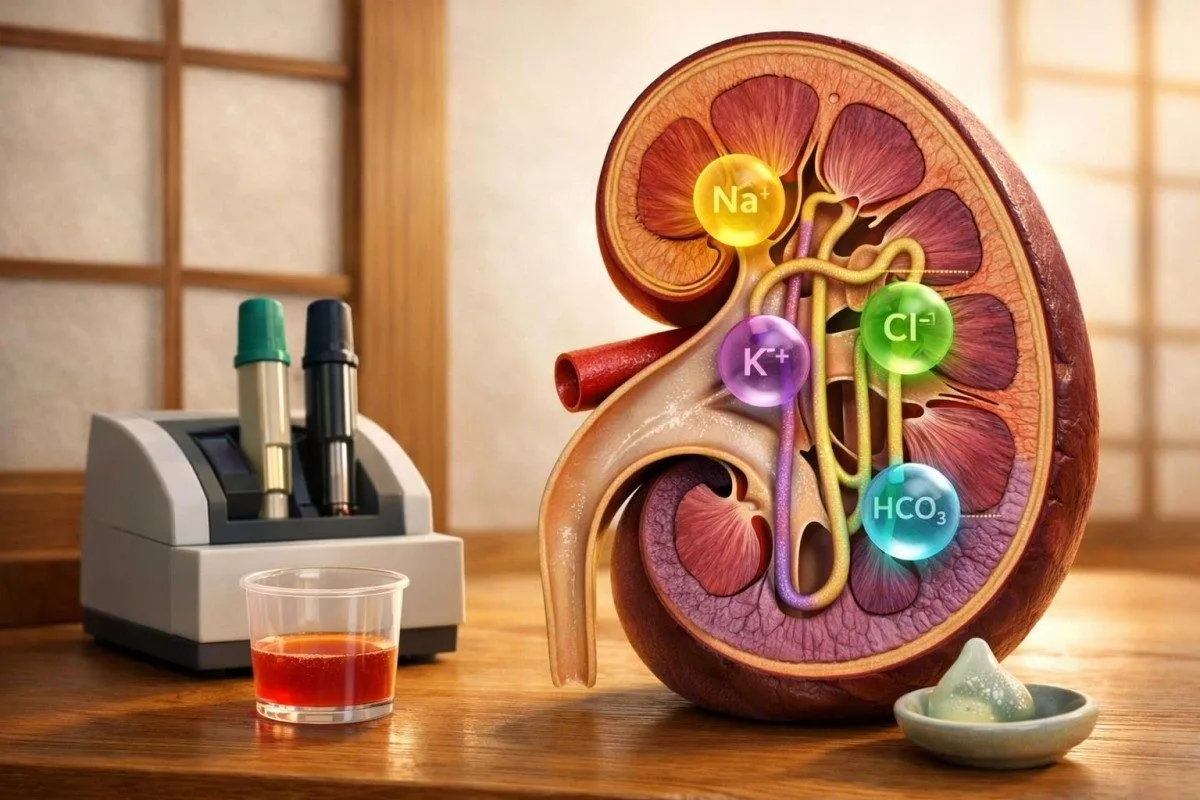
This smaller chemistry test answers a big question: are your body fluids, salts, and acid-base balance behaving normally? The value comes from reading sodium, potassium, chloride, and CO2 as a pattern, not one result at a time.


- Sodium normal adult range is usually 135-145 mmol/L; values below 130 or above 150 need prompt clinical context.
- Potassium normal adult range is usually 3.5-5.0 mmol/L; levels below 2.5 or above 6.0 mmol/L can be medically urgent.
- Chloride usually runs 98-106 mmol/L; paired with CO2, it often reveals vomiting, diarrhea, saline effect, or acid-base shifts.
- CO2 on an electrolyte panel reflects serum bicarbonate, not the air you exhale; most labs use about 22-29 mmol/L.
- Hemolysis can falsely raise potassium by roughly 0.3 to 1.0+ mmol/L, so a repeat sample is common when the result does not fit the story.
- Diuretics often lower sodium and potassium, while ACE inhibitors, ARBs, spironolactone, and trimethoprim can raise potassium.
- Standalone panel means four markers only; a basic metabolic panel adds glucose, calcium, BUN, and creatinine.
- Red flags include confusion, palpitations, severe weakness, seizure, fainting, or persistent vomiting with an abnormal electrolyte result.
What an electrolyte panel actually measures
An electrolyte panel measures sodium, potassium, chloride, and CO2 from one blood sample. Read together, these four values tell us whether your body is handling water, salt, acids, and muscle-nerve signaling normally — and whether a result needs routine follow-up or urgent action.
Adult reference ranges are usually sodium 135-145 mmol/L, potassium 3.5-5.0 mmol/L, chloride 98-106 mmol/L, and CO2 22-29 mmol/L. On Kantesti AI, we see patients fixate on one starred value, but the safer read is the pattern; a mildly high chloride often means little unless sodium or CO2 moves with it.
The quartet is useful because each marker answers a different question. Sodium mostly reflects water balance, potassium levels affect heart rhythm and muscle function, chloride tracks with salt and acid-base shifts, and panel CO2 is really total carbon dioxide — mostly bicarbonate, not a breathing test. Some European labs print bicarbonate as HCO3- instead of CO2, which trips people up.
As of April 10, 2026, the most common misunderstanding I still hear is that a normal sodium blood test means everything else must be fine. As Thomas Klein, MD, I usually correct that quickly: I worry more about a potassium of 6.1 mmol/L or a CO2 of 15 mmol/L than a sodium of 136, and dehydration can skew lab results.
How sodium, potassium, chloride, and CO2 make sense together
Doctors interpret an electrolyte panel by looking for patterns, not isolated outliers. The reason is simple: sodium, potassium, chloride, and CO2 often move in recognizable clusters that point toward dehydration, vomiting, diarrhea, kidney stress, medication effects, or an acid-base disorder.
A panel with low potassium, high chloride, and low CO2 often fits gastrointestinal bicarbonate loss after several days of diarrhea. A panel with low chloride and high CO2 more often points to vomiting or diuretic use, because chloride-rich fluid is being lost while the blood becomes relatively alkalotic.
At Kantesti, our review of 2M+ uploaded reports shows mild isolated chloride highs generate anxiety far more often than true danger. One reason is that 0.9% saline can raise chloride and nudge CO2 down after 1 to 3 liters, so a hospital panel after fluids deserves a different read than an outpatient panel after a viral illness.
Low potassium can be stubborn when magnesium is also low. In practice, a potassium of 3.1 mmol/L may barely budge until magnesium is corrected, so I ask patients with abnormal potassium levels to review that result carefully. I also check the magnesium result, because potassium replacement often works poorly when magnesium is lagging behind.
Why CO2 on the panel is not a lung test
Serum CO2 is mostly bicarbonate and usually falls around 22-29 mmol/L in adults. A CO2 below 18 mmol/L often signals metabolic acidosis or compensation for respiratory alkalosis; it does not tell you your oxygen saturation, and it is not interchangeable with an arterial blood gas.
When doctors order a standalone electrolyte panel
Clinicians order a standalone electrolyte panel when the main question is fluid balance or acid-base status rather than a broad chemistry workup. Common reasons are vomiting, diarrhea, dizziness, new diuretics, kidney risk, IV fluid monitoring, or symptoms such as cramps, palpitations, and confusion.
A 72-year-old I saw after starting hydrochlorothiazide had sodium 129 mmol/L and potassium 3.3 mmol/L after three recent falls. That sort of focused abnormality is exactly when a standalone panel earns its keep, because it answers the immediate safety question before we widen the workup.
In hospitals and surgical settings, doctors often want fast repeat checks rather than a larger chemistry panel every time. That is why electrolyte testing shows up in pre-op blood work and in serial checks after bowel prep, IV fluids, or major medication changes.
I order it early when patients start or increase thiazides, loop diuretics, ACE inhibitors, ARBs, spironolactone, or trimethoprim. Those drugs can move potassium or sodium within days, sometimes before there is clear kidney dysfunction or before the patient notices much beyond vague fatigue.
How to prepare so your electrolyte panel is accurate
You usually do not need to fast for a standalone electrolyte panel. Water is fine, and in my experience mild dehydration before the draw causes more confusion than a small breakfast ever does.
Fasting matters only if your clinician is combining the sample with tests that require it, such as some glucose or lipid studies. If you are unsure, check the order sheet or review our fasting rules before the appointment.
Sample handling changes results more often than patients expect. Repeated fist clenching, a tight tourniquet, or partial cell breakdown can falsely raise potassium by 0.3 to more than 1.0 mmol/L, which is why choosing a reliable lab and repeating a questionable sample is not overkill.
Hard exercise right before the draw can push potassium up for a short time, and heavy sweating can concentrate sodium and chloride if you replace fluid poorly. I usually tell athletes to avoid an all-out session for 12 to 24 hours before testing unless the whole point is to check recovery after an event.
Normal electrolyte panel ranges and urgent cutoffs
Typical adult ranges are sodium 135-145 mmol/L, potassium 3.5-5.0 mmol/L, chloride 98-106 mmol/L, and CO2 22-29 mmol/L, but your lab's reference interval may differ slightly. Values outside those bands are not automatically dangerous; the urgent question is how far off they are, how fast they changed, and whether symptoms are present.
A sodium below 130 mmol/L or above 150 mmol/L deserves prompt review, and values below 120 or above 160 are often treated as emergencies. If you want the deeper context behind a sodium blood test, our sodium range guide walks through hydration, medications, and when to seek urgent care.
A potassium below 3.0 mmol/L or above 5.5 mmol/L usually triggers faster follow-up, especially in heart disease or kidney disease. Many hospitals escalate quickly when potassium is 2.5 or lower or 6.0 or higher, because those ranges can produce ECG changes even before symptoms show up.
The thing is, chloride is often the clue, not the star of the show. A chloride of 111 mmol/L with CO2 of 18 mmol/L suggests very different physiology than chloride 111 with CO2 26, which is why our blood test abbreviations guide encourages reading chemistry markers as a set, not as isolated flags.
Common abnormal electrolyte panel patterns doctors watch for
The commonest abnormal combinations are low sodium with low potassium, high potassium with low CO2, and low chloride with high CO2. Each pattern points clinicians toward a short list of causes, which is far more useful than chasing one abnormal number at a time.
A sodium of 128 mmol/L plus potassium 3.2 mmol/L in a patient taking hydrochlorothiazide is a pattern I see often. The drug makes the kidneys waste sodium and potassium, and older adults are especially prone to dizziness, falls, and what families describe as brain fog before anyone notices the lab shift.
A potassium of 5.8 mmol/L with CO2 17 mmol/L worries me more than potassium 5.8 alone. Together they suggest potassium retention plus acid accumulation — often kidney impairment, medication effect, or a true acid-base problem — so I usually expand the workup with a kidney panel review.
Low chloride with high CO2 usually points toward vomiting, suction losses, or contraction alkalosis; high chloride with low CO2 more often fits diarrhea or saline effect. When dehydration markers are also drifting, I look closely at the BUN/creatinine ratio, because the chemistry sometimes tells you about volume loss before the exam does.
When clinicians estimate an anion gap
Some standalone panels do not auto-report an anion gap, but clinicians can approximate it as sodium minus chloride minus CO2. On many labs, a gap above about 12 mmol/L suggests unmeasured acids, though albumin can hide a meaningful rise, so this is one of those areas where context matters more than the formula alone.
Symptoms that make an abnormal electrolyte panel more urgent
An abnormal electrolyte panel becomes more urgent when it comes with palpitations, severe weakness, confusion, seizures, fainting, or persistent vomiting. Symptoms do not perfectly predict danger, but they tell us how fast to act.
Low or high potassium is the result most likely to push us toward an ECG. Muscle cramps are common and often benign, but palpitations, chest fluttering, or profound weakness with potassium below 3.0 mmol/L or above 5.5 mmol/L should not wait for a casual follow-up.
With sodium, the pace of change matters as much as the number. A chronic sodium of 128 mmol/L can cause milder symptoms than an acute drop to 128 over a single day, while sudden shifts below 125 mmol/L can bring headache, nausea, gait trouble, or confusion; that matches the long-standing guidance from Verbalis and other hyponatremia experts.
I tell patients not to self-triage only by internet symptom lists. If your lab is abnormal and you also feel washed out, short of breath, or unable to keep fluids down, review the bigger picture with our fatigue blood test guide, but get medical help the same day if symptoms are escalating.
How a standalone electrolyte panel differs from a BMP or CMP
A standalone electrolyte panel contains four markers: sodium, potassium, chloride, and CO2. A basic metabolic panel adds glucose, calcium, BUN, and creatinine, while a CMP adds liver-related markers on top of that.
Doctors choose the smaller panel when they need a focused answer fast. If I already know your kidney function from yesterday, or if the main issue is diarrhea, vomiting, IV fluids, or a medication adjustment, repeating only electrolytes is often the cleanest next step; for the wider comparison, see our BMP versus CMP guide.
The practical difference is not just cost or convenience. A limited panel reduces noise when the question is whether salts and bicarbonate are moving in the right direction, while a bigger panel is better when you also need glucose, kidney function, or calcium; basic metabolic panel decisions are really about what clinical question you are trying to answer.
If the electrolyte pattern looks risky, we usually widen the lens. I often add kidney markers, magnesium, glucose, or an ECG, and patients with borderline results should understand how creatinine reframes potassium safety; our creatinine guide explains why a potassium of 5.4 mmol/L means something different when kidney clearance is falling. Severe hyperglycemia is another reason not to stop at a four-marker panel, because high glucose can make sodium look lower than it really is.
What happens after an abnormal electrolyte panel result
After an abnormal electrolyte panel, the next step is usually repeat, confirm, and look for cause. Mild isolated abnormalities often get rechecked, while dangerous potassium or severe sodium changes may trigger same-day ECG, IV treatment, or hospital monitoring.
A hemolyzed sample can falsely raise potassium, so a repeat tube is common and sensible. By contrast, a true potassium of 6.2 mmol/L or sodium of 118 mmol/L is rarely a watch-and-wait problem, especially if you have kidney disease, heart disease, or neurological symptoms.
Treatment depends on the pattern. Oral potassium chloride 20 to 40 mEq is a common outpatient starting range for mild hypokalemia, while IV potassium is usually given in monitored settings; chronic hyponatremia is corrected carefully because many hospitals aim to keep sodium correction around 6 to 8 mmol/L in 24 hours in higher-risk patients, even though exact cutoffs vary a bit by guideline and patient profile.
When the cause is not obvious, I often order urine studies, kidney markers, or a blood gas. A low CO2 may need acid-base clarification, and kidney reserve changes the urgency of almost every potassium decision, so review your eGFR result rather than treating the electrolyte panel as a stand-alone verdict.
Bring your medication list
Bring a complete medication and supplement list, including over-the-counter laxatives, antacids, salt substitutes, and recent antibiotics. I have seen more than one supposed mystery potassium of 5.7 mmol/L explained by trimethoprim or a potassium-containing salt substitute rather than by new kidney failure.
Using Kantesti to interpret an electrolyte panel in context
Kantesti reads an electrolyte panel as a clinical pattern, not four disconnected flags. Upload a PDF or photo and Kantesti's neural network can interpret sodium, potassium, chloride, and CO2 together in about 60 seconds, then place them beside symptoms, medications, and prior trends.
Patients usually want the answer their lab portal does not give: why chloride 109 matters if everything else is normal, or whether CO2 19 is more concerning than sodium 134. You can test that workflow with our free AI lab review, and if you want the methodology rather than the marketing, our technology guide gives the clinical view of how the interpretation layer works.
Thomas Klein, MD, reviews electrolyte content with our Medical Advisory Board, and we audit performance against published lab conventions through our medical validation standards. Across 2M+ user uploads from 127+ countries, we repeatedly see that trend direction is more clinically useful than one flagged value — a potassium rising from 4.8 to 5.4 mmol/L over three draws deserves more attention than a single isolated 5.1, even before symptoms begin.
Our platform can connect electrolyte shifts with kidney, thyroid, liver, and nutrition data, and it does so inside a CE-marked, HIPAA-, GDPR-, and ISO 27001-aligned workflow. If you want to know who builds and reviews the product, About Us outlines the clinicians and engineers behind Kantesti.
Research notes and publication references
These references are supplemental reading, not electrolyte guidelines, and we include them to document our editorial research trail as of April 10, 2026. For newer updates and related explainers, our blog archive is the best starting point.
We keep a clear boundary between formal clinical guidance and background reading. That matters in YMYL medicine: patients deserve to know which statements come from routine lab physiology, which come from guideline practice, and which come from broader publication work maintained by Kantesti LTD.
Kantesti LTD. (2026). B Negative Blood Type, LDH Blood Test & Reticulocyte Count Guide. Figshare. https://doi.org/10.6084/m9.figshare.31333819. ResearchGate: publication search. Academia.edu: paper search.
Kantesti LTD. (2026). Diarrhea After Fasting, Black Specks in Stool & GI Guide 2026. Figshare. https://doi.org/10.6084/m9.figshare.31438111. ResearchGate: publication search. Academia.edu: paper search.
Frequently Asked Questions
Do I need to fast for an electrolyte panel?
Fasting is usually not required for a standalone electrolyte panel because sodium, potassium, chloride, and CO2 are not meaningfully distorted by a light meal in most people. Water is encouraged, and I usually prefer patients arrive normally hydrated rather than mildly dry. If the same draw includes glucose, triglycerides, or another fasting-dependent test, the lab may ask for 8 to 12 hours without calories. Hard exercise within 12 to 24 hours can change potassium more than breakfast does.
Is CO2 on an electrolyte panel the same as my oxygen level?
No. CO2 on an electrolyte panel mainly reflects serum bicarbonate, and the typical adult range is about 22-29 mmol/L. A low CO2 below 18 mmol/L often points toward metabolic acidosis or compensation for respiratory alkalosis, while pulse oximetry measures oxygen saturation in a completely different way. If your CO2 is abnormal and symptoms are significant, clinicians sometimes add a blood gas for a fuller acid-base picture.
How dangerous is low potassium if I feel fine?
Low potassium can still be important even when you feel normal. A potassium below 3.0 mmol/L usually deserves prompt review, and below 2.5 mmol/L can be urgent because heart rhythm changes may occur before obvious symptoms. Risk rises if you also take a diuretic, have heart disease, or have low magnesium. Mild hypokalemia such as 3.3 to 3.4 mmol/L is often managed as an outpatient, but it should not be ignored.
Can dehydration raise sodium or chloride on a blood test?
Yes. Dehydration can concentrate sodium and chloride, especially when water loss exceeds salt loss through sweating, fever, or poor intake. Sodium above 145 mmol/L is hypernatremia, and chloride above about 108 to 110 mmol/L often fits dehydration or recent saline exposure. The nuance is that 0.9% saline can also push chloride up even when sodium stays near normal. That is why the clinical context matters more than one isolated high number.
What is the difference between an electrolyte panel and a basic metabolic panel?
A standalone electrolyte panel contains four markers: sodium, potassium, chloride, and CO2. A basic metabolic panel contains those same four plus glucose, calcium, BUN, and creatinine, so it answers a broader question about sugar balance and kidney function. Doctors often choose the smaller panel for serial monitoring after vomiting, diarrhea, IV fluids, or medication changes. If potassium is abnormal, many clinicians then expand the workup to include kidney markers and sometimes an ECG.
How quickly can electrolyte levels change?
Electrolyte levels can change within hours, not just days. Potassium and CO2 may shift quickly after diarrhea, insulin treatment, albuterol use, IV fluids, or worsening kidney function, while sodium often moves a bit more slowly but can still drop fast with excess water intake or thiazide diuretics. That is why repeat testing on the same day is common when symptoms are active or the first sample looks inconsistent. The speed of change often matters as much as the absolute number.
Should a high potassium result be repeated?
Often yes, especially when the result is only mildly high and the patient feels well. Potassium can be falsely elevated by hemolysis, fist clenching, a prolonged tourniquet time, or very high platelet or white cell counts, and the error can be around 0.3 to 1.0+ mmol/L. A repeat sample is particularly sensible when potassium is 5.2 to 5.8 mmol/L and the story does not fit. Truly high potassium at 6.0 mmol/L or above still deserves urgent clinical review, even if a repeat is being arranged.
Get AI-Powered Blood Test Analysis Today
Join over 2 million users worldwide who trust Kantesti for instant, accurate lab test analysis. Upload your blood test results and receive comprehensive interpretation of 15,000+ biomarkers in seconds.
📚 Referenced Research Publications
Klein, T., Mitchell, S., & Weber, H. (2026). B Negative Blood Type, LDH Blood Test & Reticulocyte Count Guide. Kantesti AI Medical Research.
Klein, T., Mitchell, S., & Weber, H. (2026). Diarrhea After Fasting, Black Specks in Stool & GI Guide 2026. Kantesti AI Medical Research.
⚕️ Medical Disclaimer
This article is for educational purposes only and does not constitute medical advice. Always consult a qualified healthcare provider for diagnosis and treatment decisions.
E-E-A-T Trust Signals
Experience
Physician-led clinical review of lab interpretation workflows.
Expertise
Laboratory medicine focus on how biomarkers behave in clinical context.
Authoritativeness
Written by Dr. Thomas Klein with review by Dr. Sarah Mitchell and Prof. Dr. Hans Weber.
Trustworthiness
Evidence-based interpretation with clear follow-up pathways to reduce alarm.