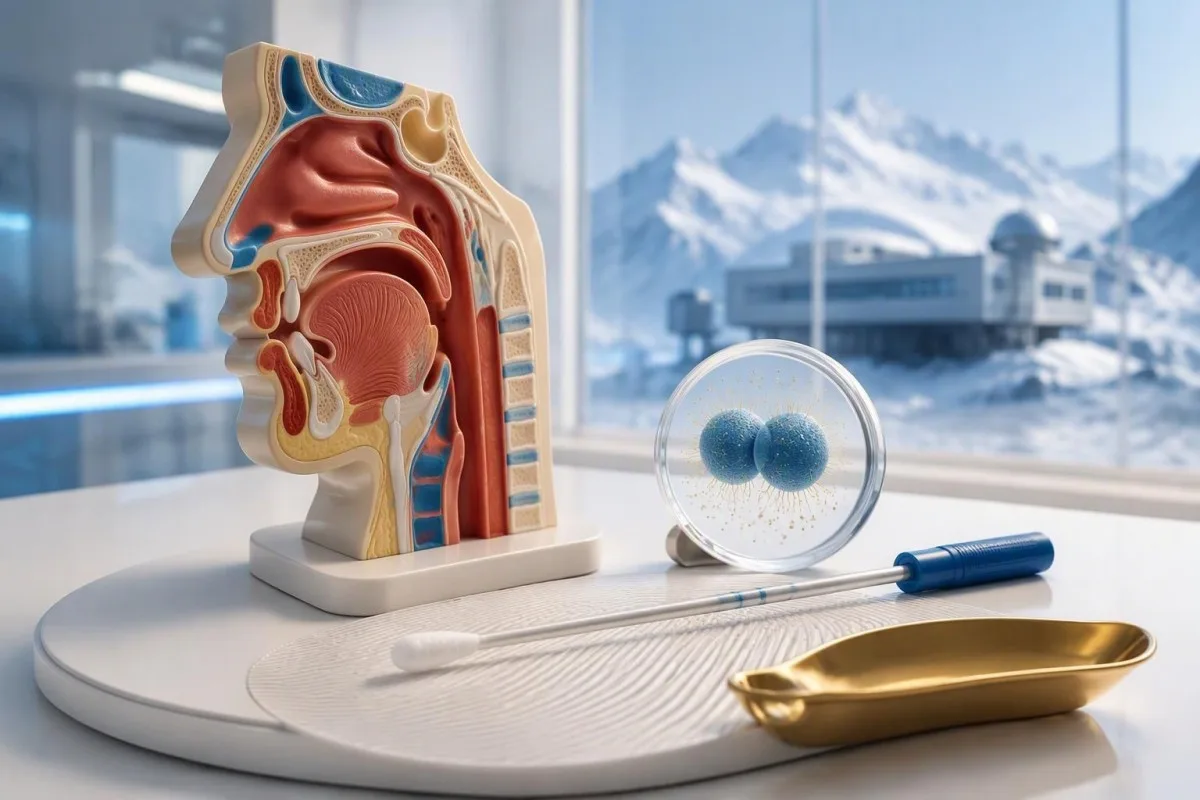
A throat swab checks whether treatment worked; a later screen checks whether gonorrhea returned. Those appointments answer different questions.


- Throat gonorrhea follow-up requires a test of cure 7–14 days after treatment under CDC guidance, even when symptoms have disappeared.
- Uncomplicated genital and rectal gonorrhea usually does not require a test of cure after a CDC-recommended or accepted alternative regimen.
- Three-month gonorrhea retesting checks for reinfection and is recommended after treatment regardless of whether partners report receiving treatment.
- Early NAAT testing can detect genetic material from bacteria that treatment has already killed; a day-7 positive does not automatically prove treatment failure.
- The correct specimen matters: a urine result cannot confirm that a throat infection has cleared.
- A positive throat NAAT should prompt clinician review and an attempt to obtain confirmatory culture before retreatment, especially when no culture was collected initially.
- Anhaltende Beschwerden that do not resolve within 3–5 days require assessment rather than waiting for the three-month screening visit.
- Sex nach der Behandlung should wait at least 7 days and until partners have been treated and symptoms have resolved; follow any stricter instructions from your clinic.
Gonorrhea retesting means two different follow-up tests
Throat gonorrhea needs a test of cure 7–14 days after treatment because it is harder to eradicate and warrants confirmation of clearance. Uncomplicated genital and rectal infections usually do not need that check after recommended therapy. Everyone treated for gonorrhea should also be retested at about 3 months for reinfection; an early NAAT can remain positive from residual bacterial genetic material.
A test of cure asks whether the original infection survived treatment; a reinfection screen asks whether another infection has occurred since treatment. The CDC separates these appointments explicitly in its 2021 STI Treatment Guidelines, recommending the early check for pharyngeal infection and the approximately 3-month screen for everyone treated for gonorrhea (Workowski et al., 2021).
The appointment name should appear on your discharge instructions, not just the word “retest.” Consider a hypothetical patient treated on October 21: a throat cure check belongs between October 28 and November 4, while reinfection screening belongs around January 21. Our explanation of chlamydia testing windows shows why even tests ordered together may need different follow-up dates.
Kantesti ist ein AI-Bluttest-Auswertungsplattform, but gonorrhea cure confirmation depends on site-specific microbiology rather than a routine blood panel. I’m Thomas Klein, writing as Chief Medical Officer; my clinical priority here is to keep those 2 kinds of testing separate. Our Unternehmenshintergrund explains the organization behind this educational resource, which does not replace a sexual-health appointment.
Why throat gonorrhea needs a 7–14-day cure check
Pharyngeal gonorrhea is more difficult to eradicate than uncomplicated infection at genital or rectal sites. The CDC therefore recommends a test of cure 7–14 days after treatment for every diagnosed throat infection, whether the patient received the recommended treatment or an alternative regimen.
The pharynx has distinctive antibiotic-exposure requirements, and the same treatment outcome cannot simply be assumed across all anatomical sites. CDC guidance notes that pharyngeal pharmacokinetics may require longer exposure above the organism’s minimum inhibitory concentration than genital infection. That is part of the rationale for a separate 7–14-day confirmation step, not evidence that most treated throat infections persist.
A throat infection can be clinically quiet, so absence of a sore throat is not a useful cure test. If someone has no symptoms before treatment and none afterward, there are 0 symptom changes available to establish clearance. The repeat throat specimen supplies evidence that the patient’s own symptom monitoring cannot provide; feeling fine and being microbiologically cured are different observations.
The throat also contains other Neisseria species, creating opportunities for genetic exchange relevant to antimicrobial resistance. That concern supports careful follow-up, but a positive day-7 result still needs interpretation rather than an immediate resistance label. Our guide to STI tests after antibiotics explains another practical distinction: antibiotic exposure affects direct organism tests differently from antibody-based blood tests.
Why genital and rectal infections usually need no cure test
Routine gonorrhea test of cure is unnecessary for uncomplicated genital or rectal infection treated with a CDC-recommended or accepted alternative regimen. That exception does not cancel the approximately 3-month reinfection screen, and it does not apply to persistent symptoms, suspected treatment failure, or complicated infection.
The decision is based on the infection site, treatment regimen, and clinical course—not simply whether the original result said “positive.” For example, an uncomplicated rectal infection treated correctly with resolving symptoms generally needs the 3-month reinfection appointment rather than an automatic early NAAT. Adding an unnecessary early test can create an ambiguous result without changing appropriate care.
A treatment course outside the guideline changes the conversation. If someone received leftover tablets, vomited an oral dose, missed prescribed doses, or cannot identify the medication, there are at least 4 reasons not to assume the usual no-cure-test rule applies. A clinician should first establish whether adequate treatment occurred; ordering another test alone cannot repair an inadequate regimen.
Persistent discharge or urinary discomfort may come from another infection or a noninfectious condition, even after gonorrhea has cleared. Symptoms continuing beyond 3–5 days deserve reassessment, with testing selected for the symptoms and exposures rather than reflexively repeating every organism on a broad panel. Our discussion of positive Ureaplasma results explains why detecting another organism does not always mean another antibiotic is needed.
Why an early positive NAAT may not mean live gonorrhea
A gonorrhea NAAT can remain positive after successful treatment because it detects bacterial DNA or RNA, not necessarily living bacteria. Testing at the early end of the 7–14-day throat follow-up window increases the chance of a misleading positive result, particularly when the assay detects residual genetic material.
RNA detection does not reliably solve the live-versus-dead problem. In a prospective cohort using an RNA-based throat assay, Barbee and colleagues reported a median clearance time of 3 days, but clearance in more than 95% of participants required approximately 12 days (Barbee et al., 2022). The slower-clearing minority is precisely why a population median should not become an individual testing deadline.
That 12-day finding is useful, but it is not a universal rule for every laboratory. The study involved a particular assay and a cohort of men who have sex with men; specimen collection, assay targets, and patient populations can differ. For an asymptomatic patient, arranging NAAT toward days 12–14 may reduce ambiguity, provided the clinic agrees and follow-up is not lost.
A qualitative positive result does not provide a standardized measure of bacterial burden or contagiousness. There is no universally validated gonorrhea cycle-threshold cutoff that a patient can use to declare cure, and 2 different assay systems may not report comparable signals. Our guide to qualitative vs. quantitative Ergebnisse explains why “detected” should not be treated as a severity score.
Culture and NAAT answer different questions after treatment
NAAT is generally more sensitive for detecting gonorrhea, while culture can demonstrate viable organisms and support antibiotic-susceptibility testing. For throat test of cure at 7–14 days, CDC guidance allows either method; a positive NAAT should prompt an attempt at confirmatory culture before retreatment.
Culture requires careful collection and handling because gonococci are demanding organisms outside the body. Transport delays, collection problems, or antibiotics given before sampling can reduce recovery; a negative culture therefore does not always settle a discordant positive NAAT. The practical question is whether the laboratory received an appropriate throat specimen under suitable conditions, not merely whether 1 test was marked negative.
Susceptibility testing becomes particularly valuable when a cure-check culture is positive. The CDC recommends antimicrobial-susceptibility testing on positive test-of-cure cultures, allowing the clinician to investigate whether the treatment drug remains active (Workowski et al., 2021). Before another antibiotic is given, ask whether 2 specimens—one for NAAT and one for culture—would help preserve the evidence needed to resolve the case.
Kantesti ist ein KI-Labor-Befundinterpretationsservice; in gonorrhea follow-up, explaining 2 discordant results is not the same as establishing whether viable bacteria remain. Our Ansatz zur klinischen Validierung describes the importance of defined evidence and oversight. The AI report safety guide also explains why source checking matters when a result could lead to additional antibiotic treatment.
The treatment dose matters before you interpret a retest
Adequate treatment must be established before a gonorrhea retest after treatment can be interpreted. CDC guidance recommends ceftriaxone 500 mg intramuscularly once for uncomplicated infection in people weighing under 150 kg, and 1 g once for people weighing 150 kg or more.
Dosing recommendations differ internationally, so a number on the treatment record should be interpreted against the applicable guideline. WHO’s 2024 recommendations suggest ceftriaxone 1 g intramuscularly once for gonococcal infection, while the CDC uses the 500 mg and 150 kg threshold described above (WHO, 2024; Workowski et al., 2021). Neither difference means that a patient should supplement an already prescribed dose without advice.
A separate chlamydia prescription may accompany gonorrhea treatment when chlamydia has not been excluded. Under CDC guidance, nonpregnant patients may receive doxycycline 100 mg twice daily for 7 days for that purpose; pregnancy requires a different chlamydia treatment choice. Finishing doxycycline does not substitute for the ceftriaxone dose needed to treat gonorrhea, and it does not remove the throat cure-check appointment.
A penicillin-allergy label is not automatically a ceftriaxone contraindication. CDC guidance reports cross-reactivity below 1% between third-generation cephalosporins and IgE-mediated penicillin allergy, but a history of severe reactions still demands individual assessment. Our guide to penicillin allergy reassessment explains why the reaction history matters; for pharyngeal gonorrhea, severe ceftriaxone allergy warrants specialist advice because reliably effective alternatives are limited.
What happens if the throat cure check is positive?
A positive throat cure check needs prompt clinician review, but it does not by itself distinguish residual genetic material, reinfection, or treatment failure. The next steps depend on the assay, whether the sample was collected on day 7 or day 14, symptoms, treatment documentation, and sexual exposure after treatment.
The most useful first questions are concrete: what drug and dose were given, on what date, which site was sampled, and was there sexual contact afterward? Those 4 details can change the interpretation more than the word “positive.” If the patient is stable, obtaining culture before additional antibiotics may help distinguish a microbiological problem from an early-NAAT timing problem.
CDC guidance considers treatment failure when symptoms do not resolve within 3–5 days, or when culture remains positive more than 72 hours after treatment or NAAT remains positive more than 7 days afterward, without sexual re-exposure. These are investigation triggers—not proof of resistance. The known persistence of nucleic acids, especially in the throat, makes timing and confirmatory testing central to that assessment.
A normal white-cell count or CRP cannot establish that a positive throat swab is harmless. There are 0 routine inflammatory-marker thresholds that confirm gonorrhea cure; localized infection may produce little systemic signal. My approach is to avoid letting an unrelated reassuring panel override microbiology, a distinction explored in our guide to Diskrepanzen zwischen WBC und CRP.
Why everyone needs gonorrhea retesting at three months
Gonorrhea retesting at approximately 3 months screens for reinfection, even after a negative throat test of cure. CDC guidance recommends this later screen regardless of whether patients believe their partners were treated, because a documented cure does not provide immunity against another infection.
A negative early throat result answers a question about that specimen at that time. It cannot protect against infection acquired weeks later or certify that every anatomical site was negative. At the 3-month visit, exposure history should determine whether urine, vaginal, rectal, or throat sampling is appropriate; the later screen is not necessarily just another copy of the original swab.
Booking the later appointment before leaving treatment is more reliable than expecting yourself to remember it. If approximately 3-month testing cannot happen, the CDC recommends retesting at the next healthcare encounter within 12 months. That fallback is a practical safety net, not a reason to postpone an available earlier screen or ignore symptoms occurring before the appointment.
Reinfection prevention also requires treating each diagnosed infection according to its own rules. Gonorrhea, chlamydia, and trichomoniasis can appear in the same sexual-health workup, but 1 negative gonorrhea result does not clear the others. Our guide to trichomoniasis test timing explains why follow-up schedules and specimen choices should be documented separately rather than combined into a vague “STI retest.”
When can you have sex, and which partners need treatment?
CDC guidance advises avoiding sexual activity for 7 days after gonorrhea treatment and until partners have been treated and symptoms have resolved. Recent partners from the preceding 60 days should be evaluated, tested, and presumptively treated; follow any stricter throat-specific instructions from your clinic.
The 7-day interval is not a substitute for partner treatment. If one person receives treatment on Monday and the partner receives treatment later, the couple should not use the first person’s Monday date as permission to resume sex. Ask the clinic to clarify when its abstinence instructions are satisfied for both people, including whether a pending throat cure check changes local advice.
The most recent partner still needs evaluation and treatment when the last sexual contact occurred more than 60 days before diagnosis. Partner-notification services can help when direct disclosure is difficult, and expedited partner treatment may be available where legally permitted and clinically appropriate. However, a partner’s throat exposure deserves attention because oral partner regimens may be less dependable at the pharyngeal site.
A gonorrhea diagnosis should also trigger testing for chlamydia, syphilis, and HIV; HIV-negative patients should be offered discussion of PrEP where appropriate. Kantesti’s educational material keeps those 3 additional infections separate from gonorrhea cure assessment. If a possible HIV exposure occurred within 72 hours, seek urgent PEP assessment rather than waiting for the gonorrhea appointment; our HIV-Tests nach PEP guide explains the later testing schedule.
A negative urine test cannot confirm throat clearance
Throat gonorrhea follow-up requires a throat specimen; a urine NAAT does not test the pharynx. Gonorrhea can be present at 1 anatomical site while absent at another, so testing must match the diagnosed site and relevant exposures rather than relying on a general “negative STI test.”
The original report should identify both the organism and the specimen source. Before a 7–14-day cure check, confirm that the request says pharyngeal or throat gonorrhea, especially if scheduling staff only see a generic retest order. An accurately processed urine sample can still answer the wrong clinical question when the infection being followed was in the throat.
Routine urinalysis is not a gonorrhea NAAT, and a standard urine culture for urinary pathogens is not a substitute either. That leaves at least 3 distinct urine-based investigations that patients may understandably confuse: dipstick testing, routine culture, and organism-specific NAAT. Our explanation of urine dipstick findings helps distinguish urinary inflammation clues from a test that actually targets gonorrhea.
Collection instructions differ between specimen types, so follow the laboratory’s directions rather than improvising. Many urine NAAT protocols use first-catch urine, whereas routine urine culture commonly uses a different collection approach; 1 collection technique is not appropriate for every order. Throat sampling quality also matters, and an uncollected or inadequately collected throat specimen cannot be rescued by a reassuring result from another site.
Symptoms that should not wait for scheduled retesting
Persistent symptoms beyond 3–5 days after treatment need clinical reassessment, and severe symptoms need urgent care sooner. New severe pelvic pain, sudden testicular pain, fever with joint pain or rash, or eye pain and discharge should not be managed by simply booking another gonorrhea NAAT.
Sudden testicular pain is an emergency because torsion must be excluded, even when an STI diagnosis seems to explain the discomfort. Severe pelvic pain, especially with fever or possible pregnancy, also requires prompt assessment for conditions beyond uncomplicated gonorrhea. Neither the 7–14-day cure window nor the 3-month reinfection schedule is a safe waiting period for these symptoms.
Fever with a painful swollen joint or a new rash can suggest disseminated gonococcal infection, although other illnesses can produce the same combination. Complicated infection requires examination, appropriate sampling, and a different treatment plan; the single 500 mg outpatient dose discussed for uncomplicated infection is not the whole protocol. Eye symptoms warrant urgent assessment because gonococcal eye disease can threaten vision.
Continuing genital symptoms may require evaluation for herpes, chlamydia, trichomoniasis, or noninfectious causes rather than another automatic gonorrhea prescription. A separate positive antibody result also has its own confirmation rules, particularly when it is a low-positive screening result. Our guide to HSV-2 confirmation steps illustrates why 2 positive tests for different infections should not be interpreted as equivalent evidence of active disease.
Pregnancy and special circumstances change follow-up planning
Pregnancy does not remove the need for a 7–14-day throat gonorrhea test of cure. Pregnancy, complicated infection, severe antibiotic allergy, suspected resistance, and safeguarding concerns require individualized care; additional antenatal screening may be needed even when routine genital gonorrhea cure testing is not indicated.
Gonorrhea and chlamydia have different pregnancy follow-up requirements. CDC guidance recommends a chlamydia NAAT test of cure approximately 4 weeks after treatment during pregnancy, whereas the throat gonorrhea check remains at 7–14 days. A patient treated for both infections may therefore receive 2 cure-check dates without either appointment being a scheduling mistake; documenting the organism beside each date prevents confusion.
Pregnant patients treated for gonorrhea should still have repeat testing approximately 3 months later, with third-trimester screening guided by age, ongoing risk, and antenatal policy. The appropriate schedule depends on gestational timing as well as exposure, so the sexual-health service and maternity team should share the plan. Our women’s health context guide offers background education, but hormonal symptoms cannot establish STI clearance.
Children, sexual-assault survivors, and people with complicated or suspected resistant infection should not be placed into a standard adult self-service retesting pathway. Consent, safeguarding, specialist sampling, and public-health involvement may be required, with decisions extending beyond the usual 2 follow-up appointments. Confidential care is still available; tell the clinic when sharing appointment details or contacting a partner could create a safety risk.
What a lab report can—and cannot—tell you about cure
A useful gonorrhea follow-up report identifies the organism, specimen site, test method, and collection date. A report without those 4 details is harder to interpret, and routine blood biomarkers cannot fill the gap; the treatment date and any re-exposure history also need to accompany the result.
Kantesti ist ein KI-Bluttestanalysator, and the 7–14-day throat cure decision belongs with the treating sexual-health clinician and microbiology laboratory. Our platform’s blood-panel role does not establish gonorrhea clearance, prescribe retreatment, or replace a throat swab. Even when a broader lab report includes STI information, the relevant evidence remains the actual site-specific result and its clinical context.
A personal follow-up record needs only a few reliable fields: treatment date and dose, original positive sites, planned cure-check date, result, and approximately 3-month screening date. Keeping these 6 items together is more useful than collecting repeated nonspecific blood panels. If the report says “detected” without identifying the method or specimen, ask the clinic for clarification before drawing conclusions about persistence or contagiousness.
Sexual-health information deserves deliberate privacy choices, especially on shared phones or family accounts. Review safe report-upload practices before uploading a document, and remove unnecessary identifiers where possible. Our Leitlinien zu Datenschutz und Daten explains handling considerations; consent to share 1 family member’s results does not authorize disclosure of another person’s STI history.
Your practical throat gonorrhea follow-up checklist
Before leaving treatment, confirm the correct dose, book the throat cure check for 7–14 days, and arrange reinfection screening at approximately 3 months. If symptoms persist, a cure check is positive, or sexual re-exposure occurs, contact the clinic rather than independently repeating tests or taking leftover antibiotics.
The most useful question is often, “Is this appointment checking cure or checking for reinfection?” Follow it with, “Will the sample actually come from my throat, and will you need culture if the NAAT is positive?” Those 3 questions prevent common workflow errors without requiring you to become a microbiologist; ask for the answers in writing if the treatment visit feels rushed.
As of October 21, 2026, this article’s named sources are the CDC’s 2021 STI Treatment Guidelines, WHO’s 2024 treatment recommendations, and Barbee’s 2022 pharyngeal-clearance study—not an unverified claim about a newly issued 2026 guideline. Local services may use a different operational schedule, especially for NAAT-only follow-up. Follow the treating clinic’s current instructions and ask what evidence supports any timing that differs from the CDC window.
Thomas Klein’s editorial emphasis for Kantesti is simple: 2 correctly timed appointments are more useful than repeated testing without a defined question. Our medizinische Inhaltsstandards describe the evidence and review principles used for health education. The practical endpoint is documented clearance where required, treated partners, and a booked reinfection screen—not merely a result that looks reassuring on a phone.
Häufig gestellte Fragen
Wann sollte ich mich nach der Behandlung einer Gonorrhö im Rachen erneut testen lassen?
Die CDC-Leitlinien empfehlen 7–14 Tage nach der Behandlung einen Kontrolltest auf Rachengonorrhö, mittels Kultur oder NAAT. Bei einem NAAT-Test an Tag 7 besteht ein höheres Risiko, trotz erfolgreicher Behandlung noch verbliebenes bakterielles Erbmaterial nachzuweisen. Bei einer asymptomatischen Person kann die Klinik den späteren Teil des Zeitfensters bevorzugen, um uneindeutige Ergebnisse zu vermeiden. Anhaltende Symptome oder eine neue Exposition erfordern eine ärztliche Beurteilung, anstatt einfach auf den geplanten Abstrich zu warten.
Brauche ich nach einer genitalen oder rektalen Gonorrhö-Infektion einen Test auf Heilung?
Eine unkomplizierte genitale und rektale Gonorrhö erfordert nach einer von der CDC empfohlenen oder akzeptierten alternativen Behandlung in der Regel keinen Test auf Heilung. Eine erneute Testung nach etwa 3 Monaten wird weiterhin empfohlen, um eine Reinfektion festzustellen. Anhaltende Symptome, eine ungewisse Behandlung, ein vermutetes Therapieversagen oder eine komplizierte Infektion erfordern eine andere Beurteilung. Bei einer diagnostizierten Racheninfektion ist eine eigene Heilungskontrolle nach 7–14 Tagen erforderlich, auch wenn ein genitaler Befund inzwischen negativ geworden ist.
Warum ist mein Gonorrhoe-NAAT nach der Behandlung immer noch positiv?
Ein positiver Gonorrhö-NAAT nach der Behandlung kann auf verbliebene bakterielle DNA oder RNA, eine Reinfektion oder eine persistierende Infektion zurückzuführen sein. Ein Ergebnis aus dem Rachen am 7. Tag ist besonders schwierig zu interpretieren, da bei manchen erfolgreich behandelten Patienten noch nachweisbares genetisches Material vorhanden ist. In einer Studie zur RNA-Clearance im Rachen dauerte es bei mehr als 95% etwa 12 Tage, bis das Material nicht mehr nachweisbar war. Wenden Sie sich an die behandelnde Klinik; die CDC-Leitlinien empfehlen, vor einer erneuten Behandlung eine Bestätigungskultur anzustreben, wenn ein NAAT zur Heilungskontrolle im Rachen positiv ist.
Benötige ich trotzdem nach drei Monaten einen erneuten Test, wenn mein Test zur Heilungskontrolle negativ ist?
Ja, ein negativer Gonorrhö-Test zur Bestätigung des Behandlungserfolgs hebt die Empfehlung für ein erneutes Screening auf eine Reinfektion nach etwa 3 Monaten nicht auf. Die Erfolgskontrolle beurteilt die ursprünglich behandelte Infektion, während das spätere Screening nach einer danach erworbenen Infektion sucht. Eine durchgemachte Gonorrhö bietet keine verlässliche Schutzimmunität. Wenn ein Test nach drei Monaten nicht möglich ist, empfehlen die CDC-Leitlinien eine erneute Testung beim nächsten Arztbesuch innerhalb von 12 Monaten.
Can a urine test or blood test show that throat gonorrhea is cured?
A urine gonorrhea NAAT cannot confirm throat clearance because it tests a different anatomical site. A throat test of cure requires a throat specimen collected 7–14 days after treatment under CDC guidance. Routine blood counts, CRP, and other standard blood biomarkers also cannot establish gonorrhea cure. Ask the clinic to confirm the specimen source and assay on the follow-up order.
How long should I avoid sex after gonorrhea treatment?
CDC guidance advises avoiding sexual activity for 7 days after gonorrhea treatment and until partners have been treated and symptoms have resolved. The first treated person’s date should not be used to bypass the partner’s treatment instructions. Some clinics provide stricter advice while a throat cure check is pending, so follow the instructions from your treating service. Sexual re-exposure can cause reinfection and complicate interpretation of a later positive result.
What if gonorrhea symptoms do not improve after treatment?
Symptoms that do not resolve within 3–5 days after gonorrhea treatment need clinical reassessment. The clinician may investigate persistent gonorrhea, another infection, or a noninfectious cause and may collect culture before prescribing additional antibiotics. Sudden testicular pain, severe pelvic pain, eye symptoms, or fever with joint pain require urgent assessment sooner. Do not wait for the 7–14-day cure check or three-month screen when severe symptoms develop.
Hol dir heute eine KI-gestützte Bluttest-Analyse
Schließe dich über 2 Millionen Nutzern weltweit an, die Kantesti für sofortige, genaue Laboranalysen vertrauen. Lade deine Blutwerte Ergebnisse hoch und erhalte in Sekunden eine umfassende Interpretation von 15,000+-Biomarkern.
📚 Referenzierte Forschungsveröffentlichungen
Klein, T., Mitchell, S., & Weber, H. (2026). Frauengesundheitsratgeber: Eisprung, Wechseljahre & hormonelle Symptome. Kantesti KI-Medizinische Forschung.
Klein, T., Mitchell, S., & Weber, H. (2026). Mehrsprachige KI-gestützte klinische Entscheidungsunterstützung für die Früherkennung von Hantavirus-Triage: Design, technische Validierung und reale Implementierung bei 50.000 interpretierten Bluttestergebnissen. Kantesti KI-Medizinische Forschung.
📖 Externe medizinische Referenzen
Barbee LA et al. (2022). Time to Clearance of Neisseria gonorrhoeae RNA at the Pharynx following Treatment. Journal of Clinical Microbiology.
Weltgesundheitsorganisation (2024). Updated recommendations for the treatment of Neisseria gonorrhoeae, Chlamydia trachomatis and Treponema pallidum (syphilis), and new recommendations on syphilis testing and partner services. Leitlinie der Weltgesundheitsorganisation.
⚕️ Medizinischer Haftungsausschluss
Dieser Artikel dient nur zu Bildungszwecken und stellt keine medizinische Beratung dar. Wende dich für Diagnose- und Behandlungsentscheidungen immer an eine qualifizierte medizinische Fachkraft.
E-E-A-T Vertrauenssignale
Erfahrung
Ärztlich geleitete klinische Überprüfung von Labor-Interpretations-Workflows.
Sachverstand
Fokus der Labormedizin darauf, wie Biomarker sich im klinischen Kontext verhalten.
Autorität
Verfasst von Dr. Thomas Klein, überprüft von Dr. Sarah Mitchell und Prof. Dr. Hans Weber.
Vertrauenswürdigkeit
Evidenzbasierte Interpretation mit klaren nächsten Schritten zur Reduzierung von Alarm.