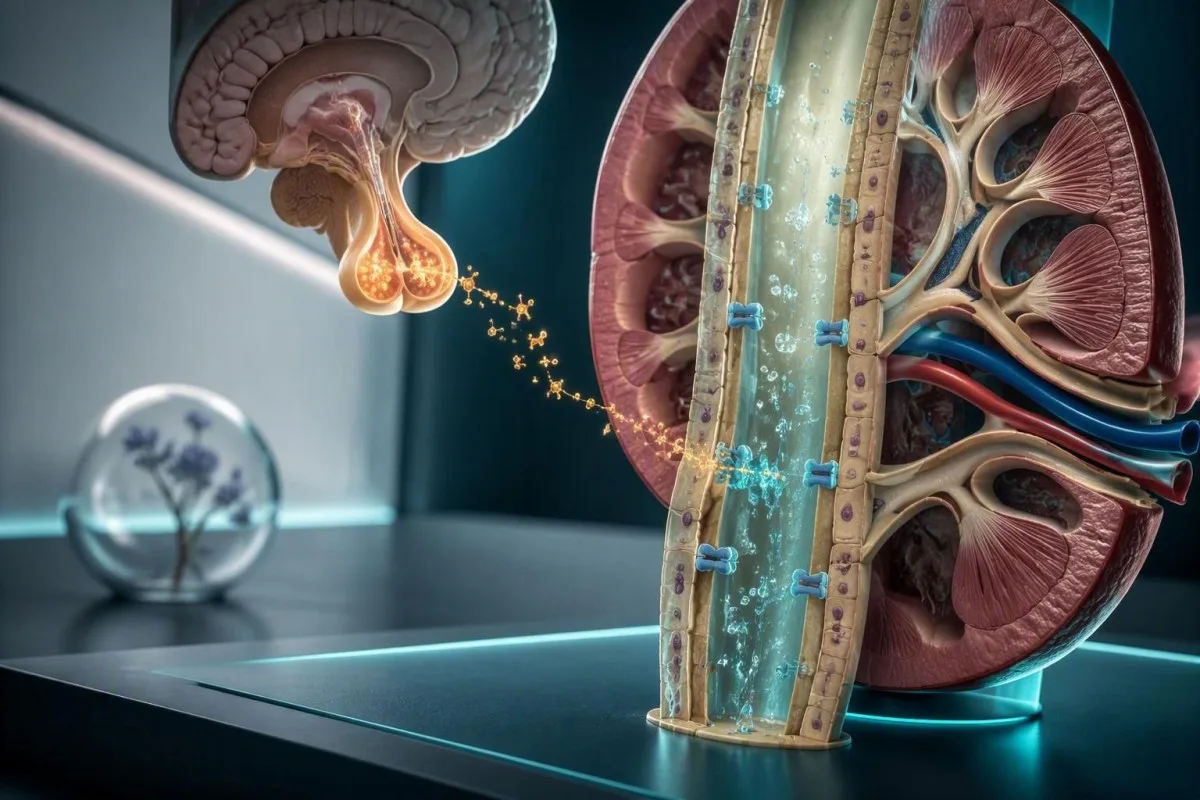
A high copeptin result usually reflects vasopressin-system activation from dehydration, physical stress, or illness—not a diagnosis by itself. Its real value comes from reading it beside sodium, serum osmolality, urine osmolality, and collection conditions.


- High copeptin often reflects dehydration, nausea, pain, exercise, infection, surgery, or low circulating volume rather than a single disease.
- Copeptin ≥21.4 pmol/L in a hypotonic polyuria work-up strongly supports nephrogenic diabetes insipidus when measured with appropriate clinical context.
- Stimulated copeptin >4.9 pmol/L after a supervised hypertonic-saline protocol generally argues against central diabetes insipidus and supports primary polydipsia.
- Low sodium plus high copeptin can occur in SIADH, but copeptin alone cannot confirm SIADH because stress and medications also raise it.
- Serum sodium 135–145 mmol/L and measured serum osmolality about 275–295 mOsm/kg are essential paired results for interpreting copeptin.
- 尿液渗透压(Urine osmolality) <300 mOsm/kg during hypernatraemia or high serum osmolality suggests inadequate antidiuretic action and needs prompt clinical assessment.
- Collection conditions matter because strenuous exercise, vomiting, acute pain, fasting, and IV fluids can materially change copeptin concentrations.
- 紧急症状 with sodium ≥150 mmol/L, confusion, severe weakness, seizure, or inability to keep fluids down require urgent care rather than repeat outpatient testing.
What a high copeptin result usually means
A high copeptin level means the body has activated its arginine vasopressin system, usually to conserve water or respond to physiological stress. The result is most informative when it is paired with sodium and osmolality; a high number by itself cannot distinguish dehydration from SIADH, nephrogenic diabetes insipidus, acute illness, or a difficult sample collection day.
Copeptin is the stable C-terminal fragment released in equal amounts with arginine vasopressin (AVP). AVP itself breaks down rapidly and is technically awkward to measure, whereas copeptin remains measurable in plasma. In practical terms, copeptin tells us that the body has received a “hold on to water” signal, not why that signal was sent.
When I review a panel with copeptin above the laboratory interval, I first ask whether the sodium is high, low, or normal. High copeptin with sodium 148 mmol/L points us toward water loss or impaired renal water response; high copeptin with sodium 126 mmol/L points toward non-osmotic AVP release, including possible SIADH. This is one of those areas where context matters more than the flag beside the number.
Kantesti 是一个 人工智能血液检测分析仪 that reads copeptin beside electrolytes, kidney markers, glucose, and prior results rather than treating one hormone fragment as a verdict. A useful companion review is our guide to serum osmolality results, because measured osmolality often explains the result more clearly than copeptin alone.
Why laboratories do not share one universal upper limit
Copeptin assays differ, and many laboratories report only a method-specific reference interval rather than a disease cutoff. A result of 12 pmol/L may be ordinary in a person with mild dehydration but inappropriate in someone with high serum osmolality who is producing litres of very dilute urine.
Why copeptin rises when the body needs to save water
Copeptin rises when osmoreceptors detect concentrated body fluids or when the circulation is under stress. The hypothalamus releases AVP with copeptin, and AVP helps the kidney reabsorb water through collecting-duct V2 receptors.
A serum osmolality increase of only 1% to 2% can stimulate AVP release in a healthy person. That sensitivity explains why a long flight, diarrhoea, an overnight fast, or a sweaty workout can produce a meaningful copeptin rise without endocrine disease. 尿渗透压测试 shows whether the kidney actually followed the signal.
Non-osmotic stimuli can be stronger than thirst. Nausea, pain, hypoglycaemia, hypoxia, major exercise, infection, myocardial injury, and surgery all stimulate AVP release even when sodium is not high. I have seen copeptin interpreted as “dehydration” in a patient whose sodium was 133 mmol/L after severe nausea—an example of stress signalling, not simple water deficit.
Dr. Thomas Klein’s clinical rule is simple: a copeptin value has to make physiological sense. If sodium, glucose, urea, measured osmolality, urine osmolality, medication exposure, and the patient’s fluid intake tell different stories, repeat or dynamic testing is usually safer than forcing a diagnosis from a resting result.
Copeptin test results: useful thresholds and their limits
There is no single normal copeptin range that diagnoses every condition. In specialist evaluation of hypotonic polyuria, basal copeptin of at least 21.4 pmol/L strongly supports nephrogenic diabetes insipidus, while hypertonic-saline stimulated copeptin above 4.9 pmol/L generally supports primary polydipsia over central diabetes insipidus.
The 21.4 pmol/L threshold is designed for a specific problem: suspected nephrogenic diabetes insipidus in a person producing excessive dilute urine. It is not a general “danger level.” A person with severe gastroenteritis or acute coronary illness may exceed that value because copeptin is also a stress biomarker.
In the multicentre trial by Christ-Crain and colleagues, a copeptin cutoff of 4.9 pmol/L after hypertonic saline distinguished primary polydipsia from central diabetes insipidus with substantially better accuracy than water deprivation alone (Christ-Crain et al., 2018). This protocol requires serial sodium monitoring and should not be attempted by drinking less water at home.
Kantesti AI interprets copeptin test results by checking whether the requested cutoff matches the assay, clinical question, and collection protocol. For perspective on why a laboratory flag is not automatically a diagnosis, see 超出范围结果意味着什么的更好解释.
High copeptin from dehydration and volume loss
Dehydration commonly raises copeptin because concentrated plasma triggers AVP release. The most convincing pattern is high or rising sodium, serum osmolality above about 295 mOsm/kg, concentrated urine, and a history of fluid loss or limited access to water.
Dehydration does not always cause hypernatraemia. Someone who can drink freely may replace enough water to keep sodium at 140 mmol/L while still generating high copeptin and concentrated urine. Conversely, a sodium of 151 mmol/L with urine osmolality below 300 mOsm/kg is not the usual dehydration response and raises concern for diabetes insipidus or impaired thirst.
The BUN-to-creatinine pattern can offer a modest clue, but it is not definitive. Urea can rise with gastrointestinal bleeding, high protein intake, steroids, or catabolism; creatinine changes with muscle mass and medicines. Our detailed BUN 和肌酐比较 explains why neither marker replaces osmolality.
A 52-year-old endurance runner may have copeptin elevation after a race, a urine specific gravity above 1.025, and creatinine mildly above baseline for 24 to 48 hours. In my experience, a repeat morning sample after normal eating, drinking, and 24 hours without intense exercise is often more clinically useful than an alarmed interpretation of the post-race panel.
High copeptin causes beyond dehydration
Acute physiological stress is a major cause of high copeptin, even without a water-balance disorder. Nausea, pain, fever, sepsis, hypoxia, myocardial injury, stroke, surgery, severe exercise, and low blood pressure can all raise AVP and copeptin.
Copeptin has been studied as a prognostic biomarker in acute care because it integrates stress signalling. That usefulness also creates a common misunderstanding: it is not a screening test for heart attack, infection, or cancer in a well outpatient. A raised result obtained during illness may simply document that the neuroendocrine stress system was active.
Glucose deserves careful attention. Marked hyperglycaemia raises effective osmolality and can cause osmotic diuresis, thirst, and high copeptin; sodium should be interpreted after considering the glucose concentration. People with thirst and frequent urination should also review high glucose warning symptoms, particularly if ketones, vomiting, or weight loss are present.
Kantesti 是一个 AI 血液检查解读平台 that places acute-phase results in their time sequence, since a copeptin result during hospitalisation should not be compared casually with a healthy outpatient baseline. A recovering illness can change sodium, urea, creatinine, CRP, and fluid intake simultaneously.
Can high copeptin diagnose SIADH?
High copeptin can occur in SIADH, but it cannot diagnose SIADH on its own. SIADH is diagnosed from hypotonic hyponatraemia, inappropriately concentrated urine, urine sodium, normal thyroid and adrenal function, and exclusion of low effective circulating volume.
In SIADH, AVP activity is inappropriate for the low plasma osmolality, so copeptin may be measurable or high despite sodium below 135 mmol/L. Yet SIADH has several physiological subtypes, and copeptin overlaps substantially with nausea, medicines, pulmonary disease, and hospital stress. The more reliable practical framework is explained in our SIADH blood test guide.
The 2014 European hyponatraemia guideline defines hypotonic hyponatraemia using effective serum osmolality below 275 mOsm/kg and recommends urine osmolality and urine sodium early in the diagnostic sequence (Spasovski et al., 2014). A urine osmolality above 100 mOsm/kg shows antidiuretic activity, but it does not establish its cause.
Medication history changes the odds. SSRIs, carbamazepine, oxcarbazepine, desmopressin, some antipsychotics, cyclophosphamide, and thiazide diuretics can contribute to hyponatraemia; do not stop a prescribed medicine abruptly based on one result. Sodium below 120 mmol/L, seizure, confusion, repeated vomiting, or severe headache needs emergency assessment.
Copeptin and diabetes insipidus: the patterns clinicians use
Copeptin helps separate central diabetes insipidus, nephrogenic diabetes insipidus, and primary polydipsia in people with hypotonic polyuria. The starting question is whether urine output is truly excessive—typically more than 3 litres daily in an adult or more than 50 mL/kg per 24 hours—and whether urine is dilute.
Central diabetes insipidus results from inadequate AVP production or release, often after pituitary-region disease, neurosurgery, trauma, autoimmune inflammation, or infiltrative disease. In complete central DI, copeptin may be very low despite high sodium or high osmolality; a basal value below 2.6 pmol/L can support the diagnosis in the appropriate hyperosmolar setting.
Nephrogenic diabetes insipidus means the kidney does not respond adequately to AVP. Copeptin is usually high because the hypothalamus is sending the right signal, while urine remains inappropriately dilute. Lithium exposure, hypercalcaemia, hypokalaemia, chronic kidney disease, and inherited V2-receptor or aquaporin-2 defects are recognised causes; our 锂监测指南 covers one particularly important medication pathway.
Christ-Crain et al. (2018) found that copeptin-guided hypertonic-saline testing improved diagnostic accuracy for polyuria-polydipsia syndromes compared with the traditional water-deprivation approach. This does not mean every thirsty person needs copeptin: uncontrolled diabetes mellitus, diuretics, hypercalcaemia, kidney disease, and excessive caffeine intake should be considered first.
Why sodium and osmolality must be paired with copeptin
Sodium and measured serum osmolality determine whether a high copeptin level is physiologically appropriate. A result is generally appropriate when high copeptin accompanies hyperosmolality or fluid loss, and potentially inappropriate when it accompanies true hypo-osmolality and persistent concentrated urine.
Serum sodium normally runs about 135到145 mmol/L, although the laboratory interval should take priority. Measured serum osmolality is usually about 275 to 295 mOsm/kg; calculated osmolality may differ when ethanol, mannitol, radiocontrast agents, or other unmeasured osmoles are present. That gap can alter the entire interpretation.
Urine osmolality supplies the kidney-side answer. With hypernatraemia, a urine osmolality above 600 mOsm/kg usually shows a strong water-conserving response, whereas persistently dilute urine below 300 mOsm/kg suggests that AVP is absent or ineffective. Our 电解质面板 explains urgent combinations that should not wait for an online interpretation.
Kantesti’s neural network compares these values as a pattern and highlights contradictions, such as high copeptin with very dilute urine. That is a follow-up trigger, not a diagnosis: a timed 24-hour urine collection, simultaneous plasma and urine osmolality, and specialist-supervised stimulation testing may be needed.
How collection conditions can distort copeptin test results
Copeptin is highly sensitive to collection conditions because stress and acute fluid shifts stimulate AVP release. A value taken after strenuous exercise, vomiting, prolonged fasting, a painful procedure, IV fluid treatment, or acute illness may not reflect baseline water regulation.
For an outpatient baseline sample, I usually want the laboratory request to document time of draw, fluid intake, urine output, recent exercise, fever, nausea, and medicines. A patient who drank 3 litres in an hour to “prepare” for testing can suppress osmolality; someone who deliberately restricts water can create a potentially unsafe and misleading high-stress state.
Assay handling matters too. Copeptin is much more stable than AVP, but results remain method-dependent, and a laboratory’s stated specimen type and reference interval must be used. This is similar to the pre-analytical detail discussed in our ACTH时间指南, although copeptin itself is less fragile than ACTH.
As of September 19, 2026, I would not advise a home water-deprivation test. If a clinician suspects diabetes insipidus, controlled testing protects against sodium rising too rapidly; even mild baseline hypernatraemia can become dangerous when water access is restricted.
Medicines, kidney function, and high copeptin
Kidney disease and certain medicines can complicate a high copeptin result because they alter both water handling and biomarker clearance. Reduced eGFR, lithium, desmopressin, diuretics, glucocorticoids, and drugs that trigger nausea or SIADH all change the clinical picture.
Copeptin concentrations tend to rise as kidney function declines, so a result in chronic kidney disease should not be interpreted with a diabetes-insipidus cutoff designed for otherwise stable patients. eGFR below 60 毫升/分钟/1.73 平方米 is a meaningful contextual threshold, but acute kidney injury, age, muscle mass, and hydration all affect creatinine-based estimates.
Lithium can cause nephrogenic DI after long exposure, often with thirst, nocturia, and dilute urine. Hypercalcaemia and hypokalaemia can also reduce the kidney’s concentrating ability; a calcium of 2.75 mmol/L or potassium of 3.0 mmol/L deserves separate assessment even if copeptin is elevated. Read our overview of 钙轻微升高 for why calcium needs confirmation and cause-finding.
Kantesti 是一个 基于 AI 的血液检测分析工具 that can surface medication-sensitive clusters—sodium, potassium, calcium, eGFR, glucose, and osmolality—before a clinical review. It cannot determine whether a prescription should be changed, and medication decisions belong with the prescriber who knows the indication and timeline.
When high copeptin results need urgent medical care
A high copeptin number itself is rarely an emergency; the accompanying sodium, symptoms, and fluid balance determine urgency. Seek urgent assessment for confusion, seizure, fainting, severe weakness, inability to drink, persistent vomiting, or sodium at or above 150 mmol/L.
Hypernatraemia can cause intense thirst, irritability, lethargy, muscle twitching, and neurological symptoms as brain cells lose water. Adults with sodium ≥160 mmol/L have a particularly high risk of complications, but the rate of change matters as much as the absolute value. Our high sodium symptom guide outlines warning signs in plain language.
Hyponatraemia is the opposite biochemical problem but can coexist with high copeptin in SIADH or nausea-driven AVP release. Symptoms become more concerning when sodium falls rapidly, especially below 125 mmol/L; severe headache, confusion, seizure, and reduced consciousness warrant emergency services rather than oral salt or water experiments.
A practical point from Dr. Thomas Klein: do not respond to an unexplained copeptin result by forcing fluids or restricting fluids. Both can be harmful when sodium is abnormal. Bring the full laboratory report, medication list, 24-hour fluid estimate, and urine-output history to the clinician.
What clinicians usually check after elevated copeptin
The next step after elevated copeptin is usually a targeted fluid-balance assessment, not a repeat copeptin test alone. Clinicians commonly review simultaneous sodium, glucose, calcium, potassium, creatinine/eGFR, serum osmolality, urine osmolality, urine sodium, and 24-hour urine volume.
A reliable history can be surprisingly diagnostic. We ask about thirst that wakes someone at night, measured urine volume, new headache or visual symptoms, head injury, pituitary surgery, lithium, diuretics, pregnancy, and recent hospital care. Polyuria means high volume, not simply frequent small voids—a distinction that prevents many unnecessary DI referrals.
If hypotonic polyuria is confirmed, an endocrinologist may use a hypertonic saline copeptin protocol, copeptin after arginine stimulation, or a carefully supervised water-deprivation test depending on local expertise. The 4.9 pmol/L hypertonic-saline threshold cannot be transplanted into an unsupervised random sample. For accurate reporting, see our blood test PDF checklist.
Kantesti AI supports the preparation step by organising the relevant results and prior trends for a clinician conversation. Our 医学验证标准 explain why contextual interpretation and human clinical oversight remain necessary for complex endocrine testing.
Common misconceptions about high copeptin
High copeptin does not automatically mean SIADH, dehydration, diabetes insipidus, or a pituitary disorder. It signals AVP-system activity, and the same result can arise from several very different physiological states.
“High copeptin means diabetes insipidus” is backwards in many cases. In complete central DI, copeptin can be low because AVP release is deficient; in nephrogenic DI it can be high because AVP release is intact but the kidney does not respond. The urine and sodium pattern tells the difference.
“Drinking more water will fix the result” is also unsafe advice. Excessive free-water intake may worsen hyponatraemia in SIADH, while inadequate intake can worsen hypernatraemia in DI. The 低钠症状指南 is relevant because water advice must be matched to the actual sodium disorder.
A final misconception is that a normal sodium rules out a problem. Early DI, compensated polydipsia, or intermittent AVP stimulation can all occur with sodium between 135 and 145 mmol/L. Repeated paired tests under consistent conditions often reveal more than a single technically perfect but poorly timed result.
Using a copeptin result safely in real life
A copeptin result is safest when used as one piece of a documented fluid-balance story. Record the exact collection time, symptoms, recent fluid intake, urine output, exercise, illness, and medications before comparing it with a previous measurement.
Most patients find it helpful to write down fluid intake and urine volume for 24 hours before an endocrine appointment, without deliberately changing either. A measured urine volume over 3 litres per day, particularly with night-time thirst and low urine osmolality, is more actionable than a vague report of “urinating often.”
Kantesti can organise a copeptin report alongside sodium, osmolality, glucose, and kidney trends for discussion with a professional; our 临床用例示例 show how structured result summaries can reduce missed context. Our physician reviewers, listed on the 医疗顾问委员会, emphasise that dynamic endocrine protocols must remain clinician-led.
The bottom line is reassuring for many people: a high copeptin level often reflects a temporary and appropriate stress or dehydration response. But high copeptin plus major sodium disturbance, dilute urine despite hyperosmolality, or rapidly changing thirst and urine output warrants timely medical assessment rather than self-treatment.
Research publication and clinical evidence
The strongest current evidence supports copeptin mainly as a specialist diagnostic tool for polyuria-polydipsia syndromes, not as a stand-alone screening biomarker. Evidence publication and technical validation are useful, but neither replaces a clinician’s assessment of sodium, osmolality, symptoms, and safety.
The landmark randomised diagnostic comparison by Christ-Crain et al. used supervised hypertonic saline to evaluate copeptin in suspected diabetes insipidus and primary polydipsia (Christ-Crain et al., 2018). The European hyponatraemia guideline remains useful for SIADH-style work-ups because it prioritises serum and urine osmolality over isolated hormone values (Spasovski et al., 2014).
Kantesti Ltd is a privacy-focused health organisation, and Kantesti AI uses multilingual lab-context analysis with human clinical governance rather than claiming to diagnose endocrine disease from a PDF. Readers interested in methodology can review our AI技术指南 and the referenced research publications below.
Klein, T. (2026). Women’s Health Guide: Ovulation, Menopause & Hormonal Symptoms. Figshare. https://doi.org/10.6084/m9.figshare.31830721. ResearchGate 和 Academia.edu records may provide additional discovery routes. Klein, T. (2026). Multilingual AI Assisted Clinical Decision Support for Early Hantavirus Triage: Design, Engineering Validation, and Real-World Deployment Across 50,000 Interpreted Blood Test Reports. Figshare. https://doi.org/10.6084/m9.figshare.32230290. ResearchGate 和 Academia.edu records may provide additional discovery routes.
常见问题
促肾上腺皮质激素升高意味着什么?
较高的降钙素原水平通常意味着加压素系统活跃,原因常为脱水、血浆渗透压升高、恶心、疼痛、运动、感染或循环血容量低。它本身并不能诊断某种疾病。在评估低渗性多尿的患者时,基础降钙素原水平达到 21.4 pmol/L 或更高,强烈支持肾源性尿崩症,但该临界值并非用于一般筛查。钠、血清渗透压、尿液渗透压、症状和采集条件决定了其含义。.
脱水会导致高血管升压素原C水平吗?
是的。脱水会提高降钙素原水平,因为即使血浆渗透压升高 1% 至 2%,也会刺激抗利尿激素释放。通常伴随的模式是尿液浓缩、尿素升高,有时钠水平会高于 145 mmol/L,但如果个体能够饮水,钠水平也可能保持正常。尿液渗透压低于 300 mOsm/kg 的高钠血症并非典型的单纯脱水模式,需要临床评估。.
高的 copeptin 意味着 SIADH 吗?
不。高水平的降钙素原可能出现在 SIADH 中,但不能确诊 SIADH,因为恶心、疼痛、肺部疾病、药物和急性疾病也会升高降钙素原。SIADH 评估需要低渗性低钠血症,通常血清渗透压低于 275 mOsm/kg,尿液渗透压高于 100 mOsm/kg,尿钠评估,并排除甲状腺、肾上腺、肾脏和容量相关的原因。神经系统症状伴随钠低于 125 mmol/L 需要紧急治疗。.
测定何种降压素原水平提示尿崩症?
有用的血管加压素原(copeptin)阈值取决于所研究的尿崩症类型和检测方案。对于已确诊的低渗性多尿患者,至少 21.4 pmol/L 的基础血管加压素原水平强烈支持肾性尿崩症。在监督下的高渗盐水刺激后,超过 4.9 pmol/L 的血管加压素原通常支持原发性烦渴而非中枢性尿崩症。在适当的高渗环境下,完全性中枢性尿崩症可能表现出非常低的血管加压素原,包括低于 2.6 pmol/L 的值。.
在进行科肽素血检前,我需要多喝水吗?
Do not deliberately overdrink or restrict water before a copeptin test unless the ordering clinician gives specific instructions. Rapid water intake can lower osmolality and alter the physiology being measured, while water restriction can raise sodium and create avoidable risk. Record your usual fluid intake, recent exercise, vomiting, fever, medicines, and sample time instead. Specialist stimulation or deprivation tests require medical supervision with serial sodium measurements.
When is a high copeptin result urgent?
A high copeptin result is urgent when it occurs with dangerous fluid-balance symptoms or marked sodium abnormality, not because of the copeptin number alone. Seek urgent assessment for confusion, seizures, fainting, severe weakness, inability to drink, persistent vomiting, or sodium at or above 150 mmol/L. Sodium at or above 160 mmol/L is particularly concerning, especially when urine remains dilute. Do not try to correct major sodium abnormalities by forcing water, salt, or supplements at home.
立即获取AI驱动的血液检测分析
加入全球超过2,000,000名用户,他们信任Kantesti进行即时、准确的检验分析。上传你的血液检查结果,并在几秒内获得对15,000+生物标志物的全面解读。.
📚 参考研究论文
Klein, T., Mitchell, S., & Weber, H. (2026). 女性健康指南:排卵、更年期和激素症状. Kantesti AI医学研究。.
Klein, T., Mitchell, S., & Weber, H. (2026). 面向早期汉坦病毒分诊的多语言AI辅助临床决策支持:设计、工程验证与跨50,000份已解读血液检查报告的真实世界部署. Kantesti AI医学研究。.
📖 外部医学参考资料
⚕️ 医疗免责声明
本文仅用于教育目的,不构成医疗建议。诊断和治疗决策请始终咨询合格的医疗专业人员。.
E-E-A-T信任信号
经验
由医生主导的临床审阅:实验室解读工作流程。.
专业知识
实验室医学重点:生物标志物在临床情境中的表现。.
权威
由 Thomas Klein 博士撰写,并由 Sarah Mitchell 博士与 Hans Weber 教授审阅。.
可信度
基于循证的解读,并提供清晰的后续路径以减少警报。.