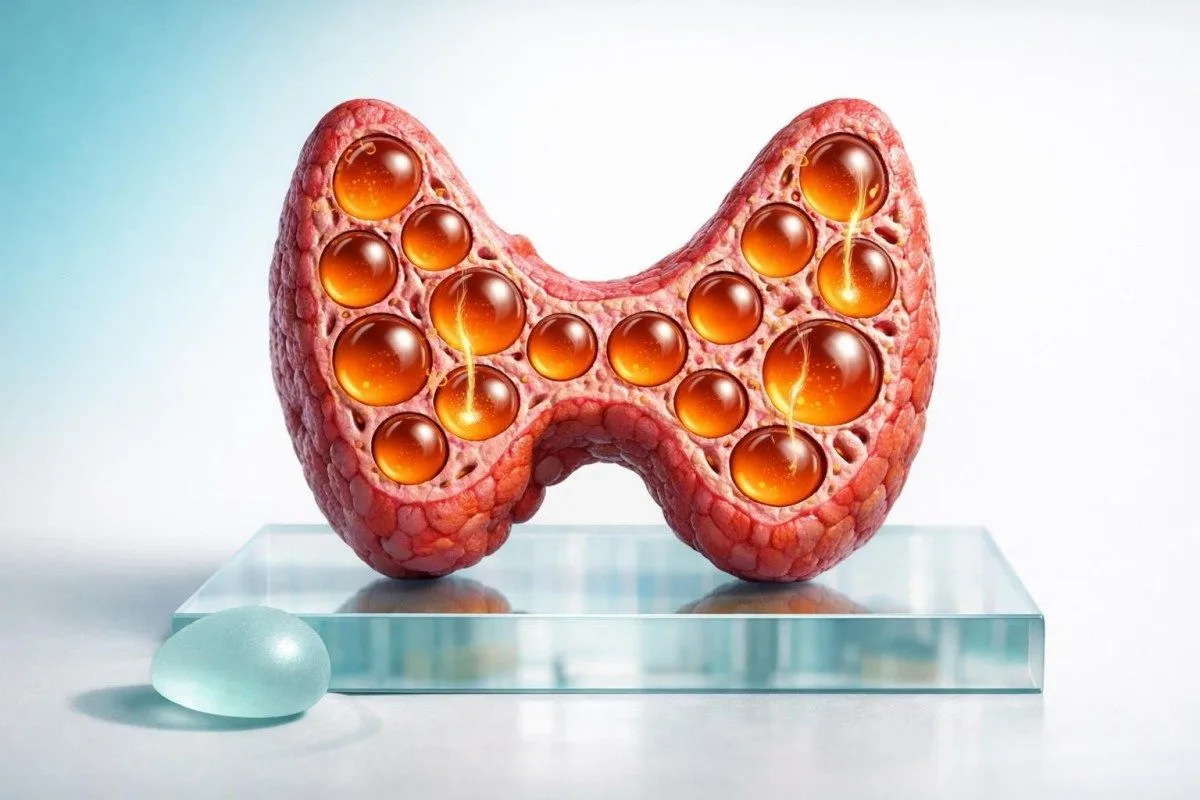
A normal TSH can coexist with low T3 for reasons that have little to do with permanent thyroid failure. I’ll show you how I sort conversion issues, illness effects, assay noise, and the few patterns that deserve a fuller workup.


- TSH in many adult labs is roughly 0.4-4.0 mIU/L, but a normal value does not rule out low T3 patterns.
- Free T4 is commonly 0.8-1.8 ng/dL; a low free T4 with normal TSH raises concern for central hypothyroidism.
- Free T3 is often 2.3-4.2 pg/mL; isolated low FT3 more often reflects illness, under-fueling, or timing than classic gland failure.
- Peripheral conversion produces about 80% of circulating T3 outside the thyroid, mainly through deiodinase enzymes.
- Biotin at 5,000-10,000 mcg/day can distort thyroid immunoassays and create misleading TSH, T4, or T3 results.
- Levothyroxine timing can shift free T4 for several hours after a dose; repeat testing should use the same timing conditions.
- Illness recovery can cause a temporary TSH rebound up to about 5-10 mIU/L for a few weeks without permanent hypothyroidism.
- Ferritin below 30 ng/mL and B12 below about 300 pg/mL can mimic thyroid symptoms even when TSH is normal.
Why low T3 can coexist with normal TSH
Low T3 with a normal TSH usually does not mean classic primary hypothyroidism. In practice, this pattern more often reflects reduced T4-to-T3 conversion, recent illness, calorie deficit, medication timing, or assay noise, while the pituitary still senses enough hormone to keep TSH levels in range. That is why I read T3 T4 levels as a system, not a single line item, and why patients often do better when results are reviewed on Kantesti AI alongside a solid free T4 guide.
About 80% of circulating T3 is produced outside the thyroid by deiodinase enzymes in liver, kidney, muscle, and brain. TSH mainly tells you what the pituitary senses, so a perfectly ordinary TSH of 1.6 mIU/L can sit next to a free T3 of 2.2 pg/mL when peripheral conversion slows.
One recent example was a 34-year-old schoolteacher with TSH 1.9 mIU/L, free T4 1.1 ng/dL, and free T3 2.3 pg/mL three weeks after influenza and a 4-kg weight loss. We repeated the panel six weeks later, without starting thyroid medicine, and the free T3 normalized; that sort of story is far more common than social media would have you believe.
Across more than 2 million user reports processed on Kantesti, we see this mismatch most often after illness, abrupt dieting, or medication changes. As of April 10, 2026, my rule is simple: if the numbers clash with the story, repeat the thyroid panel under cleaner conditions before committing someone to a lifelong label.
What T3, T4, and TSH actually measure on a thyroid panel
Adult TSH reference range in many labs is about 0.4-4.0 mIU/L, free T4 about 0.8-1.8 ng/dL, and free T3 about 2.3-4.2 pg/mL. Those numbers sound simple, but they measure different parts of the control system, which is why a 'normal thyroid test' is often not normal at all when you look closely.
Adult outpatient ranges commonly run TSH 0.4-4.0 mIU/L, free T4 0.8-1.8 ng/dL, free T3 2.3-4.2 pg/mL, and total T3 80-180 ng/dL. Some European labs use a slightly lower upper TSH boundary or report hormones in pmol/L, which is one reason people think their result changed when only the units changed.
TSH is a signal from the pituitary, not the hormone doing the work in tissues. T4 is largely a storage and transport hormone, while T3 has stronger receptor activity in the brain, heart, gut, and muscle; that separation explains many normal-TSH, low-T3 puzzles.
More than 99% of circulating thyroid hormone is protein-bound, so free and total tests can disagree when albumin or thyroid-binding globulin shifts. When that happens, I compare the pattern with our guides to low TSH patterns and high TSH interpretation, rather than treating one line on the report as gospel.
When the problem is conversion, not thyroid gland output
A true conversion issue means the gland is supplying enough T4 but the body is activating less of it into T3. The typical pattern is normal TSH, normal or high-normal free T4, and low or low-normal free T3, which is why many people first notice it on our AI blood test platform when the lab sheet looks internally contradictory.
Deiodinase 1 and 2 remove an iodine atom from T4 to form T3. Bianco's work in Endocrine Reviews made this point elegantly years ago: illness, fasting, inflammation, and some drugs can push the body toward lower active T3 without any structural damage to the thyroid itself.
The liver matters more than most patients realize because a meaningful share of peripheral conversion happens there. If a patient has low T3 plus abnormal ALT, AST, or GGT, I look at the whole metabolic picture and often review a liver enzyme pattern before I tell them the thyroid is the villain.
Patients often ask about reverse T3. I am not dogmatic about it, but most outpatient endocrine guidelines still do not recommend reverse T3 as a routine decision-maker; clinicians disagree on the cutoff, and the result rarely changes what I do next.
Why low selenium is only part of the story
Deiodinase enzymes are selenoproteins, so severe selenium deficiency can impair conversion, but in my experience it is rarely the lone explanation in someone eating a varied diet. A low T3 result is much more often a context problem than a single nutrient deficiency.
How illness and recovery temporarily distort T3 T4 levels
Acute illness can lower T3 within days even when the thyroid itself is normal. This non-thyroidal illness syndrome often produces low total T3, sometimes low free T3, normal or low TSH, and occasionally a mild TSH rebound during recovery.
In severe illness, total T3 usually falls first, sometimes by 20-50%, while free T4 stays normal early on. Fliers, Langouche, and Boelen have argued that this is an adaptive stress program, which is why blindly adding liothyronine outside select settings has never become routine care.
After major surgery, pneumonia, sepsis, or even a hard ICU stay, the thyroid numbers can look frankly strange. I have seen TSH 0.4 mIU/L with low T3 and normal T4 within 48 hours of a large operation, so I am very careful with panels drawn around pre-op blood work or acute admissions.
Recovery has its own trap: TSH can rebound into the 5-10 mIU/L range for a few weeks and then settle. If muscle injury or overtraining is also in play, pair the thyroid view with AST muscle versus liver clues so you do not misread the context.
Medication timing, biotin, fasting, and exercise that skew results
Medication timing and supplements can distort T3 T4 levels enough to create false patterns. The two culprits I see most are drawing labs soon after thyroid tablets and forgetting that biotin 5,000 to 10,000 mcg can skew common immunoassays.
Levothyroxine is slow overall, but blood drawn 2-4 hours after the dose can make free T4 look higher than a pre-dose sample. Liothyronine changes faster still, so I tell patients to repeat their panel under the same timing rules each time; the logic is very similar to our fasting rules before labs.
Biotin is a classic troublemaker. Doses of 5,000 to 10,000 mcg, common in hair and nail supplements, can falsely lower TSH or falsely raise T4 and T3 on some biotin-streptavidin immunoassays, which is why many hair-shedding patients also need a broader hair loss lab review.
Drugs matter too—amiodarone, glucocorticoids above roughly 20 mg prednisone daily, and high-dose propranolol can reduce T4-to-T3 conversion. And yes, very hard training plus low calorie intake can mimic endocrine disease; I have backed away from more than one scary-looking panel after simply asking about race week, sleep, and supplements.
When a full thyroid blood test matters more than TSH alone
A full thyroid blood test matters when symptoms and TSH do not match, when a patient uses thyroid medication, or when pituitary disease is on the table. My usual outpatient panel is TSH, free T4, free T3 or total T3, and thyroid peroxidase antibodies, with extras chosen by context.
When symptoms and TSH do not line up, my practical panel is TSH, free T4, total or free T3, TPO antibodies, and sometimes Tg antibodies or TRAb. Our physicians on the Medical Advisory Board keep returning to one point: low free T4 with normal TSH is never a result I ignore.
Central hypothyroidism is rare, but it is the reason TSH-only screening has blind spots. In that setting the TSH molecule may be quantitatively normal yet biologically weak, and age-specific interpretation helps—especially in pediatrics, where our TSH age guide for children and lab abbreviations guide are genuinely useful.
Pregnancy changes the math. Total T4 often rises by roughly 50% because thyroid-binding globulin rises, first-trimester TSH usually trends lower than the non-pregnant range, and symptoms like fatigue or constipation become much less specific.
A practical panel to discuss with your clinician
If the first panel is discordant, I usually add CBC, ferritin, B12, CMP, and sometimes prolactin or morning cortisol rather than ordering obscure thyroid markers. That broader lens catches the look-alikes and the rare pituitary cases faster.
Common low T3, normal TSH patterns and what they usually mean
The commonest low T3, normal TSH pattern is low free T3 with normal free T4, which usually suggests illness, under-eating, or recovery rather than thyroid failure. A more concerning version is low free T4 with an inappropriately normal TSH, because that can hint at pituitary disease.
Low free T3 with normal free T4 and TSH usually points to illness, under-fueling, or recovery. Low free T4 with normal TSH is the pattern that changes my tone, because it can signal central hypothyroidism, assay interference, or a very early evolving problem.
A low total T3 alone can be a binding-protein story rather than a hormone production story. Estrogen therapy, liver disease, nephrotic-range protein loss, and severe illness can all move total levels without meaning the thyroid gland itself has failed.
I worry more when the thyroid pattern sits beside headaches, visual symptoms, cycle changes, erectile issues, or unexpectedly high prolactin. That cluster deserves pituitary thinking and often a prolactin clue review.
Symptoms still matter. If the panel is odd and the patient is exhausted, cold, constipated, or foggy, I widen the workup instead of staring harder at T3 alone, which is why a structured fatigue lab workup often solves the mystery sooner.
When symptoms look thyroid-related but the thyroid is not the main issue
Fatigue, hair shedding, low mood, constipation, and palpitations are not specific to thyroid disease. In my clinic, iron deficiency, low B12, vitamin D deficiency, anxiety states, and poor sleep explain a large share of 'thyroid-like' symptoms when TSH is normal.
Ferritin below 30 ng/mL often tracks with fatigue and hair loss even when hemoglobin is still normal. That is why I regularly pair a thyroid review with a ferritin range check before anyone starts assuming lifelong thyroid medication.
Vitamin B12 below about 300 pg/mL can produce brain fog, tingling, and weakness that patients describe as hypothyroid. If the story fits, I also look at a vitamin B12 result and ask whether panic symptoms should prompt targeted anxiety blood tests.
This is one of those areas where context matters more than the number. Thomas Klein, MD, can review the same TSH 2.1 mIU/L in two patients and make very different plans if one has ferritin 12 ng/mL, B12 260 pg/mL, and a month of poor sleep.
Red flags that deserve repeat testing or an endocrinology review
Repeat testing or endocrinology review is sensible when free T4 is below range, TSH is below 0.1 or above 10 mIU/L, symptoms are escalating, or the history suggests pituitary disease. Pregnancy, new arrhythmia, significant unintentional weight loss, or neck swelling also move the case out of the watch-and-wait category.
For a stable outpatient, repeating the same lab in 6-8 weeks is usually better than repeating it in 6 days. Short-interval retesting mostly magnifies day-to-day noise, especially with sleep disruption, recent illness, or a different lab platform.
Low free T4 with normal TSH, unexplained hyponatremia, morning cortisol problems, new headaches, or visual field change should trigger a pituitary conversation. Our clinical standards page explains why combined-pattern reading beats single-marker reading in endocrine safety.
Pregnancy and the postpartum period deserve lower thresholds for review because thyroiditis can swing from suppressed TSH to elevated TSH over months. If hormone symptoms overlap with life-stage changes, our women's hormone guide helps frame what is thyroid and what may be something else.
How we interpret T3 T4 levels on Kantesti
Trend analysis beats a single snapshot, especially when T3 T4 levels shift with illness or medication timing. On Kantesti AI we interpret the whole report—units, reference intervals, neighboring markers, and symptom context—so a low T3 line is not read in isolation.
Kantesti serves users in 127+ countries and 75+ languages, and our 2.78T-parameter health model was built for messy real-world reports, not ideal textbook panels. As Thomas Klein, MD, I pushed hard for trend reading because in clinical practice two carefully timed results are often worth more than one dramatic outlier.
Kantesti AI interprets thyroid blood test results by mapping assay type, timing clues, medication class, and nearby markers such as ferritin or liver enzymes. You can read more About Us and in our technology guide, or upload a report through our blood test PDF workflow.
We are CE Marked and operate under HIPAA, GDPR, and ISO 27001 controls, but I still present the output as clinical decision support rather than a diagnosis. If your report is confusing, try the free demo and bring that summary to your own clinician; most patients find the conversation becomes much more concrete.
Research publications and further reading
These references are not thyroid trials, but they show the citation standard we use across Kantesti's education library. I prefer formal DOI-backed publication trails to anonymous reposting, so we keep that standard visible on the Kantesti blog.
Klein, T. (2026). Urobilinogen in Urine Test: Complete Urinalysis Guide 2026. Zenodo. https://doi.org/10.5281/zenodo.18226379. Related access points: ResearchGate and Academia.edu.
Klein, T. (2026). Iron Studies Guide: TIBC, Iron Saturation & Binding Capacity. Zenodo. https://doi.org/10.5281/zenodo.18248745. Related access points: ResearchGate and Academia.edu.
As Thomas Klein, MD, I do not think citation volume replaces bedside judgment. For confusing T3 T4 levels, the best next step is still clinical context, repeat testing under consistent conditions, and escalation when free T4 or symptoms point beyond a simple conversion issue.
Frequently Asked Questions
Can you have low T3 and normal TSH?
Yes. Low T3 with a normal TSH is common in illness, calorie restriction, overtraining, and some medication effects because about 80% of circulating T3 is made outside the thyroid from T4. A TSH between roughly 0.4 and 4.0 mIU/L does not rule out a free T3 below about 2.3 pg/mL. The pattern becomes more concerning when free T4 is also low, symptoms suggest pituitary disease, or the result persists on repeat testing after recovery.
Does a normal TSH rule out hypothyroidism?
No. A normal TSH makes classic primary hypothyroidism less likely, but it does not fully rule out central hypothyroidism or lab interference. The pattern I worry about most is a free T4 below range with a TSH that is normal, low, or only slightly elevated. That combination deserves a fuller thyroid panel and sometimes pituitary evaluation.
What thyroid blood test should I ask for if my TSH is normal but I still have symptoms?
If symptoms persist despite a normal TSH, a practical next panel is TSH, free T4, free or total T3, and TPO antibodies. In people with fatigue, hair loss, or brain fog, I usually widen the workup to include CBC, ferritin, B12, and a metabolic panel because ferritin below 30 ng/mL or B12 below about 300 pg/mL can mimic thyroid disease. If free T4 is low with a non-elevated TSH, prolactin and morning cortisol may also be worth discussing with your clinician. The best panel depends on symptoms, medication use, pregnancy status, and whether the first test was drawn during illness.
Should reverse T3 be tested when T3 is low?
Usually not as a routine first step. Reverse T3 often rises during illness or fasting, but most outpatient endocrine guidelines still do not recommend it as a standard diagnostic test for low T3 patterns. The result can be biologically interesting and still not change management. In my experience, repeating TSH, free T4, and T3 under better conditions is more useful than chasing reverse T3 in most cases.
Can biotin or thyroid medication timing affect T3 and T4 results?
Yes. Biotin at doses of 5,000 to 10,000 mcg per day can interfere with some thyroid immunoassays and falsely shift TSH, T4, or T3 results. Levothyroxine can transiently raise free T4 for several hours after a dose, and liothyronine typically peaks around 2 to 4 hours after dosing. That is why repeat tests should be done with the same medication timing each time, and any decision to stop biotin should be made with your own clinician.
When should I repeat a thyroid panel after illness or a dose change?
For a stable outpatient, repeating a thyroid panel in about 6 to 8 weeks is usually the most useful interval. After a clear illness effect, many patients can be retested once recovery is underway, often 2 to 6 weeks later depending on how sick they were. After a levothyroxine dose change, 6 weeks is a common checkpoint because the drug has a long half-life of about 7 days. Testing sooner can create noise unless symptoms are severe, pregnancy is involved, or free T4 is clearly abnormal.
Get AI-Powered Blood Test Analysis Today
Join over 2 million users worldwide who trust Kantesti for instant, accurate lab test analysis. Upload your blood test results and receive comprehensive interpretation of 15,000+ biomarkers in seconds.
📚 Referenced Research Publications
Klein, T., Mitchell, S., & Weber, H. (2026). Urobilinogen in Urine Test: Complete Urinalysis Guide 2026. Kantesti AI Medical Research.
Klein, T., Mitchell, S., & Weber, H. (2026). Iron Studies Guide: TIBC, Iron Saturation & Binding Capacity. Kantesti AI Medical Research.
⚕️ Medical Disclaimer
This article is for educational purposes only and does not constitute medical advice. Always consult a qualified healthcare provider for diagnosis and treatment decisions.
E-E-A-T Trust Signals
Experience
Physician-led clinical review of lab interpretation workflows.
Expertise
Laboratory medicine focus on how biomarkers behave in clinical context.
Authoritativeness
Written by Dr. Thomas Klein with review by Dr. Sarah Mitchell and Prof. Dr. Hans Weber.
Trustworthiness
Evidence-based interpretation with clear follow-up pathways to reduce alarm.