
A hormone result is a snapshot, not a scorecard. The day of the cycle, the reason for testing and the units on the report all change what that snapshot can tell you.

Кључне поруке
- Време циклуса: Estradiol generally rises before ovulation, while progesterone rises after ovulation; values from different phases are not a direct contest.
- Day 1: Count the first day of full menstrual flow as cycle day 1, unless your fertility clinic gives you different instructions.
- Progesterone timing: To assess ovulation, a sample is usually taken about 1 week before the expected period—not automatically on day 21.
- Ovulation evidence: A progesterone result above 3 ng/mL, or approximately 9.5 nmol/L, provides evidence of recent ovulation in the appropriate clinical setting.
- One-sample limit: A single progesterone result cannot reliably judge the quality of the luteal phase because secretion fluctuates substantially.
- Različite jedinice: Progesterone in ng/mL and estradiol in pg/mL cannot be compared by their printed numbers without conversion.
- Ratios: No universally accepted progesterone-to-estradiol ratio diagnoses a general hormone imbalance or determines whether treatment is needed.
- Seek care: Severe one-sided pelvic pain, fainting, or heavy bleeding with possible pregnancy warrants urgent assessment.
How do estradiol and progesterone change during the cycle?
Estradiol usually rises before ovulation, while progesterone rises afterward. Comparing estradiol vs progesterone blood results without knowing when each sample was collected can make a normal cycle look contradictory.
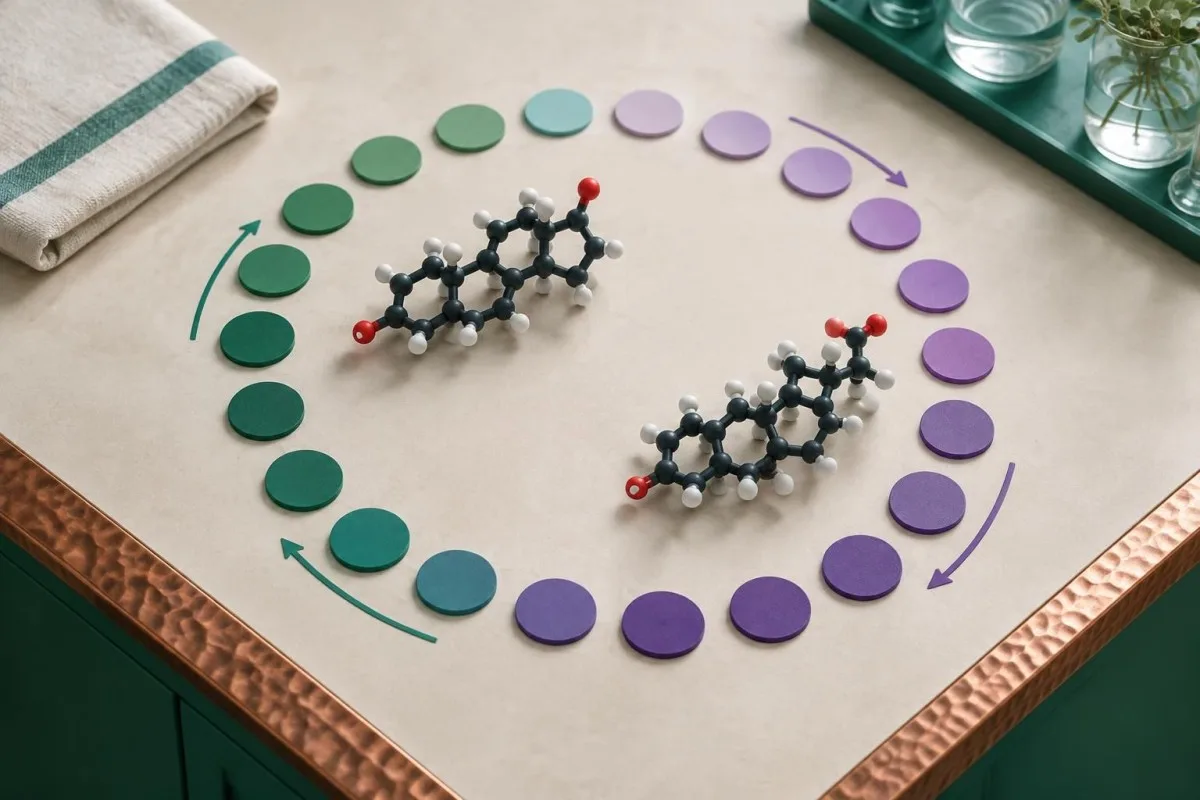
У follicular phase, which starts with menstrual bleeding, an ovarian follicle develops and produces increasing estradiol. Progesterone is generally low before ovulation, so a low early-cycle progesterone result is often expected rather than evidence of a deficiency.
Near ovulation, estradiol typically reaches a prominent peak and contributes to the hormonal signals that lead to egg release. After ovulation, the emptied follicle becomes the corpus luteum, which produces progesterone and also estradiol.
У luteal phase, progesterone prepares the uterine lining for a possible pregnancy. If pregnancy does not occur, the corpus luteum stops functioning and both hormones fall before the next period.
The familiar 28-day diagram is only an example: ovulation does not always happen on day 14, and the follicular phase varies in length. Our guide to Rezultati LH i FSH explains the upstream signals that help coordinate this sequence.
What do estradiol and progesterone levels by cycle day mean?
Estradiol and progesterone levels by cycle day are best read as phase-dependent patterns, not a universal day-by-day target. Your laboratory's method, reference intervals and reason for testing matter more than an isolated online chart.
Cycle day 1 is usually the first day of full menstrual flow, not a day of light spotting. A day-3 result and a day-23 result can both be appropriate for the same person because they represent different physiological questions.
The table describes typical directions in an unmedicated ovulatory cycle, not diagnostic ranges. Actual concentrations overlap between phases, and a result outside a printed interval does not automatically establish a disease.
Estradiol assays can differ between laboratories, especially at low concentrations; methods and reporting units may also differ. Keep the original report with its phase-specific interval, rather than applying a range intended for another laboratory or population.
A calendar alone cannot prove ovulation. If cycles are irregular, the draw date may not tell you the phase at all; the broader women's hormone health guide covers cycle and menopause context.
| Nivo | Opseg | Značenje |
|---|---|---|
| Рани фоликуларни | Around days 2–5 in a typical cycle | Progesterone is generally low; estradiol is often lower than its pre-ovulatory peak. |
| Late follicular | Before ovulation; timing varies | Estradiol generally rises as a follicle develops; progesterone generally remains low. |
| Oko ovulacije | Not always day 14 | Estradiol peaks near ovulation and then changes; progesterone begins to rise afterward. |
| Luteal | After ovulation until the next period | Progesterone rises and fluctuates; estradiol often has a smaller second rise. |
When should progesterone be tested to check ovulation?
For ovulation assessment, progesterone is generally measured about one week before the expected next period. Day 21 is a useful approximation only for someone with a consistently 28-day cycle.
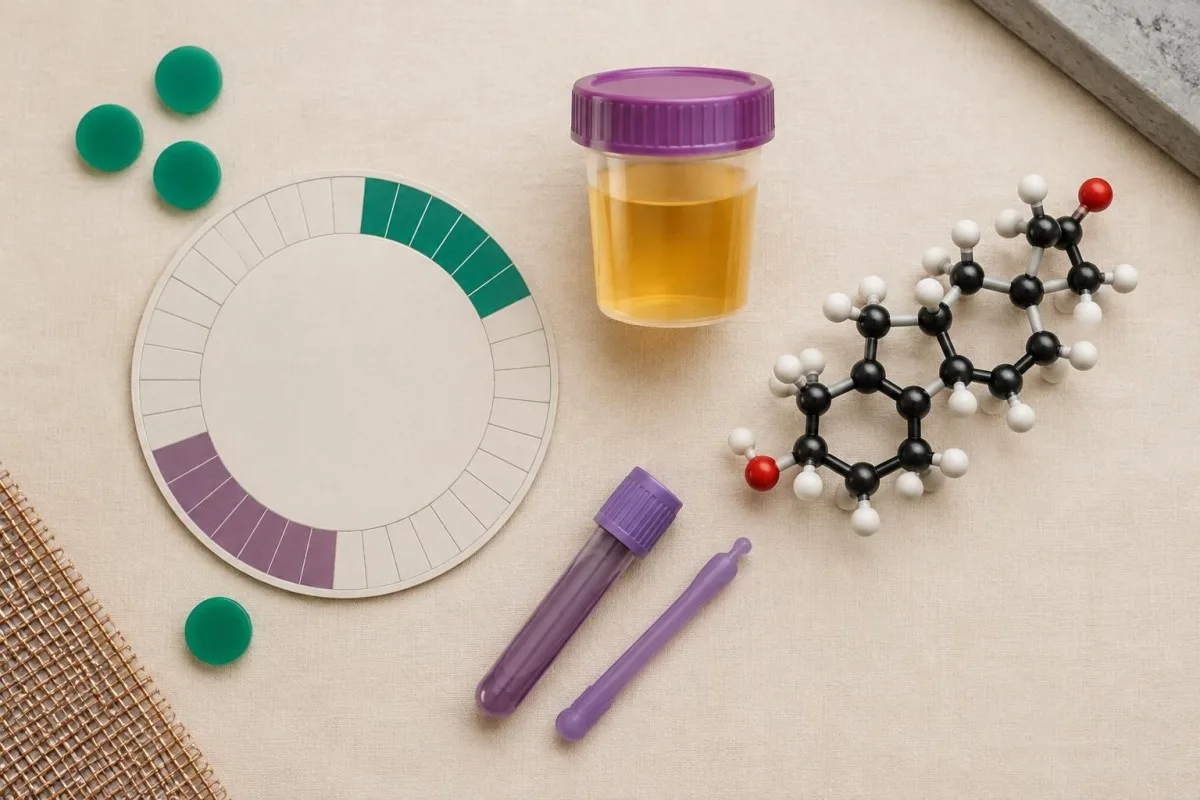
The American Society for Reproductive Medicine states that a progesterone concentration изнад 3 нг/мЛ provides presumptive evidence of recent ovulation (ASRM Practice Committee, 2021). This threshold answers whether progesterone rose enough to support recent ovulation; it is not a minimum level that guarantees fertility.
For a hypothetical person whose cycles are reliably 35 days long, sampling around day 28 may be more useful than day 21. In a 24-day cycle, approximately day 17 may be closer to the intended window; both are estimates, not guarantees of the correct phase.
An ovulation predictor kit detects the urinary LH surge, which usually precedes ovulation, but it does not confirm that an egg was released. A clinician may use the surge, cycle history and expected period together when choosing a progesterone draw date.
Progesterone is released in pulses and can vary severalfold over a few hours. The ASRM luteal-phase guidance explains why a single value cannot establish whether the luteal phase is adequate for conception (ASRM Practice Committee, 2021); a low result may also reflect a draw that was too early or too late.
If periods are unpredictable or absent, ask the ordering clinician how to time testing rather than guessing day 21. Related information on : високих LH резултата explains why one LH value also needs context.
How should you compare estradiol vs progesterone blood results?
Compare each hormone with its own unit, assay and phase-specific reference interval—not with the other hormone's printed number. Estradiol and progesterone often use different reporting scales even when the samples were taken at the same visit.

Estradiol is commonly reported in пг/мЛ или pmol/L; progesterone is commonly reported in нг/мл или нмол/л. For estradiol, 1 pg/mL is approximately 3.67 pmol/L; for progesterone, 1 ng/mL is approximately 3.18 nmol/L.
Consider a hypothetical same-day report: estradiol 150 pg/mL and progesterone 10 ng/mL. The printed 150 looks larger than 10, but 10 ng/mL equals 10,000 pg/mL, so the visual comparison reverses when the concentrations use the same mass units.
Even that conversion does not establish which hormone is more active or whether either result is appropriate. The molecules have different structures, receptors and biological effects, and mass concentration alone is not a measure of hormone action.
Record the collection date, cycle day, expected period, laboratory, units and medication schedule beside each result. The Референтни водич за биомаркере can help identify the exact analyte name before you compare reports.
A report may list estradiol as E2; this is not the same measurement as total estrogens. Likewise, 17-hydroxyprogesterone testing measures a different steroid and should not be substituted for progesterone.
What does the progesterone and estradiol ratio mean?
A progesterone-to-estradiol ratio is a mathematical comparison, not a validated stand-alone diagnosis of hormone imbalance. Its value changes with cycle phase, sample timing and the units chosen for the calculation.
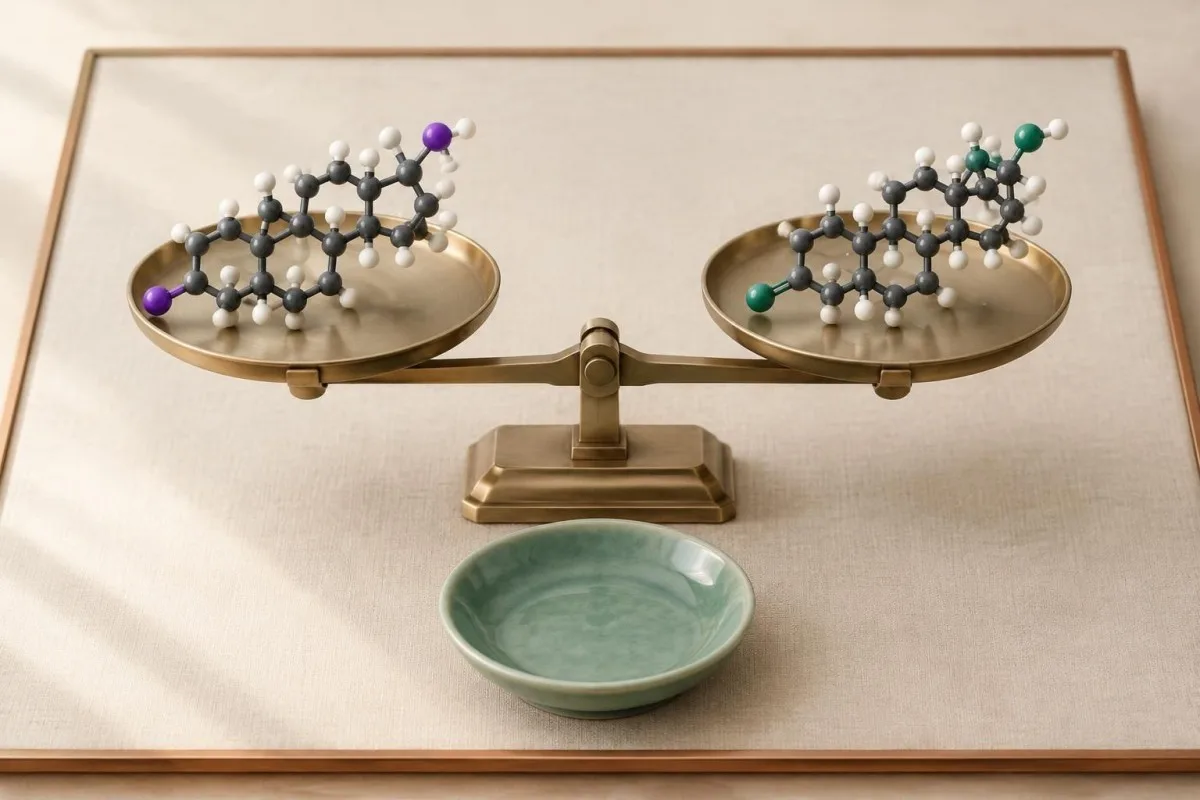
Using the hypothetical results of progesterone 10 ng/mL and estradiol 150 pg/mL, dividing the printed numbers gives approximately 0.067. Converting both to pg/mL first gives 10,000 divided by 150, or approximately 67—a thousandfold difference caused solely by the unit choice.
A ratio may be studied for a specific research or fertility-treatment question, but those findings cannot automatically be applied to an untreated cycle or a consumer test. A proposed cutoff also needs a defined assay, sample type, collection time and population before it can be assessed.
Фраза estrogen dominance is often used online to describe many unrelated symptoms, but there is no established blood ratio that diagnoses a general condition by that name. Symptoms deserve assessment on their own merits rather than hormone treatment based on a calculated ratio.
Binding proteins add another layer: a total hormone concentration is not the same as the unbound fraction, and binding characteristics differ between hormones. Read about sex hormone binding globulin for context, but do not use SHBG alone to reinterpret a progesterone-to-estradiol ratio.
How do contraception, pregnancy and menopause affect interpretation?
Hormonal contraception, fertility medicines, pregnancy and the menopause transition can make an ordinary unmedicated-cycle chart inappropriate. Interpretation must account for the treatment, reproductive stage and clinical question.

Combined hormonal contraception commonly suppresses ovulation, so the usual pre-ovulatory estradiol rise and post-ovulatory progesterone pattern may not appear. Progestogen-only methods vary in their effect on ovulation; tell the clinician the method, formulation and when it was last taken.
Laboratory progesterone tests primarily measure прогестерон, not necessarily synthetic progestins. A low measured progesterone while using a progestin does not by itself show that the medication is absent or ineffective, and prescribed hormones should not be stopped solely to make a test easier to interpret.
Fertility treatment can alter both levels and their timing; clinics may use estradiol and progesterone for specific decisions that do not apply to spontaneous cycles. Similarly, pregnancy changes hormone production, and a single result must not be used on its own to establish pregnancy location or viability.
During perimenopause, cycles and estradiol can fluctuate substantially; one low or high value does not reliably define the transition. The article on estradiol during menopause explains why age, symptoms and menstrual history often carry more weight than one number.
After stopping contraception, cycle tracking can help distinguish an early draw from a genuinely irregular pattern, but persistent absent periods deserve clinical assessment. See testing after the pill for questions to discuss with a clinician.
What should you do with unexpected hormone results?
An unexpected hormone result should prompt a check of timing, medications, units and the reason for testing before any diagnosis is made. A clinician may recommend a repeat sample or different tests based on the pattern and symptoms.
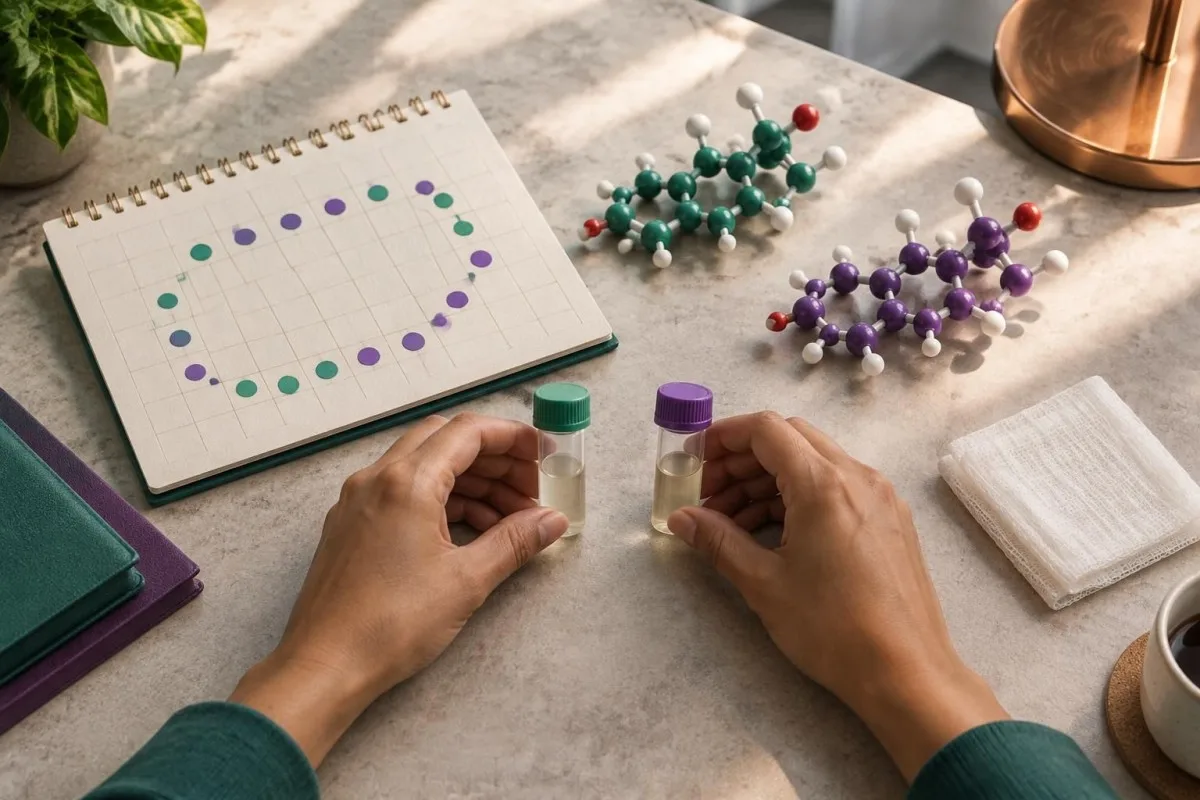
First, ask whether the result was collected at the right point for the question. A low progesterone on cycle day 3 is usually expected; the same number drawn about 7 days before an anticipated period has a different interpretation, although inaccurate ovulation timing remains possible.
Second, check whether the laboratory supplied a follicular, ovulatory or luteal reference interval and whether that interval applies to your treatment status. A flag based on an automatically selected interval can be misleading if the laboratory was not given the cycle phase.
Third, review the clinical picture. Irregular or absent periods may lead a clinician to consider pregnancy testing, thyroid function, prolactin or assessment for polycystic ovary syndrome; which tests are appropriate depends on the person's history, examination and goals.
A diagnosis of polycystic ovary syndrome is not made from an estradiol-to-progesterone ratio. An elevated prolactin result may also need careful review and sometimes repeat testing, as explained in blago povišenog prolaktina.
When repeat testing is useful, ask whether to use the same laboratory and comparable cycle timing; doing so reduces avoidable differences but cannot eliminate normal biological variation. Our standardi medicinskog sadržaja describe the principles behind educational material, which cannot replace individual clinical assessment.
When do symptoms need medical attention?
Seek urgent medical assessment for severe pelvic pain, fainting or heavy bleeding, especially when pregnancy is possible. Estradiol and progesterone values cannot rule out an ectopic pregnancy or another urgent cause of symptoms.

If pregnancy is possible and you have severe or one-sided pelvic pain, shoulder-tip pain, dizziness or fainting, seek emergency care immediately. Ectopic pregnancy can become dangerous before a routine hormone appointment, and a negative early home test does not always settle the question.
For heavy menstrual bleeding, seek urgent care if you are soaking through a pad or tampon every hour for more than 2 hours, particularly if you feel faint, breathless or unwell. Our guide to обилно менструално крварење discusses other warning signs and assessment.
Arrange a non-urgent appointment for persistent cycle changes, bothersome symptoms or difficulty conceiving. ASRM recommends infertility evaluation after 12 months of regular unprotected intercourse for women under 35, or after 6 months at age 35 or older; evaluation can start sooner when cycles are irregular or another known risk is present.
Bring the original report, the first day of your last period, usual cycle lengths and a list of medicines and supplements. Questions about how health information is handled can be checked in our smernice o privatnosti i podacima; clinical decisions should be made with a qualified professional.
Često postavljana pitanja
Should estradiol be higher than progesterone?
There is no universal rule that estradiol should be higher or lower than progesterone. Estradiol is often reported in pg/mL and progesterone in ng/mL, so the printed numbers are not directly comparable; 1 ng/mL equals 1,000 pg/mL. Their expected patterns also differ before and after ovulation. Interpret each result against its own laboratory interval and the reason for testing.
What cycle day is best for an estradiol test?
The best day for an estradiol test depends on why it was ordered. Basal estradiol is often measured with FSH on cycle days 2–4 during an infertility assessment, while fertility treatment may require testing on other days. Cycle day 1 is generally the first day of full menstrual flow. Follow the ordering clinician's instructions rather than assuming every estradiol test belongs on day 3.
Does progesterone have to be tested on day 21?
No: progesterone is generally measured about 1 week before the expected next period when the goal is to assess ovulation. Day 21 is an approximation for a regular 28-day cycle, whereas a person with a regular 35-day cycle might be tested around day 28. Irregular cycles make calendar estimates less reliable. A clinician can help choose the timing or decide whether another approach is needed.
Који ниво прогестерона потврђује овулацију?
A serum progesterone concentration above 3 ng/mL, approximately 9.5 nmol/L, provides presumptive evidence of recent ovulation in the appropriate clinical setting. It does not prove that conception occurred or guarantee that the luteal phase is sufficient for pregnancy. Progesterone changes throughout the day, so one value cannot reliably grade luteal-phase quality. A low result may reflect an anovulatory cycle or poorly timed sampling.
What is a normal progesterone-to-estradiol ratio?
There is no universally accepted progesterone-to-estradiol blood ratio that diagnoses a general hormone imbalance. A ratio changes substantially across the cycle and can change 1,000-fold numerically if one result is expressed in ng/mL rather than pg/mL without consistent conversion. Individual laboratories' hormone ranges and the testing indication are more useful than an online ratio target. A ratio alone should not be used to start or change hormone treatment.
Can low progesterone on day 3 mean a hormone problem?
Low progesterone on cycle day 3 is often an expected finding because day 3 is usually in the early follicular phase, before ovulation. A progesterone test intended to assess ovulation is usually collected about 1 week before the expected next period instead. The interpretation changes if a person is pregnant, using hormones or undergoing fertility treatment. Discuss persistent symptoms or irregular cycles with a clinician rather than treating a single early-cycle number.
Сазнајте како да читате крвну слику
Отпремите свој лабораторијски извештај, а AI алата Kantesti ће за неколико секунди објаснити сваки биомаркер једноставним језиком. Користи га више од 2 милиона људи широм света.
Референце
- Klein, T., Mitchell, S., & Weber, H. (2026). Vodič za studije gvožđa: TIBC, zasićenost gvožđem i kapacitet vezivanja. Kantesti AI Medical Research. ДОИ
- Klein, T., Mitchell, S., & Weber, H. (2026). Referentni opseg aPTT-a: D-dimer, protein C i vodič za zgrušavanje krvi. Kantesti AI Medical Research. ДОИ
- Practice Committee of the American Society for Reproductive Medicine (2021). Fertility evaluation of infertile women: a committee opinion. Fertility and Sterility. ДОИ
- Practice Committee of the American Society for Reproductive Medicine (2021). Diagnosis and treatment of luteal phase deficiency: a committee opinion. Fertility and Sterility.
- 2 милиона+Analizirani testovi
- 127+Земље
- 100+Језици
O medicinskom timu


Е-Е-А-Т сигнали поверења
Искуство
Клиничка ревизија процеса тумачења лабораторијских налаза коју води лекар.
Експертиза
Фокус на лабораторијску медицину: како се биомаркери понашају у клиничком контексту.
Ауторитативност
Medicinski pregledao dr Thomas Klein, uz doprinos dr Sarah Mitchell i prof. dr Hansa Webera.
Поузданост
Тумачење засновано на доказима, са јасним путевима праћења како би се смањила узнемиреност.




Medicinsko odricanje od odgovornosti
Овај чланак је само у образовне сврхе и не представља медицински савет. За одлуке о дијагнози и лечењу увек се консултујте са квалификованим здравственим радником.
Objavljeno · Kontaktirajte urednički tim
Objavio Kantesti Ltd, registrovan u Engleskoj i Velsu, broj kompanije. 17090423, London, Ujedinjeno Kraljevstvo.
