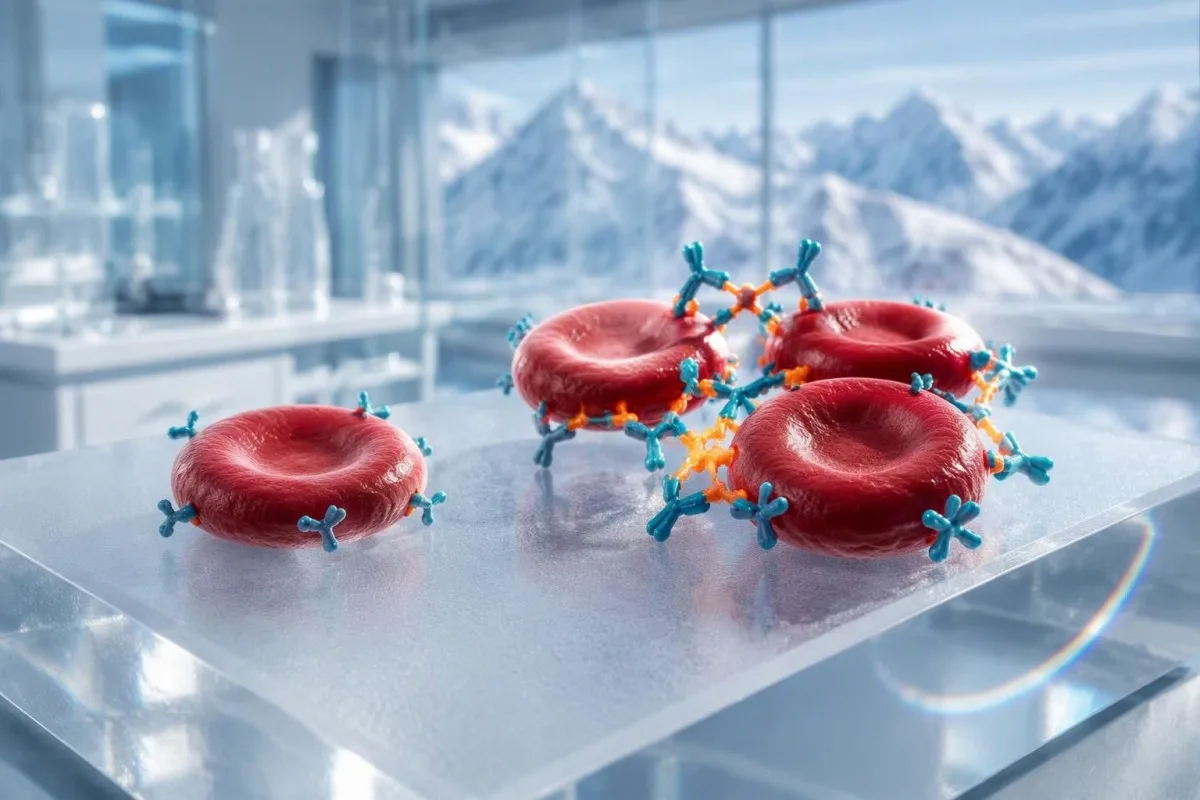
Pozitiven rezultat identificira s celicami rdeče krvi pritrjen material — ne nujno uničevanje rdečih krvnih celic. Naslednja odločitev je odvisna od trendov hemoglobina, označevalcev hemolize, zdravil in zgodovine transfuzij.


- Pozitiven neposredni Coombsov test pomeni, da so bili na rdečih krvnih celicah zaznani protitelesa, komplement ali oboje; sam po sebi ne diagnosticira hemolitične anemije.
- Neposredno testiranje v primerjavi s posrednim ločuje 2 različni vprašanji: material, ki je že pritrjen na rdeče krvne celice, v primerjavi s protitelesi, ki krožijo v serumu ali plazmi.
- Moč DAT je pogosto ocenjena od 1+ do 4+, vendar ocena zanesljivo ne meri resnosti anemije ali ne določa zdravljenja.
- Trend hemoglobina je pomembnejši od enega rezultata: padec z 12 na 9 g/dL je enak padcu s 120 na 90 g/L in potrebuje pojasnilo.
- Aktivna hemoliza se ocenjuje z uporabo hemoglobina, retikulocitov, LDH, bilirubina, haptoglobina in perifernega razmaza — ne samo DAT.
- Nedavna transfuzija naj se razkrije z natančnimi datumi, zlasti v zadnjih 3 mesecih; zapoznele reakcije se pogosto pojavijo več dni po tem.
- Pregled zdravil mora vključevati antibiotike, imunske terapije, IVIG in zdravila, ustavljena v zadnjih 2–4 tednih; ne ustavljajte predpisanega zdravljenja samo zaradi izoliranega rezultata DAT.
- Nujni simptomi vključite težko sapo v mirovanju, omedlevanje, bolečino v prsih ali nov temen urin z zlatenico; ne čakajte na načrtovani ponovni test.
Kaj dejansko pomeni pozitiven neposredni Coombsov test?
A pozitiven direkten Coombsov test pomeni, da so protitelesa, komplementni proteini ali oboje pritrjeni na vaše rdeče krvne celice. To ne ne samodejno pomeni hemolitične anemije: klinični zdravniki iščejo uničenje rdečih krvnih celic z uporabo trendov hemoglobina, retikulocitov, LDH, bilirubina in haptoglobina, medtem ko preverjajo zdravila in nedavne transfuzije. Prva ocena postavlja 2 ločeni vprašanji: kaj je pritrjeno in ali povzroča škodo.
Direkten test s antihumanim globulinom, običajno skrajšano DAT, je laboratorijsko ime za direkten Coombsov test. Njegovi 2 pogosto preiskovani tarči sta imunoglobulin G ali IgG in fragmenti komplementa, kot je C3d; pozitiven izvid identificira površinsko oblogo, ne pa merjenja, koliko celic vaše telo uničuje.
Hemoliza in anemija sta različna izvoda. Nekdo lahko ima kompenzirano hemolizo z normalnim hemoglobinom, ker proizvodnja kostnega mozga sledi, medtem ko ima lahko druga oseba anemijo zaradi pomanjkanja železa in nepovezanega pozitivnega DAT; hemoglobin 10 g/dL ne določa, katera razlaga velja.
Ko pregledam DAT, je moje prvo vprašanje, ali preostali del panela podpira imunske vzrok. Kot Thomas Klein, MD, glavni zdravstveni direktor, laboratorijske zastavice 1+ ne bi spremenil v diagnozo brez tega drugega koraka; razlika preprečuje tako nepotrebno zdravljenje kot tudi zamujanje poslabšanja.
Kantesti je analitik za krvne preiskave z umetno inteligenco, ki pomaga organizirati pozitiven DAT skupaj s spremljajočim CBC in označevalci hemolize. Naša vloga je razlaga, ne testiranje združljivosti krvne banke ali nujna triaža; naša organizacija in klinični namen opišite to razliko, vključno s tem, zakaj lahko 1 naloženo poročilo potrebuje dodatno klinično zgodovino.
Neposredni vs posredni Coombsov test: kakšna je razlika?
The direkten Coombsov test pregleduje protitelesa ali komplement, ki so že pritrjeni na rdeče krvne celice osebe. The neposredni Coombs test, imenovan tudi indirekten test s antihumanim globulinom ali IAT, pregleduje serum ali plazmo za protitelesa, ki se lahko vežejo na laboratorijske testne celice; to sta 2 povezana testa z različnimi kliničnimi nameni.
DAT testiranje se uporablja, ko se sumi na imunska uničenja rdečih krvnih celic, vključno z avtoimunsko hemolizo, nekaterimi reakcijami na transfuzijo in oceno novorojenčkov. DAT ne identificira vaše skupine ABO ali tipa RhD, njegov običajni pozitiven/negativen rezultat pa ni zamenljiv s koncentracijo protiteles, poročano v IU/mL.
IAT testiranje podpira predtransfuzijsko testiranje protiteles in presejanje v nosečnosti. Laboratorijsko osebje izpostavi testne celice serumu ali plazmi pacienta in oceni vezavo; rezultat presejanja matere torej odgovori na drugo vprašanje kot DAT novorojenčka, tudi če obe poročili uporabljata besedo Coombs.
Dva testa se lahko razlikujeta, ne da bi bil kateri koli napačen. Oseba ima lahko krožeča protitelesa in negativen DAT, ker ta protitelesa ne oblagajo lastnih celic, ali pozitiven DAT brez zaznanih protiteles s rutinskim presejalnim testom, ker metode pregledujejo različne vzorce in reakcijske pogoje.
For a pregnancy report, first check whether the heading says presejalni test protiteles (antibody screen), IAT, ali DAT before interpreting a positive result. Our razlaga presejalnega testa nosečnosti na protitelesa explains why antibody identity and previous anti-D administration matter; combining these 2 types of results into one generic antibody label can send follow-up in the wrong direction.
Kako DAT zazna IgG in komplement na rdečih krvnih celicah?
The DAT detects red-cell coating by adding antiglobulin reagents that react with human immunoglobulin or complement attached to the cells. Laboratories commonly use an initial polyspecific reagent followed by 2 monospecific tests—anti-IgG and anti-C3d—to clarify the pattern.
Tube, gel-column, and solid-phase methods do not have identical sensitivity. A weak positive from 1 method may not reproduce with another, and a reference laboratory may investigate an unexplained result using additional techniques rather than simply repeating the original assay unchanged.
DAT reactions may be reported as weak positive or graded 1+ through 4+. These grades describe the observed laboratory reaction, not a calibrated antibody concentration; there is no conversion from a 3+ DAT to a predicted hemoglobin decline in g/dL.
An EDTA sample helps limit complement attachment after collection, reducing one potential source of misleading interpretation. Sample age, reagent specificity, and the testing method also matter; Parker and Tormey's 2017 review describes why 1 positive DAT must be interpreted with laboratory details and clinical findings rather than treated as a stand-alone diagnosis.
C3d on red cells is not the same measurement as a serum C3 concentration. Someone can have a C3d-positive DAT without a low circulating C3 level; our vodnik za dopolnilno testiranje separates these 2 questions so a complement label is not mistakenly read as proof of systemic autoimmune disease.
Zakaj je lahko DAT pozitiven brez hemolitične anemije?
A positive DAT without hemolytic anemia can occur when red-cell coating does not cause clinically significant destruction, or when coating is incidental to another illness or treatment. The interpretation requires 2 independent assessments: evidence of hemolysis and evidence of anemia.
Antibody amount alone does not determine red-cell survival. Antibody characteristics, complement activation, and the body's clearance response all influence whether destruction occurs; a 1+ result may matter in one patient, while a stronger reaction may accompany stable hemoglobin in another.
Passive antibody exposure can produce a temporary positive DAT, particularly after IVIG or other antibody-containing products. Reviewing treatments administered during the preceding 2–4 weeks is often more useful than ordering a broad autoimmune panel immediately, although the relevant interval depends on the product and clinical circumstances.
Anemia can coexist with incidental DAT positivity. Consider an illustrative patient with hemoglobin 10.5 g/dL, low ferritin, stable bilirubin, and no convincing hemolysis pattern: iron deficiency still deserves assessment rather than being replaced by an autoimmune label because the DAT is positive.
A normal hemoglobin does not completely exclude hemolysis, because the marrow may compensate by producing additional cells. Our vodnik za pozitivne rezultate protiteles explains the broader distinction between antibody detection and active disease; here, at least 1 assessment of red-cell turnover is needed before reassurance.
Kateri krvni testi pokažejo, ali poteka aktivna hemoliza?
Active hemolysis is supported by a pattern, usually falling hemoglobin, increased LDH and indirect bilirubin, reduced haptoglobin, and an appropriate reticulocyte response. No single marker proves hemolysis; clinicians combine these findings with symptoms, a smear, and changes across at least 2 time points when available.
LDH reflects cell turnover but is not specific to red cells. For example, LDH of 500 U/L is twice an upper limit of 250 U/L, but muscle or liver injury can also cause elevation; our LDH interpretation explanation helps distinguish the ratio from the cause.
Low haptoglobin supports hemolysis but can also reflect reduced liver production. A result below approximately 25 mg/dL, equivalent to 0.25 g/L, can be supportive in the right setting, yet inflammation may raise haptoglobin and mask depletion; our nonhemolytic haptoglobin causes explain why neither a low nor normal result settles the diagnosis.
Indirect bilirubin is more relevant to red-cell breakdown than direct bilirubin alone. A total bilirubin of 2 mg/dL is approximately 34 µmol/L, but bilirubin fractionation is needed to understand the pattern; Gilbert syndrome, liver disease, and hemolysis can overlap rather than appearing as neatly separate categories.
Kantesti is an AI blood test interpretation platform that places DAT findings beside hemoglobin and turnover-marker trends. Hill et al.'s 2017 British Society for Haematology guideline starts with establishing hemolysis and then assessing its immune cause; comparing 2 reports can clarify direction, but our AI cannot replace examination or specialist interpretation.
Kaj dodajo CBC, število retikulocitov in razmaz?
The CBC measures the anemia, reticulocytes assess marrow compensation, and the smear adds clues about the mechanism. These 3 assessments help distinguish immune destruction from bleeding, reduced production, inherited red-cell disorders, and laboratory artifacts that can coexist with a positive DAT.
A hemoglobin change should be read in consistent units and context. A decline from 12 to 9 g/dL equals 120 to 90 g/L; dehydration, intravenous fluids, and recent transfusion can alter concentrations, so the dates and circumstances of both measurements belong beside the numbers.
The reticulocyte percentage can exaggerate marrow response in anemia. An illustrative reticulocyte count of 6% with hematocrit 24%, corrected against 45%, becomes about 3.2%; a reticulocyte production index requires an additional maturation adjustment, and an absolute count often provides a clearer starting point.
Spherocytes and polychromasia support particular mechanisms but are not diagnostic alone. Spherocytes can occur in immune hemolysis or hereditary spherocytosis, whereas polychromasia reflects younger cells entering circulation; our polychromasia interpretation guide explains why 1 smear feature cannot establish an autoimmune cause.
An inadequate reticulocyte response does not rule out severe hemolysis. Marrow suppression, nutrient deficiency, or delayed compensation can blunt the expected increase; our vodnik za retikulocite in hematologijo also distinguishes reticulocyte count from other red-cell measurements, which becomes especially useful when 2 abnormalities point in different directions.
Katera zdravila lahko povzročijo ali zapletejo pozitiven DAT?
Medicines can cause immune hemolysis, produce red-cell coating without hemolysis, or interfere with antibody testing. Clinicians review current drugs and exposures from the preceding 2–4 weeks, sometimes longer, including antibiotics, IVIG, immune therapies, and medicines discontinued during a hospital stay.
Ceftriaxone and piperacillin are recognized causes of drug-induced immune hemolytic anemia. A sudden hemoglobin decline soon after an implicated medicine is more concerning than an isolated positive DAT; recording the exact administration date and whether symptoms began within hours or days is more useful than listing only the drug class.
Methyldopa can produce red-cell autoantibodies and DAT positivity without hemolysis. A positive result alone does not prove the drug is harming red cells, but an accompanying hemolysis pattern changes the assessment; a hemoglobin of 9 g/dL needs comparison with the pretreatment baseline and an evaluation for other causes.
Anti-CD38 therapies such as daratumumab particularly complicate indirect antiglobulin testing and compatibility work. They should not be casually equated with drug-induced hemolysis or a reliably positive DAT; telling the blood bank about 1 such treatment can prevent avoidable confusion when arranging a transfusion.
As Thomas Klein, MD, I would ask for the discharge medication list as well as the current list, because a medicine stopped 7 days ago may still explain today's result. Kantesti can help organize that timeline, while our medication effects checklist supports preparation; suspected acute drug-related hemolysis requires urgent clinical assessment, not self-directed stopping and restarting.
Kako nedavna transfuzija spremeni interpretacijo DAT?
A positive DAT after transfusion can reflect antibodies coating donor red cells, with or without clinically significant hemolysis. Give the clinician and blood bank the exact transfusion dates, particularly for transfusions within the previous 3 months, and describe any new jaundice, dark urine, or unexpected hemoglobin decline.
Delayed hemolytic transfusion reactions often appear several days after transfusion, commonly around 5–14 days, although timing varies and later presentations occur. A previously formed antibody may have fallen below detection before transfusion and then reappear after exposure to the relevant donor-cell antigen.
A new positive DAT is not automatically a hemolytic transfusion reaction. A delayed serologic reaction can occur without demonstrable hemolysis; clinicians compare posttransfusion hemoglobin, bilirubin, LDH, and haptoglobin with earlier values, rather than interpreting 1 positive compatibility-related result as proof of injury.
The blood bank may repeat the antibody screen and identify antibodies eluted from the cells. This helps distinguish an alloantibody against donor cells from an autoantibody, and a mixed-field pattern may reflect coated donor cells alongside uncoated recipient cells; requesting at least 1 pretransfusion result can materially improve interpretation.
Transfusion also changes the interpretation of other tests. HbA1c reflects a mixture of donor and recipient red-cell histories rather than only your own glucose exposure; our A1c after transfusion guide explains why a reassuring percentage obtained shortly after transfusion may be misleading, particularly when red-cell survival is also shortened.
Ali IgG-pozitiven ali C3-pozitiven DAT identificira vzrok?
An IgG-positive DAT often supports warm-antibody hemolysis, while a C3d-positive pattern raises consideration of cold-antibody processes. Neither pattern establishes the diagnosis by itself: clinicians interpret the 2 reagent results alongside hemolysis, antibody studies, treatment exposure, and transfusion history.
Warm autoimmune hemolytic anemia commonly has an IgG-positive DAT, with or without C3d. The name warm refers to antibody activity near 37°C, not whether a patient feels hot; drug-related and transfusion-related causes still need exclusion before this pattern is labeled primary autoimmune disease.
Cold agglutinin disease typically has a strongly C3d-positive DAT, because the antibody may detach while complement remains on the red cell. A cold agglutinin titer of at least 1:64 at 4°C is commonly part of diagnostic criteria, but titer alone does not establish clinically significant disease.
Thermal amplitude can matter more than a cold antibody's titer. An antibody reacting near or above 30°C may be more clinically relevant than one reacting only at very low temperatures; Jäger et al.'s 2020 international consensus recommendations emphasize classifying the antibody process because treatment decisions differ between warm and cold disease.
Confirmed cold-antibody hemolysis may prompt investigation for an underlying clonal disorder, rather than assuming every case is a transient response to illness. Our immunofixation result explanation explains one possible component of that work-up; detecting 1 small monoclonal band is not, by itself, a diagnosis of lymphoma.
Kdaj avtoimunska bolezen ali okužbe pojasnijo DAT pozitivnost?
Autoimmune conditions, some infections, and lymphoproliferative disorders can accompany DAT positivity or immune hemolysis. Investigation should follow the clinical pattern rather than trigger an indiscriminate panel: 1 positive DAT without hemolysis provides much less justification for extensive testing than anemia with convincing immune destruction.
Lupus can be associated with DAT positivity, with or without autoimmune hemolytic anemia. A DAT does not diagnose lupus, and testing should be guided by findings such as inflammatory joint symptoms, rashes, kidney abnormalities, or multiple cytopenias; the presence of 2 immune-related test flags still does not replace a clinical assessment.
Anti-dsDNA testing answers a different question from the DAT. Naš anti-dsDNA interpretation guide explains its relevance to lupus assessment; clinicians also consider complement concentrations and urinalysis when appropriate, rather than assuming that 1 red-cell coating result predicts autoimmune activity throughout the body.
Some infections can trigger cold-antibody hemolysis or transient immune red-cell findings. Recent respiratory illness or mononucleosis-like symptoms may guide testing, but an EBV IgG-positive result alone commonly reflects previous exposure; our Vodilo za vzorec protiteles proti EBV distinguishes that from evidence of a recent episode.
Primary autoimmune hemolytic anemia is considered only after relevant secondary explanations are assessed. Persistent lymph-node enlargement, unexplained weight loss, or abnormalities in more than 1 blood-cell lineage can change the work-up; no universal number of scans or antibody tests suits every patient, and specialists often stage the investigation to avoid misleading incidental findings.
Kaj pomeni pozitiven DAT med nosečnostjo ali pri novorojenčku?
In pregnancy, the maternal antibody screen is usually an indirect test; in a newborn, the DAT detects coating of the baby's red cells. A DAT-positive newborn needs assessment for jaundice and anemia, but the result alone does not determine treatment: bilirubin interpretation changes with age measured in hours, not simply 1 adult reference range.
Maternal antibodies can cross the placenta and attach to fetal or newborn red cells. ABO or other red-cell antigen incompatibility may contribute, but the antibody involved and the baby's laboratory course matter more than a DAT grade of 1+ or 2+ considered in isolation.
Preventive maternal anti-D immunoglobulin can sometimes explain newborn DAT positivity without significant hemolysis. The maternity and pediatric teams interpret this against the mother's antibody history and the infant's bilirubin and hemoglobin; 1 positive DAT is not a reason to assume preventive treatment has caused clinically important harm.
Newborn bilirubin treatment decisions depend on gestational age, age in hours, and relevant risk factors. Jaundice appearing during the first 24 hours warrants prompt assessment; an adult bilirubin threshold in mg/dL should never be copied into a newborn's treatment plan or used to delay pediatric advice.
Children need age-specific interpretation and a pediatric safety pathway. Naš omejitve interpretacije za otroke AI explain why pediatric and newborn results require additional context; arrange the recommended bilirubin check before leaving care, because a follow-up scheduled 24 hours later may address a different risk window than a routine adult repeat test.
Kateri simptomi ali laboratorijske spremembe zahtevajo nujno oskrbo?
A positive DAT becomes urgent when it accompanies symptoms of severe anemia or rapidly developing hemolysis. Seek immediate care for breathlessness at rest, chest pain, fainting, confusion, or new dark urine with jaundice; do not wait 24–48 hours for a routine repeat if symptoms are progressing.
The speed of hemoglobin decline matters as much as the final value. A fall from 12 to 8 g/dL over 2 days deserves urgent assessment even if the person initially appears comfortable; bleeding, dilution, sampling error, and hemolysis all remain possible until evaluated.
Hemoglobin near or below 7 g/dL, equivalent to 70 g/L, requires prompt clinical assessment, but transfusion decisions are individualized. Symptoms, cardiovascular disease, rate of decline, and instability can make a higher concentration dangerous; conversely, a stable chronic value is not interpreted the same way as an abrupt new fall.
Schistocytes with anemia and a low platelet count raise concern for a different urgent mechanism, such as thrombotic microangiopathy. Our urgent schistocyte findings guide explains why an incidental positive DAT must not distract from this pattern; a platelet count of 40 × 10^9/L adds a separate warning signal.
Dark urine has several possible causes, including hemoglobin, bilirubin, medicines, and urinary red cells. Our opozorilne znake temnega urina explain that distinction; when dark urine starts within days of a transfusion or alongside jaundice and weakness, the transfusion service and treating team need the information immediately rather than at the next routine visit.
Kaj storiti naprej po pozitivnem neposrednem Coombsovem testu?
The next step is to establish whether hemolysis is active, review the DAT pattern, and identify relevant exposures. Bring at least 2 dated CBC results if available, the medication list, transfusion dates, and any IgG/C3d breakdown; treatment is directed at the cause and clinical severity, not at making the DAT negative.
Ask whether the clinician needs a repeat CBC, reticulocytes, LDH, bilirubin fractions, haptoglobin, and smear. If results are unexpected, the laboratory may repeat the DAT or use another method; a damaged sample can distort some chemistry results, but an elevated hemolysis index is not itself proof of immune destruction inside your body.
Repeat-testing intervals depend on risk rather than one fixed calendar rule. An evolving hemoglobin decline may require reassessment within 24 hours or sooner, while an asymptomatic person with stable markers may have a planned outpatient review; Thomas Klein, MD's practical starting point is to arrange the follow-up before debating whether the DAT should be repeated.
Kantesti is an AI-powered blood test analysis tool that helps compare dated laboratory findings while keeping clinical interpretation separate from compatibility testing. Naš razlaga tehnologije umetne inteligence describes the interpretation workflow; verify that a 1+ result, units, and the collection date were read correctly before discussing the generated explanation with your clinician.
Blood-bank expertise remains necessary when transfusion is needed, particularly if autoantibodies complicate identification of clinically significant alloantibodies. Our pristop klinične validacije describes the standards behind our explanatory service, not a guarantee for every case; neither a 4+ DAT nor a difficult crossmatch should automatically delay a medically necessary emergency transfusion under specialist supervision.
Medicinski dokazi, povezave do publikacij in omejitve interpretacije
DAT interpretation rests on hematology and transfusion evidence, not on general wellness publications. As of October 5, 2026, the 2017 British Society for Haematology guideline, the 2020 international consensus recommendations, and Parker and Tormey's laboratory review support the central approach: establish hemolysis, characterize the immune finding, and investigate its context.
The 3 external medical references below directly concern DAT interpretation or autoimmune hemolytic anemia. Their publication years are stated so readers can distinguish an article update from a newly issued guideline; this October 5, 2026 update does not imply that a new 2026 DAT grading threshold or universal retesting schedule exists.
The 2 Figshare items below were supplied as related organizational publications, not evidence for DAT diagnosis or treatment. With verified author and publication-date metadata unavailable here, the APA-style entries begin with their titles and use n.d.; a DOI identifies an archived item but does not, by itself, establish peer review or clinical validation.
Diarrhea after fasting, black specks in stool & GI guide 2026. (n.d.). Figshare. DOI: 10.6084/m9.figshare.31438111. Discovery links are available through Iskanje publikacij na ResearchGate in Iskanje publikacij na Academia; these search destinations are not verified copies of the publication.
Women's health guide: Ovulation, menopause & hormonal symptoms. (n.d.). Figshare. DOI: 10.6084/m9.figshare.31830721. Discovery links include ResearchGate title search in Academia title search; neither item replaces the 3 DAT-specific references, and Kantesti's medical advisory board directory identifies our clinical contributors without implying an independent review of every individual result.
Pogosto zastavljena vprašanja
Ali pozitiven neposredni Coombsov test pomeni, da imam hemolitično anemijo?
Pozitiven neposredni Coombsov test ne pomeni samodejno hemolitične anemije; zazna protitelesa ali komplement, pritrjena na rdeče krvničke. Klinični zdravniki ocenijo hemoglobin, retikulocite, LDH, bilirubin, haptoglobin in razmaz, da ugotovijo, ali poteka uničevanje rdečih krvničk. DAT stopnje 1+ do 4+ opisuje laboratorijsko reakcijo, ne resnosti anemije. Normalen hemoglobin je lahko prisoten pri kompenzirani hemolizi, zato ustrezni označevalci prometa še vedno štejejo.
Kakšna je razlika med neposrednim in posrednim Coombsovim testom?
Neposredni Coombsov test zazna protitelesa ali komplement, ki so že vezani na rdeče krvničke osebe, medtem ko neposredni Coombsov test zazna krožeča protitelesa, ki se lahko vežejo na laboratorijske testne celice. Ti 2 testoma odgovarjata na različna vprašanja in imata lahko pri isti osebi različne rezultate. Neposredni test se običajno uporablja za presejanje na protitelesa med nosečnostjo in pred transfuzijo. Neposredni test se uporablja pri oceni uničevanja rdečih krvničk zaradi imunskega odziva, nekaterih transfuzijskih reakcij ali oblaganja rdečih krvničk pri novorojenčkih.
Ali lahko zdravilo povzroči pozitiven neposredni Coombsov test?
Zdravila lahko povzročijo pozitiven neposredni Coombsov test z imunskim oblaganjem rdečih krvničk, klinično pomembno imunsko hemolizo ali zaplete pri testiranju. Cefftriakson in piperacilin sta znana povzročitelja imunske hemolitične anemije, povzročene z zdravili, medtem ko lahko metildopa povzroči pozitivnost DAT brez hemolize. Klinični strokovnjaki pregledajo trenutno zdravljenje in zdravila, uporabljena v zadnjih 2–4 tednih, včasih dlje. Ne prekinjajte predpisanega zdravljenja samo zaradi izoliranega rezultata DAT, temveč poiščite nujno oceno v primeru nenadne oslabelosti, zlatenice ali temnega urina.
Je pozitiven Coombsov test po transfuziji nevaren?
Pozitiven direkten Coombs test po transfuziji lahko odraža donorjeve rdeče krvničke, prevlečene z protitelesi, vendar sam po sebi ne dokazuje nevarne reakcije. Zapoznele hemolitične transfuzijske reakcije se pogosto pojavijo približno 5–14 dni po transfuziji, čeprav se čas razlikuje. Padajoč hemoglobin, zlatenica, zvišan LDH in zmanjšan haptoglobin vzbujajo skrb glede aktivne hemolize. Takoj stopite v stik z zdravniško ekipo ali transuzijsko službo, če se pojavijo novi simptomi, in posredujte natančne datume transfuzije.
Kaj pomeni pozitiven test neposredne antiglobulinske preiskave na C3?
C3d-pozitiven neposreden antiglobulinski test pomeni, da so bili fragmenti komplementa zaznani na rdečih krvničkah in lahko podpira preiskavo hladne protitelesne bolezni. Vroča protitelesna bolezen, učinki zdravil in z transfuzijo povezani izvidi lahko prav tako vključujejo komplement, zato sama C3d-pozitivnost ne določi vzroka. Titre hladnega aglutinina vsaj 1:64 pri 4°C je običajno del kriterijev za bolezen s hladnimi aglutinini, vendar sta potrebna tudi hemoliza in širša klinična slika. C3d-pozitiven DAT ni enakovreden nizki koncentraciji C3 v serumu.
Ali potrebujem zdravljenje, če je moj DAT pozitiven, moj hemoglobin pa normalen?
Izoliran pozitiven DAT z normalnim hemoglobinom ne zahteva samodejno kortikosteroidov ali druge imunske terapije. Klinični zdravniki pred odločitvijo o tem, ali je potreben nadzor ali nadaljnja preiskava, preverijo kompenzirano hemolizo, učinke zdravil in zgodovino transfuzij. Primerjava vsaj dveh datiranih rezultatov hemoglobina lahko pomaga pri določanju stabilnosti, vendar noben sam ponovni interval ni primeren za vse bolnike. Poiščite nujno pomoč, če se pojavi piskanje v mirovanju, omedlevanje, bolečina v prsih ali nov temen urin z zlatenico.
Danes pridobite analizo krvnih preiskav z umetno inteligenco
Pridružite se več kot 2 milijonoma uporabnikov po vsem svetu, ki zaupajo Kantesti za takojšnjo, natančno analizo laboratorijskih preiskav. Naložite svoje rezultate krvnih preiskav in v nekaj sekundah prejmite celovito razlago biomarkerjev 15,000+.
📚 Citirane raziskovalne publikacije
Klein, T., Mitchell, S., & Weber, H. (2026). Driska po postu, črne pike v blatu in prebavila, vodnik 2026. Kantesti AI Medical Research.
Klein, T., Mitchell, S., & Weber, H. (2026). Vodnik za žensko zdravje: ovulacija, menopavza in hormonski simptomi. Kantesti AI Medical Research.
📖 Zunanje medicinske reference
Hill QA et al. (2017). Diagnoza in obravnava primarne avtoimunske hemolitične anemije. British Journal of Haematology.
Jäger U in sod. (2020). Diagnoza in zdravljenje avtoimunske hemolitične anemije pri odraslih: Priporočila prvega mednarodnega konsenznega sestanka. Blood Reviews.
Parker V, Tormey CA. (2017). The Direct Antiglobulin Test: Indications, Interpretation, and Pitfalls. Archives of Pathology & Laboratory Medicine.
⚕️ Medicinska izjava o omejitvi odgovornosti
Ta članek je namenjen izobraževalnim namenom in ne predstavlja medicinskega nasveta. Za odločitve o diagnozi in zdravljenju se vedno posvetujte z usposobljenim izvajalcem zdravstvenih storitev.
E-E-A-T zaupanja vredni signali
Izkušnje
Zdravniški klinični pregled delovnih postopkov za interpretacijo laboratorijskih izvidov.
Strokovno znanje
Laboratorijska medicina s poudarkom na tem, kako se biomarkerji obnašajo v kliničnem kontekstu.
Avtoritativnost
Napisal dr. Thomas Klein, pregledala dr. Sarah Mitchell in prof. dr. Hans Weber.
Zanesljivost
Interpretacija na podlagi dokazov z jasnimi nadaljnjimi potmi za zmanjšanje alarmiranja.