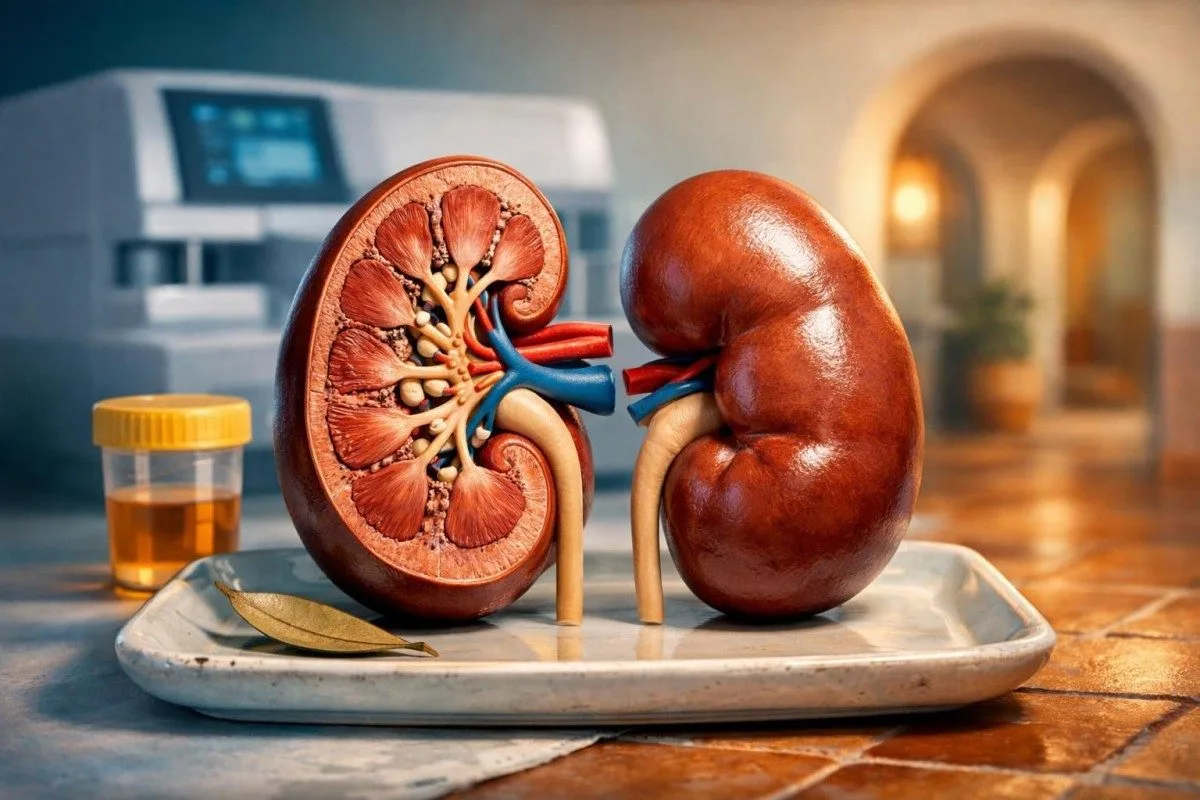
A renal panel is usually the sharper test when the question is kidney filtration, electrolyte shifts, phosphorus balance, or medication monitoring. A CMP is broader and often better for general screening because it adds liver markers that the renal function panel does not.


- Best use A renal panel is usually more useful than a CMP when CKD, dehydration, ACE inhibitor use, ARB use, or phosphorus tracking is the main question.
- Overlap Both tests usually include sodium 135-145 mmol/L, potassium 3.5-5.1 mmol/L, BUN 7-20 mg/dL, creatinine, calcium, and glucose.
- Unique marker A renal function panel typically includes phosphorus 2.5-4.5 mg/dL; a comprehensive metabolic panel usually adds ALT, AST, ALP, bilirubin, and total protein.
- CKD cutoff eGFR below 60 mL/min/1.73 m² for 3 months or longer suggests chronic kidney disease when confirmed with clinical context.
- Dehydration clue A BUN/creatinine ratio above 20:1 often points to volume depletion or another prerenal state rather than permanent kidney damage.
- Medication effect After starting an ACE inhibitor or ARB, a creatinine rise up to about 25-30% can be acceptable if potassium stays safe and the patient feels well.
- Urgent potassium Potassium 6.0 mmol/L or higher needs urgent review, especially if there is weakness, palpitations, chest symptoms, or an abnormal ECG.
- Missing piece Urine albumin-to-creatinine ratio below 30 mg/g is considered normal to mildly increased; both a renal panel and CMP can miss early kidney damage without urine testing.
When a renal panel matters more than a CMP
As of April 8, 2026, if your clinician mainly wants to know whether your kidneys are under strain, a renal panel usually matters more than a CMP. It is the better kidney blood test for CKD follow-up, dehydration, and blood pressure medication monitoring because it centers kidney chemistry rather than general screening. On Kantesti AI blood test analyzer, we see this distinction constantly, and it is easy to miss if you only look at generic standard blood test basics.
A renal function panel usually includes sodium, potassium, chloride, CO2 or bicarbonate, BUN, creatinine, calcium, glucose, albumin, and phosphorus. A comprehensive metabolic panel includes most of those same markers, but it usually swaps that kidney-focused framing for liver markers and total protein.
The extra value is not just one lab item. In practice, the renal panel pulls the eye toward phosphorus, acid-base balance, and serial kidney trends, which is exactly what we need when a patient has swelling, medication changes, or possible chronic kidney disease.
In our analysis of more than 2 million interpreted reports, renal panels cluster with urine testing, nephrology follow-up, and hypertension visits, while CMPs cluster with annual exams, abdominal pain workups, and pre-op screening. That pattern matters because the best test is the one that matches the question, not the one with the longest name.
Last month I reviewed a 63-year-old with ankle edema and an eGFR of 48 mL/min/1.73 m². Her earlier CMP looked only mildly abnormal, but once the renal panel showed phosphorus 5.2 mg/dL and albumin 3.2 g/dL, the case stopped looking like simple dehydration and started looking like true kidney disease.
What overlaps between a renal function panel and a CMP
A renal function panel and a CMP overlap on most kidney chemistry: sodium, potassium, chloride, CO2, BUN, creatinine, calcium, glucose, and albumin are usually shared. The renal panel typically adds phosphorus, while the CMP usually adds ALT, AST, ALP, bilirubin, and total protein—a difference that becomes obvious when you compare it with a CMP vs BMP comparison.
Patients often assume the CMP is automatically better because it sounds broader. Broad is not always better; a broader panel can add noise when the real question is whether the kidneys are handling electrolytes, phosphorus, and filtration normally.
Labs do vary. Some automatically report eGFR with creatinine, some report total CO2 instead of the word bicarbonate, and some European labs list creatinine in µmol/L rather than mg/dL—for example, 53-97 µmol/L roughly corresponds to 0.6-1.1 mg/dL.
A subtle but clinically useful point: a CMP includes albumin, so patients are often surprised when I still prefer a renal panel. The reason is that the renal panel places albumin next to phosphorus, calcium, bicarbonate, and creatinine in a kidney-monitoring context, which makes interpretation cleaner over time.
If abbreviations are half the problem, that is common. We built blood test abbreviations guide because many patients see CMP, BMP, BUN, and eGFR on the same page and understandably think they are separate diseases rather than pieces of one chemistry story.
Why clinicians choose a renal panel in real life
Clinicians usually order a renal panel when they need kidney-focused trending. The common situations are CKD follow-up, dehydration after vomiting or diarrhea, medication monitoring, heart failure management, and unexplained electrolyte changes.
If a patient already has CKD stage 3, I usually want repeatable kidney chemistry rather than a broader wellness screen. KDIGO guidance still treats persistence over 3 months as central to CKD diagnosis, so clean serial comparisons matter more than extra liver data in that setting.
When the concern is low circulating volume, the BUN/creatinine ratio becomes useful. A ratio around 10:1 to 20:1 is typical, while above 20:1 often suggests prerenal stress such as dehydration, though it can also rise with steroids, gastrointestinal bleeding, or a very high-protein intake; our BUN/creatinine ratio guide goes deeper on that pattern.
Trend speed also matters. A drop in eGFR greater than 5 mL/min/1.73 m² per year is not a diagnosis by itself, but it gets my attention, especially if urine albumin is rising at the same time; this is where an eGFR range guide is often more helpful than a generic internet explanation.
I see this a lot in muscular patients: creatinine looks high, panic follows, and then the rest of the story calms everything down. A 34-year-old who lifts heavily, takes creatine 3 to 5 g/day, and eats a high-protein diet can land at creatinine 1.4 mg/dL without intrinsic kidney disease, especially if cystatin C later comes back normal.
How to read the kidney markers both tests share
The shared kidney markers on a renal panel and CMP are the ones patients worry about most: creatinine, BUN, sodium, potassium, chloride, CO2 or bicarbonate, calcium, glucose, albumin, and often calculated eGFR. Creatinine alone is a rough clue; eGFR, electrolytes, and trends over time usually tell the richer story.
Creatinine is still the anchor test, but it is imperfect. A typical adult reference range is about 0.6-1.1 mg/dL in women and 0.7-1.3 mg/dL in men, although some labs set slightly different limits; our creatinine range guide explains why muscle mass, age, and even cooked meat the night before can skew the number.
BUN is more influenced by hydration and protein metabolism than many patients realize. The usual adult range is roughly 7-20 mg/dL, and values above that can rise from dehydration, catabolism, steroids, or GI blood loss—not just kidney disease; I often send patients to our BUN reference guide because isolated BUN elevation is one of the most over-read findings online.
Potassium above 5.5 mmol/L needs prompt medical review, and 6.0 mmol/L or higher is potentially urgent. CO2 below 22 mmol/L suggests a metabolic acid-base problem, while sodium below 130 mmol/L becomes concerning faster if there is headache, confusion, vomiting, or seizures.
Albumin is not just a nutrition marker. Low albumin can make total calcium appear low even when ionized calcium is normal, and that is why we sometimes correct calcium mathematically before reacting; if the protein side of the panel is confusing, our serum proteins overview helps connect albumin, globulins, and fluid shifts.
What a renal panel misses — and what a CMP misses too
Neither a renal panel nor a CMP can diagnose CKD by itself. Both miss urine albumin, urine sediment, blood pressure history, medication timing, muscle mass, and the context around why a creatinine changed.
The biggest blind spot is urine. Urine albumin-to-creatinine ratio, or ACR, below 30 mg/g is considered normal to mildly increased, 30-300 mg/g is moderately increased, and above 300 mg/g is severely increased; a basic chemistry panel cannot see that, which is why I still order urine studies and often point patients to our urinalysis guide.
There is another blind spot: body composition. A frail older adult with low muscle mass can have a creatinine that looks normal while the true filtration rate is reduced, and a muscular athlete can look abnormal for the opposite reason—this is where cystatin C can settle an argument that creatinine alone cannot.
A renal panel also does not tell you about liver injury, and a CMP still misses phosphorus at many labs. That matters because phosphorus often starts drifting upward as kidney function worsens, especially when eGFR falls below about 30 mL/min/1.73 m², and that clue disappears on a standard comprehensive metabolic panel.
Kantesti AI was built to reduce exactly this kind of tunnel vision. When patients upload results, our system cross-checks kidney chemistry against medication lists, longitudinal trends, and broader markers from our 15,000+ biomarkers guide so that a single red flag does not drown out the actual pattern.
How dehydration can distort a kidney blood test
Dehydration commonly raises BUN first, may push creatinine up modestly, and can alter sodium, chloride, and bicarbonate in either direction depending on what fluid was lost. A BUN/creatinine ratio above 20:1 often suggests a prerenal picture rather than permanent kidney injury.
The sodium result can be surprisingly counterintuitive. Sodium 135-145 mmol/L is the typical adult range, but dehydration from sweating may push sodium up, while dehydration from vomiting plus lots of plain water can push it down; our sodium range explainer shows why the direction depends on the type of fluid loss.
One of my more memorable cases was a 52-year-old runner who arrived after a hot-weather event with BUN 31 mg/dL, creatinine 1.38 mg/dL, and dark urine. After oral rehydration and 48 hours off hard exercise, creatinine fell back to 1.00 mg/dL, which is why I am cautious about labeling a single abnormal chemistry panel as CKD.
For a repeat draw, most patients do best with normal hydration rather than extreme hydration. I usually suggest drinking water normally the day before, having a glass or two the morning of the test unless fluid restriction has been prescribed, and avoiding strenuous exercise for about 24 hours; the practical details are similar to our fasting tips before labs.
The thing is, dehydration should improve quickly once the underlying problem is fixed. If creatinine stays high after rehydration, urine output drops, swelling appears, or the patient has foamy urine, shortness of breath, or persistent vomiting, the story is no longer a simple volume issue.
table-placeholder
How blood pressure medicines change renal panel results
ACE inhibitors and ARBs can raise creatinine by about 25% to 30% after starting or dose escalation and still be acceptable, because they lower pressure inside the glomerulus. Diuretics more often change sodium and potassium than creatinine, although they can worsen kidney numbers indirectly if they dry you out.
This is one of those areas where context matters more than the number. If lisinopril or losartan is started and creatinine rises from 1.0 to 1.2 mg/dL, I usually do not panic; if it climbs more than about 30%, or potassium pushes above 5.5 mmol/L, the drug dose, hydration status, renal artery disease risk, and NSAID use need review.
Thiazide diuretics are famous for hyponatremia and hypokalemia, while loop diuretics can lower potassium and magnesium. If potassium falls below 3.5 mmol/L, symptoms such as cramps, palpitations, and weakness become more plausible, and our low potassium meaning article helps patients sort nuisance symptoms from urgent ones.
I still remember a 74-year-old whose potassium jumped to 6.1 mmol/L after a perfectly ordinary medication change on paper. The real problem was the combination of spironolactone, trimethoprim, and intermittent ibuprofen—three small decisions that together created one very unsafe electrolyte pattern.
Most higher-risk patients need repeat creatinine and potassium within 1 to 2 weeks of starting or increasing an ACE inhibitor, ARB, or mineralocorticoid receptor blocker. That timing is part of the routine advice our physicians review through our medical advisory board, and it is the reason a renal panel is often more useful than a CMP right after a medication change.
Suspected CKD: which tests actually matter
For suspected CKD, the most useful combination is a renal panel or BMP/CMP plus urine albumin-to-creatinine ratio, blood pressure history, and repeat testing over time. CKD is usually defined by eGFR below 60 mL/min/1.73 m² or another marker of kidney damage present for 3 months or longer, which is how we structure interpretation on our clinical standards page.
A single abnormal creatinine does not diagnose chronic kidney disease. eGFR 60-89 mL/min/1.73 m² can be normal in some older adults if urine ACR is normal, while eGFR below 60 deserves attention if it persists, and below 30 usually means advanced disease that should not be managed casually.
Urine protein changes often appear before creatinine changes do. In my practice, a patient with diabetes and ACR 120 mg/g plus a creatinine of 0.9 mg/dL already has a kidney problem worth treating seriously, and Thomas Klein, MD, has spent years reminding patients that early CKD can hide behind a completely ordinary-looking CMP.
Sometimes I add cystatin C when creatinine may be misleading—very muscular patients, frail older adults, amputees, or people with unusual body composition. That is one reason the team on About Kantesti built our interpretation flow around context, not isolated red arrows.
If you already have results and want the trend interpreted in plain language, upload them to our free demo. Kantesti AI compares creatinine, eGFR, potassium, bicarbonate, calcium, albumin, and phosphorus over time in about 60 seconds, which is often faster than waiting for the next clinic message.
table-placeholder
The tests that change management fastest
A urine ACR above 30 mg/g, potassium above 5.5 mmol/L, CO2 below 22 mmol/L, or a consistent downward eGFR trend usually changes what I do next. Those results affect medication choice, blood pressure targets, referral timing, and whether I start looking for secondary complications such as anemia or mineral-bone disease.
Confusing patterns patients ask me about most
The pattern matters more than any single number. High BUN with normal creatinine often points to dehydration, higher protein intake, catabolic stress, or GI bleeding, while high phosphorus with falling eGFR raises more concern for true renal impairment.
Low calcium is one of the common traps. If albumin is low, total calcium may look falsely low, and if phosphorus is high I start thinking about PTH and CKD-mineral bone disease rather than just calcium intake; our PTH and calcium guide is useful when these three markers move together.
Low CO2 with normal creatinine does not automatically mean kidney failure. I see that pattern with diarrhea, ketogenic dieting, acetazolamide, sometimes metformin-associated physiology, and early CKD; a CO2 of 18 mmol/L deserves more respect than a borderline creatinine because acid-base problems can affect the whole clinical picture quickly.
Here is where a CMP can still win. If kidney numbers are only mildly off but ALT, AST, ALP, or bilirubin are abnormal, the explanation may be liver disease, cholestasis, or systemic illness rather than primary renal disease, which is why I often cross-reference our liver enzyme patterns article when a CMP looks messy.
Kantesti AI is particularly helpful with mixed patterns because it does not read creatinine in isolation. Our system flags combinations such as creatinine 1.3 mg/dL + potassium 5.4 mmol/L + recent lisinopril increase very differently from creatinine 1.3 mg/dL + normal potassium + intense exercise, and clinically those are not the same problem at all.
When to repeat the test, call your doctor, or seek urgent care
Repeat a mildly abnormal renal panel within days to 2 weeks if the cause looks reversible, but seek same-day advice for potassium 6.0 mmol/L or higher, sodium below 125 mmol/L, a rapidly rising creatinine, new confusion, chest symptoms, or very low urine output. If you want the result translated before your callback arrives, our AI blood test platform can help you organize the question—but it does not replace urgent care.
A small creatinine bump after gastroenteritis often just needs hydration and a repeat test. In my experience, if creatinine rises less than about 0.3 mg/dL, BUN is high, blood pressure is stable, and the patient feels better, repeating the panel within 48 hours to 1 week is often reasonable—assuming a clinician agrees.
Bring the missing context to the repeat visit. Recent NSAIDs, antibiotics like trimethoprim, creatine supplements, contrast scans, diarrhea, vomiting, fever, new swelling, or low blood pressure can explain more than the chemistry alone, and our PDF lab upload guide helps patients organize those details before a visit.
Kantesti now supports more than 2 million users across 127+ countries and 75+ languages, and our renal-panel interpretation flow is built for trend analysis rather than one-off alarmism. If you want to see how real patients used side-by-side comparison after medication changes, the best examples are in our real patient case stories.
Thomas Klein, MD, has learned the same lesson repeatedly in practice: the best kidney test is rarely the fanciest one. It is the test that answers the actual question, is repeated at the right time, and is interpreted beside urine findings, blood pressure, medication history, and how the patient feels that day.
Research publications and deeper reading
These publications help with two of the chemistry questions that confuse patients most—how kidney markers interact with broader lab interpretation, and how the BUN/creatinine ratio should actually be used. We also keep related updates in the Kantesti blog.
Kantesti LTD. (2025). RDW Blood Test: Complete Guide to RDW-CV, MCV & MCHC. Zenodo. https://doi.org/10.5281/zenodo.18202598. ResearchGate: https://www.researchgate.net/search/publication?q=RDW%20Blood%20Test%3A%20Complete%20Guide%20to%20RDW-CV%2C%20MCV%20%26%20MCHC. Academia.edu: https://www.academia.edu/search?q=RDW%20Blood%20Test%3A%20Complete%20Guide%20to%20RDW-CV%2C%20MCV%20%26%20MCHC.
Kantesti LTD. (2025). BUN/Creatinine Ratio Explained: Kidney Function Test Guide. Zenodo. https://doi.org/10.5281/zenodo.18207872. ResearchGate: https://www.researchgate.net/search/publication?q=BUN%2FCreatinine%20Ratio%20Explained%3A%20Kidney%20Function%20Test%20Guide. Academia.edu: https://www.academia.edu/search?q=BUN%2FCreatinine%20Ratio%20Explained%3A%20Kidney%20Function%20Test%20Guide.
Why include an RDW paper in a kidney article? Because patients with CKD often develop anemia, and red cell indices can shift long before symptoms become obvious. The BUN/creatinine paper is even more directly relevant: in my experience, that ratio is one of the most misread numbers in routine chemistry, especially after dehydration or blood pressure medication changes.
Frequently Asked Questions
Is a renal panel better than a CMP for kidney disease?
A renal panel is usually better when the main question is kidney disease because it focuses the interpretation on creatinine, eGFR, electrolytes, bicarbonate, albumin, calcium, and phosphorus. A CMP overlaps on many of those markers, but it typically adds liver tests instead of emphasizing kidney-specific chemistry. For suspected or known CKD, I usually want a renal panel plus urine albumin-to-creatinine ratio, because eGFR below 60 mL/min/1.73 m² for at least 3 months or persistent albuminuria matters more than one isolated blood test.
Does dehydration affect a renal function panel?
Yes—dehydration can temporarily worsen a renal function panel, especially BUN, and sometimes creatinine. A BUN/creatinine ratio above 20:1 often suggests a prerenal or volume-depleted pattern, although high protein intake, steroids, and GI bleeding can do the same. In my clinic, a mild creatinine rise of 0.2 to 0.3 mg/dL after vomiting, diarrhea, or intense exercise often normalizes after hydration and repeat testing within 48 hours to 1 week.
Can lisinopril or losartan raise creatinine on a renal panel?
Yes—ACE inhibitors such as lisinopril and ARBs such as losartan can raise creatinine modestly after you start them or increase the dose. A rise of about 25% to 30% can still be acceptable if the patient is otherwise stable and potassium remains safe, but larger increases need review. Most higher-risk patients should have creatinine and potassium rechecked within 1 to 2 weeks, especially if they also take diuretics, NSAIDs, or have known CKD.
Can you have CKD with a normal CMP?
Yes—you can absolutely have early CKD with a normal CMP, especially if the missing clue is in the urine rather than the blood. A person may have a creatinine in the normal range but a urine albumin-to-creatinine ratio above 30 mg/g, which already suggests kidney damage. That is why a normal comprehensive metabolic panel does not rule out CKD, and why I often add urine testing even when the chemistry looks reassuring.
Do you need to fast for a renal panel?
Most patients do not need strict fasting for a standard renal panel, although local lab rules vary. Water is usually fine, and normal hydration often makes the kidney results more reliable than showing up dehydrated after an overnight fast. If glucose is being interpreted for a specific fasting goal, or if the renal panel is bundled with other tests such as a lipid panel, the lab may ask for 8 to 12 hours without food.
What renal panel results are urgent?
The renal panel results that worry me most are potassium 6.0 mmol/L or higher, sodium below 125 mmol/L, a rapidly rising creatinine, or CO2 well below 18-20 mmol/L when the patient is symptomatic. Those numbers can reflect dangerous arrhythmia risk, serious fluid imbalance, or significant acid-base disturbance. If the abnormal result comes with weakness, palpitations, confusion, chest pain, shortness of breath, or very low urine output, urgent medical review is the right move.
Get AI-Powered Blood Test Analysis Today
Join over 2 million users worldwide who trust Kantesti for instant, accurate lab test analysis. Upload your blood test results and receive comprehensive interpretation of 15,000+ biomarkers in seconds.
📚 Referenced Research Publications
Klein, T., Mitchell, S., & Weber, H. (2026). RDW Blood Test: Complete Guide to RDW-CV, MCV & MCHC. Kantesti AI Medical Research.
Klein, T., Mitchell, S., & Weber, H. (2026). BUN/Creatinine Ratio Explained: Kidney Function Test Guide. Kantesti AI Medical Research.
⚕️ Medical Disclaimer
This article is for educational purposes only and does not constitute medical advice. Always consult a qualified healthcare provider for diagnosis and treatment decisions.
E-E-A-T Trust Signals
Experience
Physician-led clinical review of lab interpretation workflows.
Expertise
Laboratory medicine focus on how biomarkers behave in clinical context.
Authoritativeness
Written by Dr. Thomas Klein with review by Dr. Sarah Mitchell and Prof. Dr. Hans Weber.
Trustworthiness
Evidence-based interpretation with clear follow-up pathways to reduce alarm.