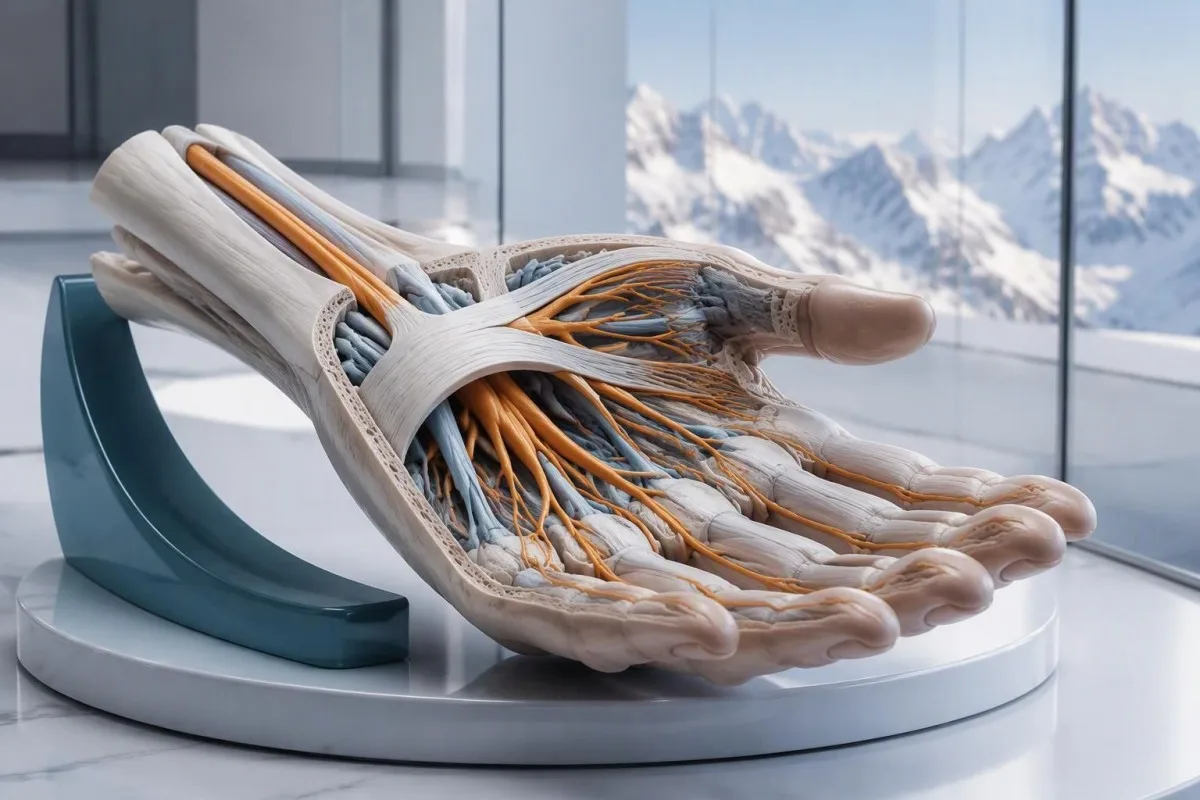
Los dets afectats ajudan a localisar lo problèma nerviós. Los simptòmas nocturns, la fòrça del det gròs e lo patron de simptòmas en defòra de la man ajudan a decidir se l’examen sol es sufisent.


- Patron dels dets: Lo sindròma del tunèl carpián afecta tipicament lo det gròs, l’indèx, lo det major e la mitat del costat del det gròs de l’anular: lo territòri d’aproximativament 3½ dets del nervi median.
- Det pichon: L’engordiment que tòca subretot lo det pichon e l’anular adjacent indica lo nervi cubital puslèu qu’un sindròma del tunèl carpián isolat.
- Formigaments nocturns: Una ortèsi de ponhet en posicion neutra pòt reduire los simptòmas pendent lo sòm; una feblesa persistenta deu pas esperar l’acabament d’un ensag prolongat de tractament a l’ostal.
- Feblesa del det gròs: La dificultat a levar lo det gròs luènh de la pauma o a lo opausar al det pichon es un signe mai especific qu’una prension generalament febla.
- Diagnostic clinic: La recomandacion AAOS de 2024 sosten l’evaluacion CTS-6 de 6 elements puslèu que l’ecografia o los tèsts de conduccion nerviosa sistematics dins los cases simples.
- Tèsts nervioses: Los estudis de conduccion nerviosa ajudan a localizar la compression e a n’avalorar la gravetat; un resultat normal exclutz pas completament una afeccion leugièra e intermitenta.
- Limites dels tèsts sanguins: Un HbA1c d’almens 6.5% pòt ajudar a establir un diagnostic de diabetis, amb una confirmacion apropriada, mas cap de tèst sanguin confirma una compression nerviosa al ponhet.
- Símptomes urgents: Un engordiment subte de la man amb afondrament de la cara, dificultat per parlar o feblesa novèla del braç necessita una evaluacion d’urgéncia immediata —quitament se sola 1 man es afectada.
Quins dets son generalament afectats pels simptòmas del sindròma del tunèl carpián?
Los simptòmas del canal carpian afèctan generalament lo poce, l’indèx, lo det major e la mitat del det annelar del costat del poce. Lo det pichon es generalament preservat. Las formigadas desrevelhan sovent las personas la nuèch, mentre qu’un engordiment persistent o una pèrda de fòrça del poce suggerís una compression mai importanta del nervi median al ponhet.
Lo nervi median passa jos lo ligam carpian transversal abans d’assegurar la sensibilitat d’aperaquí 3½ dets. Los simptòmas concernisson sovent las superfícias dels dets del costat de la palma e las puntas dels dets, inclusent la region del lièch ungueal; an pas d’arrestar exactament sus una linha neta dessenhada sus un esquèma de la man.
La dolor es mens precisa anatomicament que l’engordiment: lo malèsser del canal carpian pòt s’espandir al ponhet o a l’avantbraç, quitament quand l’alteracion de la sensibilitat demòra dins lo territòri del nervi median. Padua e sos collègas descrivon aquesta combinason de simptòmas sensitius caracteristics e de dolor variabla dins lor revista de 2016 dins Lancet Neurology; 1 dolor sordenta del ponhet soleta establís pas lo diagnostic.
Mon apròchi editorial, coma Thomas Klein, MD, es de començar pel mapa dels dets abans d’interpretar los resultats de laboratòri. Kantesti es un Analizador de tèst de sang d'IA que permet d’explicar de resultats de laboratòri pertinents, mas que remplaça pas la localizacion d’un nervi comprimit; nòstre organizacion e ambit clinic explica aquela distincion, que compta quand 1 man es engordida malgrat de resultats normals de las analisis sanguinas.
Que significan los simptòmas a l’anular e l’engordiment de la pauma?
Lo det annelar a una innervacion sensitiva partejada: sa mitat del costat del poce depend principalament del nervi median, mentre que son costat del det pichon depend principalament del nervi cubital. L’engordiment sus la basa carnauda del poce es mens tipic d’un canal carpian isolat, perque una branca del nervi median arriba a aquela zona defòra del canal.
Lo branca cutanèa palmària se separa generalament del nervi median qualques centimètres abans del ponhet e passa per dessús del ligam carpian. Aquel desviament anatomic significa qu’una vertadièra pèrda de sensibilitat sus l’eminéncia tenar —la zona carnauda de la basa del poce— pòt justificar un examen d’una compression mai amont dins l’avantbraç, puslèu que de supausar que cada simptòma del nervi median proven d’1 endrech.
Los pacients pòdon descriure tota la man coma engordida quitament quand l’examen revela una distribucion mai limitada. Una observacion utila en 2 etapas consistís a identificar la punta del det mai afectada pendent un episòdi, puèi a comparar lo det pichon amb l’indèx; aquò ajuda mai un professional de santat que d’ensajar de memorizar un dessenh anatomic perfièch.
De simptòmas sensitius espandits demandan una explicacion mai ampla, subretot quand los dos pès son tanben afectats, en mai de las doas mans. Nòstra discussion sus lo B12 limitròf e los simptòmas nervioses aborda una autra possibilitat que pòt se produire sens anèmia evidenta; una valor de B12 d’aperaquí 200–300 pg/mL exigís sovent de prene en compte lo contèxte clinic, e non pas d’etiquetar automaticament lo cas coma un canal carpian.
Perqué los formigaments de la man la nuèch suggerisson un sindròma del tunèl carpián?
Las formigadas nocturnas de la man son caracteristicas del canal carpian, perque la flexion o l’extension del ponhet pendent lo sòmi pòt aumentar la pression a l’entorn del nervi median. Waking with numb fingers and getting temporary relief by shaking the hand supports the diagnosis, but neither feature proves it on its own.
The wrist does not have to be sharply bent to aggravate symptoms; prolonged positioning can matter more than a brief movement. In a hypothetical 46-year-old who wakes twice nightly with index- and middle-finger tingling, I would ask whether the hand is tucked beneath a pillow, whether the elbow is bent, and whether changing position actually helps.
An elbow bent for hours can also irritate the ulnar nerve, producing nighttime ring- and little-finger symptoms. That is why 2 people with identical sleep disruption may need different advice: a wrist splint targets median nerve pressure, while reducing prolonged elbow flexion targets a different compression site.
Nighttime numbness is a localization clue, not a reason to order a hormone panel simply because sleep is poor. Our guide to sleep-related laboratory changes separates temporary lab effects from structural nerve problems; record symptoms across 7 nights, including the affected fingers and the position that relieved them, before your appointment.
Quins son los primièrs signes del sindròma del tunèl carpián?
Early signs of carpal tunnel usually include intermittent fingertip tingling, nighttime waking, and symptoms during sustained wrist positions or gripping. Constant numbness and visible thumb-muscle wasting are not reassuring early features; they can indicate more advanced nerve dysfunction and warrant prompt clinical assessment.
A normal-looking hand does not rule out carpal tunnel, and 1 symptom-free morning does not mean the nerve has recovered. Early episodes may disappear within minutes after changing position; later, the same person may notice altered touch while buttoning clothing, handling coins, or distinguishing a small object inside a pocket.
Progression is not a fixed sequence, and there is no reliable rule that symptoms become permanent after a particular number of weeks. A practical 3-part diary records episode frequency, whether sensation returns fully between episodes, and whether tasks are becoming harder; loss of recovery between episodes is more concerning than an isolated increase in discomfort.
Sensory symptoms can also precede anemia in deficita de vitamina B12, so a normal hemoglobin or MCV should not end the discussion when numbness involves the feet or balance. Our B12 versus folate comparison explains why checking 1 vitamin cannot always answer the question, particularly when high-dose folate supplements are already being taken.
Quand la feblesa de la prension suggerís una lesion del nervi median?
Carpal tunnel can weaken thumb opposition and thumb movement away from the palm, making pinch tasks and object handling difficult. General grip weakness is less specific: pain, arthritis, tendon problems, and other neurological conditions can all reduce how firmly someone holds an object.
Lo abductor pollicis brevis is particularly useful during examination because it lifts the thumb away from the plane of the palm. Clinicians compare the 2 hands and assess resistance rather than simply asking for a fist; squeezing can remain fairly strong while a small but important thumb movement is already weak.
Dropping a mug does not automatically mean permanent nerve damage. It may reflect reduced sensation, pain-limited grip, or true motor weakness—3 different mechanisms with different implications; visible flattening of the thumb-base muscles, especially with constant fingertip numbness, makes a specialist assessment more pressing.
A hypothetical 58-year-old with painful hand joints and weak grip needs a different evaluation from someone with painless thumb weakness and index-finger numbness. Muscle-related laboratory investigations such as those discussed in our aldolase and muscle weakness guide address a separate problem; neither an aldolase nor a CK result identifies compression inside 1 wrist tunnel.
En qué los problèmas del coide e del còl diferisson del sindròma del tunèl carpián?
Little-finger numbness suggests ulnar nerve involvement, while neck pain with radiating arm symptoms raises concern for a cervical nerve-root problem. Carpal tunnel more often produces median-territory fingertip symptoms, especially at night, without explaining weakness across several unrelated arm muscles.
Ulnar nerve compression at the elbow commonly affects the little finger and little-finger half of the ring finger; compression at the wrist can produce a similar fingertip pattern. Examining sensation on the back of the ulnar side of the hand helps distinguish these 2 sites, because the relevant sensory branch leaves the nerve before it enters the wrist canal.
A C6 or C7 radiculopathy can overlap thumb, index, or middle-finger symptoms, making finger distribution alone insufficient. Reflex changes, neck-provoked symptoms, and weakness outside the median nerve’s wrist territory help resolve the overlap; carpal tunnel and cervical disease can coexist, but the proposed double-crush mechanism remains more debated than the coexistence itself.
Weakness without sensory loss points away from a straightforward sensory nerve-compression explanation. Our myasthenia testing and symptom guide describes a different pattern involving fatigable weakness with preserved sensation; no single diagnosis should be chosen simply because 1 hand feels less capable.
Las analisis sanguinas pòdon identificar la causa de l’engordiment de la man?
Blood tests cannot confirm carpal tunnel, but selected tests can identify contributors or alternative causes of numbness. HbA1c or glucose, vitamin B12, thyroid tests, and kidney function are considered when the history suggests generalized neuropathy, systemic illness, or symptoms beyond 1 median nerve territory.
Vitamin B12 below about 200 pg/mL, equivalent to approximately 148 pmol/L, often supports deficiency, although assays and diagnostic thresholds differ. An indeterminate result may need methylmalonic acid testing; renal impairment can raise that marker independently, so our d'interpretacion de biomarcador is best used alongside the clinical history rather than as an automatic diagnosis.
Tingling around the mouth together with both hands or muscle cramps suggests an electrolyte problem more than isolated wrist compression. Total calcium commonly falls near 8.5–10.5 mg/dL in adult laboratory ranges, but albumin and ionized calcium change interpretation; our low-calcium symptom guide explains why widespread tingling should not be managed with a wrist brace alone.
Kantesti es un plataforma d’interpretacion d’analisi de sang d’AI that can organize these findings, but laboratory interpretation cannot establish which nerve is compressed. For unexplained distal neuropathy, a clinician may also consider protein electrophoresis with immunofixation; our serum protein assessment guide explains a targeted investigation, not a screening panel that everyone with 1 numb finger needs.
Quinas afeccions de santat aumentan lo risc de sindròma del tunèl carpián?
Diabetes, pregnancy, obesity, and some inflammatory joint conditions are associated with carpal tunnel; hypothyroidism can also be a contributor. These associations increase clinical suspicion but do not replace examination, and treating a systemic condition does not necessarily remove an established compression at the wrist.
HbA1c of at least 6.5%, or 48 mmol/mol, is a diabetes diagnostic threshold when appropriate confirmation and test reliability requirements are met. Diabetes can produce generalized neuropathy and focal entrapment at the same time; our high-glucose symptom guide helps distinguish systemic clues such as thirst from a 3½-finger sensory pattern.
A TSH above a laboratory’s reference range—often approximately 0.4–4.0 mIU/L—needs interpretation with free T4, symptoms, and medication history rather than automatic attribution of hand numbness to thyroid disease. Our subclinical hypothyroidism discussion explains this uncertainty; pregnancy-related carpal tunnel may improve after delivery, but persistent weakness still requires assessment rather than waiting through an assumed 6-week recovery.
Vitamin B6 supplements are not an established treatment for carpal tunnel, and excessive intake can itself cause sensory neuropathy. Kantesti can help readers put laboratory results in context, but supplement exposure often requires a separate history: add the B6 amounts across all products, including 1 multivitamin plus a B-complex, using our guida de seguretat del B-complex as a checklist.
Cossí un professional de santat examina un sindròma del tunèl carpián sospiechat?
A clinician assesses the sensory pattern, nighttime symptoms, thumb strength, and provocative wrist maneuvers to estimate the likelihood of carpal tunnel. The 2024 AAOS guideline supports the 6-item CTS-6 clinical assessment instead of routinely using ultrasound or nerve conduction studies in a typical presentation.
Phalen’s test usually involves holding the wrist flexed for up to 60 seconds; Tinel’s sign involves tapping over the nerve to reproduce tingling. A positive result is more useful when it recreates the person’s usual median-territory symptoms, rather than merely causing local discomfort; Wipperman and Goerl’s 2016 American Family Physician review emphasizes the combined clinical picture.
Lo CTS-6 combines 6 findings rather than relying on a single maneuver, and a score around 12 or higher commonly supports a likely clinical diagnosis. The score is not intended as a do-it-yourself guarantee: accurate assessment of thenar weakness and two-point discrimination requires technique, and an atypical pattern can still justify further investigation despite a persuasive score.
Examination should extend beyond the wrist when 2 explanations remain plausible. Testing neck movement, reflexes, other hand muscles, and foot sensation can prevent indiscriminate laboratory testing; our guide to targeted tests for unexplained pain explains why normal inflammatory markers do not settle a nerve-localization question.
Quand los estudis de conduccion nerviosa e l’EMG son utils?
Nerve conduction studies help when the diagnosis is uncertain, symptoms are atypical, weakness is present, or severity will affect treatment decisions. They measure how electrical signals travel along the nerve; electromyography may be added to assess muscle involvement or look for a cervical nerve-root disorder.
A median nerve signal can be compared with an ulnar or radial nerve signal traveling a similar distance in the same hand. Differences of approximately 0.4–0.5 milliseconds may be significant in some comparison protocols, but thresholds depend on the technique; hand temperature, often kept at least 32°C, matters because cold can slow conduction and distort the interpretation.
A normal test does not completely exclude mild or intermittent carpal tunnel, and an abnormal result must still match the symptoms. There are 2 particularly useful questions for the report: does it show focal slowing across the wrist, and is there evidence of axonal loss rather than slowing alone; the latter can make persistent weakness more concerning.
The 2024 AAOS recommendation against routine testing in straightforward cases does not mean nerve studies are unnecessary before every difficult decision. Kantesti’s validation methods and limitations concern laboratory interpretation, not electrodiagnostic accuracy; a blood-test engine benchmark cannot demonstrate sensitivity for 1 compressed median nerve, and some clinicians obtain baseline studies when surgery is being considered.
L’ecografia pòt confirmar lo sindròma del tunèl carpián?
Ultrasound can support carpal tunnel diagnosis by showing median nerve enlargement and identifying structural contributors at the wrist. It measures anatomy rather than electrical function, so it complements—not duplicates—nerve conduction studies; routine imaging is usually unnecessary when the clinical presentation is already clear.
A median nerve cross-sectional area near or above 10 mm² at the tunnel inlet is a commonly used research and clinical threshold, but there is no universally reliable cutoff. Body size, measurement site, equipment, and local reference data matter; a value of 9.8 versus 10.2 mm² should not be treated as a sharp biological divide.
Ultrasound can identify a bifid median nerve, tendon-sheath changes, or a space-occupying structure that may alter management. A bifid nerve has 2 main divisions, so measuring only 1 can underestimate the total area; this is an example of why a technically detailed report can be more useful than its final positive-or-negative wording.
Disagreement between ultrasound and nerve conduction testing does not automatically mean that 1 test is wrong. Anatomy and function answer different questions, and our checklist de seguretat del rapòrt medical encourages readers to check the original report and stated limitations; MRI is generally reserved for another suspected problem rather than routine confirmation of typical carpal tunnel.
De qué podètz far en esperant una evaluacion?
For intermittent symptoms without weakness, a neutral-position wrist splint at night and avoidance of sustained wrist bending are reasonable first steps. Arrange assessment if symptoms keep recurring, impair sleep or work, or fail to improve; constant numbness, thumb weakness, or muscle wasting should not wait for a prolonged self-care trial.
A splint should hold the wrist close to neutral, not force it backward, and its straps should not create new tingling. For mild intermittent symptoms, reviewing the response over roughly 2–6 setmanas can help guide the next appointment; improvement supports a mechanical contributor but does not prove carpal tunnel, and worsening sensation or strength overrides that observation period.
A local corticosteroid injection can provide short-term symptom relief, but the 2024 AAOS guideline concludes that injections do not provide long-term improvement. Decompression may be discussed for persistent symptoms or significant neurological impairment; there is no single 3-month waiting rule that is appropriate for both intermittent tingling and progressive thumb weakness.
Kantesti es un Outil d’analisi de sang amb IA, not a treatment-selection system for wrist compression, and our limitas d’una IA responsabla explain why clinical examination remains necessary. For repetitive tasks, try changing wrist angle and taking brief breaks every 20–30 minutes as a practical experiment—not a proven cure—and stop any exercise that consistently worsens tingling.
Quins simptòmas d’engordiment de la man necessitan de suènhs urgents?
Sudden hand numbness with facial drooping, speech difficulty, new arm weakness, severe imbalance, or visual disturbance needs emergency assessment. A cold, pale, painful hand or rapidly worsening weakness also needs urgent evaluation; these are not symptoms to assume are routine carpal tunnel.
A stroke can occasionally begin with symptoms that seem confined to 1 hand, so sudden onset matters even when the usual facial or speech signs are absent. Symptoms that resolve can still represent a transient ischemic attack; seek emergency advice immediately rather than waiting until the next morning to see whether a wrist splint helps.
Rapidly progressive weakness in both legs or arms, especially after a recent illness, suggests a different neurological emergency. Our Guillain-Barré weakness warning guide explains why progression over hours to days is more concerning than a stable 2-month history of position-related fingertip tingling; breathing or swallowing difficulty warrants immediate emergency help.
Gradually developing thumb-muscle wasting is usually a prompt specialist issue rather than a stroke-style emergency, but it should not sit on a waiting list without clinical triage. Tell the service explicitly about constant numbness and new weakness, not just wrist pain; a noticeable decline over 1–2 weeks is a reason to request earlier assessment.
Publicacions de recèrca: qué sosten aquesta recomandacion?
Carpal tunnel guidance should rest on condition-specific clinical evidence, not blood-test AI performance claims. As of October 22, 2026, this article draws on the 2024 AAOS guideline and published clinical reviews; the 2 Figshare records below concern separate AI engineering and deployment questions, not validation of carpal tunnel diagnosis.
Lo 2024 AAOS guideline supports structured clinical diagnosis and selective testing, while Padua et al. (2016) and Wipperman and Goerl (2016) explain presentation, differentials, and assessment. Thomas Klein, MD, Chief Medical Officer at Kantesti LTD, UK Company No. 17090423, is the named author for this draft; our conselh medical describes the medical team, but this draft does not claim a completed independent review.
Multilingual AI assisted clinical decision support for early Hantavirus triage: Design, engineering validation, and real-world deployment across 50,000 interpreted blood test reports. (n.d.). Figshare. This supplied repository record addresses a different clinical topic; its title refers to 50,000 reports, which should not be treated as evidence about median nerve compression or the accuracy of a hand examination.
A pre-registered, rubric-based automated technical benchmark of the Kantesti blood-test interpretation engine on 100,000 synthetic test cases. (n.d.). Figshare. Synthetic-case performance does not establish patient diagnostic accuracy for carpal tunnel; DOI links and ResearchGate/Academia.edu discovery searches appear in the reference data below, with the 2 searches identified as discovery links rather than verified copies of either publication.
Questions frequentas
Adormiment del canal carpià: quins dets son abitualament afectats?
L'entorpidiment del tunèl carpian afecta generalament lo poce, l'indèx, lo det mejan e la mitat del det anular del costat del poce — lo territòri sensitiu d'aproximativament 3½ dets innervat pel nervi median. Lo det auricular es tipicament preservat dins lo sindròme del tunèl carpian isolat. De còps, las personas descrivon tota la man coma entorpida; lo patron informat es doncas un indici e non pas una pròva definitiva. Un professional de santat avalora la sensibilitat, la fòrça del poce e los autres territòris nervioses abans de decidir se cal d'examèns complementaris.
Lo sindròm del canal carpian pòt afectar lo det pichon?
0. Un tunnel carpian isolat causa pas tipicament d'engordiment del det pichon, per çò que lo det pichon recep la sensibilitat del nervi cubital. L'engordiment del det pichon e de la mitat vesina del det annular suggerís una compression del nervi cubital, sovent al coide o de còps al ponhet. Dos problèmas nervioses pòdon coexistir, e los simptòmas son pas totjorn descriches amb precision anatomica. L'examen es mai util que lo diagnostic de la causa a partir d'un solet det.
Perqué me formiguejan las mans la nuèch ?
Lo formigueig de la man de nuèit pòt se produire quand la flexion prolongada del ponhet aumenta la pression sul nervi median dins lo canal carpian. La flexion prolongada del codo pòt en cambi irritar lo nervi cubital, particularament quand lo det anular e lo det pichon son tocats. Una ortèsi de ponhet en posicion neutra pòt ajudar en cas de simptòmas intermitents dins lo territòri del nervi median, mentre qu’un diari de 7 nuèits pòt revelar de patrons ligats a la posicion. Un engordiment persistent, una feblesa o de simptòmas que tòcan los pès meritan una avaloracion puslèu que d’assumir que la posicion de dormida explica tot.
0 Ai beson d’estudis de conduccion nerviosa per diagnosticar lo sindròm del tunèl carpian?
Totes las personas an pas besonh d’estudis de conduccion nerviosa per diagnosticar lo sindròm del canèl carpian. La recommandacion AAOS de 2024 sosten l’evaluacion clinica CTS-6 de 6 elements puslèu que l’ecografia o los tèsts de conduccion nerviosa de rutina dins los cases tipics. Los estudis nervioses son utils quand los simptòmas son atipics, que lo diagnostic es incert, qu’una flaquesa es presenta o que la gravetat influenciarà las decisions terapeuticas. Un resultat normal exclutz pas completament una compression intermitenta leugièra.
Un test sanguin pòt diagnosticar lo sindròm del canal carpià?
Cap de test sanguinari pòt confirmar lo sindròm del canau carpian, perque los tests de laboratòri mòstran pas se lo nèrvi median es comprimit al nivèl del ponhet. De tests seleccionats pòdon identificar de factors contribuents o d’autres diagnostics possibles, coma lo diabèta, una caréncia de vitamina B12, una disfoncion tiroïdiana o una malautiá renala. Un HbA1c d’almens 6.5% pòt justificar un diagnostic de diabèta quand las exigéncias de confirmacion e de fisabilitat del test son satisfachas, mas prova pas lo sindròm del canau carpian. Los tests devon seguir lo perfil dels simptòmas e l’istòria medicala, puslèu qu’un panèl universel per las mans engordidas.
Quand deuriái m'inquietar per l'engordiment de la man e una presa febla?
0 La pèrda sobta de sensibilitat d’una man amb afaissement de la cara, dificultat per parlar, feblesa novèla d’un braç o cambiaments de la vision requerís una avaloracion urgenta immediata, quitament quand una sola man es afectada. Una man freja, pallida e dolorosa, o una feblesa que s’agreuja rapidament, requerís tanben una avaloracion urgenta. Una insensibilitat constanta e progressiva, una dificultat per opausar lo det gròs, o una atròfia visibla dels muscles del det gròs justifica una avaloracion clinica rapida per una possibla compression nerviosa significativa. Esperetz pas d’acabar un ensag d’esplech de 6 setmanas se la fòrça o la sensibilitat se deteriora.
Obtén uèi una analisi de sang amb IA
Joinhètz mai de 2 milions d’utilizaires al mond que confian en Kantesti per una analisi instantanèa e precisa dels analisis de laboratòri. Mandatz vòstres resultats analisi de sang e recebetz una interpretacion complèta de 15,000+ biomarcadors en segondas.
📚 Publicacions de recerca citadas
Klein, T., Mitchell, S., & Weber, H. (2026). IA multilingüe d'ajuda a la decision clinica per la tria precòça de l'Hantavirus: concepcion, validacion d'engenhariá e desplegament real sus 50 000 rapòrts de bilans sanguins interpretats. Kantesti IA Recèrca Medicala.
Klein, T., Mitchell, S., & Weber, H. (2026). Un Benchmark tecnic automatizat basat sus una rubric pre-registrada de l’Engine d’interpretacion de l’analisi de sang Kantesti sus 100.000 cas de tèst sintetics. Kantesti IA Recèrca Medicala.
📖 Referéncias mèdicas externes
American Academy of Orthopaedic Surgeons (2024). Management of Carpal Tunnel Syndrome: Evidence-Based Clinical Practice Guideline. AAOS Clinical Practice Guideline.
Padua L et al. (2016). Carpal tunnel syndrome: clinical features, diagnosis, and management. The Lancet Neurology.
Wipperman J and Goerl K (2016). Carpal Tunnel Syndrome: Diagnosis and Management. American Family Physician.
⚕️ Avertiment medical
Aqueste article es solament per tòcas educatius e constituís pas de conselh medical. Consultatz totjorn un professional de la sant qualificat per las decisions de diagnostica e de tractament.
Senhals de confiança E-E-A-T
Experiéncia
Revisión clinica menada pel metge de las practicas d’interpretacion de las analisis.
Expertisa
Fòcus sus la medicina de laboratòri sus cossí los biomarcadors se comportan dins un contèxte clinic.
Autoritat
Escrich pel Dr. Thomas Klein amb revisión pel Dr. Sarah Mitchell e Prof. Dr. Hans Weber.
Fisança
Interpretacion basada sus d’evidéncias amb de camins de seguiment clars per reduzir l’alarmisme.