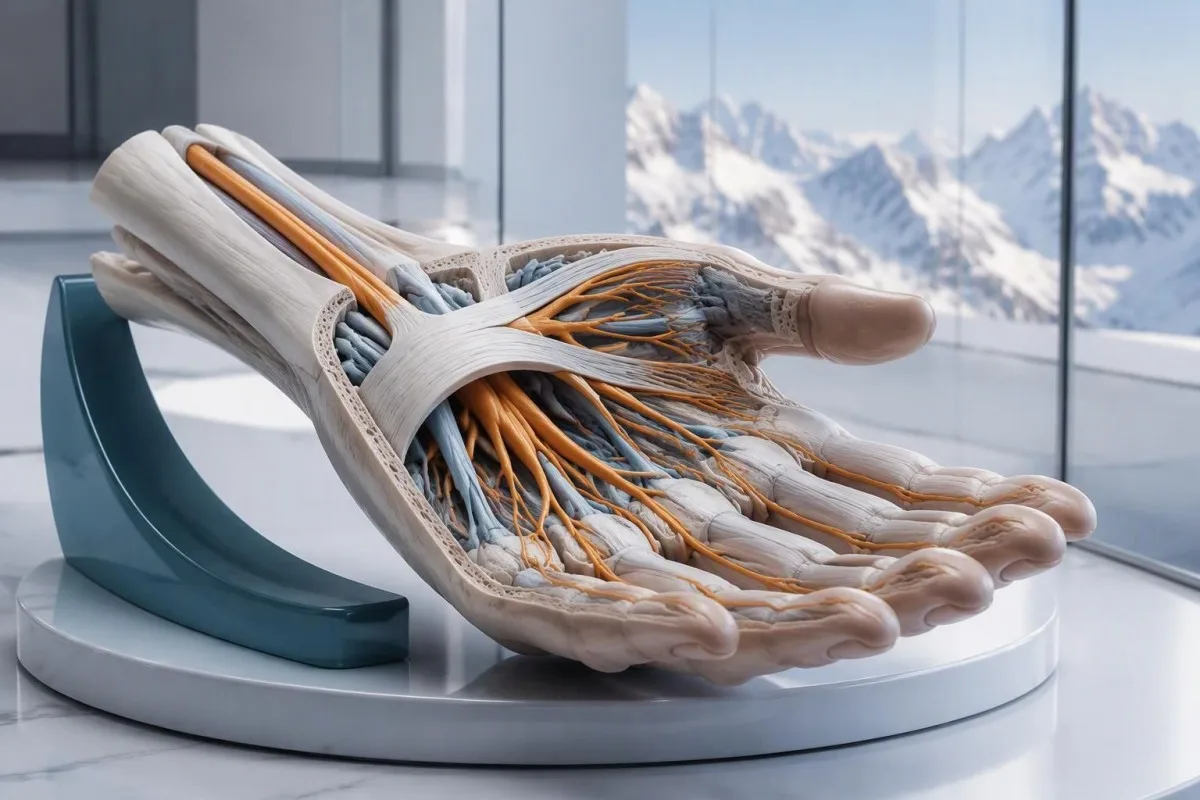
The affected fingers help locate the nerve problem. Nighttime symptoms, thumb strength, and the pattern outside the hand help decide whether examination alone is enough.


- Finger pattern: Carpal tunnel typically affects the thumb, index finger, middle finger, and thumb-side half of the ring finger—the median nerve’s approximately 3½-finger territory.
- Little finger: Numbness mainly in the little finger and adjacent ring finger points toward the ulnar nerve rather than isolated carpal tunnel.
- Nighttime tingling: A neutral-position wrist splint can reduce symptoms during sleep; persistent weakness should not wait through a prolonged home-treatment trial.
- Thumb weakness: Difficulty lifting the thumb away from the palm or opposing it to the little finger is more specific than a generally weak grip.
- Clinical diagnosis: The 2024 AAOS guideline supports the 6-item CTS-6 assessment instead of routine ultrasound or nerve conduction testing in straightforward cases.
- Nerve testing: Nerve conduction studies help locate compression and assess severity; a normal result does not completely exclude mild, intermittent disease.
- Blood test limits: An HbA1c of at least 6.5% may support a diabetes diagnosis, with appropriate confirmation, but no blood test confirms wrist nerve compression.
- Яаралтай шинж тэмдгүүд: Sudden hand numbness with facial drooping, speech difficulty, or new arm weakness needs immediate emergency assessment—even if only 1 hand is affected.
Which fingers do carpal tunnel symptoms usually affect?
Carpal tunnel symptoms usually affect the thumb, index finger, middle finger, and thumb-side half of the ring finger. The little finger is typically spared. Tingling often wakes people at night, while persistent numbness or loss of thumb strength suggests more significant median nerve compression at the wrist.
The median nerve travels beneath the transverse carpal ligament before supplying sensation to roughly 3½ fingers. Symptoms commonly involve the palm-facing finger surfaces and fingertips, including the nail-bed region; they do not have to stop exactly at a neat line drawn on a hand diagram.
Pain is less anatomically tidy than numbness: carpal tunnel discomfort can spread into the wrist or forearm, even when altered sensation stays in the median territory. Padua and colleagues describe this combination of characteristic sensory symptoms and variable pain in their 2016 Lancet Neurology review; 1 aching wrist alone does not establish the diagnosis.
My editorial approach as Thomas Klein, MD, is to start with the finger map before interpreting laboratory results. Kantesti is an AI цусны шинжилгээний анализатор that helps explain relevant laboratory findings, not a substitute for locating a compressed nerve; our байгууллага ба клиник хамрах хүрээ explain that distinction, which matters when 1 hand feels numb despite normal blood work.
What do ring-finger symptoms and palm numbness mean?
The ring finger has divided sensory supply: its thumb-side half belongs mainly to the median nerve, while its little-finger side belongs mainly to the ulnar nerve. Numbness over the fleshy base of the thumb is less typical of isolated carpal tunnel because a median nerve branch reaches that area outside the tunnel.
The palmar cutaneous branch usually leaves the median nerve several centimeters before the wrist and passes superficial to the carpal ligament. That anatomical detour means true sensory loss over the thenar eminence—the fleshy thumb-base area—can prompt examination for compression farther up the forearm, rather than assuming every median-nerve symptom comes from 1 location.
Patients may describe the entire hand as numb even when examination finds a narrower distribution. A useful 2-step observation is to identify the worst fingertip during an episode, then compare the little finger with the index finger; this helps a clinician more than trying to memorize a perfect anatomical drawing.
Broad sensory symptoms deserve a broader explanation, especially when both feet are affected as well as both hands. Our discussion of borderline B12 and nerve symptoms addresses an alternative that may occur without obvious anemia; a B12 value around 200–300 pg/mL often needs clinical context, not an automatic carpal tunnel label.
Why does hand tingling at night suggest carpal tunnel?
Hand tingling at night is characteristic of carpal tunnel because wrist flexion or extension during sleep can increase pressure around the median nerve. Waking with numb fingers and getting temporary relief by shaking the hand supports the diagnosis, but neither feature proves it on its own.
The wrist does not have to be sharply bent to aggravate symptoms; prolonged positioning can matter more than a brief movement. In a hypothetical 46-year-old who wakes twice nightly with index- and middle-finger tingling, I would ask whether the hand is tucked beneath a pillow, whether the elbow is bent, and whether changing position actually helps.
An elbow bent for hours can also irritate the ulnar nerve, producing nighttime ring- and little-finger symptoms. That is why 2 people with identical sleep disruption may need different advice: a wrist splint targets median nerve pressure, while reducing prolonged elbow flexion targets a different compression site.
Nighttime numbness is a localization clue, not a reason to order a hormone panel simply because sleep is poor. Our guide to sleep-related laboratory changes separates temporary lab effects from structural nerve problems; record symptoms across 7 nights, including the affected fingers and the position that relieved them, before your appointment.
What are the early signs of carpal tunnel?
Early signs of carpal tunnel usually include intermittent fingertip tingling, nighttime waking, and symptoms during sustained wrist positions or gripping. Constant numbness and visible thumb-muscle wasting are not reassuring early features; they can indicate more advanced nerve dysfunction and warrant prompt clinical assessment.
A normal-looking hand does not rule out carpal tunnel, and 1 symptom-free morning does not mean the nerve has recovered. Early episodes may disappear within minutes after changing position; later, the same person may notice altered touch while buttoning clothing, handling coins, or distinguishing a small object inside a pocket.
Progression is not a fixed sequence, and there is no reliable rule that symptoms become permanent after a particular number of weeks. A practical 3-part diary records episode frequency, whether sensation returns fully between episodes, and whether tasks are becoming harder; loss of recovery between episodes is more concerning than an isolated increase in discomfort.
Sensory symptoms can also precede anemia in D витамины дутагдал, so a normal hemoglobin or MCV should not end the discussion when numbness involves the feet or balance. Our B12 versus folate comparison explains why checking 1 vitamin cannot always answer the question, particularly when high-dose folate supplements are already being taken.
When does grip weakness suggest median nerve damage?
Carpal tunnel can weaken thumb opposition and thumb movement away from the palm, making pinch tasks and object handling difficult. General grip weakness is less specific: pain, arthritis, tendon problems, and other neurological conditions can all reduce how firmly someone holds an object.
The abductor pollicis brevis is particularly useful during examination because it lifts the thumb away from the plane of the palm. Clinicians compare the 2 hands and assess resistance rather than simply asking for a fist; squeezing can remain fairly strong while a small but important thumb movement is already weak.
Dropping a mug does not automatically mean permanent nerve damage. It may reflect reduced sensation, pain-limited grip, or true motor weakness—3 different mechanisms with different implications; visible flattening of the thumb-base muscles, especially with constant fingertip numbness, makes a specialist assessment more pressing.
A hypothetical 58-year-old with painful hand joints and weak grip needs a different evaluation from someone with painless thumb weakness and index-finger numbness. Muscle-related laboratory investigations such as those discussed in our aldolase and muscle weakness guide address a separate problem; neither an aldolase nor a CK result identifies compression inside 1 wrist tunnel.
How do elbow and neck problems differ from carpal tunnel?
Little-finger numbness suggests ulnar nerve involvement, while neck pain with radiating arm symptoms raises concern for a cervical nerve-root problem. Carpal tunnel more often produces median-territory fingertip symptoms, especially at night, without explaining weakness across several unrelated arm muscles.
Ulnar nerve compression at the elbow commonly affects the little finger and little-finger half of the ring finger; compression at the wrist can produce a similar fingertip pattern. Examining sensation on the back of the ulnar side of the hand helps distinguish these 2 sites, because the relevant sensory branch leaves the nerve before it enters the wrist canal.
A C6 or C7 radiculopathy can overlap thumb, index, or middle-finger symptoms, making finger distribution alone insufficient. Reflex changes, neck-provoked symptoms, and weakness outside the median nerve’s wrist territory help resolve the overlap; carpal tunnel and cervical disease can coexist, but the proposed double-crush mechanism remains more debated than the coexistence itself.
Weakness without sensory loss points away from a straightforward sensory nerve-compression explanation. Our myasthenia testing and symptom guide describes a different pattern involving fatigable weakness with preserved sensation; no single diagnosis should be chosen simply because 1 hand feels less capable.
Can blood tests identify the cause of hand numbness?
Blood tests cannot confirm carpal tunnel, but selected tests can identify contributors or alternative causes of numbness. HbA1c or glucose, vitamin B12, thyroid tests, and kidney function are considered when the history suggests generalized neuropathy, systemic illness, or symptoms beyond 1 median nerve territory.
Vitamin B12 below about 200 pg/mL, equivalent to approximately 148 pmol/L, often supports deficiency, although assays and diagnostic thresholds differ. An indeterminate result may need methylmalonic acid testing; renal impairment can raise that marker independently, so our биомаркер тайлбарлах гарын авлага is best used alongside the clinical history rather than as an automatic diagnosis.
Tingling around the mouth together with both hands or muscle cramps suggests an electrolyte problem more than isolated wrist compression. Total calcium commonly falls near 8.5–10.5 mg/dL in adult laboratory ranges, but albumin and ionized calcium change interpretation; our low-calcium symptom guide explains why widespread tingling should not be managed with a wrist brace alone.
Кантести бол AI цусны шинжилгээний тайлал платформ that can organize these findings, but laboratory interpretation cannot establish which nerve is compressed. For unexplained distal neuropathy, a clinician may also consider protein electrophoresis with immunofixation; our serum protein assessment guide explains a targeted investigation, not a screening panel that everyone with 1 numb finger needs.
Which health conditions increase carpal tunnel risk?
Diabetes, pregnancy, obesity, and some inflammatory joint conditions are associated with carpal tunnel; hypothyroidism can also be a contributor. These associations increase clinical suspicion but do not replace examination, and treating a systemic condition does not necessarily remove an established compression at the wrist.
HbA1c of at least 6.5%, or 48 mmol/mol, is a diabetes diagnostic threshold when appropriate confirmation and test reliability requirements are met. Diabetes can produce generalized neuropathy and focal entrapment at the same time; our high-glucose symptom guide helps distinguish systemic clues such as thirst from a 3½-finger sensory pattern.
A TSH above a laboratory’s reference range—often approximately 0.4–4.0 mIU/L—needs interpretation with free T4, symptoms, and medication history rather than automatic attribution of hand numbness to thyroid disease. Our subclinical hypothyroidism discussion explains this uncertainty; pregnancy-related carpal tunnel may improve after delivery, but persistent weakness still requires assessment rather than waiting through an assumed 6-week recovery.
Vitamin B6 supplements are not an established treatment for carpal tunnel, and excessive intake can itself cause sensory neuropathy. Kantesti can help readers put laboratory results in context, but supplement exposure often requires a separate history: add the B6 amounts across all products, including 1 multivitamin plus a B-complex, using our B-комплексийн аюулгүй байдлын гарын авлага as a checklist.
How does a clinician examine suspected carpal tunnel?
A clinician assesses the sensory pattern, nighttime symptoms, thumb strength, and provocative wrist maneuvers to estimate the likelihood of carpal tunnel. The 2024 AAOS guideline supports the 6-item CTS-6 clinical assessment instead of routinely using ultrasound or nerve conduction studies in a typical presentation.
Phalen’s test usually involves holding the wrist flexed for up to 60 seconds; Tinel’s sign involves tapping over the nerve to reproduce tingling. A positive result is more useful when it recreates the person’s usual median-territory symptoms, rather than merely causing local discomfort; Wipperman and Goerl’s 2016 American Family Physician review emphasizes the combined clinical picture.
The CTS-6 combines 6 findings rather than relying on a single maneuver, and a score around 12 or higher commonly supports a likely clinical diagnosis. The score is not intended as a do-it-yourself guarantee: accurate assessment of thenar weakness and two-point discrimination requires technique, and an atypical pattern can still justify further investigation despite a persuasive score.
Examination should extend beyond the wrist when 2 explanations remain plausible. Testing neck movement, reflexes, other hand muscles, and foot sensation can prevent indiscriminate laboratory testing; our guide to targeted tests for unexplained pain explains why normal inflammatory markers do not settle a nerve-localization question.
When do nerve conduction studies and EMG help?
Nerve conduction studies help when the diagnosis is uncertain, symptoms are atypical, weakness is present, or severity will affect treatment decisions. They measure how electrical signals travel along the nerve; electromyography may be added to assess muscle involvement or look for a cervical nerve-root disorder.
A median nerve signal can be compared with an ulnar or radial nerve signal traveling a similar distance in the same hand. Differences of approximately 0.4–0.5 milliseconds may be significant in some comparison protocols, but thresholds depend on the technique; hand temperature, often kept at least 32°C, matters because cold can slow conduction and distort the interpretation.
A normal test does not completely exclude mild or intermittent carpal tunnel, and an abnormal result must still match the symptoms. There are 2 particularly useful questions for the report: does it show focal slowing across the wrist, and is there evidence of axonal loss rather than slowing alone; the latter can make persistent weakness more concerning.
The 2024 AAOS recommendation against routine testing in straightforward cases does not mean nerve studies are unnecessary before every difficult decision. Kantesti’s validation methods and limitations concern laboratory interpretation, not electrodiagnostic accuracy; a blood-test engine benchmark cannot demonstrate sensitivity for 1 compressed median nerve, and some clinicians obtain baseline studies when surgery is being considered.
Can ultrasound confirm carpal tunnel syndrome?
Ultrasound can support carpal tunnel diagnosis by showing median nerve enlargement and identifying structural contributors at the wrist. It measures anatomy rather than electrical function, so it complements—not duplicates—nerve conduction studies; routine imaging is usually unnecessary when the clinical presentation is already clear.
A median nerve cross-sectional area near or above 10 mm² at the tunnel inlet is a commonly used research and clinical threshold, but there is no universally reliable cutoff. Body size, measurement site, equipment, and local reference data matter; a value of 9.8 versus 10.2 mm² should not be treated as a sharp biological divide.
Ultrasound can identify a bifid median nerve, tendon-sheath changes, or a space-occupying structure that may alter management. A bifid nerve has 2 main divisions, so measuring only 1 can underestimate the total area; this is an example of why a technically detailed report can be more useful than its final positive-or-negative wording.
Disagreement between ultrasound and nerve conduction testing does not automatically mean that 1 test is wrong. Anatomy and function answer different questions, and our AI-д тулгуурласан үр дүнгийн хувьд encourages readers to check the original report and stated limitations; MRI is generally reserved for another suspected problem rather than routine confirmation of typical carpal tunnel.
What can you do while waiting for an assessment?
For intermittent symptoms without weakness, a neutral-position wrist splint at night and avoidance of sustained wrist bending are reasonable first steps. Arrange assessment if symptoms keep recurring, impair sleep or work, or fail to improve; constant numbness, thumb weakness, or muscle wasting should not wait for a prolonged self-care trial.
A splint should hold the wrist close to neutral, not force it backward, and its straps should not create new tingling. For mild intermittent symptoms, reviewing the response over roughly 2–6 долоо хоног can help guide the next appointment; improvement supports a mechanical contributor but does not prove carpal tunnel, and worsening sensation or strength overrides that observation period.
A local corticosteroid injection can provide short-term symptom relief, but the 2024 AAOS guideline concludes that injections do not provide long-term improvement. Decompression may be discussed for persistent symptoms or significant neurological impairment; there is no single 3-month waiting rule that is appropriate for both intermittent tingling and progressive thumb weakness.
Кантести бол AI-аар ажилладаг цусны шинжилгээний үр дүнгийн шинжилгээний хэрэгсэл, not a treatment-selection system for wrist compression, and our хариуцлагатай AI-ийн хязгаарлалт explain why clinical examination remains necessary. For repetitive tasks, try changing wrist angle and taking brief breaks every 20–30 minutes as a practical experiment—not a proven cure—and stop any exercise that consistently worsens tingling.
Which hand numbness symptoms need urgent care?
Sudden hand numbness with facial drooping, speech difficulty, new arm weakness, severe imbalance, or visual disturbance needs emergency assessment. A cold, pale, painful hand or rapidly worsening weakness also needs urgent evaluation; these are not symptoms to assume are routine carpal tunnel.
A stroke can occasionally begin with symptoms that seem confined to 1 hand, so sudden onset matters even when the usual facial or speech signs are absent. Symptoms that resolve can still represent a transient ischemic attack; seek emergency advice immediately rather than waiting until the next morning to see whether a wrist splint helps.
Rapidly progressive weakness in both legs or arms, especially after a recent illness, suggests a different neurological emergency. Our Guillain-Barré weakness warning guide explains why progression over hours to days is more concerning than a stable 2-month history of position-related fingertip tingling; breathing or swallowing difficulty warrants immediate emergency help.
Gradually developing thumb-muscle wasting is usually a prompt specialist issue rather than a stroke-style emergency, but it should not sit on a waiting list without clinical triage. Tell the service explicitly about constant numbness and new weakness, not just wrist pain; a noticeable decline over 1–2 weeks is a reason to request earlier assessment.
Research publications: what supports this guidance?
Carpal tunnel guidance should rest on condition-specific clinical evidence, not blood-test AI performance claims. As of October 22, 2026, this article draws on the 2024 AAOS guideline and published clinical reviews; the 2 Figshare records below concern separate AI engineering and deployment questions, not validation of carpal tunnel diagnosis.
The 2024 AAOS guideline supports structured clinical diagnosis and selective testing, while Padua et al. (2016) and Wipperman and Goerl (2016) explain presentation, differentials, and assessment. Thomas Klein, MD, Chief Medical Officer at Kantesti LTD, UK Company No. 17090423, is the named author for this draft; our эмнэлгийн зөвлөх зөвлөл describes the medical team, but this draft does not claim a completed independent review.
Multilingual AI assisted clinical decision support for early Hantavirus triage: Design, engineering validation, and real-world deployment across 50,000 interpreted blood test reports. (n.d.). Figshare. This supplied repository record addresses a different clinical topic; its title refers to 50,000 reports, which should not be treated as evidence about median nerve compression or the accuracy of a hand examination.
A pre-registered, rubric-based automated technical benchmark of the Kantesti blood-test interpretation engine on 100,000 synthetic test cases. (n.d.). Figshare. Synthetic-case performance does not establish patient diagnostic accuracy for carpal tunnel; DOI links and ResearchGate/Academia.edu discovery searches appear in the reference data below, with the 2 searches identified as discovery links rather than verified copies of either publication.
Байнга асуудаг асуултууд
Бугуйн сувгийн хам шинжийн үед мэдээ алдалт: ихэвчлэн аль хуруунууд өртдөг вэ?
Бугуйн сувгийн хам шинжийн үеийн мэдээ алдалт ихэвчлэн эрхий, долоовор, дунд хуруу болон ядам хурууны эрхий хуруу талын хагасыг хамардаг бөгөөд энэ нь дунд мэдрэлийн мэдрэхүйн хариуцдаг ойролцоогоор 3½ хурууны хэсэг юм. Бугуйн сувгийн дан хам шинжийн үед чигчий хуруу ихэвчлэн өртдөггүй. Зарим хүн гар бүхэлдээ мэдээ алдсан гэж хэлдэг тул мэдээлсэн шинжийн тархалт нь эцсийн оношлох сорил бус, харин баримжаа болдог. Эмч нэмэлт шинжилгээ шаардлагатай эсэхийг шийдэхийн өмнө мэдрэхүй, эрхий хурууны хүч болон бусад мэдрэлийн хариуцдаг хэсгүүдийг шалгана.
Бугуйн сувгийн хам шинж чигчий хуруунд нөлөөлж болох уу?
Бугуйн сувгийн дан хам шинж нь чигчий хурууны мэдээ алдалтыг ихэвчлэн үүсгэдэггүй. Учир нь чигчий хурууны мэдрэхүйг ulnar мэдрэл дамжуулдаг. Чигчий хуруу болон нэргүй хурууны түүнтэй залгаа хагасын мэдээ алдалт нь ulnar мэдрэл дарагдсаныг илтгэх бөгөөд энэ нь ихэвчлэн тохой орчимд, заримдаа бугуйнд тохиолддог. Хоёр мэдрэлийн эмгэг хавсарч болох бөгөөд шинж тэмдгийг анатомийн хувьд үргэлж нарийн тодорхойлдоггүй. Шалтгааныг зөвхөн 1 хуруунд үндэслэн оношлохоос илүү үзлэг хийх нь ач холбогдолтой.
Шөнө гар бадайрдаг нь яагаад вэ?
Шөнө гар бадайрах нь бугуйг удаан хугацаанд нугалснаар бугуйн сувгийн дунд мэдрэлд ирэх даралт нэмэгдэхэд тохиолдож болно. Харин тохойг удаан хугацаанд нугалах нь тохойн мэдрэлийг цочроож болох бөгөөд ялангуяа ядам болон чигчий хуруу өртсөн үед илүүтэй тохиолдоно. Бугуйг саармаг байрлалд тогтоох чиг нь дунд мэдрэлийн мэдрэлжүүлдэг хэсэгт үе үе илрэх шинж тэмдгийг намдаахад тусалж болох бол 7 шөнийн тэмдэглэл нь байрлалаас хамаарах хэв маягийг илрүүлж чадна. Мэдээ алдалт, сулрал удаан үргэлжлэх, эсвэл хөлд шинж тэмдэг илрэх тохиолдолд бүхнийг унтах байрлалаар тайлбарлахын оронд мэргэжлийн үнэлгээ хийлгэх хэрэгтэй.
Бугуйн сувгийн хам шинжийг оношлуулахын тулд мэдрэлийн дамжуулалтын шинжилгээ хийлгэх шаардлагатай юу?
Бугуйн сувгийн хам шинжийг оношлоход хүн бүрд мэдрэлийн дамжуулалтын шинжилгээ шаардлагатай биш. 2024 оны AAOS-ийн удирдамжид хэв шинжит тохиолдолд хэт авиан шинжилгээ эсвэл мэдрэлийн дамжуулалтын шинжилгээг тогтмол хийхийн оронд CTS-6 гэсэн 6 үзүүлэлттэй эмнэлзүйн үнэлгээг зөвлөсөн. Шинж тэмдэг хэв шинжит бус, онош тодорхойгүй, булчин сулрал илэрсэн эсвэл хүндийн зэрэг нь эмчилгээний шийдвэрт нөлөөлөх тохиолдолд мэдрэлийн шинжилгээ тустай. Хэвийн үр дүн гарсан ч хөнгөн, үе үе илрэх шахалтыг бүрэн үгүйсгэхгүй.
Цусны шинжилгээгээр бугуйн сувгийн хам шинжийг оношлох боломжтой юу?
Лабораторийн шинжилгээгээр бугуйн хонгилын хам шинжийг батлах боломжгүй. Учир нь лабораторийн шинжилгээ бугуйн хэсэгт дунд мэдрэл дарагдсан эсэхийг харуулдаггүй. Сонгомол шинжилгээгээр чихрийн шижин, В12 аминдэмийн дутагдал, бамбай булчирхайн үйл ажиллагааны алдагдал, бөөрний өвчин зэрэг нөлөөлж болзошгүй шалтгаан эсвэл өөр оношийг илрүүлж болно. HbA1c 6.5% ба түүнээс дээш байх нь баталгаажуулах болон шинжилгээний найдвартай байдалд тавигдах шаардлагыг хангасан тохиолдолд чихрийн шижингийн оношийг дэмжиж болох ч бугуйн хонгилын хам шинжийг нотлохгүй. Шинжилгээг гар мэдээ алдах бүх хүнд ижил багц шинжилгээ хийхийн оронд шинж тэмдгийн илрэл болон өвчний түүхэнд үндэслэн сонгох хэрэгтэй.
Гар бадайрах, атгалт сулрах үед хэзээ санаа зовох ёстой вэ?
Нүүр мурийх, хэл ярианд хүндрэл үүсэх, гар шинээр сулрах эсвэл хараа өөрчлөгдөхтэй хавсарсан гар гэнэт мэдээ алдах тохиолдолд зөвхөн нэг гар өртсөн байсан ч яаралтай тусламжийн үнэлгээ хийлгэх шаардлагатай. Гар хүйтэн, цонхийж, өвдөх эсвэл сулрал хурдан даамжрах тохиолдолд мөн яаралтай үзүүлэх хэрэгтэй. Байнгын аажим мэдээ алдалт, эрхий хуруугаа бусад хуруутай сөргүүлэн хөдөлгөхөд хүндрэлтэй болох эсвэл эрхий хурууны булчин илт хатингарших шинж илэрвэл мэдрэлийн мэдэгдэхүйц дарагдал байж болзошгүй тул цаг алдалгүй эмнэлзүйн үнэлгээ хийлгэх шаардлагатай. Хүч эсвэл мэдрэхүй муудаж байгаа үед чигийг 6 долоо хоног туршин зүүх хугацааг хүлээж болохгүй.
Өнөөдөр AI-аар дэмжигдсэн цусны шинжилгээний тайлал аваарай
Лабораторийн шинжилгээний агшин зуур, үнэн зөв тайлалд итгэдэг дэлхийн 2 сая гаруй хэрэглэгчтэй нэгдээрэй. Цусны шинжилгээний хариугаа байршуулж, 15,000+ биомаркеруудын цогц тайллыг хэдхэн секундын дотор аваарай.
📚 Иш татсан судалгааны нийтлэлүүд
Клейн, Т., Митчелл, С., ба Вебер, Х. (2026). Гантовирусын эрт үеийн ялгаварлалтыг хэлний олон улсын хиймэл оюун ухааны тусламжтай эмнэлзүйн шийдвэр гаргах дэмжлэг: 50,000 тайланг тайлбарласан цусны шинжилгээний тайлангаар загварчлал, инженерчлэлийн баталгаажуулалт, бодит байдалд нэвтрүүлсэн байдал. Kantesti AI Медикл Рисерч.
Клейн, Т., Митчелл, С., ба Вебер, Х. (2026). Kantesti Цусны шинжилгээний тайлбарлах хөдөлгүүрийн 100,000 синтетик тест кейс дээрх урьдчилан бүртгэгдсэн, рубрик суурьтай автомат техникийн жишиг (benchmark). Kantesti AI Медикл Рисерч.
📖 Гадаад эмнэлгийн лавлагаа
American Academy of Orthopaedic Surgeons (2024). Management of Carpal Tunnel Syndrome: Evidence-Based Clinical Practice Guideline. AAOS Clinical Practice Guideline.
Padua L et al. (2016). Carpal tunnel syndrome: clinical features, diagnosis, and management. The Lancet Neurology.
Wipperman J and Goerl K (2016). Carpal Tunnel Syndrome: Diagnosis and Management. American Family Physician.
⚕️ Эмнэлгийн мэдэгдэл
Энэ нийтлэл зөвхөн боловсролын зорилготой бөгөөд эмнэлгийн зөвлөгөө биш болно. Оношилгоо, эмчилгээний шийдвэр гаргахдаа мэргэшсэн эрүүл мэндийн үйлчилгээ үзүүлэгчтэй заавал зөвлөлдөнө.
E-E-A-T итгэлийн дохио
Туршлага
Эмчийн удирдлагатай лабораторийн тайлалын ажлын урсгалын клиник хяналт.
Мэргэшсэн байдал
Биомаркерууд клиникийн нөхцөлд хэрхэн ажиллаж/өөрчлөгдөж байгаад чиглэсэн лабораторийн анагаах ухаан.
Эрх мэдэл
Доктор Томас Клейн бичсэн, Доктор Сара Митчелл, Проф. Доктор Ханс Вебер нар хянан тохиолдуулсан.
Найдвартай байдал
Сэрэмжлүүлгийг бууруулахын тулд тодорхой дараагийн алхамтай, нотолгоонд суурилсан тайлал.