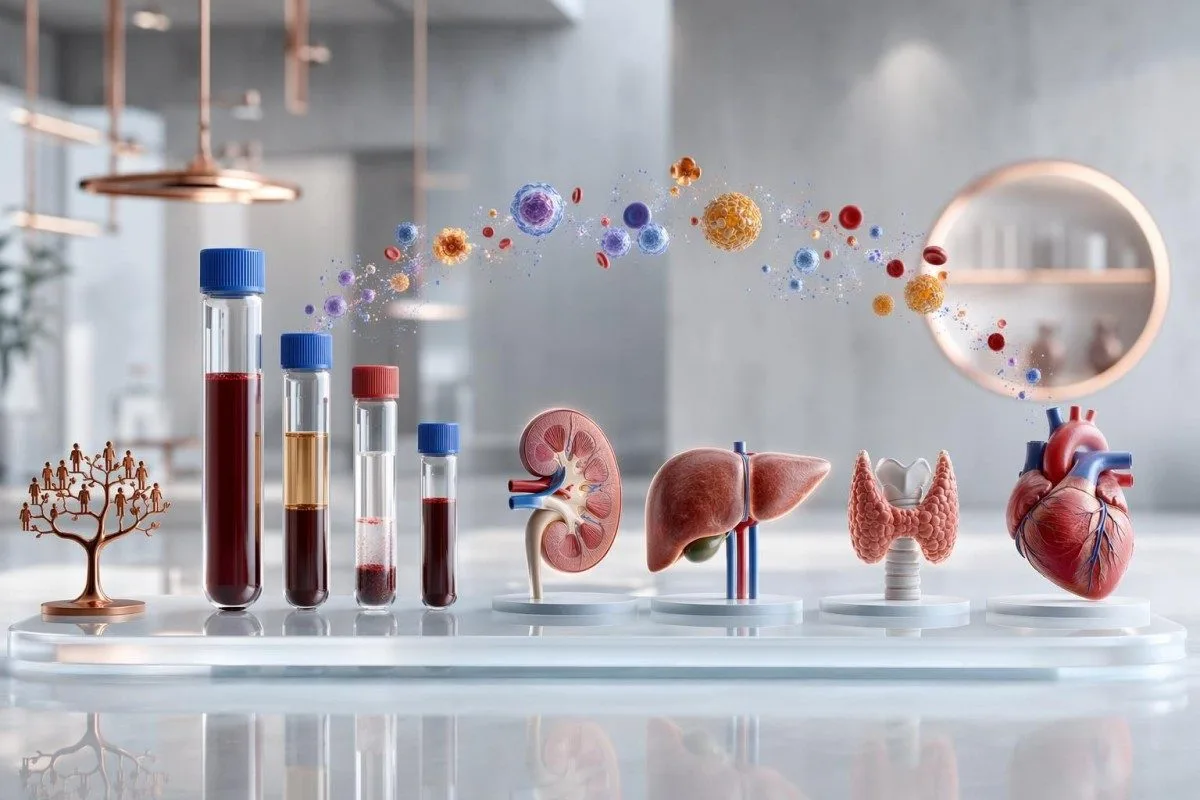
En praktisk husholdningsplan for screening for voksne, barn, tenåringer, eldre slektninger og pårørende, med aldersspesifikke laboratorieforskjeller og tryggere langsiktig sporing.


- Adults trenger vanligvis CBC, metabolsk panel, lipider og glukose eller HbA1c; HbA1c ≥6.5% kan diagnostisere diabetes når det er bekreftet.
- Barn krever aldersspesifikk tolkning; alkalisk fosfatase kan være 150–500 IU/L under vekst og fortsatt være fysiologisk.
- Teenagers trenger ofte ferritin, vitamin D, lipider og målrettet hormon- eller STI-testing basert på symptomer, pubertet og samtykkeregler.
- Blodprøvepakke for familien bør være risikobasert, ikke identisk for alle; arvelig lipidrisiko kan kreve Lp(a) eller ApoB en gang i voksen alder.
- Blodprøve for pårørende planlegging må inkludere medikamentovervåking, samtykke, mobilitetsbehov og en navngitt person som følger opp unormale resultater.
- Faste er ikke nødvendig for hver test, men triglyserider over 400 mg/dL fortjener vanligvis en fastende kontroll.
- Critical values for eksempel kalium ≥6,0 mmol/L, natrium <125 mmol/L eller hemoglobin nær 7 g/dL trenger vurdering av lege samme dag.
- Trend tracking fungerer best når familier beholder enheter, analyttmetode, fastetilstand og symptomer ved siden av hvert resultat.
Hva bør en husholdningsblodprøve sjekke først?
A blodprøve for hele familien bør ikke bety samme panel for alle. Voksne trenger vanligvis metabolsk, nyre-, lever-, lipid- og diabetes-screening; barn trenger aldersjusterte kontroller; ungdom trenger testing som tar hensyn til pubertet; personer som er forsørgede trenger oppfølging av medisiner og kroniske tilstander. Per 7. mai 2026 er denne risikobaserte tilnærmingen tryggere enn å kjøpe ett overdimensjonert panel.
På min klinikk er den vanligste feilen å bestille et stort familieblodprøve-pakke og deretter sammenligne alle med samme voksne referanseområde. Et 7-årig barn med kreatinin 0,42 mg/dL er vanligvis normalt, mens den samme verdien hos en skrøpelig voksen kan tyde på lav muskelmasse heller enn utmerkede nyrer.
Kantesti AI hjelper familier ved å lese alder, kjønn, enheter, flagg og rapportformat før den tolker et resultat. Du kan starte med Kantesti AI når du allerede har PDF-er eller bilder, men den første medisinske avgjørelsen er fortsatt hvilke tester som er passende for hver person.
Som et praktisk utgangspunkt starter de fleste voksne med CBC, CMP eller BMP, lipidpanel og HbA1c; mange barn trenger bare målrettet screening med mindre symptomer, familiehistorie eller lokale regler for folkehelse gjelder. Et standardpanel kan overse vitamin D-mangel, uttømming av ferritin og stoffskiftesykdom, så jeg kombinerer det ofte med vår veiledning til en standard blodprøve før familier betaler for tillegg.
Hvilke rutinemessige laboratorietester trenger foreldre og voksne slektninger?
Voksne familiemedlemmer trenger vanligvis CBC, nyre- og leverkjemi, faste- eller ikke-faste-lipider, og glukose eller HbA1c, med tillegg basert på symptomer og medisiner. Et normalt screeningpanel for voksne inkluderer ofte hemoglobin, blodplater, kreatinin, eGFR, ALT, AST, LDL-C, HDL-C, triglyserider og HbA1c.
USPSTF 2021-anbefalingen anbefaler diabetes screening for voksne i alderen 35–70 år med overvekt eller fedme, ved bruk av fastende glukose, HbA1c eller oral glukosetest (USPSTF, 2021). HbA1c under 5,7 % er vanligvis normalt, 5,7–6,4 % antyder prediabetes, og 6,5 % eller høyere støtter diabetesdiagnose når den er bekreftet.
Jeg ser mange spreke foreldre med utmerket vekt, men LDL-C over 160 mg/dL fordi arv slår livsstil oftere enn folk forventer. 2018 AHA/ACC kolesterolretningslinje behandler LDL-C ≥190 mg/dL som alvorlig hyperkolesterolemi og en grunn til kliniker-ledet behandlingsdiskusjon, ikke bare et annet kostholdsprosjekt (Grundy et al., 2019).
CBC forblir nyttig, men ikke fordi det finner alt. Voksen hemoglobin er vanligvis omtrent 12,0–15,5 g/dL hos kvinner og 13,5–17,5 g/dL hos menn; et sakte fall fra 14,2 til 12,4 g/dL over 18 måneder kan ha betydning selv om laboratoriet ikke merker det som rødt.
For voksne i midten av livet foretrekker jeg én ren baseline fremfor spredte engangsresultater. Hvis du bygger et foreldrepanel, hjelper vår lipidprofilresultater guide til å forklare hvorfor LDL, HDL, triglyserider og non-HDL kolesterol bør leses sammen.
Hvordan skiller barns blodprøver seg fra voksnes?
Barns blodprøver er forskjellige fordi vekst endrer normalområder for hvite blodlegemer, alkalisk fosfatase, kreatinin, skjoldbruskkjertelmarkører og jernlagre. En verdi som ser høy eller lav ut på et voksenkart kan være normal for en smårolling, et skolebarn eller en tenåring.
Et barns kreatinin er ofte 0,3–0,7 mg/dL fordi muskelmasse er lav; bruk av voksen nyrekutt kan falskt berolige eller falskt alarmerere. Pediatrisk eGFR bruker også forskjellige ligninger, og et enkelt kreatininresultat bør ikke tolkes som et resultat fra en 45 år gammel forelder.
Alkalisk fosfatase er den klassiske fellen. Et voksende barn kan ha ALP 150–500 IU/L fra benvekst, mens samme mønster hos en voksen kan peke mot lever-, gallegang- eller beinsykdom avhengig av GGT, kalsium, fosfat og symptomer.
Mønstre av hvite blodlegemer endrer seg også med alder. Spedbarn og små barn kan ha lymfocytt-predominante differensialer som ville se uvanlige ut hos voksne; hvis du vil ha en dypere aldersnedbrytning, vår artikkel om blodprøver for tenåringer viser hvordan pubertet endrer flere vanlige markører.
TSH er et annet sted hvor kontekst betyr noe. Et barn med TSH 5,5 mIU/L, normalt fritt T4 og ingen symptomer kan håndteres annerledes enn en voksen som prøver å bli gravid eller en tenåring med tretthet, forstoppelse og vekstretardasjon.
Hvilke blodprøver trenger tenåringer annerledes?
Tenåringer trenger blodprøver som tar hensyn til pubertet, menstruasjon, vekst, idrettstrening, kostholdsendringer og personvern. Ferritin, vitamin D, lipider, HbA1c, TSH og målrettede tester for seksuell helse er mer nyttige enn et stort voksenpanel kopiert til en 15-åring.
Ferritin er markøren jeg legger til oftest for slitne tenåringer som menstruerer eller trener hardt. Et ferritin under 15 ng/mL er jernmangel i henhold til mange laboratoriedefinisjoner, men symptomer kan oppstå ved 20–40 ng/mL, spesielt med rastløse ben, hodepine eller fallende sportsprestasjoner.
En 16 år gammel svømmer kom til meg med normal hemoglobin på 12,6 g/dL og et ferritin på 8 ng/mL; familien hadde blitt fortalt at ingen anemi betydde ingen problemer. Det er nettopp derfor vår guide for lavt ferritin skiller tidlig jerntap fra etablert anemi.
Lipidscreening hos tenåringer fortjener mer oppmerksomhet enn den får. NHLBI barneekspertpanel anbefaler universell lipidscreening i en alder av 9–11 og igjen i 17–21 år, fordi arvelige lipidforstyrrelser ofte er tause frem til voksen alder (Expert Panel, 2011).
Personvern er ikke en bisetning for tenåringer. Avhengig av lokal lov og modenhet, kan tester for seksuelt overførbare infeksjoner, graviditetsrelaterte tester og noen tester knyttet til mental helse kreve konfidensiell håndtering, og foreldre bør spørre klinikeren hvordan resultatene vil vises i portalen før bestilling.
Hvordan bør planlegging av blodprøver for pårørende fungere?
A avhengiges blodprøve plan bør starte med diagnoser, medisiner, mobilitet, samtykke og hvem som skal handle på unormale resultater. Eldre slektninger, funksjonshemmede voksne og medisinsk komplekse barn trenger ofte færre tilfeldige velværemarkører og mer presis overvåking av medisinsikkerhet.
Metforminbrukere kan trenge B12-kontroller hvert 1.–2. år hvis nevropati, anemi eller langvarig bruk er til stede. ACE-hemmere, ARB-er og diuretika krever ofte kreatinin og kalium innen 1–4 uker etter en doseendring, fordi kalium kan stige før en person føler seg dårlig.
For personer som tar antikoagulantia, er en rutinemessig familiepakke ikke nok. Warfarinovervåking er bygget rundt INR, som ofte sikter mot 2,0–3,0 for mange indikasjoner, mens noen heparin- og direkte antikoagulantiascenarier krever anti-Xa eller nyrefunksjon snarere enn INR.
Det praktiske problemet er ikke bare testen; det er overleveringen. Jeg har sett omsorgspersoner beholde seks års PDF-er, men gå glipp av en kreatininøkning fra 0,9 til 1,4 mg/dL fordi ingen sammenlignet datoer, doser og hydreringsnotater.
Hvis et husstandsmedlem tar vanlige resepter, parer screeningkalenderen med vår medikamentovervåkings-tidslinje. Det er den enkleste måten å unngå å bestille brede paneler mens man går glipp av det ene sikkerhetslaboratoriet som faktisk betyr noe.
Hvor passer graviditets- og fertilitetslaboratorier inn i familiens screening?
Svangerskap, fertilitetsbehandling og barselrekonvalesens krever separat lablogikk fra vanlig husstands-screening. CBC, blodgruppe, antistoffscreening, testing for smittsomme sykdommer, TSH, ferritin og glukosetest kan tidsstyres etter trimester, syklusdag eller symptomer etter fødsel.
Under svangerskap faller hemoglobin vanligvis på grunn av ekspansjon av plasmavolum, så mild fortynningsanemi leses ikke på samme måte som anemi hos en voksen som ikke er gravid. Mange klinikere undersøker hemoglobin under ca. 11 g/dL i første trimester eller under 10,5 g/dL i andre trimester, selv om lokale referanseområder varierer.
Thyroideatester er mer tidssensitiv rundt unnfangelse. TSH-mål er ofte lavere tidlig i svangerskapet enn i den generelle voksne befolkningen, og en TSH på 4,0 mIU/L kan håndteres annerledes hos noen som prøver å bli gravide enn hos en asymptomatisk 55-åring.
Fertilitetspaneler er et sted hvor overtesting kan skape forvirring. AMH, FSH, LH, østradiol, prolaktin, TSH og progesteron besvarer alle forskjellige spørsmål, og progesteron sjekkes vanligvis ca. 7 dager etter eggløsning snarere enn på en tilfeldig kalenderdag.
Når familier også planlegger svangerskapsbesøk, viser vår blodprøver i forbindelse med svangerskap veiledning hvorfor trimester-timing endrer tolkning. Jeg forteller fortsatt par at blodresultater støtter historien; de erstatter ikke historien.
Hva hører hjemme i en fornuftig blodprøvepakke for familien?
A sensible familieblodprøve-pakke inkluderer delte kjernemarkører pluss aldersspesifikke tillegg, ikke alle tilgjengelige biomarkører. Den delte kjernen dekker vanligvis CBC, nyre- og leverkemi, glukoseregulering og lipider for voksne, mens barn og tenåringer trenger smalere screening med mindre risikofaktorer er til stede.
For to foreldre, en tenåring og en 8-åring, ville jeg ikke bestilt identiske tester. Foreldrene kan trenge HbA1c og fulle lipider, tenåringen kan trenge ferritin og vitamin D, og 8-åringen kan bare trenge lipidscreening hvis alder eller familiehistorikk støtter det.
Kantesti AI kartlegger mer enn 15 000 biomarkører på tvers av enheter og referansesystemer, men plattformen vår flagger fortsatt når en markør ikke er passende for en persons alder eller kontekst. Vår biomarkører veileder er nyttig når en rapport inneholder obskure forkortelser som familier aldri har sett før.
Den beste familiepakken er kjedelig på de riktige stedene. CBC oppdager anemi og blodplataproblemer, CMP oppdager elektrolytt-, nyre- og levermønstre, HbA1c oppdager kronisk glykemi, og lipider oppdager kardiovaskulær risiko som kan være tause i 20 år.
Hvis en pakke annonserer dusinvis av tumormarkører for friske mennesker, anbefaler jeg vanligvis forsiktighet. Bred tumormarkør-screening kan skape falske positiver; en omfattende blodprøvepanel bør vurderes ut fra hva det kan handle om, ikke hvor mange linjer det er på fakturaen.
Når bør familier faste eller gjenta unormale laboratorietester?
Familier bør bare faste når den bestilte testen krever det, og de bør gjenta unormale resultater når tidspunkt, sykdom, trening, hydrering eller kosttilskudd kan forvrenge tallet. Triglyserider, fastende glukose, insulin og noen metabolske studier påvirkes mest av tidspunkt for måltider.
Ikke-fastende kolesterol er akseptabelt for mange screeningtilfeller, men triglyserider kan stige etter måltider. Hvis triglyserider er over 400 mg/dL på en ikke-fastende prøve, gjentar de fleste klinikere en fastende lipidprofil før de tar store beslutninger.
Trening er en snikende forstyrrende faktor. En 52 år gammel maratonløper med AST 89 IE/L og CK 1 200 IE/L etter et løp kan ha muskelenzymfrigjøring, ikke primær leversykdom; mønsteret endres hvis bilirubin, ALP eller GGT også er høyt.
Biotin kan forstyrre noen skjoldbruskkjertel- og hormonimmunoanalyser, spesielt ved kosttilskudd på 5–10 mg daglig. Jeg ber vanligvis pasienter om å diskutere å stoppe biotin i 48–72 timer før testing, fordi en falskt lav TSH kan sende en familie ned feil sti.
Før du gjentar et grenseresultat, skriv ned faste timer, nylig feber, trening, alkoholforbruk, kosttilskudd og hydrering. Vår guide for fastende blodprøve og variasjon i blodprøver artikkel forklarer hvilke endringer som er støy og hvilke som fortjener handling.
Hvilke arvelige risikoer bør en familie screene for?
Screening for arvelig risiko bør fokusere på lipidforstyrrelser, tidlige diabetesmønstre, skjoldbruskkjertelautoimmunitet, nyresykdom og utvalgte næringsproblemer. Lp(a), ApoB, LDL-C, HbA1c, urin albumin-kreatinin-ratio og TSH er ofte mer informative enn en generisk velværescore.
Lp(a) er i stor grad genetisk og må vanligvis måles én gang i voksen alder, med mindre en kliniker har en grunn til å gjenta det. Et nivå over 50 mg/dL, eller omtrent over 125 nmol/L avhengig av analyse, blir ofte behandlet som en risikoforsterkende faktor for hjerte- og karsykdommer.
ApoB er nyttig når triglyserider er høye, metabolsk syndrom er til stede eller LDL-C ser bedragersk normalt ut. AHA/ACC-retningslinjen lister opp ApoB ≥130 mg/dL som en risikoforsterkende faktor, spesielt når triglyserider er ≥200 mg/dL (Grundy et al., 2019).
Barn med en forelder som hadde tidlig hjertesykdom eller LDL-C over 190 mg/dL fortjener tidligere lipiddiskusjon. Expert Panel-retningslinjen for barn anbefaler selektiv screening fra 2 års alder når familiehistorie eller risikoforhold er til stede, med universell screening i 9–11 års alder og 17–21 års alder (Expert Panel, 2011).
For husholdninger med tidlig hjertesykdom, forklarer vår høye Lp(a)-guide og ApoB-blodprøve artikkel hvorfor arvelig partikkelbyrde kan skjule seg bak akseptabelt totalkolesterol.
Hvilke blodprøveresultater for familien krever handling samme dag?
Handling samme dag er nødvendig for kritiske elektrolytter, alvorlig anemi, svært høyt blodsukker med symptomer, farlige nyreforandringer, markante koagulasjonsavvik eller blodtellingmønstre som tyder på akutt sykdom. Et kalium ≥6,0 mmol/L, natrium <125 mmol/L or hemoglobin near 7 g/dL should not wait for routine follow-up.
Kalium er resultatet jeg aldri ignorerer uten kontekst. Et kalium på 6,2 mmol/L kan være en laboratorieartefakt fra prøvehåndtering, men det kan også utløse farlige rytmeproblemer, spesielt ved nyresykdom, ACE-hemmere eller spironolakton.
Alvorlig anemi avhenger av personen, men hemoglobin rundt 7 g/dL utløser ofte akutt vurdering, og høyere terskler gjelder med brystsmerter, graviditet, hjertesykdom eller aktive symptomer. Hos barn endrer blekhet pluss sløvhet eller rask pust alvorlighetsgraden enda før det nøyaktige tallet er kjent.
Svært høyt glukose trenger symptomkontekst. Et tilfeldig glukose over 300 mg/dL med oppkast, dehydrering, forvirring, dyp pusting eller ketoner er ikke et øyeblikk for livsstilsveiledning; det er et medisinsk problem samme dag.
Familier bør lagre nødterskler separat fra langsiktige trender. Vår kritiske blodprøveverdier artikkel forklarer når et faresignal er akutt, og vår advarselstegn for høyt kalium veiledning dekker kaliummønsteret mer detaljert.
Hvordan leser Kantesti AI ett familiemedlem annerledes?
Kantesti AI tolker familieresultater ved å skille hver persons alder, kjønn, graviditetsstatus, enheter, labmetode, medisiner og tidligere trender før den genererer forklaringer. Samme kreatinin-, ALP-, ferritin- eller TSH-verdi kan bety forskjellige ting hos et barn, en forelder, en gravid person eller en eldre avhengig.
Vår AI behandler ikke en husholdning som én pasient. Den bygger en individuell profil, sjekker om enhetene er mg/dL, mmol/L, ng/mL eller IU/L, og sammenligner deretter resultatet med aldersadekvat logikk og eventuelle tidligere opplastede rapporter.
Kantestis nevrale nettverk er designet for mønstergjenkjenning på tvers av CBC, kjemi, hormoner, næringsstoffer og spesialmarkører, men det fremhever også når et resultat trenger klinikerbekreftelse. En grenseverdi for TSH på 4,6 mIU/L leses ikke på samme måte hos et 10-åring, en forelder etter fødsel og en 72-åring på amiodaron.
Jeg er Thomas Klein, MD, og prinsippet for gjennomgang jeg presser hardest er ydmykhet rundt kontekst. Vår AI-drevet tolkning av blodprøver kan forklare mønstre raskt, men den bør ikke brukes til å forsinke akutt behandling når symptomer og kritiske verdier peker i samme retning.
Kantesti sine kliniske standarder er beskrevet i vår medisinsk validering materialer, inkludert benchmark-metoder, hyperdiagnosetilfeller og rubrikker på spesialistnivå. På enkelt engelsk: vi bryr oss like mye om å unngå falske alarmer som vi gjør om å fange risiko.
Hvordan kan familier trygt spore blodresultater over tid?
Familier bør spore blodresultater etter person, dato, enheter, labnavn, fastestatus, symptomer og medisinendringer. Trendsporing er tryggere når hver profil har sin egen baseline, fordi søsken, foreldre og besteforeldre ikke bør sammenlignes som om de deler samme normal.
En ekte trend slår vanligvis en isolert flagg. LDL-C som faller fra 162 til 118 mg/dL etter 12 uker med kostholdsendring er meningsfullt; kalsium som skifter fra 9,7 til 10,1 mg/dL kan være vanlig variasjon med mindre albumin, PTH eller symptomer peker et annet sted.
Jeg forteller familier å registrere de kjedelige detaljene: faste timer, infeksjon de siste 2 ukene, menstruasjonstidspunkt, medisinendringer og kosttilskudd. En ferritinøkning etter jerntilskudd, for eksempel, leses annerledes hvis personen også hadde en nylig inflammatorisk sykdom.
Kantesti AI's trendanalyse kan sammenligne PDF-er fra forskjellige år, men familier trenger fortsatt å unngå portalkaos. Plasser hver person i en egen profil, aldri gi nytt navn til filer bare som Pappa labs, og behold originale PDF-er fordi referanseområder kan endres.
For organisering i hjemmet, bruk vår blodprøvehistorikk veiledning og den familiejournal-app artikkel. De fleste pasienter opplever at en godt vedlikeholdt tidslinje reduserer angst mer enn å bestille ekstra tester.
Hvordan bør familier bruke laboratorieresultater til ernæringsbeslutninger?
Familier bør kun bruke laboratorieresultater til å personalisere ernæring etter å ha bekreftet markør, dosebehov og oppfølgingstidspunkt. Vitamin D, ferritin, B12, HbA1c og lipider kan veilede mat- og tilskuddsvalg, men generell tilskudd i en hel familie kan skade noen medlemmer.
Vitamin D er et godt eksempel. Et 25-OH vitamin D under 20 ng/mL kalles ofte mangelfullt, 20–29 ng/mL utilstrekkelig av mange klinikere, og 30–50 ng/mL tilstrekkelig for de fleste benhelsemål, selv om eksperter fortsatt er uenige om ideelle mål.
B12 trenger også kontekst. En B12 under 200 pg/mL er vanligvis lavt, 200–300 pg/mL er grensetilfelle, og symptomer som nevropati, glossitt eller kognitive endringer kan rettferdiggjøre testing av metylmalonsyre selv når CBC er normal.
Jern bør ikke deles som et multivitamin. En tenåring med ferritin 9 ng/mL kan trenge jerntilskudd, mens en voksen med ferritin 420 ng/mL og høy transferrinmetning trenger en helt annen vurdering.
Hvis et resultat peker mot tilskudd, bruk en doseringsplan og en ny kontroll-dato. Vår veiledning for dosering av vitamin D og veiledning for B12-tilskudd hjelper familier med å unngå den vanlige feilen med å starte piller uten å måle responsen.
Hvordan bør familier beskytte personvern og samtykke til laboratorietester?
Familier bør beskytte laboratoriepersonvern ved å bruke separate profiler, samtykkebasert deling, kryptert lagring og klare regler for hvem som kan se hvert resultat. Barn, tenåringer og voksne avhengige har ikke alle samme juridiske eller etiske personvernstatus.
En forelder kan administrere et lite barns resultater, men en tenåring kan ha konfidensielle rettigheter for testing knyttet til seksuell helse, graviditet eller mental helse, avhengig av land og lokal lov. Her kan familiebekvemmelighet kollidere med pasientautonomi.
For voksne avhengige bør samtykke være eksplisitt når det er mulig. En datter som organiserer farens laboratorieresultater etter et hjerneslag, kan trenge juridisk fullmakt, men det medisinske målet er fortsatt å dele minimum av nødvendig informasjon med riktig kliniker.
Unngå å sende laboratorie-PDF-er gjennom familiegruppechatter. En rapport inneholder navn, fødselsdato, laboratoriekontonumre og sensitive diagnoser; når den er delt, kan den kopieres, søkes i og lagres på steder ingen hadde tiltenkt.
Kantesti LTD er et britisk selskap, og vår sikkerhetsmodell er bygget rundt GDPR, HIPAA og ISO 27001-justerte kontroller. Du kan lese mer om Kantesti som organisasjon før du laster opp familiejournaler.
Hva er den tryggeste måten å gjennomgå familieundersøkelser på?
Den sikreste arbeidsflyten for laboratorieresultater i familien er å laste opp hver persons rapport separat, bekrefte alder og enheter, identifisere presserende verdier først, deretter gjennomgå trender og risikobaserte neste steg. Ikke tolk en rapport for hele husstanden som ett delt medisinsk problem.
Start med triagering: kalium, natrium, glukose, hemoglobin, blodplater, kreatinin og alvorlige mønstre for leverenzymer. Gå deretter over til forebyggende markører som LDL-C, HbA1c, ferritin, vitamin D og TSH, fordi disse vanligvis tillater dager til uker med grundig oppfølging.
Kantesti AI kan tolke en blodprøve-PDF eller et bilde på omtrent 60 sekunder, produsere forklaringer på enkelt språk og organisere resultater etter individuell profil. Du kan prøv gratis analyse av blodprøver med AI før du bestemmer deg for om du vil bygge en full familieoppfølgingsrutine.
Våre leger gjennomgår kliniske standarder gjennom Medisinsk rådgivende styre, og jeg, Thomas Klein, MD, minner fortsatt familier om at AI-tolkning er støtte, ikke en erstatning for akuttmedisinsk hjelp. Hvis et barn er slapt, en forelder har brystsmerter eller en avhengig person er forvirret, trumfer symptomer dashbord.
Kantesti research publications: Klein, T., & Kantesti Clinical AI Team. (2026). Women’s Health Guide: Ovulation, Menopause & Hormonal Symptoms. Figshare. https://doi.org/10.6084/m9.figshare.31830721. ResearchGate. Academia.edu.
Klein, T., & Kantesti Clinical AI Team. (2026). Clinical Validation of the Kantesti AI Engine (2.78T) on 100,000 Anonymised Blood Test Cases Across 127 Countries: A Pre-Registered, Rubric-Based, Population-Scale Benchmark Including Hyperdiagnosis Trap Cases — V11 Second Update. Figshare. https://doi.org/10.6084/m9.figshare.32095435. ResearchGate. Academia.edu.
Ofte stilte spørsmål
Hvilke blodprøver bør hele familien ta?
En blodprøve for en hel familie bør være basert på alder og risiko, ikke identisk for alle. Mange voksne trenger CBC, CMP eller BMP, lipidprofil og HbA1c, mens barn kanskje bare trenger bly-, anemi- eller lipidundersøkelser ved bestemte aldre eller risikofaktorer. Tenåringer trenger ofte ferritin, vitamin D, lipid- og thyroideakontroller når symptomer, kraftige menstruasjoner, idrett eller kostholdsbekymringer foreligger. Personer som er forsørget kan trenge medikamentspesifikke tester som INR, kreatinin, kalium, litium eller leverenzymprøver.
Kan barn bruke normale referanseområder for blodprøver for voksne?
Barn bør ikke tolkes med voksne referanseområder for blodprøver fordi vekst endrer kreatinin, alkalisk fosfatase, differensialtelling av hvite blodceller, tyreoideaverdier og jernmarkører. Et barns kreatinin kan være 0,3–0,7 mg/dL på grunn av lavere muskelmasse, og ALP kan nå 150–500 IU/L under vekst. Voksne referanseområder kan skape falske alarmer eller skjule reelle pediatriske problemer. Bruk alltid aldersspesifikke referanseområder og vurder symptomkontekst.
Trenger foreldre og barn blodprøver å faste?
Foreldres og barns blodprøver trenger ikke alltid å tas fastende, men faste er viktig for triglyserider, fastende glukose, insulin og enkelte metabolske paneler. Mange lipidpaneler kan screenes uten faste, men triglyserider over 400 mg/dL bør vanligvis gjentas fastende. Vann er vanligvis tillatt under faste, mens kalorier, søtede drikker og enkelte kosttilskudd kan forvrenge resultatene. Barn bør ikke fastes lenger enn det den rekvirerende klinikeren anbefaler.
Hvor ofte bør et familie-blodprøvepakke gjentas?
Et familieblodprøvepanel gjentas ofte årlig for voksne med risikofaktorer, hvert 2.–3. år for voksne med lavere risiko, og kun med intervaller som er tilpasset alder eller symptomer for mange barn. HbA1c kan kontrolleres hver 3.–6. måned ved behandling av diabetes eller prediabetes, mens stabile lipider kan gjentas årlig eller sjeldnere avhengig av behandling. Medikamentovervåking kan være mye hyppigere etter doseendringer, noen ganger innen 1–4 uker. Det tryggeste skjemaet følger tilstanden, ikke bare kalenderen.
Hvilke blodprøveresultater bør en familie ikke overse?
Familier bør ikke overse kalium ≥6,0 mmol/L, natrium <125 mmol/L, hemoglobin near 7 g/dL, very high glucose with symptoms, severe kidney changes or markedly abnormal clotting results. A critical result can be due to sample handling, but it still needs prompt clinician review. Children with abnormal labs plus lethargy, bruising, breathing difficulty or weight loss need urgent assessment even if the number is only moderately abnormal. Symptoms and lab patterns should be read together.
Hvordan kan familier trygt følge laboratorieresultater over tid?
Familier kan følge med på laboratorieresultater på en trygg måte ved å opprette separate profiler for hver person med dato, enheter, analyttenavn, faste-status, symptomer og medisinendringer. Sammenligning av et barns resultat med en forelders resultat er ofte misvisende fordi normale referanseområder varierer med alder, pubertet, graviditet og muskelmasse. Trender er mest nyttige når resultatene kommer fra samme laboratoriemetode eller tolkes med enhetskonvertering. Sikker lagring er bedre enn å sende PDF-er via gruppechatter eller e-posttråder.
Hvordan kan jeg hjelpe et barn som er redd for å få tatt blodprøve?
Gi beskjed til blodprøvetakeren før besøket, og spør om barnet kan sitte sammen med en omsorgsperson, bruke distraksjon eller smøre på en bedøvende krem på forhånd. Hold forklaringene enkle og ærlige, og innhent medisinsk råd hvis barnet tidligere har besvimt.
Kan kosttilskudd påvirke en familiemedlems blodprøveresultater?
Ja. Biotin, jern, vitamin D, kreatin og urtemidler kan påvirke enten selve resultatet eller hvordan det tolkes, så oppgi alt med doser. Ikke stopp foreskrevne medisiner med mindre den som har bestilt undersøkelsen, ber deg om det.
Få AI-drevet analyse av blodprøver i dag
Bli med over 2 millioner brukere over hele verden som stoler på Kantesti for øyeblikkelig, nøyaktig analyse av laboratorietester. Last opp blodprøveresultatene dine og få omfattende tolkning av 15,000+-biomarkører på sekunder.
📚 Refererte forskningspublikasjoner
Klein, T., Mitchell, S., & Weber, H. (2026). Kvinnehelseguide: Eggløsning, overgangsalder og hormonelle symptomer. Kantesti KI medisinsk forskning.
Klein, T., Mitchell, S., & Weber, H. (2026). Klinisk validering av Kantesti AI-motoren (2.78T) på 100 000 anonymiserte blodprøve-tilfeller på tvers av 127 land: En forhåndsregistrert, rubrikkbasert, populasjonsskala-benchmark som inkluderer tilfeller fra «hyperdiagnosefellen» — V11 andre oppdatering. Kantesti KI medisinsk forskning.
📖 Eksterne medisinske referanser
⚕️ Medisinsk ansvarsfraskrivelse
Denne artikkelen er kun for informasjonsformål og utgjør ikke medisinsk rådgivning. Rådfør deg alltid med en kvalifisert helsepersonell for beslutninger om diagnose og behandling.
E-E-A-T tillitssignaler
Experience
Klinisk gjennomgang ledet av lege av arbeidsflyter for laboratorietolkning.
Expertise
Fagområde laboratoriemedisin med fokus på hvordan biomarkører oppfører seg i klinisk kontekst.
Authoritativeness
Skrevet av Dr. Thomas Klein med gjennomgang av Dr. Sarah Mitchell og Prof. Dr. Hans Weber.
Trustworthiness
Evidensbasert tolkning med tydelige oppfølgingsveier for å redusere uro.