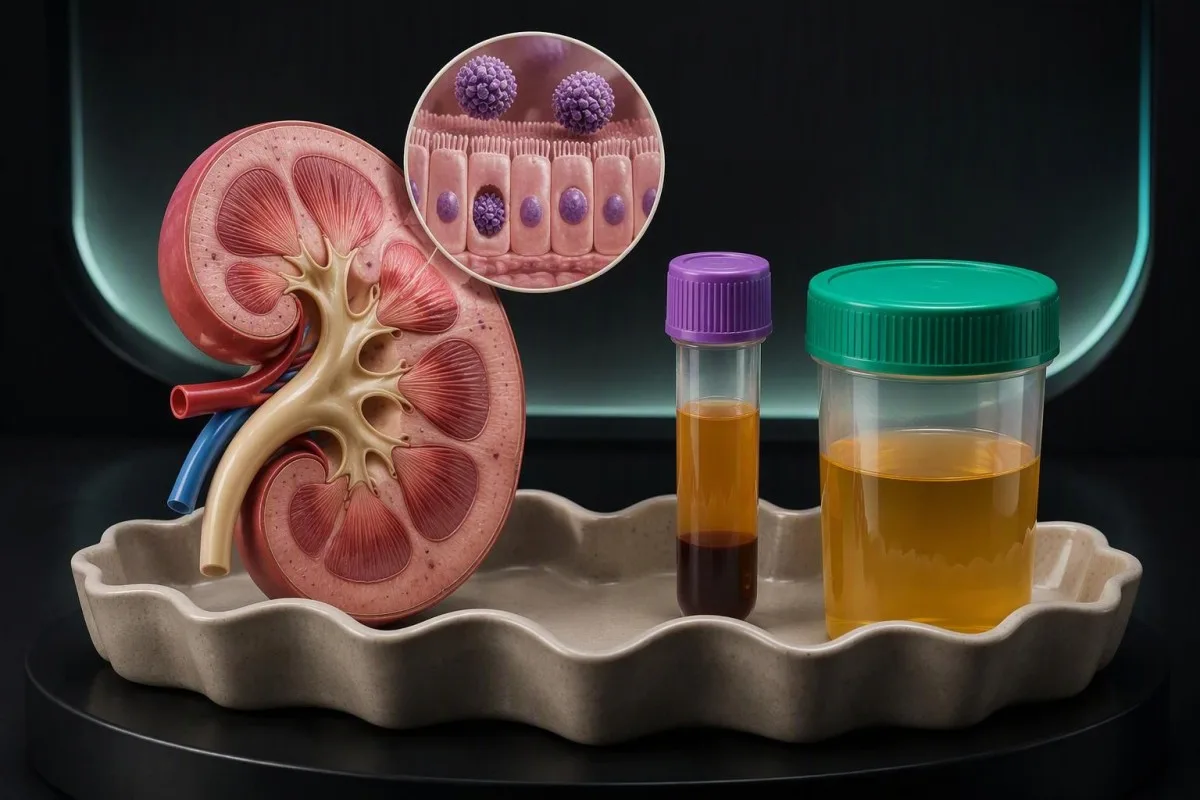
A positive result detects viral DNA—not necessarily damage to your transplanted kidney. The sample type, laboratory method, and direction of change determine what happens next.


- BK virus PCR positive means the test detected BK viral DNA; it does not, by itself, diagnose injury to a transplanted kidney.
- Urine shedding can occur without DNA detected in blood. Urine loads above 10 million copies/mL usually prompt plasma testing rather than automatic medication changes.
- Blood DNAemia above 1,000 copies/mL that persists for more than 2 weeks warrants transplant-team assessment and often a supervised reduction in immunosuppression.
- Higher plasma loads above 10,000 copies/mL are associated with greater concern for BK nephropathy, but this threshold is not a universal emergency cutoff.
- Ny test is generally recommended within 2–3 weeks for plasma results of 1,000–10,000 copies/mL; established DNAemia is usually followed every 2–4 weeks.
- Assay consistency matters: compare the same specimen type, laboratory, method, and units. A 0.5 log10 change is approximately a 3.2-fold difference.
- Kidney injury requires assessment of creatinine, other possible causes, and sometimes a biopsy. A stable creatinine does not exclude early BK-related injury.
- Medisiner og sikkerhet comes first: do not stop, skip, or reduce tacrolimus, mycophenolate, or other anti-rejection medicines yourself.
What does a BK virus PCR positive result actually mean?
BK virus PCR positive means BK viral DNA was detected in the tested sample. After kidney transplantation, a positive urine test may represent shedding, a positive blood test signals DNAemia, and biopsy-confirmed BK nephropathy means kidney tissue injury; these are related but different findings. Do not change anti-rejection medicines yourself.
A result containing only the word positiv leaves out at least 3 decision-making details: urine versus plasma, the numerical viral load, and whether this is the first detection or a persistent finding. PCR measures genetic material; it does not directly measure the number of damaged kidney cells or prove that the graft is failing.
Consider a hypothetical recipient whose urine contains 20 million copies/mL while plasma remains undetectable and creatinine is unchanged. That pattern deserves follow-up, but it is not equivalent to another recipient with plasma BK DNA rising from 2,000 to 25,000 copies/mL over 3 weeks—even if both reports display the same positive flag.
Kantesti er en AI-blodprøveanalysator that can help explain the distinction between a qualitative positive flag and a numerical result. I’m Thomas Klein, Chief Medical Officer at Kantesti; our organisasjon og kliniske formål center on explaining results, not replacing the transplant team responsible for balancing viral control against rejection.
Why can BK virus reactivate after a kidney transplant?
BK virus reactivation occurs when immunosuppression weakens the immune control that usually keeps this common virus quiet in urinary tract and kidney tissues. Most post-transplant detections reflect reactivation or donor-associated transmission, not a recent exposure that the recipient could have prevented.
The 2024 international consensus describes high-level urine shedding in roughly 20%–40% of kidney recipients, plasma DNAemia in 10%–20%, and biopsy-proven nephropathy in approximately 1%–15% during the first year. Those ranges vary substantially with screening, drug regimens, and diagnostic practices; they are population estimates, not predictions for an individual patient (Kotton et al., 2024).
The relevant exposure is the overall intensity of immunosuppression, not simply whether one tacrolimus level is inside its target range. Recent rejection treatment, corticosteroid exposure, and combinations of anti-rejection drugs can alter risk; a result obtained 3 weeks after rejection therapy has a different context from the same number in an otherwise stable long-term recipient.
BK PCR should not be confused with antibody tests for other transplant-related viruses. Our explanation of CMV antibody result patterns illustrates why past exposure and current viral replication require different tests; CMV IgG positivity cannot explain a BK DNA result, and a negative BK blood PCR does not establish protection against future reactivation.
BK virus blood vs urine test: which result matters more?
Plasma BK PCR generally guides transplant management more directly than urine PCR because DNAemia is more closely associated with clinically significant replication affecting the graft. Urine is useful for detecting shedding, but a very large urine number cannot be compared directly with a smaller plasma number.
Urine BK loads above 10 million copies/mL, or urine decoy cells, should generally trigger plasma testing under the 2024 consensus recommendations. High-level viruria often precedes plasma DNAemia by several weeks, but not every recipient progresses; the clinical task is to identify those who do, rather than treating every episode of shedding as kidney injury.
Urine concentration changes with hydration, collection conditions, and handling. A change from 15 million to 8 million copies/mL may reflect some biological improvement, dilution, or both; it is not necessarily a reliable treatment response when plasma results are unchanged. Standard urinalysis cannot substitute for PCR, although funn i urinsediment can identify other urinary problems.
Ask what the laboratory means by blod: plasma, serum, or whole blood. These specimen types are not interchangeable, and whole-blood values may differ from plasma values because of their cellular content; a urine-negative/plasma-positive combination also deserves laboratory and team review rather than assuming that either result automatically cancels the other.
Which BK virus viral load thresholds prompt action?
Persistent plasma BK DNA above 1,000 copies/mL or a plasma level above 10,000 copies/mL usually prompts supervised intervention, depending on the assay and clinical context. These are management thresholds, not a universal normal range or proof that a biopsy would show kidney injury.
The 2024 consensus defines probable BK nephropathy as plasma DNAemia above 1,000 copies/mL sustained for more than 2 weeks and presumptive BK nephropathy as plasma DNAemia above 10,000 copies/mL. Biopsy-proven disease remains a separate category; the terminology reflects increasing likelihood and the need to act before extensive injury occurs (Kotton et al., 2024).
For plasma values of 1,000–10,000 copies/mL, the consensus suggests confirmation within 2–3 weeks. A single value above 10,000 copies/mL generally supports prompt transplant-team assessment and immunosuppression reduction when laboratory error is unlikely; neither recommendation means patients should calculate their own tacrolimus or mycophenolate adjustments.
En rapport som leser detected below the quantification limit cannot be assigned a reliable numerical trend. Our guide to kvalitative og kvantitative resultater explains this difference; a detected result below 200 copies/mL, for example, is not equivalent to a precisely measured 200 copies/mL.
How do BK viral-load trends change the interpretation?
A sustained rise or fall in comparable plasma BK measurements is usually more informative than one isolated result. Interpretation requires the dates between samples, the same assay and specimen type, and the kidney-function trend—not merely whether the latest number is colored red.
En økning fra 1,200 to 1,600 copies/mL is approximately 0.12 log10 and may fall within assay variability. A rise from 1,200 to 12,000 copies/mL is 1 log10, a tenfold increase; when measured consistently, that larger change is much harder to dismiss, particularly if it occurs over only 2–3 weeks.
En nedgang fra 80,000 to 8,000 copies/mL is encouraging, but it does not mean replication has fully cleared or that kidney tissue has recovered. Creatinine may improve later, remain abnormal because of scarring, or rise for a different reason; our comparison of serial results explains why linked measurements need context.
The time interval changes the story. Two values of 3,000 copies/mL separated by 3 weeks demonstrate persistence, whereas measurements from the same day do not establish a 2-week duration; reviewing meningsfulle endringer mellom kontroller can help distinguish measurement noise from a developing pattern.
Why can different laboratories report different BK PCR numbers?
BK PCR results can differ between laboratories because extraction methods, genetic targets, calibration, and specimen types differ. Copies/mL and international units per milliliter are not automatically interchangeable; use a laboratory-specific conversion only when the laboratory validates and provides it.
Differences within approximately 0.5 log10, equivalent to about a 3.2-fold change, may be difficult to separate from analytical variation in some settings. This is not permission to ignore smaller persistent increases; it is a reason to ask whether 2 results came from the same laboratory before labeling a change as worsening replication.
Et resultat av 4,000 IU/mL cannot simply be placed beside a previous result of 4,000 copies/mL and called unchanged. Even internationally calibrated assays can differ because of their target sequences and reference-material behavior; the 2024 consensus specifically discusses these limitations, so published thresholds require local laboratory interpretation rather than blind numerical transfer.
Kantesti er en AI-blodprøvetolkningsplattform that can help explain specimen names, units, and reported detection limits alongside the numbers. Our tekniske og kliniske standarder should be read as methodology information, not evidence that an automated explanation can validate a BK assay or determine whether a 0.3 log10 rise needs treatment.
Does normal creatinine rule out BK-related kidney injury?
Normal or stable creatinine does not exclude early BK-related injury, while rising creatinine does not prove BK is the cause. Transplant teams compare the recipient’s established baseline and assess rejection, obstruction, dehydration, drug effects, and other infections before attributing reduced kidney function to BK.
For a hypothetical recipient with a baseline creatinine of 1.0 mg/dL, an increase to 1.3 mg/dL is a 30% rise despite sometimes remaining near a laboratory reference range. An increase from 1.8 to 2.1 mg/dL may matter too; the patient’s baseline and trajectory are more useful than deciding whether the result is simply normal or abnormal.
Diarrhea can produce dehydration while also altering tacrolimus exposure, creating more than 1 plausible explanation for a creatinine increase. The distinction between BUN and creatinine changes helps frame the investigation, but BUN/creatinine ratios cannot diagnose BK nephropathy or safely exclude rejection.
Estimated GFR is less dependable when creatinine is changing rapidly because the calculation assumes a relatively steady state. Our explanation of dehydration and temporary eGFR changes addresses one confounder; in a transplant recipient, however, waiting 2 weeks to see whether hydration fixes a substantial creatinine rise may be inappropriate without team advice.
When is a kidney biopsy needed to confirm BK nephropathy?
A kidney biopsy confirms BK nephropathy by demonstrating characteristic tissue changes with evidence of polyomavirus in kidney cells. Adults with DNAemia and stable graft function do not always need biopsy, but dysfunction, high immunological risk, or uncertainty about rejection can make tissue assessment necessary.
The 2024 consensus says biopsy is not routinely required in adults without graft dysfunction unless immunological risk is high. That distinction matters: a recipient with 15,000 copies/mL and stable creatinine may receive supervised treatment without biopsy, while another with lower DNAemia and rising creatinine may need biopsy to clarify competing diagnoses.
SV40 large T-antigen staining is commonly used to identify polyomavirus-associated tissue changes, but the stain is not uniquely specific for BK rather than other polyomaviruses. Pathologists interpret the stain alongside morphology and virological results; BK involvement can also be patchy, so 1 negative tissue sample does not always exclude disease when the overall evidence remains concerning.
BK-associated inflammation can resemble rejection, and some forms of rejection are difficult to diagnose confidently in tissue containing active viral injury. Our discussion of kidney biopsy and antibody findings concerns a different kidney condition but illustrates the same interpretive principle: a circulating marker and a tissue diagnosis answer different questions.
How often should BK PCR be checked after transplantation?
The 2024 international consensus recommends plasma BK screening monthly through month 9, then every 3 months through year 2 in adult kidney recipients. Screening continues through year 3 in children; positive results, graft dysfunction, and increased immunosuppression can require a different schedule.
For sustained plasma DNAemia above 1,000 copies/mL, follow-up is generally every 2–4 weeks until clearance or stabilization below that level. The interval may shorten when viral load climbs quickly or kidney function worsens; testing every day is rarely useful because biological response and assay variation can make closely spaced results difficult to interpret.
Hirsch and Randhawa’s 2019 AST guidance also recommended monthly screening until month 9 and every 3 months until year 2. The 2024 consensus extends routine pediatric surveillance through year 3 and discusses screening after intensified immunosuppression; these recommendations are broadly aligned rather than evidence that every center must follow an identical calendar (Hirsch & Randhawa, 2019).
After antirejection treatment or increased immunosuppression, the 2024 consensus suggests resuming monthly screening for 3 måneder. Keep the prior negative result and the date treatment changed, using the principles in our baseline laboratory preparation guide; a negative result from 6 months earlier does not settle the current risk.
Why does the transplant team adjust immunosuppression?
Carefully reducing immunosuppression is the main established treatment for clinically significant BK DNAemia, because it allows antiviral immune control to recover. The transplant team must simultaneously protect against rejection, so the sequence and size of changes depend on the recipient’s history and current findings.
Some protocols reduce an antimetabolite first; others reduce calcineurin-inhibitor exposure first. The 2024 consensus describes stepwise strategies and reassessment when DNAemia has not fallen tenfold after approximately 4 weeks, but these are specialist protocols—not a patient dosing worksheet—and the appropriate approach changes when rejection is suspected or recently treated.
A tacrolimus value drawn 2 timer etter en dose is not a trough and should not be used as though it were. Our guide to tacrolimus trough sampling explains the timing problem; even a correctly collected trough within target does not prove that the overall immunosuppressive regimen is appropriate for active BK replication.
Do not skip a dose while waiting for a callback unless the treating team explicitly instructs you to do so. I, Thomas Klein, would frame the question around 2 linked risks—viral injury and rejection; information about our medical advisory physicians cannot substitute for the transplant clinicians who know the recipient’s antibodies, biopsy findings, and medication history.
Can antivirals, antibiotics or supplements clear BK virus?
No routinely recommended antiviral medicine reliably replaces supervised immunosuppression reduction for BK after kidney transplantation. The 2024 consensus recommends against using cidofovir, leflunomide, or fluoroquinolones for routine BK treatment; experimental therapies belong in specialist assessment or clinical trials.
A course of ciprofloxacin for a bacterial urinary infection should not be described as BK therapy. The 2024 consensus recommends against fluoroquinolones for BK prevention or treatment because benefit has not been established and harms remain relevant; 1 antibiotic prescription may address a separate bacterial problem without changing the viral-management plan.
Intravenous immunoglobulin may be considered selectively as an adjunct in difficult situations or when rejection risk complicates immunosuppression reduction, but supporting evidence is limited. There is no dependable copies/mL cutoff at which IVIG becomes automatically indicated; virus-specific T cells and neutralizing approaches remain specialist or investigational options rather than established routine substitutes.
No supplement dose has been established to clear BK DNAemia. Our guidance on supplement safety with kidney disease explains why immune-boosting products deserve scrutiny, while kidney diet safety limits address a separate issue: nutrition can support care, but it does not replace 2–4-week virological monitoring or prescribed treatment.
When should a positive BK result lead to an urgent call?
A new positive BK result should be reported promptly to the transplant team, but the number alone does not determine an emergency. Fever, markedly reduced urine, graft-area discomfort, rapidly worsening kidney function, or inability to take anti-rejection medicine require faster assessment regardless of the BK load.
En temperatur på 38 °C eller høyere after transplantation deserves prompt contact under the center’s fever instructions. BK nephropathy is often silent, so fever may instead signal another infection; an undetectable BK PCR should never be used to dismiss fever, shaking chills, or significant illness in an immunosuppressed recipient.
Markedly less urine over several hours, new swelling, or a substantial creatinine rise warrants team advice rather than waiting for the next scheduled PCR. Our guide to akutte varselsignaler på nedsatt nyrefunksjon explains general symptoms, but a transplant recipient’s instructions may be stricter; 1 missed day of essential medicine because of vomiting also deserves prompt contact.
Visible blood in urine can reflect several causes and should not automatically be attributed to BK. The assessment described in our hematuria testing guide remains relevant; severe breathlessness, confusion, fainting, or near-absent urine calls for emergency care, even when the last plasma load was below 1,000 copies/mL.
What information should you bring to the transplant team?
Bring the complete BK report, at least 2 previous results when available, kidney-function measurements, and an accurate medication timeline. A useful review preserves specimen type, units, assay notes, and collection dates; a cropped screenshot containing only the word positive is often insufficient.
Record the transplant date, recent rejection treatment, missed doses, diarrhea, and the exact time of tacrolimus dosing relative to sample collection. Useful questions include: Is this urine shedding or plasma DNAemia? Is the change larger than expected assay variation? Should the next plasma sample be collected in 2–3 uker, and what would justify earlier testing?
A missing exponent can be a serious transcription error: 2.4 × 10³ copies/mL means 2,400 copies/mL, not 2.4 copies/mL. Review our sjekkliste for feil i PDF-ekstraksjon before relying on copied values; also verify decimal separators, less-than symbols, and whether an undetectable result was converted incorrectly to zero.
Kantesti can help explain uploaded reports and organize questions for follow-up, but neither our AI nor a general reference table can authorize a medication change. Our analysis technology guide explains the workflow; check all extracted values against the source document, and send a new plasma result above 10,000 copies/mL directly to your transplant team rather than waiting for an automated explanation.
Research publications, evidence limits and safe interpretation
BK transplant decisions should rely on transplant-specific evidence, not unrelated laboratory guides or an automated score. As of October 16, 2026, this article draws its management thresholds from the verified 2024 international consensus and 2019 AST guidance; the 2 Zenodo resources below provide background laboratory education only.
Kantesti er en Tjeneste for tolkning av laboratorieprøver med AI that explains reported measurements while preserving the distinction between education and treatment decisions. My approach as Thomas Klein is to separate 3 layers—what the assay detected, how the trend changes risk, and whether tissue injury is established; our responsible AI boundaries apply especially when immunosuppressant changes could cause harm.
Serum Proteins Guide: Globulins, Albumin & A/G Ratio Blood Test. (n.d.). Zenodo. DOI: 10.5281/zenodo.18316300. This serum protein background guide explains albumin and globulins, not BK clearance or rejection; the ResearchGate-tittelsøk is a discovery link rather than a verified publication page.
C3 C4 Complement Blood Test & ANA Titer Guide. (n.d.). Zenodo. DOI: 10.5281/zenodo.18353989. This complement laboratory background guide addresses different immune markers, not BK DNAemia; the ResearchGate publikasjonssøk and Academia.edu searches below are discovery tools, not proof of independent peer review.
Det Academia serum-protein search og Academia complement-guide search may help locate copies of these 2 background resources. DOI registration does not itself establish clinical validity; the practical next step after a positive BK result remains confirmation of specimen type, review of comparable plasma trends, and an agreed transplant-team plan.
Ofte stilte spørsmål
Betyr en positiv BK-virus-PCR at den transplanterte nyren min svikter?
En positiv BK-virus-PCR betyr ikke i seg selv at en transplantert nyre svikter. Virusutskillelse i urin, DNA-emi i plasma og biopsibekreftet nefropati er forskjellige funn. DNA i plasma over 1 000 kopier/ml som vedvarer i mer enn 2 uker, eller over 10 000 kopier/ml, fører vanligvis til oppfølging fra transplantasjonsteamet, men nyrefunksjon og klinisk sammenheng er fortsatt viktig. Ikke slutt med eller reduser dosen av avstøtningshemmende legemidler uten instruksjoner fra transplantasjonsteamet ditt.
Can BK virus be positive in urine but negative in blood?
BK virus can be positive in urine while plasma PCR remains negative because urinary shedding can precede or occur without DNAemia. Urine loads above 10 million copies/mL generally prompt plasma testing rather than automatic medication changes. Urine concentration varies with hydration, so urine numbers are not directly comparable with plasma numbers. Follow the transplant team's repeat-testing schedule even when creatinine is stable.
What BK viral load is considered high after a kidney transplant?
A plasma BK viral load above 10,000 copies/mL is a commonly used threshold for presumptive BK nephropathy and prompt transplant-team assessment. Plasma levels above 1,000 copies/mL that persist for more than 2 weeks also warrant assessment and often supervised immunosuppression reduction. These thresholds depend on the assay and cannot be applied directly to urine results or converted automatically to IU/mL. A high plasma number is not, by itself, an emergency diagnosis or biopsy confirmation.
How soon should a positive BK blood PCR be repeated?
The 2024 international consensus suggests repeating plasma BK PCR within 2–3 weeks when the result is 1,000–10,000 copies/mL. Sustained DNAemia is usually monitored every 2–4 weeks until clearance or stabilization below 1,000 copies/mL. Rapid increases, worsening kidney function, or recent rejection treatment may require a different schedule. Use the same laboratory and specimen type whenever practical.
Why did my BK viral load change after switching laboratories?
BK viral-load measurements can change between laboratories because PCR targets, extraction methods, calibration, and specimen types differ. A 0.5 log10 difference is approximately a 3.2-fold change and may be difficult to distinguish from analytical variation in some settings. Copies/mL and IU/mL require an assay-specific validated conversion rather than an assumed one-to-one relationship. Ask the transplant team whether a same-laboratory repeat is needed before interpreting the change as biological progression.
Should I reduce tacrolimus if my BK PCR is positive?
Do not reduce, skip, or stop tacrolimus because of a positive BK PCR unless your transplant team instructs you to do so. Clinically significant plasma DNAemia often leads to supervised immunosuppression reduction, but the choice of medicine and size of adjustment depend on rejection risk and the full regimen. A tacrolimus sample collected 2 hours after a dose is not a trough and may mislead dosing decisions. Contact the team with the complete BK report and accurate medication timing.
Is BK virus PCR still important if my creatinine is normal?
BK plasma PCR remains important when creatinine is normal because early viral replication can occur before a measurable decline in graft function. A change from a personal creatinine baseline of 1.0 to 1.3 mg/dL is a 30% increase and may deserve assessment even if a laboratory considers the value near its reference range. Conversely, rising creatinine can result from rejection, dehydration, obstruction, or medication effects rather than BK alone. The transplant team uses viral trends, kidney-function trends, and sometimes biopsy to distinguish these possibilities.
Få AI-drevet analyse av blodprøver i dag
Bli med over 2 millioner brukere over hele verden som stoler på Kantesti for øyeblikkelig, nøyaktig analyse av laboratorietester. Last opp blodprøveresultatene dine og få omfattende tolkning av 15,000+-biomarkører på sekunder.
📚 Refererte forskningspublikasjoner
Klein, T., Mitchell, S., & Weber, H. (2026). Veiledning for serumproteiner: Globuliner, albumin og blodprøve for A/G-forhold. Kantesti KI medisinsk forskning.
Klein, T., Mitchell, S., & Weber, H. (2026). Veiledning for blodprøve for C3 C4-komplement og ANA-titer. Kantesti KI medisinsk forskning.
📖 Eksterne medisinske referanser
Kotton CN et al. (2024). The Second International Consensus Guidelines on the Management of BK Polyomavirus in Kidney Transplantation. Transplantation.
Hirsch HH, Randhawa PS. (2019). BK polyomavirus in solid organ transplantation—Guidelines from the American Society of Transplantation Infectious Diseases Community of Practice. Clinical Transplantation.
⚕️ Medisinsk ansvarsfraskrivelse
Denne artikkelen er kun for informasjonsformål og utgjør ikke medisinsk rådgivning. Rådfør deg alltid med en kvalifisert helsepersonell for beslutninger om diagnose og behandling.
E-E-A-T tillitssignaler
Experience
Klinisk gjennomgang ledet av lege av arbeidsflyter for laboratorietolkning.
Expertise
Fagområde laboratoriemedisin med fokus på hvordan biomarkører oppfører seg i klinisk kontekst.
Authoritativeness
Skrevet av Dr. Thomas Klein med gjennomgang av Dr. Sarah Mitchell og Prof. Dr. Hans Weber.
Trustworthiness
Evidensbasert tolkning med tydelige oppfølgingsveier for å redusere uro.