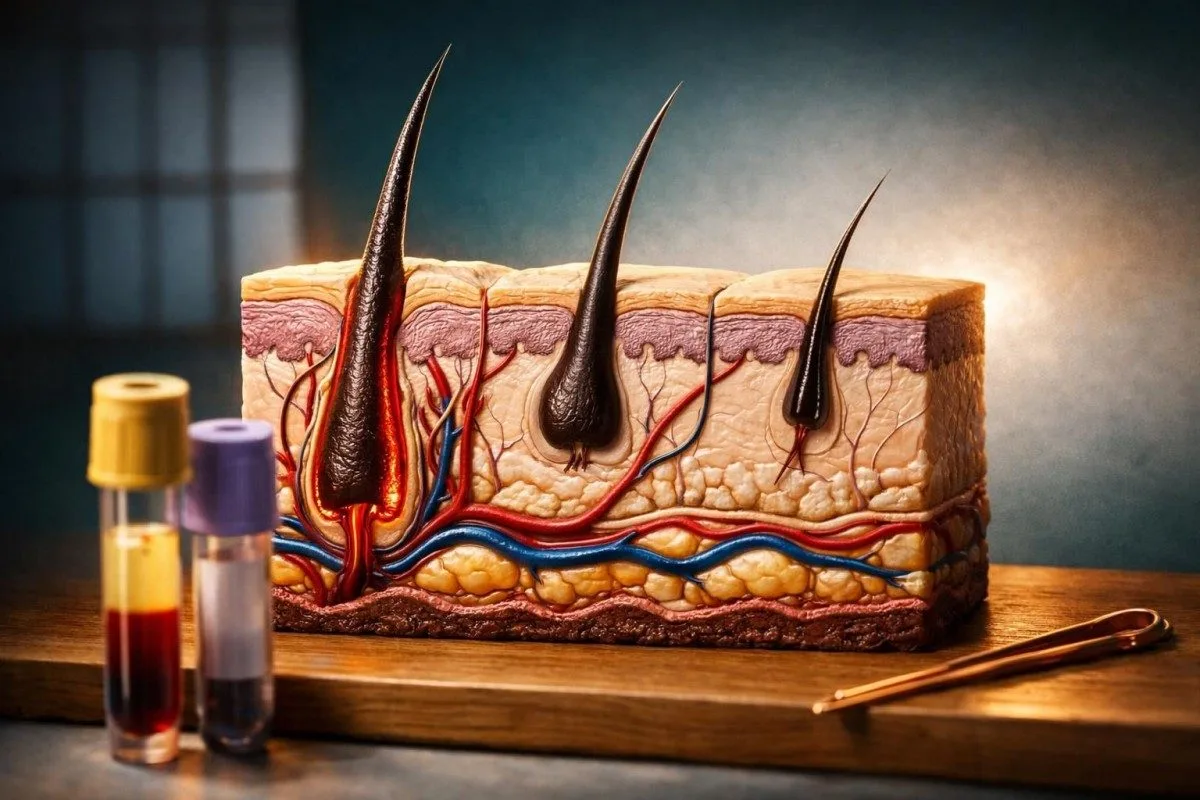
If you are shedding more hair than usual, the most useful starting labs are ferritin with full iron studies, TSH with free T4, and 25-hydroxy vitamin D. The right panel depends on the pattern—diffuse shedding, patterned thinning, patchy loss, or hair loss with fatigue, heavy periods, acne, or menstrual changes.


- Ферритин below 15 ng/mL usually confirms iron deficiency; many hair clinics investigate shedding more closely when ferritin is under 40-70 ng/mL.
- TSH above 4.0-4.5 mIU/L can slow hair cycling, especially if free T4 is low; a TSH below 0.4 mIU/L can also trigger shedding.
- D дәрумені is best checked as 25-hydroxy vitamin D; levels below 20 ng/mL are deficient, and the link to hair loss is strongest in alopecia areata.
- Трансферриннің қанығу дәрежесі under 20% suggests iron delivery to follicles may be inadequate even when ferritin looks "normal."
- CBC matters because hemoglobin below 12.0 g/dL in adult women or MCV below 80 fL makes iron-related shedding more likely.
- Биотин at 5-10 mg per day can distort thyroid immunoassays; stopping it for 48-72 hours, and sometimes 7 days, is often sensible.
- SHBG can explain androgen-related thinning when total testosterone is normal but free testosterone is effectively higher.
- CRP above 10 mg/L can inflate ferritin and hide depleted iron stores during inflammation.
- Қабылдау уақыты helps: androgen labs are best drawn in the morning, while vitamin D rechecks usually make more sense after 8-12 weeks.
Which shedding pattern points to the most useful labs?
Blood tests for hair loss are most useful when they match the shedding pattern. Diffuse daily shedding usually points first to ферритин, CBC, TSH/free T4, және 25-гидрокси D дәрумені; patterned thinning with acne or irregular periods adds androgen labs, and patchy loss needs thyroid and autoimmune clues more than a huge shotgun panel. If you want a quick overview before seeing a clinician, Кантесті А.И pairs well with our симптом декодері.
Diffuse shedding that fills the shower drain 6-12 weeks after illness, surgery, crash dieting, or severe stress is usually telogen effluvium until proven otherwise. In my practice, I start with the smallest panel that can change management, not a random stack of 20 hormones; if you are seeing more than your usual loose hairs and the shedding is generalized, that usually means ферритин, CBC, TSH, бос T4, әрі көбіне дәрумені D. If you are unsure what the abbreviations mean, our guide on қан анализінің нәтижелерін қалай оқуға болады is a good place to start.
A different pattern tells a different story. Heavy periods, vegetarian or vegan eating, restless legs, pica, or shortness of breath push me toward iron studies; cold intolerance, constipation, dry skin, eyebrow thinning, or a new hoarse voice make thyroid testing more valuable; acne, chin hairs, irregular cycles, and widening of the central part make me think about androgens even if ferritin is fine.
As Thomas Klein, MD, I have learned that patients often arrive after being told one isolated number is the whole answer. It rarely is. A ferritin of 22 ng/mL in a marathon runner with heavy periods means something very different from the same ferritin in a postmenopausal man, and the lab list should reflect that kind of context from the start.
Ferritin hair loss: when low iron stores really matter
Ферритин is the single blood marker I order most often for diffuse shedding because it estimates stored iron. A ferritin level below 15 ng/mL usually confirms iron deficiency in adults, while many dermatology clinics investigate hair shedding more closely when ferritin is below 40-70 нг/мл even if hemoglobin is still normal.
Here is the catch: ferritin is an acute-phase reactant. Ferritin can look reassuring at 80 or 100 ng/mL during inflammation, infection, liver disease, or after recent iron use, while transferrin saturation sits at 12-18% and tells you iron is not reaching tissues well. That is why I rarely look at ferritin alone; our deeper guides on ферритин көрсеткіштері және темірді зерттеу explain why serum iron, TIBC, and saturation often change the story.
I see this pattern all the time in menstruating patients: ferritin 18 ng/mL, hemoglobin 12.6 g/dL, MCV 84 fL, and months of shedding after a stressful winter. The CBC looks "not that bad," so the issue gets dismissed, yet the follicles are very likely seeing reduced iron availability. Trost and colleagues are often quoted for the idea that hair growth may prefer ferritin above roughly 40 ng/mL, though clinicians still disagree on the exact cutoff and the evidence is honestly mixed.
One more nuance: iron repletion is not a same-week hair fix. Even when ferritin rises by 20-40 ng/mL over 8-12 weeks, visible regrowth usually lags because the follicle cycle needs time to reset; most patients who truly respond notice less shedding first, then thicker regrowth around month 3 to 6. If ferritin is high rather than low, especially above 150 ng/mL in women or 300 ng/mL in men, I start asking about inflammation, alcohol use, liver markers, and iron overload instead of reflexively recommending more iron.
When ferritin looks normal but iron is still the problem
A ferritin of 70 ng/mL does not automatically rule out iron-related shedding. If CRP is elevated, platelets are high, or transferrin saturation is under 20%, I worry about functional iron deficiency rather than healthy iron stores.
Thyroid blood tests for hair loss: TSH, free T4, and antibodies
Thyroid blood tests for hair loss should start with TSH және бос T4. A TSH above 4.0-4.5 mIU/L can slow hair cycling, and a suppressed TSH below 0.4 mIU/L can also trigger diffuse shedding; both hypothyroidism and hyperthyroidism affect the follicle.
TSH is a pituitary signal, not a direct thyroid hormone, so I never interpret it in isolation. Overt hypothyroidism usually means TSH is high and бос T4 is low, while субклиникалық гипотиреозға often means TSH is elevated with a normal free T4; the second pattern is where most confusion happens. If you are sitting with cold intolerance, constipation, heavier periods, and a TSH of 6.2 mIU/L, the lab likely matters more than a generic reference range might suggest, and our pages on жоғары TSH және төмен TSH walk through the common forks in the road.
Some European labs use a slightly narrower reference interval than US labs, which is one reason patients get mixed messages. In a symptomatic person with a strong family history, I often add TPO антиденелері because autoimmune thyroid disease can show up before free T4 clearly drifts, and eyebrow thinning is a surprisingly helpful clue when the story feels borderline.
Biotin is the lab saboteur patients rarely hear about. Doses of 5,000-10,000 mcg daily can falsely lower TSH and falsely raise free T4 on certain immunoassays, so stopping biotin for 48-72 сағат, and occasionally up to 7 күннен in high-dose users, is one of the simplest ways to avoid a misleading thyroid panel. When I review a result that does not match the symptoms, biotin and lab interference are near the top of my list.
When to add thyroid antibodies
Қосу TPO антиденелері when hair loss comes with fatigue, dry skin, menstrual change, infertility concerns, a family history of Hashimoto disease, or a TSH that keeps drifting upward. Antibodies do not explain every shedding episode, but a positive result can explain why a "borderline" TSH keeps recurring.
Vitamin D and shedding: useful test, but not the whole story
25-гидрокси D дәрумені is the correct vitamin D test for hair loss, not 1,25-dihydroxy vitamin D. Levels below 20 нг/мл are deficient, 20–29 нг/мл are insufficient, and the association with hair loss is strongest in alopecia areata; for everyday diffuse shedding, the evidence is much less clean.
The reason vitamin D gets overhyped is simple: low levels are common. If half the waiting room has a 25-hydroxy vitamin D of 18-25 ng/mL in winter, the number may be relevant without being the sole cause of hair loss. Rasheed and colleagues helped popularize the connection in alopecia areata and female pattern hair loss, but low vitamin D is not a diagnosis by itself; our D дәрумені ауқымына арналған нұсқаулық is helpful when you are trying to decide whether the result is mildly low or clearly deficient.
In clinic, I am more persuaded by vitamin D when there are other hints: minimal sun exposure, darker skin living at northern latitude, malabsorption, obesity, inflammatory disease, or bone pain. A 25-гидрокси D дәрумені of 12 нг/мл deserves treatment regardless of the hair question, but patients should know regrowth is rarely immediate and low D often rides alongside low ferritin, thyroid disease, or a recent telogen trigger.
Too much vitamin D creates a different problem. Levels above 100 ng/mL are higher than I like to see, and toxicity becomes a serious concern above roughly 150 ng/mL, especially if calcium rises. If you are correcting a deficiency, a recheck after 8-12 аптада қайта тексеріңіз. is usually more informative than checking again after a few days, and our article on AI қосымша ұсыныстары explains how we think about dose changes without guessing.
If shedding comes with fatigue, what extra labs matter most?
If hair loss comes with fatigue, shortness of breath, brittle nails, weight change, poor appetite, or restrictive eating, add CBC, B12, фолий қышқылы, кейде мырыш, albumin/total protein, және CRP. Гемоглобиннің төмендігі 12.0 g/dL in adult women or 13,0 г/дл in adult men, and an MCV 60 мл/мин/1,73 м²-ден 80 fL, makes iron-related shedding much more plausible.
The humble CBC still does a lot of heavy lifting. RDW шамамен 14.5% can rise before MCV drops, which means an iron problem may be brewing while the red cells still look only mildly abnormal; that is one reason I often combine a hair-loss workup with the broader approach we use for fatigue labs and a close look at RDW and red-cell indices.
Vitamin gaps can matter, but this is where context matters more than the internet usually admits. B12 60 мл/мин/1,73 м²-ден 200 пг/мл is strongly suggestive of deficiency, 200-350 pg/mL is a gray zone, and фолий қышқылы шамамен төмен 4 ng/mL deserves attention; альбуминді 60 мл/мин/1,73 м²-ден 3,5 г/дл-ден төмен or total protein below 6.0 g/dL makes me think about under-nutrition, malabsorption, or chronic illness rather than a simple cosmetic shedding problem.
Inflammation can muddy everything. A CRP жоғары 10 мг/л-ден жоғары often tells me ferritin may be inflated, and if ferritin looks decent while platelets are high and transferrin saturation is low, I stop assuming the iron story is settled. Our guide to CRP-ті түсіндіру is useful here because chronic inflammatory patterns are one of the commonest reasons a hair-loss lab review goes off track.
When patterned thinning suggests hormones instead of simple shedding
Patterned thinning at the crown or temples with acne, irregular periods, chin hair, or central weight gain points to androgen-related testing more than ferritin alone. The most useful labs are жалпы тестостерон, SHBG, calculated or direct бос тестостерон, DHEAS, әрі көбіне пролактин; in a PCOS workup, timing can matter.
A normal total testosterone does not end the conversation. SHBG binds testosterone, so when SHBG is low—often with insulin resistance, weight gain, or hypothyroidism—free androgen exposure can still be higher than expected, which is why the SHBG guide matters so much in female-pattern thinning. This is one of those areas where a "normal" result can still be misleading.
If I suspect PCOS, I prefer morning testing and I pay attention to cycle timing, especially for patients not using hormonal contraception. Our article on PCOS blood test timing covers the details, but the practical summary is simple: a пролактин шамамен 25 ng/mL in women often deserves a repeat under calmer, fasting conditions, and a markedly elevated DHEAS makes me think harder about adrenal contribution rather than ovarian biology alone.
Not every woman with shedding needs an ovarian encyclopedia of labs, and most men with straightforward male-pattern hair loss do not need hormone testing at all. I usually reserve broader endocrine workups for patients with menstrual change, infertility, acne, new hirsutism, or symptoms captured in our broader women's hormonal symptom guide.
Patchy hair loss, eyebrow loss, or scalp pain: which labs help?
Patchy hair loss, eyebrow thinning, scalp burning, or smooth shiny areas change the blood-test strategy. TSH, ферритин, ал кейде дәрумені D are still reasonable, but broad autoimmune screening is usually low-yield unless you also have rash, joint pain, mouth ulcers, Raynaud's, or other systemic clues.
Alopecia areata is often a clinical diagnosis before it is a laboratory one. Patients are sometimes sent for a huge autoimmune panel when the smarter first step is confirming the pattern on scalp exam, checking thyroid status, and deciding whether a biopsy would add more than an ANA ever could; our autoimmune blood test guide explains why shotgun testing creates more false alarms than clarity.
If the story includes fever, joint pain, profound fatigue, rashes, or unexplained weight loss, then inflammatory markers can become useful. ЭТЖ жоғары 20-30 mm/h is nonspecific but can support systemic inflammation in the right clinical context, and our article on sed rate interpretation explains why age and sex matter so much when you are deciding whether a result is truly abnormal.
Scalp pain with pustules, crusting, or shiny scar-like patches is the point where I stop thinking purely in blood tests. That pattern can signal a scarring alopecia, and in my experience a prompt dermatologist visit plus possible biopsy matters far more than adding six more tubes of blood.
Labs that sound useful but often are not
Routine complement levels, extractable nuclear antibodies, or broad rheumatology panels are not first-line tests for uncomplicated patchy hair loss. I order them only when the history points beyond the scalp.
Why combinations of results matter more than one isolated number
Combinations matter more than isolated numbers. A ферритин of 25 ng/mL плюс TSH of 6.0 mIU/L is more clinically meaningful than either borderline result alone, while ferritin 120 нг/мл бірге CRP 18 мг/л and transferrin saturation 12% suggests inflammation is masking poor iron availability.
The thing is, hair follicles do not read labs one by one. A patient with ferritin 28 ng/mL, hemoglobin 12.1 g/dL, TSH 5.8 mIU/L, and vitamin D 19 ng/mL has a very different probability story from someone with one mildly off result and everything else pristine. If metabolic clues are also present—say HbA1c мына жерде 5.8-6.0% and low SHBG—the hormonal environment can amplify thinning, which is why our HbA1c нұсқаулығымызбен салыстырыңыз. belongs in the conversation more often than many people expect.
As Thomas Klein, MD, I am cautious about lab reports that call everything normal simply because each marker barely fits its reference box. Кантесті А.И reviews biomarker relationships rather than isolated flags, and our 15,000-plus biomarker guide shows how ferritin, thyroid hormones, inflammatory markers, and sex-hormone binding proteins can interact in ways standard lab printouts rarely explain.
Reference ranges are not treatment goals, and they are certainly not perfect hair-growth thresholds. That is why Қантесті publishes its медициналық валидация стандарттары openly: context-aware interpretation is where the real signal lives, especially when one borderline value looks trivial but a cluster of borderline values clearly is not.
What if your blood tests are normal but your hair is still falling out?
Normal blood tests do not rule out hair loss. Telogen effluvium after fever, surgery, childbirth, rapid weight loss, or emotional shock often appears 6–12 аптадан кейін after the trigger, and ferritin, TSH, CBC, and vitamin D can all sit inside the reference range.
I mention this because many patients come in frightened that something was missed when the labs look ordinary. Quite often the biology is timing: the stressful event happened two or three months ago, the follicle shifted into telogen, and the actual shedding starts later. I see this after major operations, which is one reason I warn surgical patients that a normal pre-op lab panel does not protect them from temporary postoperative shedding.
Medication history matters more than people think. Isotretinoin, valproate, heparin and other anticoagulants, amphetamine stimulants, beta blockers, and very rapid weight loss—whether intentional or illness-related—can all push follicles into a resting phase without leaving a dramatic signature on basic blood work.
When shedding lasts beyond 6 ай, I widen the lens. At that point I start rechecking the timeline, reviewing scalp symptoms, asking about traction hairstyles and chemical damage, and deciding whether dermoscopy or dermatology referral will answer more than another round of routine labs. In my experience, "normal tests" should calm you, but they should not end the discussion if the hair story still does not make sense.
How to prepare for a hair loss blood test so the results are usable
Preparation changes results more than most patients expect. For the most useful hair loss blood test panel, take iron and androgen labs in the morning when possible, stop high-dose биотин for at least 48-72 сағат, and fast 8–12 сағат only if your clinician is also checking glucose, lipids, or zinc.
Ferritin itself does not require fasting, but fasting helps if you are adding мырыш, глюкозаны айтарлықтай өзгерте алады, or a lipid panel. Acute infection can push ferritin upward for days to weeks, so if you just had a fever or bad viral illness, waiting 2-3 weeks can make the iron story easier to read; our practical guide on қан талдауларына дейін ораза ұстау covers the usual exceptions.
Cycle timing is mostly relevant for hormone testing, not ferritin. Ферритин can be checked on any cycle day, though I like to know whether the patient is having a very heavy period; тестостерон, SHBG, and related hormones are often most interpretable in the morning, and many clinicians prefer cycle day 3-5 for a fuller endocrine workup. If the report comes back packed with abbreviations, our біздің зертхана аббревиатураларына арналған нұсқаулық can save you some guesswork.
Turnaround times are shorter than most patients fear. A CBC often returns the same day, TSH және ферритин usually come back in 1-3 days, және дәрумені D often takes 2-5 күн ішінде, depending on the lab; if you are waiting and wondering, our timeline piece on how long blood tests take gives realistic ranges rather than best-case promises.
Using Kantesti to make sense of ferritin, TSH, vitamin D, and hormone results
Қазіргі жағдай бойынша 1 сәуір, 2026 ж., the fastest way to understand a blood tests for hair loss panel is to interpret the pattern, not each marker in isolation. With біздің AI қан анализі платформамыз, you can upload a PDF or photo and see how ферритин, thyroid markers, дәрумені D, CBC, and hormone data fit together in about 60 seconds.
Kantesti is not a replacement for a dermatologist or endocrinologist, and I would never pretend otherwise. What our system does well is organize complicated reports across many labs, languages, and units so you can see whether a ferritin of 32 ng/mL, TSH of 4.8 mIU/L, and vitamin D of 21 ng/mL are three separate footnotes or one coherent pattern; if you want the bigger picture on who we are, our Біз туралы page covers the clinical and technical side.
Our platform now serves users in more than 127 countries және 75-plus languages, and the review standards are shaped with physician oversight rather than marketing shortcuts. I am proud of that, and as Thomas Klein, MD, I think patients deserve to know who is behind their interpretation tools—our Медициналық консультативтік кеңес and the science behind our AI analysis technology are both public for exactly that reason.
If you already have results, the practical next step is simple: try the тегін қан анализі демосын. Most patients find it helpful to upload the full report rather than typing a few numbers by hand, because the low-friction details—unit conversions, hidden reference ranges, and marker-to-marker relationships—are often where hair-loss interpretation gets derailed.
Research, validation, and editorial oversight
Our clinical claims need sources. The medical standards behind Kantesti's interpretation workflow are summarized in our clinical validation materials and reviewed with input from our physician team.
Kantesti LTD. (2026). Clinical Validation Framework v2.0 [Data set]. Zenodo. https://doi.org/10.5281/zenodo.17993721 | ResearchGate | Academia.edu.
Kantesti LTD. (2026). AI қан анализін талдағыш: 2.5M талдау | Global Health Report 2026 [Report]. Zenodo. https://doi.org/10.5281/zenodo.18175532 | ResearchGate | Academia.edu.
Bottom line: blood tests can explain a lot of hair loss, but never all of it. The strongest workups combine a targeted lab panel, a good scalp history, careful timing, and transparent interpretation methods rather than a one-number answer.
Жиі қойылатын сұрақтар
Егер шашым түсіп жатса, қандай қан талдауларын сұрауым керек?
The most useful starting blood tests for hair loss are ферритин, a full CBC, TSH бірге бос T4, және 25-гидрокси D дәрумені. If you have heavy periods, fatigue, or shortness of breath, add full iron studies because transferrin saturation under 20% can matter even when ferritin looks acceptable. If you have acne, irregular periods, or patterned thinning, ask about жалпы тестостерон, SHBG, бос тестостерон, DHEAS, ал кейде пролактин. Patchy loss or scalp inflammation may change the plan and make a dermatologist exam more useful than broad routine blood work.
Ферритиннің төмен болуы гемоглобин қалыпты болса да шаштың түсуіне себеп бола ала ма?
Yes. A person can have normal hemoglobin and still have iron stores low enough to contribute to shedding, especially when ferritin is below 30-40 ng/mL. A ferritin below 15 ng/mL strongly supports iron deficiency, but many hair specialists pay attention to levels below 40-70 нг/мл when the symptoms fit. The key nuance is that ferritin rises with inflammation, so a "normal" ferritin with CRP 10 мг/л-ден жоғары can be falsely reassuring. That is why ferritin often needs to be interpreted alongside transferrin saturation, CBC indices, and the clinical story.
Шаш түсуіне арналған қалқанша без анализдерінің қайсысы ең жақсы?
The best thyroid blood tests for hair loss are TSH және бос T4. көрсетеді. Егер TSH above 4.0-4.5 mIU/L can slow hair cycling, while a TSH 0.4 мИУ/л-ден төмен can also trigger diffuse shedding. If symptoms suggest autoimmune thyroid disease or the TSH is borderline, TPO антиденелері can add useful context. Patients taking 5,000-10,000 mcg of biotin daily should pause it for at least 48-72 сағат before testing because some assays can be distorted.
D дәрумені жетіспеушілігі шынымен шаштың түсуіне себеп бола ма?
Vitamin D deficiency can be associated with hair loss, but it is not a guaranteed cause. The relevant test is 25-гидрокси D дәрумені, with 20 нг/мл-ден төмен деп анықталады. considered deficient and 20–29 нг/мл considered insufficient in most labs. The evidence is strongest in alopecia areata and less consistent in ordinary telogen effluvium or common patterned thinning. In practice, a low result is worth correcting for overall health, but many patients need ferritin, thyroid, stress, medication, or hormonal factors addressed at the same time.
Ер адамдар шаш түсуі үшін гормондық қан талдауларын тапсыра ма?
Most men with straightforward male-pattern hair loss do емес need a broad hormone panel. Hormone blood tests are more useful if hair loss comes with low libido, erectile dysfunction, infertility, gynecomastia, very rapid change, or signs of systemic illness. In women, androgen-related testing matters more often because low SHBG, high free testosterone, or elevated DHEAS can shift the pattern of thinning even when total testosterone is normal. So the answer depends less on sex alone and more on the symptom pattern around the hair loss.
Биотин шаш түсуіне қатысты қан талдауына әсер ете ала ма?
Yes. High-dose биотин, especially 5-10 mg per day, can interfere with certain immunoassays used for TSH, бос T4, troponin, and some hormone tests. The effect can make TSH look falsely low және free T4 look falsely high, which may create a fake hyperthyroid pattern. Most clinicians suggest stopping biotin for 48-72 сағат before testing, though some prefer 7 күннен for very high doses. Ferritin and CBC are usually less affected, but thyroid panels are the classic trouble spot.
Бүгін AI арқылы қан талдауы нәтижесін алыңыз
Kantesti-ті лезде әрі дәл зертханалық талдау үшін сенетін бүкіл әлем бойынша 2 миллионнан астам пайдаланушыға қосылыңыз. Қан анализінің нәтижелерін ж.үктеп, бірнеше секунд ішінде 15,000+ биомаркерлерінің жан-жақты түсіндірмесін алыңыз.
📚 Сілтеме жасалған ғылыми жарияланымдар
Klein, T., Mitchell, S., & Weber, H. (2026). Клиникалық валидациялау негіздемесі v2.0 (Медициналық валидация беті). Kantesti AI медициналық зерттеулер.
Klein, T., Mitchell, S., & Weber, H. (2026). AI қан анализін талдағыш: 2.5M талдау | Global Health Report 2026. Kantesti AI медициналық зерттеулер.
⚕️ Медициналық ескерту
Бұл мақала тек білім беру мақсатында ғана және медициналық кеңес болып табылмайды. Диагноз және ем туралы шешімдер үшін әрдайым білікті медицина қызметкеріне жүгініңіз.
E-E-A-T сенім сигналдары
Тәжірибе
Дәрігер басқаратын зертханалық талдауды түсіндіру жұмыс ағындарын клиникалық шолу.
Сараптама
Биомаркерлердің клиникалық контексте қалай әрекет ететініне зертханалық медицина фокусы.
Билік
Доктор Томас Клейн жазған, доктор Сара Митчелл және профессор доктор Ханс Вебер шолған.
Сенімділік
Дабыл қаупін азайту үшін айқын бақылау жолдарымен дәлелге негізделген түсіндіру.