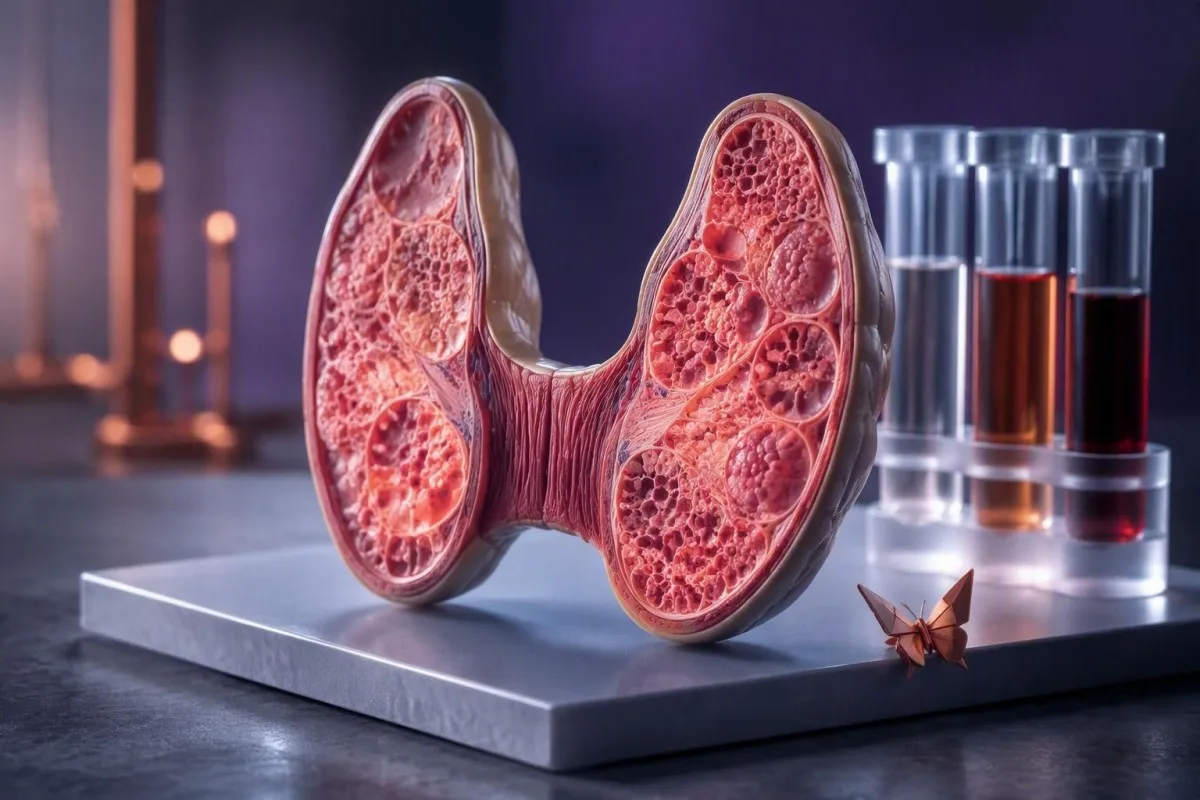
急性甲状腺炎は、甲状腺の結果が週ごとに矛盾しているように見えることがあります。通常、TSH、遊離T4、遊離T3、ESR、CRPの順序がその理由を説明します。.


- 初期パターン: 貯蔵されたホルモンが新たに過剰産生されるのではなく、損傷した甲状腺から漏れ出すため、遊離T4と遊離T3は上昇し、TSHは低下します。.
- TSHラグ: 遊離T4が基準値に戻った後、TSHは0.1 mIU/L未満で4〜12週間続くことがあります。.
- 炎症: 疼痛を伴う活動期疾患中、CRPは一般的に10 mg/Lを超え、ESRは50 mm/hourを超えることがよくありますが、どちらのマーカーも甲状腺炎に特異的ではありません。.
- 低摂取の手がかり: 血液検査の結果だけでは不明瞭な場合、放射性ヨウ素摂取率の低下は、甲状腺炎とバセドウ病を区別するのに役立ちます。.
- 甲状腺機能低下期: TSHが上昇する前に遊離T4が約0.8 ng/dLを下回ることがあり、症状とTSHがまだ一致しない短い期間が生じます。.
- 回復: ほとんどの人は6~12か月以内に甲状腺機能が正常に戻りますが、約5~15%が持続的な甲状腺機能低下症を発症します。.
- 再検査: 症状を追いかけたり毎週検査したりするよりも、4~6週間ごとにTSHと遊離T4を再検査する方が通常はより有益です。.
急性甲状腺炎の血液検査で通常見られること
A 亜急性甲状腺炎の血液検査 通常、高TSH、低遊離T4/遊離T3、次に遅延した高TSHを伴う低遊離ホルモン、次に段階的な正常化という3つの段階を経ます。これは損傷した甲状腺濾胞からのホルモン漏出であり、古典的な甲状腺過剰産生ではありません。.
最初の1~3週間で、多くの成人は遊離T4が検査上限値約1.8 ng/dLを上回り、TSHが0.1 mIU/Lを下回ります。. TSHは下垂体反応です, 、したがって、収集時の瞬間だけでなく、以前の数日間の循環ホルモンの状態を反映します。.
私はTSHが0.01 mIU/Lであることを恐れている患者に会ったことがありますが、永続的な甲状腺機能亢進症であると仮定しています。トーマス・クライン医師(MD)は、その結果を首の痛み、体温、脈拍、遊離ホルモン、炎症マーカーと併せて読みます。単一の指標よりもその組み合わせの方がはるかに有用です。.
カンテスティは AI血液検査分析装置 それは、個々の結果を孤立した決定と見なすのではなく、TSH、遊離T4、遊離T3、ESR、およびCRPを日付付きのタイムラインに配置します。10日後に得られた結果が全く異なる話をしているように見える場合、そのタイムラインは重要です。私たちのガイドを参照してください。 甲状腺検査スケジュール.
パターンは、1つの数値よりも診断的です
低TSHと高遊離T4は、バセドウ病、甲状腺炎、過剰なレボチロキシン、ヨウ素曝露、およびアッセイ干渉で発生する可能性があります。痛みを伴う甲状腺腫脹とCRPまたはESRの上昇は、亜急性甲状腺炎の可能性を高めますが、確認には抗体検査または取り込み画像検査が必要な場合があります。.
なぜ遊離T4と遊離T3は最初に上昇するのか
炎症を起こした甲状腺濾胞が形成されたホルモンを循環に放出するため、遊離T4と遊離T3は早期に上昇します。腺は貯蔵された供給を漏らしているため、抗甲状腺薬は一般的にこの段階を短縮しません。.
破壊性甲状腺炎では遊離T4が遊離T3よりも顕著に上昇することが多く、バセドウ病でよく見られるよりも低い総T3対総T4比を生じます。総T3が範囲上限またはわずかに上昇したレベルであっても、甲状腺炎を除外するものではありません。アッセイの選択とサンプリング日は重要です。.
自己限定的なメカニズムにもかかわらず、症状は激しく感じられることがあります。安静時脈拍100拍/分以上、震え、熱不耐症、睡眠障害が一般的です。臨床医は、適切な場合には症状に対してプロプラノロールなどのβ遮断薬を使用することがありますが、それは甲状腺を修復したり、ホルモン放出曲線を変えたりするものではありません。.
アメリカ甲状腺協会ガイドラインは、甲状腺炎関連の甲状腺中毒症を低取り込み状態と説明しており、合成が問題ではないため(Ross et al., 2016)、ルーチンの抗甲状腺薬に反対しています。動悸が優勢な場合は、私たちの 動悸の血液検査ガイド は、どの非甲状腺所見が並行して注意を払うべきかを説明しています。.
遊離T4が改善した後、なぜTSHは低いままでいるのか
遊離T4が正常化した後もTSHは数週間抑制されたままであることが一般的です。これは、下垂体の甲状腺刺激ホルモン細胞がホルモン曝露からゆっくりと回復するためです。低TSHだけでは、進行中の甲状腺ホルモン過剰を証明するものではありません。.
多くの成人向け検査室でのTSHの実用的な参照範囲は約0.4〜4.0 mIU/Lですが、報告書固有の範囲が常に優先されます。甲状腺中毒症の後、遊離T4はすでに0.9〜1.4 ng/dLであり、症状が落ち着いている間、TSHは4〜12週間0.4 mIU/Lを下回ったままになることがあります。.
これは一般的なエラーを引き起こします。5週目にTSHのみに基づいて監視を強化したり、治療を開始したりします。私の経験では、繰り返す TSHと遊離T4をセットで依頼します。 は、抑制されたTSHを単独の治療目標として解釈するよりも、4~6週間後の検査の方が安全です。.
ビオチンサプリメントは、一部のTSH結果を偽低値にし、特定のイムノアッセイで遊離T4または遊離T3を偽高値にする可能性があります。治療医から別の指示がない限り、検査の少なくとも48時間前には高用量ビオチンの摂取を中止してください。私たちの記事を参照してください。 遊離T3アッセイエラーが高い は、その仕組みを扱っています。.
甲状腺炎のESR値とCRP:典型的な高さは?
Painful subacute thyroiditis often raises ESR above 50 mm/hour そして CRPが10 mg/Lを超える場合, but neither value measures thyroid damage directly. ESR can remain elevated after pain improves, whereas CRP tends to fall faster with resolving tissue response.
A CRP reference range is commonly below 5 mg/L, although some laboratories use below 8 or 10 mg/L. CRP above 30 mg/L supports active inflammation in the right clinical setting, but bacterial infection, autoimmune disease, injury and obesity can also raise it.
ESR is affected by age, anaemia, pregnancy, immunoglobulins and red-cell shape. An ESR of 70 mm/hour with a CRP of 4 mg/L may reflect slower ESR kinetics or a non-thyroid factor, which is why we do not use ESR as a pain score.
Stasiak and colleagues note that raised ESR and CRP support subacute thyroiditis but diagnosis remains clinical and imaging-supported when uncertain (Stasiak et al., 2019). Compare a persistent result with our explanation of why ESR falls slowly, especially if haemoglobin is also low.
甲状腺炎とバセドウ病を区別する血液学的手がかり
Subacute thyroiditis and Graves disease can both cause low TSH with high free T4, but painful thyroiditis usually has high ESR or CRP and low uptake on nuclear imaging. Graves disease more often has positive TSH-receptor antibodies and increased gland blood flow.
陽性の TRAb or TSI strongly supports Graves disease, though low-level or occasionally transient positivity can complicate real cases. Thyroid peroxidase antibodies may be absent or present in subacute thyroiditis, so TPO antibody positivity does not establish Hashimoto disease or explain the current phase.
Radioactive iodine uptake is typically low in destructive thyroiditis because follicles are not actively trapping iodine to manufacture hormone. Doppler ultrasound often shows reduced or patchy vascularity in affected regions, while Graves disease classically shows diffuse increased flow.
A normal CRP does not fully exclude thyroiditis, particularly after anti-inflammatory treatment or later in the course. When the diagnosis feels uncertain, ask whether the laboratory pattern could represent high free T4 from medicines or testing error rather than assuming one diagnosis fits every result.
移行期:結果が混乱して見える時期
The transition from thyrotoxicosis to hypothyroidism can produce normal free T4 with persistently low TSH, followed by falling free T4 before TSH rises. This mismatch is expected physiology, not necessarily a laboratory mistake.
A patient may move from free T4 of 2.2 ng/dL to 1.0 ng/dL over 2-4 weeks while TSH remains 0.05 mIU/L. If thyroid reserve has been depleted, free T4 can then drop below 0.8 ng/dL before the pituitary has had time to increase TSH.
Symptoms change direction too. Palpitations may fade, then fatigue, constipation, dry skin and slowed concentration can emerge. These symptoms overlap with recovery from inflammation, so a new symptom alone is less reliable than paired hormone testing.
Do not judge an apparent change using different laboratories if it can be avoided: free-hormone immunoassays have method-dependent ranges. Our guide to 血液検査間での「意味のある変化」 explains why assay variation can imitate a biological shift.
甲状腺炎後の一時的な甲状腺機能低下症の結果
A temporary hypothyroid phase occurs when stored hormone is exhausted and damaged thyroid tissue cannot promptly restore production. Free T4 below the local lower limit with a rising TSH is the clearest laboratory pattern.
TSH may rise above 4.0 mIU/L, and levels above 10 mIU/L with low free T4 usually merit timely clinical review. The decision to prescribe levothyroxine depends on symptoms, TSH level, free T4, pregnancy plans, cardiovascular context and whether the hypothyroidism appears persistent.
Kantesti AIは、 AI血液検査の読み方プラットフォーム that identifies the sequence of low free T4 followed by TSH elevation, a pattern that is easy to miss when results arrive as separate PDFs. It is a prompt for clinician follow-up, not a diagnosis or a substitute for examination.
Some patients are given a time-limited levothyroxine trial for significant symptoms or prolonged hypothyroidism. A later supervised withdrawal, often after 6-12 months, may be needed to determine whether the thyroid recovered; see 正常なTSHを伴う遊離T4の低下 for the early lag pattern.
回復のタイムライン:何が最初に変化し、何が残るか
Pain and CRP often improve within days to weeks, free T4 usually settles over 1-3 months, and TSH may take 3-6 months to normalise. Complete recovery of thyroid function occurs in most people within 6-12 months.
The classic painful phase lasts about 2-8 weeks, though I have cared for people whose symptoms recur after an apparently quiet fortnight. A rapid CRP fall after anti-inflammatory treatment is reassuring for response, but it does not guarantee that TSH will be normal at the next draw.
Permanent hypothyroidism develops in roughly 5-15% of patients after subacute thyroiditis; published estimates differ because follow-up duration and diagnostic criteria differ. Higher thyroid antibody levels, more severe gland injury and prior autoimmune thyroid disease may increase the chance, but no single early test predicts it perfectly.
Dr. Thomas Klein, MD, advises recording the exact dates of pain onset, treatment changes and each sample. Kantesti AI trend analysis is designed for this kind of serial comparison; it can also support a concise 医師受診時の検査サマリー rather than replacing medical care.
甲状腺、ESR、CRP検査を再検査する時期
Most patients benefit from repeat TSH and free T4 testing every 4-6 weeks during active change, not every few days. ESR and CRP are most useful when pain, fever or diagnostic uncertainty persists.
Repeat testing sooner, often within 1-2 weeks, can be reasonable if free T4 is substantially high, pulse symptoms are difficult to control, pregnancy is possible, or the clinician is changing medication. Stable symptoms with a falling free T4 rarely require weekly thyroid panels.
Use the same laboratory and request the same core set: TSH, free T4 and, when initially high or clinically useful, free T3. Adding total T3, TRAb, TPO antibodies, ESR or CRP repeatedly without a clinical question can generate noise and expense.
Bring all prior reports, including reference intervals, because a value of 1.1 ng/dL can be normal in one free-T4 assay and borderline in another. For practical collection advice, see our baseline blood test preparation のような年齢別の参照値を使うべきです。.
治療が検査室での回復曲線を変える方法
NSAIDs, corticosteroids and beta-blockers affect symptoms and inflammatory markers differently, so a better CRP does not always mean TSH will normalise quickly. Antithyroid drugs usually do not correct subacute thyroiditis because they block synthesis rather than release.
Nonsteroidal anti-inflammatory treatment may reduce neck pain and CRP within several days. Corticosteroids can produce a striking response, sometimes within 24-72 hours, but recurrence during a too-fast taper is a familiar clinical problem and should be managed by the prescriber.
Beta-blockers lower pulse and tremor but do not lower free T4 directly. This distinction matters when a person feels better at day 5 yet still has free T4 above range; the lab is describing the hormone pool, not the success or failure of symptom control.
Do not start iodine, kelp or so-called thyroid support products in an attempt to speed recovery. Their iodine content can be unpredictable; our review of iodine-rich foods and limits explains why food-level intake is different from concentrated supplements.
甲状腺炎の検査結果が予想されるパターンに合わない場合
Persistent high free T4 with high or normal TSH, or severe symptoms with normal free hormones, is not a typical subacute thyroiditis pattern and deserves reassessment. Assay interference, medication effects, central causes and a second illness can alter the picture.
High free T4 with a non-suppressed TSH raises the possibility of biotin interference, heterophile antibodies, familial binding-protein variants, thyroid hormone resistance or rare pituitary causes. Repeating the sample on another assay platform can be more informative than ordering a large panel immediately.
A low total T3 during acute illness may reflect non-thyroidal illness rather than recovery-stage thyroiditis. Albumin, nutritional status, glucocorticoids and severe systemic illness change hormone transport and conversion; our explanation of 疾患時の低T3です 正常なHbA1cの範囲.
Kantesti recognizes internally inconsistent patterns and prompts users to verify units, collection dates and medication lists. A result should never be acted on automatically when it conflicts with clinical findings, particularly if pregnancy, atrial fibrillation or heart disease is in the background.
緊急の医学的評価が必要な結果と症状
Chest pain, fainting, severe breathlessness, confusion, a sustained resting pulse above 120 beats/minute, or fever with severe neck swelling need urgent assessment regardless of the thyroid panel. Subacute thyroiditis is usually self-limited, but it should not become a catch-all explanation for dangerous symptoms.
Thyroid storm from destructive thyroiditis is uncommon, but marked thyrotoxicosis can destabilise people with coronary disease, heart failure or atrial fibrillation. An ECG, electrolytes and clinical examination may matter more than repeating TSH, which is predictably low and changes slowly.
High fever, redness over the neck, focal swelling, trouble swallowing or a markedly raised white cell count can suggest an alternative process such as suppurative thyroid infection. That condition is uncommon but requires urgent in-person evaluation rather than home management.
A CRP above 80 mg/L is not an emergency by itself, yet it should trigger a careful search for another source when the history is atypical. Review infection-related blood test clues if a clinician is considering concurrent illness.
再発、妊娠、および既存の甲状腺疾患
Subacute thyroiditis can recur, and pregnancy planning changes the urgency of managing both high and low thyroid hormone states. Anyone using levothyroxine before the illness needs individualised interpretation rather than a standard timeline.
Recurrence is reported in a minority of cases and can occur months or years after a first episode. A second episode should prompt clinicians to reconsider the original diagnosis, medication exposures, antibody profile and whether symptoms could instead reflect autoimmune thyroid disease.
During pregnancy, maternal free T4 and TSH are interpreted using trimester-specific ranges when available. New thyroid pain or thyrotoxic symptoms in pregnancy merits prompt obstetric and endocrine input; do not use non-prescribed iodine or anti-inflammatory medicines without advice.
People with known Hashimoto disease may have a narrower functional reserve after an inflammatory episode. Our article on 高TPO抗体 explains why antibodies indicate risk context, not the speed or severity of today's symptoms.
過剰反応せずに変化する結果をどのように使用するか
The safest way to use changing thyroiditis results is to compare dated pairs of TSH and free T4, symptoms, pulse and treatment exposure. A single abnormal result rarely tells you which phase you are in.
As of September 15, 2026, current clinical practice still relies on history, examination, thyroid tests, inflammatory markers and selective imaging rather than a single definitive blood marker. The practical question is whether the curve is moving in the expected direction, not whether every number has already returned to range.
カンテスティは AIバイオマーカー解釈プラットフォーム that compares serial thyroid and inflammatory results while preserving the original laboratory ranges and collection dates. Our medical reviewers set safety boundaries for those comparisons; read about our 臨床的妥当性基準 そして 医療諮問委員会を をレビューできます。.
Keep a short record of pulse, temperature, neck pain, new medicines and supplements beside your results. That small habit helps an endocrinologist distinguish recovery, relapse, assay interference and a separate illness far better than a screenshot of TSH alone.
よくある質問
亜急性甲状腺炎では、どのような血液検査結果が一般的ですか?
急性甲状腺炎は、初期段階では高値の遊離T4と遊離T3、低値のTSHを呈し、回復期には低値の遊離T4と遅延性の高値のTSHを呈することが一般的です。多くの検査室では、成人TSHを約0.4-4.0 mIU/L、遊離T4を約0.8-1.8 ng/dLと定義していますが、検査項目ごとの基準値を使用すべきです。疼痛を伴う場合、ESRは50 mm/hourを超え、CRPは10 mg/Lを超えることがあります。4~12週間の経過は、単一の結果よりも有益です。.
亜急性甲状腺炎の後、TSHはどのくらい低値が続きますか?
TSHは、遊離T4が基準範囲に戻った後、4〜12週間は0.4 mIU/Lを下回ったままになることがあります。この遅延は、下垂体が過剰な循環性甲状腺ホルモンに曝露された後にTSHを抑制し、回復に時間が必要なため発生します。この期間中にTSHが低く、遊離T4が正常であることは、継続的な甲状腺機能亢進症を自動的に意味するものではありません。臨床医は一般的に、4〜6週間後にTSHと遊離T4を同時に再検査します。.
亜急性甲状腺炎ではESRとCRPは常に高値ですか?
ESRとCRPは痛みを伴う亜急性甲状腺炎ではしばしば高値を示しますが、常に上昇するとは限らず、どちらの検査も甲状腺疾患に特異的ではありません。頸部痛と甲状腺ホルモン異常が存在する場合、ESRが50 mm/hour以上、CRPが10 mg/L以上であることは、活発な組織反応を支持します。症状が改善するにつれて、CRPは通常ESRよりも速く低下します。病状の後半、特に抗炎症療法後には、CRPが正常値であっても甲状腺炎を完全に除外することはできません。.
亜急性甲状腺炎は永続的な甲状腺機能低下症を引き起こす可能性がありますか?
急性甲状腺炎は、患者の推定5〜15%に永続的な甲状腺機能低下症を引き起こしますが、ほとんどは6〜12か月以内に正常な甲状腺機能を回復します。10 mIU/Lを超える持続的なTSH、低い遊離T4、過去の自己免疫性甲状腺疾患、および症状は、臨床医にレボチロキシンの処方を促す可能性があります。一時的な治療を受け、その後、回復をテストするために投薬中止の監督下での試行を受ける人もいます。したがって、頸部痛がなくなった後でも、長期的なフォローアップは有用です。.
甲状腺炎の後、遊離T4は低いのにTSHも低いのはなぜですか?
低い遊離T4と依然として低いTSHは、亜急性甲状腺炎のホルモン高値期から低値期への移行中に起こり得ます。甲状腺ホルモン値は、下垂体がTSHを上昇させるのに十分な時間が得られる前に、約0.8 ng/dLを下回ることがあります。このパターンは、不可能であるとして却下されるのではなく、2〜4週間、または症状が著しい場合はそれよりも早く繰り返されるべきです。薬剤の影響、重度の病気、およびアッセイ干渉もレビューされるべきです。.
今日、AIによる血液検査分析を
いますぐ利用しませんか。即時で正確な検査分析を提供するKantestiを信頼する、世界中の200万人以上のユーザーに参加してください。血液検査結果をアップロードすると、15,000+のバイオマーカーについて数秒で包括的な解釈が得られます。.
📚 参考文献
📖 外部の医学的参考文献
⚕️ 医療免責事項
この記事は教育目的のみを対象としており、医療助言を構成するものではありません。診断や治療の判断を行う際は、必ず有資格の医療提供者にご相談ください。.
E-E-A-T 信頼性シグナル
経験
医師主導による、検査結果解釈ワークフローの臨床レビュー。.
専門知識
臨床的な文脈においてバイオマーカーがどのように振る舞うかに焦点を当てた検査医学。.
権威
トーマス・クライン博士が執筆し、サラ・ミッチェル博士およびハンス・ヴェーバー教授によるレビュー。.
信頼性
アラームを減らすための明確なフォローアップ経路を備えた、エビデンスに基づく解釈。.