
Kadar lacosamide mengukur paparan terhadap Vimpat, bukan memastikan apakah pengobatan akan berhasil. Beberapa laboratorium menggunakan 1–10 µg/mL, tetapi interpretasinya bergantung pada rentang rujukan laboratorium, waktu pemberian dosis, fungsi ginjal, pengendalian kejang, dan efek samping.

Poin-poin penting
- Kadar lacosamide Pemeriksaan paling bermanfaat untuk kejang yang penyebabnya tidak jelas, dugaan efek samping, pertanyaan tentang kepatuhan, atau perubahan klirens obat—bukan otomatis pada setiap kunjungan.
- Interval referensi berbeda-beda: beberapa laboratorium melaporkan 1–10 µg/mL, sementara yang lain menggunakan rentang yang lebih sempit atau 10–20 mg/L; angka-angka ini bukan sasaran pengobatan yang dapat dipertukarkan.
- Satuan mudah dikonversi: 1 µg/mL sama dengan 1 mg/L, jadi hasil 8 µg/mL juga sama dengan 8 mg/L.
- Kadar palung lacosamide biasanya berarti sampel diambil tepat sebelum dosis berikutnya; pada pengobatan dua kali sehari, waktu pengambilan ini biasanya sekitar 12 jam setelah dosis sebelumnya.
- Keadaan stabil umumnya tercapai setelah sekitar 3 hari dengan regimen yang tidak berubah pada orang dewasa dengan klirens tipikal; gangguan ginjal dapat memperpanjang masa penyesuaian.
- Fungsi ginjal mengubah paparan: informasi peresepan AS menganjurkan pengurangan dosis maksimum sebesar 25% pada gangguan ginjal berat, yang didefinisikan berdasarkan klirens kreatinin di bawah 30 mL/menit.
- Efek samping dapat terjadi dalam rentang laboratorium; pusing, penglihatan ganda, koordinasi yang buruk, dan gangguan konduksi jantung memerlukan interpretasi klinis.
- Keputusan yang aman menggabungkan setidaknya 4 informasi: waktu pengambilan sampel, dosis yang diresepkan, riwayat kejang, dan gejala. Jangan mengubah atau menghentikan lakosamida hanya berdasarkan tanda pada hasil laboratorium.
Apa sebenarnya yang ditunjukkan oleh kadar lacosamide?
A kadar lakosamida mengukur konsentrasi lakosamida, obat aktif dalam Vimpat, di dalam serum atau plasma. Beberapa laboratorium menggunakan 1–10 µg/mL, tetapi tidak ada satu konsentrasi pun yang menjamin kendali kejang atau terbebas dari efek samping; hasilnya paling berguna jika menjawab pertanyaan pengobatan yang spesifik.
Kadar Vimpat dalam darah merupakan pengukuran paparan, bukan pemeriksaan aktivitas listrik di otak. Hasil sebesar 6 µg/mL tidak dapat memastikan apakah suatu episode tertentu adalah kejang, dan tidak dapat menggantikan catatan kejang, penilaian neurologis, atau EEG bila pemeriksaan tersebut diindikasikan; panduan kami tentang interpretasi hasil levetirasetam menjelaskan perbedaan serupa untuk obat antikejang lainnya.
Konsentrasi efektif seseorang dapat lebih berguna daripada rentang populasi. Sebagai contoh, seorang dewasa hipotetis yang tetap bebas kejang dengan kadar palung yang diambil pada waktu yang tepat sebesar 4.2 µg/mL memiliki nilai dasar pribadi yang berpotensi berguna; hasil berikutnya sebesar 2.1 µg/mL menimbulkan pertanyaan yang berbeda dibandingkan hasil pertama sebesar 2.1 µg/mL yang berdiri sendiri.
Kantesti adalah penganalisis tes darah berbasis AI yang membantu menjelaskan hasil lakosamida beserta satuan dan rentang acuannya, sementara keputusan pengobatan tetap berada di tangan tim dokter yang meresepkan. Kami kami dan tujuan menjelaskan peran pendukung tersebut; bahkan hasil yang tampaknya meyakinkan sebesar 8 µg/mL tidak boleh mengesampingkan pingsan yang baru terjadi, kejang yang memburuk, atau pusing yang mengganggu aktivitas.
Mengapa rentang terapeutik lacosamide berbeda-beda?
Itu rentang terapeutik lakosamida berbeda karena laboratorium dan publikasi tidak selalu menggunakan waktu pengambilan sampel, populasi pasien, atau definisi rentang yang berguna yang sama. Rentang yang dipublikasikan mencakup 1–10 mg/L Dan 10–20 mg/L; rentang yang berorientasi pada kadar palung tidak boleh dianggap setara dengan rentang yang didasarkan pada pengukuran setelah pemberian dosis.

Reference intervals describe observed or proposed concentrations; they are not a universal boundary between effective and ineffective treatment. Schultz and Mahmoud's review in the European Journal of Drug Metabolism and Pharmacokinetics describes substantial variation in proposed lacosamide ranges and supports selective monitoring rather than a single target for everyone (Schultz and Mahmoud, 2020).
The historical 1–10 mg/L interval was commonly associated with trough measurements, whereas the higher 10–20 mg/L proposal drew on peak-oriented information. Otero Torres and colleagues specifically questioned applying that higher interval to fasting, pre-dose samples in their 2023 study; this sampling mismatch explains more than simply saying that one country or laboratory uses a stricter cutoff.
A hypothetical result of 11 mg/L may be flagged by a laboratory using 1–10 mg/L and unflagged by one using 10–20 mg/L, without any change in the patient's actual exposure. Ask which sampling assumptions support the printed interval; the same distinction between a laboratory flag and a treatment decision appears in our lamotrigine range explanation.
| Tingkat | Rentang | Maknanya |
|---|---|---|
| Common trough-oriented interval | 1–10 µg/mL | Used by some laboratories; neither endpoint guarantees seizure control or tolerability. |
| Narrower published interval | 5–10 µg/mL | Appears in some laboratory or review guidance; values below 5 are not automatically ineffective. |
| Higher published interval | 10–20 mg/L | Sampling assumptions matter; this interval has been questioned when applied to trough samples. |
| Personal treatment baseline | Established trough in µg/mL | A documented concentration during good seizure control and acceptable tolerability can guide later comparisons. |
Kapan kadar palung lacosamide sebaiknya diukur?
A lacosamide trough level is usually collected immediately before the next scheduled dose. For twice-daily immediate-release lacosamide, that often means approximately 12 jam setelah dosis sebelumnya; a sample collected 1–4 hours after a dose measures a different part of the concentration curve.
Oral immediate-release lacosamide typically reaches its maximum concentration about 1–4 hours after administration. Consequently, a morning result obtained after taking the medicine can be higher than a pre-dose result on the same prescription, and the magnitude of that difference varies with absorption and clearance rather than following one universal correction factor.
For example, a hypothetical patient taking 150 mg at 8 am and 8 pm might have a planned sample shortly before 8 am, then take the usual morning dose after collection according to the clinic's instructions. A 10 am appointment after the 8 am dose is not a trough appointment; tell the laboratory what actually happened rather than trying to make the result fit the intended schedule.
Record the last dose time, collection time and any missed doses over the preceding 3 hari. Do not omit an entire dose merely to create a low result, and do not postpone necessary treatment without instructions; our carbamazepine sampling guide explains why accurately documented timing is more valuable than the word 'trough' written on a request.
Bagaimana perubahan dosis dan keadaan tunak memengaruhi hasil?
Lacosamide concentrations usually approach steady state after about 3 days on an unchanged regimen in adults with typical clearance. Its elimination half-life is approximately 13 hours, so a result obtained immediately after a dose change may still partly reflect the previous regimen rather than the new long-term exposure.
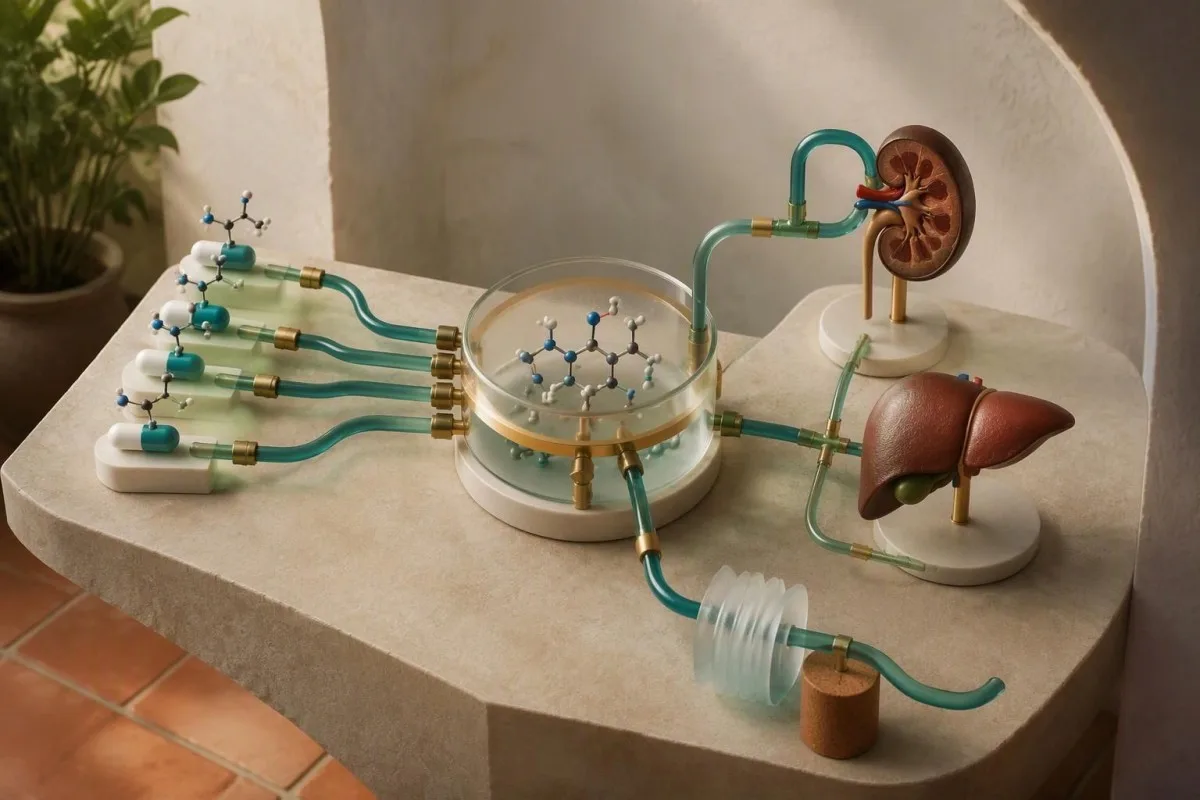
Lacosamide has approximately linear pharmacokinetics over usual treatment doses, meaning that exposure generally increases as the daily dose increases. However, doubling a hypothetical prescription from 100 to 200 mg/day does not justify predicting an exact measured trough: sample timing, missed doses, renal function and interacting medicines can all change the observed relationship.
A loading dose and a maintenance regimen answer different questions. A concentration collected 6 hours after a supervised loading dose can help describe immediate exposure when clinically needed, but it should not be mistaken for the stable pre-dose baseline used to compare outpatient visits; extended-release formulations also require their own formulation-specific sampling instructions.
A late sample can look lower simply because elimination continued. Using a simplified 13-hour half-life model, an additional 4-hour delay would reduce concentration by about 19% after absorption is complete; this is an illustration, not a patient-specific correction formula, and our trough timing discussion explains why recording actual times remains safer than mathematically 'fixing' a result.
Kapan pemantauan kadar Vimpat dalam darah bermanfaat?
A Vimpat blood level is most useful when seizures, side effects or a change in clearance cannot be explained from the prescription alone. A well patient on a stable regimen does not automatically need testing every 3 or 6 months; monitoring should have a question that could change clinical management.

Breakthrough seizures despite an unchanged prescription are a reasonable reason to consider targeted measurement. If a hypothetical person's established trough was 7 µg/mL and the new correctly timed trough is 3 µg/mL, the clinician can investigate missed doses, vomiting, a medicine interaction or a dispensing misunderstanding before concluding that the epilepsy itself has become harder to control.
Suspected accumulation is another useful indication, especially after a kidney-function change or a new interacting prescription. Schultz and Mahmoud's 2020 review identifies circumstances such as altered pharmacokinetics and adherence assessment in which monitoring may help; testing is less informative when there is no baseline, no collection time and no symptom history to interpret.
Kantesti AI can help organize the reported concentration alongside previous results, but a comparison such as 5 versus 9 µg/mL still requires matching dose and sampling conditions. Our untuk tren pengobatan emphasizes these context fields; valproate monitoring differences also show why one antiseizure medicine's testing rules should not be copied directly to another.
Apakah kadar lacosamide yang rendah berarti pengobatan tidak berhasil?
A low lacosamide concentration does not by itself prove treatment failure. A trough of 2 µg/mL may be effective for one person and inadequate for another; a low result becomes more concerning when it coincides with recurrent seizures, a substantial fall from a personal baseline or evidence of missed medication.

A missed dose can lower the result without proving that the prescribed dose is insufficient. In a simplified model with a 13-hour half-life, about 53% of an already absorbed concentration remains after 12 hours if no further medicine enters the circulation; real repeated-dose concentrations are more complex, so this calculation cannot identify exactly how many tablets were missed.
A single concentration cannot reliably distinguish nonadherence from unusually rapid clearance, an interacting medicine or an incorrectly timed sample. For a hypothetical trough of 1.5 µg/mL, useful follow-up questions include whether both daily doses were taken, whether vomiting occurred soon afterward and whether the prescription or formulation changed; those questions are more actionable than labeling the patient noncompliant.
Breakthrough seizures can occur without a falling lacosamide level. For example, hypoglycemia below 70 mg/dL may contribute to neurological symptoms and requires its own assessment, while major sleep loss or illness can alter seizure susceptibility; our panduan penyebab glukosa rendah kami explains why a medication concentration should not become the only explanation considered.
Apa arti kadar lacosamide yang tinggi bagi efek samping?
A high lacosamide level suggests greater medication exposure, but there is no universally validated concentration that separates safe treatment from toxicity. A trough above 10 µg/mL deserves interpretation against the laboratory interval, symptoms and baseline—not an automatic diagnosis of poisoning or an automatic decision to stop treatment.
Dizziness, double vision, nausea, sleepiness and unsteadiness can increase with lacosamide exposure or dose escalation. A hypothetical patient developing disabling imbalance at 8 µg/mL still needs review even if the laboratory calls that result in range; another patient tolerating 11 µg/mL cannot assume that the same concentration will remain comfortable after an additional sedating medicine.
Otero Torres and colleagues studied 44 adults with fasting lacosamide concentrations above 10 mg/L and reported adverse effects in approximately 41%, suggesting that an upper reference limit around 12 mg/L could be more suitable for such samples (Clinical Neuropharmacology, 2023). This selected, observational group does not establish 12 mg/L as a universal toxicity cutoff or describe the adverse-effect rate among all lacosamide users.
A concentration should never delay care for fainting, severe confusion, repeated falls or a suspected large ingestion. For example, a result of 18 mg/L with new collapse is clinically different from an incidental stable trough of 11 mg/L; our salicylate toxicity timing guide illustrates the broader emergency principle that symptoms and exposure history can matter before a confirmatory result returns.
Bagaimana fungsi ginjal mengubah kadar lacosamide?
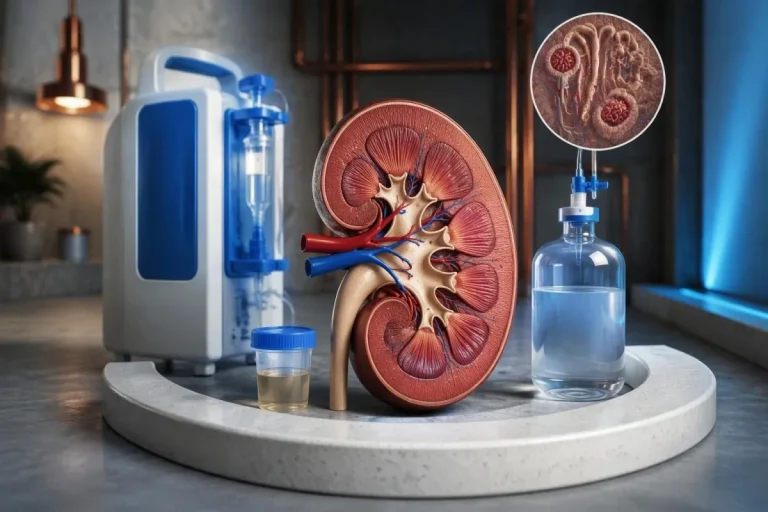
Reduced kidney function can increase lacosamide exposure because approximately 40% of a dose is excreted in urine as unchanged medicine. US prescribing information recommends a 25% reduction in the maximum dose for severe renal impairment, defined as creatinine clearance below 30 mL/min, or end-stage renal disease.
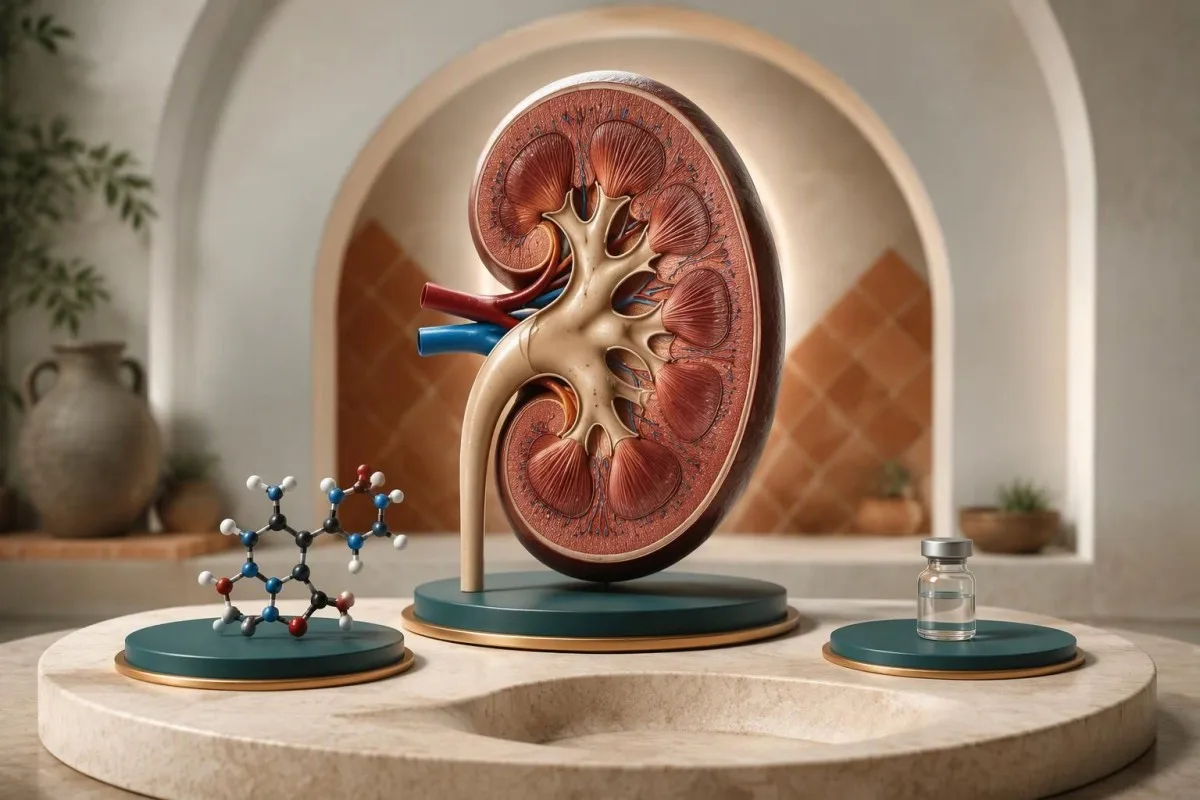
The US prescribing information reports approximately 25% greater overall exposure in mild or moderate renal impairment and approximately 60% greater exposure in severe impairment compared with normal renal function. Those are group-average AUC changes, not exact trough multipliers; an individual result should not be predicted by multiplying a previous concentration by 1.6.
Creatinine clearance used for a dose recommendation is not always interchangeable with the automatically reported eGFR dalam mL/menit/1,73 m². Kantesti AI can place the concentration beside kidney results, but the prescriber must select the appropriate renal estimate and account for acute changes; our panduan rasio fungsi ginjal Dan tanda peringatan eGFR rendah explain complementary pieces of that assessment.
Hemodialysis removes approximately 50% of lacosamide from plasma during a 4-hour session, and prescribing information allows clinicians to consider a post-dialysis supplement of up to 50%. This is not a self-dosing instruction: a pre-dialysis result and a post-dialysis result are different measurements, so the dialysis session's timing must accompany the laboratory request.
Obat dan faktor hati apa yang mengubah interpretasi?
Enzyme-inducing antiseizure medicines can lower lacosamide concentrations, while impaired clearance and certain enzyme inhibitors can increase exposure. Lacosamide is less than 15% protein bound, so routine free-drug measurement and albumin correction are generally less useful than they are for highly protein-bound medicines such as phenytoin.

Carbamazepine, phenytoin and phenobarbital are associated with roughly 15–20% lower lacosamide concentrations in population pharmacokinetic analyses cited in prescribing information. That modest average reduction does not mean every combination needs an increased dose; our free versus total phenytoin guide explains why phenytoin's own result requires a different protein-binding interpretation.
Moderate hepatic impairment can increase overall lacosamide exposure by approximately 50–60%, and US labeling recommends reducing the maximum dose by 25% in mild or moderate hepatic impairment; severe hepatic impairment is not a recommended setting for use. Strong CYP3A4 or CYP2C9 inhibitors warrant additional assessment particularly when renal or hepatic impairment is already present, rather than a blanket assumption that every inhibitor causes clinically significant accumulation.
Kantesti, our AI blood test interpretation platform, helps separate a reported concentration from the medication context supplied with it—for example, 2 daily doses plus another sodium-channel-blocking medicine. Additive dizziness or cardiac conduction effects can occur without a major rise in lacosamide concentration; our digoxin timing and safety guide illustrates why a second medicine's own monitoring requirements also need attention.
Dapatkah kadar Vimpat dalam rentang rujukan menyingkirkan masalah jantung?
An in-range Vimpat level cannot rule out a cardiac conduction problem. Lacosamide can prolong the PR interval, and a PR interval longer than 200 milliseconds defines first-degree atrioventricular block in adults; an ECG, not a medication concentration alone, evaluates this electrical effect.
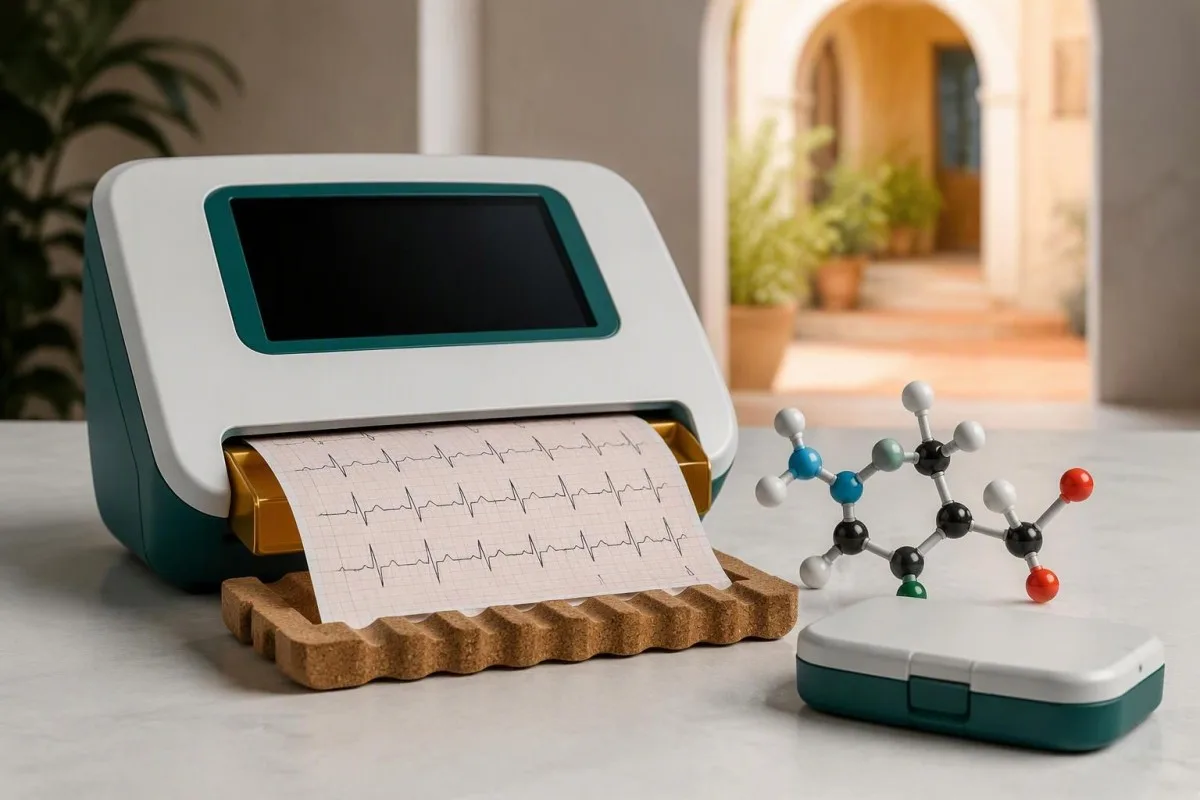
US prescribing information reports asymptomatic first-degree AV block in approximately 0.4% of adults receiving lacosamide in adjunctive focal-seizure trials, compared with 0% receiving placebo. This trial finding does not capture every real-world risk situation, and more serious rhythm or conduction problems have been reported particularly in susceptible patients or with other conduction-affecting medicines.
An ECG before treatment and after reaching the maintenance dose is recommended in patients with relevant cardiac conditions or concomitant medicines affecting conduction. For example, a hypothetical adult taking a beta-blocker who develops faintness after increasing lacosamide to 200 mg twice daily needs symptom and ECG assessment even if the trough is 7 µg/mL; our penilaian palpitasi kami explains additional causes clinicians may investigate.
New fainting, a markedly slow pulse with symptoms, chest pain or persistent palpitations warrants urgent assessment rather than waiting 24–48 jam for a drug-level report. Electrolytes can influence rhythm risk but do not replace the ECG; our panduan keamanan hasil elektrolit kami explains why these measurements may be reviewed together without treating a normal panel as proof of cardiac safety.
Bagaimana kehamilan, masa kanak-kanak, dan usia mengubah pemantauan?
Pregnancy can lower lacosamide exposure at the same dose, while childhood dosing and older-adult clearance require individualized assessment. In the 2022 MONEAD study, dose-normalized lacosamide concentrations decreased by up to 39.9% during pregnancy relative to postpartum values, supporting attention to a person's own baseline rather than a universal target.
Pennell and colleagues' MONEAD study in JAMA Neurology found pregnancy-related concentration changes across several antiseizure medicines, including lacosamide (Pennell et al., 2022). The lacosamide evidence base is smaller than that for some established alternatives, so an observed fall in concentration supports individualized specialist monitoring—not a claim that a particular concentration proves fetal safety or prevents every seizure.
A hypothetical pre-pregnancy trough of 6 µg/mL followed by a similarly timed pregnancy trough of 3.6 µg/mL represents a 40% decline, which may be clinically meaningful even if both results fall inside the laboratory interval. After delivery, clearance can move back toward baseline; any pregnancy-related dose increase therefore needs a planned postpartum review to avoid excessive exposure.
Children often receive weight-based prescriptions, while older adults may have reduced renal clearance or more interacting medicines; neither group should inherit an adult concentration target without context. For example, a 20-kg child's mg/kg regimen cannot be evaluated from the concentration alone, and our batas interpretasi AI pada anak-anak explain why pediatric medication decisions require the treating specialist.
Bagaimana sebaiknya dua hasil kadar lacosamide dibandingkan?
Two lacosamide results should be compared only after checking units, dose, formulation, collection timing and the clinical state. A change from 4 to 8 µg/mL is a doubling of measured concentration, but it is not automatically a doubling of long-term exposure if one sample was a trough and the other was collected after dosing.
Consider a hypothetical adult taking 150 mg twice daily whose first sample was 4 µg/mL immediately before a dose and whose next sample was 8 µg/mL two hours afterward. These results cannot establish accumulation because their timing differs; if symptoms are absent and the question is longitudinal exposure, the clinician may request a repeat under matching pre-dose conditions.
A different hypothetical patient has troughs of 5 and 10 µg/mL on the same dose, collected at the same interval, alongside a new creatinine rise and worsening unsteadiness. That combination is more persuasive for altered clearance than the concentration change alone; our perbandingan hasil antar-kunjungan discusses why biological and collection context should accompany any apparent trend.
A stable number can still coexist with a changing clinical problem. For example, repeated troughs near 6 µg/mL do not resolve new nocturnal events, falls or double vision; bring a dated description of events, the complete medication list and any videos obtained safely, because those observations may direct evaluation more effectively than another unmatched concentration.
Apa yang dapat dijelaskan oleh AI—dan apa yang memerlukan dokter yang meresepkan?
AI can explain a lacosamide report's units, interval and documented context, but it cannot establish an individualized dose from a concentration alone. A result of 9 µg/mL still requires a prescriber to judge seizure control, tolerability, cardiac risk and whether the sample represents the intended dosing interval.

Kantesti is an AI-powered blood test analysis tool that helps readers connect a lacosamide result with related laboratory findings rather than treating the printed interval as a prescription. For example, the combination of 12 µg/mL and a new kidney-function decline deserves contextual explanation; our kerangka validasi klinis describes how evaluation and oversight should be considered when using AI-generated information.
Missing metadata limits any interpretation, whether produced by software or a clinician reading an isolated report. If a result of 3 µg/mL arrives without dose timing, the useful output is a list of missing questions—not a confident claim of underdosing; our panduan teknologi AI explains the supporting workflow without turning it into an autonomous prescribing service.
Kantesti AI does not replace urgent assessment or authorize changes such as moving from 100 to 200 mg twice daily. A laboratory concentration cannot capture the entire history of seizures, an ECG's findings or the risks of withdrawal; stopping lacosamide abruptly can worsen seizures, and prescribing information generally recommends withdrawal over at least one week unless urgent circumstances require a clinician-led alternative.
Apa saja yang perlu dicakup dalam rencana tindak lanjut dan pemeriksaan sumber Anda?
Your follow-up plan should identify 4 essentials: the clinical question, the intended sampling time, the current regimen and who will review the result. Evidence supporting lacosamide monitoring should come from lacosamide-specific research or prescribing information; a DOI attached to an unrelated publication does not validate a therapeutic cutoff.

Bring the full report rather than just a screenshot of 1 flagged number, together with the last dose time, collection time, formulation and recent symptom history. Persistent vomiting or diarrhea may affect dose retention and kidney function, but an extra tablet after vomiting is not automatically appropriate; our digestive symptoms and fasting guide provides background, not a lacosamide redosing protocol.
Ask whether a repeat sample would answer a question that the current one cannot, and whether it should be collected after approximately 3 days of an unchanged regimen or later because clearance is impaired. A medication adjustment should have a defined reassessment plan covering seizures and adverse effects, not just a plan to push the next number into the laboratory's shaded interval.
Itu 2 Kantesti listed below concern hematology and gastrointestinal education, not lacosamide pharmacokinetics, and should not be used as evidence for Vimpat dose targets. The directly relevant external references are the 2020 monitoring review, the 2023 high-concentration study and the 2022 MONEAD pregnancy study; our standar konten medis explain why topic relevance and transparent evidence limits matter more than merely having a citation.
Pertanyaan yang sering diajukan
Berapa kadar lakosamida yang normal?
Lacosamide does not have one universally accepted normal or therapeutic concentration. Some laboratories use 1–10 µg/mL, while other sources use narrower intervals or 10–20 mg/L with different sampling assumptions. A result must be interpreted against the reporting laboratory's interval, dose timing, seizure control and adverse effects. A concentration inside the interval does not guarantee effectiveness or safety.
Haruskah saya mengonsumsi Vimpat sebelum tes darah untuk mengukur kadar lakosamid?
For an intended lacosamide trough level, the sample is usually collected immediately before the next scheduled dose, followed by the usual dose according to the clinic's instructions. With twice-daily immediate-release treatment, this is commonly about 12 hours after the previous dose. Do not skip an entire dose or substantially delay treatment simply to obtain a lower result. If you already took Vimpat, report the exact time because a sample 1–4 hours afterward may be near the post-dose maximum.
Apakah kadar lakosamida sebesar 12 tergolong tinggi?
ระดับ lacosamide sebesar 12 µg/mL berada di atas rentang laboratorium yang berakhir pada 10 µg/mL, tetapi ini bukan ambang toksisitas universal. Sebuah studi observasional tahun 2023 terhadap 44 orang dewasa dengan konsentrasi puasa di atas 10 mg/L menyarankan agar batas atas nilai rujukan sekitar 12 mg/L dipertimbangkan untuk sampel tersebut. Usulan itu tidak berarti bahwa setiap orang dengan kadar di atas 12 mengalami toksisitas atau setiap orang dengan kadar di bawah 12 aman. Waktu pengambilan sampel, pusing, masalah koordinasi, fungsi ginjal, dan gejala jantung menentukan penilaian selanjutnya.
Apakah kadar Vimpat perlu dipantau secara rutin?
0 Vimpat tidak secara otomatis mengharuskan pemeriksaan kadar setiap 3 atau 6 bulan pada orang dengan kejang yang terkontrol stabil dan tolerabilitas yang dapat diterima. Pemeriksaan terarah dapat membantu jika terjadi kejang terobosan, dugaan efek samping, ketidakpastian kepatuhan, kehamilan, gangguan ginjal, atau perubahan penting pada pengobatan. Pemeriksaan dasar yang waktunya tepat dan dilakukan saat kontrol kejang baik dapat membuat hasil berikutnya lebih informatif. Dokter yang meresepkan harus memutuskan apakah hasilnya akan mengubah penatalaksanaan.
Apakah penyakit ginjal dapat meningkatkan kadar lakosamida?
Gangguan ginjal dapat meningkatkan paparan terhadap lakosamida karena sekitar 40% dari dosis yang diberikan dieliminasi melalui urine sebagai obat yang tidak berubah. Informasi peresepan AS merekomendasikan pengurangan dosis maksimum sebesar 25% bila klirens kreatinin di bawah 30 mL/menit atau pada penyakit ginjal stadium akhir. Sesi hemodialisis selama 4 jam menghilangkan sekitar 50% lakosamida dari plasma, sehingga waktu dialisis relevan untuk interpretasi. Angka-angka ini menjadi panduan untuk penilaian yang dilakukan oleh klinisi dan bukan instruksi untuk menyesuaikan dosis Anda sendiri.
Apakah hasil lakosamida dalam mg/L dan µg/mL sama?
Hasil lakosamida dalam mg/L dan µg/mL setara secara numerik: 1 mg/L sama dengan 1 µg/mL. Oleh karena itu, 7 mg/L dan 7 µg/mL menunjukkan konsentrasi yang sama. Hasil yang dinyatakan dalam ng/mL berbeda secara numerik, karena 7 µg/mL sama dengan 7.000 ng/mL. Konversi satuan tidak mengatasi perbedaan waktu pengambilan sampel atau rentang nilai rujukan laboratorium.
Dapatkan penjelasan tentang hasil tes darah Anda
Unggah laporan lab Anda dan AI Kantesti menjelaskan setiap biomarker dengan bahasa sederhana dalam hitungan detik. Digunakan oleh lebih dari 2 juta orang di seluruh dunia.
Referensi
- Klein, T., Mitchell, S., & Weber, H. (2026). Panduan Golongan Darah B Negatif, Tes Darah LDH & Hitung Retikulosit. Riset Medis AI Kantesti. DOI
- Klein, T., Mitchell, S., & Weber, H. (2026). Diare Setelah Puasa, Bintik Hitam pada Tinja & Panduan GI 2026. Riset Medis AI Kantesti. DOI
- Schultz L, Mahmoud SH. (2020). Is Therapeutic Drug Monitoring of Lacosamide Needed in Patients with Seizures and Epilepsy? European Journal of Drug Metabolism and Pharmacokinetics.
- Otero Torres S et al. (2023). Therapeutic Drug Monitoring of Lacosamide: Is 10 to 20 mg/L a Suitable Reference Range for Patients With Epilepsy? Clinical Neuropharmacology.
- Pennell PB et al. (2022). Antiseizure Medication Concentrations During Pregnancy: Results From the Maternal Outcomes and Neurodevelopmental Effects of Antiepileptic Drugs (MONEAD) Study. JAMA Neurology. DOI
- 2 juta+Pemeriksaan yang dianalisis
- 127+Negara
- 100+Bahasa
Tentang tim medis


Sinyal Kepercayaan E-E-A-T
Pengalaman
Tinjauan klinis yang dipimpin dokter terhadap alur kerja interpretasi hasil lab.
Keahlian
Fokus pada kedokteran laboratorium tentang bagaimana biomarker berperilaku dalam konteks klinis.
Kewenangan
Ditinjau secara medis oleh Dr. Thomas Klein, dengan kontribusi dari Dr. Sarah Mitchell dan Prof. Dr. Hans Weber.
Kepercayaan
Interpretasi berbasis bukti dengan jalur tindak lanjut yang jelas untuk mengurangi kepanikan.

Penafian medis
Artikel ini hanya untuk tujuan edukasi dan tidak merupakan nasihat medis. Selalu konsultasikan dengan penyedia layanan kesehatan yang berkualifikasi untuk keputusan diagnosis dan perawatan.
Diterbitkan · Hubungi tim editorial
Diterbitkan oleh Kantesti Ltd, terdaftar di Inggris & Wales, nomor perusahaan. 17090423, London, Britania Raya.
