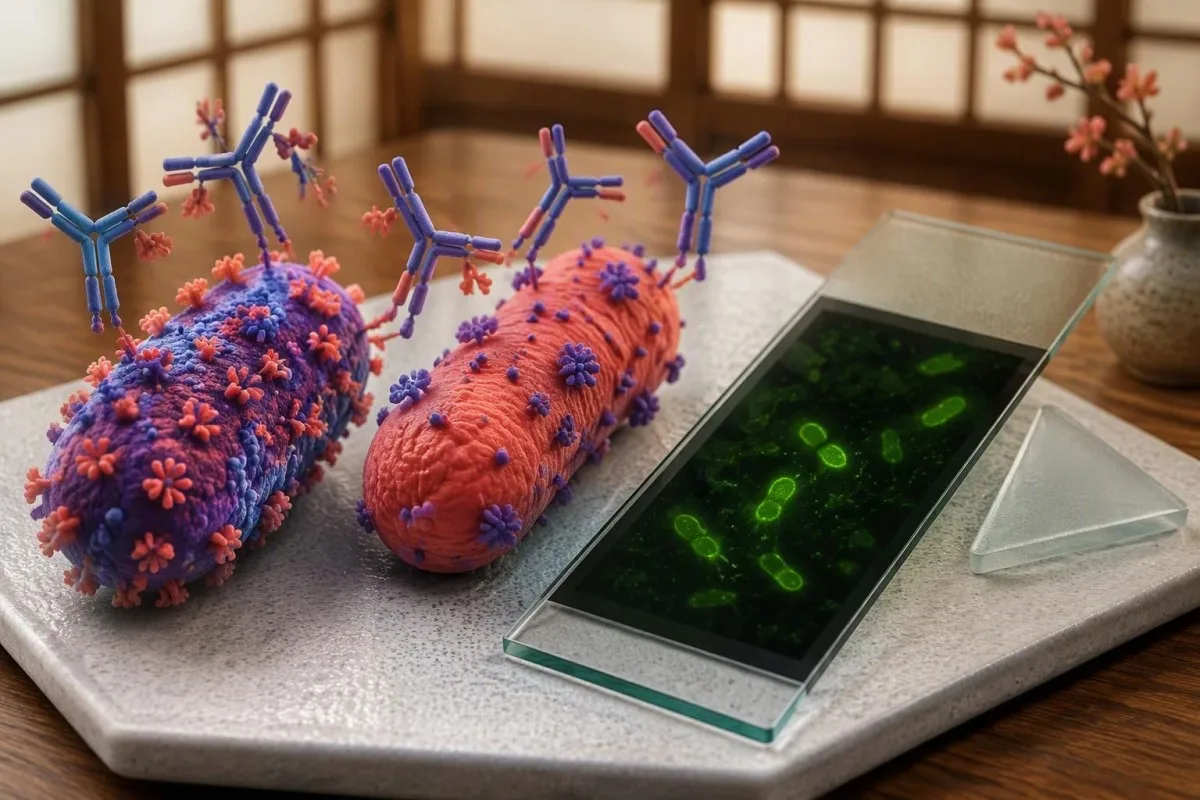
Bidh IgG ìre II gu tric a' toirt taic do ghalar o chionn ghoirid; tha IgG ìre I àrdaichte a' togail ceist eile. Dearbhaidh ùine sampall, an dòigh obair-lann, agus fianais air fòcas leantainneach dè tha an dà thoradh a' ciallachadh gu dearbh.


- Antibodies fiabhras Q a' comharrachadh freagairt dìonach ri Coxiella burnetii; chan urrainn do 1 toradh deimhinneach galar gnìomhach a stèidheachadh gu neo-eisimeileach.
- IgG ìre II a' prìomhadh mar as trice ann am fiabhras Q dian, ach faodaidh tiotal deimhinneach singilte cuideachd nochdadh seann nochdadh.
- Sampallan càraid a chaidh a chruinneachadh timcheall air 3–6 seachdainean bho chèile faodaidh iad àrdachadh ceithir-fhillte ann an IgG ìre II a nochdadh a' toirt taic do ghalar o chionn ghoirid.
- Àrdachadh ceithir-fhillte a' ciallachadh 1:64 gu 1:256, chan e 1:64 gu 1:128; feumaidh coimeas earbsach an aon dòigh, gu roghnach an aon obair-lann.
- IgG ìre I aig no os cionn 1:1024 le IFA na bhrosnachadh co-cheangailte ri CDC airson measadh galar leantainneach, chan e breithneachadh leis fhèin.
- Stairslblàir ag atharrachadh: tha an ìre ESC endocarditis a’ cleachdadh ìre I IgG nas motha na 1:800, nach gabh ath-chur air sgèile aithris gach obairlann.
- PCR tràth tha e as fheumaile timcheall air a’ chiad 2 sheachdain den tinneas, gu sònraichte mus tòisich antibiotics no goirid às an dèidh.
- Luchd-euslaint a tha nas ann an cunnart a’ toirt a-steach daoine le tinneas nam bhalbhaichean, gràbhagan shoithichean no aneurysms, torrachas, agus cuid de dhòighean-beatha dìonach.
- Comharraidhean èiginneach leithid anail bhochd, troimh-chèile, faochadh, no dìth nèamhach ùr a dh’ fheumas measadh sa bhad seach feitheamh ri antibodies ath-aithris.
Dè tha toradh antibody fiabhras Q deimhinneach a' ciallachadh?
Antibodies fiabhras Q a’ sealltainn freagairt dìonach ri Coxiella burnetii. Mar as trice bidh ìre II IgG a’ faighinn làmh an uachdair ann an galar acute o chionn ghoirid; tha ìre I IgG a tha air a thogail gu mòr a’ cur feum air measadh airson galar bunaiteach leantainneach. Chan eil gin de na pàtranan sin a’ dearbhadh galair gnìomhach leis fhèin: feumar comharran, stairsblàir obairlann sònraichte, sampallan càraid, agus uaireannan PCR no ìomhaigh.
Aithisg ag ràdh Coxiella burnetii IgG deimhinneach a’ freagairt ceist nas cumhang na tha a’ mhòr-chuid de dh’euslaintich an dùil: chaidh antibodies a lorg leis an t-siostam sin. Chan eil e a’ stèidheachadh cuin a thachair nochdadh, a bheil organan fhathast gnìomhach, no a bheil feum air làimhseachadh; is e seo 3 ceistean clionaigeach air leth, agus tha a bhith gan cur còmhla ann an aon rud a’ cruthachadh dragh gun fheum.
Tha mi a’ sgrìobhadh mar Thomas Klein, Prìomh Oifigear Meidigeach, agus is e a’ chiad cheist a th’ agam mu bhith a’ leughadh aithisg a bheil an toradh càileachdail no a bheil e a’ toirt a-steach fìor inbhe dilution. Tha an eadar-dhealachadh nas cudromaiche na an t-soidhnichean rabhaidh ri taobh an toraidh: faodar 1:64 agus 1:1024 a ghairm deimhinneach, ach tha iad a’ brosnachadh còmhraidhean eadar-dhealaichte. An mìneachadh againn air toraidhean antibody deimhinneach a’ còmhdach an eadar-dhealachaidh nas fharsainge sin.
is e inneal sganaidh fala AI a chuidicheas le bhith a’ cur toraidhean ìre-sònraichte ri taobh cinn-latha sampall agus toraidhean obairlann eile, an àite a bhith a’ làimhseachadh 1 toradh comharraichte mar dhiagnosis. Fiosrachadh mu dheidhinn —àireamhan a tha cudromach oir tha iad a’ cruinneachadh, chan ann air sgàth ’s gu bheil luach sam bith fa leth a’ coimhead dràmadach. Aig a’ mìneachadh co-theacsa na seirbheis; tha teagamh ann mu Q fiabhras fhathast a’ feumachdainn neach-clionaigeach a dh’ fhaodas measadh a dhèanamh air nochdadh, toraidhean sgrùdaidh, agus an fheum air deuchainn speisealta.
Dè a mhìnicheas ìre 1 agus ìre 2 de fhiabhras Q gu dearbh?
Q fiabhras ìre 1 agus ìre 2 a’ toirt cunntas air cumaidhean antigenic de Coxiella burnetii, chan e 2 ìre sreathach troimh bheil a h-uile h-euslainteach a’ dol. Tha organan ìre I a’ nochdadh lipopolysaccharide làn-fhad; tha antigen ìre II a’ nochdadh cruth giorraichte a chaidh a dhèanamh aig àm ath-fhadalachadh obairlann.
Mar as trice bidh ìre II IgG a’ dol am meud nas motha rè Q fiabhras acute, fhad ‘s a dh’ fhaodadh ìre àrd de ìre I IgG a bhith an cois galar bunaiteach leantainneach. Tha na ceanglaichean sin feumail, ach chan eil iad cinnteach: faodaidh an dà bhuidheann antibody a bhith air an togail às deidh tinneas acute, agus faodaidh ìre II IgG a bhith fhathast mòr eadhon nuair a tha fòcas leantainneach ann (Anderson et al., 2013).
Thathas gu tric a’ cur na h-àireamhan Ròmanach I agus II an àite nan àireamhan 1 agus 2 air aithisgean; tha iad a’ toirt iomradh air na h-aon roinnean antigen. Chan fhaodar an troimh-chèile le IgG an aghaidh IgM, a tha a’ toirt cunntas air clas antibodies. A coitcheann stiùireadh mìneachaidh immunoglobulin a’ mìneachadh carson a tha dùmhlachd iomlan IgG agus IgG sònraichte do organism nan tomhasan eadar-dhealaichte.
A phase I-to-phase II comparison is a clue, not a standalone classification rule, and there is no universally diagnostic 1:1 ratio. Unlike the named antigen combinations used in pàtrain antibody EBV, Q fever interpretation depends heavily on endpoint titers, their change over time, and the presence or absence of a focal clinical problem.
Ciamar a leughas tu tiotalan antibody fiabhras Q agus crìochan obair-lann?
Q fever antibody titers usually report the highest serum dilution that remains reactive by indirect immunofluorescence, or IFA. A result of 1:256 is higher than 1:64; these are dilution endpoints, not antibody concentrations in mg/dL or IU/mL.
The denominator expresses how far the serum was diluted: 1:256 remains reactive at a greater dilution than 1:64. Laboratories may begin testing at different dilutions and use different antigen preparations or reading procedures, so a positive flag from one laboratory cannot automatically be assigned the clinical meaning used by another laboratory.
Screening positivity and a clinical decision threshold are not the same thing. A laboratory might classify a low endpoint as detectable, while a guideline uses a much higher phase I value to trigger investigation for persistent infection; an ELISA index of 2.4 cannot simply be converted into an IFA titer of 1:1024.
Ask for 3 details: the testing method, the phase-specific endpoints, and the laboratory's interpretive comment. Our discussion of deuchainn càileachdail an aghaidh tomhasail explains why positive/negative reports cannot show a fourfold rise; if comparison is needed, the clinician may request quantitative IFA through a reference laboratory rather than repeating an unsuitable screening assay.
Carson a tha sampallan càraid a' cuideachadh le fiabhras Q o chionn ghoirid a chomharrachadh?
Sampallan serum càraid can identify recent Q fever by demonstrating a fourfold or greater increase in phase II IgG. The CDC's diagnostic approach compares an acute sample, ideally collected early in illness, with a convalescent sample collected approximately 3–6 weeks later (Anderson et al., 2013).
A rise from 1:64 to 1:256 is fourfold; 1:64 to 1:128 is only twofold. Many IFA methods use doubling dilutions, so a fourfold increase spans 2 dilution steps. That requirement helps distinguish a meaningful antibody rise from small differences in assay reading, although the complete clinical story remains necessary.
Both specimens should preferably go to the same laboratory, using the same method, and may be tested together to reduce run-to-run variation. A 1:128 result from one laboratory followed by 1:256 elsewhere is not reliable evidence of biological progression; our stiùireadh loidhne-tìm nan deuchainnean fala againn explains why measurement conditions belong on every comparison.
A first specimen collected 4 weeks into illness may already show a high phase II titer, leaving little room for a further fourfold rise. Failure to demonstrate a rise in that situation does not exclude recent infection; the initial sample was simply too late to capture the developing response, and PCR may also have become less sensitive.
At Kantesti, the useful comparison is not just earlier versus later: it is sample date versus symptom-onset date, with antibiotic timing added as a third reference point. Tell the clinician whether the first specimen was taken on day 3 or day 23, and ask whether a stored original specimen can be retested alongside the second sample.
An urrainn do aon toradh IgG deimhinneach a bhith a' riochdachadh seann ghalar?
One positive Coxiella burnetii IgG result can reflect past exposure, because antibodies may persist for months or years. An isolated phase II IgG result cannot reliably distinguish a recent infection from a remote one, even when the numerical titer looks impressive.
The probability of active Q fever changes with the reason the test was ordered. A phase II titer of 1:256 in someone with recent fever after livestock exposure carries a different implication from the same result in a well person tested during a broad fatigue workup; the laboratory number has not changed, but the pretest probability has.
IgM does not settle the question on its own: it can persist and is generally less specific than IgG in Q fever testing. A positive IgM plus a single positive IgG still needs timing and clinical interpretation, rather than a simple new-infection label; the distinction resembles some issues discussed in CMV IgG interpretation, although the organisms require different diagnostic rules.
A single elevated phase II IgG titer may support a probable acute diagnosis in a clinically compatible case, but the laboratory's reporting framework must be checked. The CDC's 2013 guidance discusses a phase II IgG titer of at least 1:128 as supportive in that setting; it does not make 1:128 a universal diagnostic threshold for every assay or every asymptomatic patient.
Cuin a tha PCR agus ath-dheuchainn feumail an dèidh toraidh àicheil?
Coxiella burnetii PCR is most useful early in acute illness, often during approximately the first 2 weeks and before or shortly after antibiotics begin. Antibodies are frequently negative during the first week, so an early negative serology result cannot exclude Q fever.
PCR detects bacterial genetic material, whereas IFA measures the host antibody response; those tests therefore have different windows of usefulness. A negative antibody result on day 5 and a positive PCR can be entirely consistent with acute Q fever, and a later positive IgG does not mean the earlier antibody assay malfunctioned.
Antibiotic exposure can reduce PCR sensitivity, and declining circulating bacterial material also limits detection later in illness. A negative PCR on day 18, especially after treatment, does not carry the same exclusionary weight as a well-timed early specimen; timing is similarly central to early dengue testing, although the actual tests and organisms differ.
Clinicians should not delay appropriate treatment for strongly suspected acute Q fever while waiting 3–6 weeks for convalescent antibodies. Record the exact antibiotic start date and ask which specimen type the reference laboratory accepts; serum, whole blood, and tissue testing have different uses, and a late negative blood PCR cannot by itself exclude a persistent focal infection.
Dè na nochdaidhean agus na comharraidhean a nì fiabhras Q nas dualtaiche?
Q fever becomes more plausible after exposure to aerosolized material from infected livestock, particularly sheep, goats, or cattle and their birth products. Acute illness commonly begins about 2–3 weeks after exposure and may cause fever, severe headache, pneumonia, or hepatitis without a distinctive rash.
Directly touching an animal is not required for Q fever exposure, because contaminated dust can be inhaled. A useful 3-week history includes farm visits, veterinary work, abattoir work, lambing or kidding environments, and nearby livestock activity; a patient who says they never handled animals may still have an exposure worth discussing.
Fever after animal contact has more than 1 possible explanation, and broadening the differential can prevent a positive Q fever antibody result from becoming an anchor. Unpasteurized dairy exposure or occupational animal contact may also prompt brucellosis testing interpretation. Freshwater or floodwater exposure may instead strengthen the case for leptospirosis test timing.
An ALT of 180 IU/L with fever may support a hepatitis presentation, but it does not identify Coxiella as the cause; acute Q fever can also occur with a normal white-cell count. Our stiùireadh againn airson giorrachaidhean deuchainn grùthan helps separate markers of liver injury from organism-specific testing, and normal routine results should not override a convincing exposure history.
Cuin a tha IgG ìre I àrdaichte a' cur feum air measadh bho speisealaiche?
Elevated phase I IgG warrants evaluation when it reaches a method-specific concerning threshold, rises over time, or accompanies relevant symptoms or risk factors. CDC guidance uses phase I IgG at least 1:1024 by IFA together with an identifiable persistent focus to diagnose chronic Q fever (Anderson et al., 2013).
Phase I IgG at or above 1:1024 is not a treatment order. Some patients develop substantial phase I responses after acute infection without demonstrable persistent disease, so clinicians look for endocarditis, vascular infection, or another focal site rather than prescribing prolonged therapy based on the number alone; a stable patient usually needs coordinated assessment, not panic.
An 2023 ESC endocarditis guideline lists a phase I IgG titer greater than 1:800 as a major microbiological criterion for infective endocarditis (Delgado et al., 2023). That criterion belongs within a complete endocarditis evaluation; different dilution series and reference-laboratory methods help explain why 1:800 and 1:1024 appear in different documents without being universally interchangeable.
The Dutch consensus separates proven, probable, and possible chronic Q fever using combinations of serology, PCR, imaging, and clinical risk factors, rather than one antibody result alone (Wegdam-Blans et al., 2012). This is a useful corrective to the idea that antibodies directly measure disease severity, an issue also discussed in high ASO titer interpretation.
A Kantesti explanation should frame a phase I result of 1:2048 as a follow-up trigger, not a declaration of endocarditis. Fever, weight loss, night sweats, a known valve problem, an aortic aneurysm, or a vascular graft changes the urgency; conversely, a result below 1:1024 should not dismiss persistent focal infection when clinical suspicion is substantial.
Ciamar a ni clionaichean sgrùdadh air fiabhras Q fòcasach leantainneach?
Persistent focal Q fever requires a search for an anatomical site of ongoing infection, most often a heart valve or an abnormal vascular site. Evaluation may combine phase-specific IFA, PCR, echocardiography, vascular imaging, and specialist-directed FDG-PET/CT; no single test answers all of these questions.
A normal transthoracic echocardiogram does not exclude Q fever endocarditis, because vegetations may be small or absent and prosthetic material can complicate imaging. Transoesophageal echocardiography may be needed when suspicion remains; 1 reassuring scan should not automatically close the investigation in someone with compatible serology and a high-risk cardiac history.
Vascular grafts and aneurysms create a second major diagnostic pathway, sometimes without obvious cardiac findings. CT angiography or FDG-PET/CT may help identify the relevant focus, while tissue PCR can be informative if material becomes available for clinical reasons; clinicians should not obtain invasive tissue solely because an isolated phase I titer is 1:1024.
Routine blood cultures often remain negative in Q fever endocarditis, so culture-negative disease does not mean there is no infection. Bartonella is another organism considered in this setting, and our Bartonella titer explanation describes why targeted serology differs from ordinary culture; the selected tests depend on exposure history and the broader endocarditis differential.
Tell the laboratory when Q fever is suspected, because Coxiella culture requires specialized facilities and should not be requested casually. Our culture result interpretation guide explains what standard cultures can establish; a negative blood PCR, negative routine cultures, and 1 normal echocardiogram still need to be weighed against the patient's overall risk and imaging findings.
Cò a dh'fheumas sgrùdadh nas dlùithe an dèidh nochdadh no galar fiabhras Q?
People with valve disease, prosthetic valves, vascular grafts, aneurysms, pregnancy, or certain forms of immunosuppression need closer clinical attention after Q fever. Persistent infection develops in a minority of patients—commonly described as fewer than 5% overall—but that average does not describe an individual high-risk patient.
A valve history can matter more than a twofold titer difference, so the clinician needs to know about prosthetic valves, congenital valve abnormalities, and previously documented valve disease. Not every incidental murmur carries the same risk; the practical question is whether a structural abnormality has been established and whether baseline cardiac assessment is appropriate.
Pregnancy changes both risk assessment and treatment choices, and compatible symptoms or newly concerning serology deserve prompt discussion with obstetric and infectious-disease teams. Q fever serology is not the same test as the routine pregnancy antibody screen, which assesses antibodies against red-cell antigens; 1 positive result on either report needs its own distinct clinical pathway.
Immunosuppression can alter symptoms and antibody responses, so a low titer should not be used as automatic reassurance in a symptomatic transplant recipient or someone receiving substantial immune-suppressing treatment. A person with no recalled acute illness can still have persistent focal Q fever; missing a memorable fever 6 months earlier does not exclude the diagnosis.
Dè a tha na pàtrain IgG ìre I agus ìre II cumanta a' moladh?
Common Q fever antibody patterns suggest possibilities rather than establish diagnoses. Low phase I IgG with rising phase II IgG supports recent infection; stable phase II IgG may represent past exposure; high phase I IgG raises concern for a persistent focus when the clinical circumstances fit.
Consider an illustrative—not an actual patient—case: a 34-year-old veterinary worker has fever for 5 days, phase I IgG below detection, and phase II IgG of 1:64. If phase II IgG reaches 1:256 after 4 weeks using the same IFA method, that fourfold rise supports recent Q fever; the first low result did not mean the illness was mild.
Another hypothetical patient feels well and has phase II IgG of 1:256 with phase I IgG of 1:32, unchanged on a properly timed repeat. That pattern is compatible with prior exposure, but stability alone cannot establish the precise date of infection; 2 results obtained after antibodies have plateaued may miss the earlier rise entirely.
A third example is a 68-year-old with an aortic graft, weight loss, phase I IgG of 1:2048, and phase II IgG of 1:4096. Phase II remaining higher does not exclude persistent infection; the graft history and high phase I endpoint warrant specialist evaluation, and this is exactly where a simplistic phase-I-greater-than-phase-II rule can fail.
Kantesti is an AI blood test interpretation platform that can help organize these phase-specific values and their dates, but the report should never substitute a pattern label for a clinical diagnosis. Our inbhean clionaigeach agus dearbhadh page describes the broader evaluation framework; an automated explanation cannot locate a vascular focus or independently exclude endocarditis.
Cuin a bu chòir antibodies fiabhras Q a sgrùdadh a-rithist?
Repeat testing depends on the question being asked: approximately 3–6 weeks helps confirm recent infection, while longer follow-up checks for persistent disease in selected patients. CDC guidance describes assessment around 6 months for lower-risk patients and closer monitoring at 3, 6, 12, 18, and 24 months for higher-risk groups.
Weekly antibody testing usually adds little, because IgG changes more slowly than symptoms and ordinary inflammatory markers. A repeat after 7 days may show a small fluctuation without settling whether infection is recent or persistent; worsening clinical symptoms require reassessment now, not a decision to wait until the next planned serology date.
Follow-up should preserve the original report, laboratory method, phase I and phase II values, symptom dates, and antibiotic history. Our coimeasan obair-lann brìgh guide explains the value of consistent measurement conditions; a switch from a 1:800-based reference scale to a 1:1024-based scale should be identified before anyone labels the difference a true rise.
Kantesti can help organize a result timeline, but a 60-second explanation is not equivalent to 24 months of specialist surveillance. Our stiùireadh teicneòlais AI explains the report-processing context; the clinician should individualize follow-up for pregnancy, cardiac or vascular risk, persistent symptoms, and the exact national or reference-laboratory protocol being used.
A bheil antibodies deimhinneach a' ciallachadh gu bheil feum agad air antibiotics?
Positive Q fever antibodies do not automatically justify antibiotics. Symptomatic acute Q fever is commonly treated with doxycycline 100 mg twice daily for 14 days in appropriate adults, while confirmed persistent focal infection requires specialist-directed prolonged treatment; pregnancy and pediatric care require separate decisions.
Q fever endocarditis treatment is measured in months, not days, and commonly combines doxycycline with hydroxychloroquine under specialist supervision. CDC guidance describes at least 18 months for native-valve infection and 24 months for prosthetic-valve infection; drug interactions, retinal monitoring, clinical response, and serological trends matter, so these durations are not instructions for self-treatment.
Persistent fatigue after acute Q fever is not synonymous with persistent focal infection, and a positive IgG result does not prove that ongoing bacterial activity explains fatigue. A separate evaluation may uncover anemia or another contributor; our stiùireadh làn sgrùdaidhean iarainn is relevant when hemoglobin or iron markers are abnormal, but iron results neither confirm nor exclude Coxiella infection.
There is no established supplement, dietary plan, or detox regimen that reliably clears Q fever IgG, and a titer of 1:256 does not create a nutrient prescription. New dark urine, jaundice, or renal abnormalities need their own assessment; our stiùireadh eadar-mhìneachaidh urinalysis nas fharsainge explains complementary findings without implying that urinary markers can diagnose Q fever.
Dè a bu chòir dhut a thoirt leat gu do choinneamh agus leughadh an ath rud?
Bring the full laboratory report, not just the word positive, plus symptom-onset dates, exposure history, medication dates, and relevant cardiac or vascular records. As of October 11, 2026, the central distinction remains unchanged: antibodies support an assessment, but 1 result cannot independently establish recent or persistent focal Q fever.
Write down 4 questions: Which method was used? Are the phase I and phase II values actual endpoints? Is a paired sample needed? Does my history warrant a search for a persistent focus? Include the exact laboratory cutoff, because saying the result was high omits the detail that distinguishes a low screening positive from a phase I titer of 1:2048.
Kantesti is an AI-powered blood test analysis tool that can support preparation for that discussion, but urgent symptoms should bypass report upload and routine interpretation. Severe breathlessness, confusion, fainting, new neurological symptoms, or serious chest pain require immediate medical assessment; even 1 of these symptoms matters more than waiting for a second antibody sample.
My checklist as Thomas Klein, Chief Medical Officer at Kantesti LTD, separates report explanation from diagnosis and treatment. Information about our structar comhairleachaidh meidigeach describes the organization of clinical input; this article does not represent a personal consultation, and any claim of independent review should be confirmed through the publication's actual editorial records.
The following 2 associated publications concern complementary laboratory interpretation, not the evidence for Q fever thresholds or treatment. Their DOI identifiers are supplied below for traceability; they should not be read as substitutes for the CDC, ESC, and Dutch consensus references cited in this article.
Kantesti. (n.d.). Urobilinogen in urine test: Complete urinalysis guide 2026. Zenodo. DOI: 10.5281/zenodo.18226379. A Rannsachadh clàr air ResearchGate agus Rannsachadh foillseachaidhean air Academia are discovery links, not verified hosted copies. Kantesti. (n.d.). Iron studies guide: TIBC, iron saturation & binding capacity. Zenodo. DOI: 10.5281/zenodo.18248745. The corresponding Rannsachadh foillseachaidhean air ResearchGate agus Academia record search likewise do not establish independent peer review.
Ceistean Bitheanta
Dè tha Coxiella burnetii IgG deimhinneach a' ciallachadh?
Tha Coxiella burnetii IgG deimhinneach a' ciallachadh gun do lorg an dearbhadh antibodies an aghaidh a' meanbh-organism a tha ag adhbhrachadh fiabhras Q. Faodaidh aon toradh deimhinneach nochdadh galar o chionn ghoirid no nochdadh mìosan gu bliadhnaichean roimhe agus chan eil e a' stèidheachadh galar gnìomhach gu neo-eisimeileach. Tha mìneachadh ag iarraidh toraidhean ìre I agus ìre II, dòigh obair-lann, comharran, agus àm an sampall. Faodaidh sampallan càraid timcheall air 3–6 seachdainean bho chèile cuideachadh le bhith a' comharrachadh galar o chionn ghoirid.
Dè an diofarachd eadar Q fever ìre I agus ìre II IgG?
Tha IgG de ìre I agus ìre II den chaochladh Q a’ aithneachadh 2 fhoirm de antigen aig Coxiella burnetii seach 2 ìre stèidhichte de thinneas euslaintich. Mar as trice bidh IgG de ìre II a’ riaghladh rè galar goirid, fhad ‘s a tha IgG de ìre I air a thogail gu mòr a’ togail dragh airson galar leantainneach aig aon àite. Tha stiùireadh bho na CDC a’ cleachdadh IgG de ìre I aig co-dhiù 1:1024 le IFA còmhla ri fianais mu fòcas leantainneach. Chan urrainn do mheud coimeasach an 2 thiotalan dearbhadh no dùnadh a-mach galar leantainneach leis fhèin.
Dè tha cunntais mar àrdachadh ceithir-fhillte ann an dùilean an aghaidh Q fiabhras?
Bidh àrdachadh ceithir-fhillte ann an tiùrran antibodies fiabhras Q a’ ciallachadh gun àrdaich an crìoch le factar de 4, leithid IgG ìre II ag èirigh bho 1:64 gu 1:256. Chan eil atharrachadh bho 1:64 gu 1:128 ach dà-fhillte agus cha bhithinn a’ coinneachadh ris an sin slat-tomhais. Mar as trice bidh sampallan càraidteach acut agus convalescent air an cruinneachadh timcheall air 3–6 seachdainean bho chèile. Tha coimeas air a bhith nas earbsaiche leis an aon dòigh IFA agus is fheàrr leis an aon obair-lann.
A bheil ìre IgG ìre I de 1:1024 a' ciallachadh fiabhras Q leantach?
'S e adhbhar airson measadh air fiabhras Q leantainneach fòcasach a th' ann an tiùtar IgG ìre I de 1:1024 le IFA, chan e breithneachadh leis fhèin. Tha stiùireadh CDC a' cothlamadh tiùtar IgG ìre I aig co-dhiù 1:1024 le fòcas leantainneach a ghabhas aithneachadh, leithid endocarditis no galar shoithichean fala. Tha stiùireadh endocarditis ESC 2023 a' cleachdadh tiùtar IgG ìre I nas motha na 1:800 mar phrìomh shlatan-tomhais mean-chabhlaich taobh a-staigh measadh iomlan air endocarditis. Tha eadar-dhealachadh air obair-lann, mar sin feumar dòigh agus mìneachadh naithisg a sgrùdadh mus tèid gin de na tresholds a chur an sàs.
An urrainnear searbhagan fiabhras Q a bhith àicheil tràth san galar?
Faodaidh antibodies Q fever a bhith àicheil anns a' chiad seachdain den tinneas dian. Tha PCR Coxiella burnetii gu tric a' chuid as fheàrr anns a' chiad 2 seachdain mu thimcheall, gu h-àraid mus tòisich làimhseachadh antibiotics no goirid às a dhèidh. Faodaidh sampall nas fhaide air adhart bho àm slànachaidh a chaidh a chruinneachadh mu 3–6 seachdainean às deidh an sampall tùsail sealltainn àrdachadh antibody a tha a' dearbhadh. Cha bu chòir do lighiche dàil a chuir air làimhseachadh iomchaidh airson Q fever dian a tha air a bhith air a bhith a' dùileachadh a-mhàin fhad's a tha e a' feitheamh ris an dàrna sampall sin.
Dè cho fada ‘s a dh’fhanas anticorpaichean fiabhras Q deimhinneach, agus an fheum iad leigheas?
Faodaidh antibodies Q fever fuireach deimhinneach airson mìosan no bliadhnaichean às deidh nochdadh, mar sin chan fheum IgG leantainneach gu fèin-ghluasadach antibiotics. Ann an inbhich iomchaidh, mar as trice thathas a’ làimhseachadh acute Q fever symptomatic le doxycycline 100 mg dà uair san latha airson 14 latha, fhad ‘s a tha galar fòcasach leantainneach dearbhte a’ feumachdainn làimhseachadh leudaichte fo stiùir eòlaiche. Chan eil gluasadan antibody ach mar aon phàirt de bhith a’ cumail sùil agus chan urrainn dhaibh gu neo-eisimeileach a bhith a’ stèidheachadh leigheas no fàilligeadh làimhseachaidh. Tha torrachas, leanabachd, eadar-obrachadh dhrogaichean, agus galar cridhe no shoithichean ag iarraidh cùram fa leth.
Faigh Mion-sgrùdadh Deuchainn Fala le Cumhachd AI an-diugh
Thig còmhla ri còrr is 2 mhillean neach air feadh an t-saoghail a tha a’ earbsa Kantesti airson mion-sgrùdadh sa bhad, ceart air deuchainnean obair-lann. Luchdaich suas na toraidhean deuchainn fala agad agus faigh mìneachadh coileanta air biomarcair 15,000+ ann an diogan.
📚 Foillseachaidhean Rannsachaidh le Iomraidhean
Klein, T., Mitchell, S., & Weber, H. (2026). Urobilinogen ann an Deuchainn Fuaime: Stiùireadh Coileanta air Urinalysis 2026. Rannsachadh Leigheis AI Kantesti.
Klein, T., Mitchell, S., & Weber, H. (2026). Stiùireadh Sgrùdaidhean Iarainn: TIBC, Sàthadh Iarainn & Comas Ceangail. Rannsachadh Leigheis AI Kantesti.
📖 Iomraidhean Meidigeach Taobh a-muigh
Anderson A et al. (2013). Diagnosis and Management of Q Fever—United States, 2013: Recommendations from CDC and the Q Fever Working Group. MMWR MolRecommendations and Reports.
Delgado V et al. (2023). 2023 ESC Guidelines for the management of endocarditis. European Heart Journal.
Wegdam-Blans MCA et al. (2012). Chronic Q fever: review of the literature and a proposal of new diagnostic criteria. Iris Galaran.
⚕️ Àicheadh Meidigeach
Tha an artaigil seo dìreach airson adhbharan foghlaim agus chan eil e a’ dèanamh comhairle mheidigeach. Cuir fios an-còmhnaidh gu solaraiche cùram slàinte teisteanasach airson co-dhùnaidhean breithneachaidh is leigheis.
Comharran earbsa E-E-A-T
Eòlas
Lèirmheas clionaigeach air a stiùireadh le lighiche air sruthan-obrach mìneachaidh obair-lann.
Eòlas
Fòcas air leigheas obair-lann air mar a bhios bith-chomharraidhean (biomarkers) a’ giùlan ann an co-theacsa clionaigeach.
Ùghdarrasachd
Air a sgrìobhadh le Dr. Thomas Klein le ath-sgrùdadh le Dr. Sarah Mitchell agus Prof. Dr. Hans Weber.
Earbsachd
Mìneachadh stèidhichte air fianais le slighean leanmhainn soilleir gus dragh a lughdachadh.