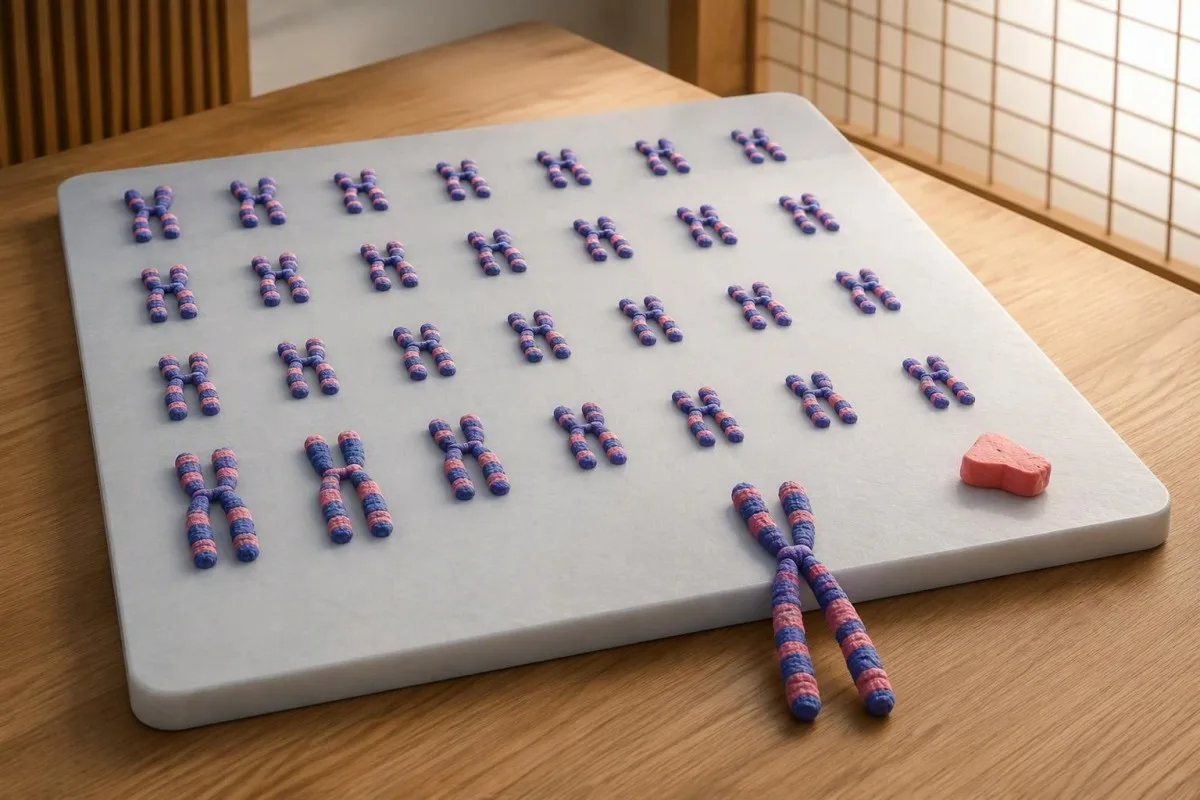
Faodaidh toradh cromosòim dearbhadh a dhèanamh air a’ bhreithneachadh gun a bhith a’ ro-innse gach toradh slàinte. Tha an sampall, an àireamh cheallan agus adhbhar na deuchainn uile a’ toirt buaidh air mar a bu chòir an aithisg a leughadh.


- Deuchainn airson Turner syndrome mar as trice a’ ciallachadh karyotype fala iomaill a bhios a’ sgrùdadh co-dhiù 30 cealla metaphase, agus a thèid a mhìneachadh còmhla ri toraidhean clionaigeach.
- Toradh cromosòim 45,X a’ ciallachadh gu bheil 45 cromosoman anns na ceallan a chaidh a sgrùdadh, a’ gabhail a-steach aon chrosom X; chan eil e a’ toirt cunntas air tuigse no a’ ro-innse gach duilgheadas.
- Turner syndrome mozaigeach a’ ciallachadh gu bheil co-dhiù dà loidhne de cheallan le diofar chruinneachaidhean cromosòim an làthair, mar 45,X agus 46,XX; faodaidh na co-mheasan aca a bhith eadar-dhealaichte eadar maothran.
- Karyotype fala àbhaisteach a’ lùghdachadh coltas Turner syndrome ach dh’fhaodadh e mozaigeachd aig ìre ìosal no cuibhrichte ri maothran a chall nuair a tha amharas clionaigeach làidir fhathast ann.
- Sgrìonadh ro-bhreith àicheil chan eil e a’ cur Turner syndrome às oir chan e deuchainn bhreithneachaidh a th’ ann an sgrìonadh DNA gun cheallan agus tha e gu ìre a’ nochdadh pàtrain cromosòim na placenta.
- Deuchainn a bharrachd dh’fhaodadh barrachd cheallan, FISH cuimsichte, no sampall eile de stuth a ghabhail a-steach nuair a dh’aithnicheas eòlaiche ginteachd ceist shònraichte nach deach a freagairt.
- Measadh cardiovascular leanaidh e dearbhadh eadhon ann an cùisean breac-dhualach a tha coltach ri bhith tlàth; chan eil toraidhean àbhaisteach dheuchainnean fala àbhaisteach a’ cur às do neo-riaghailteachdan san aorta no ann am bhalbhaichean.
- Sgrùdadh fad-ùine gabhaidh e a-steach ìomhaighean nan dubhagan, measadh air fàs agus inbhidheachd, sgrùdaidhean èisteachd, agus sgrùdadh air an thyroid, glùcois, grùthan, galar celiac agus cnàmhan a rèir aois.
Dè an deuchainn airson Turner syndrome a dhearbhas am breithneachadh?
Is e an dearbhadh àbhaisteach Deuchainn airson Turner syndrome fuil karyotype, air a mhìneachadh còmhla ri toraidhean clionaigeach. Tha 45,X toradh a’ comharrachadh cheallan aig a bheil aon chromosome X; tha syndrome Turner breac-dhualach a’ comharrachadh diofar loidhnichean cheallan chromosome, leithid 45,X/46,XX. Chan eil sgrìonadh ro-bhreith àicheil a’ cur às do phàtran sam bith dhiubh, agus bu chòir dearbhadh leantainn gu measadh cardiovascular, nan dubhagan, fàis, hormonail agus èisteachd.
Tha stiùireadh eadar-nàiseanta 2024 a’ moladh gun tèid co-dhiù 30 cealla metaphase a sgrùdadh mar a’ chiad roghainn airson mion-sgrùdadh chromosome nuair a tha amharas ann air syndrome Turner (Gravholt et al., 2024). Bidh an obair-lann a’ cunntadh nan chromosomean agus a’ sgrùdadh an structair, agus mar sin chan urrainn do chunntas fala slàn àbhaisteach, toradh thyroid no pannal hormona àite an sgrùdaidh seo a ghabhail—eadhon nuair a tha na toraidhean sin uile misneachail.
’S e anailisiche deuchainnean fala le AI a th’ ann an Kantesti a chuidicheas le mìneachadh air toraidhean obair-lann a tha na chois, ach chan urrainn dha dearbhadh a dhèanamh air breithneachadh chromosome. Fiosrachadh mu ar fòcas clionaigeach a’ mìneachadh ar dreuchd; feumar aithneachadh chromosome a dhèanamh ann an obair-lann cytogenetics, agus feumaidh an lighiche a tha a’ toirt cùram don euslainteach no an sgioba ginteachd aithisgean a tha a’ toirt iomradh air 45,X, atharrachadh structarail X no breac-dhualachas a mhìneachadh.
Is e mo chuideam clionaigeach, mar Thomas Klein, MD, dà cheist a sgaradh: “Dè am pàtran chromosome a chaidh a lorg?” agus “Dè an cùram a tha a dhìth air an neach seo?” Tha mìneachadh co-cheangailte air karyotype nan cromosoman gnè a’ sealltainn an aon eadar-dhealachadh, ged a tha toraidhean chromosome eadar-dhealaichte an lùib syndrome Turner agus slighe sgrùdaidh eadar-dhealaichte na chois.
Cuin a bu chòir fàs neo-phàirteach no dàil ann am breithidheachd leantainn gu deuchainnean?
Faodaidh inbhe ìosal gun mhìneachadh, dàil ann an inbhidheachd, amenorrhea bun-sgoile, no cuid de thoraidhean gnèitheach a bhith nan adhbhar airson karyotype syndrome Turner. Cha bu chòir deuchainn a bhith an urra ri amhach lìnichte no coltas aithnichte eile; bidh cuid de dhaoine le syndrome Turner breac-dhualach a’ tighinn gu aire an toiseach nuair a thathar a’ measadh hormonaichean ann an òigeachd no a’ sgrùdadh torachais ann an inbheach.
A girl whose height is below approximately −2 standard deviations, or whose growth trajectory is falling away from her family’s expected pattern, needs a clinical growth assessment rather than an automatic diagnosis. Turner testing may be appropriate even when growth hormone measurements are normal, because reduced growth can arise from chromosome-related mechanisms rather than classic growth hormone deficiency.
Absent breast development by around 13 years, or no first period by 15 bliadhna, warrants assessment for delayed puberty or primary amenorrhea; these are investigation triggers, not Turner-specific diagnostic cutoffs. Our guide to teenage hormone assessment explains why age, development, nutrition, and the laboratory’s pediatric reference intervals must be considered together.
Beachdaich air eisimpleir 14-bliadhna with short stature and little pubertal development: a high FSH result may suggest reduced gonadal function, but it cannot establish the chromosome cause. I would also ask about congenital heart findings, repeated ear problems, neonatal hand or foot swelling, family heights, and previous genetic testing before deciding which investigations answer the actual clinical question.
Dè tha toradh cromosòim 45,X a’ ciallachadh dha-rìribh?
A Toradh cromosòim 45,X means that the reported cell line contains 45 chromosomes, including one X chromosome rather than two sex chromosomes. In an appropriate clinical context, this supports Turner syndrome; the notation describes the examined cells, not a complete inventory of every cell in the person’s body.
Most human somatic cells contain 46 chromosomes: 22 pairs of autosomes and 2 sex chromosomes. Turner syndrome can result from complete or partial absence of a second sex chromosome, so a report need not say exactly 45,X to be clinically relevant; structural X findings require assessment of the missing or altered material.
SHOX gene dosage helps explain why short stature can occur: this gene lies in a region normally represented on both sex chromosomes, and losing one functional copy can affect growth. Chromosome count is therefore different from a hormone concentration; our explanation of result types and measurements helps readers distinguish descriptive findings from numerical laboratory ranges.
A report stating 45,X in 30 examined cells does not prove that no 46,XX cells exist elsewhere, and it does not mean that every Turner-associated complication will develop. Intelligence is usually within the normal range, although some people benefit from assessment of visuospatial skills, mathematics, attention, or social cognition—needs that cannot be read directly from the chromosome notation.
Ciamar a tha Turner syndrome mozaigeach eadar-dhealaichte bho 45,X?
Turner syndrome mozaigeach means that at least 2 genetically different cell lines are present in the same person. A common example is 45,X/46,XX, but other combinations occur; a second cell line may contain a structural X change or Y chromosome material rather than an entirely typical 46,XX complement.
If a laboratory finds 8 cells with 45,X and 22 with 46,XX, the observed 45,X proportion is about 27% in that analyzed sample. That percentage is not the percentage of the whole body “affected,” and it is not a reliable numerical forecast of height, fertility, heart risk, or future hormone requirements.
Spontaneous puberty and menstruation are more likely in some 45,X/46,XX groups than in nonmosaic 45,X groups, but neither outcome is guaranteed for an individual. A person may have periods initially and later develop ovarian insufficiency; FSH elevation and its causes can help explain that hormonal change without pretending that one FSH measurement predicts its timing.
The distribution of 2 cell lines can differ between blood, skin, and other tissues, which is one reason outward appearance and blood percentages do not always match. I would not describe mosaic Turner syndrome as automatically “mild”: the practical question is which complications have been excluded through assessment, not whether the chromosome report contains a reassuring-looking second line.
An urrainn do karyotype fala àbhaisteach mozaigeachd a chall?
A normal blood karyotype can miss low-level or tissue-limited mosaicism, particularly when the clinical picture remains strongly suggestive. Examining more cells improves the chance of detecting a minority cell line in the sampled tissue, but no finite blood-cell count proves that every other tissue has the same chromosome pattern.
Under a simplified independent-sampling model, finding no abnormal cells among 30 cells excludes a cell line occurring at roughly 10% or more with about 95% confidence. This is the statistical basis behind traditional mosaicism-exclusion tables, not a guarantee of diagnostic sensitivity in every patient (Hook, 1977); culture conditions and tissue differences can weaken the model’s assumptions.
At the same 95% confidence level, examining 60 negative cells corresponds to approximately a 5% upper bound, and 100 corresponds to approximately 3%, if sampling assumptions hold. The formula is 1 − 0.05^(1/n), where n is the number examined; it describes uncertainty within a specimen, not the chance that a person does or does not have Turner syndrome.
Kantesti is an AI lab test interpretation service that can help organize accompanying results, but a normal chemistry panel cannot resolve chromosome mosaicism. Ar mìneachadh teicneòlas AI describes a different task from cell counting; if a report says 46,XX in 30 cells, the next decision still depends on the referral indication and specialist assessment.
Carson nach eil sgrìonadh ro-bhreith àicheil a’ cur Turner syndrome às?
A negative prenatal screen does not exclude Turner syndrome because screening estimates risk rather than establishing a fetal chromosome diagnosis. Cell-free DNA screening analyzes a mixture dominated by maternal DNA, with a pregnancy-associated component largely originating from the placenta; fetal mosaicism, placental differences, and assay limitations can produce discordant results.
Not every prenatal panel includes sex-chromosome aneuploidy, so “low risk” may refer only to trisomies 21, 18, and 13. The original report matters more than a remembered phone message: check which conditions were screened, whether monosomy X was included, and whether the laboratory reported a result or an uninterpretable sample.
Positive monosomy X screens also require caution: a clinical review described a pooled positive predictive value of about 26%, with substantial variation between studies and populations (Dowlut-McElroy et al., 2022). That number concerns positive screens, not sensitivity or the reassurance provided by a negative screen; it must not be used to calculate a particular pregnancy’s residual risk.
A later child with unexplained short stature or delayed puberty still deserves assessment despite an earlier “negative” prenatal result. An ordinary urine pregnancy result answers an even narrower question—it detects hCG, not chromosomes—and neither a normal ultrasound nor any single screening result can rule out all forms of 45,X mosaicism.
Dè na deuchainnean breithneachaidh ro-bhreith a shoilleiricheas lorg cromosòim a tha fo amharas?
Chorionic villus sampling and amniocentesis can provide specimens for diagnostic chromosome testing, following counseling about their benefits, limitations, and procedure-related risks. Amniocentesis may be particularly useful when placental mosaicism is a concern because it samples a different source of pregnancy-associated cells from chorionic villus sampling.
CVS is usually performed in the first trimester, commonly around 11–14 weeks, whereas amniocentesis is generally performed from 15 weeks onward. A maternal-fetal medicine specialist should explain local timing and laboratory methods; the deciding issue is not simply which procedure is earlier, but which specimen can best resolve the suspected chromosome discrepancy.
A mosaic finding in chorionic villi may reflect confined placental mosaicism rather than the same pattern throughout the fetus. When 2 cell lines are reported, counseling may include whether cultured and uncultured preparations differ, whether amniocentesis is warranted, and what uncertainty remains even after additional testing—questions that are easily lost in a one-line summary.
Maternal chromosome testing can sometimes explain a positive cell-free DNA monosomy X result, but maternal findings do not automatically establish or exclude a fetal diagnosis. Keep the complete original report: our clàr-obrach clò-bhualadh PDF is especially relevant when punctuation, brackets, or the distinction between 45,X and 46,XX could be altered during document extraction.
Cuin a tha FISH, maothran eile no deuchainnean airson stuth Y feumail?
Specialist-directed additional testing helps when the initial karyotype leaves a clinically meaningful question unanswered. Options can include counting more blood cells, targeted FISH, chromosome analysis of another tissue, or testing for Y chromosome material; these approaches are not interchangeable and should not be ordered as an indiscriminate “more is better” panel.
FISH uses fluorescent probes directed at selected chromosome regions, allowing laboratories to examine many nuclei for a defined target. A probe can help investigate a suspected minority cell line or unidentified marker chromosome, but a normal targeted result does not exclude every structural abnormality; even examining 100 nuclei only answers the question addressed by that particular assay.
If a 46,XX blood result conflicts with a strong Turner phenotype, a geneticist may consider buccal cells or skin-derived cells, depending on the suspected finding and validated laboratory methods. Chromosomal microarray can clarify some copy-number changes but may miss low-level mosaicism or balanced rearrangements; repeating blood testing alone cannot settle a chromosome pattern restricted to another tissue.
Deuchainn airson Y chromosome material is particularly relevant when a marker chromosome needs identification or a 45,X finding accompanies virilization; the 2024 guideline supports molecular investigation in that latter setting (Gravholt et al., 2024). Detection requires specialist discussion of gonadal growth risk and individualized management—not automatic surgery from an app; Kantesti AI’s inbhean clionaigeach agus crìochan should not be confused with cytogenetic validation.
Dè na sgrùdaidhean cridhe is na h-aorta a bu chòir a leantainn air dearbhadh?
Every confirmed Turner syndrome diagnosis warrants cardiovascular assessment, including people with mosaic findings and few outward features. Initial evaluation generally includes echocardiography and blood-pressure assessment; cardiovascular MRI is also recommended for newly diagnosed adolescents and adults, with timing and follow-up determined by age, findings, and clinical feasibility.
The 2024 guideline recommends cardiovascular MRI, in addition to or instead of initial echocardiography, for newly diagnosed adolescents and adults, ideally within 12 mìosan when appropriate (Gravholt et al., 2024). MRI can identify aortic and venous anatomy that echocardiography may not fully show; for children, MRI timing can depend on the ability to complete the study without general anesthesia.
Blood pressure should be assessed annually, preferably with ambulatory monitoring when available, because hypertension can amplify aortic risk and may be missed by a single office reading. Our discussion of hypertension assessment explains laboratory clues to other causes, but normal electrolytes or kidney markers do not eliminate Turner-associated cardiovascular surveillance.
Low-risk adults with an entirely reassuring initial evaluation may have imaging intervals of roughly 5–10 years, while abnormalities, pregnancy planning, or changing measurements require closer follow-up. Aortic size must be interpreted with body-size-aware methods; sudden severe chest, back, or neck pain, collapse, or new breathlessness needs emergency assessment rather than waiting for a chest-pain blood panel.
Carson a nìthear sgrùdadh air cumadh nan dubhagan nuair a tha creatinine àbhaisteach?
A renal ultrasound is recommended at Turner syndrome diagnosis because kidney anatomy and kidney function are different questions. A horseshoe kidney, unusual position, or collecting-system difference can exist despite a normal creatinine result; imaging establishes anatomy, while blood and urine tests assess function and selected complications.
Faodaidh duine a bhith aige 2 functioning kidney components joined in a horseshoe configuration without an abnormal estimated filtration rate. The reason to identify the anatomy is practical: it can change the assessment of urinary symptoms, drainage problems, stones, and blood pressure rather than merely adding another label to the medical record.
Creatinine-based eGFR does not show kidney shape, and its interpretation depends partly on muscle mass and the equation used. Our metabolic panel kidney guide explains that limitation; children require age-appropriate assessment, and an adult eGFR automatically printed beside a child’s result should not be accepted without checking the laboratory’s method.
If imaging identifies a significant renal anomaly, the clinician may add periodic urinalysis or protein assessment and tailor repeat imaging to symptoms; an annual proteinuria check is recommended for selected anomalies in the 2024 guidance. Repeated urinary symptoms, unexplained hypertension, or a change in renal markers should prompt review rather than assuming that a reassuring scan from childhood answers every later question.
Dè na deuchainnean thyroid, celiac, glùcois agus grùthan a thig an ath rud?
Turner syndrome follow-up includes age-appropriate surveillance for thyroid disease, celiac disease, diabetes, and liver abnormalities. These tests monitor associated health risks rather than confirm the chromosome diagnosis; the 2024 international guideline provides starting ages and intervals, with earlier or more frequent investigation when symptoms or previous abnormalities justify it.
TSH screening is recommended every 1–2 years from age 2, with additional investigation for symptoms or abnormal results (Gravholt et al., 2024). Free T4 and, when appropriate, thyroid antibodies answer different follow-up questions; our mìneachadh deuchainn tìoroide helps distinguish hormone production from the pituitary signal that stimulates it.
Celiac screening generally uses tissue-transglutaminase IgA plus total IgA, beginning around age 2 and repeating every 2–5 years, or sooner for relevant symptoms. A low total IgA can make an IgA-based screen misleading, and avoiding gluten before testing can reduce sensitivity; the gluten-before-testing guide explains why dietary changes should be discussed before drawing conclusions.
HbA1c or fasting glucose and liver enzymes are generally checked every 1–2 years from age 10, with the exact panel and response tailored to the individual. Kantesti AI can help display these longitudinal results, but a reassuring HbA1c does not rule out every glucose abnormality, and a raised ALT should be investigated rather than automatically attributed to weight or to Turner syndrome itself.
Ciamar a thèid fàs, breithidheachd, cnàmhan agus èisteachd a mheasadh?
Growth, pubertal development, bone health, and hearing need planned assessment after Turner syndrome confirmation. Growth hormone treatment may help selected children even without classic growth hormone deficiency, while estrogen replacement may support puberty and skeletal health when endogenous hormone production is insufficient; neither treatment should be chosen from the chromosome percentage alone.
The 2024 guideline supports considering growth hormone from about age 2 when growth failure, short stature, or likely short adult height justifies treatment (Gravholt et al., 2024). A childhood growth hormone evaluation answers a related but different question; baseline growth, family height, treatment burden, and monitored response all matter more than a single IGF-1 value.
For girls with evidence of ovarian insufficiency, low-dose estrogen often begins around age 11–12, with gradual increases to imitate normal pubertal progression. Bone density assessment is generally obtained after growth completion and before age 21, then often every 5–10 years in adults; bone-loss investigations complement DXA, whose interpretation must account for short stature and smaller bone size.
Hearing assessment is generally recommended every 2–3 years in childhood and adolescence and every 5 years in adulthood, or sooner for symptoms (Gravholt et al., 2024). Hearing difficulties can be mistaken for poor concentration or school problems, so educational support should consider audiology alongside learning needs; vitamin D, dental care, and psychosocial support also belong in the follow-up plan.
Dè tha toraidhean mozaigeach a’ ciallachadh a thaobh torachais agus torrachais?
Mosaic chromosome findings may increase the possibility of spontaneous ovarian function, but they do not establish fertility or pregnancy safety. Menstrual history, hormone results, ovarian-reserve assessment, and specialist counseling address reproductive potential; cardiovascular evaluation answers the separate question of whether pregnancy would pose an unacceptable maternal risk.
AMH can help assess ovarian reserve, but there is no single Turner-specific AMH value that guarantees spontaneous conception or a successful preservation procedure. A mosaic proportion of 20% or 80% in blood cannot replace reproductive assessment; our explanation of low AMH interpretation describes why age, assay, treatment history, and the clinical purpose of testing affect interpretation.
A person who menstruates spontaneously may still face a shorter reproductive window, so fertility counseling should not be postponed until 12 months of unsuccessful trying if ovarian insufficiency is already suspected. Selected patients may consider fertility preservation, but suitability and expected benefit vary; an IVF laboratory assessment provides information without resolving the cardiovascular risks of carrying a pregnancy.
Donor eggs do not remove Turner-associated pregnancy risks, because those risks arise partly from the pregnant person’s cardiovascular anatomy and physiology. Preconception cardiac imaging is generally recommended within 2 years before a planned pregnancy or assisted reproduction, with additional assessment as indicated; some aortic findings make pregnancy inadvisable, and estrogen replacement itself should not be assumed to provide contraception.
Foillseachaidhean rannsachaidh agus liosta phractaigeach airson leanmhainn
After confirmation, the useful next step is a coordinated specialist plan—not repeated chromosome testing without a clinical question. As of October 12, 2026, the 2024 international Turner syndrome guideline is the principal contemporary guideline cited here; the accompanying general laboratory publications below are educational resources, not evidence that a blood-analysis tool can diagnose Turner syndrome.
Kantesti is an AI biomarker interpretation platform that can help organize the laboratory part of a Turner follow-up plan. Bring 3 practical records to the next visit: the complete cytogenetic report, previous heart and kidney imaging reports, and a dated list of medications and laboratory results; chromosome notation, specimen source, and cells counted should remain attached to the original report.
General laboratory publications should be read within their scope: the iron-panel interpretation guide concerns iron status, not chromosome confirmation. The stiùireadh deuchainn clotadh againn discusses clotting assays, which are not routine Turner diagnostic tests; their 2 supplied Zenodo DOIs are listed below with title-first APA citations and clearly identified repository-search links.
Editorial perspective from Thomas Klein, MD: ask who will coordinate genetics, endocrinology, cardiology, and primary care, and when the first follow-up review will occur. Kantesti’s fiosrachadh comhairleachaidh meidigeach describes our clinical oversight context, but this draft does not assert an individual reviewer’s sign-off; before publication or clinical use, recommendations and any personal management plan require documented physician review.
Ceistean Bitheanta
Dè an deuchainn fala a dhearbhas syndrome Turner?
’S e karyotype fala iomallaich an deuchainn dhearbhaidh àbhaisteach mar chiad cheum nuair a tha amharas ann air syndrome Turner, agus bu chòir a mhìneachadh còmhla ri toraidhean clionaigeach. Tha an stiùireadh eadar-nàiseanta 2024 a’ moladh sgrùdadh a dhèanamh air co-dhiù 30 cealla meata-phase. ’S urrainn dhan anailis 45,X, sreathan cheallan moasaig, agus cuid de dh’eas-òrdughan structarail air a’ chromosom X aithneachadh. Chan urrainn do dheuchainnean hormona àbhaisteach, cunntas fala slàn, no mìneachadh obair-lann le AI dearbhadh a dhèanamh air a’ bhreithneachadh chromosomach.
A bheil toradh 45,X an-còmhnaidh a’ ciallachadh syndrome Turner?
Tha toradh bun-reachdail de 45,X cromosoman ann an co-theacsa clionaigeach iomchaidh a’ toirt taic do shionndrom Turner, ach feumar ath-sgrùdadh a dhèanamh air an t-sampall, aois, àireamh nan ceallan, agus adhbhar na deuchainne. Tha an comharrachadh a’ ciallachadh gu bheil 45 cromosoman aig an loidhne-chealla a chaidh aithris, a’ gabhail a-steach aon chrogamosom X. Uaireannan faodaidh àireamh glè bheag de cheallan 45,X ann an inbheach nas sine a bhith mar thoradh air call X co-cheangailte ri aois seach sionndrom Turner bun-reachdail nach deach aithneachadh roimhe. Bu chòir do speisealaiche gintinneachd toraidhean ris nach robh dùil aig ìre ìosal a mhìneachadh, seach a’ bhreithneachadh a shònrachadh bhon chomharrachadh a-mhàin.
An urrainn do karyotype àbhaisteach syndrome Turner mozaigeach a chur às àicheadh?
0 Tha karyotype fala àbhaisteach a’ fàgail nach eil syndrome Turner cho coltach, ach chan eil e a’ cur às do gach pàtran moasaig aig ìre ìosal no cuingealaichte ri clò. A rèir barailean samplachaidh nas sìmplidhe, tha 30 ceallan àicheil a’ cur às do loidhne chealla bheag-chuid, timcheall air 10%, anns an t-sampall sin le mu 95% de dh’earbsa. Chan eil an àireamhachadh sin a’ toirt cunntas air pàtrain chromosoman ann an clòthan eile agus tha buaidh aig samplachadh is cultar obair-lann air. Faodaidh amharas clionaigeach làidir leantainneach fìreanachadh a thoirt do dheuchainnean a bharrachd fo stiùir speisealaiche.
Am faod NIPT fàiligeadh air syndrome Turner a lorg?
0 Tha, faodaidh sgrìonadh DNA gun cheallan, ris an canar gu tric NIPT, fàilligeadh air syndrome Turner a lorg agus chan urrainn dha cur às don chomas a tha ann às dèidh toradh le cunnart ìosal. Chan eil cuid de phannalan a’ sgrìonadh ach airson trisomies 21, 18 agus 13 agus chan eil iad a’ gabhail a-steach monosomy X. Fiù ’s nuair a tha monosomy X air a ghabhail a-steach, faodaidh mosaicism fetal, eadar-dhealachaidhean sa phlacenta agus cuingealachaidhean an assay toraidhean neo-chòrdail adhbharachadh. Bu chòir beachdachadh fhathast air deuchainn breithneachaidh chromosomal nuair a tha na toraidhean ro-bhreith no draghan nas fhaide air adhart mu fhàs agus breith na h-òige ga fhìreanachadh.
A bheil an ceudad de mhaoiseachachd a’ ro-innse dè cho dona ’s a bhios syndrome Turner?
0 Chan eil an ceudad de mhosaicism ann an sampall fala na ro-innse earbsach air cho dona ’s a tha syndrome Turner ann an neach fa leth. Tha lorg 8 ceallan le 45,X am measg 30 cealla a chaidh a sgrùdadh a’ ciallachadh gun deach cuibhreann de mu 27% fhaicinn san t-sampall sin, chan e 27% den bhodhaig gu lèir. Faodaidh cuibhreannan eadar-dhealaichte a bhith ann an diofar fhigheagan, agus tha samplachadh fala a’ toirt mì-chinnt a-steach. Tha measadh a’ chridhe, nan dubhagan, nan hormonaichean, na claisneachd agus an fhàis fhathast riatanach eadhon nuair a tha an cuibhreann 45,X a chaidh aithris ìosal.
Am faod cuideigin le sionndrom Turner moasaig ùineachan fhaighinn no fàs trom le leanabh?
Bidh caithreachas, mìosan, no torrachasan gun eadar-theachd aig cuid de dhaoine le sionndrom Turner mosaicach, gu h-àraidh leis a’ phàtran cealla 45,X/46,XX. Chan urrainnear na cothroman sin a ro-innse gu earbsach a rèir ceudad mosaicachd ann am fuil no aon toradh AMH. Tha comhairleachadh mu thorrachas agus measadh cardiovascular nan riatanasan fa leth, agus mar as trice thathar a’ moladh ìomhaigheachd cridhe ro bhreith taobh a-staigh 2 bhliadhna mus tèid torrachas no gintinn le taic a phlanadh. Chan eil uighean tabhartaiche a’ cur às do chunnartan cardiovascular a tha an lùib torrachais, agus tha cuid de thoraidhean aortic a’ ciallachadh nach eilear a’ comhairleachadh torrachas.
Dè na sgrùdaidhean slàinte a tha a dhìth an dèidh dearbhadh gu bheil syndrome Turner ann?
Bu chòir do dhearbhadh air syndrome Turner leantainn gu measadh cardiovascular, ultrasound nan dubhagan, agus measadh air fàs, òigeachd, èisteachd agus cunnartan co-cheangailte eile. Bu chòir bruthadh-fala a mheasadh gach bliadhna, agus thathar a’ moladh sgrìonadh thyroid san fharsaingeachd gach 1–2 bhliadhna bho aois 2. Mar as trice, tòisichidh sgrùdadh glùcois no HbA1c agus einnseanan grùthan mu aois 10, aig amannan eadar 1–2 bhliadhna, agus tha clàr-ama air leth aig sgrìonadh airson galar celiac. Bu chòir don sgioba làimhseachaidh dealbhachadh, measadh cnàimh agus ath-dheuchainnean a chur air dòigh a rèir aois, chomharran, thoraidhean roimhe agus phlanaichean torrachais.
Faigh Mion-sgrùdadh Deuchainn Fala le Cumhachd AI an-diugh
Thig còmhla ri còrr is 2 mhillean neach air feadh an t-saoghail a tha a’ earbsa Kantesti airson mion-sgrùdadh sa bhad, ceart air deuchainnean obair-lann. Luchdaich suas na toraidhean deuchainn fala agad agus faigh mìneachadh coileanta air biomarcair 15,000+ ann an diogan.
📚 Foillseachaidhean Rannsachaidh le Iomraidhean
Klein, T., Mitchell, S., & Weber, H. (2026). Stiùireadh Sgrùdaidhean Iarainn: TIBC, Sàthadh Iarainn & Comas Ceangail. Rannsachadh Leigheis AI Kantesti.
Klein, T., Mitchell, S., & Weber, H. (2026). Raon Àbhaisteach aPTT: D-Dimer, Pròtain C Stiùireadh air Clotadh Fuil. Rannsachadh Leigheis AI Kantesti.
📖 Iomraidhean Meidigeach Taobh a-muigh
Gravholt CH et al. (2024). Clinical practice guidelines for the care of girls and women with Turner syndrome: proceedings from the 2023 Aarhus International Turner Syndrome Meeting. Iris Eòrpach Endocrineachais.
Dowlut-McElroy E et al. (2022). Cell-Free DNA Screening Positive for Monosomy X: Clinical Evaluation and Management of Suspected Maternal or Fetal Turner Syndrome. Iris Ameireaganach Obstetrics agus Gynecology.
Hook EB (1977). Exclusion of chromosomal mosaicism: tables of 90%, 95% and 99% confidence limits and comments on use. American Journal of Human Genetics.
⚕️ Àicheadh Meidigeach
Tha an artaigil seo dìreach airson adhbharan foghlaim agus chan eil e a’ dèanamh comhairle mheidigeach. Cuir fios an-còmhnaidh gu solaraiche cùram slàinte teisteanasach airson co-dhùnaidhean breithneachaidh is leigheis.
Comharran earbsa E-E-A-T
Eòlas
Lèirmheas clionaigeach air a stiùireadh le lighiche air sruthan-obrach mìneachaidh obair-lann.
Eòlas
Fòcas air leigheas obair-lann air mar a bhios bith-chomharraidhean (biomarkers) a’ giùlan ann an co-theacsa clionaigeach.
Ùghdarrasachd
Air a sgrìobhadh le Dr. Thomas Klein le ath-sgrùdadh le Dr. Sarah Mitchell agus Prof. Dr. Hans Weber.
Earbsachd
Mìneachadh stèidhichte air fianais le slighean leanmhainn soilleir gus dragh a lughdachadh.