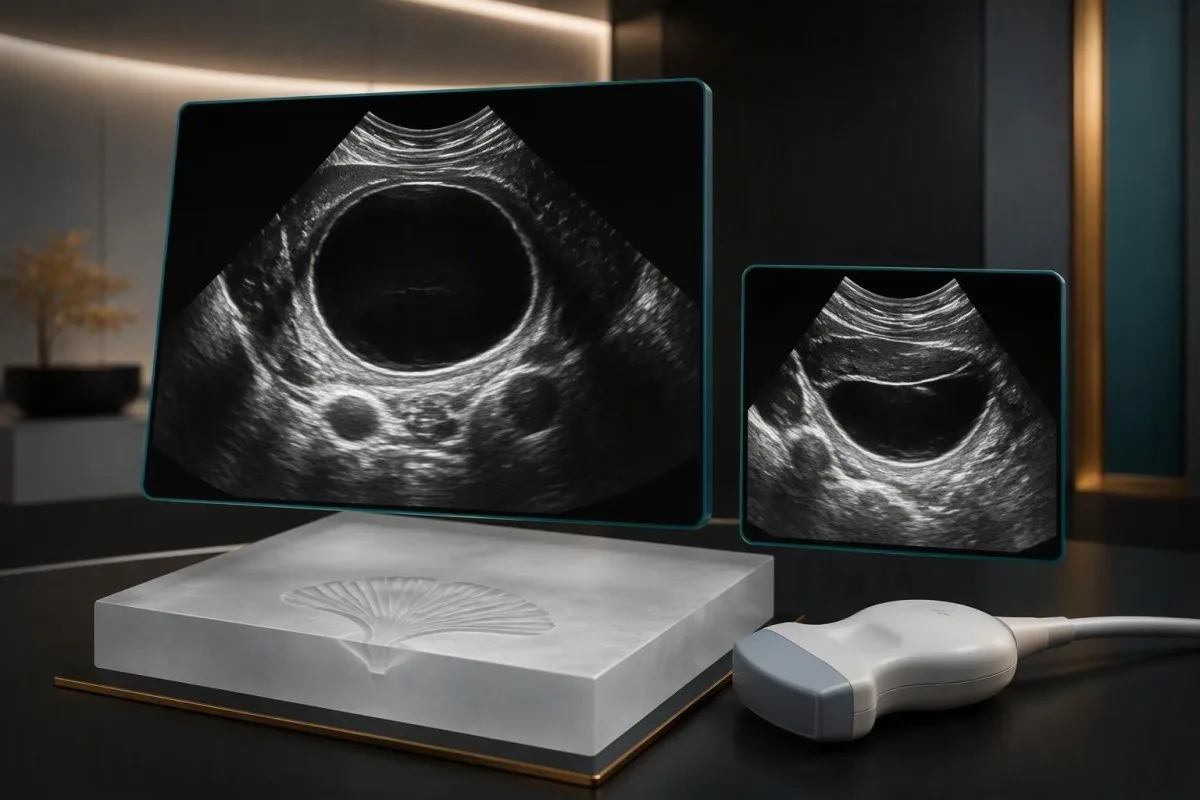
In skuorring kin floeistof frijlitte of ynterne blieding feroarsaakje; by torsje draait de eierstok om en komt de bloedfoarsjenning yn gefaar. Beide kinne hommelse bekkenpine feroarsaakje, dus symptomen allinnich kinne se net feilich faninoar ûnderskiede.


- Symptomen fan in ovariale cyste kinne iensidige pine yn it bekken, druk, in opblaasd gefoel of pine by seks omfetsje, mar in protte cysten feroarsaakje gjin symptomen.
- Symptomen fan in skuorde ovariale cyste kinne hommelse pine mei in bytsje faginale blieding omfetsje; in flinke blieding kin folslein binnen de búk bliuwe.
- Symptomen fan ovariale torsje omfetsje faak hommelse iensidige pine en mislikens of braken, mar de pine kin wikselje as de draaiing tuskenskoften optreedt.
- Needbeoardieling is nedich by hommelse, slimme bekkenpine, benammen mei braken, in flau gefoel, pine yn it skouderpunt, koarts of in mooglike swangerskip.
- De grutte fan de cyste boppe likernôch 5 cm fergruttet it risiko op torsje, mar in lytsere cyste — of gjin sichtbere cyste — slút torsje net út.
- Swierensûndersyk is ûnderdiel fan de beoardieling fan akute bekkenpine as in swangerskip biologysk mooglik is, ek by gebrûk fan anticonsepsje.
- Echografie mei Doppler helpt by it beoardieljen fan in cyste, bekkenfloeistof en de bloedsirkulaasje, mar behâld fan Dopplerstreaming slút in torsy net út.
- Serieel testen kin werhelle hemoglobinemjittingen omfetsje by fertinking op in blieding en werhelle mjittingen fan serum-hCG mei sa'n 48 oeren tuskenromte by in klinysk stabile swangerskip fan ûnbekende lokaasje.
Hoe ferskille it skuorren fan in cyste en ovariale torsje?
Cysteruptuer lit de ynhâld fan de cyste en soms bloed yn it bekken frijkomme; ovariumtorsy draait de stypjende weefsels fan it ovarium en kin de bloedfoarsjenning ûnderbrekke. Beide kinne hommelse, iensidige bekkenpine feroarsaakje, en noch it pinepatroan noch it ûntbrekken fan faginale blieding makket in betrouber ûnderskied tusken har mooglik.
Hommelse, slimme bekkenpine freget om in needbeoardieling ynstee fan in besykjen om de oarsaak thús fêst te stellen. Klinisy kombinearje meastal fitale tekens, ûndersyk, swangerskipstests en echografie fan it bekken; by fertinking op torsy kin driuwende sjirurgy nedich wêze, ek as de earste scan gjin dúdlikheid jout.
In ovariumcyste is in struktuer mei floeistof, net automatysk in sykte dy't behanneling fereasket. In protte funksjonele cysten ferdwine binnen 2–3 menstruele syklusen, wylst endometriomen, dermoïdcysten en oare oanhâldende massa's har oars gedrage; ús gids foar frouljussûnens leit de eftergrûn fan de syklus út.
Myn klinyske prioriteit, skriuwend as Dr. Thomas Klein, is om in mooglike tiidgefoelige needsitewaasje te ûnderskieden fan in cyste dy't neifolge wurde kin — net om pine allinnich op basis fan de beskriuwing dêrfan te labeljen. De organisatoaryske eftergrûn fan Kantesti ferklearret ús rol: Kantesti is in AI-analyser foar bloedtests dy't laboratoariumfynsten útlizze kin, mar gjin cysteruptuer fêststelle of ovariumtorsy útslute kin.
Hokker symptomen kin in net-komplisearre ovariale cyste feroarsaakje?
Symptomen fan in ovariale cyste kin in doffe bekkenpine, iensidige druk, in opgeblazen gefoel, ûngemak by seks of faak urinearjen troch druk op tichteby lizzende struktueren omfetsje. In protte cysten feroarsaakje gjin symptomen, en it ûntdekken fan in cyste op in echografy bewijst net dat dy alle symptomen ferklearret.
De lokaasje fan pine is in ûnfolsleine kaart fan it ûnderlizzende probleem. In cyste oan de rjochterkant kin sintraal ûngemak feroarsaakje, wylst in opblaasde term, pine yn de bekkenbodemspieren of in urinaire oandwaning ferlykbere gefoelens jaan kin; de nuttige fraach is oft de symptomen oerienkomme mei it ûndersyk en de ôfbylding, net allinnich mei de kant.
De timing yn de syklus jout kontekst, gjin befêstiging. Koartduorjend ûngemak midden yn de syklus kin mei de ovulaasje gearhingje, wylst pine dy't mei de menstruaasje weromkomt op endometriose wize kin; in symptoomdeiboek oer 2–3 syklusen helpt patroanen te werkennen as driuwende oarsaken útsletten binne.
Polysystysk-ovariumsyndroom is net itselde as it hawwen fan ien grutte ovariumcyste. De lytse follikels dy't by PCOS hearre, ferskille fan in akute pynlike cyste, en allinnich bekkenpine bewijst gjin PCOS; ús diagnostyske kritearia foar PCOS ferklearje wêrom't hormoanpatroanen, menstruele skiednis en oare befiningen fan belang binne.
Hoe fielt it as symptomen ûntsteane troch in skuorde ovariale cyste?
Symptomen fan in skuorde ovariale cyste begjinne faak mei hommelse bekkenpine, soms by oefening of seks en soms sûnder dúdlike oanlieding. De pine kin op ien plak bliuwe of wiidfersprater wurde as floeistof of bloed it búkflues irritearret; faginale blieding kin ûntbrekke.
In lytse hoemannichte frijkommen floeistof kin opfallende pine feroarsaakje sûnder gefaarlik bloedferlies. Ek it tsjinoerstelde is fan belang: oanhâldende ynterne blieding kin yn earste ynstânsje mar matich ûngemak feroarsaakje, dus de yntinsiteit fan de pine is gjin betroubere mjitte fan de earnst fan de blieding.
Pine oan de skouderpunt, duizeligheid, flaufallen of ûngewoane swakte kinne foarkomme by in wichtige búkblieding. Dizze symptomen fereaskje needsoarch, benammen by in mooglike swangerskip; it tal brûkte maandverbanden kin ynterne blieding net mjitte, al kin ús heavy menstrual bleeding guidance can help distinguish separate concerns about vaginal blood loss.
After a clinician confirms an uncomplicated rupture and establishes stability, pain often begins improving over the next 24–48 hours, although tenderness can last longer. That timeframe is not permission to wait out an unassessed first episode: a presumed rupture can actually be torsion, ectopic pregnancy, or another abdominal emergency.
Hokker symptomen fan ovariale torsje moatte soargen jaan?
Symptomen fan ovariale torsje commonly include sudden one-sided pelvic or lower abdominal pain with nausea or vomiting. Pain can come and go when the adnexa twist and partially untwist, so temporary improvement does not make torsion safe to dismiss.
An enlarged ovary or adnexal mass increases mobility and creates a mechanical opportunity for twisting. Masses around 5 cm or larger are a recognized risk factor, but size is not a diagnostic cutoff; torsion also occurs with smaller masses and without a mass.
ACOG's Committee Opinion No. 783 reports that torsion occurs without an associated mass or cyst in as many as 46% of pediatric and adolescent cases (ACOG, 2019). That adolescent finding should not be applied as an adult prevalence estimate, but it explains why a normal-looking or cyst-free scan cannot end the assessment automatically.
Fertility treatment can enlarge the ovaries and increase torsion risk, including during early pregnancy. Anyone receiving ovarian stimulation should mention the treatment and the date of their last monitoring scan during emergency assessment; our IVF monitoring explanation describes why laboratory results and ultrasound measurements are interpreted together.
Wêrom kinne symptomen allinnich in skuorde cyste net fan torsje ûnderskiede?
Rupture and torsion share too many symptoms for a reliable home diagnosis: abrupt pain, tenderness, nausea, and sometimes fluctuating discomfort. Appendicitis, ectopic pregnancy, kidney stones, and pelvic infection can overlap with both, making examination and testing necessary.
Consider a hypothetical 29-year-old with 30 minutes of right-sided pelvic pain and vomiting. A known cyst makes torsion or rupture plausible, but it does not eliminate appendicitis or ectopic pregnancy; anchoring on an old ultrasound report can delay recognition of the actual emergency.
Nausea makes torsion more concerning, but rupture can also provoke nausea through pain and abdominal irritation. Fever is similarly unhelpful as a gatekeeper: early torsion may occur without fever, and fever with pelvic pain broadens the differential rather than identifying one cause.
Normal inflammatory markers do not reliably exclude an early abdominal emergency. Our appendicitis testing limits explain the same principle: a reassuring white cell count is one piece of evidence, not a substitute for a repeat examination when pain persists or changes.
Wannear fereasket hommelse bekkenpine needsoarch?
Sudden severe pelvic pain requires emergency assessment, even without fever or vaginal bleeding. Seek urgent help immediately for pain with fainting, marked dizziness, repeated vomiting, shoulder-tip pain, a rigid or increasingly swollen abdomen, or possible pregnancy.
Call your local emergency number if you collapse, feel close to fainting, or cannot travel safely; do not drive yourself while dizzy or impaired by pain. There is no dependable pain-score threshold or minimum duration that makes waiting safe when torsion or internal bleeding is possible.
Anticoagulants and bleeding disorders lower the threshold for urgent assessment because a ruptured cyst may bleed more extensively. Bring the medication name and last dose, and do not stop prescribed anticoagulation without clinician advice; our coagulation test limitations explain why apparently normal clotting results may not capture every medication effect.
New persistent pelvic pain that is not severe still deserves prompt clinical advice, particularly with a known cyst, pregnancy possibility, or recent fertility treatment. Tell the service if pain has improved after a sudden episode: intermittent torsion can produce a misleadingly comfortable interval, and pain relief does not establish the diagnosis.
Wêrom is in swangerskipstest nedich by pine troch in ovariale cyste?
Pregnancy testing helps identify ectopic pregnancy, a potentially life-threatening cause of pelvic pain that can resemble cyst rupture or torsion. Testing is appropriate whenever pregnancy is biologically possible, regardless of contraception use or whether the pain feels familiar.
A negative home urine test can be misleading very early in pregnancy or when urine is dilute. Many urine assays detect hCG at approximately 20–25 IU/L, but sensitivity varies; our urine pregnancy test guidance explains why the test date and menstrual history matter.
NICE guideline NG126 recommends considering pregnancy testing in reproductive-age patients even when symptoms are nonspecific and emphasizes that ectopic pregnancy can present atypically (NICE, 2019; updated 2023). Pelvic pain with a positive pregnancy test needs prompt assessment, and severe pain or circulatory symptoms require emergency care.
A pregnancy test does not determine where a pregnancy is located. A corpus luteum cyst may be a normal early-pregnancy finding, while an ectopic pregnancy can coexist with an ovarian cyst; clinicians therefore interpret the test alongside ultrasound rather than treating either finding as a complete explanation.
Hoe stjoere serum-hCG-útslaggen de folgjende stappen?
Serum hCG helps establish pregnancy status and guide follow-up, but a single concentration cannot diagnose ectopic pregnancy or distinguish cyst rupture from torsion. If pregnancy is confirmed but its location is not visible, clinicians may arrange repeat hCG measurements and ultrasound.
Many laboratories report serum hCG below 5 IU/L as negative and 5–25 IU/L as indeterminate, although the assay's own interpretation takes precedence. An indeterminate result may reflect very early pregnancy, a resolving pregnancy, or another explanation; severe symptoms require assessment rather than waiting for the number to cross a threshold.
For a clinically stable pregnancy of unknown location, NICE recommends 2 serum hCG measurements as close as possible to 48 hours apart, but not earlier. Symptoms take priority over the trend, and even a falling concentration does not immediately remove ectopic risk; our hCG decline explanation discusses why follow-up continues until the clinical situation is resolved.
Kantesti is an AI blood test interpretation platform that can explain hCG units and serial laboratory changes, but an algorithm cannot locate a pregnancy. The practical limitation is substantial: the same hCG concentration can accompany different ultrasound findings, so an apparently reassuring result must never overrule new pain, faintness, or a clinician's concern.
Wat kin in echografy sjen litte — en wat kin er misse?
Pelvic ultrasound can characterize a cyst, assess ovarian size, identify free fluid, and evaluate circulation with Doppler. Transvaginal imaging often provides more detail when appropriate and consented to; transabdominal imaging is an alternative or a complementary examination.
Free pelvic fluid supports several possibilities rather than one diagnosis. A small amount can be physiological, while complex or extensive fluid can raise concern for bleeding; clinicians assess its appearance and amount alongside pregnancy status, vital signs, and hemoglobin rather than calling every fluid collection a rupture.
Preserved Doppler flow does not rule out torsion because the ovary has more than one source of arterial supply and twisting can be intermittent. ACOG states that Doppler findings alone should not guide decision-making and that no clinical or imaging criteria reliably confirm torsion before surgery (ACOG, 2019).
Cyst appearance also helps distinguish a simple functional cyst from a hemorrhagic cyst, endometrioma, or another mass. Our endometriosis diagnostic explanation discusses why imaging carries more diagnostic weight than an isolated biomarker; persistent severe pain after an inconclusive scan still warrants gynecologic reassessment.
Hokker bloedûndersiken helpe by it beoardieljen fan in skuorde cyste of torsje?
Blood tests assess consequences and alternative diagnoses, not torsion itself. A complete blood count can help monitor suspected bleeding, pregnancy testing addresses ectopic risk, and additional tests depend on hydration, medications, infection concerns, and whether an operation may be needed.
Hemoglobin can initially remain normal during acute blood loss because plasma and red cells are lost together. A later fall may reflect ongoing bleeding, fluid redistribution, intravenous fluids, or several factors; our hemoglobin and hematocrit comparison explains why the trend needs clinical context.
An illustrative fall from 12.8 to 10.4 g/dL over 4 hours would prompt careful reassessment, but it is not a universal operation threshold. Clinicians also consider pulse, blood pressure, increasing abdominal tenderness, fluid on imaging, and ongoing symptoms; a stable number cannot make an unstable patient safe.
White cell count and CRP may be normal early or elevated for nonspecific reasons, including physiological stress. Our WBC and CRP interpretation explains these disagreements; the examination still matters, particularly guarding, focal tenderness, and a change between the first assessment and a repeat assessment.
Hoe wurdt in befêstige skuorde ovariale cyste behannele?
A stable patient with a confirmed uncomplicated cyst rupture may be treated with observation and pain relief, while ongoing bleeding or clinical instability may require hospital care or surgery. The decision depends on the whole assessment, not simply whether ultrasound shows free fluid.
Kim and colleagues reported conservative management in 80.8% of 78 healthy reproductive-age women with ruptured cysts and hemoperitoneum; 19.2% underwent surgery (Kim et al., 2014). This retrospective cohort excluded important higher-risk situations and is not a guarantee that any individual patient can safely be managed at home.
Observation may involve repeat vital signs, abdominal examinations, hemoglobin measurements, and sometimes repeat imaging. Increasing pain, worsening circulatory signs, or evidence of continuing blood loss can change the plan quickly; receiving fluids or pain medicine is supportive care, not proof that the underlying problem has resolved.
After discharge, instructions should specify whom to contact, which symptoms require immediate return, and whether another scan is needed. Iron testing is useful later if blood loss or heavy periods have depleted stores—not as the first test for sudden internal bleeding; our izerûndersyk útslach explains that follow-up distinction.
Wêrom freget fertinking op torsje om driuwende beoardieling troch in gynekolooch?
Suspected ovarian torsion needs urgent gynecologic assessment because delayed treatment can compromise ovarian function. Definitive diagnosis usually occurs during laparoscopy, and treatment generally aims to untwist the adnexa and preserve the ovary whenever clinically appropriate.
There is no validated 6-hour or 12-hour deadline that guarantees whether an ovary will recover. Earlier treatment is preferred, but a longer symptom history is not a reason to abandon assessment or assume preservation is impossible; ACOG's adolescent guidance favors detorsion and preservation regardless of the ovary's appearance when feasible.
Fertility concerns should inform follow-up without delaying emergency treatment. AMH does not diagnose torsion and cannot predict the outcome of an acute episode; our AMH after ovarian surgery discussion explains why age, procedure type, and test timing affect later interpretation.
Persistent or complex cysts, particularly after menopause, require a different risk assessment from a transient functional cyst. CA-125 is often interpreted around a laboratory cutoff of 35 U/mL but is not a rupture or torsion test; our CA-125 limits and warnings explains benign elevations, while our HE4 interpretation guidance explains why kidney function can complicate another tumor-marker result.
Wat moat de ferfolchsoarch omfetsje nei pine troch in ovariale cyste?
Follow-up should confirm symptom improvement, clarify the cyst type, and provide a specific return plan. A repeat ultrasound is sometimes arranged in approximately 6–12 weeks for selected presumed functional or hemorrhagic cysts, but timing depends on the scan, age, symptoms, and local guidance.
A planned scan weeks away does not cover a new emergency today. Return for reassessment if pain becomes sudden or severe, vomiting develops, or dizziness and weakness appear; improving discomfort is reassuring only within the context of an established diagnosis and an appropriate discharge plan.
Kantesti is an AI-powered blood test analysis tool that can help explain a CBC or iron panel after clinician-directed follow-up, not provide real-time pelvic triage. Before sharing laboratory reports, review our privacy and data handling; ultrasound access, an examination, and symptom reassessment remain outside a blood-report interpretation workflow.
My advice as Dr. Thomas Klein is to keep 3 items together: the ultrasound report, the relevant laboratory results, and the discharge instructions. Kantesti's AI-technologygids describes our interpretation approach, but neither an AI explanation nor a normal-looking panel should persuade someone to ignore recurrent symptoms suggestive of torsion or internal bleeding.
Undersykspublikaasjes en klinysk bewiis: wat is fan tapassing?
Clinical guidance on torsion and ectopic pregnancy—not AI performance reports—supports the emergency recommendations in this article. As of October 13, 2026, the cited evidence includes ACOG's 2019 torsion opinion, NICE guideline NG126, and Kim and colleagues' 2014 observational rupture-management study.
The 3 external references have different scopes: ACOG addresses adolescents, NICE addresses early-pregnancy complications, and Kim et al. studied selected healthy patients with confirmed rupture. Applying them responsibly means preserving those boundaries; an adolescent recommendation or a small retrospective cohort should not be presented as a universal diagnostic rule.
The 2 Kantesti publications listed below describe a clinical validation framework and a global blood-test report, respectively. They are platform publications hosted on Zenodo, not trials validating AI diagnosis of ovarian torsion, cyst rupture, or ectopic pregnancy; the ResearchGate and Academia.edu links are discovery searches rather than verified copies of those records.
Readers assessing our methodology can consult Kantesti's ynformaasje oer klinyske validaasje alongside the independently published medical references. This article provides education rather than an individual diagnosis: sudden severe pelvic pain warrants emergency assessment, and an online explanation should never delay ultrasound, pregnancy testing, or urgent gynecologic review.
Faak stelde fragen
Wat binne de meast foarkommende symptomen fan in ovariumcyste?
Symptomen fan in ovariumcyste kinne ûnder mear iensidige pine yn it bekken, druk, in opblaasd gefoel, pine by seks of faak urinearjen omfetsje, mar in protte cysten feroarsaakje gjin symptomen. Funksjonele cysten ferdwine faak binnen 2–3 menstruele syklusen, hoewol't oare soarten cysten oanhâlde kinne. Symptomen bewize net dat in cyste de oarsaak is, ek net as in eardere scan ien fûn hat. Ynienen ûntstiene slimme pine freget om in urgente beoardieling en net om in gewoane opfolging fan de cyste.
Hoe kin ik in barste ovariumcyste ûnderskiede fan ovariumtorsy?
Jo kinne in skuorde ovariumcyste net betrouber ûnderskiede fan ovariumtorsje allinnich op basis fan symptomen. Beide kinne hommelse pine oan ien kant en mislikens feroarsaakje, wylst torsje tuskentroch klachten jaan kin as de draaiïng foar in part weromdraait. In massa fan sa’n 5 cm of grutter fergruttet it risiko op torsje, mar ek lytsere massa’s en eierstokken sûnder cysten kinne draaie. In swangerskipstest, ûndersyk en echografy helpe by de beoardieling, en by fertinking op torsje kin in operaasje nedich wêze, sels as de byldfoarming gjin dúdlikheid jout.
Kin in ovariumcyste barste sûnder faginale bloedingen?
In ovariumcyste kin skuorre sûnder faginale bloeding, om't frijkommen floeistof of bloed yn de búkholte bliuwe kin. De hoemannichte faginale bloeding is dêrom gjin maat foar de earnst fan in skuorren cyste. Nei't in dokter befêstige hat dat it om in unkomplisearre skuorren cyste giet, begjint de pine faak binnen 24–48 oeren ôf te nimmen, mar dat is gjin feilige wachttiid foar in ôflevering dy't noch net beoardiele is. Flaufallen, slimme duizeligheid, pine yn 'e skouderpunt of slimmer wurdende pine fereasket needsoarch.
Slút normale Doppler-bloedstreaming ovariumtorsje út?
Normale Doppler-bloedstream slút ovariumtorsje net út. De ovary hat 2 wichtige boarnen fan arteriële bloedfoarsjenning, en intermitterend of ûnfolslein draaien kin detectable bloedstream behâlde. De rjochtlinen fan ACOG út 2019 advisearje om besluten net allinnich op Dopplerbefiningen te basearjen. Oanhâldende klinyske soargen fereaskje in driuwende gynekologyske beoardieling, sels as it echografierapport gerêststellend liket.
Wêrom kontrolearje dokters op swangerskip as se in ovariumcyste fermoedzje?
Dokters kontrolearje op swangerskip, om't in bûtenmoederske swangerskip lykje kin op it barsten fan in cyste of in torsy en gefaarlike ynterne bloedingen feroarsaakje kin. In protte swangerskipstests foar urine kinne hCG by likernôch 20–25 IU/L ûntdekke, dus in iere of ferdunde urinemonster kin in falsk-negatyf resultaat jaan. In positive test jout net oan wêr't de swangerskip sit; in echografy en soms werhelle mjittingen fan serum-hCG binne nedich. Swiere bekkenpine by in mooglike swangerskip freget om in needbeoardieling, sels nei in negative thústest.
Kinne normale bloedûndersiken in barste cyste of torsje útslute?
Normale bloedûndersiken kinne ovariumtorsje of it betide barsten fan in bloedende cyste net útslute. It hemoglobine kin yn earste ynstânsje normaal bliuwe by akút bloedferlies, en it witebloedzeltal of CRP kin betiid normaal wêze of om net-spesifike redenen tanimme. By in klinysk stabile swangerskip fan ûnbekende lokaasje wurdt it serum-hCG ornaris mei in tuskenskoft fan likernôch 48 oeren opnij metten, mar by fergrutsjende symptomen is earder opnij beoardieljen nedich. Undersyk, byldfoarming, fitale parameters en laboratoariumtrends moatte yn gearhing ynterpretearre wurde.
Hoe lang kin ik wachtsje as ik tink dat ik in ovariumtorsy ha?
By fertinking fan in ovariumtorsy freget om in needbeoardieling ynstee fan in perioade fan observaasje thús. Der is gjin validearre tiidfinster fan 6 of 12 oeren dat garandearret dat it ovarium herstelt of fêststelt dat wachtsjen feilich is. Ynienen ûntstiene, slimme pine oan ien kant is soarchlik, benammen mei mislikens of braken, ek as de pine letter minder wurdt. In prompt gynekologysk ûndersyk biedt de bêste kâns om torsy te identifisearjen en, as it mooglik is, de funksje fan it ovarium te behâlden.
Krij hjoed noch AI-oandreaune bloedtest-analyse
Doch mei oan mear as 2 miljoen brûkers wrâldwiid dy’t Kantesti fertrouwe foar direkte, krekte analyse fan laboratoariumtests. Upload jo bloedtest resultaten en ûntfange wiidweidige ynterpretaasje fan 15,000+-biomarkers yn sekonden.
📚 Ferwiisde ûndersykspublikaasjes
Kantesti (2026). Klinyske validaasjeramtwurk v2.0 (Medyske validaasjeside). Kantesti AI Medysk Undersyk.
Kantesti (2026). AI bloedtestanalyzer: 2,5M testen analysearre | Wrâldwiid sûnensrapport 2026. Kantesti AI Medysk Undersyk.
📖 Eksterne medyske referinsjes
American College of Obstetricians and Gynecologists (2019). Adnexal Torsion in Adolescents: ACOG Committee Opinion No. 783. Obstetrics & Gynecology, 134(2), e56–e63.
National Institute for Health and Care Excellence (2019). Bûtenbaarmoederlike swierens en miskream: diagnoaze en earste behanneling. NICE guideline NG126; updated 2023.
Kim JH et al. (2014). Successful Conservative Management of Ruptured Ovarian Cysts with Hemoperitoneum in Healthy Women. PLOS ONE, 9(3), e91171.
⚕️ Medyske disclaimer
Dit artikel is allinnich foar ûnderwiisdoelen en foarmet gjin medysk advys. Rieplachtsje altyd in kwalifisearre soarchferliener foar besluten oer diagnoaze en behanneling.
E-E-A-T fertrouwensignalen
Ûnderfining
Dokter-oandreaune klinyske resinsje fan lab-ynterpretaasje-wurkprosessen.
Ekspertize
Fokus fan laboratoariummedisyne op hoe’t biomarkers har gedrage yn in klinyske kontekst.
Autoriteit
Skreaun troch dr. Thomas Klein mei resinsje troch dr. Sarah Mitchell en prof. dr. Hans Weber.
Betrouberens
Bewiis-basearre ynterpretaasje mei dúdlike ferfolchpaadkes om alarm te ferminderjen.