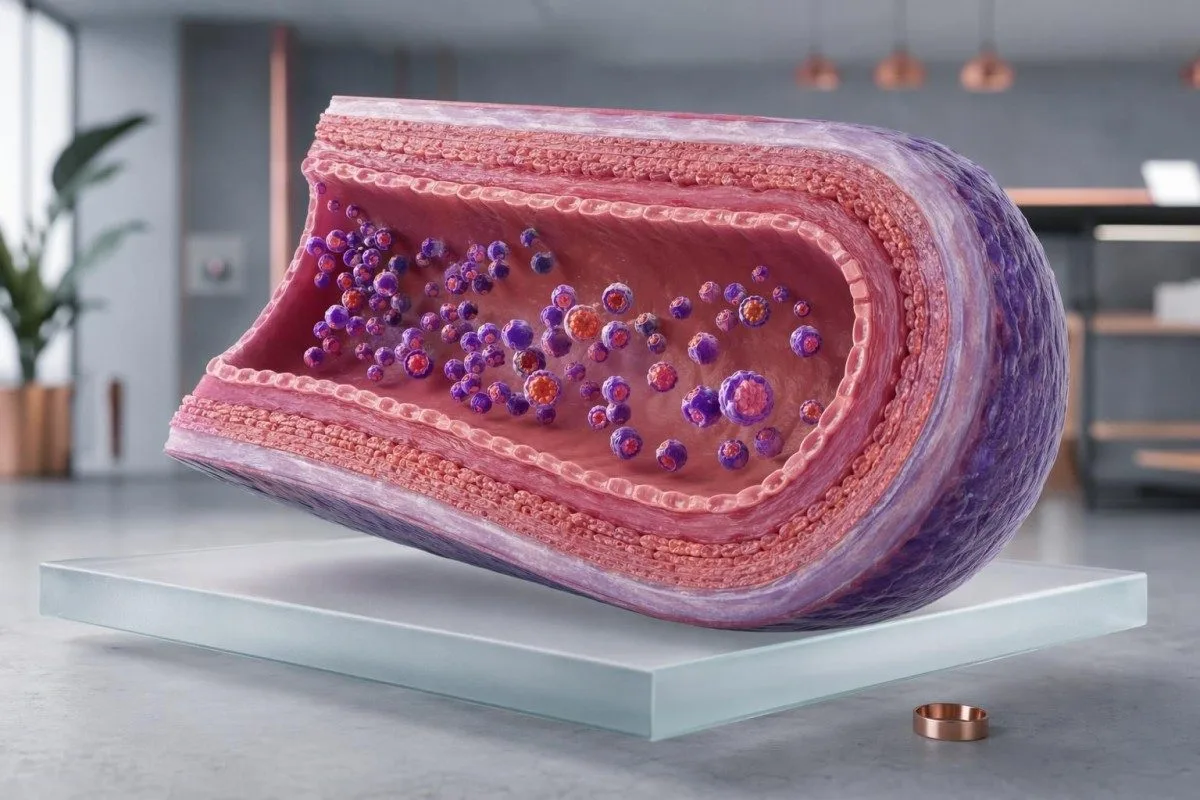
Les mesures standard du cholestérol LDL indiquent la quantité de cholestérol transportée à l’intérieur des particules de LDL. Le nombre de particules estime combien de « véhicules » athérogènes circulent sur la route — et cette différence peut avoir de l’importance.


- Nombre de particules de LDL estime le nombre de particules de LDL dans le sang, généralement rapporté comme LDL-P en nmol/L ; des valeurs inférieures à 1000 nmol/L sont souvent considérées comme présentant un risque plus faible.
- Le LDL-C peut sembler normal lorsque les particules de LDL sont petites et nombreuses, en particulier en cas de résistance à l’insuline, de triglycérides élevés, de HDL bas ou de prise de poids abdominale.
- Profil lipidique NMR est le test le plus courant qui rapporte le LDL-P, le petit LDL-P, les mesures des particules de HDL, et parfois un score de résistance à l’insuline.
- ApoB est un proche cousin du nombre de particules de LDL, car chaque particule de LDL, VLDL, IDL et Lp(a) transporte une protéine ApoB.
- La discordance compte. lorsque le LDL-C est inférieur à 100 mg/dL, mais que le LDL-P est supérieur à 1300 nmol/L, ou lorsque l’ApoB est plus élevée que prévu pour le LDL-C.
- Analyses avancées du bilan lipidique sont particulièrement utiles pour les personnes atteintes de diabète, de syndrome métabolique, de maladie cardiaque familiale prématurée, de Lp(a) élevé, de maladie rénale chronique, ou de calcifications coronaires inexpliquées.
- triglycérides au-dessus de 150 mg/dL et un HDL-C inférieur à 40 mg/dL chez les hommes ou inférieur à 50 mg/dL chez les femmes signalent souvent un LDL appauvri en cholestérol et riche en particules.
- Les objectifs de traitement varient: les recommandations américaines utilisent l’ApoB principalement comme facteur de risque renforçant, tandis que les recommandations européennes fournissent des objectifs d’ApoB, par exemple en dessous de 65 mg/dL pour les patients à très haut risque.
- Refaire un test est généralement le mieux après 8 à 12 semaines de régime, de médicaments, de poids et de statut thyroïdien stables ; le LDL-P peut évoluer de manière significative après une maladie ou une perte de poids importante.
- IA Kanséti peut interpréter le LDL-P en parallèle avec le LDL-C, l’ApoB, les triglycérides, l’HbA1c, la CRP ultrasensible (hs-CRP), les marqueurs rénaux, les enzymes hépatiques et les schémas de risque familial en environ 60 secondes.
Pourquoi un LDL-C « normal » peut quand même masquer un risque lié aux particules
Nombre de particules de LDL peut révéler un risque d’athérosclérose lorsque le LDL-C semble normal, car les artères sont exposées à des particules, pas seulement à la masse de cholestérol. Au 1er mai 2026, je demanderais un bilan lipidique avancé lorsque le LDL-C et le risque global ne concordent pas : diabète, triglycérides élevés, HDL bas, maladie cardiaque familiale prématurée, Lp(a) élevé, ou calcifications coronaires malgré un LDL-C acceptable.
Le LDL-C est le transporteur de cholestérol à l’intérieur des particules LDL, tandis que le nombre de particules LDL compte le nombre approximatif de véhicules LDL transportant cette cargaison. Deux personnes peuvent avoir toutes deux un LDL-C de 95 mg/dL, pourtant l’une peut transporter 850 particules LDL par équivalent microlitre et l’autre 1600 nmol/L en NMR, car chaque particule contient moins de cholestérol.
Je vois souvent ce schéma dans notre analyse des numérations formule sanguine de sang 2M+ : les triglycérides sont à 180 mg/dL, le HDL-C à 38 mg/dL, l’HbA1c à 5.8%, et le compte rendu du LDL-C indique proche de la normale. Lorsque ces indices se regroupent, IA Kanséti ils signalent une possible discordance entre le LDL-C et les particules plutôt que de traiter le chiffre du LDL-C comme rassurant.
La recommandation de l’AHA/ACC sur le cholestérol de 2018 reconnaît l’ApoB comme un facteur de risque renforçant, en particulier lorsque les triglycérides sont à 200 mg/dL ou plus (Grundy et al., 2019). C’est la raison pratique pour laquelle des patients ayant une fourchette de LDL normale peuvent quand même mériter une discussion lipidique plus approfondie.
Une façon simple de l’expliquer aux patients : le LDL-C estime le volume de trafic du cholestérol, mais le nombre de particules LDL estime combien de voitures continuent de percuter la paroi artérielle. Plus il y a de voitures, plus il y a d’occasions de rétention, d’oxydation, de réponse immunitaire et de formation de plaques.
Ce que mesure réellement le nombre de particules de LDL
Nombre de particules de LDL mesure le nombre de particules LDL qui circulent dans le plasma, généralement rapporté comme LDL-P en nmol/L. Le LDL-P n’est pas la même chose que le LDL-C, et il s’aligne souvent davantage avec l’ApoB qu’avec les valeurs standard du cholestérol.
Chaque particule LDL contient une protéine ApoB-100 enveloppée autour d’un noyau lipidique, donc ApoB est souvent utilisé comme substitut pratique du nombre de particules athérogènes. L’ApoB inclut le LDL, les IDL, les remnants de VLDL et le Lp(a), tandis que le LDL-P se concentre spécifiquement sur les particules LDL mesurées par des méthodes de taille des particules.
En consultation, j’explique généralement l’ApoB comme le compte plus large et le LDL-P comme le compte spécifique au LDL. Si un patient a une ApoB à 115 mg/dL avec un LDL-C à 92 mg/dL, je ne dis pas que le risque est normal ; je recherche une résistance à l’insuline, le cholestérol des remnants, un dysfonctionnement thyroïdien, une maladie rénale, ou un Lp(a) élevé.
Le ApoB bilan sanguin is souvent plus facile à prescrire que le LDL-P dans de nombreux pays, et il bénéficie d’un fort soutien des recommandations. Le LDL-P peut toutefois apporter une valeur ajoutée lorsque le laboratoire propose déjà un profil lipidique par RMN ou lorsque la taille des LDL et les petits LDL-P sont pertinents sur le plan clinique.
Otvos et ses collègues ont rapporté dans le *Journal of Clinical Lipidology* que, lorsque le LDL-C et le LDL-P étaient discordants, le risque cardiovasculaire suivait davantage le LDL-P que le LDL-C dans des données de cohorte multiethniques (Otvos et al., 2011). Cette observation correspond à mon expérience au quotidien : la discordance est là que se trouve l’information utile.
Comment un profil lipidique NMR rapporte le LDL-P
Un Profil lipidique NMR rapporte le nombre de particules de LDL en utilisant des signaux de résonance magnétique nucléaire provenant des particules de lipoprotéines. La plupart des comptes rendus incluent le LDL-P total, les petits LDL-P, la taille des LDL, les mesures des particules HDL, les triglycérides et le LDL-C calculé.
Le test par RMN ne compte pas les particules une par une comme des billes au microscope. Il détecte des signaux caractéristiques de groupes méthyle provenant des particules lipidiques, puis utilise des algorithmes validés pour estimer les concentrations de particules en nmol/L.
Un compte rendu typique peut classer le LDL-P en dessous de 1000 nmol/L comme faible, 1000-1299 nmol/L comme modéré, 1300-1599 nmol/L comme limite-haut, 1600-2000 nmol/L comme élevé, et au-dessus de 2000 nmol/L comme très élevé. Ces catégories sont des marqueurs de risque, pas des diagnostics automatiques.
Lorsque je passe en revue une bilan lipidique avancé, je prête attention à savoir si la taille des LDL est petite, moyenne ou grande uniquement après avoir vérifié la charge totale en particules. Un petit LDL n’est pas inoffensif, mais un nombre très élevé de n’importe quelles particules athérogènes est le problème principal.
Le point clé est que les plateformes de RMN et les intervalles de référence ne sont pas identiques d’un laboratoire à l’autre. Certains laboratoires européens privilégient un compte rendu en ApoB, tandis que de nombreux laboratoires spécialisés aux États-Unis proposent le LDL-P ; les patients devraient comparer les tendances au sein du même laboratoire autant que possible.
Les intervalles de référence et les seuils de discordance qui comptent
Un LDL-P inférieur à 1000 nmol/L est généralement considéré comme un nombre de particules à plus faible risque, tandis qu’un LDL-P supérieur à 1600 nmol/L suggère le plus souvent une charge accrue en particules athérogènes. La discordance est significative sur le plan clinique lorsque le LDL-C est acceptable mais que le LDL-P, l’ApoB ou le non-HDL-C reste élevé.
Un LDL-C inférieur à 100 mg/dL est souvent appelé quasi optimal pour les adultes à risque moyen, mais cette étiquette peut induire en erreur un patient ayant un LDL-P de 1700 nmol/L. Dans les états riches en particules, chaque particule de LDL transporte moins de cholestérol, de sorte que le LDL-C sous-estime le nombre de particules orientées vers les artères.
Les triglycérides aident à mettre en évidence l’inadéquation. Un taux de triglycérides au-dessus de 150 mg/dL pointe souvent vers un excès de VLDL et des particules de LDL plus petites, appauvries en cholestérol, c’est pourquoi j’associe l’interprétation du LDL-P avec le intervalle des triglycérides plutôt que de le lire seul.
Un schéma pratique de discordance est : LDL-C inférieur à 100 mg/dL avec ApoB supérieur à 90 mg/dL chez un patient à risque modéré, ou ApoB supérieur à 80 mg/dL chez un patient à risque élevé. Les patients à très haut risque, comme ceux ayant une maladie coronarienne connue, ont souvent besoin d’objectifs encore plus bas liés aux particules.
Le profil métabolique qui entraîne un LDL-P élevé
Un LDL-P élevé avec un LDL-C normal apparaît le plus souvent en cas de résistance à l’insuline, de syndrome métabolique, de diabète de type 2, de physiologie du foie gras et d’états associés à des triglycérides élevés. Le schéma est généralement : triglycérides élevés, HDL-C bas, LDL-C d’apparence normale et, de façon inattendue, un nombre de particules élevé.
Un cadre de 48 ans avec un LDL-C de 101 mg/dL peut se sentir rassuré jusqu’à ce que le reste du bilan montre des triglycérides à 212 mg/dL, un HDL-C à 36 mg/dL, une insuline à jeun à 18 µIU/mL et un LDL-P à 1780 nmol/L. Ce n’est pas seulement un problème de cholestérol ; c’est un problème de “trafic” métabolique.
La résistance à l’insuline augmente la production hépatique de VLDL, et l’échange VLDL-triglycérides peut laisser des particules de LDL plus petites et plus nombreuses. Une insuline à jeun au-dessus d’environ 15 µIU/mL ou un HOMA-IR au-dessus de 2,0-2,5 soutient souvent ce mécanisme, bien que les seuils varient selon l’analyse et la population.
Si cela ressemble à votre profil, le Le LDL est encore le paramètre le plus souvent traité vaut la peine d’être lu avant de supposer que la réponse est uniquement un statine plus forte. D’après mon expérience, le tour de taille, l’horaire du sommeil, les enzymes hépatiques et la glycémie post-repas expliquent souvent pourquoi le LDL-P est élevé malgré un LDL-C moyen.
L’HbA1c peut prendre du retard par rapport aux changements des particules. J’ai vu le LDL-P s’améliorer de 300 à 500 nmol/L après 12 semaines d’une baisse de l’apport en glucides raffinés et d’un entraînement en résistance, tandis que l’HbA1c ne passait que de 5,8% à 5,6%.
Qui devrait demander un bilan lipidique avancé
Les patients devraient demander des informations sur un bilan lipidique avancé lorsque le LDL-C standard ne correspond pas au risque personnel. Les groupes les plus pertinents sont les personnes ayant une maladie cardiaque familiale prématurée, un diabète, un syndrome métabolique, des triglycérides élevés, un HDL bas, un Lp(a) élevé, une maladie rénale chronique ou un calcium coronaire.
Je suis plus susceptible de recommander le LDL-P ou l’ApoB pour un homme de 42 ans dont le père a eu une pose de stent à 49 ans, plutôt que pour un athlète de 24 ans avec un LDL-C de 88 mg/dL, des triglycérides de 55 mg/dL, un HDL-C de 72 mg/dL et aucun antécédent familial. La probabilité avant le test compte.
Un Lp(a) élevé change la discussion, car les particules de Lp(a) portent aussi l’ApoB et peuvent augmenter la charge mesurée de particules athérogènes. Si votre Lp(a) est au-dessus de 50 mg/dL ou au-dessus de 125 nmol/L, consultez notre guide de risque Lp(a) et demandez à votre clinicien comment cela influence les objectifs.
Un bilan lipidique avancé est aussi raisonnable lorsque le score de calcium des artères coronaires est supérieur à 0 avant 45 ans chez les hommes ou avant 55 ans chez les femmes, même si le LDL-C semble ordinaire. Un score CAC de 100 ou plus me pousse généralement à traiter le risque de manière plus affirmée.
Tout le monde n’a pas besoin d’un test NMR. Si le LDL-C est de 190 mg/dL ou plus, le résultat signale déjà une hypercholestérolémie sévère ; attendre le LDL-P avant d’agir peut retarder la prise en charge.
Comment les recommandations utilisent ApoB versus LDL-P
Les grandes recommandations utilisent l’ApoB de façon plus explicite que le LDL-P, car l’ApoB est standardisée, largement disponible et représente toutes les particules athérogènes. Le LDL-P reste utile sur le plan clinique, mais il est moins souvent intégré aux objectifs de traitement.
La recommandation AHA/ACC indique un ApoB de 130 mg/dL ou plus comme facteur d’intensification du risque, en particulier lorsque les triglycérides sont de 200 mg/dL ou plus (Grundy et al., 2019). Ce seuil d’ApoB correspond approximativement à une charge élevée en particules, et pas seulement à une masse de cholestérol élevée.
La recommandation 2019 de l’ESC/EAS sur les dyslipidémies donne des objectifs de traitement pour l’ApoB : en dessous de 65 mg/dL pour les patients à très haut risque, en dessous de 80 mg/dL pour les patients à haut risque, et en dessous de 100 mg/dL pour les patients à risque modéré (Mach et al., 2020). Ces objectifs sont plus stricts que ce que beaucoup de patients s’attendent à voir lorsque leur LDL-C ne paraît que légèrement anormal.
Les objectifs de LDL-P sont souvent utilisés par les laboratoires et les cliniques lipidiques, mais les cliniciens ne s’accordent pas sur la manière exacte de traiter de façon plus ou moins agressive un LDL-P limite de 1350 nmol/L chez une personne à faible risque. C’est l’un de ces domaines où le contexte compte plus que le chiffre.
Pour une vue plus large des lipides standard avant les marqueurs avancés, je dirige généralement les patients vers notre guide de la fourchette de cholestérol. Un cholestérol total normal n’annule pas un résultat élevé d’ApoB ou de LDL-P.
Comment Kantesti interprète le risque de particules dans son contexte
L’IA Kantesti interprète le nombre de particules de LDL en vérifiant si le LDL-P s’intègre au reste du tableau métabolique, inflammatoire, rénal, thyroïdien, hépatique et du risque familial. Notre plateforme ne traite pas une seule valeur lipidique avancée comme un diagnostic.
Lorsque je, Thomas Klein, MD, examine un résultat de LDL-P, je pose quelques questions directes : le patient est-il résistant à l’insuline ? Les triglycérides sont-ils supérieurs à 150 mg/dL ? L’ApoB est-il élevé ? La TSH est-elle anormale ? Les taux d’ALT et de GGT suggèrent-ils une physiologie de stéatose hépatique ?
Le réseau neuronal de Kantesti compare le LDL-P à plus de 15 000 biomarqueurs et a appris des relations de profils de laboratoire à partir de données mondiales anonymisées. Notre normes de validation médicale décrit comment la revue clinique, les cas de référence et les contraintes de sécurité façonnent notre logique d’interprétation.
Un schéma utile est un LDL-P de 1650 nmol/L, une hs-CRP de 0,4 mg/L, des triglycérides de 85 mg/dL, un HDL-C de 66 mg/dL et un ApoB de 82 mg/dL. Cette combinaison ne signifie pas la même chose qu’un LDL-P de 1650 nmol/L avec une hs-CRP de 4,2 mg/L, des triglycérides de 240 mg/dL et un HbA1c de 6,3%.
Pour les lecteurs qui souhaitent la couche de validation technique, l’évaluation de référence du moteur d’IA Kantesti est publiée sous forme d’évaluation à l’échelle de la population, pré-enregistrée, avec des cas pièges de surdiagnostic à données de validation clinique. Je préfère ce niveau d’examen pour l’interprétation des analyses YMYL.
Que faire si le LDL-P est élevé mais que le LDL-C est normal
Si le LDL-P est élevé alors que le LDL-C est normal, la prochaine étape n’est pas la panique : c’est la stratification du risque. Confirmez le résultat, vérifiez l’ApoB ou le non-HDL-C, recherchez les facteurs métaboliques, puis décidez de l’intensité du traitement en fonction du risque cardiovasculaire absolu.
Un LDL-P unique de 1450 nmol/L chez un homme de 35 ans à faible risque n’est pas la même situation que le même LDL-P chez un fumeur de 61 ans atteint d’hypertension et présentant un calcium coronaire. Le chiffre lance la conversation ; il ne la termine pas.
Je veux généralement l’ApoB, le non-HDL-C, les triglycérides, le HDL-C, le HbA1c, la glycémie à jeun, la TSH, la créatinine/le eGFR, l’ALT, et parfois le rapport albumine/créatinine urinaire. En cas de douleur thoracique, de pression à l’effort ou d’essoufflement nouveau, la discussion du laboratoire doit s’interrompre et l’évaluation clinique urgente doit passer en premier.
Les choix de médicaments dépendent de la catégorie de risque et du jugement du clinicien. Les statines peuvent réduire le LDL-C de 30-50% à intensité modérée à élevée, mais l’ApoB et le LDL-P restent parfois plus élevés que prévu, c’est pourquoi le suivi par des tests est important.
Pour les personnes qui cherchent à comprendre quels bilans cardiaques prédisent réellement des événements, notre guide des marqueurs cardiaques compare les lipides, l’ApoB, la hs-CRP, la troponine, la BNP et les marqueurs de glucose sans prétendre que tout répond à la même question.
Les biomarqueurs de l’athérosclérose qui complètent le tableau
Biomarkers de l’athérosclérose qui ajoutent du contexte au nombre de particules de LDL incluent l’ApoB, le non-HDL-C, le Lp(a), la hs-CRP, le HbA1c, l’insuline à jeun, le rapport albumine/créatinine urinaire et le calcium des artères coronaires. Aucun test sanguin unique ne mesure entièrement la charge de plaque.
L’ApoB nous indique la charge en particules, le Lp(a) le risque héréditaire en particules, la hs-CRP le ton inflammatoire, et le HbA1c l’exposition à la glycation. Le calcium coronaire, lorsqu’il est utilisé correctement, montre la plaque calcifiée déjà présente dans la paroi de l’artère.
Une hs-CRP inférieure à 1 mg/L est souvent considérée comme un risque cardiovasculaire inflammatoire plus faible, 1–3 mg/L comme un risque moyen, et au-delà de 3 mg/L un risque plus élevé si une infection ou une blessure n’est pas présente. Notre comparaison hs-CRP explique pourquoi une CRP régulière et une CRP ultrasensible ne sont pas interchangeables.
Je suis prudent avec les marqueurs inflammatoires pendant une maladie. Un patient avec un LDL-P de 1250 nmol/L et une hs-CRP de 9 mg/L deux jours après une grippe ne présente pas la même interprétation vasculaire que quelqu’un avec une hs-CRP de 4 mg/L sur trois tests stables.
Un rapport albumine/créatinine urinaire supérieur à 30 mg/g peut signaler un stress microvasculaire endothélial et rénal, en particulier en cas de diabète ou d’hypertension. Dans ce contexte, un LDL-P modestement élevé peut avoir un poids pratique plus important que dans le cas d’un athlète d’endurance par ailleurs en bonne santé.
Les changements de mode de vie qui peuvent réduire la charge de particules
Le mode de vie peut réduire le nombre de particules LDL lorsque le facteur en cause est une résistance à l’insuline, des triglycérides élevés, un excès de graisse viscérale ou une faible condition physique. Les plus grands changements de taille de particules proviennent généralement d’une perte de poids de 5-10%, d’une baisse des glucides raffinés, d’une hausse des fibres solubles et d’un entraînement régulier en résistance plus cardio.
Les fibres solubles, autour de 5 à 10 g/jour, provenant d’avoine, de légumineuses, de psyllium, de chia ou de légumes peuvent faire baisser modestement le LDL-C et peuvent améliorer l’ApoB chez certains patients. Je commence généralement par l’alimentation, puis j’envisage le psyllium si le patient tolère les ballonnements pendant les 1 à 2 premières semaines.
Le LDL-P porté par les triglycérides répond souvent à la réduction des boissons sucrées, des céréales raffinées, des grignotages de fin de soirée et d’un excès d’alcool. Pour les profils de stéatose hépatique, le guide d’alimentation pour le foie gras est plus pertinent qu’une fiche générique de régime pauvre en graisses.
La dose d’exercice compte. Un objectif pratique est de 150 à 300 minutes par semaine d’activité aérobie modérée plus 2 à 3 séances de renforcement, mais j’ai vu des marqueurs de particules s’améliorer avec seulement des marches de 20 minutes après le repas, après le plus gros repas.
Il existe une variabilité honnête. Certains patients minces ayant génétiquement une ApoB élevée ou une hypercholestérolémie familiale ont besoin de médicaments même avec une excellente alimentation, tandis que de nombreux patients résistants à l’insuline peuvent faire bouger le LDL-P de façon substantielle en changeant l’environnement métabolique.
Refaire le test et la variabilité du laboratoire
Le LDL-P devrait généralement être recontrôlé après 8 à 12 semaines si le traitement, le poids, l’alimentation, le statut thyroïdien ou une maladie a récemment changé. Comparer le LDL-P entre différentes plateformes NMR ou pendant une maladie aiguë peut créer des récits de tendance trompeurs.
Une infection virale, un déficit calorique majeur, la grossesse, un changement de traitement thyroïdien ou une perte de poids rapide peuvent fausser les valeurs lipidiques pendant plusieurs semaines. Je prends rarement une décision de risque permanente à partir d’un seul bilan lipidique avancé recueilli à un moment physiologique confus.
Le jeûne n’est pas toujours requis pour le cholestérol standard, mais il peut aider lorsque les triglycérides, le cholestérol des remanents et la discordance du LDL-P sont les principales questions. Notre guide cholestérol sans jeûne explique quand un repas avant le test compte encore et quand cela brouille les résultats.
Kantesti peut faire évoluer le LDL-C, l’ApoB, le LDL-P, les triglycérides et le HDL-C au fil des téléversements, mais notre IA signale encore les changements majeurs de méthode de laboratoire comme une mise en garde. Une différence de 12% de LDL-P peut être du bruit ; une réduction persistante de 35-50% après le traitement est généralement cliniquement significative.
Conservez le PDF. Les portails de laboratoire changent, les intervalles de référence se mettent à jour et les patients oublient s’ils ont utilisé le même laboratoire ; conserver le rapport original évite une quantité surprenante de confusion clinique.
Questions à apporter à votre clinicien
Les meilleures questions sur le nombre de particules LDL sont spécifiques, axées sur le risque et liées à l’action. Demandez si le LDL-P change votre catégorie de risque, si l’ApoB suffirait et quelle cible de traitement correspond à votre âge, vos antécédents et vos résultats d’imagerie.
J’aime que les patients apportent cinq chiffres : LDL-C, non-HDL-C, triglycérides, HDL-C et ApoB ou LDL-P. Si vous avez aussi Lp(a), HbA1c, la tension artérielle, le statut tabagique et les antécédents familiaux, la consultation devient beaucoup plus productive.
Les questions utiles incluent : Mon LDL-P est-il discordant avec mon LDL-C ? Faut-il confirmer avec l’ApoB ? Mes triglycérides suggèrent-ils une résistance à l’insuline ? L’imagerie du calcium coronaire changerait-elle le traitement ? Quelle cible faut-il recontrôler dans 8 à 12 semaines ?
Vous pouvez téléverser votre bilan lipidique essayer une analyse gratuite par IA avant le rendez-vous et apporter l’interprétation à votre clinicien. Kantesti ne remplace pas les soins médicaux, mais cela aide les patients à repérer le schéma exact qu’ils doivent discuter.
Si un résultat indique que le LDL-P est élevé, n’arrivez pas en demandant uniquement un nom de médicament. Arrivez en demandant ce qui a causé le nombre élevé de particules, comment le risque a été estimé et comment le succès sera mesuré.
Signaux d’alerte et quand le LDL-P ne suffit pas
Le LDL-P ne suffit pas lorsqu’il existe des symptômes, un LDL-C très élevé, des troubles lipidiques héréditaires, une maladie rénale, une maladie thyroïdienne, une physiologie de grossesse ou des marqueurs cardiaques anormaux. Dans ces cas, le LDL-P n’est qu’un élément d’une évaluation médicale plus large.
Consultez en urgence en cas de pression thoracique, malaise avec perte de connaissance, essoufflement sévère, nouveaux symptômes neurologiques, ou douleur irradiant vers la mâchoire ou le bras gauche. Un LDL-P normal n’exclut jamais un syndrome coronarien aigu, et une tendance de troponine est le test pertinent à ce moment-là.
Le cholestérol LDL-C à 190 mg/dL ou plus suggère une hypercholestérolémie primaire sévère jusqu’à preuve du contraire, même avant le retour du LDL-P. Les xanthomes tendineux, l’arc cornéen avant 45 ans, ou plusieurs parents présentant des événements précoces devraient déclencher une évaluation lipidique héréditaire.
Les causes secondaires sont fréquentes. L’hypothyroïdie, les pertes protéiques de type néphrotique, les maladies hépatiques cholestatiques, le diabète non contrôlé, certains médicaments et la transition ménopausique peuvent tous modifier le LDL-C, l’ApoB et le LDL-P dans des directions différentes.
Si la fonction rénale fait partie de votre profil de risque, comparez les tests de particules avec le guide d’âge du eGFR. La maladie rénale chronique peut augmenter le risque cardiovasculaire même lorsque le LDL-C ne semble pas inquiétant.
Publications de recherche Kantesti et revue médicale
Le contenu médical de Kantesti est revu selon des standards cliniques, des preuves issues des recommandations et des contrôles de sécurité des schémas de laboratoire observés dans le monde réel. Thomas Klein, MD, et nos évaluateurs médecins traitent l’interprétation avancée des lipides comme une communication du risque, et non comme un diagnostic automatisé.
Notre Conseil consultatif médical explique comment nous abordons des sujets YMYL tels que le nombre de particules de LDL, l’ApoB et les biomarqueurs de l’athérosclérose. Je préfère une incertitude transparente : le LDL-P est utile en cas de discordance, mais l’ApoB repose sur des bases plus solides dans les recommandations internationales.
Kantesti LTD est une entreprise de healthtech britannique qui développe une analyse de sang par IA pour l’interprétation des résultats de prise de sang, destinée aux patients et aux cliniciens dans 127+ pays. Vous pouvez en savoir plus sur l’organisation, les certifications et la gouvernance clinique sur À propos de Kantesti.
Klein, T., & Kantesti Medical Research Group. (2026). Plage normale de l’aPTT : guide de la D-dimère et de la coagulation du sang par la protéine C. Zenodo. https://doi.org/10.5281/zenodo.18262555. Lien ResearchGate : Recherche de publications sur ResearchGate. Lien Academia.edu : Recherche de publications sur Academia.
Klein, T., & Kantesti Medical Research Group. (2026). Guide des protéines sériques : globulines, albumine et test sanguin du rapport A/G. Zenodo. https://doi.org/10.5281/zenodo.18316300. Lien ResearchGate : Recherche de publications sur ResearchGate. Lien Academia.edu : Recherche de publications sur Academia.
Questions fréquemment posées
Quel est un bon nombre de particules LDL ?
Un nombre de particules LDL couramment utilisé et présentant un risque plus faible est inférieur à 1000 nmol/L sur un profil lipidique NMR. Un LDL-P compris entre 1000 et 1299 nmol/L est souvent considéré comme modéré, entre 1300 et 1599 nmol/L comme limite élevé, entre 1600 et 2000 nmol/L comme élevé, et au-delà de 2000 nmol/L comme très élevé. Ces fourchettes doivent être interprétées en tenant compte du LDL-C, de l’ApoB, des triglycérides, du HDL-C, du statut diabétique, de la tension artérielle, du tabagisme, des antécédents familiaux de santé et du calcium coronaire si disponible.
Le cholestérol LDL (LDL-C) peut-il être normal, mais le nombre de particules LDL élevé ?
Oui, le LDL-C peut être normal tandis que le nombre de particules de LDL est élevé lorsque les particules de LDL sont petites et transportent moins de cholestérol par particule. Ce schéma est courant en cas de résistance à l’insuline, de triglycérides au-dessus de 150 mg/dL, de faible HDL-C, de physiologie du foie gras, de diabète de type 2 et de certains profils lipidiques héréditaires. Un patient ayant un LDL-C de 95 mg/dL et un LDL-P de 1700 nmol/L peut avoir une exposition aux particules plus athérogènes que ce que suggère le LDL-C seul.
L’ApoB est-elle meilleure que le nombre de particules LDL ?
L’ApoB est souvent plus pratique que le nombre de particules LDL, car elle est standardisée, largement disponible et soutenue par les principales recommandations. Chaque particule athérogène transporte généralement une protéine ApoB ; ainsi, l’ApoB estime le nombre total de particules LDL, IDL, VLDL remnant et Lp(a). Le LDL-P peut toutefois rester utile lorsqu’un profil lipidique par RMN (NMR) est disponible, en particulier pour les schémas de discordance impliquant de petites particules LDL.
Quand devrais-je demander un profil lipidique par RMN ?
Vous devriez demander un profil lipidique par RMN (NMR) lorsque le LDL-C standard ne correspond pas à votre risque clinique. Les raisons les plus fréquentes et les plus utiles incluent des triglycérides supérieurs à 150-200 mg/dL, un HDL-C inférieur à 40 mg/dL chez l’homme ou inférieur à 50 mg/dL chez la femme, le diabète, le syndrome métabolique, un taux élevé de Lp(a), une maladie cardiaque familiale précoce, une maladie rénale chronique, ou une calcification coronaire malgré un LDL-C normal. Si le LDL-C est déjà de 190 mg/dL ou plus, les décisions de traitement ne devraient généralement pas attendre un test par RMN.
La réduction du nombre de particules LDL réduit-elle le risque cardiaque ?
La réduction de la charge de particules athérogènes est fortement associée à un risque cardiovasculaire plus faible, bien que la plupart des essais sur les résultats utilisent les effets du traitement liés au LDL-C et à l’ApoB plutôt qu’au LDL-P seul. Les statines, l’ézétimibe, les thérapies ciblant la PCSK9, la perte de poids, l’amélioration de la résistance à l’insuline et la baisse des triglycérides peuvent réduire la charge de particules à des degrés variables. L’objectif le plus sûr est de réduire le LDL-P ou l’ApoB d’une manière adaptée au risque absolu du patient et à sa tolérance au traitement.
Le régime alimentaire peut-il réduire le nombre de particules LDL ?
L’alimentation peut réduire le nombre de particules de LDL lorsque le principal facteur est la résistance à l’insuline, des triglycérides élevés ou un excès de graisse viscérale. Une perte de poids de 5-10%, 5 à 10 g par jour de fibres solubles, moins de glucides raffinés et la réduction des boissons sucrées peuvent améliorer le LDL-P dans de nombreux profils métaboliques. Les personnes atteintes d’hypercholestérolémie familiale ou présentant génétiquement un ApoB élevé peuvent avoir besoin d’un traitement médicamenteux même avec une alimentation excellente.
À quelle fréquence faut-il répéter le LDL-P ?
Le LDL-P est généralement répété après 8 à 12 semaines lorsqu’un médicament, un régime, le poids, l’état thyroïdien ou le plan d’exercice a changé. Faire le test plus tôt peut être trompeur, car les lipoprotéines se modifient pendant une maladie, lors d’une perte de poids rapide, pendant la grossesse ou en cas de restriction calorique importante. Pour le suivi à long terme, les tendances issues de la même méthode de laboratoire sont plus fiables que la comparaison de résultats ponctuels provenant de plateformes différentes.
Une hypothyroïdie peut-elle augmenter le nombre de particules LDL ?
Oui. L'hypothyroïdie peut augmenter le LDL-C, le non-HDL-C, l'ApoB, et souvent la charge particulaire en ralentissant la clairance des particules athérogènes. Si des symptômes thyroïdiens ou une TSH anormale sont présents, le traitement et la stabilisation de la maladie thyroïdienne avant un nouveau test peuvent clarifier votre risque lipidique de base.
Faut-il être à jeun avant un test LDL-P ou ApoB ?
Souvent non ; l’ApoB et le LDL-P peuvent généralement être mesurés sur un échantillon non à jeun. Un jeûne de 9 à 12 heures peut être demandé si les triglycérides étaient élevés, si les résultats étaient à la limite, ou si votre clinicien souhaite la comparaison la plus fiable avec des tests précédents réalisés à jeun.
Un régime très pauvre en glucides ou cétogène peut-il augmenter le nombre de particules de LDL ?
Oui, certaines personnes constatent une hausse du LDL-C, de l’ApoB ou du LDL-P après avoir commencé un régime très pauvre en glucides, surtout en cas de perte de poids rapide ou d’apport élevé en graisses saturées. Recontrôlez une fois le poids stabilisé et demandez s’il faut remplacer le beurre, l’huile de coco et les viandes grasses par de l’huile d’olive, des noix, du poisson et davantage de fibres solubles.
Obtenez dès aujourd’hui une analyse de sang par IA
Rejoignez plus de 2 millions d’utilisateurs dans le monde qui font confiance à Kantesti pour une analyse instantanée et précise des analyses de laboratoire. Téléversez vos résultats prise de sang et recevez une interprétation complète des biomarqueurs de 15,000+ en quelques secondes.
📚 Publications de recherche citées
Klein, T., Mitchell, S., & Weber, H. (2026). Valeurs normales du TCA : D-dimères, protéine C – Guide de coagulation sanguine. Recherche médicale par IA Kantesti.
Klein, T., Mitchell, S., & Weber, H. (2026). Guide des protéines sériques : Analyse sanguine des globulines, de l’albumine et du rapport albumine/globuline (A/G).. Recherche médicale par IA Kantesti.
📖 Références médicales externes
Lignes directrices 2019 de l’ESC/EAS pour la prise en charge des dyslipidémies : modification des lipides pour réduire le risque cardiovasculaire. Lignes directrices ESC/EAS 2019 pour la prise en charge des dyslipidémies : modification des lipides pour réduire le risque cardiovasculaire. European Heart Journal.
⚕️ Avertissement médical
Cet article est fourni à des fins éducatives uniquement et ne constitue pas un avis médical. Consultez toujours un professionnel de santé qualifié pour les décisions de diagnostic et de traitement.
Signaux de confiance E-E-A-T
Expérience
Revue clinique guidée par un médecin des flux d’interprétation des analyses.
Compétence
Orientation en médecine de laboratoire sur la façon dont les biomarqueurs se comportent dans un contexte clinique.
autorité
Rédigé par le Dr Thomas Klein, avec relecture par le Dr Sarah Mitchell et le Prof. Dr Hans Weber.
Fiabilité
Interprétation fondée sur des preuves, avec des parcours de suivi clairs pour réduire l’alarme.