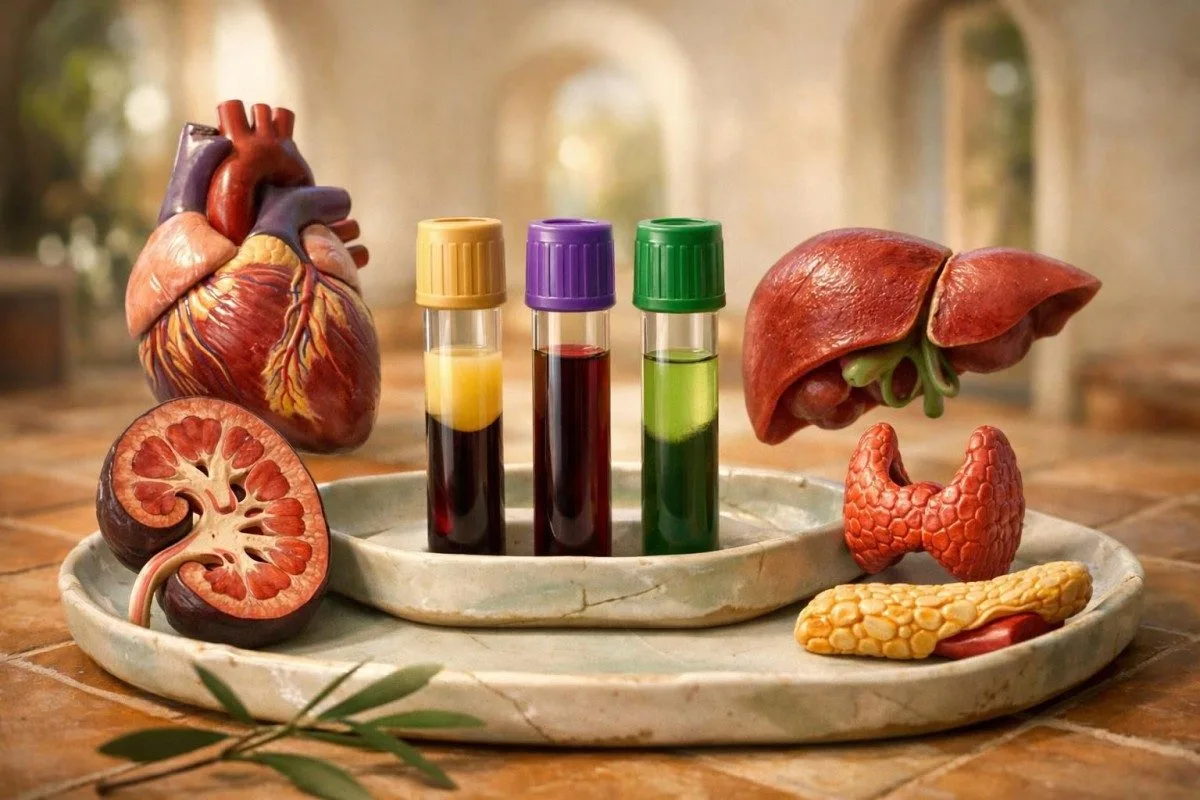
Premium screening can be useful, but only if you know which labs actually change care. This is the practical breakdown I give patients when they are deciding whether a high-end panel is worth paying for.


- CBC can flag anemia, infection patterns, or platelet issues, but it often misses iron deficiency unless ferritin is added.
- HbA1c below 5.7% is the usual non-diabetic range; 5.7-6.4% suggests prediabetes, and 6.5% or higher supports diabetes on repeat testing.
- Lp(a) above 50 mg/dL or 125 nmol/L signals higher lifetime cardiovascular risk and usually only needs to be measured once.
- hs-CRP under 1 mg/L suggests lower cardiovascular risk, while values above 3 mg/L warrant context if there is no acute infection.
- Ferritin below 30 ng/mL often means depleted iron stores even when hemoglobin is still normal.
- eGFR below 60 mL/min/1.73 m² for at least 3 months supports chronic kidney disease, not just a one-day lab blip.
- Best candidates for an executive health panel are adults over 40, people with family history, cardiometabolic risk, or years of deferred routine care.
- Big miss these panels do not replace colon cancer screening, sleep apnea evaluation, skin exams, blood pressure monitoring, or coronary calcium scoring.
Who should consider an executive health panel in 2026?
An executive health panel usually includes a CBC, comprehensive metabolic panel, lipid panel, HbA1c or fasting glucose, thyroid testing, and often urinalysis. Better packages add ApoB, Lp(a), hs-CRP, ferritin, B12, and age-appropriate markers such as PSA. I'm Thomas Klein, MD, and as of April 9, 2026, I recommend it most often for adults over 40, people with strong family history, and busy professionals who have gone years without routine care. If you want rapid context for existing labs, Kantesti AI can interpret them, but compare it first with a plain standard blood test.
The phrase full body blood test sounds broader than it is. Even a premium panel cannot diagnose sleep apnea, replace colon screening, or tell you whether a coronary artery calcium score is 0 or 400; that is why the smartest buyers look at gaps, not just extras.
I see this pattern often. A 46-year-old founder feels fine, runs twice a week, and assumes he is low risk, yet his panel shows LDL-C 148 mg/dL, ApoB 117 mg/dL, HbA1c 6.0%, and ALT 49 U/L—numbers that matter because they cluster, not because any single value looks dramatic. At our organization, we review lab patterns from users in 127+ countries, and this clustering problem is one of the commonest reasons routine care gets missed.
The bad fit is the 29-year-old with a recent normal physical, stable weight, normal blood pressure, no family history, and labs done 8 weeks ago. In that setting, an expensive wellness blood test often creates more false alarms than useful action.
Which tests are usually in an executive health panel?
A real executive health panel nearly always includes CBC, CMP, lipids, glucose control markers, renal function, liver enzymes, and TSH. Many premium programs also include urinalysis and urine albumin-creatinine ratio, although that last piece is missing more often than patients realize; our blood biomarker library shows how wide the menu can get across 15,000+ supported markers.
For cardiometabolic risk, the minimum useful set is total cholesterol, LDL-C, HDL-C, triglycerides, fasting glucose, and HbA1c. Fasting glucose of 70-99 mg/dL is the usual reference range, 100-125 mg/dL supports impaired fasting glucose, and 126 mg/dL or higher on repeat testing supports diabetes; our deep dives on the lipid panel and HbA1c cutoffs explain how these numbers move together.
A CBC tells you whether hemoglobin, white cells, or platelets are off, but it does not tell you why. I still see iron deficiency missed when hemoglobin is 13.2 g/dL and the only clue is a low-normal MCV with fatigue—without ferritin, a glossy preventive blood test can look deceptively normal.
The CMP covers sodium, potassium, bicarbonate, glucose, calcium, albumin, bilirubin, alkaline phosphatase, AST, ALT, BUN, and creatinine. In our analysis of more than 2 million uploaded reports at Kantesti, missing ferritin or urine albumin is one of the commonest reasons a seemingly normal panel misses early disease.
What extra tests separate a basic package from a real wellness blood test?
The add-ons that separate a serious program from a dressed-up preventive blood test are ApoB, Lp(a), hs-CRP, fasting insulin, ferritin, B12, and sometimes vitamin D. If the package skips particle-related cholesterol or inflammation, it may still be useful, but it is not giving you the whole cardiovascular picture; start with hs-CRP interpretation.
Here is a rule I use in clinic: Lp(a) above 50 mg/dL or 125 nmol/L counts as elevated lifetime cardiovascular risk, and most people only need it measured once. The 2019 ACC/AHA prevention framework kept Lp(a) in risk assessment for exactly this reason—it changes the conversation even when standard LDL looks ordinary.
Insulin resistance often appears before glucose crosses the diabetes line. A fasting insulin of 10-12 μIU/mL with normal glucose can still be metabolically noisy, and pairing it with a HOMA-IR calculation often explains why triglycerides are 210 mg/dL even when LDL looks respectable.
Iron status is another blind spot. Ferritin below 30 ng/mL often means depleted iron stores even before anemia develops, and values above 300 ng/mL in men or 200 ng/mL in women deserve context because inflammation, fatty liver, alcohol, and iron overload can all push ferritin up; our ferritin guide goes through the usual traps.
Fancy extras that sound impressive but rarely change care
I am cautious with blanket cortisol panels, reverse T3, and broad tumor-marker bundles in people without symptoms. They can be reasonable in selected cases, but in most executive packages they add drama faster than they add diagnosis.
Which organ-system markers matter most when you read the report?
The organ-system markers that matter most are liver enzymes, kidney markers, and thyroid tests, because they are often mildly abnormal and easy to overread. A single out-of-range value is rarely the whole story, which is why I still send patients to our liver enzyme pattern guide before anyone panics.
For kidney function, creatinine must be read beside eGFR and, ideally, urine albumin-creatinine ratio. eGFR below 60 mL/min/1.73 m² persisting for 3 months or more supports chronic kidney disease, but a muscular person taking creatine can run a creatinine 0.1-0.3 mg/dL higher than expected without intrinsic renal disease; see our renal panel comparison.
For thyroid, TSH around 0.4-4.0 mIU/L is still the common adult reference range, though some endocrinologists get uneasy once it climbs above 2.5-3.0 in symptomatic patients. TSH 4.5-10 mIU/L with normal free T4 is usually called subclinical hypothyroidism, and the next step depends on symptoms, antibodies, pregnancy plans, and repeat testing; our high TSH guide covers that nuance.
A 52-year-old marathon runner with AST 89 U/L and ALT 38 U/L after a weekend race does not read like classic liver injury in my clinic. The reason we worry more when ALT, GGT, and triglycerides rise together is that the pattern points toward fatty liver, whereas AST alone after intense training is often muscle spillover; some European labs also use lower ALT cutoffs than many U.S. labs.
What an executive health panel usually misses
An executive health panel usually misses the conditions that require imaging, physiology, or a hands-on exam: sleep apnea, masked hypertension, atrial fibrillation, coronary calcium, skin cancer, colon polyps, and most early cancers. Even when a package includes PSA, it is only one piece of the puzzle; age-specific context still matters in our PSA by age review.
Tumor markers are poor general screening tools in asymptomatic adults. CEA, CA 19-9, and CA-125 can rise for benign reasons, and USPSTF-style screening strategy still favors targeted tests such as FIT or colonoscopy, mammography, cervical screening, and low-dose CT for eligible smokers.
The lab report also misses how your body behaves at 2 a.m. Obstructive sleep apnea can coexist with perfectly ordinary lipids and glucose, and a patient with office blood pressure 122/78 mmHg may still have home readings averaging 145/92.
And then there is coronary risk that hides in plain sight. In my experience, the 48-year-old executive with normal CBC, normal CMP, and a coronary artery calcium score of 312 teaches the most humbling lesson: bloodwork is powerful, but it is not a camera.
When is an executive health panel worth the price?
An executive health panel is usually worth the cost when the buyer has higher pretest probability: age over 40, family history of premature cardiovascular disease, central adiposity, prior gestational diabetes, hypertension, or years of deferred care. If you are comparing standalone labs with a concierge package, our review of routine blood test costs is a good reality check before you pay for polish.
Price alone does not tell you value. I would rather see a $300-500 lab set interpreted well than a $2,500 package with flashy extras and no follow-up, though some comprehensive executive programs with imaging and physician time legitimately run $1,500-5,000+.
A 44-year-old consultant with a father who had an MI at 49, waist circumference 104 cm, triglycerides 236 mg/dL, and HDL 36 mg/dL gets real yield from premium screening. A 27-year-old with recent normal labs, BP 110/70, no symptoms, and no family history usually does not.
The hidden value is clinician time. When a program gives you 45-60 minutes with a doctor who can reconcile medications, symptoms, family history, and next steps, the panel becomes an actual medical encounter; meet our medical advisory board if you want to see how seriously we take that part at Kantesti.
When premium screening is not worth it
Premium screening is not worth it when it repeats recent normal tests, ignores pretest probability, or turns every borderline value into a crisis. This is one of those areas where analytical accuracy, biological variation, and reference intervals matter more than raw test count, which is exactly why we publish our medical validation standards.
Here is the math patients rarely hear: a test with 95% specificity run across 20 low-yield markers has about a 64% chance of producing at least one false-positive result if the person is low risk. That does not make labs useless; it means indiscriminate stacking of markers can create anxiety, scans, and procedures that never needed to happen.
Timing can also sabotage a good panel. HbA1c reflects roughly 8-12 weeks of glycemia, so repeating it after 3 weeks tells you very little, and ferritin or TSH often need 6-8 weeks to show meaningful response after treatment changes.
Preparation errors are common and surprisingly costly. Hard exercise within 24-48 hours can raise AST and CK, a dehydration-related creatinine bump may reach 0.2 mg/dL, and our fasting guide explains why that just-one-coffee morning sometimes muddies a preventive blood test.
How do you compare executive health panel packages without getting sold extras?
The best way to compare packages is to ask for the exact biomarker list, the follow-up plan, and the clinical reasoning behind each add-on. If the brochure talks more about luxury than medicine, I would walk away and use our AI blood test platform later for interpretation rather than pay for theater.
A serious package should spell out whether it includes CBC, CMP, lipid fractions, HbA1c, TSH, kidney markers, liver markers, and urine testing. If cardiovascular prevention is the goal, I want to see ApoB, Lp(a), and ideally hs-CRP listed explicitly, not buried in small print.
Ask how results are integrated across time. Kantesti's neural network can read PDF reports and photos, compare trends, and surface family-risk patterns in about 60 seconds for a community that now spans 2M+ users across 127+ countries and 75+ languages; the nuts and bolts are in our technology guide.
There is another angle here: privacy and clinical governance. When labs are uploaded to our platform, we built interpretation around CE-marked processes and HIPAA, GDPR, and ISO 27001 controls, but I still think AI works best as an accelerator for physician reasoning rather than a substitute for it.
How should you prepare for a preventive blood test so the results are usable?
To make a wellness blood test clinically useful, fast 8-12 hours when glucose or triglycerides are ordered, stay well hydrated, avoid very hard training for 24-48 hours, and bring a full medication and supplement list. Once the report arrives, our guide to blood test PDF upload shows how to turn a static lab sheet into something interpretable.
Water is fine before most fasting panels. Alcohol within 24 hours can raise triglycerides and GGT, and high-dose biotin 5-10 mg/day from hair or nail supplements can distort certain immunoassays, sometimes making TSH look falsely low and free T4 falsely high.
Timing matters for hormones. Total testosterone is best measured in the morning—usually before 10 a.m.—and menstrual-cycle timing can change LH, FSH, and estradiol enough to alter interpretation if the lab order is vague.
Do not underestimate the boring details. I ask patients to skip iron tablets the morning of iron studies, note any recent viral illness, and keep the lab slip; if you want a quick second read afterward, try our free demo with a photo or PDF.
What follow-up matters more than the panel itself?
After the report, group abnormalities into patterns rather than reacting to each red flag one by one. A panel becomes useful when it answers a clinical question—insulin resistance, fatty liver, early kidney stress, iron depletion, thyroid disease—not when it produces a collection of isolated arrows.
Pattern-reading changes decisions. LDL-C 98 mg/dL can look reassuring until you notice ApoB 122 mg/dL, triglycerides 210 mg/dL, HDL 38 mg/dL, and waist gain, which together suggest insulin resistance more than bad-luck cholesterol.
Repeat strategically. I usually recheck lifestyle-driven lipid or glucose abnormalities in 8-12 weeks, thyroid dose changes in 6-8 weeks, and iron repletion labs after 6-8 weeks unless symptoms force a faster look.
Kantesti AI is especially useful after the first panel because trends tell the real story; our biological age blood test explainer shows how repeated chemistry and hematology data can reflect risk aging even when single results look ordinary. I tell patients—Thomas Klein, MD, included—that if a result does not change action, ask why it was ordered, and if you need help sorting next steps, contact our team.
Frequently Asked Questions
Is an executive health panel the same as an annual physical?
No. An executive health panel is usually lab-centered and often includes CBC, CMP, lipids, HbA1c, TSH, and selected add-ons such as ApoB or Lp(a), while an annual physical also covers blood pressure, examination, medication review, vaccines, and age-appropriate screening referrals. In practice, the best programs combine both because a lab-only package can miss sleep apnea, skin findings, alcohol overuse, depression, and home blood pressure patterns. Most patients get the most value when the blood panel supports a real medical visit rather than replacing it.
How much does an executive health panel usually cost?
A stripped-down preventive blood test may cost roughly $150-500 when ordered à la carte, while many executive health panel packages land around $800-3,000. Programs that add physician time, imaging, fitness testing, or same-day specialty review can run $1,500-5,000 or more. In my experience, cost makes sense when pretest probability is high—age over 40, strong family history, metabolic risk, or years without routine care. It makes much less sense when the package mostly repeats normal testing from the last 3-6 months.
Does an executive health panel screen for cancer?
Not reliably as a stand-alone strategy. An executive health panel may include markers such as PSA, CBC, liver tests, or inflammatory markers, but those do not replace evidence-based screening like FIT or colonoscopy, mammography, cervical screening, or low-dose CT for eligible smokers. Broad tumor-marker bundles are especially weak in asymptomatic adults because false positives often outnumber true findings when prevalence is low. A blood panel can raise suspicion, but it is not a general early-cancer detector.
What is the difference between a preventive blood test and a full body blood test?
A preventive blood test is the real medical concept; a full body blood test is mostly a marketing phrase. Most packages share the same core labs—CBC, CMP, lipids, glucose markers, kidney and liver tests—and the useful differences come from better add-ons such as ApoB, Lp(a), hs-CRP, ferritin, and urine albumin-creatinine ratio. Even a very broad panel is not literally full-body because it cannot assess coronary calcium, sleep apnea, skin lesions, or colon polyps. That is why I tell patients to compare clinical coverage, not grandiose wording.
Should men and women get different executive health panels?
The core panel is similar for most adults, but the most useful add-ons do differ by age, symptoms, and medical history. Women with heavy periods, pregnancy history, hair loss, or fatigue often benefit from ferritin and iron studies, while PSA may enter the conversation for men from about age 45-50 depending on risk and shared decision-making. Hormone testing should be selective rather than automatic; testosterone, estradiol, LH, and FSH are most helpful when symptoms or treatment decisions are on the table. In other words, sex matters, but context matters more.
How often should you repeat an executive health panel?
For a stable adult with reassuring results, yearly testing is usually enough. When the first panel is abnormal or treatment changes are made, lipids and glucose often deserve repeat testing in 8-12 weeks, thyroid labs in 6-8 weeks after dose changes, and iron studies in about 6-8 weeks when deficiency is being treated. Some markers are even less frequent: Lp(a) is often a once-in-a-lifetime measurement, and PSA timing depends on age and risk. Repeating too soon can add noise because biology has not had time to change.
Get AI-Powered Blood Test Analysis Today
Join over 2 million users worldwide who trust Kantesti for instant, accurate lab test analysis. Upload your blood test results and receive comprehensive interpretation of 15,000+ biomarkers in seconds.
📚 Referenced Research Publications
Klein, T., Mitchell, S., & Weber, H. (2026). Nipah Virus Blood Test: Early Detection & Diagnosis Guide 2026. Kantesti AI Medical Research.
Klein, T., Mitchell, S., & Weber, H. (2026). B Negative Blood Type, LDH Blood Test & Reticulocyte Count Guide. Kantesti AI Medical Research.
⚕️ Medical Disclaimer
This article is for educational purposes only and does not constitute medical advice. Always consult a qualified healthcare provider for diagnosis and treatment decisions.
E-E-A-T Trust Signals
Experience
Physician-led clinical review of lab interpretation workflows.
Expertise
Laboratory medicine focus on how biomarkers behave in clinical context.
Authoritativeness
Written by Dr. Thomas Klein with review by Dr. Sarah Mitchell and Prof. Dr. Hans Weber.
Trustworthiness
Evidence-based interpretation with clear follow-up pathways to reduce alarm.