
AMH stands for anti-Müllerian hormone. It helps estimate ovarian reserve and likely response to fertility medication—not egg quality or your individual chance of conceiving naturally.

Βασικά συμπεράσματα
- AMH full name is anti-Müllerian hormone, a protein produced by cells surrounding small growing follicles in the ovaries.
- Αποθεματικό ωοθηκών describes the remaining egg supply; AMH is an indirect marker, not an exact count of every egg.
- Egg quality is not measured by AMH. Age is more informative about the likelihood of age-related chromosome abnormalities.
- Μετατροπή μονάδων matters: 1 ng/mL AMH equals approximately 7.14 pmol/L, so 0.7 ng/mL and 5.0 pmol/L represent essentially the same concentration.
- Χαμηλή AMH below approximately 1 ng/mL often suggests a lower response to ovarian stimulation, but this is not a universal infertility cutoff.
- Natural conception cannot be reliably predicted from AMH alone; ovulation, sperm, fallopian tubes, age, and time trying all matter.
- Υψηλή AMH can accompany PCOS, but the 2023 international guideline does not support using AMH alone to diagnose PCOS.
- Fertility evaluation is generally appropriate after 12 months trying below age 35, after 6 months at ages 35–39, and sooner at age 40 or with known concerns.
AMH full name and anti-Müllerian hormone meaning
AMH stands for anti-Müllerian hormone, a protein made by granulosa cells surrounding small growing ovarian follicles. An AMH result estimates aspects of ovarian reserve, not egg quality: a value such as 0.8 ng/mL cannot reveal whether an individual egg has the correct chromosomes or will produce a pregnancy.

Anti-Müllerian hormone meaning comes from its role in development, not from a process that damages eggs. AMH helps Müllerian ducts regress during typical male fetal development; in an adult fertility report, the same hormone is interpreted mainly as a marker of follicle activity, usually reported in ng/mL or pmol/L.
AMH-producing follicles are not identical to the entire remaining egg pool. AMH comes primarily from preantral and small antral follicles, with production changing as follicles develop; the 2–10 mm follicles counted during an antral follicle count overlap with this population but are not a one-to-one translation of the hormone result.
Ovarian reserve is estimated indirectly because a routine test cannot count all dormant eggs. For example, a hypothetical 31-year-old with AMH of 1.2 ng/mL has a measurable signal from growing follicles, but that number cannot be converted into a claim that exactly 1,200 eggs remain or that a fixed number of fertile years is available.
A laboratory reference interval answers a different question from a fertility forecast. A result of 0.8 ng/mL may fall within one laboratory's broad age-spanning interval while still suggesting a relatively low stimulation response for a younger adult; our οδηγός ορολογίας βιοδεικτών explains why reference intervals and clinical decision thresholds should not be treated as interchangeable.
Does AMH measure egg quality or egg quantity?
AMH does not measure egg quality. It reflects the activity of small growing follicles and helps estimate likely egg yield during stimulation; age is more informative about age-related chromosome abnormalities, which become increasingly relevant through the late 30s and early 40s.

Egg quality usually refers to an egg's ability to mature, fertilize, and support development toward a live birth. Chromosome competence is one component, but cellular energy, maturation, sperm contribution, and subsequent embryo development also matter; an AMH concentration of 3 ng/mL does not directly test any of those properties.
People with the same AMH can have different reproductive prospects because age changes the interpretation. Consider two hypothetical adults, aged 28 and 41, each with AMH of 0.7 ng/mL: both may produce relatively few eggs during stimulation, but the older adult generally has a higher probability of age-related chromosome errors in those eggs.
More eggs can increase the number of opportunities without improving each egg's underlying competence. A hypothetical retrieval of 12 eggs offers more opportunities than a retrieval of 3, but neither number guarantees mature eggs, usable embryos, or a live birth; the ASRM committee opinion distinguishes ovarian-response prediction from the much weaker prediction of qualitative outcomes (Practice Committee of the ASRM, 2020).
FSH, LH, estradiol, and progesterone also do not provide a direct egg-quality score. Their timing and relationships can clarify follicle development or ovulation, which is why μοτίβα LH και FSH need context. A progesterone result collected about 7 days before an expected period answers a different question from AMH, as explained in our cycle-timed hormone guide.
How to read AMH units and common result bands
AMH has no single universal normal range or infertility cutoff. Results must be interpreted using age, the laboratory method, and the clinical purpose; 1 ng/mL equals approximately 7.14 pmol/L, so comparing bare numbers from different reports can create a false impression of a major change.
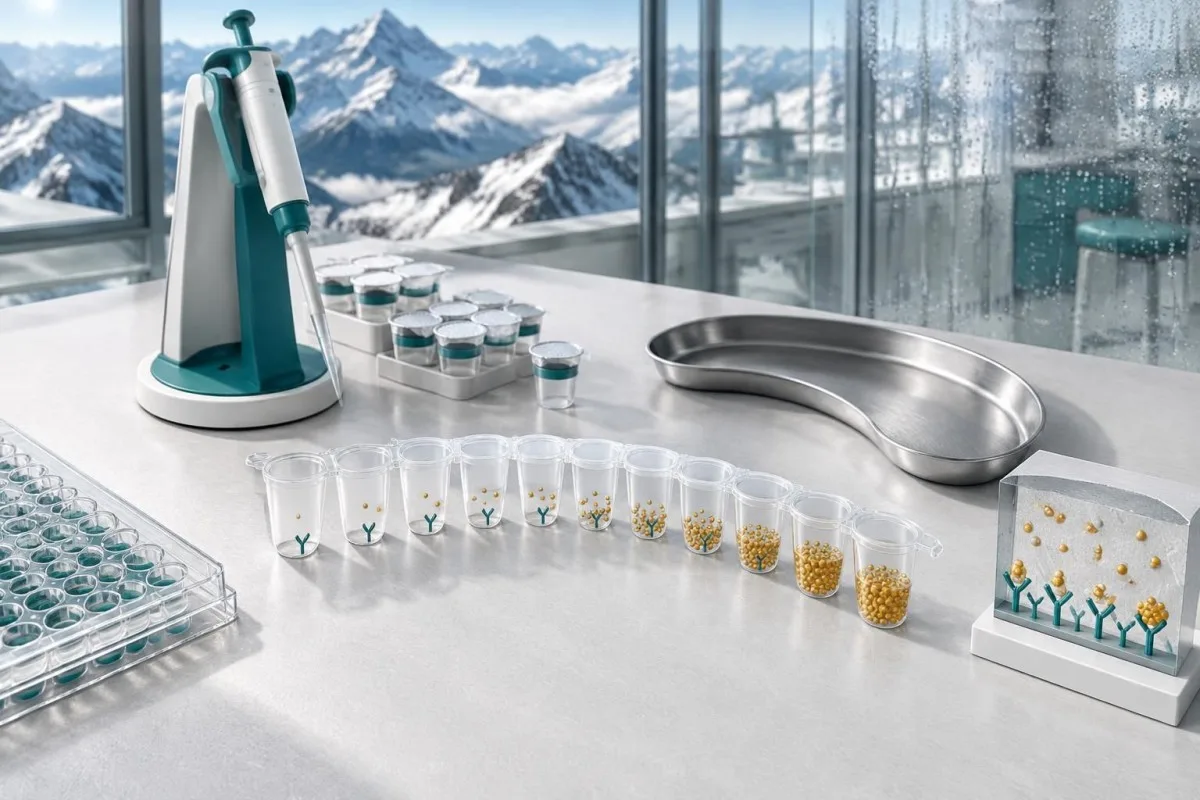
Common AMH bands are treatment-oriented conventions, not boundaries between fertile and infertile. Values below approximately 1 ng/mL are often used to flag possible reduced response to stimulation, while higher concentrations may suggest a stronger response; the reason these bands exist is to help plan medication and counseling, not to declare whether natural pregnancy is possible.
A change in units can look much larger than a biological change. For example, a hypothetical first report of 0.7 ng/mL and second report of 5.0 pmol/L are essentially equivalent, because 0.7 × 7.14 = 5.0; comparing them as though AMH rose from 0.7 to 5 would substantially misread the result.
Age-specific percentiles and treatment cutoffs describe different comparisons. An AMH of 1.5 ng/mL might be relatively low compared with other people aged 25 but less unusual at age 39, yet it still cannot supply an individual conception probability; ask whether the laboratory flag uses an age-specific interval, a broad adult interval, or a clinic's stimulation threshold.
Small differences near a cutoff should not automatically change a diagnosis or treatment plan. Hypothetical results of 0.95 and 1.05 ng/mL straddle a commonly used threshold but may not represent a meaningful biological shift, especially across laboratories; our προσέγγιση κλινικής επικύρωσης explains why method limitations and clinical context belong alongside numerical interpretation.
| Επίπεδο | Εύρος | Τι σημαίνει |
|---|---|---|
| Often described as very low | <0.5 ng/mL; <3.6 pmol/L | May indicate a markedly reduced response to stimulation. Does not establish infertility, egg quality, or menopause. |
| Often described as low | 0.5 to <1.0 ng/mL; approximately 3.6 to <7.1 pmol/L | Often prompts counseling about potentially fewer retrieved eggs. Interpret against age and antral follicle count. |
| Common middle treatment band | 1.0–3.5 ng/mL; approximately 7.1–25.0 pmol/L | May be compatible with an intermediate stimulation response. This is not a universal normal range or a guarantee of conception. |
| Often described as high | >3.5 ng/mL; >25.0 pmol/L | May suggest a stronger stimulation response and can occur with PCOS. The relevant upper threshold varies by assay and clinic. |
Can AMH predict your chance of conceiving naturally?
AMH alone cannot reliably predict an individual's chance of natural conception. A low result does not prove infertility, and a high result does not guarantee pregnancy; a frequently cited JAMA study examined 750 women aged 30–44 and found no significantly lower conception probability in the low-AMH group.

The JAMA study evaluated women without known infertility who had been trying for 3 months or less. Participants with AMH below 0.7 ng/mL did not have significantly lower cumulative conception probabilities after adjustment for relevant factors, including age; these findings concern that study population, not every person with very low AMH or established infertility (Steiner et al., 2017).
The reported conception estimates illustrate why a low AMH should not be converted into a personal failure rate. In that cohort, estimated conception by 12 cycles was 84% in the low-AMH group versus 75% in the comparison group, with overlapping uncertainty; this does not mean low AMH improves fertility, because subgroup estimates, selection, and sampling variation can produce apparently favorable differences.
Natural conception requires a functioning sequence that AMH does not examine. A hypothetical 33-year-old with AMH of 2.5 ng/mL can still have difficulty conceiving because of blocked tubes, sperm factors, or endometriosis, while someone with AMH of 0.6 ng/mL may ovulate and conceive; our endometriosis diagnostic guide explains why a reassuring hormone result cannot exclude that condition.
A fertility evaluation should follow age, duration of trying, and known risk factors rather than waiting for AMH to become abnormal. Evaluation is generally appropriate after 12 months below age 35 or 6 months at ages 35–39, and sooner at age 40 or with irregular cycles or suspected tubal disease; when exposure history warrants it, chlamydia testing and timing address a separate issue that AMH cannot detect.
What AMH can tell you about IVF and egg freezing
AMH is most useful for estimating response to ovarian stimulation in IVF or egg freezing. It helps anticipate whether a cycle may produce relatively few or many eggs, but an AMH of 1 ng/mL cannot be translated into an exact retrieval count, embryo count, or live-birth percentage.

AMH and antral follicle count are useful predictors of ovarian response, not interchangeable measurements of embryo competence. Clinics combine them with age, prior treatment response, and other findings when choosing medication; the ASRM committee opinion advises that an extremely low AMH should not, by itself, be used to refuse IVF treatment (Practice Committee of the ASRM, 2020).
Egg retrieval involves several stages of attrition that AMH cannot individually forecast. In a clearly hypothetical cycle, 8 retrieved eggs might include 6 mature eggs, 4 fertilized eggs, and 2 blastocysts, but these numbers are an illustration rather than expected rates; age, sperm, laboratory factors, and the treatment protocol can alter every transition.
High AMH can influence safety planning because a strong stimulation response can increase ovarian hyperstimulation risk. A hypothetical concentration of 6 ng/mL may prompt a clinic to adjust starting medication, monitoring, or the trigger strategy, especially when the follicle count is also high; the appropriate protocol depends on the whole assessment, not an automatic dose attached to that number.
Egg-freezing counseling must separate age at freezing from anticipated egg yield. A hypothetical 29-year-old with low AMH may need more than 1 stimulation cycle to bank a chosen number of mature eggs, while a 40-year-old with higher AMH still faces age-related limitations per egg; our ovulation and hormonal health guide provides background for discussing menstrual patterns alongside treatment goals.
Does high AMH mean PCOS or better fertility?
High AMH can accompany PCOS, but it does not diagnose PCOS by itself or prove better fertility. The 2023 international guideline allows AMH to help define polycystic ovarian morphology in adults within the diagnostic algorithm; it does not recommend AMH for diagnosing PCOS in adolescents.

Adult PCOS diagnosis generally requires 2 of 3 features after other causes are excluded: ovulatory dysfunction, clinical or biochemical hyperandrogenism, and polycystic ovarian morphology. AMH can replace ultrasound for the morphology component in suitable adults, but a concentration such as 5 ng/mL cannot replace the complete assessment (Teede et al., 2023).
AMH and ultrasound should not routinely be added together simply to accumulate evidence for PCOS. The 2023 guideline recommends using either approach to define morphology, reducing overdiagnosis; if irregular cycles and hyperandrogenism already provide 2 diagnostic features, additional AMH or ultrasound is not required just to meet the criteria, as explained in our οδηγός μας για τα διαγνωστικά κριτήρια του PCOS.
There is no universally accepted AMH cutoff that diagnoses PCOS across all laboratories and ages. A result of 4 ng/mL may have different implications at age 22 versus 38, and assay methods, hormonal contraception, and other factors affect interpretation; the international guideline calls for population- and assay-specific thresholds rather than treating one internet number as definitive.
High AMH with infrequent periods raises a different concern from high AMH with regular ovulation. A hypothetical 26-year-old with AMH of 7 ng/mL and only 4 periods per year needs assessment of ovulatory dysfunction and alternative causes, not reassurance that more hormone means greater fertility; selected patients may need 17-hydroxyprogesterone assessment to investigate an androgen-related condition that can resemble PCOS.
Can birth control, cycle timing, or the laboratory change AMH?
AMH can generally be measured on any menstrual-cycle day, but it is not perfectly constant. Hormonal contraception, laboratory methods, and some assay interferences can change the result; a hypothetical fall from 1.4 to 1.0 ng/mL should therefore be checked for context before being interpreted as rapid loss of eggs.
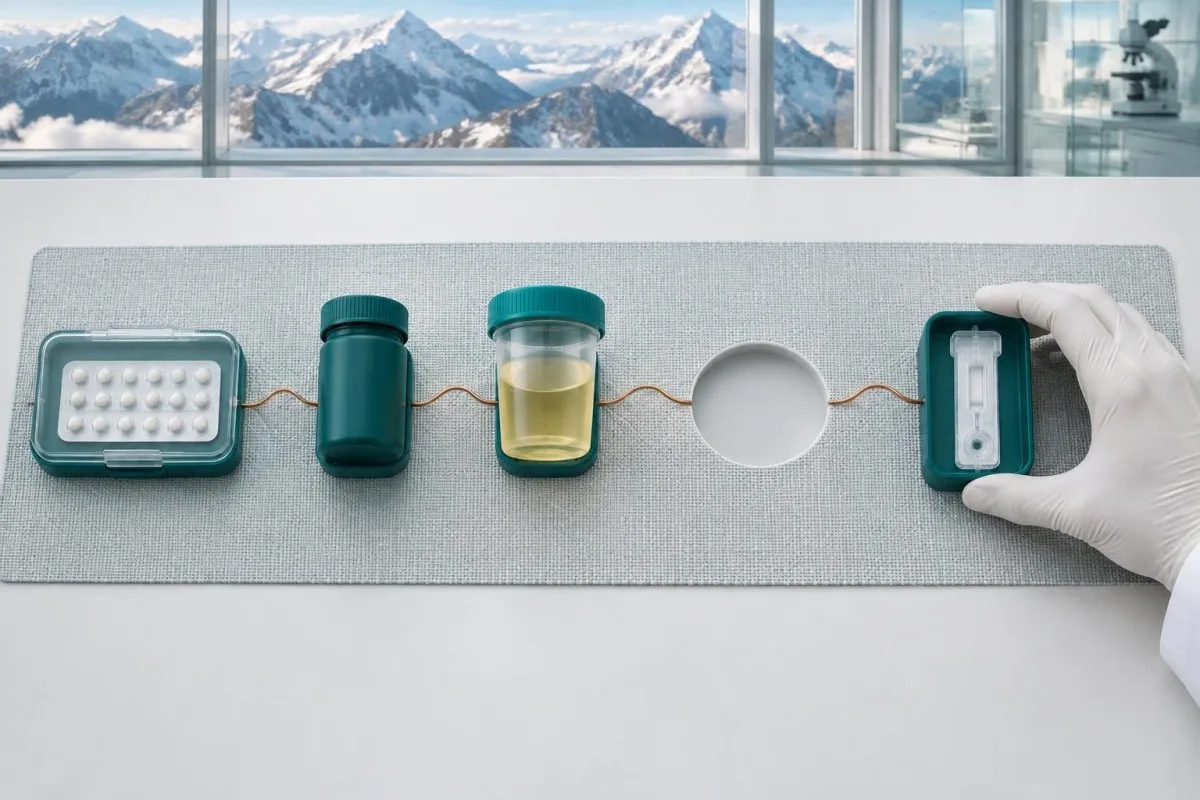
Hormonal contraception can suppress measured AMH without proving permanent depletion of the egg supply. The size of the effect varies by contraceptive type, duration, and individual; if a result of 0.8 ng/mL was obtained while using contraception, discuss whether it changes the treatment decision before considering a clinician-supervised reassessment after a washout period, sometimes around 2–3 months.
Stopping contraception solely to raise an AMH number is not automatically useful or safe. Pregnancy prevention, symptom control, and the reason for testing still matter, and recovery may not follow an identical schedule in every person; our guide to hormones after stopping the pill explains why a repeat test after 1 cycle may not answer every endocrine question.
High-dose biotin can interfere with some immunoassays, including certain AMH methods, but the direction and magnitude are method-dependent. A hair supplement containing 5,000 micrograms supplies 5 mg of biotin—far more than typical nutritional intake—and should be disclosed to the laboratory; our supplement interference guide explains why the laboratory, not a universal online timetable, should advise any withholding interval.
AMH alone usually does not require fasting, and serial comparisons are cleaner when the laboratory and method remain the same. A 10-hour fast requested for a combined panel may be intended for glucose or another analyte rather than AMH; check the full order using our οδηγός οδηγιών νηστείας and record contraception, supplements, units, and testing dates beside each result.
Does low AMH mean menopause or primary ovarian insufficiency?
Low AMH alone does not diagnose menopause or primary ovarian insufficiency. An AMH below 0.1 ng/mL can occur in several contexts, and a report below the assay's detection limit is not proof that no eggs remain; menstrual history, age, pregnancy testing when relevant, and other hormones are needed.

An undetectable AMH result means the concentration is below that assay's reporting capability. If a laboratory reports less than 0.03 ng/mL, the result does not distinguish 0.02 from 0.01 ng/mL and cannot establish a literal zero egg count; ask for the lower reporting limit before comparing an undetectable result with one from another laboratory.
Primary ovarian insufficiency concerns impaired ovarian function before age 40, not simply a low reserve marker. Persistent irregular or absent periods and elevated FSH are central to assessment, and an FSH above 25 IU/L may support the diagnosis in the appropriate setting; pregnancy, hormonal treatment, thyroid or prolactin disorders, and diagnostic uncertainty must also be considered.
Genetic investigations may be appropriate after a clinical diagnosis of ovarian insufficiency, not for every isolated low AMH result. At age 27, unexplained ovarian insufficiency may warrant chromosome testing and FMR1 premutation assessment, because the findings can affect counseling; our FMR1 result guide explains why a premutation is different from a full mutation.
Menopause is usually identified retrospectively after 12 months without a period when another cause does not explain the absence. AMH is not a dependable personal countdown to that date, and a low concentration cannot promise a particular remaining reproductive window; our Turner syndrome testing guide covers one chromosome-related context in which menstrual history and fertility-preservation discussions may deserve earlier attention.
Can supplements raise AMH or improve egg quality?
Raising AMH has not been established as a reliable way to improve egg quality or live-birth chances. A hypothetical increase from 0.6 to 0.9 ng/mL may reflect measurement variation, medication changes, or altered follicle activity; it does not demonstrate that new eggs were created or chromosome competence improved.

No routine supplement has been proven to replenish the dormant human egg pool in ordinary clinical use. A marketed target such as AMH above 2 ng/mL is therefore not a validated treatment goal for someone with diminished reserve; claims should distinguish changes in laboratory values from changes in mature egg yield, pregnancy, and live birth.
Evidence for supplements such as CoQ10 and DHEA is mixed and depends on the population and outcome studied. Small trials and differing treatment protocols limit certainty about live-birth benefit, while DHEA is a hormone precursor that can cause androgen-related adverse effects; a 38-year-old should not delay an indicated fertility assessment for 3 months simply to pursue an unsupported AMH increase.
In PCOS, a lower AMH after treatment is not automatically evidence of harm. If a hypothetical patient moves from 8 to 5 ng/mL while cycles become more regular, the falling hormone signal needs to be interpreted alongside ovulation and treatment rather than labeled worsening egg quality; our inositol evidence guide separates possible metabolic or cycle effects from uncertain fertility benefits.
Preconception health measures have purposes that should not be confused with boosting AMH. Standard-risk adults planning pregnancy are commonly advised to take 400 micrograms of folic acid daily to reduce neural-tube defect risk, not to improve egg quality; smoking cessation, medication review, and correcting confirmed deficiencies are sensible, but none can make an AMH result guarantee pregnancy.
What to do next with your AMH result
Use AMH to guide an informed fertility discussion, not to issue a verdict on your eggs. Bring the result, units, laboratory interval, age, cycle pattern, and treatment goals; for a concentration such as 0.7 ng/mL, the next step differs substantially between someone planning IVF now and someone with regular cycles who has just started trying naturally.

A useful AMH review starts with 5 checks: units, laboratory method, age, medication exposure, and the question being asked. For example, a hypothetical 32-year-old taking hormonal contraception with AMH of 0.9 ng/mL needs a different interpretation from a 39-year-old with the same result and a previous low-response IVF cycle; neither report, by itself, grades egg quality.
The next investigation should target missing information rather than repeat AMH automatically. Depending on the situation, that may mean antral follicle count, ovulation assessment, a semen analysis, or tubal evaluation; after 6 months trying at age 37, repeatedly checking AMH every few weeks can delay a more useful assessment of the factors that actually prevent conception.
A high or low AMH result is usually not an emergency by itself, but symptoms can change urgency. Sudden severe pelvic pain, fainting, or significant pain with a positive pregnancy test requires urgent assessment regardless of whether AMH is 0.5 or 5 ng/mL; our responsible use principles distinguish educational interpretation from diagnosis and urgent clinical care.
Ask for a prognosis tied to a defined outcome and time frame, not a vague statement that AMH is good or bad. For IVF, ask about expected response per cycle and uncertainty; for natural conception, discuss age and time trying rather than a single hormone threshold, and use our πρότυπα ιατρικού περιεχομένου to understand how clinical sources and interpretation limits should be presented.
Research publications and the limits of their relevance
The 2 DOI-linked publications below are broader laboratory education resources, not AMH studies or evidence for fertility predictions. Μας οδηγός πρωτεϊνών ορού concerns globulins, albumin, and the A/G ratio. The separate οδηγός συμπληρώματος και ANA concerns immune testing; AMH-specific recommendations in this article are supported instead by the ASRM opinion, the JAMA cohort, and the international PCOS guideline listed in the external references.
Συχνές ερωτήσεις
What does AMH stand for on a fertility blood test?
AMH stands for anti-Müllerian hormone, a protein produced by cells surrounding small growing ovarian follicles. The AMH blood test helps estimate ovarian reserve and likely response to fertility medication, rather than measuring egg quality. Results are commonly reported in ng/mL or pmol/L, with 1 ng/mL equal to approximately 7.14 pmol/L. Age, the laboratory method, and medication use affect how the result should be interpreted.
Does AMH measure egg quality?
AMH does not directly measure egg quality or determine whether an egg has the correct chromosomes. A hypothetical 28-year-old and 41-year-old can both have AMH of 0.7 ng/mL but different probabilities of age-related chromosome abnormalities. AMH is more useful for estimating egg yield during ovarian stimulation than for predicting the competence of an individual egg. No routine blood test provides a definitive egg-quality score.
Μπορώ να μείνω έγκυος φυσιολογικά με χαμηλή AMH;
Natural pregnancy can occur with low AMH because AMH alone does not establish infertility. In a JAMA cohort of 750 women aged 30–44 without known infertility, AMH below 0.7 ng/mL was not associated with significantly lower conception probabilities. That finding does not guarantee pregnancy or apply equally to every person with extremely low AMH or established fertility problems. Age, ovulation, sperm, fallopian tubes, and duration of trying remain central to assessment.
What is a normal AMH level?
AMH has no universal normal range that applies to every age, laboratory method, and clinical purpose. Many fertility clinics use approximately 1–3.5 ng/mL as a middle treatment-oriented band, but that is not a validated boundary between fertility and infertility. One ng/mL corresponds to approximately 7.14 pmol/L, so the units must be checked before comparing results. An age-specific interpretation and the laboratory's own method are more useful than a single online cutoff.
Does high AMH mean I have PCOS?
High AMH can occur with PCOS, but it is not sufficient to diagnose the condition. The 2023 international PCOS guideline permits AMH to help define polycystic ovarian morphology in adults within an assessment generally requiring 2 of 3 diagnostic features. The guideline does not recommend AMH for diagnosing PCOS in adolescents. A concentration such as 5 ng/mL needs to be interpreted alongside menstrual patterns, androgen findings, age, and the assay used.
Should I repeat AMH or stop birth control before testing?
An AMH repeat test is most useful when it could change a clinical decision or clarify an unexpected result. Hormonal contraception can suppress measured AMH, and a clinician may sometimes consider reassessment after approximately 2–3 months off treatment, although recovery varies. Do not stop contraception solely to increase an AMH number without discussing pregnancy prevention and the reason for treatment. When comparing results, use the same laboratory method where possible and check that both reports use ng/mL or both use pmol/L.
Δείτε πώς να διαβάσετε εξετάσεις αίματος
Ανεβάστε την εργαστηριακή σας αναφορά και η τεχνητή νοημοσύνη της Kantesti εξηγεί κάθε βιοδείκτη με απλή γλώσσα μέσα σε λίγα δευτερόλεπτα. Την έχουν χρησιμοποιήσει περισσότεροι από 2 εκατομμύρια άνθρωποι παγκοσμίως.
Αναφορές
- Klein, T., Mitchell, S., & Weber, H. (2026). Οδηγός πρωτεϊνών ορού: Σφαιρίνες, αλβουμίνη και εξέταση αίματος για τον λόγο A/G. Ιατρική έρευνα της τεχνητής νοημοσύνης Kantesti. DOI
- Klein, T., Mitchell, S., & Weber, H. (2026). Οδηγός για την εξέταση αίματος C3 C4 Complement και τον τίτλο ANA. Ιατρική έρευνα της τεχνητής νοημοσύνης Kantesti. DOI
- Practice Committee of the American Society for Reproductive Medicine (2020). Testing and interpreting measures of ovarian reserve: a committee opinion. Fertility and Sterility. DOI
- Steiner AZ et al. (2017). Association Between Biomarkers of Ovarian Reserve and Infertility Among Older Women of Reproductive Age. JAMA. DOI
- Teede HJ et al. (2023). Recommendations From the 2023 International Evidence-based Guideline for the Assessment and Management of Polycystic Ovary Syndrome. The Journal of Clinical Endocrinology & Metabolism. DOI
- 2+ εκατομμύριαΕξετάσεις που αναλύθηκαν
- 127+χωρών
- 100+Γλώσσες
Σχετικά με την ιατρική ομάδα


Σήματα εμπιστοσύνης E-E-A-T
Εμπειρία
Κλινική ανασκόπηση από ιατρό για τις ροές εργασίας ερμηνείας εργαστηριακών αποτελεσμάτων.
Πραγματογνωμοσύνη
Εστίαση στην εργαστηριακή ιατρική στο πώς συμπεριφέρονται οι βιοδείκτες στο κλινικό πλαίσιο.
Αυθεντικότητα
Ιατρική αξιολόγηση από τον Δρ. Thomas Klein, με συνεισφορές από τη Δρ. Sarah Mitchell και τον Καθ. Δρ. Hans Weber.
Αξιοπιστία
Ερμηνεία βασισμένη σε τεκμηριωμένα δεδομένα με σαφείς οδούς παρακολούθησης για τη μείωση του συναγερμού.



Ιατρική αποποίηση ευθύνης
Αυτό το άρθρο προορίζεται μόνο για εκπαιδευτικούς σκοπούς και δεν αποτελεί ιατρική συμβουλή. Συμβουλεύεστε πάντα έναν κατάλληλο επαγγελματία υγείας για αποφάσεις σχετικά με τη διάγνωση και τη θεραπεία.
Δημοσιεύθηκε · Επικοινωνήστε με τη συντακτική ομάδα
Εκδίδεται από την Kantesti Ltd, εγγεγραμμένη στην Αγγλία και την Ουαλία, αριθμός εταιρείας. 17090423, Λονδίνο, Ηνωμένο Βασίλειο.
