
Routine labs can reveal anemia, inflammation, liver or bile-duct patterns, and signs of dehydration. They cannot, by themselves, diagnose or exclude every gut condition.

要点
- CBC: Hemoglobin below 120 g/L (12 g/dL) in many nonpregnant adult women or 130 g/L (13 g/dL) in adult men meets common anemia thresholds, but the lab's range and personal context matter.
- 铁蛋白: A ferritin below 30 ng/mL often indicates depleted iron stores in adults; inflammation can raise ferritin and conceal iron deficiency.
- 肝源性模式: Raised ALT and AST suggest cell injury, while raised ALP with GGT and direct bilirubin can point toward a bile-flow problem; these patterns need clinical interpretation.
- CRP: A CRP above the laboratory's reference range, often around 5 mg/L, is nonspecific and cannot identify the location or cause of inflammation.
- Celiac testing: Tissue-transglutaminase IgA is usually paired with total IgA, and testing is less reliable after a person has stopped eating gluten.
- 结果正常: Normal CBC, iron, liver enzymes, and CRP do not rule out IBS, early or limited IBD, celiac disease, ulcers, gallstones, or other gut conditions.
- 紧急症状: Vomiting blood, black tarry stool, severe or rapidly worsening abdominal pain, fainting, or jaundice needs prompt medical assessment, regardless of routine lab results.
What routine digestive blood tests can show
A blood test for digestive issues can reveal consequences and clues—such as anemia, iron depletion, inflammation, dehydration, or liver and bile-duct abnormalities—but usually cannot identify the exact gut diagnosis by itself. Which tests help depends on the symptom pattern, duration, medication use, and examination.

A routine panel is most useful when read as a pattern. A 加拿大广播公司 may identify anemia or a raised white-cell count; iron studies may suggest chronic blood loss or poor absorption; liver tests can show a hepatocellular or cholestatic pattern; and CRP can indicate systemic inflammation. None of these findings names the digestive disease on its own.
For example, imagine a 52-year-old with several months of loose stools and fatigue. Hemoglobin of 105 g/L, MCV of 72 fL, and ferritin of 9 ng/mL would make iron deficiency likely and prompt a search for its cause. The next step may include dietary review, celiac serology, stool testing, or endoscopy, depending on age, symptoms, risk factors, and local guidelines.
A normal result is not a clean bill of health for the gut. IBS commonly has normal routine blood tests, while inflammation confined to a small area or an early stage of disease may not substantially change CBC or CRP. The American College of Gastroenterology's 2021 IBS guideline supports targeted testing, including celiac serology for people with diarrhea-predominant IBS symptoms, rather than treating a normal routine panel as a diagnosis (Lacy et al., 2021). See our IBS testing overview for how symptom-led investigation differs from a broad lab screen.
How CBC and iron results point to blood loss or poor absorption
A CBC and iron studies can show whether digestive symptoms are accompanied by anemia or depleted iron stores, but they cannot tell whether the cause is bleeding, low intake, increased need, or malabsorption. Hemoglobin, MCV, ferritin, transferrin saturation, and the trend over time are more informative together than any one result.

In many adult laboratories, hemoglobin below 120 g/L in nonpregnant women or below 130 g/L in men is an anemia threshold; local ranges and clinical context vary. A low MCV—often below 80 fL—can accompany iron deficiency, but MCV can remain normal early on, and mixed deficiencies can mask the expected cell-size pattern. For a focused explanation, see MCV and MCH together.
Ferritin below 30 ng/mL often supports iron deficiency in adults, even before hemoglobin falls. Ferritin is also an acute-phase protein: inflammation, infection, liver disease, and some metabolic conditions can make it appear reassuringly normal or high while iron availability is low. Transferrin saturation below about 20% can add evidence, but thresholds and interpretation differ across settings; the 铁元素研究指南 explains how the measures fit together.
A hypothetical 34-year-old with chronic diarrhea, hemoglobin 128 g/L, ferritin 14 ng/mL, and CRP 18 mg/L may have iron depletion without marked anemia; the raised CRP also makes ferritin less straightforward. Rockey et al.'s 2020 AGA technical review on gastrointestinal evaluation of iron-deficiency anemia discusses why confirmed iron-deficiency anemia warrants assessment for gastrointestinal causes, with the investigation tailored to patient characteristics and risks (Rockey et al., 2020). A low result does not prove gut bleeding: heavy menstrual periods, pregnancy, low dietary iron, and blood donation are other common explanations.
What liver blood tests can reveal about digestive symptoms
Liver tests can reveal patterns consistent with liver-cell irritation, impaired bile flow, or reduced liver function, but an abnormal result does not automatically mean the liver is causing abdominal symptoms. ALT, AST, ALP, GGT, bilirubin, albumin, and sometimes clotting tests need to be interpreted in combination.

ALT and AST are enzymes released with cell injury; they are not direct measures of how well the liver performs. ALP can rise with bile-duct problems but also with bone activity, so a raised GGT alongside ALP helps support a hepatobiliary source. An increase in direct bilirubin with ALP and GGT may strengthen concern for impaired bile flow, though imaging and the clinical story determine what happens next.
The size and combination of abnormalities matter. A mildly raised ALT—say, 55 IU/L when the local upper limit is 40—can reflect metabolic fatty liver, a recent illness, alcohol, or medication effects, among other causes. A sudden rise to many times the upper limit, especially with jaundice, dark urine, pale stools, or severe illness, deserves prompt clinical review. See liver-test abbreviations 和 高胆红素模式的重点指南 for related result interpretation.
Consider a hypothetical person with right-upper abdominal discomfort, ALP 210 IU/L, GGT 180 IU/L, and a raised direct bilirubin. This cholestatic pattern can justify prompt assessment for obstruction or other biliary disease, but it cannot confirm gallstones; ultrasound or other imaging may be needed. Conversely, uncomplicated gallstones can occur with normal liver tests between episodes, so symptoms and timing still matter.
How CRP, ESR, and white cells fit into digestive symptoms
CRP, ESR, and white blood cell counts can support the presence of inflammation or infection, but they are nonspecific: normal levels do not exclude gut inflammation, and elevated levels do not prove a digestive cause. The degree of change, symptom timing, and other findings shape the need for stool tests, imaging, or endoscopy.

CRP is a rapidly changing marker that may rise within hours of an inflammatory stimulus; many laboratories use an upper reference limit near 5 mg/L, though cutoffs vary. ESR generally changes more slowly and can be affected by age, anemia, pregnancy, and other conditions. A CRP of 25 mg/L is a meaningful clue in context, not a measurement of how much bowel is affected.
A white-cell count above a lab's upper reference limit—often around 11 × 10⁹/L in adults—can occur with infection, inflammation, stress, smoking, and some medicines. A normal count does not rule out appendicitis or localized intestinal disease. The WBC 和 CRP 对比 explains why the two markers can disagree; the ESR report guide describes common influences on ESR.
When ongoing diarrhea raises concern for inflammatory bowel disease, stool calprotectin can help distinguish intestinal inflammation from some functional disorders, but it is not a stand-alone diagnosis. The 2023 American College of Gastroenterology guideline for ulcerative colitis describes the role of objective inflammatory assessment in diagnosis and monitoring (Rubin et al., 2023). A stool calprotectin guide covers borderline results, while blood-test limits in ulcerative colitis explains why normal systemic markers can coexist with disease.
When blood tests suggest celiac disease or malabsorption
Blood tests can screen for celiac disease and reveal downstream clues such as iron, folate, or vitamin B12 deficiency, but they cannot diagnose every cause of malabsorption. For celiac screening, tissue-transglutaminase IgA is commonly paired with total IgA, and the person generally needs to be eating gluten for the test to be dependable.

The usual first-line celiac blood test is tissue-transglutaminase IgA (tTG-IgA) with a total IgA measurement. If IgA is deficient, an IgG-based test such as deamidated gliadin peptide IgG may be considered. Rubio-Tapia et al.'s 2023 ACG guideline emphasizes appropriate serologic testing and confirmation pathways; a positive blood test should be interpreted by a clinician and does not automatically replace recommended diagnostic confirmation (Rubio-Tapia et al., 2023).
Stopping gluten before testing can lower antibody levels and produce a false-negative result. Do not start a gluten-free diet solely to test a theory without discussing the timing and testing plan with a clinician; a supervised gluten challenge may be considered when someone has already stopped gluten, but its duration and amount depend on the case. Our guide to gluten challenge timing covers why preparation matters.
Iron deficiency can be an early clue to reduced absorption, while low B12 or folate may suggest other nutritional issues or conditions affecting absorption. These findings are not specific: low B12 can result from medicines, restricted intake, or autoimmune causes, and low iron has many explanations. A 临界值 B12 指南 explains why a single serum B12 value may need context; a high MMA result guide discusses one possible follow-up marker.
Why normal blood tests do not rule out every gut condition
Normal digestive blood test results cannot rule out all gastrointestinal disease because routine blood tests measure systemic effects, not the inside lining or function of the digestive tract. IBS, reflux, ulcers, some gallbladder problems, early IBD, and localized disease may not change a standard CBC, iron panel, liver panel, or CRP.
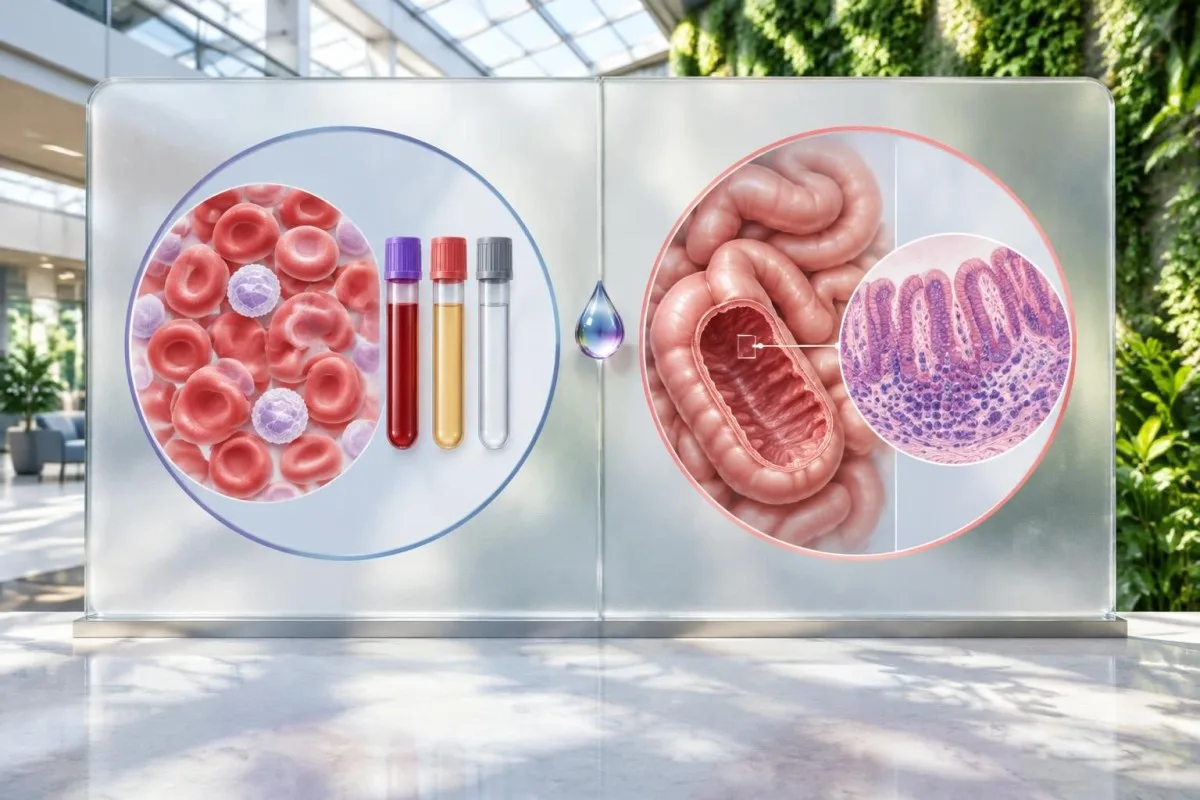
Blood tests answer specific questions. A normal hemoglobin says anemia was not detected at that draw; it does not prove there is no small-volume or intermittent bleeding. Normal CRP means there was no major systemic CRP response measured at that time, not that the bowel is necessarily free of inflammation.
Tests outside the blood panel may be more informative for particular symptoms: stool testing can check for infection or intestinal inflammation; breath tests can assess selected carbohydrate intolerance or bacterial overgrowth; imaging can examine organs and ducts; and endoscopy can inspect the lining. For instance, persistent diarrhea with normal CRP may still justify celiac serology or stool calprotectin, while difficulty swallowing calls for a different pathway. See the IBD stool-test guide 和 breath-test preparation overview.
A normal result should be matched to symptom duration and alarm features, not used to postpone care indefinitely. Ongoing symptoms, unintentional weight loss, persistent vomiting, difficulty swallowing, or visible blood in stool need clinician review even when routine blood tests are in range. The 粪便带血指南 explains why stool color and accompanying symptoms change urgency.
How clinicians combine digestive blood test results
Clinicians combine digestive blood test results by asking whether abnormalities form a coherent pattern, whether the symptoms fit that pattern, and whether the result is new or changing. A single mildly abnormal number often has several possible explanations; combinations such as low ferritin with microcytosis or raised ALP with GGT can narrow the next question.

Pattern one: hemoglobin 108 g/L, MCV 74 fL, ferritin 8 ng/mL, and transferrin saturation 9% strongly support iron-deficiency anemia. The pattern says iron stores are low, not why; a clinician considers menstrual loss, diet, pregnancy, medication use, and gastrointestinal blood loss or malabsorption based on age and risk.
Pattern two: ALT 92 IU/L, AST 70 IU/L, and normal ALP may suggest a hepatocellular pattern, but strenuous exercise, alcohol, metabolic disease, and medicines can affect enzymes. Pattern three: ALP 240 IU/L, GGT 190 IU/L, and rising direct bilirubin points more toward a cholestatic pattern. These are examples for interpretation, not universal action thresholds; laboratories use different ranges, and the rate of change matters.
A fourth pattern is symptoms with normal standard tests. A person with recurrent abdominal pain and altered bowel habits but normal CBC, ferritin, liver tests, and CRP may still need symptom-led assessment for IBS or another condition. If results span several dates, 趋势分析 can help organize changes for a clinician, but it cannot establish a diagnosis or replace examination.
What to do after an abnormal result or persistent symptoms
After an abnormal digestive blood test, the practical next step is to review the exact value, unit, laboratory range, symptoms, medicines, and prior results with a clinician. Seek urgent assessment for severe or rapidly worsening pain, vomiting blood, black tarry stool, fainting, confusion, or new jaundice; do not wait for repeat routine tests in these situations.

For nonurgent abnormalities, ask whether the result needs repeating, whether a targeted test is more useful, and how soon follow-up should happen. A repeat test may be reasonable for a small isolated change after a recent illness, but persistent anemia, falling hemoglobin, rising bilirubin, or worsening symptoms changes the urgency. Bring a medication and supplement list, because iron, NSAIDs, acid-suppressing medicines, and other drugs can affect symptoms or interpretation.
Do not treat a lab flag as a diagnosis, or a normal flag as proof that symptoms are harmless. Some laboratories use different reference intervals because of assay methods and populations; comparing the numeric result, unit, and prior trend is more useful than comparing color-coded flags across reports. The 医疗内容标准 explain our editorial approach to clear, bounded health information.
A useful appointment note lists when symptoms began, stool changes, weight change, food or medicine triggers, travel or infection exposures, and any family history of celiac disease, IBD, or colorectal cancer. For persistent symptoms, a clinician may choose stool studies, celiac serology, imaging, endoscopy, or other targeted testing. The 医学咨询委员会 provides information about clinical oversight of our medical content.
常见问题解答
消化问题通常需要进行哪些血液检查?
消化问题常见的血液检查包括 CBC、铁蛋白和铁代谢检查、电解质和肾功能指标、肝功能检查,有时还包括 CRP 或 ESR。乳糜泻筛查通常采用组织转谷氨酰胺酶 IgA 联合总 IgA 检测,尤其是在怀疑慢性腹泻、缺铁或吸收不良时。合适的检查取决于症状和体格检查结果;没有任何常规检查组合能够诊断所有肠道疾病。
Can a CBC show digestive problems?
A CBC can show anemia, changes in red-cell size, or an elevated white-cell count, which may guide evaluation of digestive symptoms. Hemoglobin below about 120 g/L in many nonpregnant adult women or 130 g/L in adult men meets common anemia thresholds, although laboratories and clinical circumstances differ. A normal CBC does not rule out IBS, celiac disease, ulcers, or localized intestinal inflammation.
Can blood tests detect IBS or IBD?
There is no blood test that confirms IBS, and routine blood tests may be normal in people with IBS. CBC, CRP, or ESR can support evaluation for anemia or systemic inflammation, but they do not diagnose or exclude inflammatory bowel disease on their own. Depending on symptoms, clinicians may use celiac serology, stool calprotectin, stool infection tests, imaging, or endoscopy.
Does low ferritin mean I have a digestive disease?
Ferritin below about 30 ng/mL often indicates low iron stores in adults, but it does not identify the cause. Menstrual blood loss, pregnancy, low dietary intake, blood donation, gastrointestinal blood loss, and malabsorption can all contribute. Inflammation can raise ferritin, so clinicians may also consider transferrin saturation and CRP when the picture is unclear.
Can normal blood tests rule out celiac disease?
Normal routine blood tests such as CBC, ferritin, and CRP do not rule out celiac disease. Celiac screening usually relies on tissue-transglutaminase IgA with total IgA, and results may be falsely reassuring if a person has stopped eating gluten or has IgA deficiency. Discuss testing before changing your diet, because gluten exposure affects the accuracy of serology.
Which digestive blood test results need urgent medical attention?
Urgency depends on the result and symptoms rather than one universal number, but rapidly rising bilirubin, marked liver-enzyme changes, severe anemia, or significant electrolyte abnormalities can require prompt review. Vomiting blood, black tarry stool, fainting, confusion, new jaundice, or severe worsening abdominal pain warrants urgent medical assessment even if recent routine tests were normal. Follow the laboratory's critical-result advice and contact a clinician promptly.
获取血液检查结果解读
上传您的实验室报告,Kantesti 的 AI 会在几秒内用通俗语言解释每项生物标志物。全球已有超过 200 万人使用。.
参考
- Klein, T., Mitchell, S., & Weber, H. (2026). 用于早期汉坦病毒分诊的多语言 AI 辅助临床决策支持:设计、工程验证及在 50,000 份已解读血液检查报告中的真实世界部署。. Kantesti AI 医学研究。. DOI
- Klein, T., Mitchell, S., & Weber, H. (2026). 基于Kantesti血液检测解释引擎的预注册、基于评分量表的自动化技术基准,使用100,000个合成测试用例。. Kantesti AI 医学研究。. DOI
- Rockey DC et al. (2020). AGA Technical Review on Gastrointestinal Evaluation of Iron Deficiency Anemia. 《胃肠病学》。. DOI
- Rubio-Tapia A et al. (2023). American College of Gastroenterology Guidelines Update: Diagnosis and Management of Celiac Disease. 《美国胃肠病学杂志》。. DOI PubMed
- Lacy BE 等(2021)。 ACG 临床指南:肠易激综合征的管理。 《美国胃肠病学杂志》。. DOI PubMed
- 200万+分析的检测项目
- 127+国家
- 100+语言
关于医疗团队


E-E-A-T信任信号
经验
由医生主导的临床审阅:实验室解读工作流程。.
专业知识
实验室医学重点:生物标志物在临床情境中的表现。.
权威
经 Thomas Klein 医生医学审核,并由 Sarah Mitchell 医生和 Hans Weber 教授参与撰写。.
可信度
基于循证的解读,并提供清晰的后续路径以减少警报。.






医疗免责声明
本文仅用于教育目的,不构成医疗建议。诊断和治疗决策请始终咨询合格的医疗专业人员。.
发表 · 联系编辑团队
由 Kantesti Ltd 发布,在英格兰和威尔士注册,注册公司编号:. 17090423, ,英国伦敦。.
