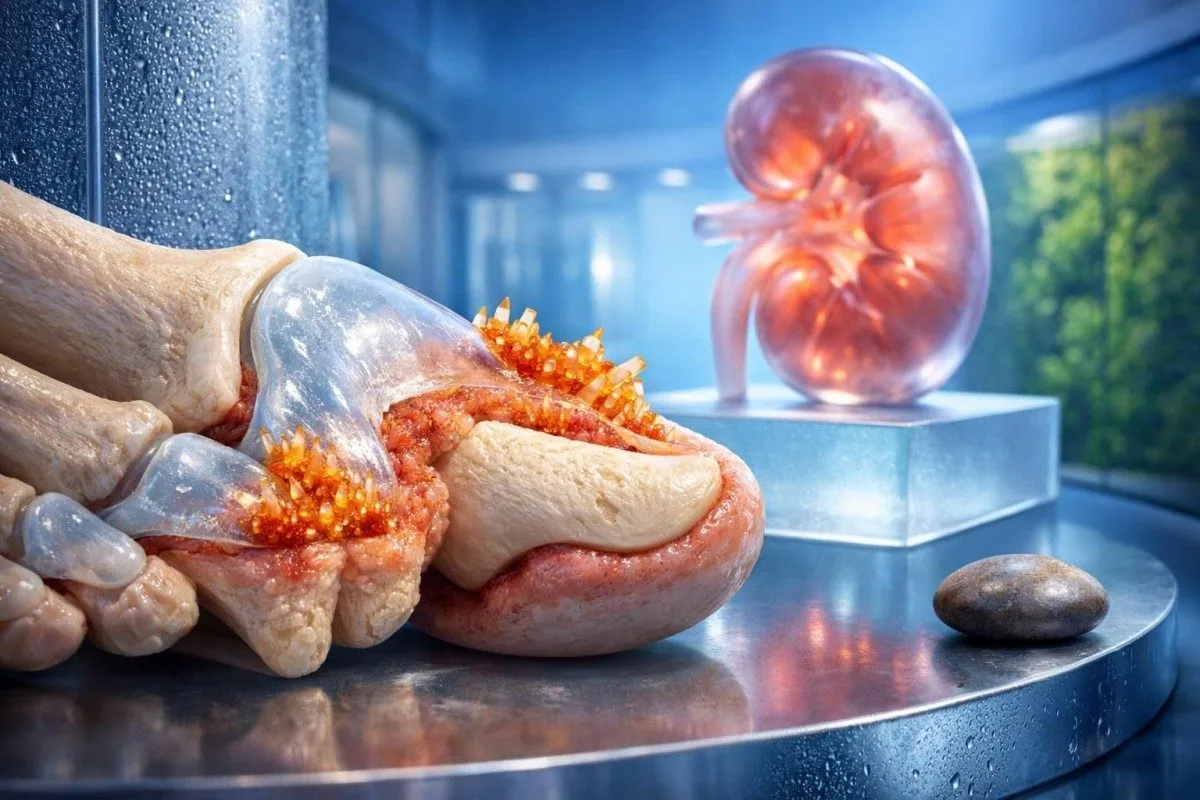
An unexpected uric acid result is common. The number matters less than whether it crosses the crystal threshold, fits gout symptoms, or travels with reduced kidney function.


- Adult men usually have a serum uric acid range of 3.4-7.0 mg/dL (202-416 µmol/L).
- Premenopausal women usually have a serum uric acid range of 2.4-6.0 mg/dL (143-357 µmol/L).
- Crystal threshold begins around 6.8 mg/dL (405 µmol/L), where urate can start to precipitate in joints and kidneys.
- Gout target for treated patients is usually below 6.0 mg/dL, and often below 5.0 mg/dL in severe tophaceous disease.
- Kidney stone clue is urine pH below 5.5, especially when uric acid is high and hydration is poor.
- Medication triggers include thiazide diuretics, loop diuretics, niacin, cyclosporine, tacrolimus, and low-dose aspirin.
- Repeat testing is reasonable in 2-4 weeks if the result is mildly high and you feel well, but sooner if the value is above 9 mg/dL or symptoms are present.
- Urgent review is needed for a hot swollen joint with fever, severe flank pain, inability to pass urine, or a rapid uric acid rise during cancer therapy.
What the uric acid normal range means on your lab report
Uric acid normal range is usually 3.4-7.0 mg/dL (202-416 µmol/L) in adult men and 2.4-6.0 mg/dL (143-357 µmol/L) in premenopausal women, though your own lab may differ slightly. Values above 6.8 mg/dL (405 µmol/L) matter because that is where urate can start crystallizing, so gout risk rises before a report looks dramatically abnormal. One unexpected high uric acid result does not diagnose gout, but it should prompt a quick look at kidney function, hydration, medications, and any history of toe pain or stones. You can place the number in context with Kantesti AI and our lab abbreviation guide.
For most adults, the reference interval is sex-specific because estrogen increases urate excretion. Premenopausal women usually run about 0.5-1.0 mg/dL lower than men, and after menopause many women drift closer to the male range. When our team at Kantesti reads a report, the first check is whether the lab uses mg/dL or µmol/L; 1 mg/dL equals about 59.5 µmol/L.
The biologic number that matters most is 6.8 mg/dL. That is the approximate saturation point of monosodium urate at body temperature and physiologic pH, and it explains why a value of 7.1 mg/dL may matter more clinically than patients expect. In cooler tissues such as the big toe, ankle, and ear helix, crystals may form even a bit sooner.
Context changes everything. When I, Thomas Klein, review a panel showing uric acid 8.2 mg/dL with normal creatinine, no joint symptoms, and a recent endurance event, I usually repeat the test before labeling disease; when the same 8.2 mg/dL arrives with prior night-time toe attacks or an eGFR of 55 mL/min/1.73 m², I interpret it very differently.
Why labs do not all use the same cutoff
Reference ranges are statistical, not magical. Some European laboratories use a slightly lower upper limit in women, and some U.S. labs report 7.2 mg/dL as normal for men even though the crystal biology has not changed. As of April 2, 2026, that mismatch between reference range and crystal threshold still confuses a lot of patients.
How the uric acid blood test is measured — and why one high result can mislead
The uric acid blood test usually measures serum urate with a uricase-based enzymatic assay, and one mildly abnormal result can be a setup rather than a diagnosis. Dehydration, hard exercise, sauna use, binge alcohol, and even aggressive fasting can push the number up transiently, so our fasting guide is often worth checking before you repeat it. If you want the mechanics, our technology overview explains how Kantesti AI standardizes lab-specific intervals.
Fasting is not always required for urate measurement, but timing still matters. In my experience, the cleanest repeat test is a morning sample taken when you are well hydrated, not the day after heavy exercise, and not in the middle of a crash diet. Day-to-day shifts of about 0.5 mg/dL are common enough that a result of 7.1 mg/dL should not trigger panic on its own.
The assay itself is usually reliable, yet pre-analytical noise is real. Severe hemolysis, lipemia, and large doses of vitamin C can sometimes distort colorimetric readings, although modern analyzers handle most of that better than older systems did. A patient who arrives fasting, mildly ketotic, and dry can look more hyperuricemic on paper than they really are over the long run.
In our review of more than 2 million uploaded lab reports across 127+ countries, isolated uric acid values between 7.0 and 7.8 mg/dL often normalize on repeat when hydration and timing are controlled. Persistent elevation across two tests separated by 2-12 weeks is much more informative than a single borderline result. Kantesti AI looks for that pattern rather than overreacting to one stray number.
A small but useful preparation tip
If you are repeating a mildly high result, avoid strenuous exercise and alcohol for 24-48 hours beforehand. Most patients find that simple step produces a more honest baseline than repeated testing during a weekend of dehydration and purine overload.
High uric acid is not the same as gout
High uric acid increases the chance of gout, but it does not equal gout. Gout is a crystal arthritis syndrome, and the gold standard diagnosis is still finding monosodium urate crystals in joint fluid or seeing a very classic clinical pattern. If inflammation markers are elevated at the same time, our CRP guide helps with context.
Many people with hyperuricemia never develop gout. Population studies show that serum urate above 9 mg/dL carries a much higher long-term gout risk than a value of 7.1 mg/dL, yet even then the number is probability, not certainty. Dalbeth, Stamp, and Merriman have made this point well: the urate level is the fuel, while the flare is the fire.
A typical gout flare is abrupt, often peaks within 24 hours, and frequently hits the first metatarsophalangeal joint, ankle, or midfoot. Patients often tell me they went to bed fine and woke at 3 a.m. unable to tolerate even a bedsheet on the toe. That timing, plus recurrence after alcohol, dehydration, surgery, or a diuretic change, is often more diagnostic than the isolated lab value.
And here is the part patients almost never hear early enough: serum urate can be normal during an acute flare in up to 30% of cases. The body may temporarily shift urate out of the blood and into inflamed tissues, so a result of 5.9 mg/dL during a hot swollen joint does not rule gout out. If a flare looks unusual, lasts longer than expected, or might be infection, use our symptom decoder and get examined promptly.
What makes me worry more
Repeated uric acid values above 8.5-9.0 mg/dL, visible tophi, kidney stones, or chronic kidney disease change the conversation fast. A mildly high number without symptoms is one thing; a mildly high number plus recurrent monoarthritis is very different medicine.
When elevated uric acid points toward kidney stones or kidney disease
A kidney blood test matters whenever uric acid is high because the kidneys handle most daily urate excretion. High uric acid becomes more meaningful when the eGFR is low, the BUN is rising, or the urine is acidic, and our eGFR guide is often the next page I send patients to after a urate result.
Roughly 90% of hyperuricemia cases are driven more by underexcretion than by overproduction. If the kidneys are filtering less effectively, serum urate rises even when the diet has not changed much. That is why a uric acid of 8.4 mg/dL paired with an eGFR of 52 mL/min/1.73 m² worries me more than the same urate value in a young healthy athlete.
Uric acid stones form more easily when urine pH is below 5.5. These stones are often radiolucent on plain X-ray, so patients may hear that imaging was negative even though the pain is very real; non-contrast CT is much better at finding them. When I see flank pain, nausea, or blood in the urine, I also check a BUN range guide and the BUN/creatinine ratio.
A simple urinalysis adds more than people expect. Acidic urine, crystals, microscopic blood, and low specific gravity can point toward the stone story or toward dehydration, which our urinalysis guide explains in more detail. In recurrent stone formers, a 24-hour urine uric acid above 800 mg/day in men or 750 mg/day in women suggests overproduction, but I find low urine volume under 2 liters/day even more common.
A practical stone clue
Patients with uric acid stones often have some mix of diabetes, obesity, low urine pH, and not enough fluid intake. That cluster matters because the treatment is not just pain control; alkalinizing the urine can be more important than chasing serum urate alone.
Common causes of high uric acid beyond red meat
Red meat is only part of the story. Insulin resistance, obesity, fructose intake, diuretics, reduced kidney function, menopause, high cell turnover states, and some transplant medicines are often bigger drivers of high uric acid than one steak dinner. If the lab pattern also suggests metabolic syndrome, check our HbA1c cutoffs.
Fructose is underrated here. Sweetened drinks and frequent fruit juice increase hepatic ATP breakdown and raise urate production, which is one reason serum urate often travels with elevated triglycerides and central adiposity. That link is clearer when you review the full lipid panel guide.
Medication history is one of the highest-yield steps in clinic. Thiazide diuretics, loop diuretics, niacin, low-dose aspirin, cyclosporine, and tacrolimus commonly raise uric acid, while losartan and fenofibrate can lower it modestly. SGLT2 inhibitors often lower uric acid by roughly 0.6-1.0 mg/dL, which is one of those side benefits patients rarely hear about unless someone is looking at the whole panel.
There is another angle here: high uric acid often travels with fatty liver and systemic metabolic stress. When urate is elevated along with ALT, triglycerides, or fasting glucose, I worry less about steak and more about underlying insulin resistance or sleep apnea; our ALT guide is useful in that scenario. Organ meats, beer, shellfish, psoriasis, chemotherapy, and rapid cell turnover still matter—but they are not the whole map.
What to do next after an unexpected uric acid result
The next step after one abnormal result is usually not immediate lifelong medication. The right move is to repeat the value under cleaner conditions, pair it with kidney markers, and match it against symptoms; if you want a fast organized read, upload the report to our free demo.
For a mildly elevated value like 7.1-8.0 mg/dL with no symptoms, I usually repeat the test in 2-4 weeks. Before the repeat, hydrate normally, avoid alcohol binges, and skip hard exercise for 24-48 hours. Most patients do not need to fast, but they do need to stop turning the repeat into a stress test.
The companion tests matter. A practical follow-up set often includes creatinine, eGFR, BUN, urine pH, and urinalysis, and sometimes HbA1c, lipids, CRP, or a CBC depending on the story. Our reading results guide helps if the lab report feels cryptic, and the biomarkers guide is useful if you are not sure what else is already on the panel.
At Kantesti, Thomas Klein, MD, and our physician reviewers built the uric acid workflow so our AI does not treat serum urate as a standalone number. Kantesti AI weighs the uricase assay result against kidney function, inflammation, medications, and trend history, and our clinical standards explain that methodology openly. In practice, a persistent uric acid above 9 mg/dL, any gout-like attack, or a stone history is enough reason to book a clinician review rather than keep guessing online.
A simple home checklist before the repeat test
Write down recent alcohol intake, new medicines, weight-loss efforts, supplements, and any overnight joint pain. That short list often explains more than patients expect, and it saves time when the repeat result comes back.
When treatment is needed — and when watchful waiting is better
Medication is usually recommended for recurrent gout, tophi, uric acid stones, or persistent marked hyperuricemia with the right clinical context. In contrast, isolated asymptomatic hyperuricemia is often watched first in U.S. and European practice, and our Medical Advisory Board reviews this content because guideline nuance matters here.
The usual urate target for established gout is below 6.0 mg/dL, and for severe or tophaceous gout many clinicians aim for below 5.0 mg/dL. The 2020 American College of Rheumatology guideline supports a treat-to-target strategy, and EULAR has stayed similar in its practical goals. In my clinic years, patients did best when we chased a target rather than just handing them a pill and hoping for the best.
Allopurinol is still the workhorse. A common starting dose is 100 mg daily, or 50 mg daily in advanced CKD, with titration every 2-5 weeks until the urate goal is reached; febuxostat 40 mg daily is another option when allopurinol is not tolerated. To reduce early flares, prophylaxis with colchicine 0.6 mg once or twice daily for 3-6 months is common, and current guidance allows starting urate-lowering therapy during a flare as long as anti-inflammatory treatment is on board.
There is genuine debate around asymptomatic hyperuricemia. Japanese guidance has historically been more willing to treat values around 8.0 mg/dL with comorbidity or 9.0 mg/dL without, while Western clinicians are usually more conservative. Before starting allopurinol, some patients should discuss HLA-B*58:01 testing because the risk of severe hypersensitivity is higher in certain ancestry groups; that kind of careful, individualized approach is part of how we work at About Us and what you can see in our success stories.
Why starting low often works better
A rapid drop in serum urate can mobilize crystal deposits and trigger more flares at first. Starting low and titrating slowly feels less dramatic, but most patients tolerate it better and stay on treatment longer.
Diet and lifestyle changes that actually move uric acid
Lifestyle can lower uric acid, but the effect is usually modest rather than miraculous. Better hydration, less beer and fructose, weight loss, and more low-fat dairy may reduce urate by about 0.5-1.5 mg/dL in the real world, which helps—but a patient starting at 9.5 mg/dL usually still needs a broader plan.
Fluid is the most underestimated intervention I see. Unless a heart or kidney condition limits intake, many patients with stones or recurrent gout do better aiming for roughly 2-3 liters of fluid daily and a urine output above 2 liters/day. Our AI-generated nutrition plans often focus on hydration before getting fancy.
Food nuance matters. Beer, organ meats, anchovies, sardines, and fructose-sweetened drinks raise urate more reliably than moderate portions of lean poultry, while low-fat yogurt and coffee tend to be associated with lower risk. Cherries and vitamin C may help a little—often about 0.3-0.5 mg/dL in studies—but I am honest with patients that these are supporting actors, not the main treatment for established gout.
The things that backfire are worth naming. Crash dieting, prolonged fasting, dehydration-heavy exercise, and ketogenic starts can transiently raise uric acid because ketosis competes with urate excretion. If you want supplement ideas grounded in your own labs rather than internet folklore, our supplement guide and AI lab interpreter can organize the bigger picture.
When high uric acid needs urgent medical review
Urgent review is needed for a hot swollen joint with fever, severe flank pain with vomiting, inability to pass urine, a rapid creatinine rise, or a sharp uric acid increase during cancer treatment. Those are not wait-and-watch situations, and while our platform can help organize the labs, sudden severe symptoms still need a human clinician quickly.
The biggest trap is confusing infection with gout. Septic arthritis and gout can both cause an acutely hot, red, exquisitely tender joint, but infection can damage a joint very fast and may come with fever, chills, or feeling systemically unwell. If the joint is unusually severe, follows a procedure, or you are immunosuppressed, same-day assessment matters more than the lab number.
Kidney symptoms can also turn quickly. Severe one-sided flank pain, repeated vomiting, visible blood in the urine, or new inability to make urine raise concern for obstructing stone or acute kidney injury, especially if uric acid is high and the urine is acidic. I tell patients not to self-manage that scenario with extra water alone if the pain is escalating or the urine output is falling.
There are a few less obvious red flags too. Marked hyperuricemia in a younger adult under 30, new severe elevation in pregnancy after 20 weeks with hypertension, or uric acid surging above 10-13 mg/dL during chemotherapy should trigger secondary-cause thinking rather than a generic gout discussion. I still tell patients what I told them long before Kantesti existed: if the story feels suddenly severe, the number is no longer the main issue.
Research publications and clinical governance
These citations are part of the transparency stack behind how we publish and validate medical content at Kantesti. They are not gout treatment guidelines themselves, but they document our broader editorial and validation framework; if you want to see the people behind that process, visit our team.
Kantesti LTD. (2026). Women's Health Guide: Ovulation, Menopause & Hormonal Symptoms. Figshare. https://doi.org/10.6084/m9.figshare.31830721. Available on ResearchGate and Academia.edu.
Kantesti LTD. (2026). Clinical Validation Framework v2.0. Zenodo. https://doi.org/10.5281/zenodo.17993721. Available on ResearchGate and Academia.edu.
Thomas Klein, MD, and Sarah Mitchell, MD, PhD, review high-risk medical topics with the same bias I had in clinic: do not let a single biomarker tell the whole story. Uric acid is a good example—useful, clinically real, and easy to overread if you ignore kidney function, symptoms, and time.
Frequently Asked Questions
What is a normal uric acid level for adults?
A normal uric acid level is usually 3.4-7.0 mg/dL in adult men and 2.4-6.0 mg/dL in premenopausal women, although each laboratory may set slightly different reference intervals. The biologic crystal threshold is about 6.8 mg/dL, so gout risk starts to rise before the number looks dramatically high. Postmenopausal women often trend closer to the male range. The most accurate interpretation combines the lab value with symptoms, kidney function, and repeat testing when needed.
Can you have gout if your uric acid blood test is normal?
Yes, you can have gout even if the uric acid blood test is normal at the time of the attack. During an acute flare, serum urate may be normal in up to 30% of cases because urate shifts into inflamed tissues and crystals are already present in the joint. That is why clinicians rely on the pattern of symptoms, joint aspiration when needed, and sometimes ultrasound or dual-energy CT. A normal result during a flare should never be used alone to rule gout out.
Does fasting affect a uric acid blood test?
Fasting can affect a uric acid blood test, but not always in the way patients expect. Prolonged fasting, dehydration, ketosis, hard exercise, and alcohol can transiently raise serum urate by reducing excretion or increasing production, sometimes by around 0.5 mg/dL or more. Most repeat tests are best done when you are normally hydrated and not recovering from strenuous activity. If your first result was only mildly high, preparation can change the interpretation quite a bit.
Is high uric acid a sign of kidney disease?
High uric acid can be a sign of kidney disease, but it is not specific for kidney disease by itself. The kidneys handle most daily urate excretion, so uric acid becomes more concerning when it appears with a low eGFR, a rising creatinine, or a rising BUN. Uric acid stones are also more likely when urine pH is below 5.5. A kidney blood test panel and urinalysis usually tell you far more than the uric acid number alone.
At what level do doctors treat high uric acid with medicine?
Doctors usually treat high uric acid with medicine when the patient has recurrent gout, tophi, uric acid stones, or persistent marked hyperuricemia with symptoms or kidney risk, not just because the number is slightly above range once. For established gout, the target serum urate is usually below 6.0 mg/dL, and often below 5.0 mg/dL in severe disease. Allopurinol often starts at 100 mg daily, or 50 mg daily in advanced CKD, and is then titrated upward. Isolated asymptomatic hyperuricemia is often watched first in U.S. and European practice.
What should I do after one unexpected high uric acid result?
After one unexpected high uric acid result, the usual next step is to repeat the test in 2-4 weeks under better conditions if you feel well and the value was only mildly elevated. Hydrate normally, avoid alcohol binges and hard exercise for 24-48 hours, and review any medicines such as diuretics or niacin. Pair the repeat with kidney markers such as creatinine, eGFR, BUN, and a urinalysis when possible. If the value is persistently above 9 mg/dL, or you have gout-like pain or stone symptoms, book a clinician review sooner.
Get AI-Powered Blood Test Analysis Today
Join over 2 million users worldwide who trust Kantesti for instant, accurate lab test analysis. Upload your blood test results and receive comprehensive interpretation of 15,000+ biomarkers in seconds.
📚 Referenced Research Publications
Klein, T., Mitchell, S., & Weber, H. (2026). Women's Health Guide: Ovulation, Menopause & Hormonal Symptoms. Kantesti AI Medical Research.
Klein, T., Mitchell, S., & Weber, H. (2026). Clinical Validation Framework v2.0 (Medical Validation Page). Kantesti AI Medical Research.
⚕️ Medical Disclaimer
This article is for educational purposes only and does not constitute medical advice. Always consult a qualified healthcare provider for diagnosis and treatment decisions.
E-E-A-T Trust Signals
Experience
Physician-led clinical review of lab interpretation workflows.
Expertise
Laboratory medicine focus on how biomarkers behave in clinical context.
Authoritativeness
Written by Dr. Thomas Klein with review by Dr. Sarah Mitchell and Prof. Dr. Hans Weber.
Trustworthiness
Evidence-based interpretation with clear follow-up pathways to reduce alarm.