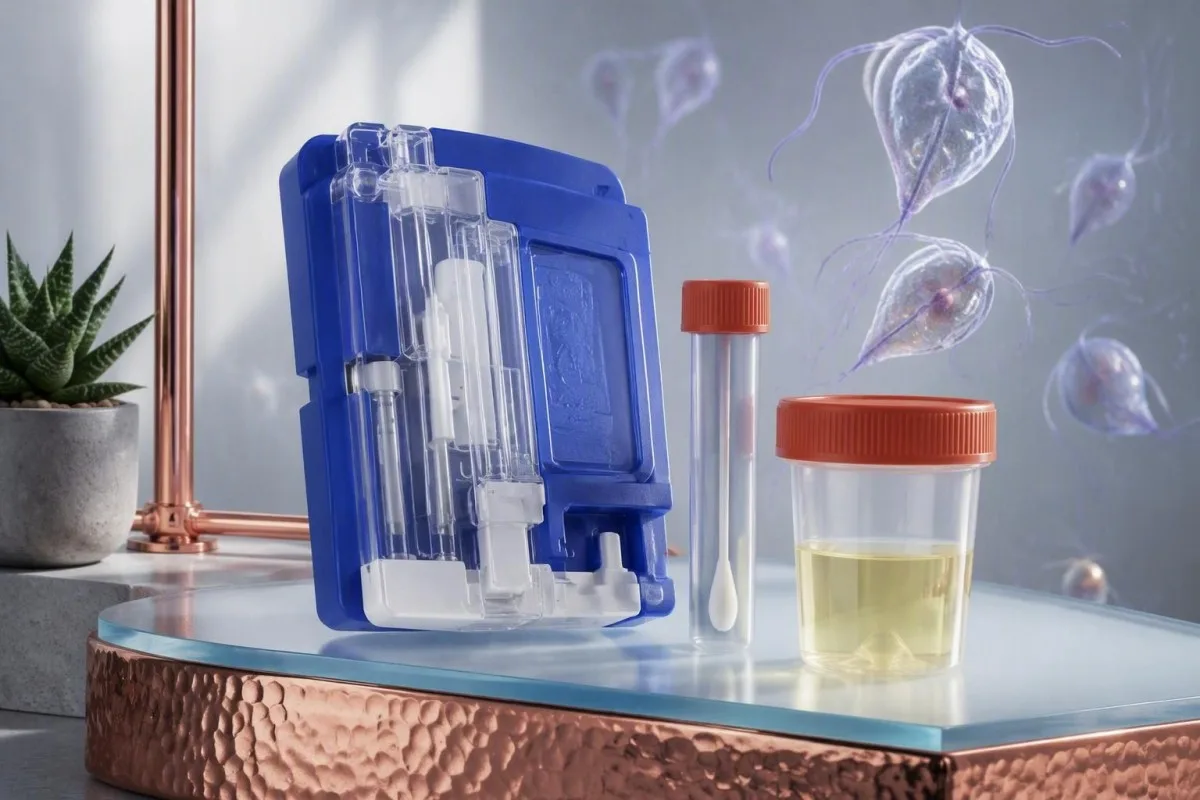
A trichomoniasis test is most reliable when the sample type fits your anatomy and symptoms. Timing matters too: a negative result immediately after exposure does not always close the case.


- ئەڭ ياخشى تەكشۈرۈش: A trichomoniasis NAAT test detects parasite genetic material and is usually more than 95% sensitive in validated specimen types.
- Timing after exposure: Test immediately if symptoms occur; after a single exposure without symptoms, testing at about 7 days is reasonable, with repeat testing at 2-4 weeks if concern remains.
- Urine testing: A first-catch urine sample is often appropriate for men, while vaginal swabs generally detect more infections in women.
- Negative result: Persistent discharge, irritation, or urinary burning after a negative test needs reassessment for other STIs, yeast, bacterial vaginosis, UTI, or a repeat trichomoniasis NAAT.
- Treatment: Women are usually treated with metronidazole 500 mg twice daily for 7 days; men commonly receive metronidazole 2 g once under CDC guidance.
- Partners: Current sexual partners need evaluation and presumptive treatment because untreated partners commonly pass the infection back.
- قايتا تەكشۈرۈش: CDC recommends retesting women about 3 months after treatment because reinfection is common.
- Test of cure: A NAAT should not be repeated before 3 weeks after treatment because residual genetic material can cause a positive result.
Which trichomoniasis test gives the most reliable answer?
A trichomoniasis NAAT test is the most accurate routine diagnostic option because it identifies genetic material from Trichomonas vaginalis. In practice, I use a validated vaginal swab for most women and a first-catch urine NAAT or urethral specimen for many men.
NAATs typically achieve sensitivity above 95% and specificity above 95% when laboratories use the specimen types approved for that assay. A positive NAAT means T. vaginalis genetic material was found; it does not measure severity, duration, or whether a partner was the source.
Wet-mount microscopy is fast but misses many infections: its sensitivity is only about 44-68%, and the slide should be examined within roughly 10 مىنۇتقىچە جىم تۇرۇپ. of collection because motility falls quickly. A negative wet mount should therefore never be the final word when discharge or genital irritation is convincing.
As of September 16, 2026, Kantesti is an AI قان تەكشۈرۈش ئانالىزچىسى, not a trichomoniasis diagnostic laboratory; a blood panel cannot diagnose this infection. Our role is to help users place related lab findings in context while directing them to validated sexual-health testing.
What the test does not tell you
A trichomoniasis NAAT cannot determine when infection began, whether it came from a particular partner, or whether symptoms have another simultaneous cause. Coinfection testing for chlamydia, gonorrhoea, HIV, and syphilis is often sensible after a positive result.
How a trichomoniasis NAAT test works
A trichomoniasis NAAT test amplifies small fragments of parasite RNA or DNA until the laboratory can detect them. This molecular approach is why NAAT outperforms microscopy when the organism count is low.
The assay needs a suitable specimen, not merely a good machine. Vaginal swabs, endocervical swabs, clinician-collected samples, and urine are not interchangeable across every manufacturer, so the laboratory’s validation list matters more than marketing language.
In a 2014 multicentre evaluation, Huppert and colleagues found a transcription-mediated amplification assay had sensitivity of 95.2-100% across female specimen types, with specificity of 98.9-99.9%. Those numbers are excellent, but they describe correctly collected samples in studied populations, not an absolute guarantee for every individual.
Dr Thomas Klein’s practical rule is simple: if symptoms strongly fit but a NAAT is negative, check specimen type, collection quality, exposure timing, and competing diagnoses before reassuring someone. The same disciplined approach applies when reading سۈپەتكە قارىغاندا مىقدارلىق نەتىجىلەر.
Why a molecular positive can persist
NAAT detects genetic remnants as well as living organisms. After successful treatment, residual nucleic acid may remain detectable for up to 3 ھەپتە, which is why early “test of cure” testing can confuse rather than clarify.
Swab or urine: which sample should you choose?
For women, a vaginal swab is generally the highest-yield specimen for trichomoniasis testing. For men, first-catch urine is convenient and commonly used, although a negative urine result can be less reassuring when symptoms persist.
A vaginal swab samples the site where T. vaginalis most often resides and is usually preferred over urine in women. Self-collected vaginal swabs can perform comparably to clinician-collected swabs when instructions are followed carefully, which can reduce embarrassment and delay.
A trichomoniasis urine test should use first-catch urine: the first 10-20 mL of the stream, ideally after not urinating for at least 1 hour. Midstream urine, the sample commonly used for a routine UTI culture, may dilute organisms and is not automatically appropriate for STI NAATs.
Do not use a routine urine dipstick result to rule in or rule out trichomoniasis. Leukocyte esterase can be positive with urethral or vaginal irritation, but it identifies white-cell activity rather than the parasite itself.
Collection mistakes that change interpretation
Vaginal creams, lubricant, douching, and heavy menstrual flow can occasionally complicate collection, though laboratories differ in their instructions. Ask the testing service before stopping prescribed vaginal medication, rather than guessing.
When should you test after exposure?
Test for trichomoniasis immediately if you develop discharge, genital itching, odour, burning with urination, or a partner tests positive. After exposure without symptoms, testing around 7 كۈن is a practical compromise, but a repeat at 2-4 ھەپتە may be needed after a very recent encounter.
The recognised incubation period is commonly 5-28 days, and many infections cause no symptoms at all. No guideline gives a perfectly validated single “window period” for every NAAT, so clinicians should be honest: a test on day 1 can be useful as a baseline, but it is not a definitive exclusion of that exposure.
I see this pattern often after anxious weekend testing. Someone has a negative result 48 hours after unprotected sex, then develops discharge on day 10; the useful next step is a repeat NAAT, not an argument about whether the first result was technically wrong.
If antibiotics were taken shortly before testing, tell the clinician and lab because treatment may lower detectable organism load. Our guide to STI blood testing after antibiotics explains why timing affects different tests differently.
Testing after a partner’s diagnosis
A person exposed to a confirmed case should seek testing and treatment promptly rather than wait for symptoms. Partners are often treated presumptively because asymptomatic carriage is common and waiting can prolong transmission.
Who should have a trichomoniasis test?
Anyone with compatible genital symptoms or a sexual partner diagnosed with trichomoniasis should be tested. Routine screening is not recommended for every asymptomatic adult, but it is recommended or considered in specific higher-prevalence settings.
CDC recommends diagnostic testing for women seeking care for vaginal discharge. It also recommends annual screening for women living with HIV, because trichomoniasis is more common in this group and may increase genital HIV shedding (Workowski et al., 2021).
Symptoms in women can include thin or frothy discharge, odour, vulval irritation, and discomfort during sex; symptoms in men may be mild urethral burning or discharge. Roughly 70-85% of infected people have few or no symptoms, so absence of symptoms is weak reassurance after a known exposure.
Pregnancy deserves a tailored conversation: testing is appropriate for symptoms, but treating asymptomatic infection solely to prevent preterm birth has not shown consistent benefit. A positive result still requires clinician-led treatment because untreated infection can cause substantial discomfort and transmission.
When another diagnosis is more likely
Vaginal odour and discharge can result from bacterial vaginosis, yeast, gonorrhoea, chlamydia, retained material, or skin conditions. Burning with urination can also reflect UTI; compare symptoms with our urinalysis versus urine culture guide.
What does a negative result mean when symptoms continue?
A negative trichomoniasis NAAT substantially lowers the chance of infection, but it does not explain persistent symptoms. Repeat testing or broader assessment is warranted when testing was early, the sample was suboptimal, or symptoms continue beyond 3-7 كۈن.
First, establish what was actually tested. A negative wet mount is far less conclusive than a negative NAAT, and a urine NAAT may miss infection that a vaginal swab detects in women. The laboratory report should name the method and specimen.
Second, do not automatically take metronidazole “just in case.” Empirical treatment can be appropriate in selected clinical situations, but unnecessary antibiotics can cause nausea, interact with warfarin, and delay diagnosis of dermatitis, herpes, yeast, or bacterial vaginosis.
When itching is prominent after antibiotics, candidiasis becomes more plausible; when urine contains yeast, contamination and true candiduria need separating. Our discussion of yeast found in urine may help frame that conversation.
Symptoms that need prompt care
قىزىتما 38°C 38°C, lower abdominal or pelvic pain, vomiting, pregnancy with pain or bleeding, testicular pain, or inability to pass urine needs urgent clinical assessment. These are not typical uncomplicated trichomoniasis features and may signal another condition.
How to interpret positive trichomoniasis test results
A positive validated NAAT is strong evidence of current or very recent trichomoniasis and should lead to treatment, partner management, and testing for other STIs. It does not prove infidelity or identify the timing of acquisition.
A positive result can represent an infection acquired weeks, months, or sometimes longer ago because asymptomatic infection may persist. In clinical practice, trying to date it from symptoms alone is unreliable and can create avoidable conflict between partners.
CDC recommends testing people with trichomoniasis for HIV, syphilis, gonorrhoea, and chlamydia (Workowski et al., 2021). This is risk-based care, not a judgement about anyone’s behaviour; infections can coexist because they share routes of transmission.
كانتېستى بىر AI قان تەكشۈرۈش نەتىجىسىنى چۈشەندۈرۈش سۇپىسى that can clarify routine laboratory reports, but it does not replace confirmatory sexual-health testing or a clinician’s prescription. HIV timing is different again; see our HIV viral-load timing guide.
Could a positive be false?
False-positive NAAT results are uncommon because specificity is usually above 98%, yet no test is perfect. Repeat testing with a new specimen can be reasonable when the result is unexpected, the pre-test likelihood is very low, or the laboratory reports an equivocal finding.
What treatment follows a positive test?
Metronidazole is the usual first-line treatment for trichomoniasis, and both the patient and current sexual partners need treatment. For women, CDC recommends 500 mg twice daily for 7 days; for men, 2 گرام بىر قېتىم is commonly recommended.
The 7-day regimen for women is not arbitrary. In a randomised trial of 623 HIV-negative women, repeat positivity at test-of-cure was 10.9% after 7-day metronidazole versus 18.6% after a single 2-g dose (Kissinger et al., 2018).
Tinidazole 2 گرام بىر قېتىم is an alternative in some settings and may cause fewer gastrointestinal effects, although access varies. Metronidazole and tinidazole interact with alcohol; clinicians commonly advise avoiding alcohol during treatment and for at least 24 سائەت after metronidazole or كەم دېگەندە 72 سائەت after tinidazole.
Do not have sex until treatment is completed, symptoms have resolved, and partners have been treated. This pause is usually at least 7 كۈن, depending on the regimen; it is one of the few practical steps that clearly prevents a rapid cycle of reinfection.
ھامىلدارلىق ۋە بالا ئېمىتىش
Metronidazole can be used in pregnancy when clinically indicated, but regimen selection should be individualised with maternity care. Tell the prescriber about pregnancy, breastfeeding, liver disease, warfarin, lithium, seizure medicines, and previous drug reactions.
Why partner testing and treatment matter so much
Partner treatment prevents reinfection more reliably than repeated testing alone. A treated person can test negative and then reacquire trichomoniasis after sex with an untreated partner within days or weeks.
Current sexual partners should be notified, evaluated, and treated presumptively under CDC guidance. Expedited partner therapy may be legal in some regions, but local rules differ, so a sexual-health clinic or prescriber should advise on the available route.
I explain reinfection without blame: a positive repeat test after treatment does not automatically mean the medication failed. It may reflect an untreated partner, sex before treatment was complete, a new exposure, vomiting after the dose, or—in a smaller number of cases—reduced drug susceptibility.
Keep the conversation factual: name the diagnosis, give the date of treatment, and state that a partner needs care even without symptoms. If privacy or safety is a concern, clinics can often offer confidential partner-notification support.
Why testing every partner is still useful
Testing partners identifies coinfections and creates an accurate clinical record, even where presumptive treatment is provided. It also gives an opportunity to offer HIV and syphilis testing, including appropriate PEP دىن كېيىن HIV تەكشۈرۈشى.
When should you retest after treatment?
Women treated for trichomoniasis should be retested about 3 ئاي after treatment, even if they believe all partners were treated. A NAAT used as a test of cure should wait at least 3 ھەپتە داۋالاش ئاخىرلاشقاندىن كېيىن.
The 3-month recommendation is mainly about detecting reinfection, not proving that the first drug course worked. Men are not routinely advised to retest when symptom-free because evidence is less complete, although clinicians may retest persistent or recurrent cases.
Testing at 7 or 10 days after treatment with a molecular assay can produce an avoidable false alarm because nonviable parasite nucleic acid may still be present. If symptoms have not improved after completion, speak with the prescriber rather than ordering repeated tests every few days.
A careful repeat assessment should document the original dose, adherence, vomiting or missed tablets, sex after treatment, and whether partners were treated. That timeline often yields more useful information than an isolated laboratory flag.
Recurrent infection and resistance
Metronidazole resistance occurs in roughly 4-10% of vaginal trichomoniasis cases, while tinidazole resistance is less common, around 1% in reported series. Persistent infection after excluding reinfection needs specialist guidance and sometimes susceptibility testing through public-health services.
How to prepare for a urine or swab test
Most trichomoniasis tests need little preparation, but collection details can affect accuracy. Follow the laboratory’s instructions exactly, especially for first-catch urine and self-collected vaginal swabs.
For a urine NAAT, avoid urinating for at least 1 hour beforehand unless the laboratory says otherwise, then collect the first part of the stream rather than a midstream clean-catch. Do not fill the container beyond the marked volume if one is provided.
For a swab, wash hands, avoid touching the tip, and place it into the transport tube promptly. Do not use an expired kit, and ask whether vaginal medications, lubricants, or bleeding affect that laboratory’s protocol; instructions vary more than people expect.
Visible mucus, epithelial cells, and contamination can complicate ordinary urine interpretation, which is why STI NAAT collection differs from general urinalysis. Our guide to سۈيدۈكتىكى epithelial cells explains the contamination issue.
Can you test while menstruating?
Many laboratories can process a vaginal swab during menstruation, but heavy flow may affect practical collection. Call ahead rather than delaying a test when symptoms are significant or a partner has a confirmed infection.
Can a blood test diagnose trichomoniasis?
No routine blood test diagnoses active trichomoniasis. Diagnosis requires detection of the parasite or its genetic material from genital or urinary specimens, usually through NAAT.
A complete blood count, CRP, liver panel, or urine dipstick may be normal with trichomoniasis and cannot exclude it. Severe systemic illness is unusual in uncomplicated infection, so normal blood results should not be used as sexual-health clearance.
كانتېستى بىر AI ئارقىلىق قوزغىتىلغان قان تەكشۈرۈش تەھلىل قورالى that interprets blood biomarkers in context; our Health AI should not be used to infer an STI from unrelated values. A blood test can be appropriate for other infections, such as HIV or syphilis, but the timing and windows are separate.
When reviewing a laboratory PDF, distinguish the specimen source before interpreting the result. Our blood-test PDF upload checklist can help users avoid mixing a urine NAAT result with routine blood chemistry.
Why inflammation markers are not useful here
CRP may rise for many reasons and is not recommended to diagnose uncomplicated trichomoniasis. A CRP of 8 mg/L, for example, neither confirms nor excludes genital infection and should be interpreted in its broader clinical setting.
What can make a trichomoniasis test inaccurate?
The commonest causes of an apparently inaccurate trichomoniasis test are early sampling, unsuitable specimen choice, poor collection, and testing too soon after treatment. Laboratory error is possible but is less common than these real-world factors.
Sensitivity is a population statistic, not a promise that every infection is detected. A NAAT with 98% sensitivity would still miss about 2 of every 100 infected people under study conditions, and an early exposure may have lower organism levels than the validation cohort.
Specificity near 99% means false positives are uncommon, but their impact is greater when testing people at very low risk. In that situation, a clinician may repeat a surprising positive with a fresh specimen before making major personal decisions.
Kantesti’s clinical review process follows transparent quality principles for lab interpretation; readers can examine our داۋالاش جەھەتتىكى دەلىللەش ئۇسۇلىمىز. That does not alter the need for a sexual-health clinician to interpret STI assay performance in local context.
Home collection versus clinic collection
Home collection can be accurate when it uses a regulated laboratory and a validated kit, but return delays and unclear sampling instructions can matter. Clinic collection is preferable when symptoms are severe, pelvic examination may be needed, or same-day treatment is likely.
A practical next-step plan after exposure or symptoms
If you have symptoms or a partner with confirmed trichomoniasis, arrange a NAAT-based assessment now and avoid sex until you have a plan. If exposure was recent and you feel well, test around day 7 and consider repeat testing at 2-4 weeks if the first result is negative.
Ask for the method by name: “Was this a NAAT, and was the specimen a vaginal swab or first-catch urine?” Save the date of exposure, date collected, result, treatment dose, and partner treatment status; those five facts make recurrent-result interpretation far easier.
Avoid douching or using unprescribed intravaginal products to “clear” symptoms before your appointment. They can worsen irritation and obscure the clinical picture, much as mucus threads in urine need context rather than assumptions.
Dr Thomas Klein advises urgent assessment for fever, pelvic pain, pregnancy with concerning symptoms, testicular pain, or rapidly worsening illness. For standards behind our educational workflow and physician oversight, see the داۋالاش مەسلىھەتچىلەر كومىتېتى.
A note on privacy and support
Sexual-health care should be confidential, nonjudgmental, and practical. Kantesti Ltd is a privacy-focused UK health technology organisation; our team and clinical remit are available for readers who want to understand how our medical content is reviewed.
دائىم سورايدىغان سوئاللار
Trichomoniasisنى بايقاشقا توغرا كەلگەن سىنىمى تاشلاندىقتىن كېيىن قانچىلىك ۋاقىتتىن كېيىن ئېنىقلىيالايدۇ؟
«Trichomoniasis» نى تەكشۈرۈش، ئەگەر يۇقۇملىنىش باشلانسا ياكى ھەمراھىدا مۇسبەت نەتىجە چىققان بولسا، دەرھال ئېلىپ بېرىلىشى مۇمكىن، لېكىن يۇقۇملانغاندىن كېيىنكى بىر نەچچە كۈن ئىچىدىكى سەلبىي نەتىجە يۇقۇملىنىشنى ئىسپاتلاشقا يېتىش بولماسلىقى مۇمكىن. يوشۇرۇن مەزگىلى ئادەتتە 5-28 كۈن ئەتراپىدا بولىدۇ. كېسەللىك ئالامىتى بولمىغان بىر قېتىملىق ئالاقىلىشىش ئۈچۈن، تەخمىنەن 7 كۈندە تەكشۈرۈش ئەقىلگە مۇۋاپىق، ئەگەر دەسلەپكى نەتىجە سەلبىي بولسا ۋە خۇپسەندە داۋاملاشسا 2-4 ھەپتىدىن كېيىن NAAT نى تەكرارلاش كېرەك. ھەر بىر ئەۋرىشكە ۋە تەجرىبىخانا ئۈچۈن بىردەك ياخشى دەلىللەنگەن NAAT كۆزنىكى يوق.
تىرىخومونىياسقا سۈيدۈك سىنىمى توغرىلامۇ؟
تىرىخومونىيازنى تەكشۈرۈشتە قوللىنىلغان سۈيدۈك سىنىقى، ئەگەر isValid NAAT بولسا ۋە توغرا تۇنجى قېتىملىق سۈيدۈك ئەۋرەكى يىغىلسا، توغرىا بولىدۇ. ئادەتتە ئەرلەر تۇنجى قېتىملىق سۈيدۈك بىلەن سىناق قىلىنىدۇ، ئاياللاردا بولسا، ۋاگىنال سۈرتكۈچى ئادەتتە ئەڭ ياخشى بايقاشنى بېرىدۇ. ئاز دېگەندە 1 سائەت تۇتۇپ تۇرغاندىن كېيىنكى تۇنجى 10-20 مىللىتىر سۈيدۈكنى يىغىڭ، گەرچە لაბوراتورىيە باشقىچە كۆرسەتمە بەرمىسە. كۆپ ئۇچرايدىغان سۈيدۈك تەكشۈرۈشى ياكى سۈيدۈكدىپتستىكى تىرىخومونىيازنى دىئاگنوز قىلالمايدۇ.
تىرىخومونىيازىسنى مەن مەنپىي تەكشۈرۈش بىلەن ئالسام بولامدۇ؟
Yes, although a negative NAAT makes trichomoniasis much less likely. False-negative results can occur if testing happens very soon after exposure, if the wrong sample type is used, or if collection is poor; wet-mount microscopy also misses many infections, with sensitivity around 44-68%. Persistent discharge, itching, odour, or urinary burning should prompt reassessment for bacterial vaginosis, yeast, chlamydia, gonorrhoea, UTI, skin conditions, or repeat NAAT testing. Seek urgent care for fever above 38°C, pelvic pain, testicular pain, or pregnancy-related concerns.
داۋالاشتىن كېيىن تىرىخومونىياسى NAAT قانچىلىك ئۇزۇن مۇسبەت بولىدۇ؟
A trichomoniasis NAAT can remain positive for up to about 3 weeks after treatment because it may detect residual parasite genetic material even after the organisms are no longer viable. For this reason, a NAAT should not be used as a test of cure before 3 weeks have passed after treatment completion. Women should instead be retested at approximately 3 months because reinfection is common. New or persistent symptoms before then should be discussed with the treating clinician.
تەڭداشلارنىڭ ھەممىسىنى توخۇمچىغا داۋالاش كېرەكمۇ؟
شۇنداق, يۇقۇملىنىشتىن ساقلاش ئۈچۈن، جىنسىي مۇناسىۋەتتىكى ھازىرقى ھەمراھلارنى بىر ۋاقىتتا داۋالىتىش كېرەك. توخۇ كېسىلىگە گىرىپتار بولغان نۇرغۇن كىشىلەردە ئالامەتلەر بولمايدۇ، شۇڭا ھەمراھى ئۆزى بىلمەيلا يۇقۇملىنىشنى تارقىتىۋېتىشى مۇمكىن. داۋالاش تامام بولمىغۇچە، ئالامەتلەر تۈگىمىگۈچە، بارلىق ھەمراھلار داۋالىنىپ بولمىغۇچە (بۇ دائىملىق گىئېناسىغا قاراپ، كەم دېگەندە 7 كۈن بولىدۇ) جىنسىي مۇناسىۋەتتىن ساقلىنىڭ. ئىجابىي نەتىجە يۇقۇملىنىشنىڭ قاچان باشلانغانلىقىنى ياكى قايسى ھەمراھنىڭ تارقاتقانلىقىنى ئىشەنچلىك ئېنىقلاپ چىقالمايدۇ.
تشاكومونىيازنىڭ ئۆلچەملىك داۋالاش ئۇسۇلى نېمە؟
CDC guidance commonly recommends metronidazole 500 mg by mouth twice daily for 7 days for women and metronidazole 2 g by mouth once for men. In a 2018 randomised trial, repeat positivity among women was 10.9% with the 7-day regimen compared with 18.6% after a single 2-g dose. Tinidazole 2 g once is an alternative in some settings. A clinician should individualise treatment during pregnancy and for people taking warfarin, lithium, seizure medicines, or with significant liver disease.
بۈگۈنلا AI بىلەن قان تەكشۈرۈش تەھلىلى ئېلىڭ
دۇنيادىكى 2 مىليوندىن ئارتۇق ئىشلەتكۈچى Kantesti نى دەرھال، توغرا تەجرىبىخانا تەھلىلى ئۈچۈن ئىشەنچ قىلىدۇ. قان تەكشۈرۈش نەتىجىڭىزنى يوللاپ، 15,000+ بىئوماركىرلىرىنىڭ تولۇق چۈشەندۈرۈشىنى بىر نەچچە سېكۇنتتا ئېلىڭ.
📚 پايدىلىنىلغان تەتقىقات ئېلانلىرى
Klein, T., Mitchell, S., & Weber, H. (2026). Kantesti LTD. (2026). BUN/Creatinine نىسبىتى چۈشەندۈرۈلدى: بۆرەك ئىقتىدار تەكشۈرۈش يېتەكچىسى. Zenodo. https://doi.org/10.5281/zenodo.18207872. Kantesti AI Medical Research.
Klein, T., Mitchell, S., & Weber, H. (2026). Kantesti LTD. (2026). Urobilinogen in Urine Test: Complete Urinalysis Guide 2026. Zenodo. https://doi.org/10.5281/zenodo.18226379. Kantesti AI Medical Research.
📖 تاشقى داۋالاش پايدىلىنىش ماتېرىياللىرى
Huppert JS et al. (2014). Use of an aptima trichomonas vaginalis assay as an alternative to culture for detection of Trichomonas vaginalis in women. Журнал Клиникалық Микробиология.
⚕️ تېببىي ئەسكەرتىش
بۇ ماقالە پەقەت تەربىيە-ئوقۇتۇش مەقسىتى ئۈچۈن بولۇپ، داۋالاش مەسلىھەتىنى تەشكىل قىلمايدۇ. دىئاگنوز قويۇش ۋە داۋالاش قارارلىرى ئۈچۈن ھەمىشە لاياقەتلىك ساغلاملىق مۇلازىمىتى تەمىنلىگۈچى بىلەن مەسلىھەتلىشىڭ.
E-E-A-T ئىشەنچ سىگناللىرى
تەجرىبە
دوختۇر رەھبەرلىكىدىكى لابوراتورىيە تەبىرىنى چۈشەندۈرۈش خىزمەت ئېقىملىرىنى بالىياتقۇچلۇق تەكشۈرۈش.
مۇتەخەسسىسلىك
بىئوماركىرلارنىڭ كىلىنىكىلىق مۇھىتتا قانداق ھەرىكەت قىلىدىغانلىقىغا مەركەزلەشكەن لابوراتورىيە تېبابىتى.
ھوقۇقدارلىق
دوكتور توماس كلېين تەرىپىدىن يېزىلغان، دوكتور سارا ميتچېل ۋە پروف. دوكتور ھانس ۋېبېر تەرىپىدىن تەكشۈرۈلگەن.
ئىشەنچلىكلىك
ئاگاھلاندۇرۇشنى ئازايتىش ئۈچۈن ئېنىق كېيىنكى قەدەملەر بىلەن ئىسپات-ئاساسلىق تەبىر.