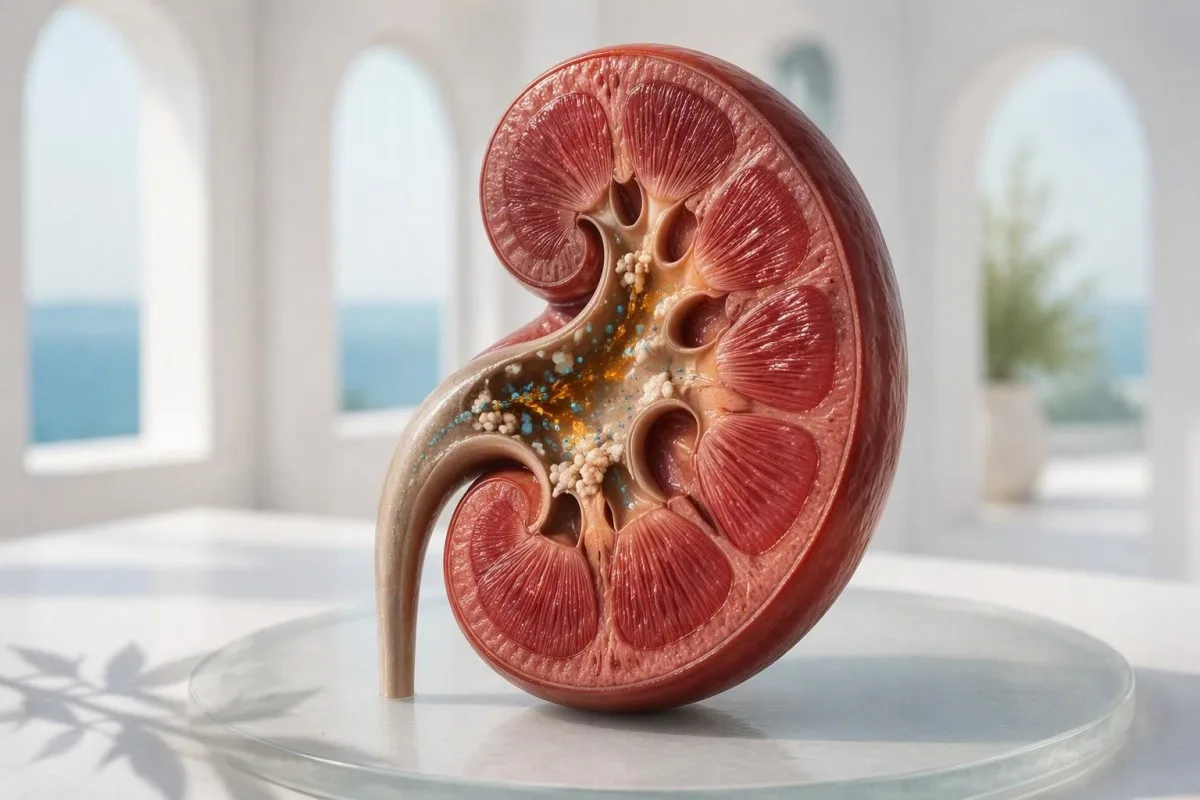
Цитратның аз күрсәткече – үзгәртеп була торган бөер ташлары барлыкка килү куркынычлыгы факторы, үзе генә диагноз түгел. Аннан соңгы файдалы адым – аны сидек күләме, pH, кальций, натрий, оксалат һәм сезнең ташларның анамнезы белән бергә анализлау.


- Гипоцитратурия гадәттә 320 мг/24 сәгатькә кадәр сидек цитратын аңлата, ләкин лаборатория һәм җенес буенча максатлар үзгәрә.
- Сидек цитраты түбән кальций ташларының барлыкка килү куркынычлыгын арттыра, чөнки цитрат ирекле сидек кальцийына бәйләнә һәм кристалл үсешен әкренәйтә.
- Гәмәли максат кабатланучы кальций ташлары булдыручылар өчен, гадәттә, көнгә ким дигәндә 600 мг цитрат, сидек күләме һәм pH белән бергә карала.
- Калии цитраты гадәттә көнгә 30–60 мЭк диетада бүленгән дозаларда билгеләнә; ул калий һәм бөер функциясен күзәтүне таләп итә.
- Диетик эшкәрткеч җимеш-яшелчәләрдән цитратны күтәрә ала, шул ук вакытта бик югары хайван протеины куллану, артык натрий һәм түбән калий куллану аны киметергә мөмкин.
- Хроник эч китү һәм дисталь бөйрек тубуляр ацидозы — югарырак аңлаешлы сәбәпләр, чөнки алар кислота туплануын һәм бөйрәкләр аша эшкәртүне киметеп, ишкәклек югалтуын китереп чыгаралар.
- Туплау сыйфаты мөһим: тән зурлыгына карата 24 сәгать эчендә креатининның түбән булуы тулы булмаган туплауны күрсәтергә мөмкин һәм цитрат нәтиҗәләрен ышанычсыз итәргә мөмкин.
- Ашыгыч бәяләү бөре авырту белән килгән температура, озак дәвам итә торган косу, сидек чыгара алмау яки обструкция шикләнгән бердәнбер эшләп торган бөйрек өчен кирәк.
Сидек цитратының аз күрсәткече чынлыкта нәрсә аңлата
Бөйрәк цитратының түбән булуы, гипоцитратурия дип атала, бу цитратның кальций кристалллары барлыкка килүен тоткарлау өчен бик аз булуын аңлата. Олыларда, күп кенә таш лабораторияләре гипоцитратурияне 24 сәгатьлек туплауда 320 мг азрак дип билгелиләр; кабатланган кальций ташлары булган кеше өчен, мин, әлбәттә, 600 мг яки аннан да күбрәк күрсәткечне теләр идем, әгәр дә сидек pH әле бик югары булмаса.
Цитрат — тукланудан барлыкка килгән һәм бөйрек тубулалары тарафыннан көйләнгән табигый юридик анион. Ул кальций белән комплекслаша, оксалат яки фосфат белән кушылырга мөмкин булган ирекле кальций микъдарын киметә. 180 мг көнлек нәтиҗә — ул бары тик диета исәбе түгел; бу сидек химиясенең үлчәнә торган үзгәреше, ул таныш кальций оксалаты ташлы мохитны уңайлырак итә ала.
Санга бүлүче кирәк: 900 мл тупланган 24 сәгатьлек сидек цитраты нәтиҗәсе 2,8 л сидеккә шул ук цитрат бүлеп чыгарудан аермалы буларак билгеле бер мәгънәгә ия. Түбән күләм таш барлыкка китерүче һәр эретмәне концентрлаштыра, шуңа күрә 24 сәгатьлек сидек җыю буенча кулланма биология нормаль булмаган дип уйлаганчы укылырга тиеш.
2026 елның 20 сентябреннән мин әле дә түбән нәтиҗә аларны лимонад эчәргә һәм эштән китәргә тиеш дип әйткән пациентларны күрәм. Бу киңәш уртача кимчелек өчен акыллы булырга мөмкин, ләкин ул кислота-исәп тоткарлыгын, эчәк авыруларын, дару эффектларын һәм тулы булмаган туплауларны сагына. Томас Клейн, MD, нәтиҗәне аерым диагноз итеп түгел, ә паттерн буенча карау кирәклегенә игътибар итәр иде.
24 сәгатьлек сидек цитраты анализы күрсәткечләре һәм дәвалау максатлары
24 сәгатьлек сидек цитраты тесты, гадәттә, көненә 320 мг азрак дип санала, ләкин профилактик дәвалау максаты еш кына лабораториянең түбән чигеннән югарырак була. Берничә лаборатория җенес буенча аерым чикләр куллана, һәм иң мөһим максат таш составына һәм сидек pHсына бәйле.
Клиник берничә бәяләү өчен цитрат көненә 450 мг күбрәк хатын-кызлар өчен һәм көненә 550 мг күбрәк ир-атлар өчен файдалы, гәрчә ни бу универсаль диагностик чикләр түгел. Америка Урология Ассоциациясе җитәкчелеге тулы метаболик профильне куллануны emphasise итә, бер чикне финал сызык итеп куллануга караганда (Pearle et al., 2014).
Кабатланган кальций оксалаты ташлары өчен, мин еш кына көненә кимендә 600 мг дигән эш максатын талкуем, аны сидек pH ны артык югары күтәрмичә ирешеп булса. Кальций фосфаты ташларын барлыкка китерүчеләрдә, көненә 6,8 артык торыклы сидек pH фосфатның артык концентрлашуын арттыра ала, шуңа күрә күбрәк эшкәртү автоматик рәвештә яхшы түгел; карагыз безнең аңлатмабыз сидек pH паттерннары.
Кантести - ЯИ анализы that can place serum bicarbonate, potassium, calcium, creatinine, and glucose beside a stone-risk panel, but a urine citrate result itself still requires the ordering clinician's interpretation. That distinction matters, because normal serum tests do not exclude a clinically relevant low urinary citrate value.
Why reference intervals differ
Citrate assays and reference populations differ between laboratories, and citrate excretion also tracks body size, diet, and collection quality. A laboratory flag is useful, but the stone-prevention question is whether the measured citrate is adequate for that person's calcium, oxalate, urine volume, and pH profile.
Ни өчен цитрат кальцийлы бөер ташларына каршы саклый
Citrate lowers low citrate kidney stone risk by binding urinary calcium and by directly slowing calcium oxalate crystal nucleation, growth, and aggregation. It is particularly relevant for calcium oxalate stones, which account for roughly 70% to 80% of kidney stones in many adult series.
Chemically, citrate forms soluble calcium-citrate complexes, reducing calcium ion activity rather than merely changing the total calcium number. This is why a person can have normal urine calcium, around 150 mg per day, and still form stones when citrate is 150 mg per day and urine volume is low.
Citrate also creates a less favorable surface for calcium oxalate crystals to stick together. That second effect is easy to overlook: a patient may improve citrate from 220 to 480 mg per day without any visible change in serum calcium, yet their supersaturation calculation can fall materially.
The AUA guideline recommends potassium citrate for recurrent calcium stone formers with low or relatively low urinary citrate (Pearle et al., 2014). In my practice, the combination that concerns me most is citrate below 250 mg per day plus urine volume below 1.5 L per day; together they often explain recurrence better than either finding alone. The companion article on кальций оксалат кристалллары explains why a routine urinalysis cannot quantify this risk.
Тулы булмаган җыю аз цитрат күрсәткеченә китерергә мөмкинме?
Yes—an incomplete or improperly timed 24-hour collection can falsely lower urine citrate, calcium, sodium, oxalate, and total volume together. Before changing medication, clinicians should compare measured urine creatinine with expected daily creatinine excretion for the person's size and muscle mass.
Most laboratories use 24-hour creatinine as a plausibility check, not a perfect lie detector. Roughly 15–20 mg/kg per day in women and 20–25 mg/kg per day in men is often expected, but age, frailty, vegetarian diet, muscularity, and amputation shift that estimate substantially.
A 62-kg woman whose urine creatinine is 450 mg per day may have an incomplete collection, whereas that same value in an older sarcopenic patient may be plausible. One missing morning or post-workout void can meaningfully change a citrate result because excretion varies over the day.
I ask patients to collect on an ordinary workday, maintain their usual food and fluid pattern, and record any missed samples rather than quietly guessing. Review urine creatinine and dilution before interpreting an unexpectedly extreme result; repeating two collections is often more informative than repeating one.
Гипоцитратуриянең диета сәбәпләре
The most common dietary hypocitraturia causes are a high net acid load from animal protein, low fruit and vegetable intake, potassium-poor diets, and low fluid intake. The kidney reabsorbs more citrate during acid stress because citrate can be metabolized to generate bicarbonate.
Animal protein is not forbidden for stone formers, but very high intakes can lower urine pH and citrate while increasing uric acid. A practical first review is portion size: consuming 250–350 g of meat daily while eating few plants can create a substantially different urinary profile than a mixed diet with 75–100 g of protein spread across meals.
Citrus contains citrate, yet the form matters. Lemon and lime juice contain abundant citric acid, but not every commercial lemonade provides meaningful alkali because sugar, dilution, and the accompanying cation alter the effect. Unsweetened lemon juice may help fluid intake, while potassium-rich produce usually has a more dependable alkali effect.
Кантести - AI кан анализы нәтиҗәләрен аңлату платформасы that helps users connect serum potassium, bicarbonate, uric acid, and kidney-function results with dietary patterns, rather than claiming that one food fixes a stone disorder. For realistic meal changes, our kidney nutrition safety guide also covers when potassium-rich foods need supervision in chronic kidney disease.
Сидек цитратын киметә торган метаболик һәм эчәклек шартлары
Chronic diarrhea, inflammatory bowel disease, bowel resection, malabsorption, and distal renal tubular acidosis can cause marked hypocitraturia through bicarbonate loss or sustained acid retention. These causes deserve more attention than diet alone because they can drive recurrent stones despite good hydration.
With chronic loose stools, bicarbonate is lost through the gastrointestinal tract; the kidneys respond by reclaiming citrate, often lowering urine citrate well below 200 mg per day. Fat malabsorption adds a separate calcium oxalate risk because unbound oxalate becomes more available for intestinal absorption.
Distal renal tubular acidosis, especially incomplete distal RTA, classically produces a pattern of urine pH persistently above 5.5, low citrate, calcium phosphate stones, and sometimes low serum bicarbonate. Serum CO2 below 22 mmol/L or potassium below 3.5 mmol/L strengthens the case, but incomplete forms can have normal routine bicarbonate between episodes; our renal tubular acidosis overview explains the work-up.
Sjögren syndrome is one autoimmune condition clinicians consider when distal RTA appears, particularly with dry eyes, dry mouth, low potassium, or recurrent calcium phosphate stones. The association is real but not common enough to screen everyone with a citrate of 290 mg per day; targeted review is more sensible, as discussed in our Sjögren testing article.
Цитратның аз күрсәткече белән бәйле дарулар һәм өстәмәләр
Carbonic anhydrase inhibitors such as topiramate and acetazolamide are classic medication causes of low urine citrate because they alter renal bicarbonate handling. Potassium-wasting diuretics, chronic laxative use, and poorly managed diarrhea can also lower citrate indirectly.
Topiramate can raise urine pH, lower citrate, and increase calcium phosphate stone risk; this is a recognizable pattern rather than a reason to stop an effective neurological medicine without advice. In a patient taking 100 mg twice daily for migraine, I would ask about stone history before treatment and repeat urine chemistry after dose changes or a first stone.
Acetazolamide has a similar acid-base effect, while loop diuretics can increase urinary calcium and thiazides can lower potassium, potentially worsening hypocitraturia if potassium is not replaced. Prescription potassium citrate sometimes offsets this, but serum potassium and creatinine must guide the decision.
Supplements can confuse the picture. High-dose vitamin C, often 1,000 mg daily or more, may increase urinary oxalate in susceptible people rather than correcting low citrate; review our evidence-based kidney supplement safety notes. Never discontinue seizure, glaucoma, or diuretic medication based solely on a home interpretation.
Ташларның куркынычлык панеленең калган өлеше белән цитратны ничек укырга
Low urine citrate is most actionable when interpreted with urine volume, calcium, oxalate, sodium, uric acid, pH, and supersaturation. A citrate value of 280 mg per day carries more risk when paired with 2.8 L of urine calcium or high oxalate supersaturation than when all other values are favorable.
Urine volume is usually the first lever: many stone clinics aim for at least 2.0–2.5 L of urine daily, which commonly requires about 2.5–3.0 L of fluid intake depending on heat and activity. A marathon runner or outdoor worker may need considerably more, and a pale urine color alone does not prove a 24-hour target was met.
Urine sodium above 100 mmol per day often signals an intake that will make hypercalciuria harder to control; sodium-driven calcium excretion can overwhelm a modest improvement in citrate. Urine oxalate above 40 mg per day points toward diet, malabsorption, vitamin C use, or less commonly a primary metabolic disorder.
Кантести AI нигезендәге кан анализы тикшерү коралы can identify related serum clues such as high calcium, low bicarbonate, impaired eGFR, or high uric acid, but it cannot determine stone composition from blood alone. Pair the urine panel with a stone analysis whenever one is available and read the база метаболик панель бөер билгеләре in that context.
Сидек цитратын күтәрә алучы туклану һәм сыеклык чаралары
Increasing fruits and vegetables, reducing excessive sodium and animal-protein load, and producing at least 2 to 2.5 L of urine daily are the safest first measures for mild low urine citrate. These changes should be individualized for people with diabetes, advanced kidney disease, heart failure, or potassium restrictions.
I favor an addition plan over a deprivation plan: add two servings of fruit and three servings of vegetables most days, then reduce the foods displacing them. Melon, bananas, potatoes, beans, squash, leafy greens, oranges, and many legumes provide potassium precursors that tend to generate alkali after metabolism.
Use fluid scheduling rather than thirst alone. A 500 mL drink with breakfast, lunch, dinner, and evening, plus 250–500 mL around exercise, is easier for most patients than carrying an enormous bottle and forgetting it. The goal is measured urine output, not heroic single-day water intake.
Calcium should usually remain in the diet at roughly 1,000–1,200 mg daily with meals; cutting calcium too low can increase intestinal oxalate absorption. People often confuse a calcium oxalate stone with a need for zero calcium, so our guide to stone-related urine crystals is useful before making major dietary restrictions.
Калии цитраты белән дәвалау кайчан кулланыла
Potassium citrate is commonly used for recurrent calcium stones with hypocitraturia, usually starting around 30–60 mEq daily in two or three divided doses. The dose is adjusted to urine citrate, urine pH, tolerance, serum potassium, and kidney function—not simply to eliminate a laboratory flag.
Extended-release tablets are often taken with meals to reduce upper gastrointestinal upset. A clinician may start at 10–20 mEq two or three times daily, then repeat a 24-hour urine study after about 8–12 weeks; doses above 100 mEq per day are uncommon and need careful oversight.
A 2015 Cochrane review found citrate salts reduced recurrent calcium-containing stone events, although the underlying trials varied in quality and treatment adherence was a recurring problem (Phillips et al., 2015). The evidence supports treatment, but it does not tell us that every borderline value requires a prescription.
Potassium citrate is not casual supplementation. It can be unsafe with eGFR below 30 mL/min/1.73 m², baseline hyperkalemia, potassium-sparing diuretics, ACE inhibitors, ARBs, or severe delayed gastric emptying unless the prescriber judges benefits and monitoring appropriate. Our түбән eGFR симптомнары буенча кулланма explains why kidney reserve changes medication choices.
Кайчан аз цитрат урология яки нефрология тикшерүен таләп итә
Specialist follow-up is appropriate after recurrent stones, bilateral stones, a first stone before age 25, calcium phosphate stones, marked hypocitraturia below 100 mg daily, impaired kidney function, or a suspected systemic cause. One uncomplicated first calcium oxalate stone with citrate of 290 mg per day can often begin with primary-care review and a repeat collection.
A urologist can confirm stone type, assess anatomy and obstruction, and decide whether imaging or preventive medication is needed. A nephrologist is particularly valuable when low citrate accompanies metabolic acidosis, potassium abnormalities, reduced eGFR, uncontrolled hypertension, or concern for renal tubular disease.
Thomas Klein, MD, has seen a recurring pattern in stone clinics: patients with three “ordinary” stones over five years are sometimes reassured repeatedly because creatinine is normal. Normal creatinine does not rule out a preventable urine chemistry disorder, particularly in smaller adults or people with preserved filtration despite recurrent obstruction.
Bring the actual 24-hour report, stone analysis, medication list, and a 3-day food record to the appointment. If you use algorithm-assisted interpretation, check how clinical safeguards are applied; our медицина валидация стандартлары describe why results should trigger clinician discussion rather than replace it.
Йөклелек, балалар һәм хроник бөер авыруларында аз цитрат
Low urine citrate in pregnancy, children, or chronic kidney disease needs individualized assessment because standard adult stone-prevention targets and potassium citrate dosing may not apply. Pregnancy changes filtration and urinary mineral handling, while children require weight-based dosing and an inherited-disorder review.
In children with recurrent stones, clinicians look more carefully for cystinuria, primary hyperoxaluria, bowel disorders, and inherited tubular conditions. A single low citrate value can follow a difficult collection day, so pediatric metabolic testing is often repeated with specialist support before labeling a child with a chronic disorder.
Pregnancy does not make flank pain benign. Hydronephrosis can be physiologic, but fever, escalating pain, or reduced urine output needs urgent obstetric and urologic assessment; see our guide to pregnancy kidney filtration changes for context around blood tests.
In chronic kidney disease, dietary potassium increases and potassium citrate may be appropriate for selected patients but can also produce dangerous hyperkalemia. A serum potassium above 5.0 mmol/L, rising creatinine, or use of a renin-angiotensin system blocker warrants prescriber-led planning rather than a generic citrus or supplement protocol.
Диетаны үзгәртү урынына тиз ярдәм таләп итә торган симптомнар
Fever or chills with flank pain, vomiting that prevents fluid intake, inability to pass urine, confusion, or pain in a person with one kidney requires urgent medical assessment. A stone plus urinary obstruction can become an infected obstructed system, which is a time-sensitive emergency even when the urine citrate result is old or incidental.
Seek same-day emergency care for a temperature of 38.0°C or higher with suspected renal colic, especially if there is shaking, weakness, or rapid heart rate. Pain intensity alone is unreliable: a small ureteral stone can hurt severely, while a more dangerous obstructing stone may intermittently hurt less.
Visible blood in urine can occur with a stone, but persistent hematuria still needs assessment after the acute episode resolves. Smoking history, age over 35–40, unexplained weight loss, or repeated blood without documented stones broadens the evaluation; our сидектәге кан турында кулланма explains the usual testing pathway.
Do not use leftover antibiotics, high-dose sodium bicarbonate, or unlimited potassium supplements to self-treat a suspected stone. If you have diabetes, immunosuppression, a solitary kidney, pregnancy, or known CKD, the threshold for urgent assessment should be lower.
Аз цитрат күрсәткеченнән соң 90 көнлек гамәли план
After a reliable low citrate result, the usual next step is to address fluid, diet, medications, and possible acid-base causes, then repeat a 24-hour urine panel in about 8 to 12 weeks. A repeat test should be done on the plan you can actually sustain, not during an unusually strict “perfect week.”
First, confirm collection completeness and obtain stone analysis if a specimen exists. Second, aim for urine output of at least 2.0–2.5 L daily, add plant-based potassium sources if medically safe, moderate sodium, and review medication contributors with the prescriber. Third, check serum bicarbonate, potassium, calcium, creatinine/eGFR, and uric acid when the clinical picture suggests an underlying disorder.
At the repeat test, compare citrate, volume, pH, sodium, calcium, oxalate, uric acid, and supersaturation rather than celebrating one improved number. For example, citrate rising from 180 to 520 mg per day is encouraging, but a simultaneous urine pH of 7.1 in a calcium phosphate stone former calls for a different conversation.
Kantesti, табиблар күзәтүе астында эшләнгән AI лаборатория тестларын аңлату хезмәтендә басылып чыга, can organize the blood-side trends and generate questions for your clinician across 75+ languages, while the stone-risk panel remains a specialist-guided urine test. Our медицина консультатив советы reviews the clinical principles behind these safety boundaries; treatment decisions belong with the clinician who knows your stone type, medicines, and kidney function.
Еш бирелә торган сораулар
Сидек цитратының нинди дәрәҗәсе түбән дип санала?
Йөгергән тизекта цитратның 24 сәгать эчендә 320 мг тан ким булуы, олыларда еш кына гипоцитратурия дип атала, шуңа да карамастан, һәр лаборатория төрле сылтама интервалларын куллана. Кабат кальций ташларыннан саклану өчен, клиницистларның күбесе, тизек рН һәм таш төре рөхсәт иткәндә, көненә кимендә 600 мг максат итеп куялар. Көненә 200–319 мг нәтиҗәсе еш кына гади, үзгәртелә торган җитешмәү, ә 100 мг тан кимрәк кыйммәт хроник кислота тоткарлану, эчәклек югалту, даруларның тәэсире яки җыю хатасын җентекләп эзләүгә китерә. Нәтиҗә һәрвакыт тизек күләме, рН, кальций, оксалат, натрий һәм таш составы белән бергә укылырга тиеш.
Сидек цитратының түбән булуы бөер ташларына китерергә мөмкинме?
Сидек цитратының түбән булуы кальций бөер ташлары ясалу куркынычлыгын арттыра, чөнки цитрат ирекле кальцийны бәйли һәм кальций оксалаты кристаллының үсүен һәм агрегациясен әкренләтә. Бу гарантия түгел, ә куркынычлык факторы: көнгә 320 мг дан азрак цитраты булган кайбер кешеләрдә беркайчан да ташлар барлыкка килми, шул ук вакытта башкаларда ташлар барлыкка килә, чөнки түбән цитрат түбән сидек күләме, югары оксалат яки югары сидек кальцийы белән берләшә. Цитрат көнгә 250 мг дан һәм сидек күләме көнгә 1,5 л дан ким булганда куркынычлык еш кына иң югары була. Таш анализы һәм тулы 24 сәгатьлек сидек панеле кайсы комбинация кулланылганын ачыклый.
Лимон согы уринадәге цитратны күтәрәме?
Шикәрсез лимон яки лайм согы кайбер кешеләргә сыеклыкны арттырырга ярдәм итә ала һәм сидек химиясен уртача яхшырта ала, ләкин ул гипоцитратурияне ышанычлы төзәтми. Цитрус соклары лимон кислотасын үз эченә ала, шул ук вакытта калий цитраты сидек цитратын күбрәк көтелгәнчә күтәрә торган ишле йөк бирә. Практик ризык-кабарынгы якын килү - җимешләр һәм яшелчәләрне арттыру, көненә ким дигәндә 2,0–2,5 л сидек чыгарганда, табиб сыеклыкны яки калийны чикләмәсә. Шикәрле лимонад бөер ташларын дәвалау түгел һәм еш кулланганда метаболик куркынычны начарлатырга мөмкин.
Сидекни киметә торган нинди дарулар бар?
Топирамат һәм ацетазоламид сидек цитратының аз булуының яхшы билгеле сәбәпләре булып тора, чөнки алар бөер бикарбонат белән эш итүен үзгәртәләр һәм сидек рН-ын күтәрә алалар. Петле диуретиклары сидек кальцийын арттырырга мөмкин, шул ук вакытта калийны югалтучы диуретиклар, әгәр алар сыворотка калийын киметсәләр, индирект рәвештә ярдәм итә алалар. Хроник эчәклек куллану һәм даими эч китүгә китергән дарулар да гастроинтестиналь бикарбонат югалту аша цитратны киметергә мөмкин. Цитрат нәтиҗәсе өчен билгеләнгән даруны туктатмагыз; кабат сидек тикшерү, калийны алыштыру яки профилактик терапия кирәклеге турында билгеләүчене сорагыз.
Калий цитраты ничек тиз эшли?
Калилий цитраты сидек pH-ын һәм цитрат бүленеп чыгуын берничә көн эчендә үзгәртә башлый, ләкин табиблар гадәттә 8–12 атна дәвамында даими дозада куллангач, тулы 24 сәгатьлек сидек профилен кабатлыйлар. Гадәти башлангыч дозалар тәүлегенә 30–60 мЭкны тәшкил итә, ризык белән бүленеп бирелә, аннары сидек цитраты, pH, сарык калийы һәм бөер функциясе буенча көйләнә. Максат - мөмкин кадәр югары цитрат кыйммәтенә ирешү түгел, чөнки 6,8 тирәсеннән югарырак сидек pH кальций фосфат ташлары булдыручылар өчен файдасыз булырга мөмкин. Ашказаны-эчәклек ягыннан тискәре йогынтылар һәм калий күтәрелүе дозаны көйләргә кирәк булырга мөмкин булган төп сәбәпләр булып тора.
Цитрат аз булганда кайчан бөер ташлары буенча белгечкә күренергә кирәк?
Кабатланучы ташлар, ике яклы ташлар, 25 яшькә кадәрге ташлар, кальций фосфат ташлары, көнгә 100 мг дан азрак цитрат, түбәнәйтелгән eGFR, түбән кан бикарбонаты яки калий аномалияләре булганда уролог яки нефрологка мөрәҗәгать итегез. Эчәк операциясеннән, хроник диареядан яки топирамат куллангач ташлар кабатланса, махсус экспертиза да акыллы. 1,5°C яки югарырак температура, янбаш авыртуы, косу, сидек чыгара алмау яки бер бөерле кешедә симптомнар булганда, гадәти махсус очрашу урынына ашыгыч ярдәм кирәк. Беренче гади булмаган таш, цитраты бераз түбән булган очракта, еш кына беренчел сәламәтлек саклау тикшерүеннән һәм кабат җыюдан башланырга мөмкин.
Бүген үк AI белән эшләнгән кан анализы тикшерүе
Дөнья буенча 2 миллионнан артык кулланучы кушылыгыз: алар Kantestiны тиз һәм төгәл лаборатория анализы өчен ышана. Кан анализы нәтиҗәләрегезне йөкләгез һәм 15,000+ биомаркерларын секундлар эчендә тулы аңлатма белән алыгыз.
📚 Сылтама бирелгән тикшеренү басмалары
Klein, T., Mitchell, S., & Weber, H. (2026). Klein, T. (2026). BUN/Creatinine Ratio Explained: Kidney Function Test Guide. Zenodo. DOI: 10.5281/zenodo.18207872. Kantesti AI медицина тикшеренүе.
Klein, T., Mitchell, S., & Weber, H. (2026). Klein, T. (2026). Urobilinogen in Urine Test: Complete Urinalysis Guide 2026. Zenodo. DOI: 10.5281/zenodo.18226379. Kantesti AI медицина тикшеренүе.
📖 Тышкы медицина белешмәләре
⚕️ Медицина кисәтүе
Бу мәкалә бары тик белем бирү максатларында гына һәм медицина киңәше булып тормый. Диагноз һәм дәвалау карарлары өчен һәрвакыт квалификацияле сәламәтлек саклау белгеченә мөрәҗәгать итегез.
E-E-A-T ышаныч сигналлары
Тәҗрибә
Табиб җитәкчелегендә лаборатория нәтиҗәләрен аңлату эш процессларын клиник тикшерү.
Белгечлек
Лаборатория медицинасы: биомаркерларның клиник контекстта үз-үзләрен тотышын аңлау.
Авторититет
Доктор Томас Кляйн тарафыннан язылган, доктор Сара Митчелл һәм профессор доктор Ханс Вебер тарафыннан тикшерелгән.
Ышанычлылык
Ачык күзәтү юллары белән куркуны киметү өчен дәлилләргә нигезләнгән аңлату.