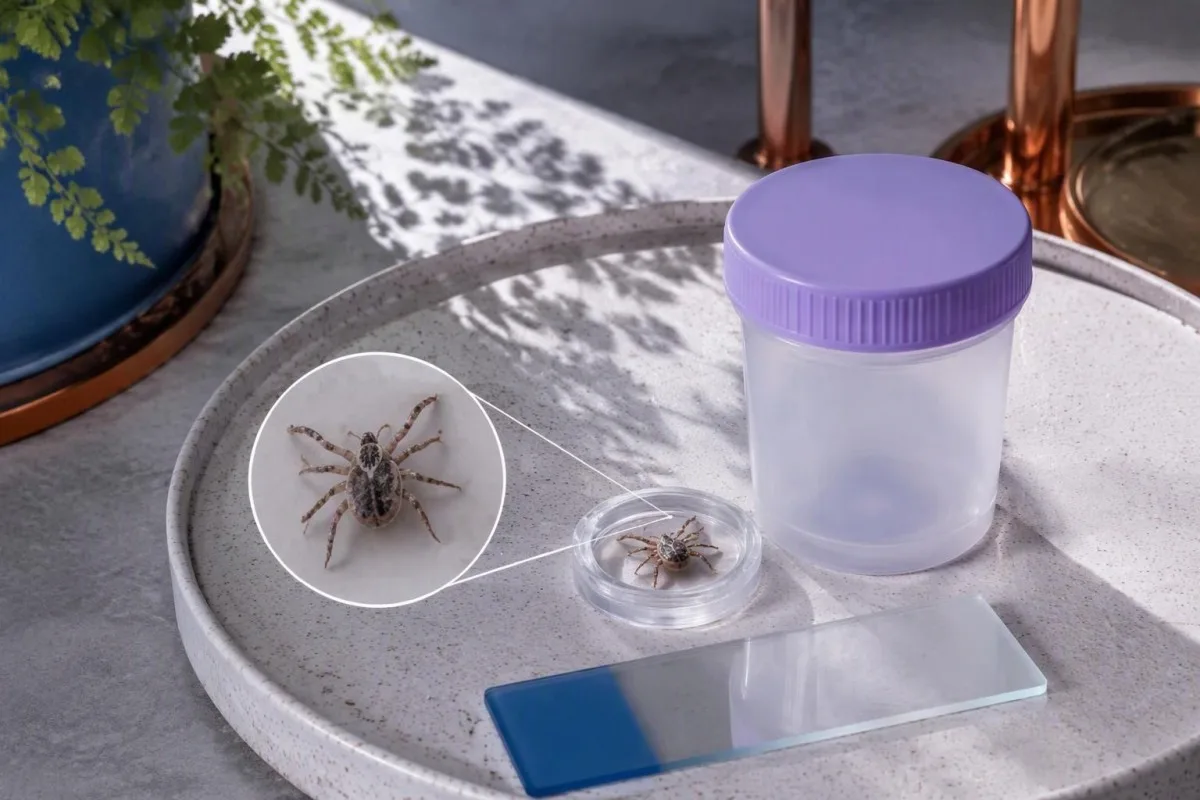
PCR detects bacterial DNA; antibody tests measure a slower immune response. Early illness and antibiotics can make these results disagree, so treatment sometimes starts before confirmation.


- Ehrlichiosis test results can disagree because PCR detects bacterial DNA while antibodies develop later; neither an early negative antibody test nor a negative PCR safely excludes suspected illness.
- PCR timing is most favorable during the first week of symptoms, and sensitivity decreases within 48 hours of appropriate antibiotics.
- Early IgG is frequently below 1:64 during the first week; a negative result at that point is not reassuring by itself.
- Paired antibody tests use an acute sample collected within the first 2 weeks and a convalescent sample collected 2–10 weeks later.
- Fourfold IgG rise means an increase such as 1:64 to 1:256 and provides evidence of recent infection when interpreted with the clinical picture.
- Single IgG titer of at least 1:128 is presumptive laboratory evidence under CDC guidance, not proof of active infection or a measure of severity.
- Дәвалану ваыты depends on clinical suspicion, not waiting for confirmation; doxycycline is first-line treatment for adults and children of all ages.
- After a tick bite without symptoms, routine ehrlichiosis testing and preventive antibiotics are not recommended; monitor for illness over the following 2 weeks.
Why can ehrlichiosis PCR and antibody results disagree?
Ehrlichiosis test results disagree because PCR and antibodies measure different stages of illness. PCR can become positive before IgG develops, while IgG can remain positive after bacterial DNA is no longer detectable; antibiotics can also make PCR negative quickly.
A positive PCR with negative IgG during the first week fits early ehrlichiosis. The reverse pattern—negative PCR with positive IgG—has several explanations, including later sampling, treatment before collection, previous exposure, or antibody cross-reactivity; it does not automatically mean the laboratory made a mistake.
I am Thomas Klein, MD, Chief Medical Officer at Kantesti, and the first thing I look for is the sequence of events: symptom onset, sample collection, and the first antibiotic dose. Those 3 dates often explain more than the red or green flag beside a result.
Consider a hypothetical adult with fever on Monday, doxycycline started Tuesday, and laboratory collection Thursday: a negative PCR on Thursday cannot be interpreted like a negative sample collected before treatment. Our explanation of уңай антитела нәтиҗәләре separates immune memory from evidence of current illness.
Кантести - ЯИ анализы that can help organize an ehrlichiosis report alongside CBC and liver results, but it cannot exclude this illness from a negative test. Our оешма һәм клиник юнәлеш describe the service; suspected acute ehrlichiosis still needs a clinician, sometimes before any laboratory result returns.
When should you test after a tick bite?
Ehrlichiosis testing after a tick bite is generally guided by symptoms, not the bite date alone. Symptoms commonly begin 5–14 days after an infected tick bite, and testing an otherwise well person immediately after exposure does not reliably predict whether illness will develop.
The testing clock starts with illness day 1, meaning the first day of fever or compatible symptoms—not necessarily the day a tick was discovered. Someone bitten 10 days ago but febrile for only 2 days is still early in the diagnostic window.
No remembered bite does not rule out ehrlichiosis. A clinician should ask about outdoor exposure during the preceding 2 weeks, travel, gardening, and contact with tick habitats; small ticks can go unnoticed, and patients may remember the walk but not the bite.
An immediate negative antibody result after an asymptomatic bite is not a useful clearance certificate. CDC guidance recommends watching for symptoms for 2 weeks rather than routine testing or preventive doxycycline for ehrlichiosis; Lyme disease prevention rules should not be transferred to a different infection.
A tick exposure can also lead to a different problem: delayed allergic reactions after mammalian meat suggest alpha-gal allergy after ticks, not the usual ehrlichiosis pattern. Fever, headache, muscle aches, or gastrointestinal symptoms developing 5–14 days after exposure warrant prompt medical assessment instead.
What does an ehrlichiosis PCR test detect?
Бер ehrlichiosis PCR test detects Ehrlichia DNA, usually in whole blood, and is most sensitive during the first week of illness. A positive result strongly supports the diagnosis in a compatible clinical setting, but a negative result cannot reliably exclude ehrlichiosis.
CDC's diagnostic guidance specifies whole-blood PCR and warns that sensitivity decreases within 48 hours of appropriate antibiotics (CDC, 2024a). The sample must meet the receiving laboratory's requirements; serum saved for antibody testing should not automatically be assumed suitable for the molecular assay.
A PCR panel is only as broad as its target list. Ask whether the assay detects E. chaffeensis, E. ewingii, and other locally relevant species; a report with 1 negative organism name is not necessarily a negative test for every cause of ehrlichiosis.
A qualitative PCR usually reports detected or not detected rather than a standardized bacterial burden. If a laboratory provides a cycle-threshold value, I would not use that number alone to grade severity or compare 2 laboratories, because extraction methods and assay targets differ.
Timing also affects molecular testing for other infections, as our explanation of PCR windows and false negatives illustrates. The transferable principle is to document specimen type and treatment exposure; the actual useful window differs by organism, so a 7-day rule for ehrlichiosis should not be generalized.
How do antibiotics change ehrlichiosis detection?
Doxycycline can reduce PCR sensitivity within 48 hours of treatment, so a negative result after antibiotics has less exclusion value than a pretreatment result. Collect samples before the first dose when practical, but never postpone necessary treatment just to preserve a testing window.
“ appropriate antibiotics matters: it means treatment active against Ehrlichia, not simply any prescription labeled an antibiotic. Record the medication name, dose, first-dose time, and number of doses taken before collection; 2 days of doxycycline and 2 days of an unrelated antibiotic are different histories.
A pretreatment sample is helpful, but speed wins when the patient is unwell. If sample collection would delay treatment by several hours, a clinician can treat first and document the exposure, then use the later antibody sample and clinical course to complete the assessment.
Early treatment can complicate interpretation of later antibody patterns, but there is no dependable rule saying a certain number of doxycycline doses prevents seroconversion. Do not cancel the planned convalescent sample simply because treatment began on illness day 2; an absent rise still needs clinical interpretation.
Stopping doxycycline for 24–48 hours to make PCR positive again is not an appropriate diagnostic strategy. Our discussion of medication effects on test timing explains why treatment timestamps belong beside laboratory values; a deliberately untreated interval can expose someone to avoidable deterioration.
How should you read Ehrlichia antibody titers?
Ehrlichia antibody titers are usually interpreted using IgG indirect fluorescent antibody testing. A titer describes the greatest serum dilution that remains reactive; a single IgG titer of at least 1:128 is presumptive evidence under CDC guidance, not confirmation of a new active infection.
Нәтиҗә 1:256 means reactivity persisted at a dilution of 1 part serum in 256 total parts. It is not a concentration in mg/dL, and a person with 1:512 is not automatically twice as ill as someone with 1:256.
CDC notes that IgG titers are frequently below 1:64 during the first week of illness (CDC, 2024a). Laboratories may label 1:64 borderline, equivocal, or positive according to their own validated criteria, so the report's method and reference interval must travel with the number.
IgM is not a reliable marker of recent ehrlichiosis and should not be used alone to make the diagnosis. An isolated IgM positive on day 3 can be misleading; a compatible syndrome, early PCR, and paired IgG testing provide a more defensible interpretation.
Persistent IgG can remain elevated for many months, and persistent antibodies without new symptoms do not justify another antibiotic course. The distinction between a dilution endpoint and active disease also appears in our guide to interpreting bacterial antibody titers, although each organism has different diagnostic criteria.
Why are two antibody samples better than one?
Paired IgG samples can demonstrate a new immune response that a single positive result cannot establish. CDC recommends an acute sample within the first 2 weeks of illness and a convalescent sample 2–10 weeks later, looking for a fourfold rise in titer.
Классик мисал — 1:64 followed by 1:256: that is a fourfold rise and supports recent infection. By contrast, 1:128 followed by 1:256 is only a twofold rise, equivalent to 1 standard dilution step, and does not meet the fourfold criterion.
Куллану same laboratory and assay reduces avoidable comparison problems. Two numbers from different methods may look comparable but reflect different antigen preparations, reading techniques, or reporting thresholds; ask whether the laboratory can test the 2 specimens together if interpretation is uncertain.
A baseline reported as below 1:64 is a censored value, not a measured zero. When the later sample becomes clearly positive, the laboratory and clinician should apply the assay's seroconversion criteria rather than inventing a numerical fold rise from an unknown starting concentration.
Arrange the second collection before the patient leaves the first visit; otherwise the 2–10-week window is easily missed once fever resolves. Our explanation of paired infection antibody patterns discusses the broader reasoning, but Q fever's phase-specific antibodies should not be confused with Ehrlichia IgG.
Can Ehrlichia antibodies cross-react with other infections?
Ehrlichia and Anaplasma antibodies can cross-react because related organisms share antigens. A positive antibody result therefore may not identify the exact organism, and many commercial laboratories cannot reliably distinguish Ehrlichia species through serology alone.
Where ehrlichiosis and anaplasmosis both occur, CDC recommends testing antibodies against both organisms side by side. If 2 assays are positive, the result may reflect cross-reactivity rather than 2 separate infections; species-specific PCR collected early is often more useful for identifying the cause.
A lone low-positive antibody result carries less weight when there is no fever, no compatible exposure, and normal supporting tests. The same titer of 1:128 means something different in an acutely febrile patient after tick exposure than in an otherwise well person tested months later.
Кантести - AI кан анализы нәтиҗәләрен аңлату платформасы that helps place reported titers beside collection dates and other laboratory findings. Our AI кан анализы нәтиҗәләрен ничек укырга методологиясе аша күрә аласыз. explains the approach, but software cannot determine the infecting species from 1 cross-reactive antibody result or compensate for an assay's missing targets.
False-positive and persistent antibody patterns are not unique to tick-borne infections; antibody timing and persistence provides another example. For ehrlichiosis, ask 3 concrete questions: which antigen was used, whether Anaplasma was tested, and whether the result represents new change or an isolated finding.
Which CBC and liver results support suspected ehrlichiosis?
Leukopenia, thrombocytopenia, and elevated liver aminotransferases commonly support suspected ehrlichiosis, particularly with fever and tick exposure. These abnormalities are not specific, and normal results early in illness do not exclude the diagnosis.
A hypothetical panel showing WBC 2.8 × 10⁹/L, platelets 88 × 10⁹/L, and AST 96 U/L deserves more attention when it accompanies new fever after outdoor exposure. Each value has other possible causes; together, the pattern raises concern for a systemic illness rather than an isolated minor abnormality.
A low WBC does not argue against infection. Our explanation of WBC һәм CRP күрсәткечләренең туры килмәве shows why an inflammatory illness need not produce leukocytosis; for ehrlichiosis, the direction and rate of change over 24–48 hours may be more informative than one result.
AST and ALT elevations indicate cellular injury but do not, by themselves, establish impaired liver function. An AST of 96 Ед/л with a laboratory upper limit of 40 U/L is about 2.4 times that limit; bilirubin, coagulation results, medication exposure, and symptoms help assess the broader picture.
Avoid calculating chronic liver fibrosis scores during an acute febrile illness when platelets and AST are temporarily abnormal. Our liver panel terminology guide separates injury markers from other measurements; repeating appropriate tests after recovery is often more useful than assigning a chronic diagnosis from 1 acute panel.
Can a blood smear diagnose ehrlichiosis?
A blood smear may show morulae—clusters of organisms inside white cells—but a negative smear does not exclude ehrlichiosis. Microscopy is less sensitive than preferred molecular testing, and the appearance alone may not reliably distinguish all related organisms.
E. chaffeensis typically forms morulae in моноцитлар, whereas E. ewingii can involve granulocytes; Anaplasma phagocytophilum also affects granulocytes. That distinction is useful educationally, but a single suspicious inclusion should prompt confirmatory testing rather than an overconfident species label.
Timing, organism burden, slide preparation, and the observer's experience affect detection. A smear collected on illness day 4 that does not show morulae cannot substitute for whole-blood PCR, and treatment should not wait for a specialist to find a diagnostic-looking cell.
A smear can answer a separate practical question: is a low platelet count real? If a report flags clumping beside a platelet count of 70 × 10⁹/L, review for EDTA тромбоцитларның төркемләнеп ябышуы; the laboratory may need another collection using an alternative anticoagulant.
Artifact and genuine illness can coexist. I would not dismiss fever because clumping explains 1 abnormal number, nor assume every low platelet result is caused by Ehrlichia; the smear, repeat count, medication history, and other CBC components each answer different parts of the problem.
Why start treatment before laboratory confirmation?
Suspected ehrlichiosis may require immediate doxycycline because delayed treatment can allow severe disease, while early tests can be negative. The CDC treatment guideline explicitly advises against waiting for confirmation when the clinical picture supports a tick-borne rickettsial illness.
Biggs and colleagues' 2016 MMWR guideline emphasizes early empiric doxycycline for suspected ehrlichiosis and related illnesses (Biggs et al., 2016). This is not treating every tick bite; it is treating a compatible acute syndrome before imperfect laboratory timing creates an unsafe delay.
CDC's usual doxycycline dose is 100 mg every 12 hours for adults; children weighing under 45 kg receive 2.2 mg/kg per dose every 12 hours, with a maximum of 100 mg per dose (CDC, 2024b). These are clinician-prescribed regimens, and severe illness may require intravenous treatment or hospitalization.
CDC recommends treatment for at least 5–7 days and until 72 hours after fever subsides, with clinical improvement. Fever often improves within 24–48 hours, but improvement alone is not proof of ehrlichiosis, and absence of improvement should prompt reassessment rather than an automatic extension of the same diagnosis.
Doxycycline does not treat every infection associated with ticks. Persistent fever, anemia, or evidence of hemolysis may justify evaluation for active Babesia infection, depending on exposure geography; a positive Ehrlichia antibody result should not stop the search for an alternative or additional cause.
Which symptoms and results need urgent assessment?
Confusion, breathing difficulty, fainting, new significant bleeding, or markedly reduced urine output require urgent assessment when ehrlichiosis is possible. Seek same-day care for compatible fever after tick exposure; do not wait for PCR, antibody results, or a rash to appear.
A rash is not a required feature: CDC reports it in fewer than 30% of adults and up to 60% of children. A febrile adult without a rash can still have ehrlichiosis, and waiting for a skin change may waste the period when treatment is most effective.
The pace of deterioration matters more than a standalone cutoff. A platelet fall from 160 to 75 × 10⁹/L over 48 hours, coupled with confusion or low blood pressure, warrants urgent evaluation even if the PCR result is pending; the same value in a stable chronic condition has different implications.
Severe ehrlichiosis can involve organ dysfunction or coagulation abnormalities, but no 1 routine test establishes the cause. Our discussion of DIC laboratory patterns explains why platelets, fibrinogen, clotting times, and the clinical condition must be assessed together rather than interpreted as independent flags.
Procalcitonin, CRP, and D-dimer cannot reliably distinguish ehrlichiosis from every other systemic illness. The коагуляцияне тикшерү буенча кулланма provides measurement context, but someone becoming confused or breathless needs immediate clinical care—not another 24 hours of home monitoring while an antibody panel is processed.
Does interpretation change in children or higher-risk patients?
Children, older adults, and immunocompromised patients need particularly careful clinical assessment, because severe illness may develop and antibody responses can be less dependable in immunosuppression. Doxycycline remains first-line treatment for suspected ehrlichiosis in children of all ages.
The old assumption that doxycycline must always be avoided under age 8 should not delay treatment of suspected ehrlichiosis. CDC and the American Academy of Pediatrics support doxycycline for suspected tick-borne rickettsial disease in children of all ages; the immediate infection risk changes the usual prescribing calculation.
Pregnancy needs urgent individualized prescribing, not an automatic instruction to withhold treatment. Tell the clinician the gestational age and any antibiotic allergy; evidence for alternative regimens is limited, so an infectious-disease specialist may be needed rather than choosing a substitute from 1 online dosing table.
An immunocompromised patient may not produce the expected fourfold antibody rise, and a negative convalescent result requires caution. Include transplant medicines, chemotherapy, and immune-suppressing treatment in the history; Kantesti's privacy and data practices explain handling of uploaded reports, but acute-risk decisions must remain with the treating team.
Travel can change the differential diagnosis completely. Fever after visiting a malaria-endemic area requires urgent evaluation even if a tick was also found; our explanation of malaria testing after travel describes why an initial negative test may need repeat assessment, commonly over 2–3 specimen collections under clinical guidance.
What should you do when results return or symptoms persist?
Follow-up should reconcile the test method, illness day, antibiotic exposure, and clinical response, rather than treating a positive or negative label in isolation. Persistent symptoms require reassessment; persistently positive IgG without new illness does not, by itself, justify additional antibiotics.
Build a 5-item result checklist: first symptom date, collection date, specimen type, exact assay target, and treatment before collection. Add the laboratory's titer reference interval; screenshots that omit these details can make an otherwise clear report surprisingly difficult to interpret.
A negative pretreatment PCR on illness day 3 lowers confidence differently from a negative PCR after 3 days of doxycycline, but neither is an absolute rule-out. Ask the clinician what alternative diagnoses are being considered and whether paired IgG testing will help resolve the remaining uncertainty.
CBC and liver results should be followed according to severity, sometimes within 24–48 сәгать during acute illness and later during recovery. Our guide to хастаханәдән чыкканнан соң анализ күрсәткечләренең үзгәрүе турындагы аңлатмабыз explains why improving trends may lag behind symptom improvement; persistent abnormalities deserve a broader review rather than a presumed chronic infection.
My advice as Thomas Klein, MD, is to ask 2 questions: what needs action now, and what will the next specimen actually clarify? Kantesti's медицина буенча киңәш бирүче командасын supports our clinical focus, but an AI explanation should never be used to stop prescribed doxycycline or delay reassessment when fever persists beyond the expected 24–48-hour response.
Фәнни басмалар һәм ИИ интерпретациясе чикләре
AI interpretation can organize ehrlichiosis reports, but it cannot independently confirm or exclude the infection. As of October 18, 2026, the practical diagnostic approach described here remains grounded in CDC testing guidance and the 2016 tick-borne rickettsial disease guideline, not a claimed 2026 diagnostic breakthrough.
Кантести - AI нигезендәге кан анализы тикшерү коралы that can help explain why PCR, IgG, platelets, and liver measurements tell different parts of the story. A report collected after 48 hours of doxycycline still needs that treatment context; pattern interpretation cannot recover bacterial DNA that the assay did not detect.
The supplied technical benchmark describes 100,000 синтетик тест очрагы, not 100,000 patients with suspected ehrlichiosis. Synthetic benchmark performance should not be presented as clinical sensitivity, specificity, or evidence that an AI system can safely rule out tick-borne infection; our раслау һәм клиник стандартлар provide additional methodological context.
The 2 research records listed below concern the interpretation engine and a validation framework. They are separate from the external medical references supporting PCR timing, paired IgG testing, and treatment; search links to ResearchGate and Academia.edu are discovery aids, not claims of publication, peer review, or endorsement on those sites.
For an individual patient, 3 pieces of information remain indispensable: exposure history, the course of symptoms, and treatment timing. Even a technically well-structured explanation must yield to bedside assessment when the patient is deteriorating, because a negative laboratory result can coexist with clinically significant early ehrlichiosis.
Еш бирелә торган сораулар
Антителалар тискәре булганда, эрлихиозга ПЦР анализы уңай нәтиҗә бирә аламы?
0 Әйе. Эрлихиозга ПЦР анализы IgG антитәнчекләре ачыклана башлаганчы ук, бигрәк тә симптомнарның беренче атнасында, уңай нәтиҗә күрсәтергә мөмкин. CDC мәгълүматларына караганда, бу иртә чорда IgG титрлары еш кына 1:64тән түбән була. Клиник күренешләргә туры килгән очракта ПЦРның уңай нәтиҗәсе диагнозны раслый, һәм антитәнчекләрнең уңай нәтиҗә күрсәтүен көтеп, дәвалауны кичектерергә ярамый.
Тискәре эрлихиоз ПЦР-тесты инфекцияне кире кагамы?
Тискәре эрлихиоз ПЦР-тесты инфекция булуын кире какмый. ПЦР авыруның беренче атнасында иң сизгер була, ә тиешле антибиотиклар белән дәвалау башланганнан соң 48 сәгать эчендә сизгерлеге кими. Үрнәк төре, тестның максатлары һәм үрнәкне алу вакыты да ачыклау мөмкинлегенә йогынты ясый. Симптомнар һәм йогыш чыганагы белән бәйле анамнез эрлихиозны раслый торган булып калса, табиб дәвалауны дәвам итә һәм IgG-антитәнчекләргә парлы анализ үткәрүне оештыра ала.
Ehrlichia IgG титры 1:128 булу нәрсәне аңлата?
Ehrlichia IgG титрының 1:128 булуы CDCның лабораториядә фараз итәргә нигез бирә торган чигенә туры килә, ләкин үзе генә яңа актив инфекцияне расламый. Нәтиҗә күптән түгел кичерелгән авыруны, элек булган йогышны яки туган микроорганизмнар белән үзара реактивлыкны күрсәтергә мөмкин. Дөрес вакытта алынган парлы үрнәкләрдә титрның дүрт тапкыр артуы, мәсәлән, 1:128 дән 1:512 гә кадәр, күптән түгел булган инфекцияне көчлерәк дәлилли. Титр авыруның авырлыгын күрсәтми.
Эрлихиягә антителаларга тестны кайчан кабат үткәрергә кирәк?
0 CDC авыруның беренче 2 атнасында алынган кискен чор үрнәге һәм 2–10 атнадан соң алынган реконвалесцент чор үрнәге белән парлы Ehrlichia IgG тестын үткәрергә киңәш итә. Антитәнчекләр титрының дүрт тапкыр артуы, мәсәлән, 1:64 тән 1:256 га кадәр, күптән түгел булган инфекцияне раслый. Чагыштыруның ышанычлырак булуы өчен бер үк лабораторияне һәм анализ ысулын куллану мөһим. Антитәнчекләрне кабат тикшерү эпизодны ретроспектив рәвештә расларга ярдәм итә; алар кискен авыруда шик туганда дәвалауны кичектерергә тиеш түгел.
Should I get an ehrlichiosis test immediately after a tick bite?
Routine ehrlichiosis testing is not recommended immediately after a tick bite if you have no symptoms. Symptoms commonly develop 5–14 days after an infected bite, and an early negative test cannot predict whether illness will develop. Monitor for fever, headache, muscle aches, or gastrointestinal symptoms over the following 2 weeks and seek prompt care if they appear. Preventive antibiotics are not recommended specifically to prevent ehrlichiosis after an asymptomatic bite.
Why would a doctor prescribe doxycycline before ehrlichiosis results return?
A doctor may prescribe doxycycline before results return because early ehrlichiosis tests can be negative and delaying treatment can allow severe illness. CDC recommends prompt treatment when the symptoms and exposure history support suspected ehrlichiosis, including in children of all ages. Fever often improves within 24–48 hours after appropriate treatment, although this response does not prove the diagnosis. Persistent fever, confusion, breathing difficulty, or worsening laboratory abnormalities require reassessment.
Бүген үк AI белән эшләнгән кан анализы тикшерүе
Дөнья буенча 2 миллионнан артык кулланучы кушылыгыз: алар Kantestiны тиз һәм төгәл лаборатория анализы өчен ышана. Кан анализы нәтиҗәләрегезне йөкләгез һәм 15,000+ биомаркерларын секундлар эчендә тулы аңлатма белән алыгыз.
📚 Сылтама бирелгән тикшеренү басмалары
Klein, T., Mitchell, S., & Weber, H. (2026). Kantesti Кан анализын аңлату двигателе өчен 100 000 синтетик тест очрагы буенча алдан теркәлгән, рубрика нигезендәге автоматлаштырылган техник бенчмарк. Kantesti AI медицина тикшеренүе.
Klein, T., Mitchell, S., & Weber, H. (2026). Клиник валидацияләү структурасы v2.0 (Медицинаны валидацияләү бите). Kantesti AI медицина тикшеренүе.
📖 Тышкы медицина белешмәләре
Centers for Disease Control and Prevention (2024a). Clinical Testing and Diagnosis for Ehrlichiosis. CDC Ehrlichiosis Clinical Guidance.
Centers for Disease Control and Prevention (2024b). Clinical Care of Ehrlichiosis. CDC Ehrlichiosis Clinical Guidance.
⚕️ Медицина кисәтүе
Бу мәкалә бары тик белем бирү максатларында гына һәм медицина киңәше булып тормый. Диагноз һәм дәвалау карарлары өчен һәрвакыт квалификацияле сәламәтлек саклау белгеченә мөрәҗәгать итегез.
E-E-A-T ышаныч сигналлары
Тәҗрибә
Табиб җитәкчелегендә лаборатория нәтиҗәләрен аңлату эш процессларын клиник тикшерү.
Белгечлек
Лаборатория медицинасы: биомаркерларның клиник контекстта үз-үзләрен тотышын аңлау.
Авторититет
Доктор Томас Кляйн тарафыннан язылган, доктор Сара Митчелл һәм профессор доктор Ханс Вебер тарафыннан тикшерелгән.
Ышанычлылык
Ачык күзәтү юллары белән куркуны киметү өчен дәлилләргә нигезләнгән аңлату.