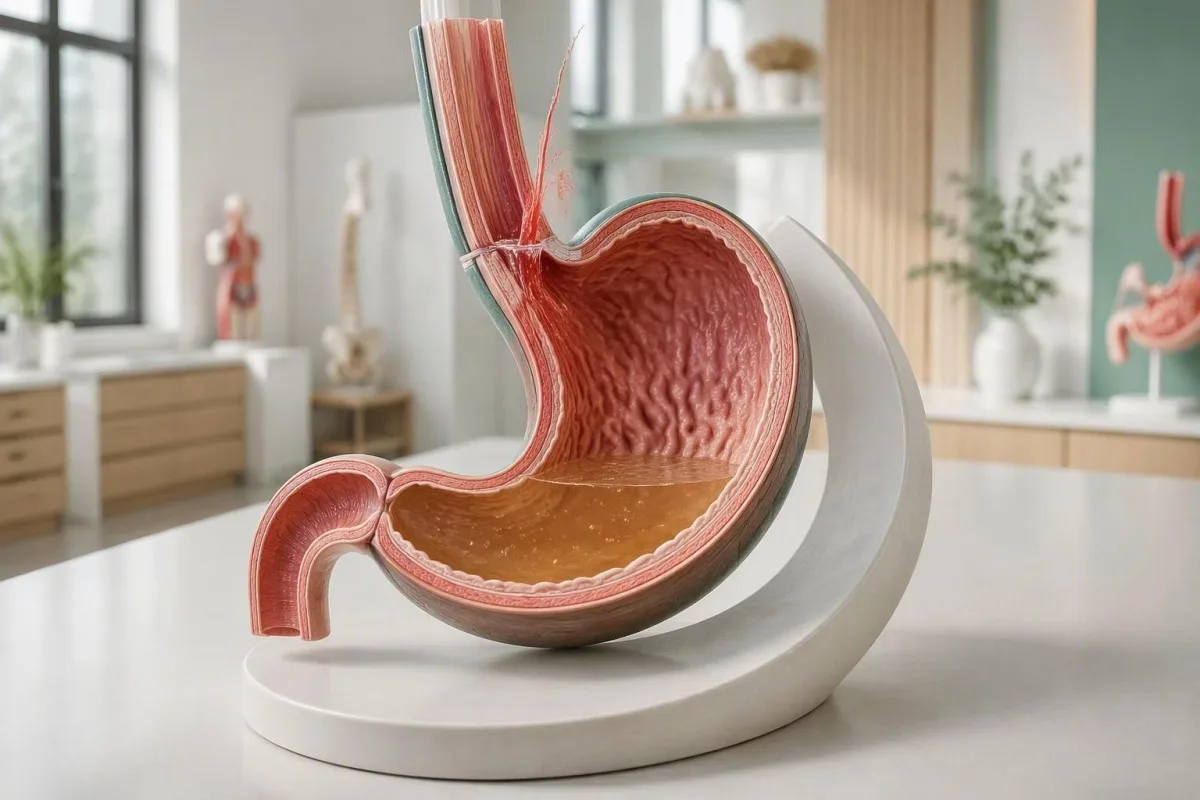
Recurring heartburn and sour regurgitation suggest GERD when they become troublesome or cause complications. Cough alone cannot confirm reflux, and swallowing difficulty, bleeding, or new chest pain need a different assessment pathway.


- Recurring heartburn on 2 or more days a week is a practical reason to discuss GERD with a clinician, not a diagnostic cutoff.
- Regurgitation means stomach contents return toward the throat or mouth, usually without the retching associated with vomiting.
- Throat symptoms alone do not establish GERD; in a 346-person trial, 16 weeks of lansoprazole did not outperform placebo for persistent throat symptoms.
- Semne de avertizare în caz de urgență include severe or new unexplained chest pain with breathlessness, sweating, faintness, or pain spreading to the arm or jaw.
- Swallowing difficulty warrants prompt assessment; inability to swallow saliva or food stuck in the esophagus requires emergency care.
- A treatment trial for typical symptoms without alarm features commonly lasts 8 weeks under the 2022 American College of Gastroenterology guideline.
- Endoscopy examines the esophageal lining but a normal result does not exclude GERD.
- Reflux monitoring measures acid exposure over approximately 24–96 hours, depending on the device, when the diagnosis remains uncertain.
- Analize de sânge de rutină cannot confirm or exclude GERD; targeted tests may investigate anemia, dehydration, or another suspected condition.
Which GERD symptoms most strongly suggest reflux?
Heartburn and regurgitation are the typical GERD symptoms: a burning feeling behind the breastbone and stomach contents returning toward the mouth. Repeated symptoms, especially after meals or during the night, suggest GERD when they disrupt comfort, sleep, eating, or daily activities; frequency alone does not establish the diagnosis.
Heartburn is usually felt behind the breastbone, not directly over the stomach, although people describe its location differently. Symptoms on 2 or more days each week are a useful conversation starter, but someone with less frequent, severe episodes can still need assessment; troublesome reflux is not defined by a stopwatch or calendar.
Regurgitation may leave a sour or bitter taste, bring fluid into the mouth when bending forward, or make a person repeatedly swallow after dinner. A hypothetical 45-year-old with these symptoms after evening meals has a more recognizable reflux pattern than someone with isolated nausea, but neither description tells us whether the esophagus has sustained damage.
My approach as Thomas Klein, MD, is to separate the symptom pattern from the test that can actually answer the question. Kantesti is an AI blood test analyzer that helps explain laboratory findings, but blood results cannot diagnose GERD; echipa noastră organizațional explains the service behind this educational content.
GERD vs occasional heartburn: what changes the picture?
Occasional heartburn becomes more suggestive of GERD when it repeatedly affects quality of life or is associated with complications. A single episode after an unusually large meal is different from recurring symptoms that wake you, limit food choices, or require frequent medication, even if both feel similar.
The lower esophageal sphincter is a muscular pressure barrier rather than a rigid valve. Brief relaxations allow belching, but reflux can occur during these relaxations; a hiatal hernia, increased abdominal pressure, and impaired clearance can make the problem more persistent without necessarily making stomach acid production unusually high.
A 14-day symptom diary can record episode timing, meals, lying down, medication use, and sleep disruption; it supports the consultation but is not a diagnostic test. I would pay particular attention to whether the same trigger produces symptoms repeatedly, because one bad evening after overeating provides less useful evidence than a consistent pattern.
Belching and bloating are not interchangeable with acid reflux symptoms, and more than one digestive problem can coexist. Our explanation of breath testing for bloating discusses a different diagnostic question; a positive breath test would not prove that heartburn or regurgitation comes from GERD.
Can GERD symptoms without heartburn include cough or hoarseness?
GERD can occur without heartburn, but cough, throat clearing, hoarseness, and a lump-in-the-throat sensation cannot confirm reflux by themselves. These symptoms overlap with airway disorders, nasal drainage, medication effects, voice strain, and laryngeal sensitivity, so the absence of typical reflux symptoms changes the testing strategy.
The 2022 American College of Gastroenterology guideline recommends evaluating non-reflux causes and considering reflux testing before PPI treatment when extraesophageal symptoms occur without heartburn or regurgitation (Katz et al., 2022). Redness seen during a throat examination is not specific enough to establish laryngopharyngeal reflux, and endoscopy alone cannot prove that reflux caused a cough.
The UK TOPPITS trial randomized 346 adults with persistent throat symptoms to lansoprazole 30 mg twice daily or placebo for 16 săptămâni, without demonstrating a benefit from lansoprazole (O'Hara et al., 2021). That finding does not mean reflux never affects the throat; it means treating an unselected throat-symptom population as though reflux were established is unreliable.
Cough duration, exposures, fever, wheeze, and medication history guide the next step; an ACE inhibitor is one possible contributor. A prolonged coughing illness may require whooping cough assessment, while a recent respiratory illness can follow the pattern described in our adult RSV symptom guide, rather than requiring more acid suppression.
When does chest pain need emergency care rather than reflux treatment?
Severe, new, or unexplained chest pain must not be assumed to be GERD, particularly when accompanied by breathlessness, sweating, faintness, or discomfort spreading to the arm, jaw, or back. Call your local emergency number for these features; do not wait to see whether an antacid helps.
Heart-related pain can feel like burning, indigestion, pressure, or an uncomfortable fullness rather than a dramatic crushing sensation. Relief after an antacid does nu exclude a heart attack, and a normal home blood-pressure reading offers no reliable reassurance; the symptom description and clinical risk determine whether emergency assessment is needed.
Consider a hypothetical 52-year-old whose usual post-dinner burning becomes discomfort during brisk walking with sweating: the change in pattern matters more than the familiar label of heartburn. Emergency evaluation may include an ECG and serial high-sensitivity troponin measurements, as discussed in our chest-pain testing guide; routine outpatient bloodwork is not an adequate substitute.
Pain that worsens while lying down is not specific to reflux, because other conditions can share that feature. Our discussion of positional chest pain explains one alternative, but new unexplained chest discomfort still needs direct assessment rather than diagnosis by posture, meal timing, or symptom searches.
Which reflux warning signs require prompt medical assessment?
Difficulty swallowing, painful swallowing, gastrointestinal bleeding, unexplained weight loss, persistent vomiting, and unexplained iron-deficiency anemia are warning signs. They require medical assessment rather than repeated self-treatment for reflux; inability to swallow saliva, food stuck in the esophagus, or bleeding with faintness requires emergency care.
Progressive difficulty with solid food can reflect a narrowing, while trouble with both solids and liquids may raise concern about a movement disorder; these patterns are clues, not firm rules. Someone who starts cutting food into smaller pieces or washing every bite down with water may have adapted to dysphagia without naming it, so I would ask about these behaviors directly.
Vomiting blood or coffee-ground material, or passing black, tarry stool, can indicate upper gastrointestinal bleeding and warrants urgent care. Iron supplements and bismuth can also darken stool, but that possibility should not delay assessment when weakness, dizziness, abdominal symptoms, or suspected bleeding are present; our stool bleeding guide explains the distinctions.
There is no minimum amount of weight loss that makes swallowing difficulty safe to ignore; any unexplained loss combined with dysphagia deserves attention. An 8-week medication trial should not postpone investigation of alarm symptoms, because acid suppression may ease discomfort while leaving a narrowing or another underlying condition unresolved.
What conditions can look like GERD?
Eosinophilic esophagitis, pill-related esophageal injury, achalasia, rumination syndrome, and functional heartburn can resemble GERD. The distinction matters because stronger acid suppression does not address every cause of burning, swallowing trouble, or returned food, and some conditions need tissue examination or esophageal function testing.
Eosinophilic esophagitis becomes particularly relevant when food sticks, there is a history of food impaction, or swallowing symptoms occur alongside allergic disease. Diagnosis requires symptoms of esophageal dysfunction and appropriate tissue findings, commonly at least 15 eosinophils per high-power field, with assessment of other causes; a peripheral eosinophil count cannot establish or exclude it.
Pill-related injury is worth considering when painful swallowing begins after medicines such as doxycycline, bisphosphonates, or certain supplements, especially if taken with little water or immediately before bed. The medication history can be more informative than the burning sensation itself; do not stop essential prescribed treatment without arranging advice about a safer formulation or administration method.
Rumination often involves effortless return of recently eaten food soon after meals, without the nausea and retching expected with vomiting. Achalasia can also cause regurgitation and swallowing difficulty, whereas functional heartburn involves symptoms without evidence that abnormal reflux explains them; normal acid exposure does not make the discomfort imaginary, but it changes which treatments make sense.
How do clinicians evaluate recurring acid reflux symptoms?
Clinical evaluation starts with the symptom pattern, alarm features, medication history, and examination—not a routine blood panel. Adults with typical heartburn and regurgitation but no alarm symptoms can often begin a supervised treatment trial, while atypical symptoms, swallowing difficulty, or an uncertain diagnosis may call for testing.
The 2022 ACG guideline recommends an 8-week once-daily PPI trial before a meal for classic symptoms without alarm features (Katz et al., 2022). A clinician should first clarify what the person means by heartburn, because upper abdominal pain, exertional chest discomfort, and nausea can lead to very different assessments even when described as indigestion.
Questions about nighttime waking, meal timing, swallowing, weight change, pregnancy, smoking, and previous treatment help identify the next useful step. I would also ask whether food returns immediately after eating or hours later, and whether symptoms began after a medication change; these details can prevent an ineffective sequence of repeated prescriptions.
Commercial digestive tests are not interchangeable with validated reflux investigations. Our review of explică decalajul dintre un profil intestinal descriptiv și un diagnostic clinic validat; simptomele persistente pe parcursul mai multor săptămâni pot necesita evaluarea altor cauze gastrointestinale, alături de evaluarea alergiilor. addresses another area where abundant results can outrun their clinical usefulness; neither a stool microbiome profile nor an indiscriminate laboratory panel measures esophageal acid exposure.
Can blood tests diagnose GERD or its complications?
No routine blood test can confirm or rule out GERD. A complete blood count, iron studies, kidney tests, or electrolytes may help investigate a suspected complication or alternative diagnosis, but reflux itself is assessed through clinical evaluation, endoscopy when indicated, and sometimes ambulatory reflux monitoring.
A complete blood count can identify anemia, but a normal hemoglobin does not exclude early iron depletion or a recent bleed. Ferritin below 15 µg/L strongly supports depleted iron stores in otherwise healthy adults, while inflammation can make ferritin less reliable; the studiile complete de fier explains why the full pattern matters.
The ACG guideline does not recommend routine vitamin B12 or creatinine monitoring solely because a low-risk patient takes a PPI; testing should reflect other risk factors and clinical concerns. Magnesium assessment is more individualized, particularly with relevant medicines, symptoms, or previous abnormalities, and vomiting with dehydration can create a separate reason to check electrolytes.
Kantesti is an AI-powered blood test analysis tool that can explain a clinician-ordered CBC or iron panel, but normal results do not clear reflux warning signs. Noastre metodologie și limite clinice should be considered alongside any interpretation; an abnormal result still needs a clinician to investigate its cause rather than automatically attributing it to GERD.
What does a PPI trial tell you about GERD?
Improvement with a proton pump inhibitor supports an acid-sensitive symptom pattern but does not prove GERD. A correctly timed trial is useful for typical symptoms without alarm features; lack of improvement should prompt a review of dosing, adherence, and the diagnosis rather than indefinite unsupervised escalation.
For many standard PPIs, the recommended timing is 30–60 minutes before a meal, usually breakfast when taken once daily. A clinician may choose a regimen such as omeprazole 20 mg once daily, but the preparation, dose, interactions, and local prescribing guidance matter; PPIs generally do not provide the immediate relief expected from an antacid.
Regurgitation can persist even when burning improves because reducing acidity does not prevent every reflux event. PPIs can also raise gastrin concentrations, so an elevated value during treatment is not a direct measure of reflux severity; our explanation of gastrin during PPI treatment describes this interpretive trap.
Persistent symptoms after an appropriate 8-week trial deserve review, especially if the original complaint was cough alone or swallowing difficulty has appeared. Our explicație nivel scăzut de magneziu covers one possible medication-related issue, but it should not be read as a reason to abandon a necessary PPI without discussing risks, benefits, and the actual treatment indication.
When is endoscopy appropriate for GERD symptoms?
Endoscopy is appropriate when reflux symptoms occur with alarm features, when symptoms persist despite appropriate treatment, or when selected risk factors justify assessment for Barrett's esophagus. It examines the esophageal lining and can obtain tissue samples, but a normal examination does not exclude GERD.
Endoscopy can identify erosive esophagitis, a narrowing, Barrett's changes, or another explanation for symptoms. The Lyon Consensus 2.0 recognizes well-characterized Los Angeles grade B, C, or D esophagitis as conclusive evidence of GERD, while grade A alone is less decisive (Gyawali et al., 2024); a report should therefore be read beyond the word irritation.
For a diagnostic examination, a specialist may recommend stopping PPIs for 2–4 săptămâni beforehand when safe, because treatment can conceal erosive changes or affect tissue findings (Katz et al., 2022). Do not arrange this yourself if you have severe established esophagitis, previous bleeding, or another reason treatment must continue, and do not delay urgent evaluation of alarm symptoms.
Barrett's screening is not automatically required for everyone with heartburn or everyone above one birthday threshold; clinicians consider chronic reflux alongside several risk factors. When sharing results, keep the original findings, tissue report, and medication context together; our sunt utile pentru a identifica unitățile, metodele și datele de colectare lipsă; chiar și un rezultat clar anormal beneficiază de aceste 3 elemente de context. explain why summaries can miss qualifications in the source document.
When should reflux monitoring replace guesswork?
Ambulatory reflux monitoring is useful when GERD remains unproven, endoscopy is inconclusive, or symptoms persist despite treatment for established GERD. Testing may measure acid alone or combine pH with impedance to detect reflux episodes with different acidity; whether testing occurs on or off medication depends on the question.
Catheter-based studies usually record for approximately 24 de ore, while wireless pH monitoring can record for up to 96 de ore, depending on the system. Longer recording helps capture day-to-day variation, but wireless pH does not provide the same information about non-acid reflux as impedance-pH; the devices answer overlapping rather than identical questions.
The Lyon Consensus 2.0 uses esophageal acid exposure time above 6% as important evidence of abnormal reflux, with 4–6% generally requiring additional context for an off-treatment catheter study (Gyawali et al., 2024). For prolonged wireless studies, exposure above 6% on at least 2 zile supports GERD, while below 4% on every day with negative symptom association supports excluding pathological GERD.
Unproven GERD is usually investigated off PPIs, often after a clinician-directed 7-day interruption, whereas impedance-pH on treatment can investigate persistent symptoms in proven GERD. Frequent antacid use should also be disclosed; our antacid calcium safety guide explains a separate consequence of excessive calcium-containing products, which acid-exposure testing would not detect.
Which everyday changes are most useful for reflux symptoms?
Avoiding meals close to bedtime, reducing weight when appropriate, and elevating the head of the bed can help selected patients with GERD. Food triggers vary considerably; targeted changes are generally more useful than banning every food commonly associated with reflux or relying on supplements to repair the sphincter.
The ACG guideline suggests avoiding meals within 2–3 hours of bedtime and elevating the head of the bed for nighttime symptoms (Katz et al., 2022). A wedge or safe bed elevation of roughly 15–20 cm can be practical, whereas stacking ordinary pillows may simply bend the upper body; the exact setup should remain comfortable and stable.
Weight reduction can improve reflux in people who are overweight, but weight loss is not a universal instruction for every person with heartburn. Smaller evening meals may be easier to test than a restrictive diet; our food-pattern evidence guide discusses general nutrition, although no anti-inflammatory food list diagnoses or cures GERD.
Left-side sleeping can reduce nighttime reflux compared with right-side sleeping in some patients, but persistent nocturnal choking or breathlessness still needs assessment. Try changing one habit at a time over 1–2 weeks and record what actually changes; stopping coffee, tomatoes, citrus, and spices simultaneously makes it hard to identify a genuine personal trigger.
What should you track before follow-up or specialist referral?
Track symptom frequency, swallowing changes, nighttime waking, medication timing, and treatment response before follow-up. Specialist referral becomes more useful when symptoms remain unexplained, persist despite correctly used treatment, or suggest a complication; new alarm symptoms should accelerate assessment rather than wait for a planned appointment.
A 2-week record of meals, symptom episodes, and doses gives a clinician something more useful than the phrase nothing works. Include which symptom improved: less burning with unchanged regurgitation is different from no change at all, and those patterns can affect whether reflux monitoring, endoscopy, or another investigation is the next sensible step.
Esophageal manometry measures pressure and movement; it is not a standalone test for GERD, but it can investigate a suspected motility disorder and is generally needed before invasive antireflux treatment. A decision about a procedure should rest on objective evidence of reflux and appropriate function assessment, not merely on years of symptoms or dislike of medication.
At Kantesti, our role is to help explain existing laboratory information, not to choose an invasive reflux treatment from a blood panel. Readers can review the expertise described on our pagina consiliului consultativ medical; children, pregnant patients, and people with complex medical histories need individualized advice rather than automatically following an adult 8-week PPI pathway.
Research publications and the limits of laboratory interpretation
Laboratory education publications can explain associated findings, but they are not evidence that blood or urine testing diagnoses GERD. As of October 23, 2026, the clinical guidance cited here supports symptom-based assessment, selective endoscopy, and reflux monitoring when needed; the two publications below address separate laboratory topics.
Kantesti is an AI blood test interpretation platform that supports understanding of existing laboratory results rather than replacing reflux investigations. Noastre standarde de conținut medical describe the intended editorial framework; a publication identifier, including a DOI, does not by itself establish peer review, clinical validation, or relevance to a specific diagnosis.
The 2026 urinalysis publication explains a separate test domain, accessible through our ghid complet pentru analiza urinei; urinary urobilinogen is not a GERD marker. The iron studies publication is potentially relevant when a clinician investigates iron deficiency, but neither publication should be cited as proof that reflux causes a particular laboratory pattern.
A note from Thomas Klein, MD: keep 3 întrebări separate—what symptoms suggest reflux, what warning signs demand assessment, and what each test can actually establish. The references below distinguish GERD guidelines and the throat-symptom trial from our laboratory education material, so readers can trace clinical recommendations without mistaking background resources for reflux diagnostic evidence.
Întrebări frecvente
Cât de des trebuie să apară arsurile la stomac pentru a sugera BRGE?
Arsurile la stomac în 2 sau mai multe zile pe săptămână reprezintă un motiv practic pentru a discuta cu un medic despre BRGE, dar nu constituie un prag de diagnostic. BRGE este mai probabilă atunci când arsurile recurente la stomac sau regurgitarea devin supărătoare ori provoacă complicații. Simptomele mai puțin frecvente pot necesita totuși o evaluare dacă sunt severe, vă trezesc din somn sau vă împiedică să mâncați. Dificultățile la înghițire, sângerările și pierderea inexplicabilă în greutate nu ar trebui să aștepte până când simptomele ating o anumită frecvență.
Poți avea boală de reflux gastroesofagian fără arsuri la stomac?
BRGE poate apărea fără arsuri la stomac, însă tusea, răgușeala și dregerea vocii, luate singure, nu pot confirma refluxul. Ghidul ACG din 2022 recomandă luarea în considerare a cauzelor care nu țin de reflux și testarea refluxului înainte de tratamentul cu IPP, atunci când aceste simptome apar fără arsuri la stomac sau regurgitație. În studiul TOPPITS, la care au participat 346 de persoane, lansoprazolul administrat timp de 16 săptămâni nu a fost mai eficient decât placebo pentru simptomele persistente în gât. Următorul pas potrivit depinde de tabloul complet al simptomelor, nu de eticheta de reflux silențios.
What GERD symptoms require emergency care?
Severe or new unexplained chest pain with breathlessness, sweating, faintness, or pain spreading to the arm or jaw requires emergency assessment rather than assumed reflux treatment. Inability to swallow saliva, food stuck in the esophagus, vomiting blood, or black tarry stool with weakness or faintness also requires emergency care. These symptoms should not wait for a 2-week diary or an 8-week medication trial. Difficulty swallowing or unexplained weight loss without an immediate emergency still warrants prompt medical assessment.
Can a blood test show acid reflux or GERD?
No routine blood test can confirm or exclude acid reflux or GERD. A complete blood count and iron studies may investigate anemia or suspected blood loss, but they do not measure reflux into the esophagus. Ambulatory reflux studies measure exposure over approximately 24–96 hours, depending on the device. Normal blood results therefore do not cancel out swallowing difficulty, bleeding, or another warning sign.
Do I need an endoscopy for recurring heartburn?
Recurring heartburn does not automatically require endoscopy when symptoms are typical and there are no alarm features. The 2022 ACG guideline supports an initial 8-week once-daily PPI trial in that situation. Endoscopy becomes more appropriate with swallowing difficulty, bleeding, unexplained weight loss, persistent symptoms despite treatment, or selected Barrett's risk factors. A normal endoscopy does not exclude GERD, so reflux monitoring may still be needed when the diagnosis remains uncertain.
Does improvement with omeprazole prove I have GERD?
Improvement with omeprazole does not prove GERD because medication response is not specific enough to establish the diagnosis. A clinician may use a regimen such as 20 mg once daily for an 8-week trial in an adult with typical symptoms and no alarm features. Many standard PPIs work best when taken 30–60 minutes before a meal. Persistent symptoms should trigger a review of timing, adherence, and alternative diagnoses rather than indefinite self-directed dose increases.
What is the difference between endoscopy and reflux monitoring?
Endoscopy examines the esophageal lining, whereas reflux monitoring measures acid exposure and, with impedance, reflux episodes of different acidity. Catheter testing usually records for about 24 hours, while wireless pH monitoring can record for up to 96 hours. For an appropriate off-treatment catheter study, acid exposure above 6% supports pathological reflux and 4–6% is generally inconclusive without additional evidence. Whether monitoring is done on or off PPIs depends on whether GERD is already established and what the clinician needs to determine.
Obține astăzi analiză de sânge cu AI
Alătură-te a peste 2 milioane de utilizatori din întreaga lume care au încredere în Kantesti pentru analiza instantanee și precisă a analizelor de laborator. Încarcă rezultatele analizelor tale de sânge și primește o interpretare completă a biomarkerilor 15,000+ în câteva secunde.
📚 Publicații de cercetare citate
Klein, T., Mitchell, S., & Weber, H. (2026). Urobilinogen în Testul de Urină: Ghid complet de analiză urină 2026. Kantesti AI Medical Research.
Klein, T., Mitchell, S., & Weber, H. (2026). Ghid de studii privind fierul: TIBC, saturația fierului și capacitatea de legare. Kantesti AI Medical Research.
📖 Referințe medicale externe
Gyawali CP et al. (2024). Updates to the modern diagnosis of GERD: Lyon consensus 2.0. Bine.
O'Hara J et al. (2021). Use of proton pump inhibitors to treat persistent throat symptoms: multicentre, double blind, randomised, placebo controlled trial. BMJ.
⚕️ Declarație medicală
Acest articol are doar scop educațional și nu constituie sfat medical. Consultă întotdeauna un furnizor calificat de servicii medicale pentru decizii privind diagnosticarea și tratamentul.
Semnale de încredere E-E-A-T
Experienţă
Revizuire clinică condusă de medici a fluxurilor de lucru pentru interpretarea analizelor.
Expertiză
Focalizare pe medicina de laborator asupra modului în care biomarkerii se comportă în context clinic.
Autoritate
Scris de dr. Thomas Klein, cu revizuire de dr. Sarah Mitchell și prof. dr. Hans Weber.
Încredere
Interpretare bazată pe dovezi, cu căi clare de urmărire pentru a reduce alarmele.